Download as PDF, PPTX


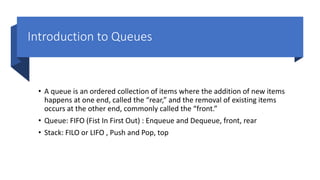
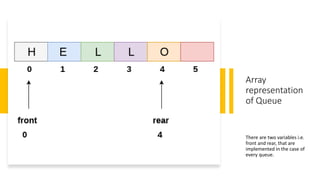
![Maxsize=6, rear=front=-1
• Qinsert(item)
• 1.If (rear = maxsize-1 )
• print (“queue overflow”) and return
• 2.Else
• rear = rear + 1
• Queue [rear] = item
0 1 2 3 4 5
rear
front
Function call
Qinsert(item)
Rear=maxsize-1? Rear=rear+1 Queue[rear]=item
If section Else section](https://image.slidesharecdn.com/queues-new-210308174005/85/Queues-and-CQueue-Implementation-4-320.jpg)
![Maxsize=6, rear=0, front=-1
• Qinsert(item)
• 1.If (rear = maxsize-1 )
• print (“queue overflow”) and return
• 2.Else
• rear = rear + 1
• Queue [rear] = item
20
0 1 2 3 4 5
rear
front
Function call
Qinsert(item)
Rear=maxsize-1 Rear=rear+1 Queue[rear]=item
Qinsert(20) -1=5 ? F Rear=-1+1=0 Queue[0]=20
If section Else section
1](https://image.slidesharecdn.com/queues-new-210308174005/85/Queues-and-CQueue-Implementation-5-320.jpg)
![Maxsize=6, rear=1, front=-1
• Qinsert(item)
• 1.If (rear = maxsize-1 )
• print (“queue overflow”) and return
• 2.Else
• rear = rear + 1
• Queue [rear] = item
20 30
0 1 2 3 4 5
rear
front
Function call
Qinsert(item)
Rear=maxsize-1 Rear=rear+1 Queue[rear]=item
Qinsert(20) -1=5 ? F Rear=-1+1=0 Queue[0]=20
Qinsert(30) 0=5? F Rear= 0+1=1 Queue[1]=30
If section Else section
1
2](https://image.slidesharecdn.com/queues-new-210308174005/85/Queues-and-CQueue-Implementation-6-320.jpg)
![Maxsize=6, rear=2, front=-1
• Qinsert(item)
• 1.If (rear = maxsize-1 )
• print (“queue overflow”) and return
• 2.Else
• rear = rear + 1
• Queue [rear] = item
20 30 40
0 1 2 3 4 5
rear
front
Function call
Qinsert(item)
Rear=maxsize-1 Rear=rear+1 Queue[rear]=item
Qinsert(20) -1=5 ? F Rear=-1+1=0 Queue[0]=20
Qinsert(30) 0=5? F Rear= 0+1=1 Queue[1]=30
Qinsert(40) 1=5? F Rear= 1+1=2 Queue[2]=40
If section Else section
1
2
3](https://image.slidesharecdn.com/queues-new-210308174005/85/Queues-and-CQueue-Implementation-7-320.jpg)
![Maxsize=6, rear=3, front=-1
• Qinsert(item)
• 1.If (rear = maxsize-1 )
• print (“queue overflow”) and return
• 2.Else
• rear = rear + 1
• Queue [rear] = item
20 30 40 50
0 1 2 3 4 5
rear
front
Function call
Qinsert(item)
Rear=maxsize-1 Rear=rear+1 Queue[rear]=item
Qinsert(20) -1=5 ? F Rear=-1+1=0 Queue[0]=20
Qinsert(30) 0=5? F Rear= 0+1=1 Queue[1]=30
Qinsert(40) 1=5? F Rear= 1+1=2 Queue[2]=40
Qinsert(50) 2=5? F Rear= 2+1=3 Queue[3]=50
If section Else section
1
2
3
4](https://image.slidesharecdn.com/queues-new-210308174005/85/Queues-and-CQueue-Implementation-8-320.jpg)
![Maxsize=6, rear=4, front=-1
• Qinsert(item)
• 1.If (rear = maxsize-1 )
• print (“queue overflow”) and return
• 2.Else
• rear = rear + 1
• Queue [rear] = item
20 30 40 50 60
0 1 2 3 4 5
rear
front
Function call
Qinsert(item)
Rear=maxsize-1 Rear=rear+1 Queue[rear]=item
Qinsert(20) -1=5 ? F Rear=-1+1=0 Queue[0]=20
Qinsert(30) 0=5? F Rear= 0+1=1 Queue[1]=30
Qinsert(40) 1=5? F Rear= 1+1=2 Queue[2]=40
Qinsert(50) 2=5? F Rear= 2+1=3 Queue[3]=50
Qinsert(60) 3=5? F Rear= 3+1=4 Queue[4]=60
If section Else section
1
2
3
4
5](https://image.slidesharecdn.com/queues-new-210308174005/85/Queues-and-CQueue-Implementation-9-320.jpg)
![Maxsize=6, rear=5, front=-1
• Qinsert(item)
• 1.If (rear = maxsize-1 )
• print (“queue overflow”) and return
• 2.Else
• rear = rear + 1
• Queue [rear] = item
20 30 40 50 60 70
0 1 2 3 4 5
rear
front
Function call
Qinsert(item)
Rear=maxsize-1 Rear=rear+1 Queue[rear]=item
Qinsert(20) -1=5 ? F Rear=-1+1=0 Queue[0]=20
Qinsert(30) 0=5? F Rear= 0+1=1 Queue[1]=30
Qinsert(40) 1=5? F Rear= 1+1=2 Queue[2]=40
Qinsert(50) 2=5? F Rear= 2+1=3 Queue[3]=50
Qinsert(60) 3=5? F Rear= 3+1=4 Queue[4]=60
Qinsert(70) 4=5? F Rear= 4+1=5 Queue[5]=70
If section Else section
1
2
3
4
5
6](https://image.slidesharecdn.com/queues-new-210308174005/85/Queues-and-CQueue-Implementation-10-320.jpg)
![Maxsize=6, rear=5, front=-1
• Qinsert(item)
• 1.If (rear = maxsize-1 )
• print (“queue overflow”) and return
• 2.Else
• rear = rear + 1
• Queue [rear] = item
20 30 40 50 60 70
0 1 2 3 4 5
rear
front
Function call
Qinsert(item)
Rear=maxsize-1 Rear=rear+1 Queue[rear]=item
Qinsert(20) -1=5 ? F Rear=-1+1=0 Queue[0]=20
Qinsert(30) 0=5? F Rear= 0+1=1 Queue[1]=30
Qinsert(40) 1=5? F Rear= 1+1=2 Queue[2]=40
Qinsert(50) 2=5? F Rear= 2+1=3 Queue[3]=50
Qinsert(60) 3=5? F Rear= 3+1=4 Queue[4]=60
Qinsert(70) 4=5? F Rear= 4+1=5 Queue[5]=70
Qinsert(80) 5=5? T stop
If section Else section
1
2
3
4
5
6
7](https://image.slidesharecdn.com/queues-new-210308174005/85/Queues-and-CQueue-Implementation-11-320.jpg)
![Maxsize=6, front=-1
rear=5
• Qdelete()
• If (front =rear)
• print “queue empty” and return
• 2. Else
• Front = front + 1
• item = queue [front];
• Return item
20 30 40 50 60 70
0 1 2 3 4 5
rear
front
Function call
Qdelete()
front=rear Front=front+1 Item=Queeue[front]
If section Else section](https://image.slidesharecdn.com/queues-new-210308174005/85/Queues-and-CQueue-Implementation-12-320.jpg)
![Maxsize=6, front=0
rear=5
• Qdelete()
• If (front =rear)
• print “queue empty” and return
• 2. Else
• Front = front + 1
• item = queue [front];
• Return item
30 40 50 60 70
0 1 2 3 4 5
rear
front
Function call
Qdelete()
front=rear Front=front+1 Item=Queeue[front]
Qdelete() -1 = 5 ? F front=-1+1=0 item=Queue[0]
If section Else section
1
Item=20](https://image.slidesharecdn.com/queues-new-210308174005/85/Queues-and-CQueue-Implementation-13-320.jpg)
![Maxsize=6, front=1
rear=5
• Qdelete()
• If (front =rear)
• print “queue empty” and return
• 2. Else
• Front = front + 1
• item = queue [front];
• Return item
40 50 60 70
0 1 2 3 4 5
rear
front
Function call
Qdelete()
front=rear Front=front+1 Item=Queeue[front]
Qdelete() -1 = 5 ? F front=-1+1=0 item=Queue[0]
Qdelete() 0 = 5 ? F front=0+1=1 item=Queue[1]
If section Else section
1
Item=30
2](https://image.slidesharecdn.com/queues-new-210308174005/85/Queues-and-CQueue-Implementation-14-320.jpg)
![Maxsize=6, front=2
rear=5
• Qdelete()
• If (front =rear)
• print “queue empty” and return
• 2. Else
• Front = front + 1
• item = queue [front];
• Return item
50 60 70
0 1 2 3 4 5
rear
front
Function call
Qdelete()
front=rear Front=front+1 Item=Queeue[front]
Qdelete() -1 = 5 ? F front=-1+1=0 item=Queue[0]
Qdelete() 0 = 5 ? F front=0+1=1 item=Queue[1]
Qdelete() 1 = 5 ? F front=1+1=2 item=Queue[2]
If section Else section
1
Item=40
2
3](https://image.slidesharecdn.com/queues-new-210308174005/85/Queues-and-CQueue-Implementation-15-320.jpg)
![Maxsize=6, front=3
rear=5
• Qdelete()
• If (front =rear)
• print “queue empty” and return
• 2. Else
• Front = front + 1
• item = queue [front];
• Return item
60 70
0 1 2 3 4 5
rear
front
Function call
Qdelete()
front=rear Front=front+1 Item=Queeue[front]
Qdelete() -1 = 5 ? F front=-1+1=0 item=Queue[0]
Qdelete() 0 = 5 ? F front=0+1=1 item=Queue[1]
Qdelete() 1 = 5 ? F front=1+1=2 item=Queue[2]
Qdelete() 2 = 5 ? F front=2+1=3 item=Queue[3]
If section Else section
1
Item=50
2
3
4](https://image.slidesharecdn.com/queues-new-210308174005/85/Queues-and-CQueue-Implementation-16-320.jpg)
![Maxsize=6, front=4
rear=5
• Qdelete()
• If (front =rear)
• print “queue empty” and return
• 2. Else
• Front = front + 1
• item = queue [front];
• Return item
70
0 1 2 3 4 5
rear
front
Function call
Qdelete()
front=rear Front=front+1 Item=Queeue[front]
Qdelete() -1 = 5 ? F front=-1+1=0 item=Queue[0]
Qdelete() 0 = 5 ? F front=0+1=1 item=Queue[1]
Qdelete() 1 = 5 ? F front=1+1=2 item=Queue[2]
Qdelete() 2 = 5 ? F front=2+1=3 item=Queue[3]
Qdelete() 3 = 5 ? F front=3+1=4 item=Queue[4]
If section Else section
1
Item=60
2
3
4
5](https://image.slidesharecdn.com/queues-new-210308174005/85/Queues-and-CQueue-Implementation-17-320.jpg)
![Maxsize=6, front=5
rear=5
• Qdelete()
• If (front =rear)
• print “queue empty” and return
• 2. Else
• Front = front + 1
• item = queue [front];
• Return item
0 1 2 3 4 5
rear
front
Function call
Qdelete()
front=rear Front=front+1 Item=Queeue[front]
Qdelete() -1 = 5 ? F front=-1+1=0 item=Queue[0]
Qdelete() 0 = 5 ? F front=0+1=1 item=Queue[1]
Qdelete() 1 = 5 ? F front=1+1=2 item=Queue[2]
Qdelete() 2 = 5 ? F front=2+1=3 item=Queue[3]
Qdelete() 3 = 5 ? F front=3+1=4 item=Queue[4]
Qdelete() 4= 5 ? F front=4+1=5 item=Queue[5]
If section Else section
1
Item=70
2
3
4
5
6](https://image.slidesharecdn.com/queues-new-210308174005/85/Queues-and-CQueue-Implementation-18-320.jpg)
![Maxsize=6, front=5
rear=5
• Qdelete()
• If (front =rear)
• print “queue empty” and return
• 2. Else
• Front = front + 1
• item = queue [front];
• Return item
0 1 2 3 4 5
rear
front
Function call
Qdelete()
front=rear Front=front+1 Item=Queeue[front]
Qdelete() -1 = 5 ? F front=-1+1=0 item=Queue[0]
Qdelete() 0 = 5 ? F front=0+1=1 item=Queue[1]
Qdelete() 1 = 5 ? F front=1+1=2 item=Queue[2]
Qdelete() 2 = 5 ? F front=2+1=3 item=Queue[3]
Qdelete() 3 = 5 ? F front=3+1=4 item=Queue[4]
Qdelete() 4= 5 ? F front=4+1=5 item=Queue[5]
Qdelete() 5=5? T queue empty - -
If section Else section
1
2
6
7](https://image.slidesharecdn.com/queues-new-210308174005/85/Queues-and-CQueue-Implementation-19-320.jpg)
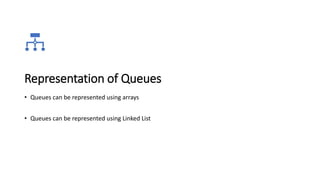
![Array representation of Queues
12 9 7 18 45
front rear
A[0] A[1] A[2] A[3] A[4]](https://image.slidesharecdn.com/queues-new-210308174005/85/Queues-and-CQueue-Implementation-23-320.jpg)
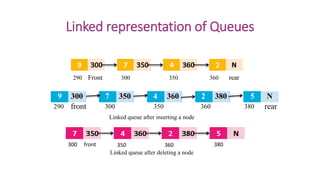
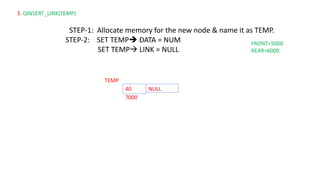
![Insert an element in queue using linked list
STEP-1: Allocate memory for the new node & name it as TEMP.
STEP-2: SET TEMP➔ DATA = NUM
SET TEMP→ LINK = NULL
STEP-3: IF FRONT = NULL
FRONT=REAR=TEMP
ELSE
REAR→ LINK =TEMP
REAR=TEMP
[ END OF IF]
STEP-4: EXIT
FRONT=REAR=NULL](https://image.slidesharecdn.com/queues-new-210308174005/85/Queues-and-CQueue-Implementation-25-320.jpg)
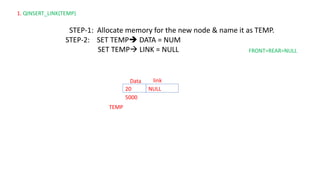
![STEP-3: IF FRONT = NULL
FRONT=REAR=TEMP
ELSE
REAR→ LINK =TEMP
REAR=TEMP
[ END OF IF]
FRONT=REAR=5000
20 NULL
5000
FRONT REAR](https://image.slidesharecdn.com/queues-new-210308174005/85/Queues-and-CQueue-Implementation-27-320.jpg)
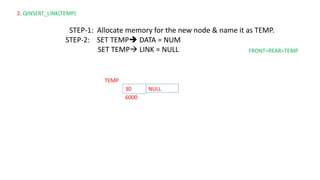
![STEP-3: IF FRONT = NULL
FRONT=REAR=TEMP
ELSE
REAR→ LINK =TEMP
REAR=TEMP
[ END OF IF]
FRONT=5000
REAR=6000
20 NULL
5000
FRONT REAR
30 NULL
6000
TEMP
20 6000
5000
FRONT
REAR
30 NULL
6000
TEMP](https://image.slidesharecdn.com/queues-new-210308174005/85/Queues-and-CQueue-Implementation-29-320.jpg)
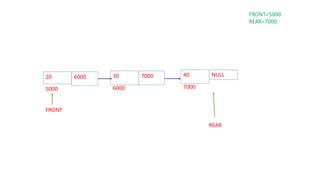
![STEP-3: IF FRONT = NULL
FRONT=REAR=TEMP
ELSE
REAR→ LINK =TEMP
REAR=TEMP
[ END OF IF]
FRONT=5000
REAR=7000
20 6000
5000
FRONT REAR
30 NULL
6000
20 6000
5000
FRONT REAR
30 7000
6000
40 NULL
7000
TEMP](https://image.slidesharecdn.com/queues-new-210308174005/85/Queues-and-CQueue-Implementation-31-320.jpg)
![Delete an element in queue using linked list
STEP-1: If FRONT = NULL
write “underflow”
go to step 3.
[End of if]
STEP-2: SET TEMP = FRONT
FRONT=FRONT→ LINK
IF FRONT = NULL
REAR=NULL
STEP-3: EXIT](https://image.slidesharecdn.com/queues-new-210308174005/85/Queues-and-CQueue-Implementation-33-320.jpg)
![Delete an element in queue using linked list
STEP-1: If FRONT = NULL
write “underflow”
go to step 3.
[End of if]
STEP-2: SET TEMP = FRONT
FRONT=FRONT→ LINK
IF FRONT = NULL
REAR=NULL
STEP-3: EXIT
20 6000
5000
FRONT
REAR
30 7000
6000
40 NULL
7000
1. QDELETE_LINK()
TEMP](https://image.slidesharecdn.com/queues-new-210308174005/85/Queues-and-CQueue-Implementation-34-320.jpg)
![Delete an element in queue using linked list
STEP-1: If FRONT = NULL
write “underflow”
go to step 4.
[End of if]
STEP-2: SET TEMP = FRONT
FRONT=FRONT→ LINK
IF FRONT = NULL
REAR=NULL
STEP-3: FREE(TEMP)
STEP-4: EXIT
20 6000
5000
FRONT REAR
30 7000
6000
40 NULL
7000
1. QDELETE_LINK()
TEMP
FRONT REAR
30 7000
6000
40 NULL
7000](https://image.slidesharecdn.com/queues-new-210308174005/85/Queues-and-CQueue-Implementation-35-320.jpg)
![Delete an element in queue using linked list
STEP-1: If FRONT = NULL
write “underflow”
go to step 4.
[End of if]
STEP-2: SET TEMP = FRONT
FRONT=FRONT→ LINK
IF FRONT = NULL
REAR=NULL
STEP-3: FREE(TEMP)
STEP-4: EXIT
2. QDELETE_LINK()
TEMP
FRONT REAR
30 7000
6000
40 NULL
7000
TEMP
FRONT REAR
30 7000
6000
40 NULL
7000
FRONT REAR
40 NULL
7000](https://image.slidesharecdn.com/queues-new-210308174005/85/Queues-and-CQueue-Implementation-36-320.jpg)
![Delete an element in queue using linked list
STEP-1: If FRONT = NULL
write “underflow”
go to step 4.
[End of if]
STEP-2: SET TEMP = FRONT
FRONT=FRONT→ LINK
IF FRONT = NULL
REAR=NULL
STEP-3: FREE(TEMP)
STEP-4: EXIT
3. QDELETE_LINK()
4. QDELETE_LINK()
FRONT=NULL
REAR=NULL
40 NULL
7000
TEMP
FRONT REAR
40 NULL
7000
TEMP
TEMP](https://image.slidesharecdn.com/queues-new-210308174005/85/Queues-and-CQueue-Implementation-37-320.jpg)
![Algorithm CQ_insert(ITEM)
• Step-1: If (REAR+1)%MAX=FRONT
• Write Overflow
• GoTo Step 4.
• [End of if]
• Step-2: If FRONT=-1 and REAR =-1
• REAR=FRONT=0
• Else If REAR=MAX-1 AND FRONT!=0
• REAR=0
• Else
• REAR=(REAR+1)%MAX
• [End of If]
• Step-3: CQ[REAR]=ITEM
• Step-4: Exit](https://image.slidesharecdn.com/queues-new-210308174005/85/Queues-and-CQueue-Implementation-43-320.jpg)
![Algorithm CQ_insert(ITEM)
• Step-1: If (REAR+1)%MAX=FRONT
• Write Overflow
• GoTo Step 4.
• [End of if]
• Step-2: If FRONT=-1 and REAR =-1
• REAR=FRONT=0
• Else If REAR=MAX-1 AND FRONT!=0
• REAR=0
• Else
• REAR=(REAR+1)%MAX
• [End of If]
• Step-3: CQ[REAR]=ITEM
• Step-4: Exit
CQ[0]
CQ[1]
CQ[2]
CQ[3]
CQ[4]
CQ[5]
CQ[6]
REAR
FRONT
FRONT=-1
REAR=-1
MAX=7](https://image.slidesharecdn.com/queues-new-210308174005/85/Queues-and-CQueue-Implementation-44-320.jpg)
![Algorithm CQ_insert(10)
• Step-1: If (REAR+1)%MAX=FRONT
• Write Overflow
• GoTo Step 4.
• [End of if]
• Step-2: If FRONT=-1 and REAR =-1
• REAR=FRONT=0
• Else If REAR=MAX-1 AND FRONT!=0
• REAR=0
• Else
• REAR=(REAR+1)%MAX
• [End of If]
• Step-3: CQ[REAR]=ITEM
• Step-4: Exit
CQ[0]
CQ[1]
CQ[2]
CQ[3]
CQ[4]
CQ[5]
CQ[6]
REAR
FRONT
10
FRONT=-1
REAR=-1
MAX=7
IF FRONT=-1 & REAR=-1 T
REAR=FRONT=0
IF ((REAR+1)%MAX=FRONT)
(-1+1)%7=-1
0 = -1 F
C1
C2
REAR=(REAR+1)%MAX
FRONT=0
REAR=0
MAX=7
REAR=MAX-1 & FRONT!=0
REAR=0
C3
CQ[REAR]=ITEM
CQ[0]=10](https://image.slidesharecdn.com/queues-new-210308174005/85/Queues-and-CQueue-Implementation-45-320.jpg)
![Algorithm CQ_insert(20)
• Step-1: If (REAR+1)%MAX=FRONT
• Write Overflow
• GoTo Step 4.
• [End of if]
• Step-2: If FRONT=-1 and REAR =-1
• REAR=FRONT=0
• Else If REAR=MAX-1 AND FRONT!=0
• REAR=0
• Else
• REAR=(REAR+1)%MAX
• [End of If]
• Step-3: CQ[REAR]=ITEM
• Step-4: Exit
CQ[0]
CQ[1]
CQ[2]
CQ[3]
CQ[4]
CQ[5]
CQ[6]
REAR
FRONT
10
FRONT=0
REAR=0
MAX=7
IF FRONT=-1 & REAR=-1 F
REAR=FRONT=0
IF ((REAR+1)%MAX=FRONT)
(0+1)%7= 0
1 = -1 F
C1
C2
REAR=(REAR+1)%MAX
(0+1)%7= 1
FRONT=0
REAR=1
MAX=7
REAR=MAX-1 & FRONT!=0
0=6 F & 0!0 F
REAR=0
C3
CQ[REAR]=ITEM
CQ[1]=20
C4
20](https://image.slidesharecdn.com/queues-new-210308174005/85/Queues-and-CQueue-Implementation-46-320.jpg)
![Algorithm CQ_insert(30)
• Step-1: If (REAR+1)%MAX=FRONT
• Write Overflow
• GoTo Step 4.
• [End of if]
• Step-2: If FRONT=-1 and REAR =-1
• REAR=FRONT=0
• Else If REAR=MAX-1 AND FRONT!=0
• REAR=0
• Else
• REAR=(REAR+1)%MAX
• [End of If]
• Step-3: CQ[REAR]=ITEM
• Step-4: Exit
CQ[0]
CQ[1]
CQ[2]
CQ[3]
CQ[4]
CQ[5]
CQ[6]
REAR
FRONT
10
FRONT=0
REAR=1
MAX=7
IF FRONT=-1 & REAR=-1 F
REAR=FRONT=0
IF ((REAR+1)%MAX=FRONT)
(1+1)%7= 0
2 = 0 F
C1
C2
REAR=(REAR+1)%MAX
(1+1)%7= 2
FRONT=0
REAR=2
MAX=7
REAR=MAX-1 & FRONT!=0
1=6 F
REAR=0
C3
CQ[REAR]=ITEM
CQ[2]=30
C4
20
30](https://image.slidesharecdn.com/queues-new-210308174005/85/Queues-and-CQueue-Implementation-47-320.jpg)
![Algorithm CQ_insert(30)
• Step-1: If (REAR+1)%MAX=FRONT
• Write Overflow
• GoTo Step 4.
• [End of if]
• Step-2: If FRONT=-1 and REAR =-1
• REAR=FRONT=0
• Else If REAR=MAX-1 AND FRONT!=0
• REAR=0
• Else
• REAR=(REAR+1)%MAX
• [End of If]
• Step-3: CQ[REAR]=ITEM
• Step-4: Exit
CQ[0]
CQ[1]
CQ[2]
CQ[3]
CQ[4]
CQ[5]
CQ[6]
REAR
FRONT
10
FRONT=0
REAR=1
MAX=7
IF FRONT=-1 & REAR=-1 F
REAR=FRONT=0
IF ((REAR+1)%MAX=FRONT)
(1+1)%7= 0
2 = 0 F
C1
C2
REAR=(REAR+1)%MAX
(1+1)%7= 2
FRONT=0
REAR=2
MAX=7
REAR=MAX-1 & FRONT!=0
1=6 F
REAR=0
C3
CQ[REAR]=ITEM
CQ[2]=30
C4
20
30](https://image.slidesharecdn.com/queues-new-210308174005/85/Queues-and-CQueue-Implementation-48-320.jpg)
![Algorithm CQ_insert(40)
• Step-1: If (REAR+1)%MAX=FRONT
• Write Overflow
• GoTo Step 4.
• [End of if]
• Step-2: If FRONT=-1 and REAR =-1
• REAR=FRONT=0
• Else If REAR=MAX-1 AND FRONT!=0
• REAR=0
• Else
• REAR=(REAR+1)%MAX
• [End of If]
• Step-3: CQ[REAR]=ITEM
• Step-4: Exit
CQ[0]
CQ[1]
CQ[2]
CQ[3]
CQ[4]
CQ[5]
CQ[6]
REAR
FRONT
10
FRONT=0
REAR=2
MAX=7
IF FRONT=-1 & REAR=-1 F
REAR=FRONT=0
IF ((REAR+1)%MAX=FRONT)
(2+1)%7= 0
3 = 0 F
C1
C2
REAR=(REAR+1)%MAX
(2+1)%7= 3
FRONT=0
REAR=3
MAX=7
REAR=MAX-1 & FRONT!=0
2=6 F
REAR=0
C3
CQ[REAR]=ITEM
CQ[3]=40
C4
20
30
40](https://image.slidesharecdn.com/queues-new-210308174005/85/Queues-and-CQueue-Implementation-49-320.jpg)
![Algorithm CQ_insert(50)
• Step-1: If (REAR+1)%MAX=FRONT
• Write Overflow
• GoTo Step 4.
• [End of if]
• Step-2: If FRONT=-1 and REAR =-1
• REAR=FRONT=0
• Else If REAR=MAX-1 AND FRONT!=0
• REAR=0
• Else
• REAR=(REAR+1)%MAX
• [End of If]
• Step-3: CQ[REAR]=ITEM
• Step-4: Exit
CQ[0]
CQ[1]
CQ[2]
CQ[3]
CQ[4]
CQ[5]
CQ[6]
REAR
FRONT
10
FRONT=0
REAR=3
MAX=7
IF FRONT=-1 & REAR=-1 F
REAR=FRONT=0
IF ((REAR+1)%MAX=FRONT)
(3+1)%7= 0
4= 0 F
C1
C2
REAR=(REAR+1)%MAX
(3+1)%7= 4
FRONT=0
REAR=4
MAX=7
REAR=MAX-1 & FRONT!=0
4=6 F
REAR=0
C3
CQ[REAR]=ITEM
CQ[4]=50
C4
20
30
40
50](https://image.slidesharecdn.com/queues-new-210308174005/85/Queues-and-CQueue-Implementation-50-320.jpg)
![Algorithm CQ_insert(60)
• Step-1: If (REAR+1)%MAX=FRONT
• Write Overflow
• GoTo Step 4.
• [End of if]
• Step-2: If FRONT=-1 and REAR =-1
• REAR=FRONT=0
• Else If REAR=MAX-1 AND FRONT!=0
• REAR=0
• Else
• REAR=(REAR+1)%MAX
• [End of If]
• Step-3: CQ[REAR]=ITEM
• Step-4: Exit
CQ[0]
CQ[1]
CQ[2]
CQ[3]
CQ[4]
CQ[5]
CQ[6]
REAR
FRONT
10
FRONT=0
REAR=4
MAX=7
IF FRONT=-1 & REAR=-1 F
REAR=FRONT=0
IF ((REAR+1)%MAX=FRONT)
(4+1)%7= 0
5= 0 F
C1
C2
REAR=(REAR+1)%MAX
(4+1)%7= 5
FRONT=0
REAR=5
MAX=7
REAR=MAX-1 & FRONT!=0
5=6 F
REAR=0
C3
CQ[REAR]=ITEM
CQ[5]=60
C4
20
30
40
50
60](https://image.slidesharecdn.com/queues-new-210308174005/85/Queues-and-CQueue-Implementation-51-320.jpg)
![Algorithm CQ_insert(70)
• Step-1: If (REAR+1)%MAX=FRONT
• Write Overflow
• GoTo Step 4.
• [End of if]
• Step-2: If FRONT=-1 and REAR =-1
• REAR=FRONT=0
• Else If REAR=MAX-1 AND FRONT!=0
• REAR=0
• Else
• REAR=(REAR+1)%MAX
• [End of If]
• Step-3: CQ[REAR]=ITEM
• Step-4: Exit
CQ[0]
CQ[1]
CQ[2]
CQ[3]
CQ[4]
CQ[5]
CQ[6]
REAR
FRONT
10
FRONT=0
REAR=5
MAX=7
IF FRONT=-1 & REAR=-1 F
REAR=FRONT=0
IF ((REAR+1)%MAX=FRONT)
(5+1)%7= 0
6= 0 F
C1
C2
REAR=(REAR+1)%MAX
(5+1)%7= 6
FRONT=0
REAR=6
MAX=7
REAR=MAX-1 & FRONT!=0
5=6 F
REAR=0
C3
CQ[REAR]=ITEM
CQ[6]=70
C4
20
30
40
50
60
70](https://image.slidesharecdn.com/queues-new-210308174005/85/Queues-and-CQueue-Implementation-52-320.jpg)
![Algorithm CQ_insert(80)
• Step-1: If (REAR+1)%MAX=FRONT
• Write Overflow
• GoTo Step 4.
• [End of if]
• Step-2: If FRONT=-1 and REAR =-1
• REAR=FRONT=0
• Else If REAR=MAX-1 AND FRONT!=0
• REAR=0
• Else
• REAR=(REAR+1)%MAX
• [End of If]
• Step-3: CQ[REAR]=ITEM
• Step-4: Exit
CQ[0]
CQ[1]
CQ[2]
CQ[3]
CQ[4]
CQ[5]
CQ[6]
REAR
FRONT
10
FRONT=0
REAR=6
MAX=7
IF ((REAR+1)%MAX=FRONT)
(6+1)%7= 0
0= 0 T
C1
20
30
40
50
60
70](https://image.slidesharecdn.com/queues-new-210308174005/85/Queues-and-CQueue-Implementation-53-320.jpg)
![Algorithm CQ_insert(80)
• Step-1: If (REAR+1)%MAX=FRONT
• Write Overflow
• GoTo Step 4.
• [End of if]
• Step-2: If FRONT=-1 and REAR =-1
• REAR=FRONT=0
• Else If REAR=MAX-1 AND FRONT!=0
• REAR=0
• Else
• REAR=(REAR+1)%MAX
• [End of If]
• Step-3: CQ[REAR]=ITEM
• Step-4: Exit
CQ[0]
CQ[1]
CQ[2]
CQ[3]
CQ[4]
CQ[5]
CQ[6]
REAR
FRONT
IF FRONT=-1 & REAR=-1 F
REAR=FRONT=0
IF ((REAR+1)%MAX=FRONT)
(6+1)%7= 1
0= 1 F
C1
C2
REAR=(REAR+1)%MAX
FRONT=1
REAR=6
MAX=7
REAR=MAX-1 & FRONT!=0
6=6 T & 1!0 T
REAR=0
C3
CQ[REAR]=ITEM
CQ[0]=80
C4
20
30
40
50
60
70
CQ_delete()
80](https://image.slidesharecdn.com/queues-new-210308174005/85/Queues-and-CQueue-Implementation-54-320.jpg)
![Algorithm CQ_delete()
• Step-1: If FRONT=-1
• Write Underflow
• go to step 4
• [End of if]
• Step-2: VAL=CQ[FRONT]
• Step-3:If FRONT = REAR
• REAR=FRONT=-1
• Else If FRONT=MAX-1
• FRONT=0
• Else
• FRONT=FRONT+1
• [End of If]
• Step-4: Exit
CQ[0]
CQ[1]
CQ[3]
CQ[5]
CQ[6]
REAR
FRONT
10 20
30
40
50
60
CQ[2]
70](https://image.slidesharecdn.com/queues-new-210308174005/85/Queues-and-CQueue-Implementation-55-320.jpg)

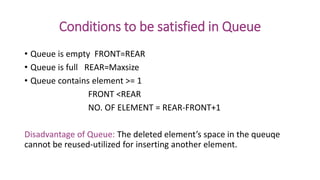
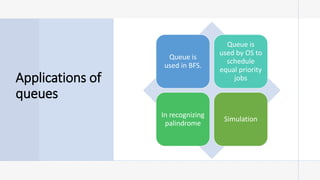
The document provides an introduction to queues, explaining that they are ordered collections where items are added at the rear and removed from the front, following a FIFO (First In First Out) principle. It details operations such as insertion (enqueue), deletion (dequeue), and outlines conditions for queue status (empty or full), as well as representations using arrays and linked lists. The document also discusses applications of queues in algorithms and operating systems.


