 Chapter 8 introduces the
queue data type.
 Several example
applications of queues are
given in that chapter.
 This presentation describes
the queue operations and
two ways to implement a
queue.
Using a Queue
Data Structures
and Other Objects
Using C++
The Queue Operations
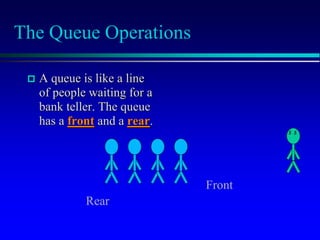
 A queue is like a line
of people waiting for a
bank teller. The queue
has a front and a rear.
$ $
Front
Rear
The Queue Operations
 New people must enter the queue at the
rear. The C++ queue class calls this a
push, although it is usually called an
enqueue operation.
$ $
Front
Rear
The Queue Operations
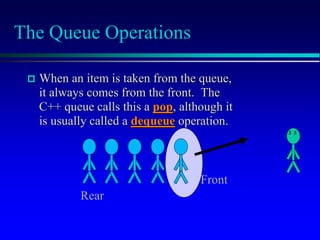
 When an item is taken from the queue,
it always comes from the front. The
C++ queue calls this a pop, although it
is usually called a dequeue operation.
$ $
Front
Rear
The Queue Class
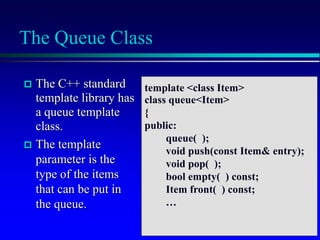
 The C++ standard
template library has
a queue template
class.
 The template
parameter is the
type of the items
that can be put in
the queue.
template <class Item>
class queue<Item>
{
public:
queue( );
void push(const Item& entry);
void pop( );
bool empty( ) const;
Item front( ) const;
…
Array Implementation
 A queue can be implemented with an array, as
shown here. For example, this queue contains the
integers 4 (at the front), 8 and 6 (at the rear).
[ 0 ] [1] [ 2 ] [ 3 ] [ 4 ] [ 5 ] . . .
An array of integers
to implement a
queue of integers
4 8 6
We don't care what's in
this part of the array.
Array Implementation
 The easiest implementation also keeps
track of the number of items in the
queue and the index of the first
element (at the front of the queue), the
last element (at the rear).
[ 0 ] [1] [ 2 ] [ 3 ] [ 4 ] [ 5 ] . . .
4 8 6
size
3
first
0
last
2
A Dequeue Operation
 When an element leaves the queue,
size is decremented, and first changes,
too.
[ 0 ] [1] [ 2 ] [ 3 ] [ 4 ] [ 5 ] . . .
4 8 6
size
2
first
1
last
2
An Enqueue Operation
 When an element enters the queue,
size is incremented, and last changes,
too.
[ 0 ] [1] [ 2 ] [ 3 ] [ 4 ] [ 5 ] . . .
2
8 6
size
3
first
1
last
3
At the End of the Array
 There is special behavior at the end of
the array. For example, suppose we
want to add a new element to this
queue, where the last index is [5]:
[ 0 ] [1] [ 2 ] [ 3 ] [ 4 ] [ 5 ]
2 1
6
size
3
first
3
last
5
At the End of the Array
 The new element goes at the front of
the array (if that spot isn’t already
used):
[ 0 ] [1] [ 2 ] [ 3 ] [ 4 ] [ 5 ]
2 1
6
size
4
first
3
last
0
4
Array Implementation
 Easy to implement
 But it has a limited capacity with a fixed array
 Or you must use a dynamic array for an
unbounded capacity
 Special behavior is needed when the rear reaches
the end of the array.
[ 0 ] [1] [ 2 ] [ 3 ] [ 4 ] [ 5 ] . . .
4 8 6
size
3
first
0
last
2
Linked List Implementation
10
15
7
null
13
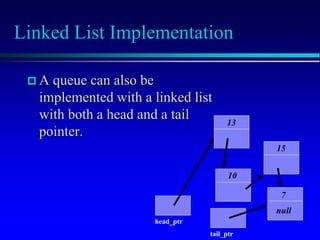
 A queue can also be
implemented with a linked list
with both a head and a tail
pointer.
head_ptr
tail_ptr
Linked List Implementation
10
15
7
null
13
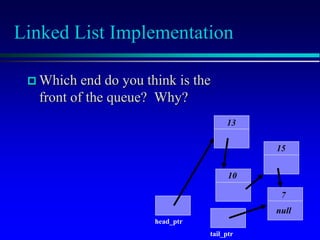
 Which end do you think is the
front of the queue? Why?
head_ptr
tail_ptr
Linked List Implementation
10
15
7
null
head_ptr
13
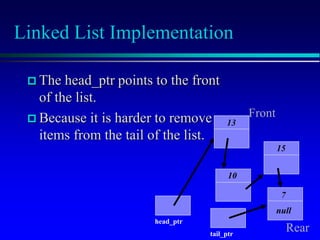
 The head_ptr points to the front
of the list.
 Because it is harder to remove
items from the tail of the list.
tail_ptr
Front
Rear
 Like stacks, queues have many applications.
 Items enter a queue at the rear and leave a
queue at the front.
 Queues can be implemented using an array
or using a linked list.
Summary
THE END
Presentation copyright 2010, Addison Wesley Longman,
For use with Data Structures and Other Objects Using C++
by Michael Main and Walter Savitch.
Some artwork in the presentation is used with permission from Presentation Task Force
(copyright New Vision Technologies Inc) and Corel Gallery Clipart Catalog (copyright
Corel Corporation, 3G Graphics Inc, Archive Arts, Cartesia Software, Image Club
Graphics Inc, One Mile Up Inc, TechPool Studios, Totem Graphics Inc).
Students and instructors who use Data Structures and Other Objects Using C++ are welcome
to use this presentation however they see fit, so long as this copyright notice remains
intact.

basics of queues

  • 1.
     Chapter 8introduces the queue data type.  Several example applications of queues are given in that chapter.  This presentation describes the queue operations and two ways to implement a queue. Using a Queue Data Structures and Other Objects Using C++
  • 2.
    The Queue Operations A queue is like a line of people waiting for a bank teller. The queue has a front and a rear. $ $ Front Rear
  • 3.
    The Queue Operations New people must enter the queue at the rear. The C++ queue class calls this a push, although it is usually called an enqueue operation. $ $ Front Rear
  • 4.
    The Queue Operations When an item is taken from the queue, it always comes from the front. The C++ queue calls this a pop, although it is usually called a dequeue operation. $ $ Front Rear
  • 5.
    The Queue Class The C++ standard template library has a queue template class.  The template parameter is the type of the items that can be put in the queue. template <class Item> class queue<Item> { public: queue( ); void push(const Item& entry); void pop( ); bool empty( ) const; Item front( ) const; …
  • 6.
    Array Implementation  Aqueue can be implemented with an array, as shown here. For example, this queue contains the integers 4 (at the front), 8 and 6 (at the rear). [ 0 ] [1] [ 2 ] [ 3 ] [ 4 ] [ 5 ] . . . An array of integers to implement a queue of integers 4 8 6 We don't care what's in this part of the array.
  • 7.
    Array Implementation  Theeasiest implementation also keeps track of the number of items in the queue and the index of the first element (at the front of the queue), the last element (at the rear). [ 0 ] [1] [ 2 ] [ 3 ] [ 4 ] [ 5 ] . . . 4 8 6 size 3 first 0 last 2
  • 8.
    A Dequeue Operation When an element leaves the queue, size is decremented, and first changes, too. [ 0 ] [1] [ 2 ] [ 3 ] [ 4 ] [ 5 ] . . . 4 8 6 size 2 first 1 last 2
  • 9.
    An Enqueue Operation When an element enters the queue, size is incremented, and last changes, too. [ 0 ] [1] [ 2 ] [ 3 ] [ 4 ] [ 5 ] . . . 2 8 6 size 3 first 1 last 3
  • 10.
    At the Endof the Array  There is special behavior at the end of the array. For example, suppose we want to add a new element to this queue, where the last index is [5]: [ 0 ] [1] [ 2 ] [ 3 ] [ 4 ] [ 5 ] 2 1 6 size 3 first 3 last 5
  • 11.
    At the Endof the Array  The new element goes at the front of the array (if that spot isn’t already used): [ 0 ] [1] [ 2 ] [ 3 ] [ 4 ] [ 5 ] 2 1 6 size 4 first 3 last 0 4
  • 12.
    Array Implementation  Easyto implement  But it has a limited capacity with a fixed array  Or you must use a dynamic array for an unbounded capacity  Special behavior is needed when the rear reaches the end of the array. [ 0 ] [1] [ 2 ] [ 3 ] [ 4 ] [ 5 ] . . . 4 8 6 size 3 first 0 last 2
  • 13.
    Linked List Implementation 10 15 7 null 13 A queue can also be implemented with a linked list with both a head and a tail pointer. head_ptr tail_ptr
  • 14.
    Linked List Implementation 10 15 7 null 13 Which end do you think is the front of the queue? Why? head_ptr tail_ptr
  • 15.
    Linked List Implementation 10 15 7 null head_ptr 13 The head_ptr points to the front of the list.  Because it is harder to remove items from the tail of the list. tail_ptr Front Rear
  • 16.
     Like stacks,queues have many applications.  Items enter a queue at the rear and leave a queue at the front.  Queues can be implemented using an array or using a linked list. Summary
  • 17.
    THE END Presentation copyright2010, Addison Wesley Longman, For use with Data Structures and Other Objects Using C++ by Michael Main and Walter Savitch. Some artwork in the presentation is used with permission from Presentation Task Force (copyright New Vision Technologies Inc) and Corel Gallery Clipart Catalog (copyright Corel Corporation, 3G Graphics Inc, Archive Arts, Cartesia Software, Image Club Graphics Inc, One Mile Up Inc, TechPool Studios, Totem Graphics Inc). Students and instructors who use Data Structures and Other Objects Using C++ are welcome to use this presentation however they see fit, so long as this copyright notice remains intact.