:
In this lesson, students should be able to:
1) divide polynomials such as;
a) monomial by monomial,
b) polynomial by monomial,
c) polynomial by polynomial,
2) solve problems involving dividing polynomials.
2
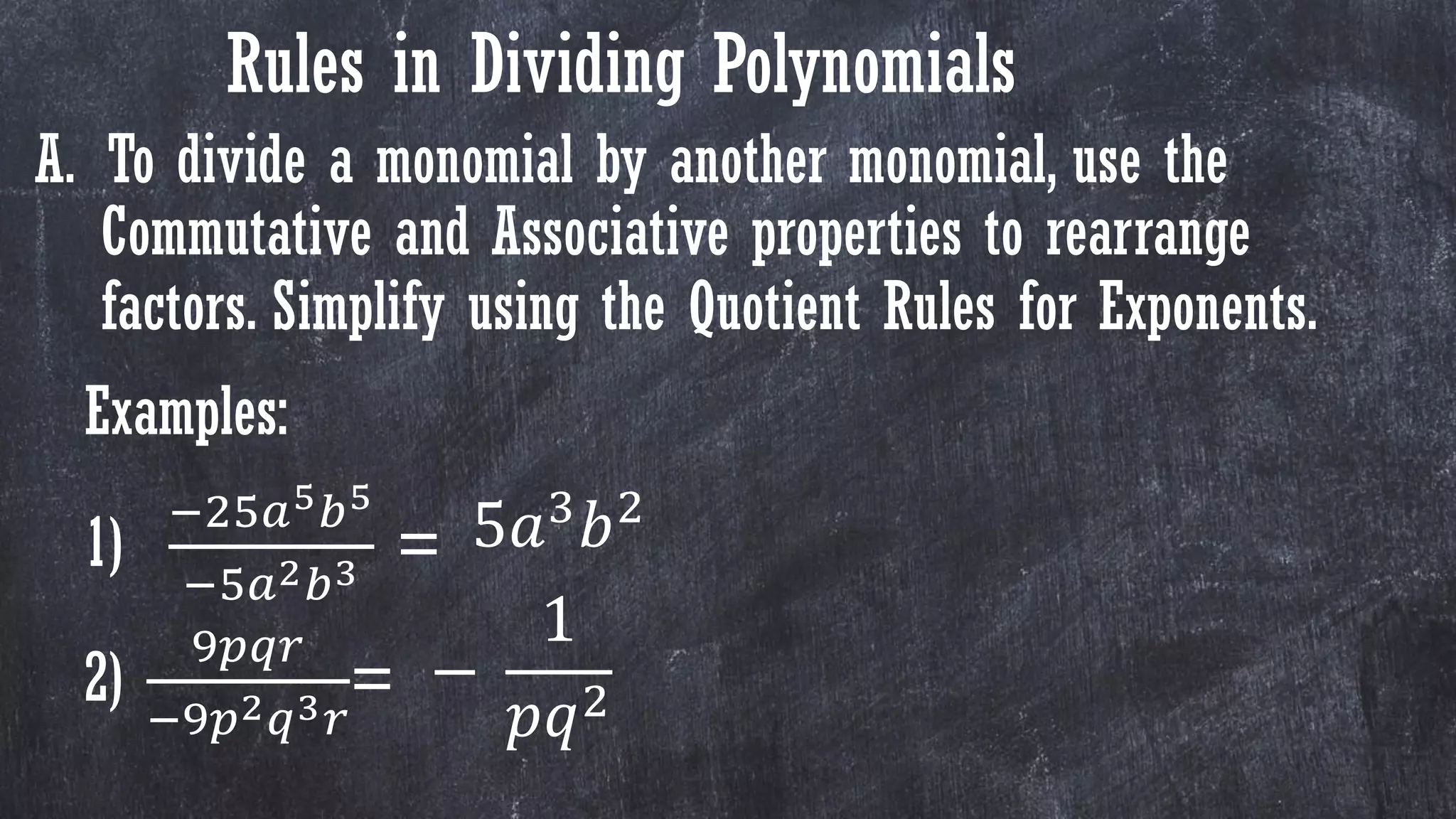
A. To divide a monomial by another monomial, use the
Commutative and Associative properties to rearrange
factors. Simplify using the Quotient Rules for Exponents.
−
1
𝑝𝑞2
Examples:
1)
−25𝑎5 𝑏5
−5𝑎2 𝑏3 =
2)
9𝑝𝑞𝑟
−9𝑝2 𝑞3 𝑟
=
5𝑎3 𝑏2
Rules in Dividing Polynomials
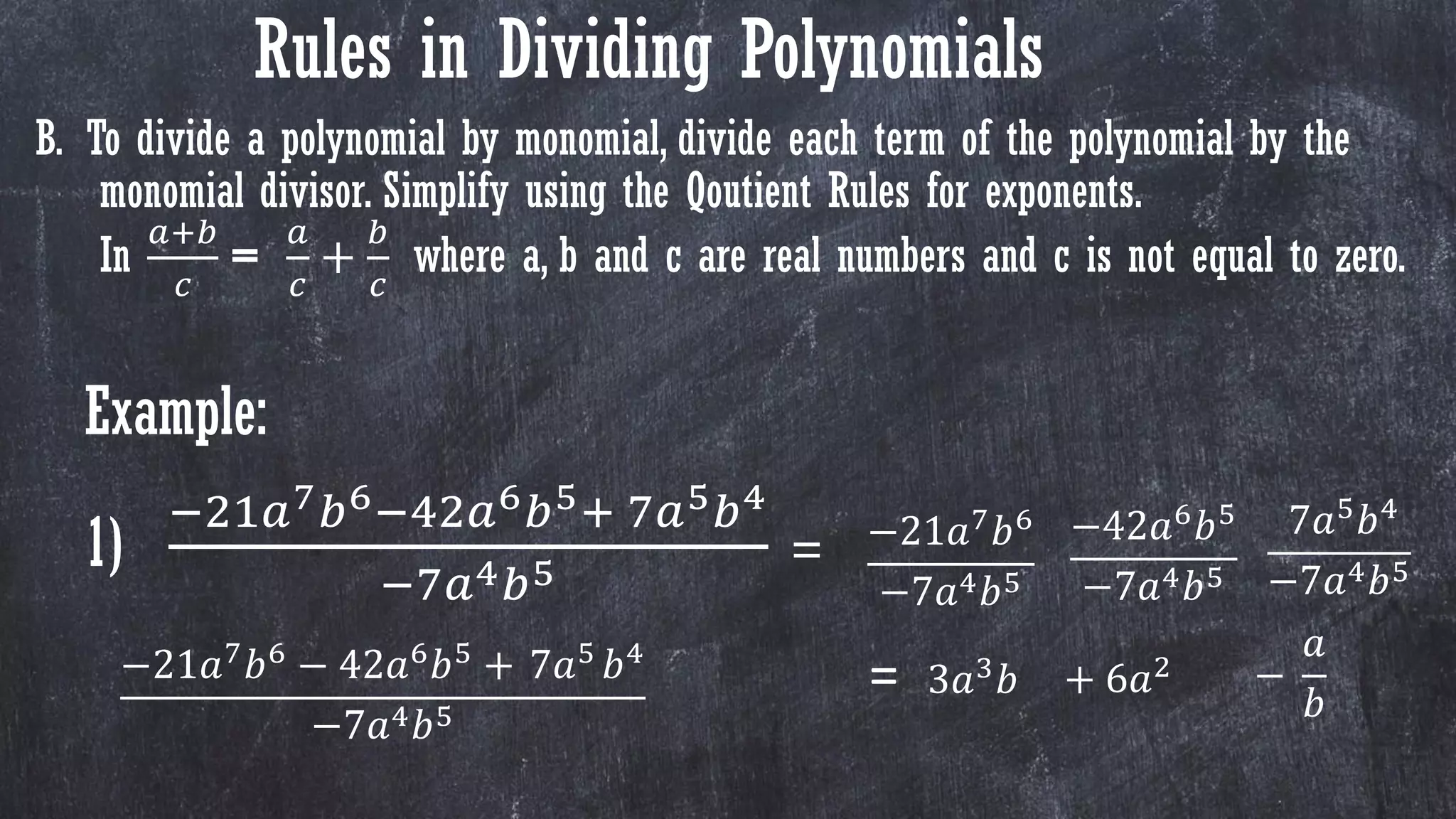
B. To divide a polynomial by monomial, divide each term of the polynomial by the
monomial divisor. Simplify using the Qoutient Rules for exponents.
In
𝑎+𝑏
𝑐
=
𝑎
𝑐
+
𝑏
𝑐
where a, b and c are real numbers and c is not equal to zero.
Example:
1)
−21𝑎7 𝑏6−42𝑎6 𝑏5+ 7𝑎5 𝑏4
−7𝑎4 𝑏5 = −21𝑎7 𝑏6
−7𝑎4 𝑏5
Rules in Dividing Polynomials
−42𝑎6
𝑏5
−7𝑎4 𝑏5
7𝑎5 𝑏4
−7𝑎4 𝑏5
−21𝑎7
𝑏6
− 42𝑎6
𝑏5
+ 7𝑎5
𝑏4
−7𝑎4 𝑏5
= 3𝑎3 𝑏 + 6𝑎2 −
𝑎
𝑏
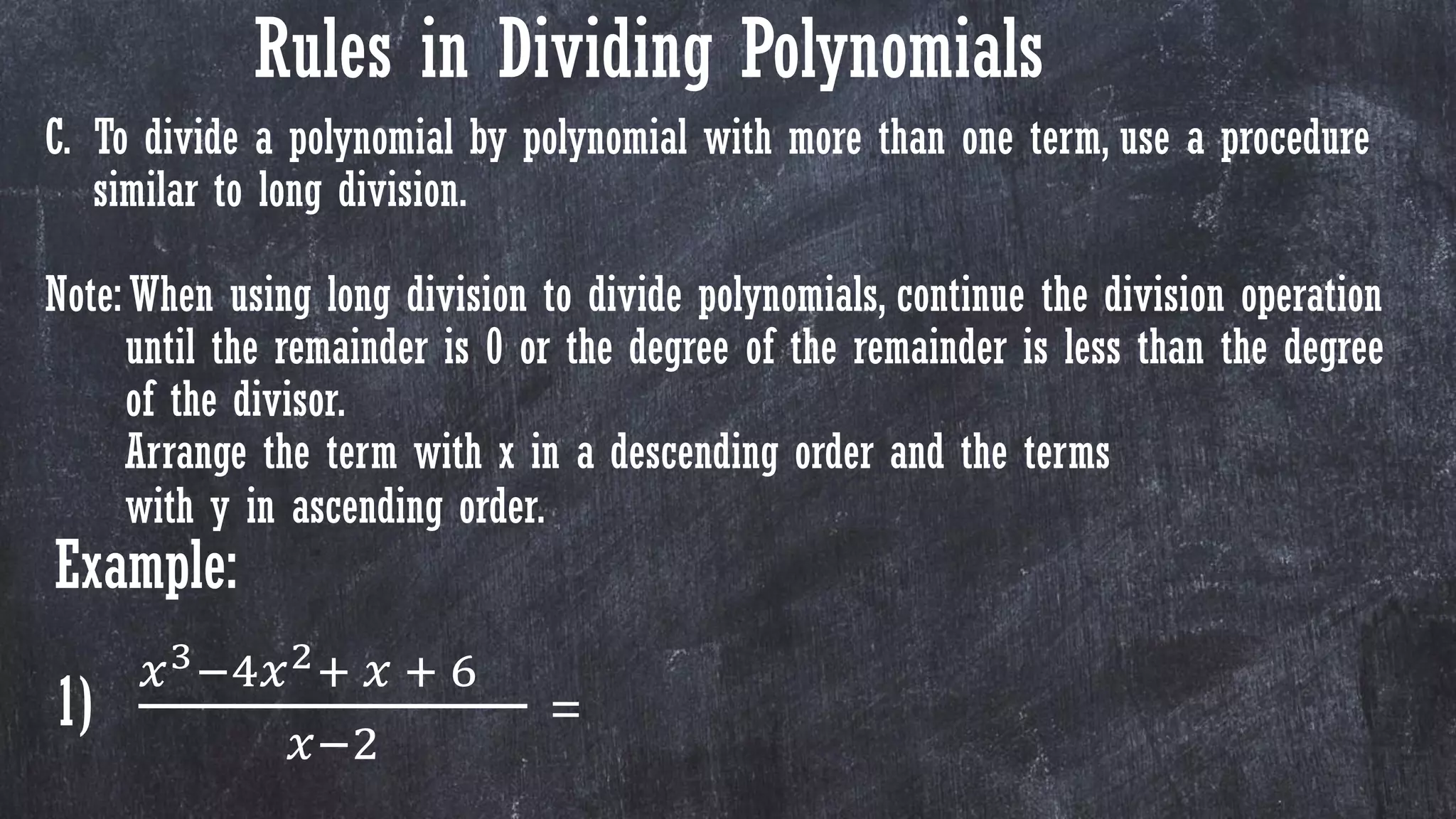
C. To divide a polynomial by polynomial with more than one term, use a procedure
similar to long division.
Note: When using long division to divide polynomials, continue the division operation
until the remainder is 0 or the degree of the remainder is less than the degree
of the divisor.
Arrange the term with x in a descending order and the terms
with y in ascending order.
Example:
1)
𝑥3−4𝑥2+ 𝑥 + 6
𝑥−2
=
Rules in Dividing Polynomials
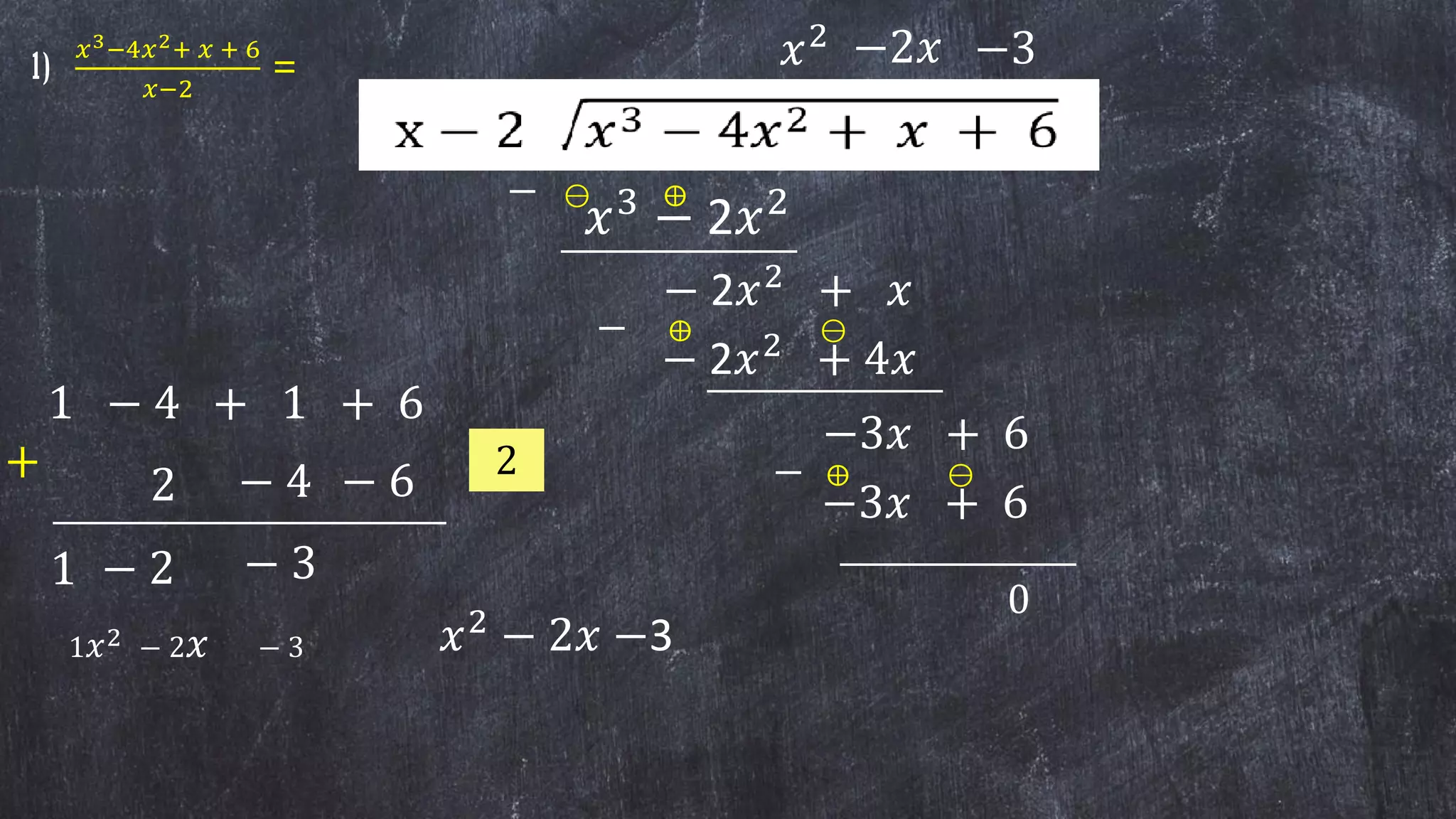
1)
𝑥3−4𝑥2+ 𝑥 + 6
𝑥−2
= 𝑥2
𝑥3
− 2𝑥2
− 2𝑥2
+ 𝑥
−
⊖ ⨁
−2𝑥
− 2𝑥2
+ 4𝑥
_______________
−
−3𝑥 + 6
2
−3𝑥 + 6_________________________
⨁ ⊖−
−3
_______________
⨁ ⊖
1 − 4 + 1 + 6
_______________
0
1
2
− 2
− 4
− 3
− 6
1 𝑥2 − 2 𝑥 − 3 𝑥2
− 2𝑥 −3
+
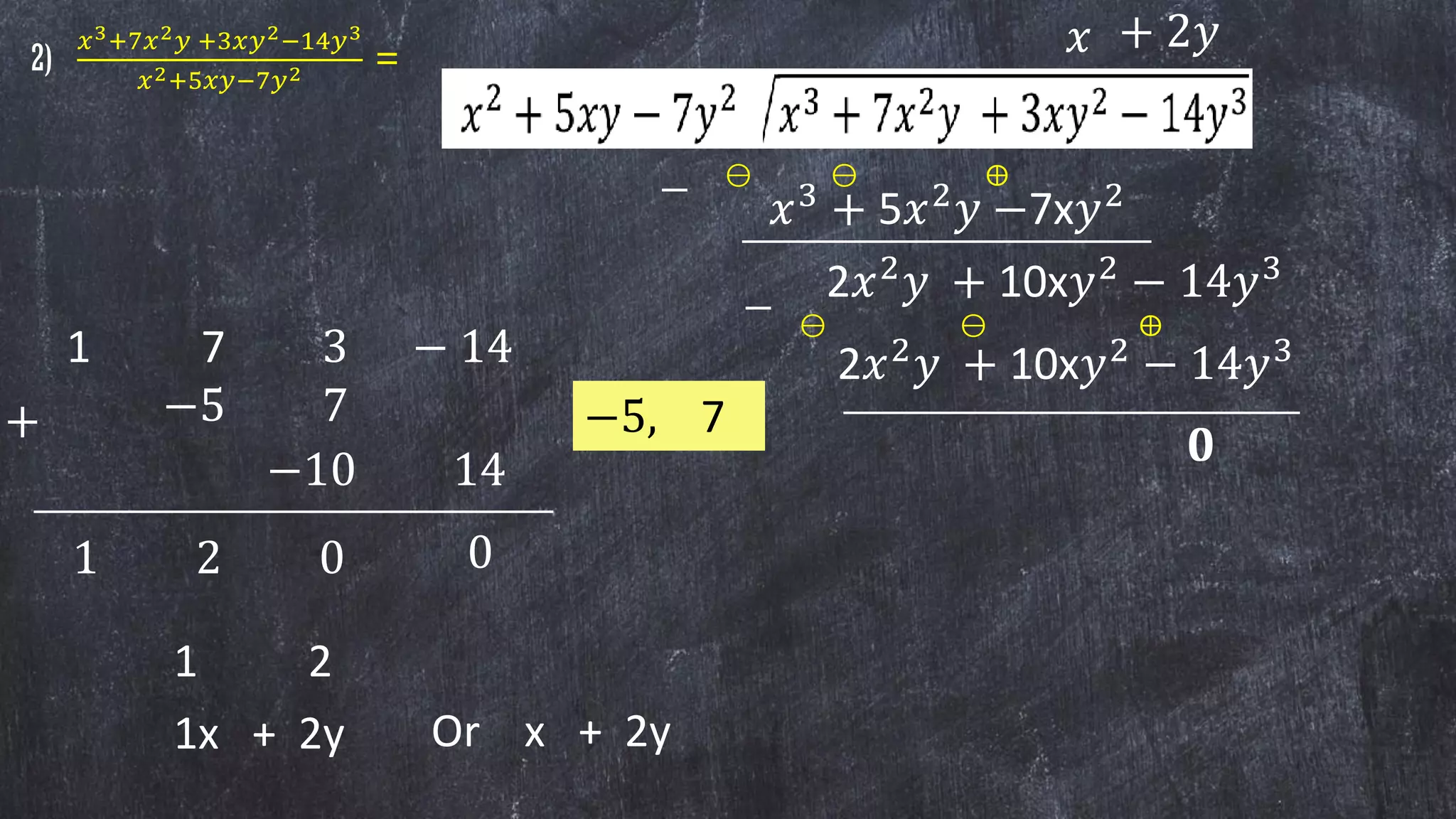
𝑥
𝑥3
+ 5𝑥2
𝑦 −7x𝑦2
2𝑥2
𝑦 + 10x𝑦2
− 14𝑦3
−
⊖ ⊖ ⨁
+ 2𝑦
2𝑥2
𝑦 + 10x𝑦2
− 14𝑦3
__________________________
−
0
_____________________________
2)
𝑥3+7𝑥2 𝑦 +3𝑥𝑦2−14𝑦3
𝑥2+5𝑥𝑦−7𝑦2 =
⊖ ⊖ ⨁
1 7 3 − 14
00
−5, 7
_________________________________
1
−5 7
−10 14
2
+
0 0
1 2
1x + 2y Or x + 2y
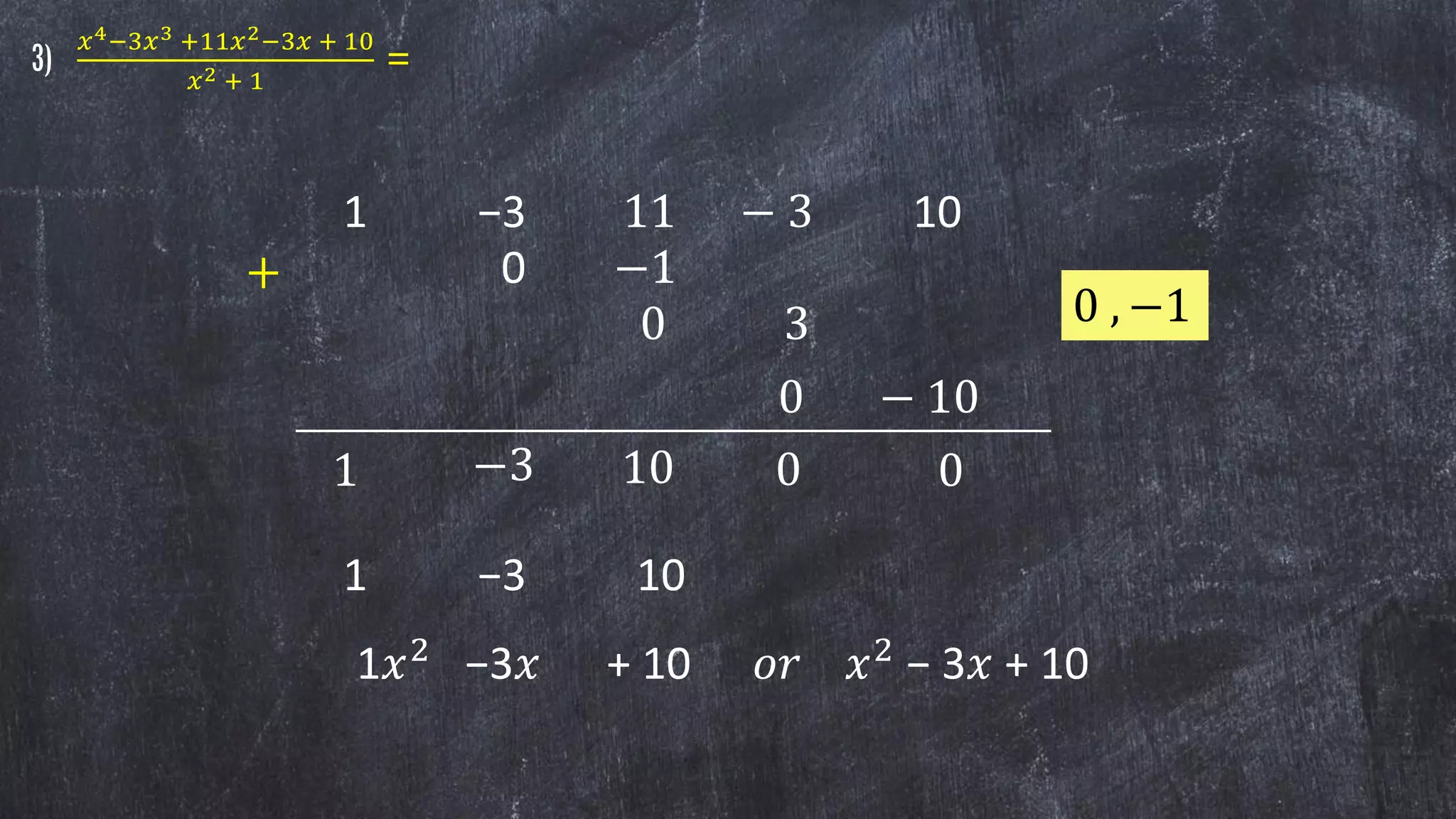
3)
𝑥4−3𝑥3 +11𝑥2−3𝑥 + 10
𝑥2 + 1
=
1 −3 11 − 3 10
0 , −1
________________________________________________
1
0 −1
0 3
−3
+
10 0
1 −3 10
0 − 10
0
1𝑥2
−3𝑥 + 10 𝑜𝑟 𝑥2
− 3𝑥 + 10

Dividing Polynomials

  • 2.
    : In this lesson,students should be able to: 1) divide polynomials such as; a) monomial by monomial, b) polynomial by monomial, c) polynomial by polynomial, 2) solve problems involving dividing polynomials. 2
  • 3.
    A. To dividea monomial by another monomial, use the Commutative and Associative properties to rearrange factors. Simplify using the Quotient Rules for Exponents. − 1 𝑝𝑞2 Examples: 1) −25𝑎5 𝑏5 −5𝑎2 𝑏3 = 2) 9𝑝𝑞𝑟 −9𝑝2 𝑞3 𝑟 = 5𝑎3 𝑏2 Rules in Dividing Polynomials
  • 4.
    B. To dividea polynomial by monomial, divide each term of the polynomial by the monomial divisor. Simplify using the Qoutient Rules for exponents. In 𝑎+𝑏 𝑐 = 𝑎 𝑐 + 𝑏 𝑐 where a, b and c are real numbers and c is not equal to zero. Example: 1) −21𝑎7 𝑏6−42𝑎6 𝑏5+ 7𝑎5 𝑏4 −7𝑎4 𝑏5 = −21𝑎7 𝑏6 −7𝑎4 𝑏5 Rules in Dividing Polynomials −42𝑎6 𝑏5 −7𝑎4 𝑏5 7𝑎5 𝑏4 −7𝑎4 𝑏5 −21𝑎7 𝑏6 − 42𝑎6 𝑏5 + 7𝑎5 𝑏4 −7𝑎4 𝑏5 = 3𝑎3 𝑏 + 6𝑎2 − 𝑎 𝑏
  • 5.
    C. To dividea polynomial by polynomial with more than one term, use a procedure similar to long division. Note: When using long division to divide polynomials, continue the division operation until the remainder is 0 or the degree of the remainder is less than the degree of the divisor. Arrange the term with x in a descending order and the terms with y in ascending order. Example: 1) 𝑥3−4𝑥2+ 𝑥 + 6 𝑥−2 = Rules in Dividing Polynomials
  • 7.
    1) 𝑥3−4𝑥2+ 𝑥 +6 𝑥−2 = 𝑥2 𝑥3 − 2𝑥2 − 2𝑥2 + 𝑥 − ⊖ ⨁ −2𝑥 − 2𝑥2 + 4𝑥 _______________ − −3𝑥 + 6 2 −3𝑥 + 6_________________________ ⨁ ⊖− −3 _______________ ⨁ ⊖ 1 − 4 + 1 + 6 _______________ 0 1 2 − 2 − 4 − 3 − 6 1 𝑥2 − 2 𝑥 − 3 𝑥2 − 2𝑥 −3 +
  • 8.
    𝑥 𝑥3 + 5𝑥2 𝑦 −7x𝑦2 2𝑥2 𝑦+ 10x𝑦2 − 14𝑦3 − ⊖ ⊖ ⨁ + 2𝑦 2𝑥2 𝑦 + 10x𝑦2 − 14𝑦3 __________________________ − 0 _____________________________ 2) 𝑥3+7𝑥2 𝑦 +3𝑥𝑦2−14𝑦3 𝑥2+5𝑥𝑦−7𝑦2 = ⊖ ⊖ ⨁ 1 7 3 − 14 00 −5, 7 _________________________________ 1 −5 7 −10 14 2 + 0 0 1 2 1x + 2y Or x + 2y
  • 9.
    3) 𝑥4−3𝑥3 +11𝑥2−3𝑥 +10 𝑥2 + 1 = 1 −3 11 − 3 10 0 , −1 ________________________________________________ 1 0 −1 0 3 −3 + 10 0 1 −3 10 0 − 10 0 1𝑥2 −3𝑥 + 10 𝑜𝑟 𝑥2 − 3𝑥 + 10