Complexity:
Algorithms can becompared or analyzed using two types of complexities:
1. Space Complexity:
It is the space required for execution of algorithm excluding the space
taken by inputs
2. Time Complexity:
It is the time required for execution of algorithm excluding the time
required for accepting the inputs
Prepared By: Prof. Swapnil S. Sonawane
4.
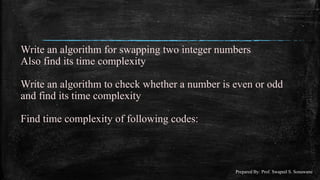
Write an algorithmfor swapping two integer numbers
Also find its time complexity
Write an algorithm to check whether a number is even or odd
and find its time complexity
Find time complexity of following codes:
Prepared By: Prof. Swapnil S. Sonawane
5.
Types of TimeFunction:
O(1) Constant
O(log n) Logarithmic
O(n) Linear
O(n log n) Super Linear
O(n^2) Quadratic
O(n^3) Cubic
O(2^n) Exponential
Prepared By: Prof. Swapnil S. Sonawane
6.
Asymptotic Notation:
It isthe analysis performed for larger number of inputs
1. Big ‘O’ Notation (Upper Bound):
The function f(n)=O(g(n)) if and only if there exist positive constant c and
n0, such that, f(n)<=c*g(n) for all n>=n0
Prepared By: Prof. Swapnil S. Sonawane
7.
2. Omega Notation(Ω) (Lower Bound):
The function f(n)=Ω(g(n)) if and only if there exist positive constant c and
n0, such that, f(n)>=c*g(n) for all n>=n0
Prepared By: Prof. Swapnil S. Sonawane
8.
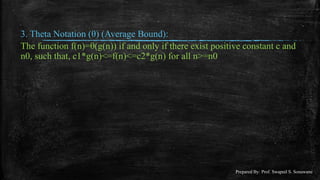
3. Theta Notation(θ) (Average Bound):
The function f(n)=θ(g(n)) if and only if there exist positive constant c and
n0, such that, c1*g(n)<=f(n)<=c2*g(n) for all n>=n0
Prepared By: Prof. Swapnil S. Sonawane
9.
Minimum Spanning TreeAlgorithms:
Kruskal’s Algorithm:
Kruskal's Algorithm is used to find the minimum spanning tree for a connected weighted
graph. Kruskal's algorithm follows greedy approach which finds an optimum solution at
every stage.
Algorithm:
1. Remove all loops and Parallel Edges
2. Arrange all edges in their increasing order of weight
3. Add the edge which has the least weightage but ignore/reject those edges that create a
cycle or closed loop
4. Add cost of every edge of spanning tree to get total cost
Prepared By: Prof. Swapnil S. Sonawane
10.
Prim’s Algorithm:
Prim's algorithmto find minimum cost spanning tree uses the greedy approach.
Prim's algorithm, treats the nodes as a single tree and keeps on adding new
nodes to the spanning tree from the given graph.
Algorithm:
1. Select starting vertex and consider all its directly connected edges
2. Select edge with minimum weight
3. Add the selected edge in spanning tree
4. Select vertex of added edge and repeat step 1 until all vertex has been
selected
Prepared By: Prof. Swapnil S. Sonawane
11.
Shortest Path Algorithm:
Dijkstra’sAlgorithm:
It is a greedy algorithm that solves the single-source shortest path problem
for a directed graph with nonnegative edge weights
It is an algorithm that is used for finding the shortest distance, or path, from
starting node to target node in a weighted graph
Algorithm:
1. Begin from the node to be selected, the source node, and it examines the entire
graph to determine the shortest path among that node and all the other nodes
connected to source node
Prepared By: Prof. Swapnil S. Sonawane
12.
2. Maintain thetrack of the currently recognized shortest distance from
each node to the source code and updates these values if it identifies
another shortest path.
3. Once the shortest path from the source code to another node is
determined, the node is marked as “visited” and can be added to the path.
4. This process is being continued till all the nodes in the graph have been
added to the path.
Prepared By: Prof. Swapnil S. Sonawane
13.
Fractional Knapsack Problem:
Thefractional knapsack problem is also one of the techniques which are used to solve
the knapsack problem. In fractional knapsack, the items are broken in order to
maximize the profit. The problem in which we break the item is known as a Fractional
knapsack problem.
This problem can be solved with the help of using two techniques:
Brute-force approach: The brute-force approach tries all the possible solutions with all
the different fractions, but it is a time-consuming approach.
Greedy approach: In Greedy approach, we calculate the ratio of profit/weight, and
accordingly, we will select the item. The item with the highest ratio would be selected
first.
Prepared By: Prof. Swapnil S. Sonawane
14.
Job Sequencing withDeadlines:
We adopt a greedy algorithm to determine how the next job is selected for an
optimal solution. The greedy algorithm described below always gives an
optimal solution to the job sequencing problem.
1. Sort all the given jobs in the decreasing order of their profits.
2. Check the value of maximum deadline. Then, draw a Gantt chart where
maximum time on Gantt chart is the value of maximum deadline.
3. Pick up the jobs one by one and then put them on the Gantt chart as far as
possible from 0 (starting point) such that the job gets completed before its
deadline.
Prepared By: Prof. Swapnil S. Sonawane
15.
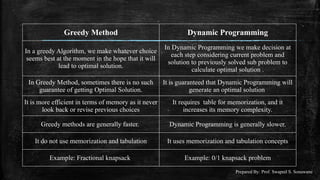
Greedy Method DynamicProgramming
In a greedy Algorithm, we make whatever choice
seems best at the moment in the hope that it will
lead to optimal solution.
In Dynamic Programming we make decision at
each step considering current problem and
solution to previously solved sub problem to
calculate optimal solution .
In Greedy Method, sometimes there is no such
guarantee of getting Optimal Solution.
It is guaranteed that Dynamic Programming will
generate an optimal solution
It is more efficient in terms of memory as it never
look back or revise previous choices
It requires table for memorization, and it
increases its memory complexity.
Greedy methods are generally faster. Dynamic Programming is generally slower.
It do not use memorization and tabulation It uses memorization and tabulation concepts
Example: Fractional knapsack Example: 0/1 knapsack problem
Prepared By: Prof. Swapnil S. Sonawane
16.
Prepared By: Prof.Swapnil S. Sonawane
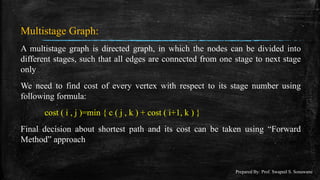
Multistage Graph:
A multistage graph is directed graph, in which the nodes can be divided into
different stages, such that all edges are connected from one stage to next stage
only
We need to find cost of every vertex with respect to its stage number using
following formula:
cost ( i , j )=min { c ( j , k ) + cost ( i+1, k ) }
Final decision about shortest path and its cost can be taken using “Forward
Method” approach
17.
Floyd-Warshall Algorithm:
Floyd-Warshall Algorithmis an algorithm for finding the shortest path between all the pairs of vertices
in a weighted graph.
Algorithm:
n = no of vertices
A = matrix of dimension n*n
for k = 1 to n
for i = 1 to n
for j = 1 to n
Ak[i, j] = min (Ak-1[i, j], Ak-1[i, k] + Ak-1[k, j])
return A
Complexity: O(n3
)
Prepared By: Prof. Swapnil S. Sonawane
18.
N Queens Problem:
Theidea is to place queens one by one in different columns, starting from
the leftmost column.
When we place a queen in a column, we check for clashes with already
placed queens.
In the current column, if we find a row for which there is no clash, we
mark this row and column as part of the solution and if we do not find
such a row due to clashes, then we backtrack and return false.
Prepared By: Prof. Swapnil S. Sonawane
19.
Algorithm:
1) Start inthe leftmost column
2) If all queens are placed, return true
3) Try all rows in the current column.
a) If the queen can be placed safely in this row,
then mark this [row, column] as part of the solution and recursively check if
placing queen here leads to a solution.
b) If placing the queen in [row, column] leads to a solution then return true.
c) If placing queen doesn't lead to a solution then unmark this [row, column]
(Backtrack) and go to step (a) to try other rows.
4) If all rows have been tried and nothing worked return false to trigger backtracking.
Prepared By: Prof. Swapnil S. Sonawane
20.
Graph Coloring Problem:
Theidea is to assign colors one by one to different vertices, starting from
the vertex 0.
Before assigning a color, check for safety by considering already assigned
colors to the adjacent vertices i.e check if the adjacent vertices have the
same color or not.
If there is any color assignment that does not violate the conditions, mark
the color assignment as part of the solution.
If no assignment of color is possible then backtrack and return false.
Prepared By: Prof. Swapnil S. Sonawane
21.
Algorithm:
1. Create arecursive function that takes the graph, current index, number of vertices, and
output color array.
2. If the current index is equal to the number of vertices. Print the color configuration in
output array.
3. Assign a color to a vertex (1 to m).
4. For every assigned color, check if the configuration is safe, (i.e. check if the adjacent
vertices do not have the same color) recursively call the function with next index and
number of vertices
5. If any recursive function returns true break the loop and return true.
6. If no recursive function returns true then return false.
Prepared By: Prof. Swapnil S. Sonawane
22.
Sum of SubsetProblem:
In this, we have weight vector of ‘n’ integers stored in ascending order
We required sum of all subset as ‘m’ (Exact sum)
The problem is to find all the subsets of given weight vector, where
sum=m
Prepared By: Prof. Swapnil S. Sonawane
23.
Prepared By: Prof.Swapnil S. Sonawane
Algorithm of “Sum of subsets”:
1. Start with an empty set
2. Add the next element from weight vector to the set
3. If the subset is having sum M, then stop with that subset as solution.
4. If the subset is not feasible or if we have reached the end of the set, then backtrack
through the subset until we find the most suitable value.
5. If the subset is feasible (sum of subbset < M) then go to step 2.
6. If we have visited all the elements without finding a suitable subset and if no
backtracking is possible then stop without solution.
24.
Prepared By: Prof.Swapnil S. Sonawane
Branch and Bound:
This is quite similar to backtracking as it also creates State-Space tree, but it is used to solve
optimization problem
In this we calculate bound of each node which represents the cost of reaching to solution node from
that node
If the solution represented by bound, is worse than best solution found so far, then that node is
killed, and corresponding branch is closed
The bound can also be used to select most promising node out of available
E-node:
It is a node which is currently getting expanded
Live node:
It is a node which is created but not expanded yet
25.
Prepared By: Prof.Swapnil S. Sonawane
In B&B at each E node, we find all the live nodes which can be generated using a
single step
Those which are infeasible are killed and others are added to list of live node
Depending on policy of selecting next E node, B&B can be categorized as follows:
LIFO BB/ LIFO Search:
In this always the youngest node in the queue is used to extend the branch. This leads
to a depth-first search
FIFO BB/ FIFO Search:
In this always the oldest node in the queue is used to extend the branch. This leads to a
breadth-first search
LC BB/ LC Search:
In this the next E node selected will be live node with least cost. It uses estimated cost
function ‘C^’ instead of actual cost function ‘C’
26.
Prepared By: Prof.Swapnil S. Sonawane
15 Puzzle Problem:
In this, we have a square block frame of 4X4 dimensions with 15 numbered tiles
and an empty slot
The problem is to reach goal state from initial state
27.
Prepared By: Prof.Swapnil S. Sonawane
There are maximum 4 legal moves, possibly as UP, DOWN, LEFT and RIGHT
Hence, we need to find set of legal moves to transform initial state to goal state
The estimated cost function can be calculated as,
C^(x)= f(x) + g^(x)
Here,
f(x)=Depth of node x
g^(x)=Number of nonblank tiles which are not in their goal state
28.
Prepared By: Prof.Swapnil S. Sonawane
Travelling Salesperson Problem using B&B:
A better estimated cost function can be found using reduced cost function
A row of a matrix is said to be reduced if it contains at least 1 zero and all
remaining elements are non negative and similarly columns can also be reduced
A matrix is said to be reduced if all rows and columns are reduced
The following steps are used to find cost (C) of a node representing an edge
from i to j:
29.
Prepared By: Prof.Swapnil S. Sonawane
1. Set all elements of row i and column j of matrix to ∞
2. Set A( j,1) to ∞
3. Reduce all rows and columns of the resultant matrix except the rows and columns containing ∞
4. Compute the total reduction value as,
C^(S)=C^(R) + A(i , j) + r
Where,
S=Current node representing an edge from i to j
R=Previous node
A(i, j)=Cost of edge (i, j)
r=Reduction value
30.
Prepared By: Prof.Swapnil S. Sonawane
Brute force (Naïve) pattern matching:
Naive pattern searching is the simplest method among other pattern searching algorithms. It checks
for all character of the main string to the pattern.
Naive algorithm is exact string matching(means finding one or all exact occurrences of a pattern in a
text) algorithm.
This algorithm is helpful for smaller texts. It does not need any pre-processing phases. We can find
substring by checking once for the string. It also does not occupy extra space to perform the
operation.
The naive approach tests all the possible placement of Pattern P [1…….m] relative to text T [1……
n]. We try shift s = 0, 1…….n-m, successively and for each shift s. Compare T [s+1…….s+m] to P
[1……m].It returns all the valid shifts found.
The time complexity is O(n-m+1)
31.
Prepared By: Prof.Swapnil S. Sonawane
Knuth-Morris-Pratt Algorithm:
KMP is an algorithm for string matching problem
It is used to avoid comparison of element that have previously been involved in comparison with
some elements of the pattern to be matched to avoid repetitive backtracking
It has 2 components:
a. The prefix function (π):
It is used to encapsulate knowledge about how the pattern matches against shift of itself
b. The KMP matcher:
With text ‘T’, pattern ‘P’ and prefix function ‘π’ as inputs, it finds the occurrence of ‘P’ in ‘T’ and
returns the number of shifts of ‘P’ after which occurrence are found
32.
Prepared By: Prof.Swapnil S. Sonawane
Rabin Carp Algorithm:
The Rabin-Karp string matching algorithm calculates a hash value for the
pattern, as well as for each M-character subsequences of text to be compared.
If the hash values are unequal, the algorithm will determine the hash value
for next M-character sequence.
If the hash values are equal, the algorithm will analyze the pattern and the M-
character sequence.
In this way, there is only one comparison per text subsequence, and character
matching is only required when the hash values match.






![Floyd-Warshall Algorithm:
Floyd-Warshall Algorithm is an algorithm for finding the shortest path between all the pairs of vertices
in a weighted graph.
Algorithm:
n = no of vertices
A = matrix of dimension n*n
for k = 1 to n
for i = 1 to n
for j = 1 to n
Ak[i, j] = min (Ak-1[i, j], Ak-1[i, k] + Ak-1[k, j])
return A
Complexity: O(n3
)
Prepared By: Prof. Swapnil S. Sonawane](https://image.slidesharecdn.com/vit-aoa-250917082331-502fc006/85/Analysis-of-Algorithm-notes-prepared-by-vit-pptx-17-320.jpg)
![Algorithm:
1) Start in the leftmost column
2) If all queens are placed, return true
3) Try all rows in the current column.
a) If the queen can be placed safely in this row,
then mark this [row, column] as part of the solution and recursively check if
placing queen here leads to a solution.
b) If placing the queen in [row, column] leads to a solution then return true.
c) If placing queen doesn't lead to a solution then unmark this [row, column]
(Backtrack) and go to step (a) to try other rows.
4) If all rows have been tried and nothing worked return false to trigger backtracking.
Prepared By: Prof. Swapnil S. Sonawane](https://image.slidesharecdn.com/vit-aoa-250917082331-502fc006/85/Analysis-of-Algorithm-notes-prepared-by-vit-pptx-19-320.jpg)





![Prepared By: Prof. Swapnil S. Sonawane
Brute force (Naïve) pattern matching:
Naive pattern searching is the simplest method among other pattern searching algorithms. It checks
for all character of the main string to the pattern.
Naive algorithm is exact string matching(means finding one or all exact occurrences of a pattern in a
text) algorithm.
This algorithm is helpful for smaller texts. It does not need any pre-processing phases. We can find
substring by checking once for the string. It also does not occupy extra space to perform the
operation.
The naive approach tests all the possible placement of Pattern P [1…….m] relative to text T [1……
n]. We try shift s = 0, 1…….n-m, successively and for each shift s. Compare T [s+1…….s+m] to P
[1……m].It returns all the valid shifts found.
The time complexity is O(n-m+1)](https://image.slidesharecdn.com/vit-aoa-250917082331-502fc006/85/Analysis-of-Algorithm-notes-prepared-by-vit-pptx-30-320.jpg)


