B-TREE
SUJITHA.M
I-M.SC(CS&IT)
Nadar Saraswathi College Of Arts and Science,
Theni.
DEFINITION OF A B-TREE
 A B-tree of order m is an m-way tree (i.e., a tree where each node may
have up to m children) in which:
 The number of keys in each non-leaf node is one less than the number
of its children and these keys partition the keys in the children in the
fashion of a search tree.
 All leaves are on the same level.
 All non-leaf nodes except the root have at least m / 2 children.
 The root is either a leaf node, or it has from two to m children
 a leaf node contains no more than m – 1 keys.
 The number m should always be odd.
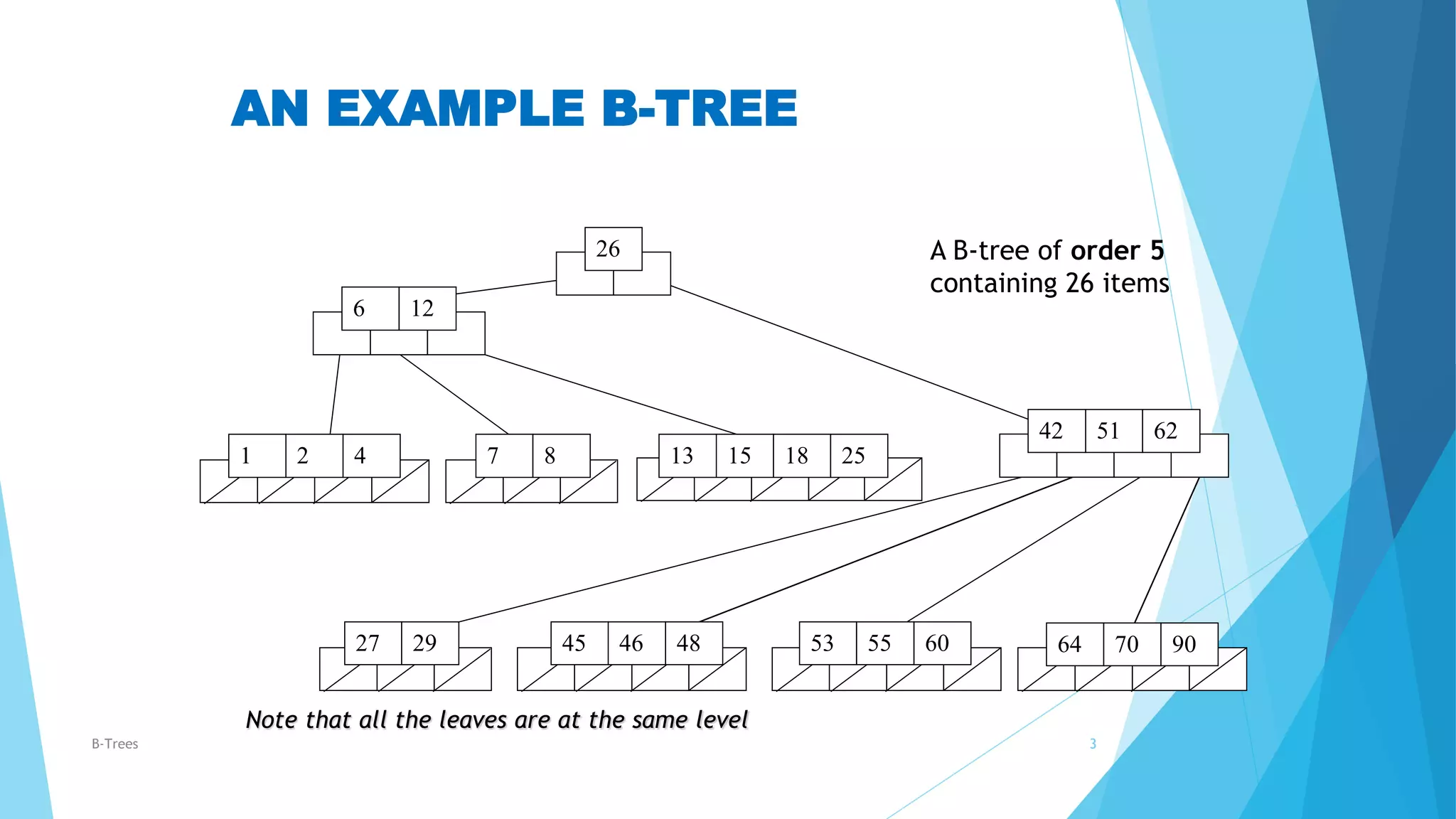
AN EXAMPLE B-TREE
B-Trees 3
51 6242
6 12
26
55 60 7064 9045
1 2 4 7 8 13 15 18 25
27 29 46 48 53
A B-tree of order 5
containing 26 items
Note that all the leaves are at the same level
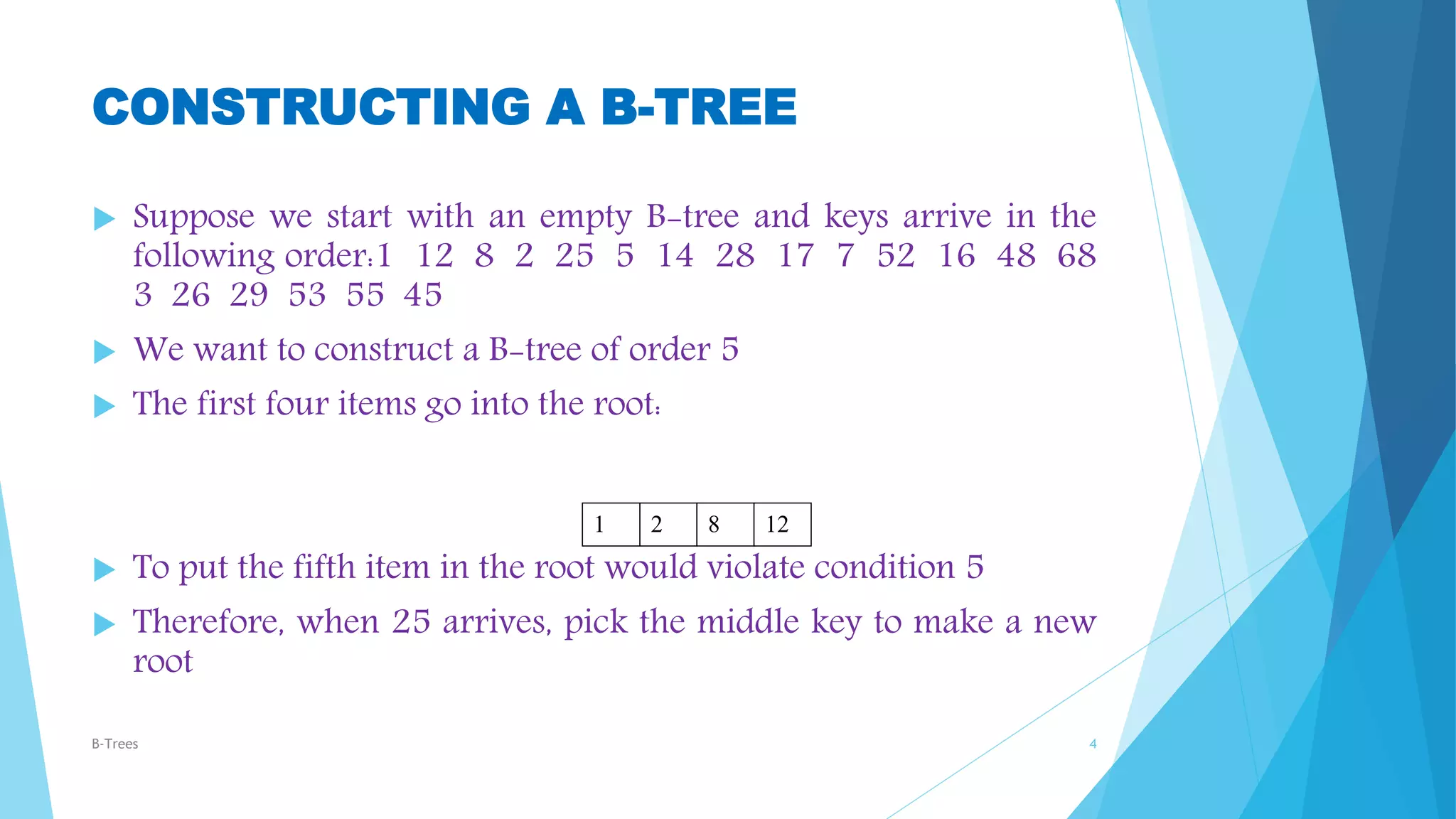
CONSTRUCTING A B-TREE
 Suppose we start with an empty B-tree and keys arrive in the
following order:1 12 8 2 25 5 14 28 17 7 52 16 48 68
3 26 29 53 55 45
 We want to construct a B-tree of order 5
 The first four items go into the root:
 To put the fifth item in the root would violate condition 5
 Therefore, when 25 arrives, pick the middle key to make a new
root
B-Trees 4
1 2 8 12
INSERTING INTO A B-TREE
 Attempt to insert the new key into a leaf
 If this would result in that leaf becoming too big, split the leaf
into two, promoting the middle key to the leaf’s parent
 If this would result in the parent becoming too big, split the
parent into two, promoting the middle key
 This strategy might have to be repeated all the way to the top
 If necessary, the root is split in two and the middle key is
promoted to a new root, making the tree one level higher
B-Trees 5
REMOVAL FROM A B-TREE
 During insertion, the key always goes into a leaf. For deletion
we wish to remove from a leaf. There are three possible ways
we can do this:
 1 - If the key is already in a leaf node, and removing it doesn’t
cause that leaf node to have too few keys, then simply remove
the key to be deleted.
 2 - If the key is not in a leaf then it is guaranteed (by the nature
of a B-tree) that its predecessor or successor will be in a leaf --
in this case we can delete the key and promote the predecessor
or successor key to the non-leaf deleted key’s position.
B-Trees 6
ANALYSIS OF B-TREE
 The maximum number of items in a B-tree of order m and height h:
root m – 1
level 1 m(m – 1)
level 2 m2(m – 1)
. . .
level h mh(m – 1)
 So, the total number of items is
(1 + m + m2 + m3 + … + mh)(m – 1) =
[(mh+1 – 1)/ (m – 1)] (m – 1) = mh+1 – 1
 When m = 5 and h = 2 this gives 53 – 1 = 124
B-Trees 7
THANKYOU!!!!

B tree-180214044656

  • 1.
  • 2.
    DEFINITION OF AB-TREE  A B-tree of order m is an m-way tree (i.e., a tree where each node may have up to m children) in which:  The number of keys in each non-leaf node is one less than the number of its children and these keys partition the keys in the children in the fashion of a search tree.  All leaves are on the same level.  All non-leaf nodes except the root have at least m / 2 children.  The root is either a leaf node, or it has from two to m children  a leaf node contains no more than m – 1 keys.  The number m should always be odd.
  • 3.
    AN EXAMPLE B-TREE B-Trees3 51 6242 6 12 26 55 60 7064 9045 1 2 4 7 8 13 15 18 25 27 29 46 48 53 A B-tree of order 5 containing 26 items Note that all the leaves are at the same level
  • 4.
    CONSTRUCTING A B-TREE Suppose we start with an empty B-tree and keys arrive in the following order:1 12 8 2 25 5 14 28 17 7 52 16 48 68 3 26 29 53 55 45  We want to construct a B-tree of order 5  The first four items go into the root:  To put the fifth item in the root would violate condition 5  Therefore, when 25 arrives, pick the middle key to make a new root B-Trees 4 1 2 8 12
  • 5.
    INSERTING INTO AB-TREE  Attempt to insert the new key into a leaf  If this would result in that leaf becoming too big, split the leaf into two, promoting the middle key to the leaf’s parent  If this would result in the parent becoming too big, split the parent into two, promoting the middle key  This strategy might have to be repeated all the way to the top  If necessary, the root is split in two and the middle key is promoted to a new root, making the tree one level higher B-Trees 5
  • 6.
    REMOVAL FROM AB-TREE  During insertion, the key always goes into a leaf. For deletion we wish to remove from a leaf. There are three possible ways we can do this:  1 - If the key is already in a leaf node, and removing it doesn’t cause that leaf node to have too few keys, then simply remove the key to be deleted.  2 - If the key is not in a leaf then it is guaranteed (by the nature of a B-tree) that its predecessor or successor will be in a leaf -- in this case we can delete the key and promote the predecessor or successor key to the non-leaf deleted key’s position. B-Trees 6
  • 7.
    ANALYSIS OF B-TREE The maximum number of items in a B-tree of order m and height h: root m – 1 level 1 m(m – 1) level 2 m2(m – 1) . . . level h mh(m – 1)  So, the total number of items is (1 + m + m2 + m3 + … + mh)(m – 1) = [(mh+1 – 1)/ (m – 1)] (m – 1) = mh+1 – 1  When m = 5 and h = 2 this gives 53 – 1 = 124 B-Trees 7
  • 8.