M.SUJITHA.,M.SC
N.S College, Theni.
ADDRESSING modes
ADDRESSING MODES
 The way in which the operand is specified is called as
Addressing mode.
 The addressing modes for the 8086 can be given as,
The Addressing mode for data
The Addressing mode for Branch Address
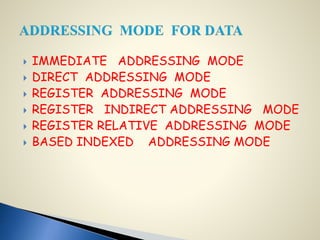
 IMMEDIATE ADDRESSING MODE
 DIRECT ADDRESSING MODE
 REGISTER ADDRESSING MODE
 REGISTER INDIRECT ADDRESSING MODE
 REGISTER RELATIVE ADDRESSING MODE
 BASED INDEXED ADDRESSING MODE
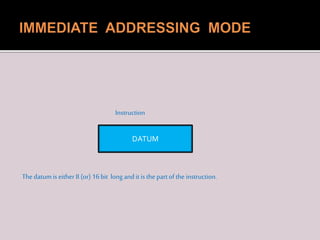
Instruction
Thedatumiseither8 (or) 16bit long andit isthe partofthe instruction.
DATUM
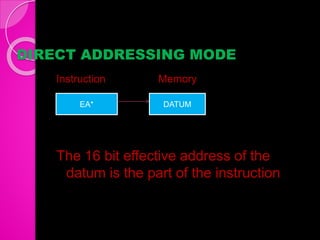
DIRECT ADDRESSING MODE
Instruction Memory
The 16 bit effective address of the
datum is the part of the instruction
EA* DATUM
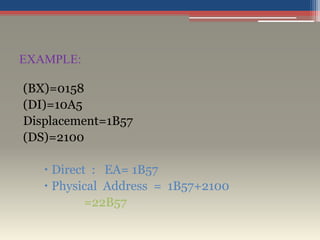
EXAMPLE:
(BX)=0158
(DI)=10A5
Displacement=1B57
(DS)=2100
 Direct : EA= 1B57
 Physical Address = 1B57+2100
=22B57
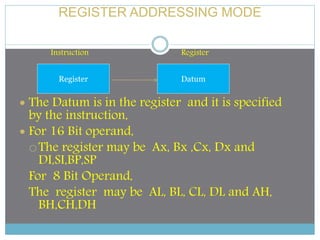
REGISTER ADDRESSING MODE
Instruction Register
 The Datum is in the register and it is specified
by the instruction,
 For 16 Bit operand,
The register may be Ax, Bx ,Cx, Dx and
DI,SI,BP,SP
For 8 Bit Operand,
The register may be AL, BL, CL, DL and AH,
BH,CH,DH
Register Datum
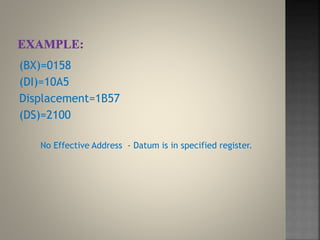
(BX)=0158
(DI)=10A5
Displacement=1B57
(DS)=2100
No Effective Address - Datum is in specified register.
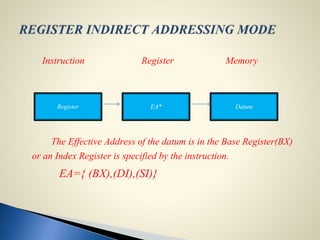
Instruction Register Memory
The Effective Address of the datum is in the Base Register(BX)
or an Index Register is specified by the instruction.
EA={ (BX),(DI),(SI)}
Register EA* Datum
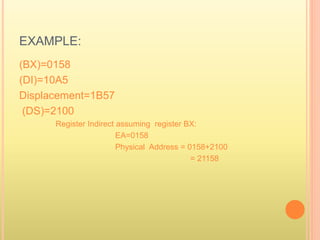
EXAMPLE:
(BX)=0158
(DI)=10A5
Displacement=1B57
(DS)=2100
Register Indirect assuming register BX:
EA=0158
Physical Address = 0158+2100
= 21158
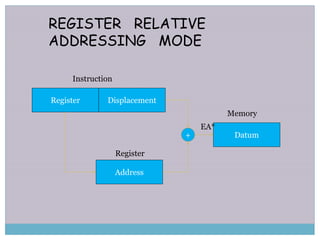
REGISTER RELATIVE
ADDRESSING MODE
Register Displacement
Address
Datum+
Instruction
EA*
Memory
Register
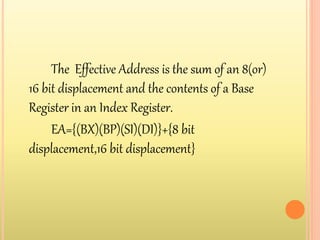
The Effective Address is the sum of an 8(or)
16 bit displacement and the contents of a Base
Register in an Index Register.
EA={(BX)(BP)(SI)(DI)}+{8 bit
displacement,16 bit displacement}
EXAMPLE:
(BX)=0158
(DI)=10A5
Displacement=1B57
(DS)=2100
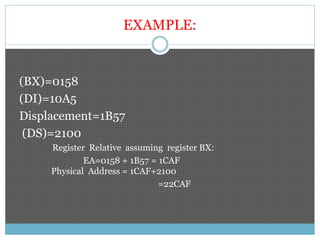
Register Relative assuming register BX:
EA=0158 + 1B57 = 1CAF
Physical Address = 1CAF+2100
=22CAF
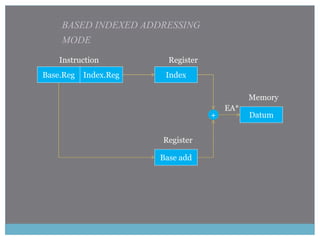
BASED INDEXED ADDRESSING
MODE
Base.Reg Index.Reg
Base add
Index
Datum+
Instruction Register
Register
Memory
EA*
The EA is the sum of the Base Register and
an Index Register, which is specified by an
instruction.
EA={[(BX)+(BP)]+[(SI)+(DI)]}
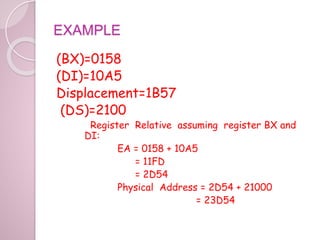
EXAMPLE
(BX)=0158
(DI)=10A5
Displacement=1B57
(DS)=2100
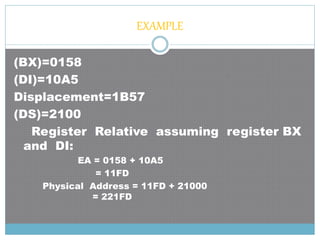
Register Relative assuming register BX
and DI:
EA = 0158 + 10A5
= 11FD
Physical Address = 11FD + 21000
= 221FD
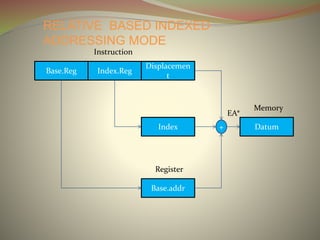
RELATIVE BASED INDEXED
ADDRESSING MODE
Base.Reg Index.Reg
Displacemen
t
Index
Base.addr
Datum+
Instruction
Register
EA*
Memory
• The EA is the sum of an 8 (or) 16 bit displacement and a
Based Indexed Address.
 EA = {[(BX)+(BP)]+[(SI)+(DI)]} + { 8 Bit
displacement,16 Bit displacement}
EXAMPLE
(BX)=0158
(DI)=10A5
Displacement=1B57
(DS)=2100
Register Relative assuming register BX and
DI:
EA = 0158 + 10A5
= 11FD
= 2D54
Physical Address = 2D54 + 21000
= 23D54
THEADDRESSINGMODESFORBRANCHADDRESS
This Addressing Modes for Branch Address can be given in the
following ways
 INTRASEGMENT DIRECT ADDRESSING MODE
 INTRASEGMENT INDIRECT ADDRESSING MODE
 INTERSEGMENT DIRECT ADDRESSING MODE
 INTERSEGMENT INDIRECT ADDRESSING MODE
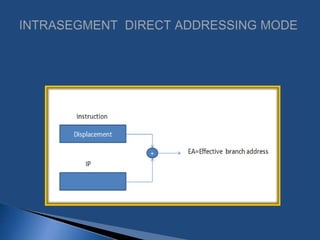
The Effective Address is the
sum of 8 (or) 16 Bit
displacement and the current
contents of IP.
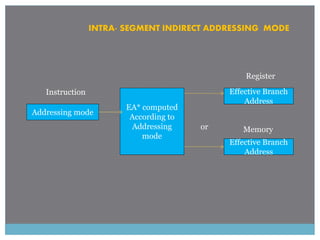
INTRA- SEGMENT INDIRECT ADDRESSING MODE
Addressing mode
EA* computed
According to
Addressing
mode
Effective Branch
Address
Effective Branch
Address
or
Register
Memory
Instruction
 The Effective Base Address is the contents of the
register and it is accessed using the Data –related
Addressing Mode.
 The contents of IP is replaced by the Effective
Addressing Mode.
INTER-SEGMENT DIRECT
ADDRESSING MODE
Offset Segment
Instruction CS
IP
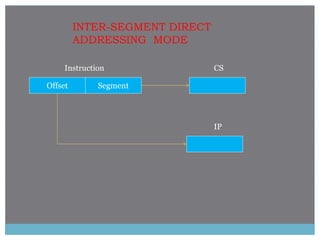
• It replaces the contents of IP with the
contents of CS
• The purpose Addressing Mode is to provide a
Branching from one segment to another
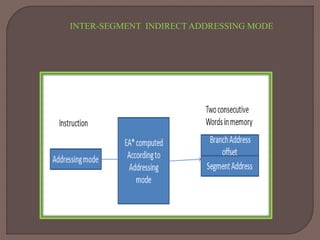
INTER-SEGMENT INDIRECT ADDRESSING MODE
It replaces the contents of IP and CS
with the contents of two
consecutive words in the memory.
THANKYOU!!!

Addressingmodes