NAME-GOURAV SINGH
DEPARTMENT OF PHARMACOLOGY
1
Drug Interaction
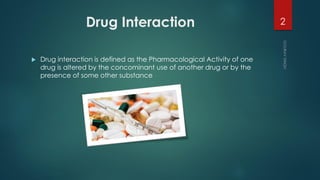
 Drug interaction is defined as the Pharmacological Activity of one
drug is altered by the concominant use of another drug or by the
presence of some other substance
2
Types of Drug Interaction
1) Drug- Drug Interaction
2) Drug-Food Interaction
3) Chemical-Drug Interaction
4) Drug-Laboratory Test Interaction
5) Drug-Disease Interaction
3
Factor Contributing to Drug
Interaction
1) Multiple drug therapy
2) Multiple Prescribers
3) Multiple pharmacological of drug
4) Multiple disease/predispasing illness
5) Poor patient Compliance
6) Advancing age of patient
7) Drug related factors
4
Mechanism of Drug Interaction
 The three mechanism by which an interaction can develop are;
1) Pharmaceutical Interaction
2) Pharmacokinetics Interaction
3) Pharmacodynamics Interactions
5
1. Pharmaceutical Interaction
 Pharmaceutical Interaction also called as incompatibility.
 It is a physicochemical interaction that occur when drugs are mixed
in IV (Intravenous).
 Infusion causing precipitation or inactivation of actives principles.
 Examples- Ampicillin, chlorpromazine and Barbiturates interact with
dextran in solution and are broken down or from chemical
compounds.
6
2. Pharmacokinetics Interaction
 These interaction are those in which ADME properties of the object
drug is altered by the precipitant and hence such interaction are
also called as ADME interaction.
 The resultant effect is altered plasma concentration of the object
drugs.
 These are classified as:-
1. Absorption Interaction
2. Distribution Interaction
3. Metabolism Interaction
4. Excretion Interaction
7
a. Absorption Interaction
 Absorption Interaction are those where the absorption of the object
drug is altered.
 The net effect of such an interaction is-
i. Faster or Slower drug absorption
ii. More or Less complete drug absorption
1.Complexation and absorption 4.Malabsorption syndrome
2.Alteration in GIT pH 5.Alteration in Gut motility
3.Inhibition of GIT Enzymes 6.Alteration & inhibition in
microflora
Major mechanism of absorption interaction are:-
8
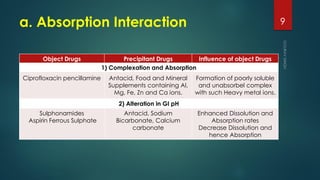
a. Absorption Interaction
Object Drugs Precipitant Drugs Influence of object Drugs
Ciprofloxacin pencillamine Antacid, Food and Mineral
Supplements containing Al,
Mg, Fe, Zn and Ca ions.
Formation of poorly soluble
and unabsorbel complex
with such Heavy metal ions.
Sulphonamides
Aspirin Ferrous Sulphate
Antacid, Sodium
Bicarbonate, Calcium
carbonate
Enhanced Dissolution and
Absorption rates
Decrease Dissolution and
hence Absorption
1) Complexation and Absorption
2) Alteration in GI pH
9
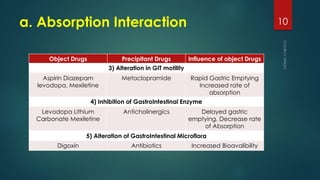
a. Absorption Interaction
Object Drugs Precipitant Drugs Influence of object Drugs
Aspirin Diazepam
levodopa, Mexiletine
Metaclopramide Rapid Gastric Emptying
Increased rate of
absorption
Levodopa Lithium
Carbonate Mexiletine
Anticholinergics Delayed gastric
emptying, Decrease rate
of Absorption
Digoxin Antibiotics Increased Bioavalibility
3) Alteration in GIT motility
4) Inhibition of GastroIntestinal Enzyme
5) Alteration of GastroIntestinal Microflora
10
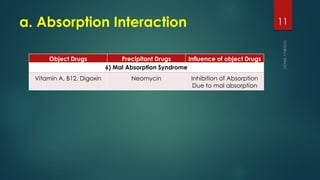
a. Absorption Interaction
Object Drugs Precipitant Drugs Influence of object Drugs
Vitamin A, B12, Digoxin Neomycin Inhibition of Absorption
Due to mal absorption
6) Mal Absorption Syndrome
11
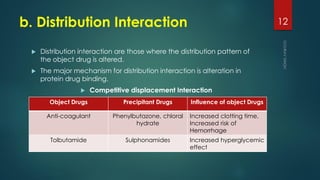
b. Distribution Interaction
 Distribution interaction are those where the distribution pattern of
the object drug is altered.
 The major mechanism for distribution interaction is alteration in
protein drug binding.
 Competitive displacement Interaction
Object Drugs Precipitant Drugs Influence of object Drugs
Anti-coagulant Phenylbutazone, chloral
hydrate
Increased clotting time,
Increased risk of
Hemorrhage
Tolbutamide Sulphonamides Increased hyperglycemic
effect
12
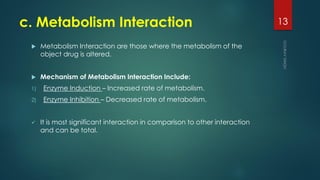
c. Metabolism Interaction
 Metabolism Interaction are those where the metabolism of the
object drug is altered.
 Mechanism of Metabolism Interaction Include:
1) Enzyme Induction – Increased rate of metabolism.
2) Enzyme Inhibition – Decreased rate of metabolism.
 It is most significant interaction in comparison to other interaction
and can be total.
13
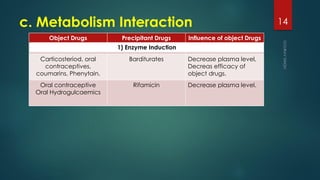
c. Metabolism Interaction
Object Drugs Precipitant Drugs Influence of object Drugs
Carticosteriod, oral
contraceptives,
coumarins, Phenytain.
Barditurates Decrease plasma level,
Decreas efficacy of
object drugs.
Oral contraceptive
Oral Hydrogulcaemics
Rifamicin Decrease plasma level.
1) Enzyme Induction
14
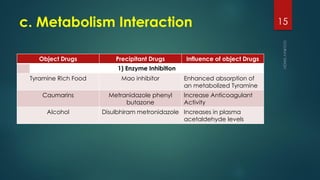
Object Drugs Precipitant Drugs Influence of object Drugs
Tyramine Rich Food Mao inhibitor Enhanced absorption of
an metabolized Tyramine
Caumarins Metranidazole phenyl
butazone
Increase Anticoagulant
Activity
Alcohol Disulbhiram metronidazole Increases in plasma
acetaldehyde levels
c. Metabolism Interaction
1) Enzyme Inhibition
15
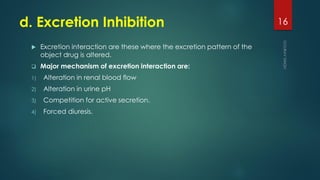
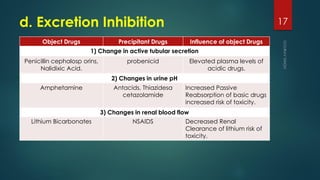
d. Excretion Inhibition
 Excretion interaction are these where the excretion pattern of the
object drug is altered.
 Major mechanism of excretion interaction are:
1) Alteration in renal blood flow
2) Alteration in urine pH
3) Competition for active secretion.
4) Forced diuresis.
16
d. Excretion Inhibition
Object Drugs Precipitant Drugs Influence of object Drugs
Penicillin cephalosp orins,
Nalidixic Acid.
probenicid Elevated plasma levels of
acidic drugs.
Amphetamine Antacids, Thiazidesa
cetazolamide
Increased Passive
Reabsorption of basic drugs
increased risk of toxicity.
Lithium Bicarbonates NSAIDS Decreased Renal
Clearance of lithium risk of
toxicity.
1) Change in active tubular secretion
2) Changes in urine pH
3) Changes in renal blood flow
17
3. Pharmacodynamics Interaction
 Pharmacodynamics Interaction are those in which the activity of
the object drug at its site of action is altered by the precipitant.
 Such interaction may be direct or indirect.
 These are of two types:-
1) Direct pharmacodynamics Interactions
2) Indirect pharmacodynamics Interactions
18
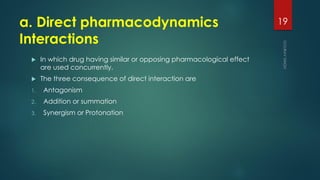
a. Direct pharmacodynamics
Interactions
 In which drug having similar or opposing pharmacological effect
are used concurrently.
 The three consequence of direct interaction are
1. Antagonism
2. Addition or summation
3. Synergism or Protonation
19
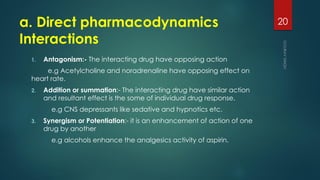
a. Direct pharmacodynamics
Interactions
1. Antagonism:- The interacting drug have opposing action
e.g Acetylcholine and noradrenaline have opposing effect on
heart rate.
2. Addition or summation:- The interacting drug have similar action
and resultant effect is the some of individual drug response.
e.g CNS depressants like sedative and hypnotics etc.
3. Synergism or Potentiation:- it is an enhancement of action of one
drug by another
e.g alcohols enhance the analgesics activity of aspirin.
20
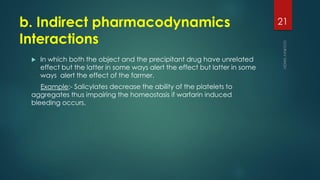
 In which both the object and the precipitant drug have unrelated
effect but the latter in some ways alert the effect but latter in some
ways alert the effect of the farmer.
Example:- Salicylates decrease the ability of the platelets to
aggregates thus impairing the homeostasis if warfarin induced
bleeding occurs.
b. Indirect pharmacodynamics
Interactions
21
22

Drug Interaction

  • 1.
  • 2.
    Drug Interaction  Druginteraction is defined as the Pharmacological Activity of one drug is altered by the concominant use of another drug or by the presence of some other substance 2
  • 3.
    Types of DrugInteraction 1) Drug- Drug Interaction 2) Drug-Food Interaction 3) Chemical-Drug Interaction 4) Drug-Laboratory Test Interaction 5) Drug-Disease Interaction 3
  • 4.
    Factor Contributing toDrug Interaction 1) Multiple drug therapy 2) Multiple Prescribers 3) Multiple pharmacological of drug 4) Multiple disease/predispasing illness 5) Poor patient Compliance 6) Advancing age of patient 7) Drug related factors 4
  • 5.
    Mechanism of DrugInteraction  The three mechanism by which an interaction can develop are; 1) Pharmaceutical Interaction 2) Pharmacokinetics Interaction 3) Pharmacodynamics Interactions 5
  • 6.
    1. Pharmaceutical Interaction Pharmaceutical Interaction also called as incompatibility.  It is a physicochemical interaction that occur when drugs are mixed in IV (Intravenous).  Infusion causing precipitation or inactivation of actives principles.  Examples- Ampicillin, chlorpromazine and Barbiturates interact with dextran in solution and are broken down or from chemical compounds. 6
  • 7.
    2. Pharmacokinetics Interaction These interaction are those in which ADME properties of the object drug is altered by the precipitant and hence such interaction are also called as ADME interaction.  The resultant effect is altered plasma concentration of the object drugs.  These are classified as:- 1. Absorption Interaction 2. Distribution Interaction 3. Metabolism Interaction 4. Excretion Interaction 7
  • 8.
    a. Absorption Interaction Absorption Interaction are those where the absorption of the object drug is altered.  The net effect of such an interaction is- i. Faster or Slower drug absorption ii. More or Less complete drug absorption 1.Complexation and absorption 4.Malabsorption syndrome 2.Alteration in GIT pH 5.Alteration in Gut motility 3.Inhibition of GIT Enzymes 6.Alteration & inhibition in microflora Major mechanism of absorption interaction are:- 8
  • 9.
    a. Absorption Interaction ObjectDrugs Precipitant Drugs Influence of object Drugs Ciprofloxacin pencillamine Antacid, Food and Mineral Supplements containing Al, Mg, Fe, Zn and Ca ions. Formation of poorly soluble and unabsorbel complex with such Heavy metal ions. Sulphonamides Aspirin Ferrous Sulphate Antacid, Sodium Bicarbonate, Calcium carbonate Enhanced Dissolution and Absorption rates Decrease Dissolution and hence Absorption 1) Complexation and Absorption 2) Alteration in GI pH 9
  • 10.
    a. Absorption Interaction ObjectDrugs Precipitant Drugs Influence of object Drugs Aspirin Diazepam levodopa, Mexiletine Metaclopramide Rapid Gastric Emptying Increased rate of absorption Levodopa Lithium Carbonate Mexiletine Anticholinergics Delayed gastric emptying, Decrease rate of Absorption Digoxin Antibiotics Increased Bioavalibility 3) Alteration in GIT motility 4) Inhibition of GastroIntestinal Enzyme 5) Alteration of GastroIntestinal Microflora 10
  • 11.
    a. Absorption Interaction ObjectDrugs Precipitant Drugs Influence of object Drugs Vitamin A, B12, Digoxin Neomycin Inhibition of Absorption Due to mal absorption 6) Mal Absorption Syndrome 11
  • 12.
    b. Distribution Interaction Distribution interaction are those where the distribution pattern of the object drug is altered.  The major mechanism for distribution interaction is alteration in protein drug binding.  Competitive displacement Interaction Object Drugs Precipitant Drugs Influence of object Drugs Anti-coagulant Phenylbutazone, chloral hydrate Increased clotting time, Increased risk of Hemorrhage Tolbutamide Sulphonamides Increased hyperglycemic effect 12
  • 13.
    c. Metabolism Interaction Metabolism Interaction are those where the metabolism of the object drug is altered.  Mechanism of Metabolism Interaction Include: 1) Enzyme Induction – Increased rate of metabolism. 2) Enzyme Inhibition – Decreased rate of metabolism.  It is most significant interaction in comparison to other interaction and can be total. 13
  • 14.
    c. Metabolism Interaction ObjectDrugs Precipitant Drugs Influence of object Drugs Carticosteriod, oral contraceptives, coumarins, Phenytain. Barditurates Decrease plasma level, Decreas efficacy of object drugs. Oral contraceptive Oral Hydrogulcaemics Rifamicin Decrease plasma level. 1) Enzyme Induction 14
  • 15.
    Object Drugs PrecipitantDrugs Influence of object Drugs Tyramine Rich Food Mao inhibitor Enhanced absorption of an metabolized Tyramine Caumarins Metranidazole phenyl butazone Increase Anticoagulant Activity Alcohol Disulbhiram metronidazole Increases in plasma acetaldehyde levels c. Metabolism Interaction 1) Enzyme Inhibition 15
  • 16.
    d. Excretion Inhibition Excretion interaction are these where the excretion pattern of the object drug is altered.  Major mechanism of excretion interaction are: 1) Alteration in renal blood flow 2) Alteration in urine pH 3) Competition for active secretion. 4) Forced diuresis. 16
  • 17.
    d. Excretion Inhibition ObjectDrugs Precipitant Drugs Influence of object Drugs Penicillin cephalosp orins, Nalidixic Acid. probenicid Elevated plasma levels of acidic drugs. Amphetamine Antacids, Thiazidesa cetazolamide Increased Passive Reabsorption of basic drugs increased risk of toxicity. Lithium Bicarbonates NSAIDS Decreased Renal Clearance of lithium risk of toxicity. 1) Change in active tubular secretion 2) Changes in urine pH 3) Changes in renal blood flow 17
  • 18.
    3. Pharmacodynamics Interaction Pharmacodynamics Interaction are those in which the activity of the object drug at its site of action is altered by the precipitant.  Such interaction may be direct or indirect.  These are of two types:- 1) Direct pharmacodynamics Interactions 2) Indirect pharmacodynamics Interactions 18
  • 19.
    a. Direct pharmacodynamics Interactions In which drug having similar or opposing pharmacological effect are used concurrently.  The three consequence of direct interaction are 1. Antagonism 2. Addition or summation 3. Synergism or Protonation 19
  • 20.
    a. Direct pharmacodynamics Interactions 1.Antagonism:- The interacting drug have opposing action e.g Acetylcholine and noradrenaline have opposing effect on heart rate. 2. Addition or summation:- The interacting drug have similar action and resultant effect is the some of individual drug response. e.g CNS depressants like sedative and hypnotics etc. 3. Synergism or Potentiation:- it is an enhancement of action of one drug by another e.g alcohols enhance the analgesics activity of aspirin. 20
  • 21.
     In whichboth the object and the precipitant drug have unrelated effect but the latter in some ways alert the effect but latter in some ways alert the effect of the farmer. Example:- Salicylates decrease the ability of the platelets to aggregates thus impairing the homeostasis if warfarin induced bleeding occurs. b. Indirect pharmacodynamics Interactions 21
  • 22.