PRESENTATION
TITLE
Mirjam Nilsson​
DRUG DEVELOPMENT PROCESS
Presented by
P. KRISHNA KEERTHI
Pharm D
INTRODUCTION
Drug development process is defined as a series of well
defined steps, for drugs of new, safe and effective treatment
to increase health and quality of life.
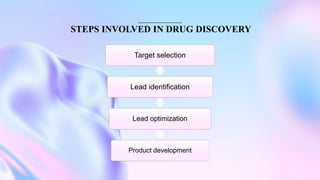
STEPS INVOLVED IN DRUG DISCOVERY
Target selection
Lead identification
Lead optimization
Product development
TARGET SELECTION
❖ Target for therapeutic interventions include: Receptors, Proteins, Enzymes, DNA, RNA,
Ribosomal targets etc.
Before discovery of drug
Disease to be treated needs to be understood, to identify the “underlying cause of the same”
Study of disease mechanism
Helps improper research
Helps to formulate a possible tip to slow/ reverse the disease progress
❖ Methods used for target identification include:
1. Classical methods
2. Newer methods
Classical
methods
Cellular
biology
Molecular
biology
Newer
methods
Genomics
Proteomics
Target validation:
❖ Identified molecule target is involved in disease process.
❖ Binding of drug to the target produces curative effect.
Process involved in validation:
In Vitro phase In Vivo phase
Defines clinical
potential of
target
❖ To determine “ drug ability of target”.
❖ Drug ability of target is defined as the ability of a target to bind to a drug.
LEAD IDENTIFICATION
In lead identification process
Compounds that interact with the target protein is identified
Sources of compounds include: microbes, plants or animals.
1st screening
Identifies hits from compound libraries
Retest is done independently of 1st assay or a different day compound
Exhibits some activity within a statistically significant range
Confirmed hits
Proceeds to dose response screening
LEAD OPTIMIZATION
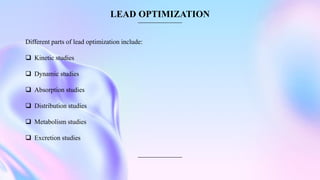
Different parts of lead optimization include:
❑ Kinetic studies
❑ Dynamic studies
❑ Absorption studies
❑ Distribution studies
❑ Metabolism studies
❑ Excretion studies
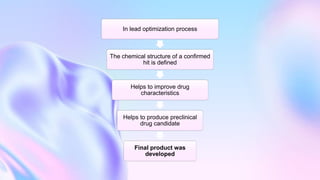
In lead optimization process
The chemical structure of a confirmed
hit is defined
Helps to improve drug
characteristics
Helps to produce preclinical
drug candidate
Final product was
developed
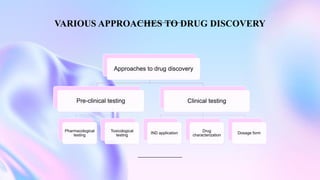
VARIOUS APPROACHES TO DRUG DISCOVERY
Approaches to drug discovery
Pre-clinical testing
Pharmacological
testing
Toxicological
testing
Clinical testing
IND application
Drug
characterization
Dosage form
EVALUATION OF PRE-CLINICAL TESTING
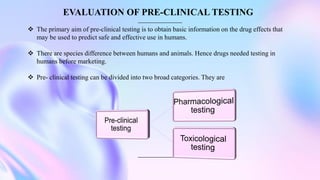
❖ The primary aim of pre-clinical testing is to obtain basic information on the drug effects that
may be used to predict safe and effective use in humans.
❖ There are species difference between humans and animals. Hence drugs needed testing in
humans before marketing.
❖ Pre- clinical testing can be divided into two broad categories. They are
PHARMACOLOGICAL TESTING
❖ These tests are to determine whether the substance has effectiveness and a reasonable safety
profile.
❖ Components of pharmacological testing/ evaluation include:
1. selectivity testing
2. Pharmacological profiling
3. Testing in animal models of disease
4. Safety pharmacology
TOXICOLOGICAL TESTING
❖ Toxicity studies are undertaken to determine the test drugs potential for toxicity with short term,
long term use etc.
❖ All drugs are toxic at some dose i.e. no drug is safe at all doses.
❖ Test drugs are studied at various dose levels to determine effects, potency and toxicity.
❖ Various toxicity studies are recommended by regulatory authorities, as follows:
1. Acute toxicity studies
2. Sub acute toxicity studies
3. Chronic toxicity studies
4. Reproduction studies
5. Carcinogenic studies
6. Geno-toxicity studies
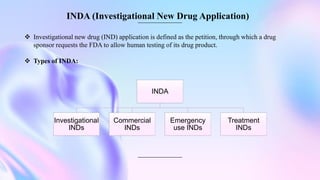
INDA (Investigational New Drug Application)
❖ Investigational new drug (IND) application is defined as the petition, through which a drug
sponsor requests the FDA to allow human testing of its drug product.
❖ Types of INDA:
INDA
Investigational
INDs
Commercial
INDs
Emergency
use INDs
Treatment
INDs
1 5
❖INDA is required to be submitted to drug regulatory authority before
initiation of clinical trial.
❖The INDA can be submitted by the sponsor, but may employ CRO to
conduct the actual studies.
❖IND application provides the FDA with the data necessary to decide
whether the new drug and the proposed clinical trials pose a reasonable
risk to the human subjects participating in the study.
DRUG CHARACTERIZATION
Drug characterization involves finding of biological and physio-chemical properties of potential drug
molecules:
❖ Biological characterization – Interaction of drug molecules with biological systems.
Ex: Receptor binding, Enzyme inhibition
❖ Physio-chemical characterization – Physical and chemical characterization of potential drugs.
Ex: Solubility, NMR, IR, UV – visible, MS, PET.
DOSAGE FORM
❖ It is defined as the dosage form(s) for the delivery of the drug.
❖ Examples:
1. Tablets
2. injections
3. Suppositories
4. Solutions
5. Ointments
6. Aerosols
7. Trans-dermal patches
❖ Therapeutic considerations play an important role in deciding the dosage form to formulate.
THANK YOU

Drug Development Process and various approaches

  • 1.
    PRESENTATION TITLE Mirjam Nilsson​ DRUG DEVELOPMENTPROCESS Presented by P. KRISHNA KEERTHI Pharm D
  • 2.
    INTRODUCTION Drug development processis defined as a series of well defined steps, for drugs of new, safe and effective treatment to increase health and quality of life.
  • 3.
    STEPS INVOLVED INDRUG DISCOVERY Target selection Lead identification Lead optimization Product development
  • 4.
    TARGET SELECTION ❖ Targetfor therapeutic interventions include: Receptors, Proteins, Enzymes, DNA, RNA, Ribosomal targets etc. Before discovery of drug Disease to be treated needs to be understood, to identify the “underlying cause of the same” Study of disease mechanism Helps improper research Helps to formulate a possible tip to slow/ reverse the disease progress
  • 5.
    ❖ Methods usedfor target identification include: 1. Classical methods 2. Newer methods Classical methods Cellular biology Molecular biology Newer methods Genomics Proteomics
  • 6.
    Target validation: ❖ Identifiedmolecule target is involved in disease process. ❖ Binding of drug to the target produces curative effect. Process involved in validation: In Vitro phase In Vivo phase Defines clinical potential of target ❖ To determine “ drug ability of target”. ❖ Drug ability of target is defined as the ability of a target to bind to a drug.
  • 7.
    LEAD IDENTIFICATION In leadidentification process Compounds that interact with the target protein is identified Sources of compounds include: microbes, plants or animals. 1st screening Identifies hits from compound libraries Retest is done independently of 1st assay or a different day compound Exhibits some activity within a statistically significant range Confirmed hits Proceeds to dose response screening
  • 8.
    LEAD OPTIMIZATION Different partsof lead optimization include: ❑ Kinetic studies ❑ Dynamic studies ❑ Absorption studies ❑ Distribution studies ❑ Metabolism studies ❑ Excretion studies
  • 9.
    In lead optimizationprocess The chemical structure of a confirmed hit is defined Helps to improve drug characteristics Helps to produce preclinical drug candidate Final product was developed
  • 10.
    VARIOUS APPROACHES TODRUG DISCOVERY Approaches to drug discovery Pre-clinical testing Pharmacological testing Toxicological testing Clinical testing IND application Drug characterization Dosage form
  • 11.
    EVALUATION OF PRE-CLINICALTESTING ❖ The primary aim of pre-clinical testing is to obtain basic information on the drug effects that may be used to predict safe and effective use in humans. ❖ There are species difference between humans and animals. Hence drugs needed testing in humans before marketing. ❖ Pre- clinical testing can be divided into two broad categories. They are
  • 12.
    PHARMACOLOGICAL TESTING ❖ Thesetests are to determine whether the substance has effectiveness and a reasonable safety profile. ❖ Components of pharmacological testing/ evaluation include: 1. selectivity testing 2. Pharmacological profiling 3. Testing in animal models of disease 4. Safety pharmacology
  • 13.
    TOXICOLOGICAL TESTING ❖ Toxicitystudies are undertaken to determine the test drugs potential for toxicity with short term, long term use etc. ❖ All drugs are toxic at some dose i.e. no drug is safe at all doses. ❖ Test drugs are studied at various dose levels to determine effects, potency and toxicity. ❖ Various toxicity studies are recommended by regulatory authorities, as follows: 1. Acute toxicity studies 2. Sub acute toxicity studies 3. Chronic toxicity studies 4. Reproduction studies 5. Carcinogenic studies 6. Geno-toxicity studies
  • 14.
    INDA (Investigational NewDrug Application) ❖ Investigational new drug (IND) application is defined as the petition, through which a drug sponsor requests the FDA to allow human testing of its drug product. ❖ Types of INDA: INDA Investigational INDs Commercial INDs Emergency use INDs Treatment INDs
  • 15.
    1 5 ❖INDA isrequired to be submitted to drug regulatory authority before initiation of clinical trial. ❖The INDA can be submitted by the sponsor, but may employ CRO to conduct the actual studies. ❖IND application provides the FDA with the data necessary to decide whether the new drug and the proposed clinical trials pose a reasonable risk to the human subjects participating in the study.
  • 16.
    DRUG CHARACTERIZATION Drug characterizationinvolves finding of biological and physio-chemical properties of potential drug molecules: ❖ Biological characterization – Interaction of drug molecules with biological systems. Ex: Receptor binding, Enzyme inhibition ❖ Physio-chemical characterization – Physical and chemical characterization of potential drugs. Ex: Solubility, NMR, IR, UV – visible, MS, PET.
  • 17.
    DOSAGE FORM ❖ Itis defined as the dosage form(s) for the delivery of the drug. ❖ Examples: 1. Tablets 2. injections 3. Suppositories 4. Solutions 5. Ointments 6. Aerosols 7. Trans-dermal patches ❖ Therapeutic considerations play an important role in deciding the dosage form to formulate.
  • 18.