PELEDAKAN TAMBANG TERBUKA Disajikan dalam : RAKER INTERNAL PT. BUMA  (11 - 12 Oktober 2004) oleh : DEDY IRAWAN DIVISI TAMBANG UMUM PT. DAHANA (PERSERO) S A M A R I N D A KALIMANTAN TIMUR  2 0 0 4
MATERI  PEMBORAN DAN PELEDAKAN TEKNIK PELEDAKAN TEKNIK PEMBORAN EKONOMI PELEDAKAN DAMPAK PELEDAKAN SAFE BLASTING
TEKNIK PELEDAKAN
MAJOR FACTORS INFLUENCING BLAST EFFICIENCY    ATTITUDE    COMMUNICATION    BLAST DESIGN    GEOLOGICAL EFFECTS
ATTITUDE    PAYING ATTENTION TO DETAILS    EACH OPERATION MUST BE COMPLETED AS PRECISELY AS POSSIBLE    TOTAL QUALITY MANAGEMENT (T.Q.M)    GROUP EFFORT
COMMUNICATION  ) SAFE BLASTING PRACTICES REQUIRE GOOD COMMUNICATION.  ) COMMUNICATION BETWEEN MEMBERS OF SAME GROUP AND BETWEEN GROUPS.  ) OPTIMUM BLAST DESIGNS DEPEND ON INPUT FROM EACH GROUP.
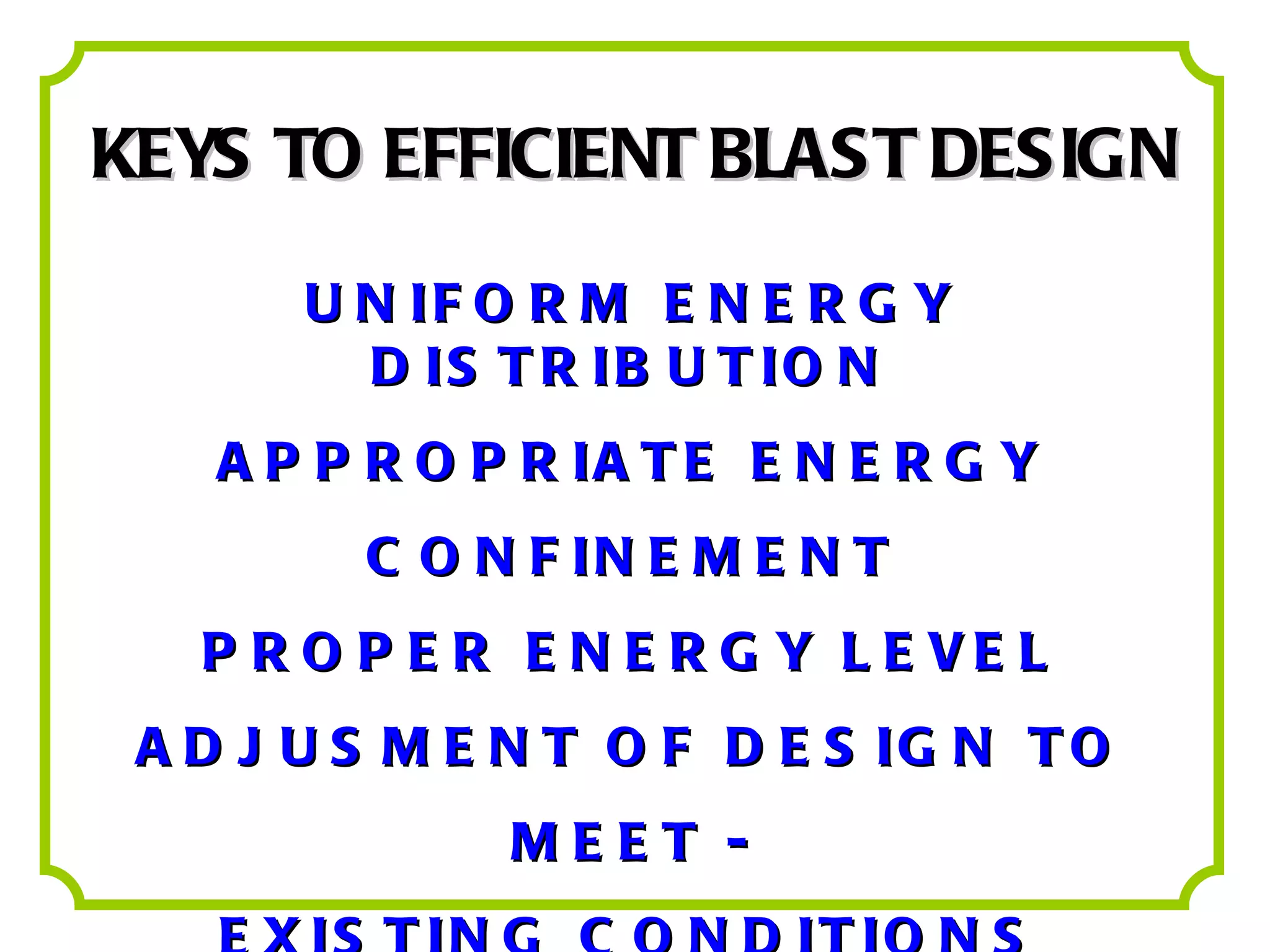
KEYS TO EFFICIENT BLAST DESIGN UNIFORM ENERGY DISTRIBUTION APPROPRIATE ENERGY CONFINEMENT PROPER ENERGY LEVEL ADJUSMENT OF DESIGN TO MEET - EXISTING CONDITIONS
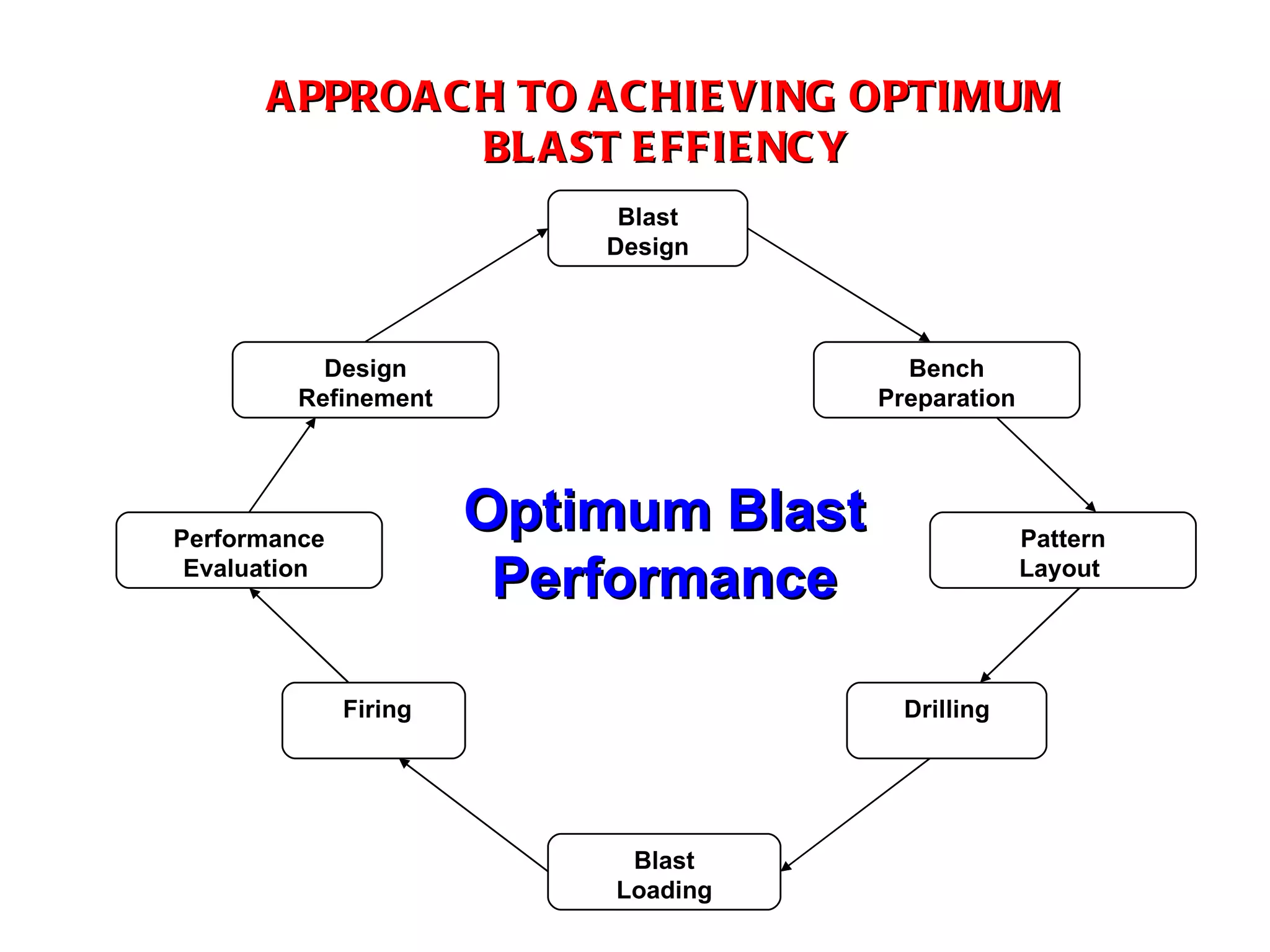
APPROACH TO ACHIEVING OPTIMUM BLAST EFFIENCY Blast Design Design Refinement Bench Preparation Performance Evaluation  Pattern Layout    Firing Drilling Blast Loading Optimum Blast Performance
 
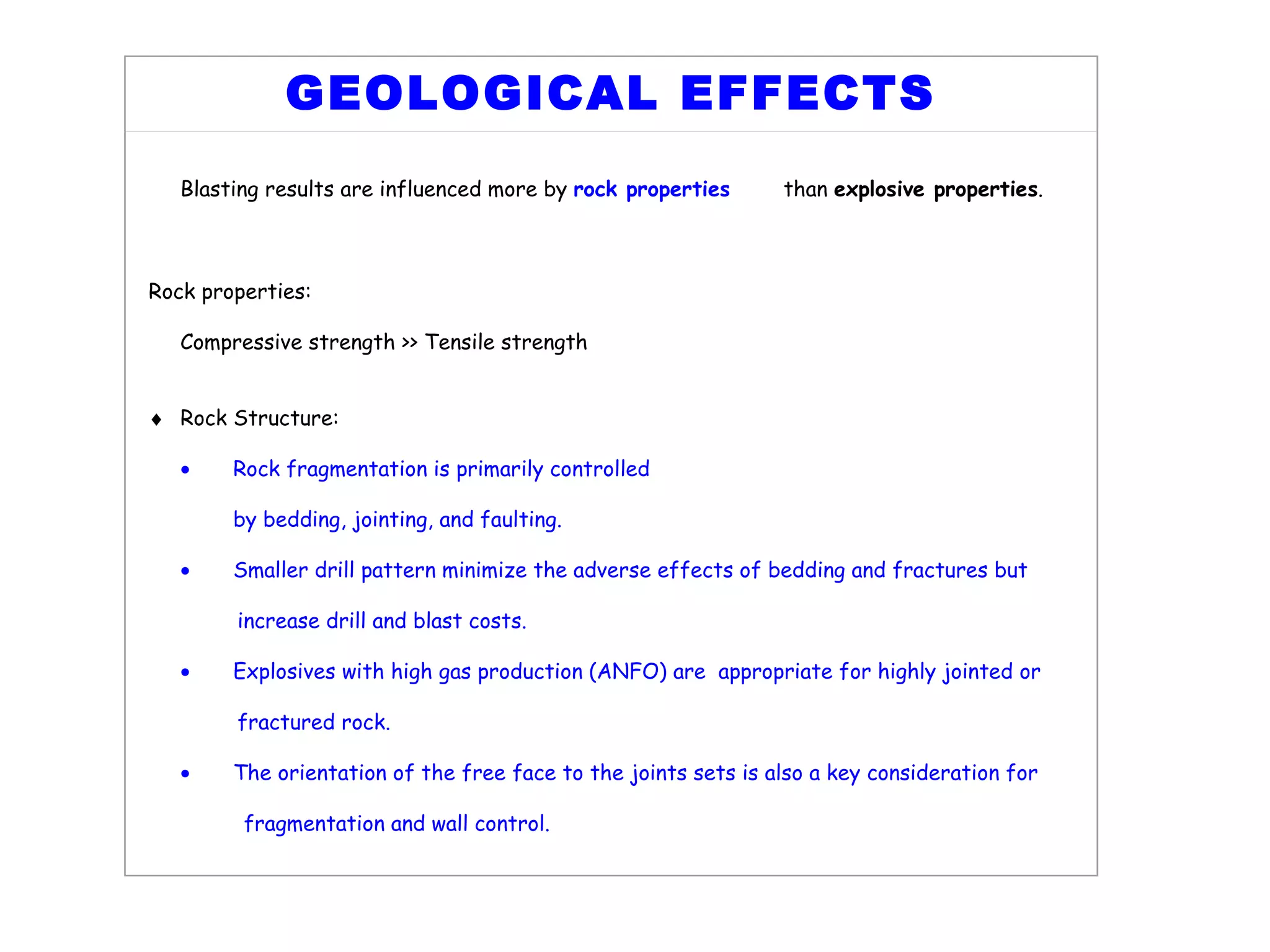
GEOLOGICAL EFFECTS   Blasting results are influenced more by  rock properties   than  explosive properties . Rock properties: Compressive strength >> Tensile strength    Rock Structure:  Rock fragmentation is primarily controlled by bedding, jointing, and faulting.  Smaller drill pattern minimize the adverse effects of bedding and fractures but increase drill and blast costs.  Explosives with high gas production (ANFO) are  appropriate for highly jointed  or fractured rock.  The orientation of the free face to the joints sets is also a key consideration  for fragmentation and wall control.  
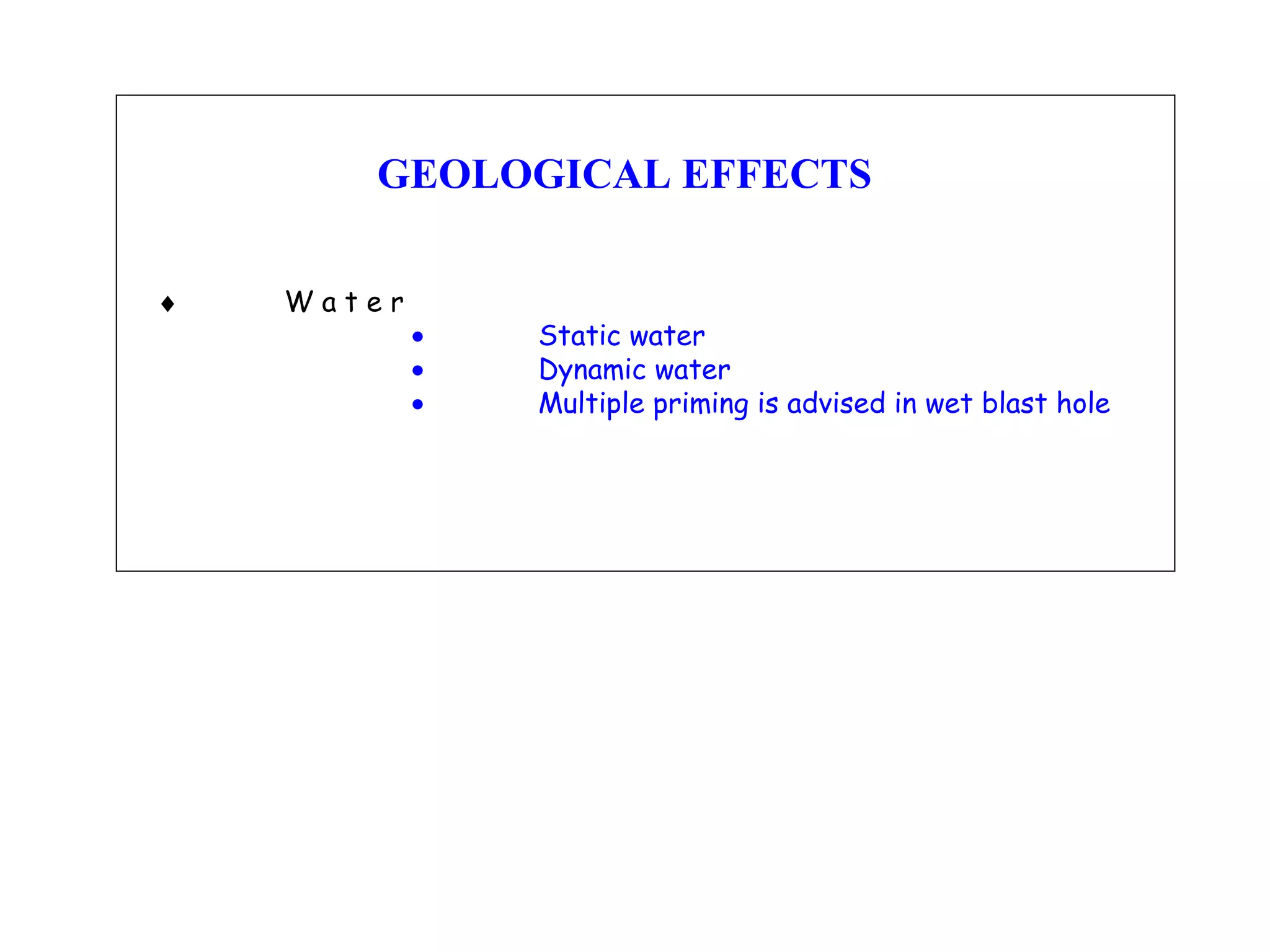
 W a t e r  Static water  Dynamic water  Multiple priming is advised in wet blast hole GEOLOGICAL EFFECTS
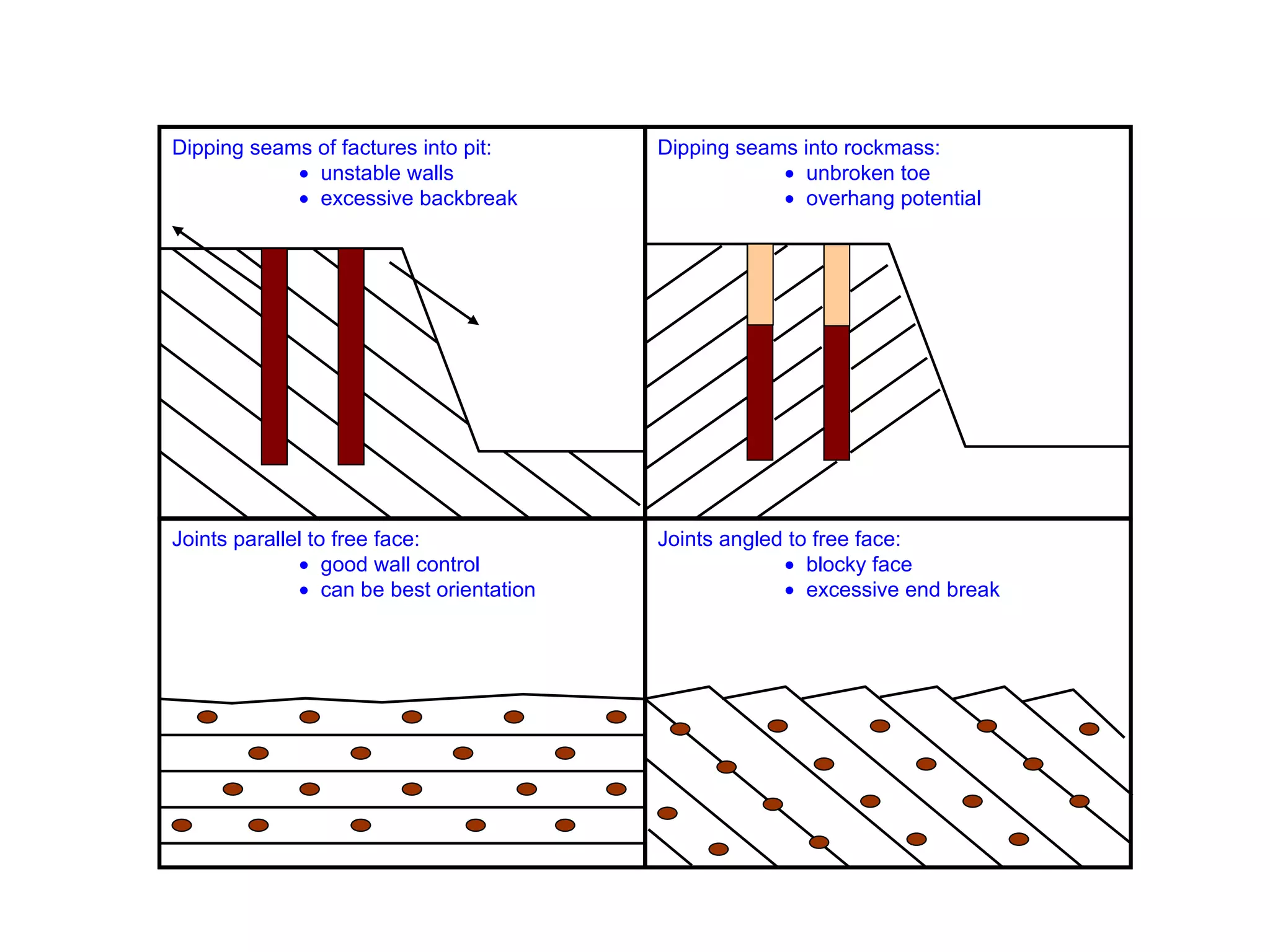
Dipping seams of factures into pit:    unstable walls    excessive backbreak Dipping seams into rockmass:    unbroken toe    overhang potential Joints parallel to free face:    good wall control    can be best orientation Joints angled to free face:    blocky face    excessive end break
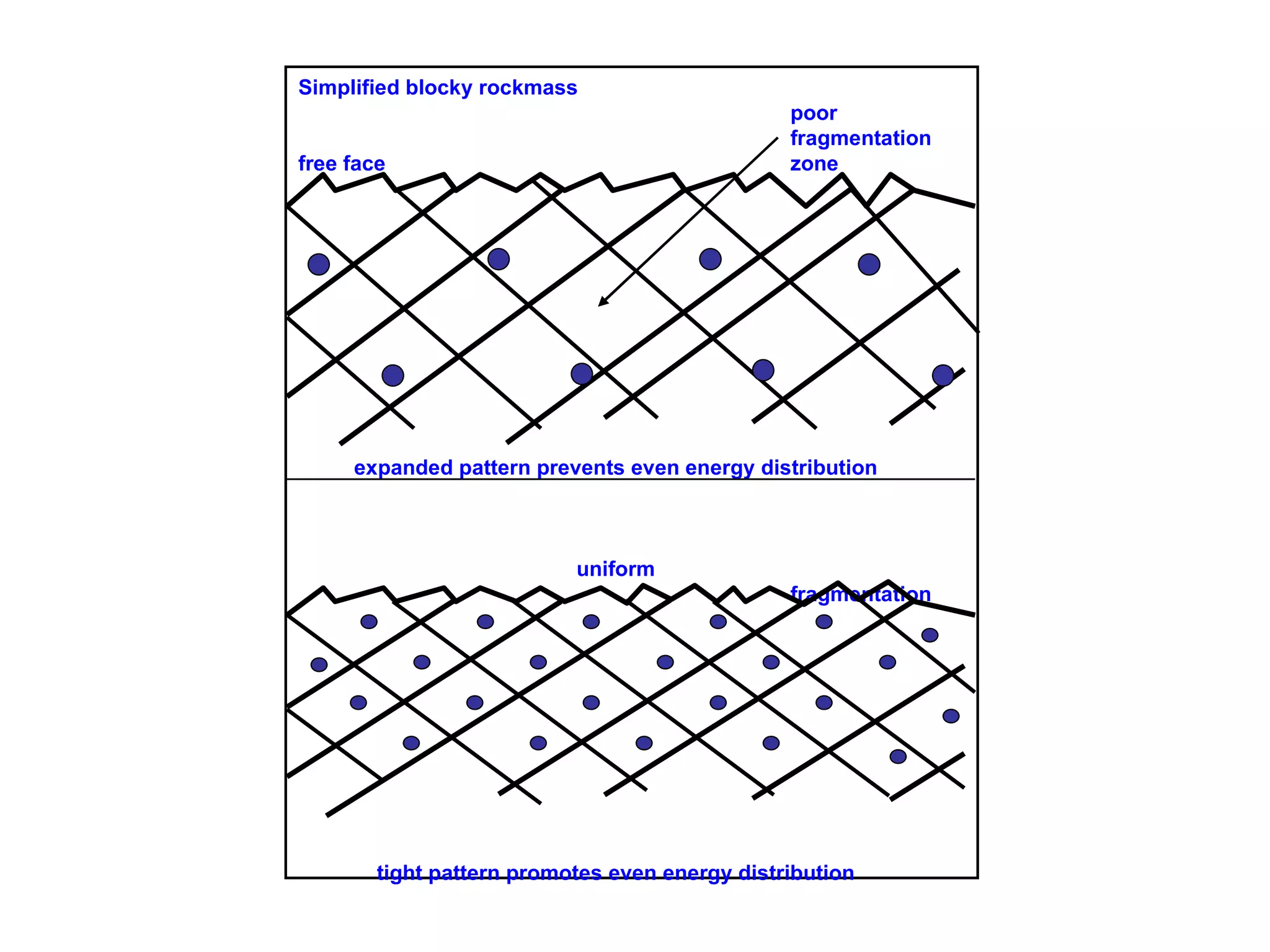
Simplified blocky rockmass   poor fragmentation f ree  face zone                     expanded pattern prevents even energy distribution     uniform fragmentation                    tight pattern promotes even energy distribution
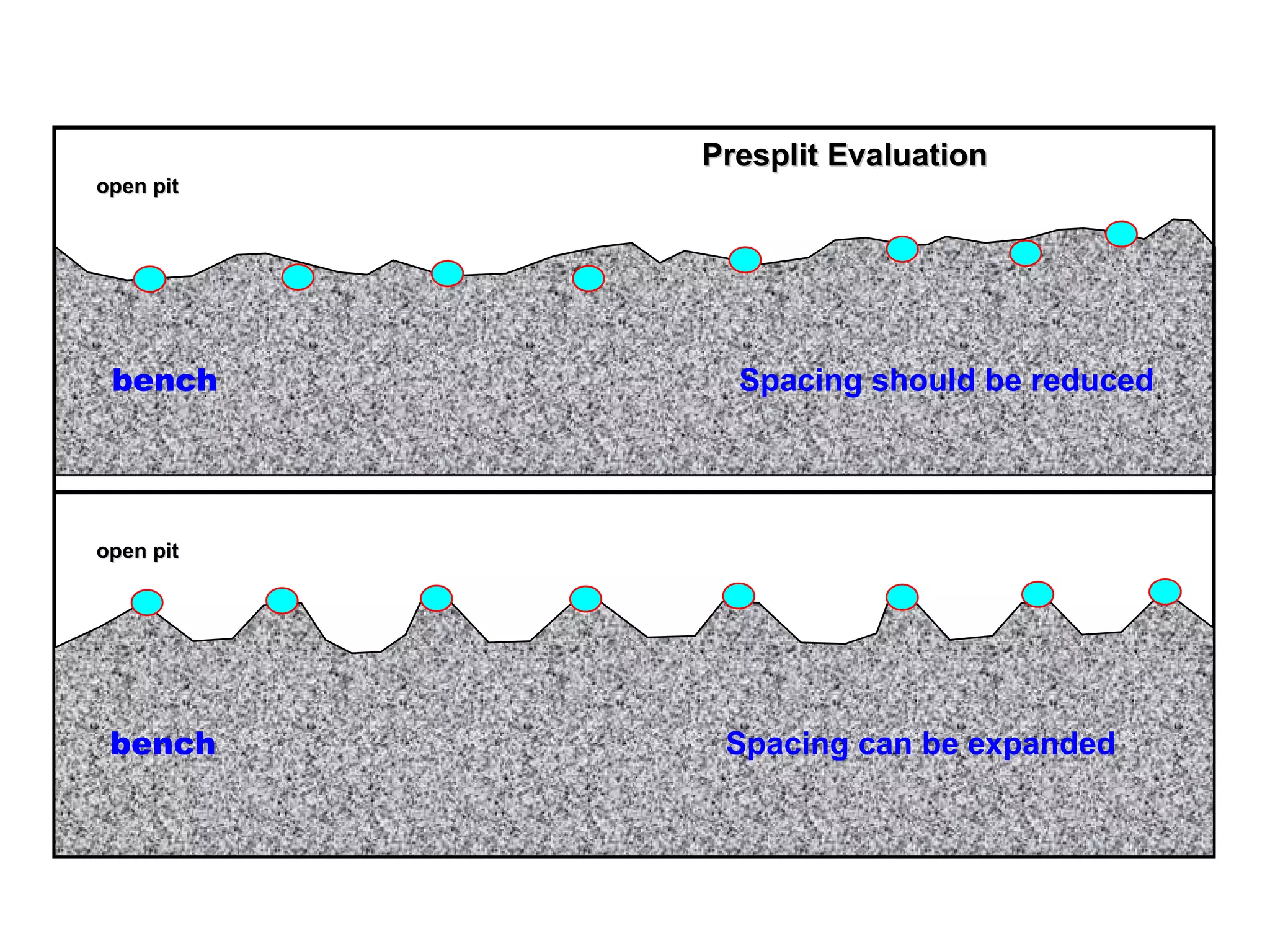
bench Spacing should be reduced Presplit Evaluation open pit open pit bench Spacing can be expanded
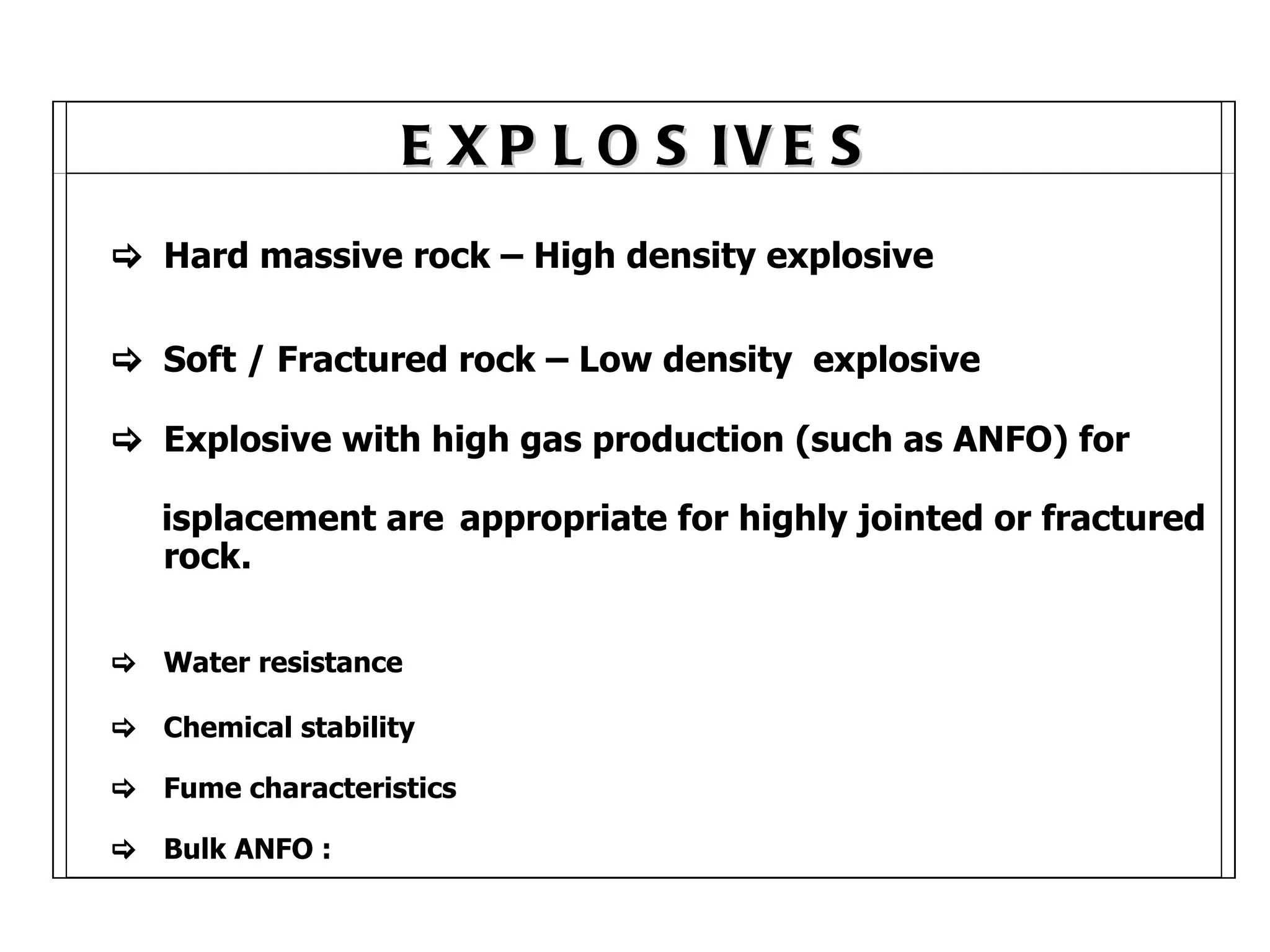
EXPLOSIVES      Hard massive rock – High density explosive    Soft / Fractured rock – Low density  explosive    Explosive with high gas production (such as ANFO) for   D  isplacement are  appropriate for highly jointed or   fractured  rock.    Water resistance    Chemical stability    Fume characteristics    Bulk ANFO :
Zero Oxygen Balance = 94.3% AN + 5.7% FO    Over fuel mix, example: 92% AN + 8% FO    Prod. 6% less energy CO    Under fuel mix, example: 96% AN + 4% FO   Prod. 18% less energy  N O2   Increase sensitivity    It’s generally better to over fuel ANFO rather than under fuel     it.   P r i m e r s :    Primer diameter should closely match hole dia.    Two primers are recommended for blasthole over 15 meters    deep   [ANFO] & 10 meters deep [Emulsion Blend].    
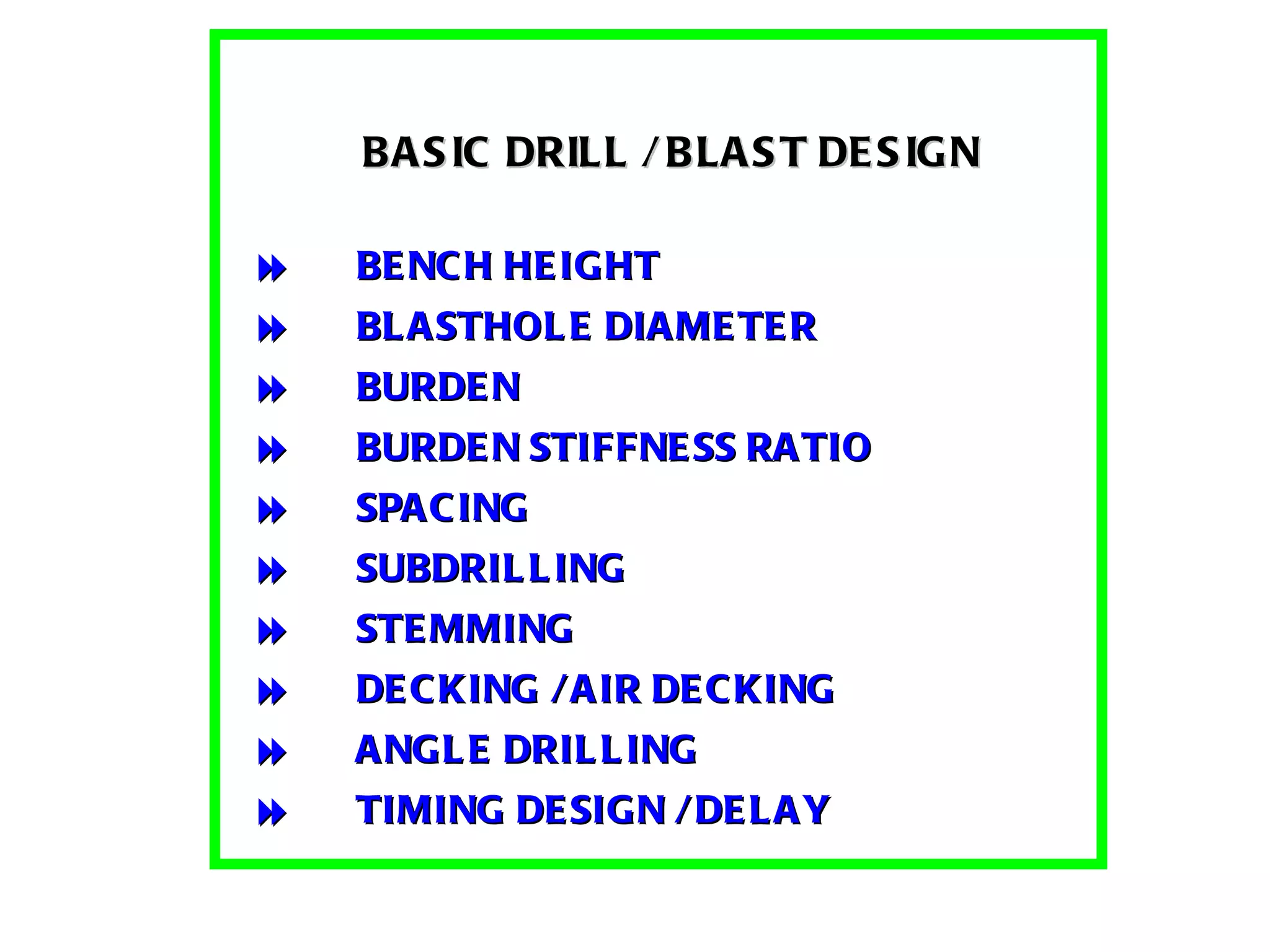
    BASIC DRILL / BLAST DESIGN      BENCH HEIGHT  BLASTHOLE DIAMETER  BURDEN  BURDEN STIFFNESS RATIO  SPACING  SUBDRILLING  STEMMING  DECKING / AIR DECKING  ANGLE DRILLING  TIMING DESIGN / DELAY      
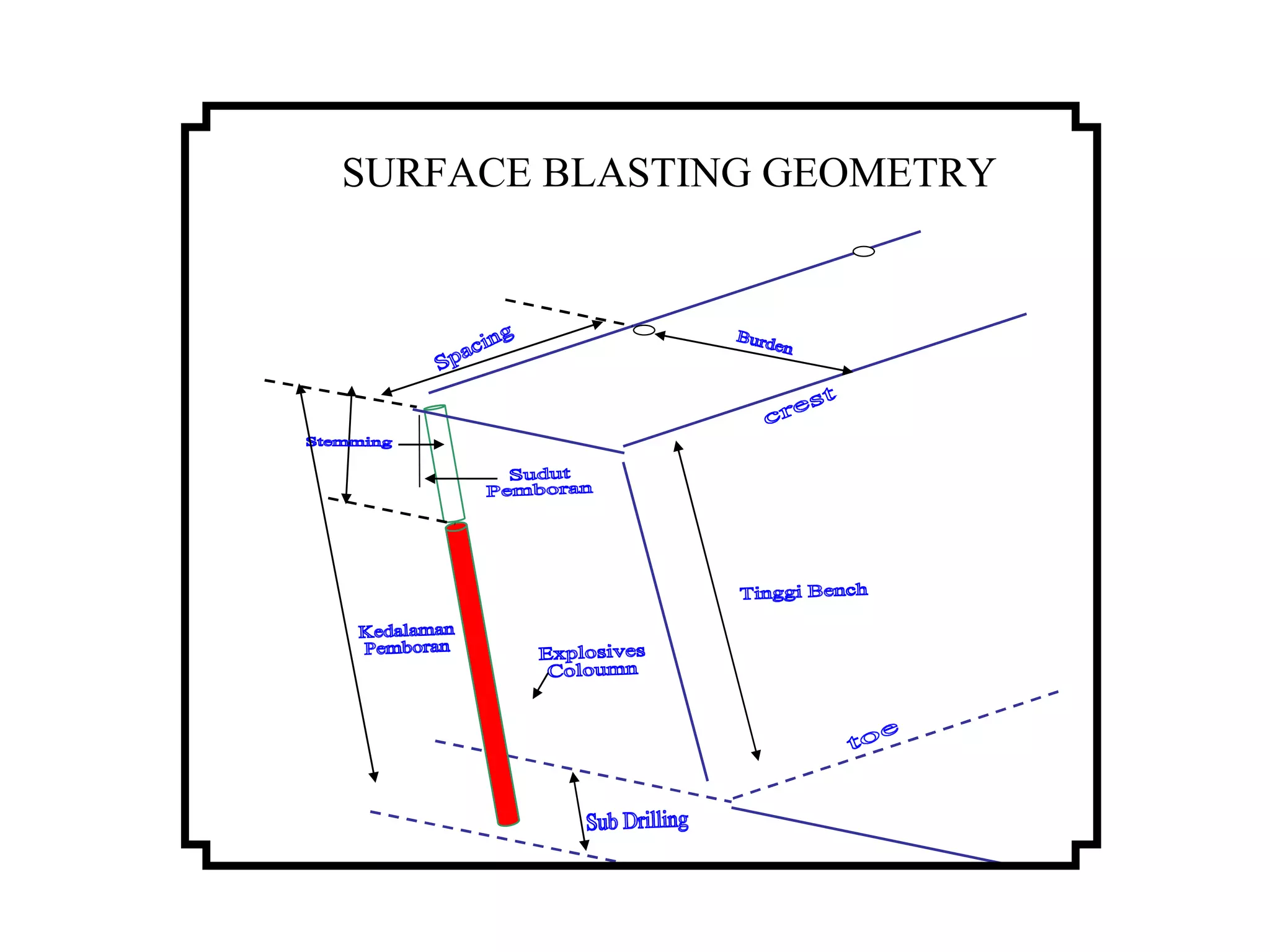
Spacing Burden crest toe Explosives Coloumn Sudut Pemboran Sub Drilling Stemming Kedalaman Pemboran Tinggi Bench SURFACE BLASTING GEOMETRY
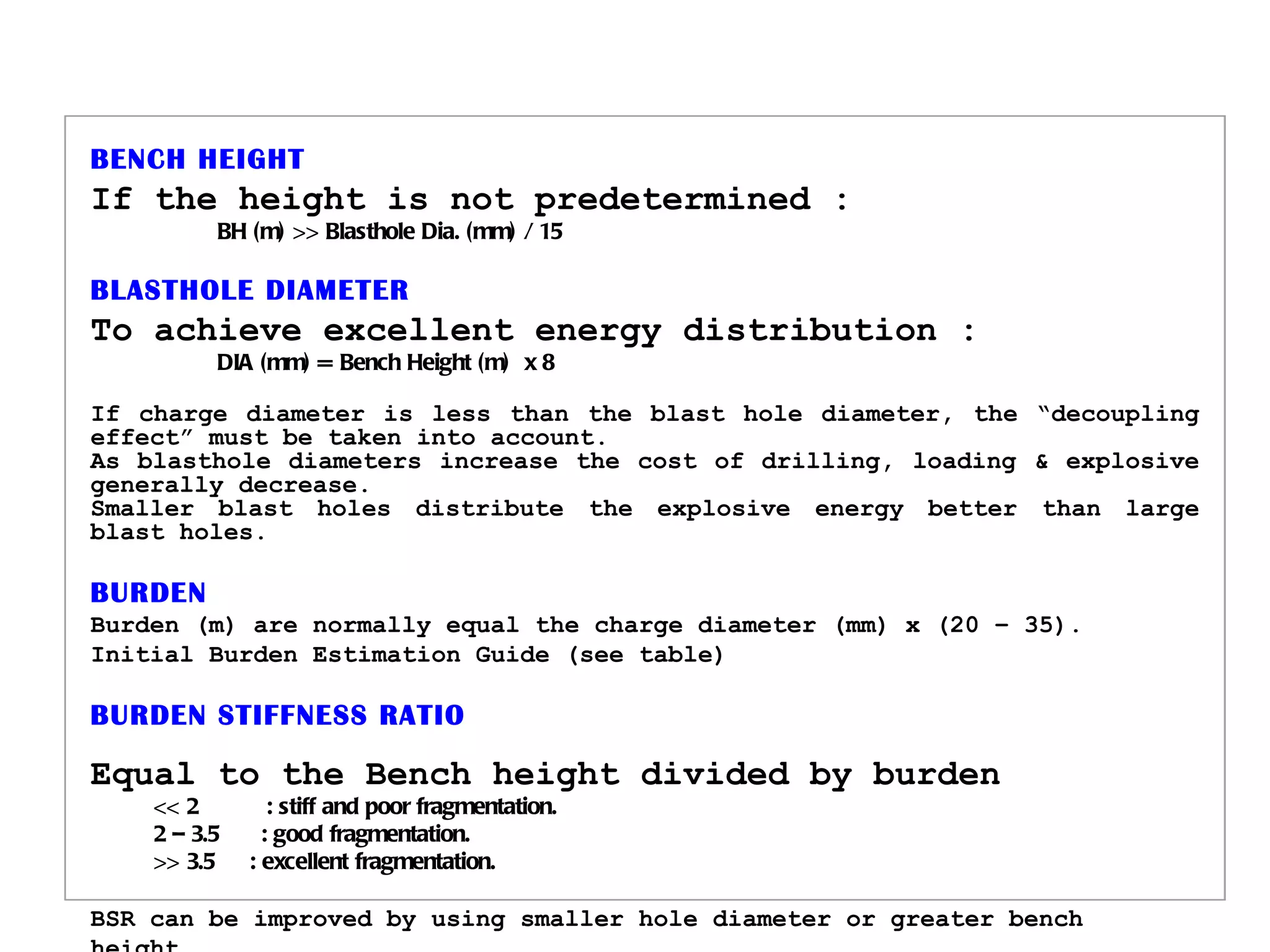
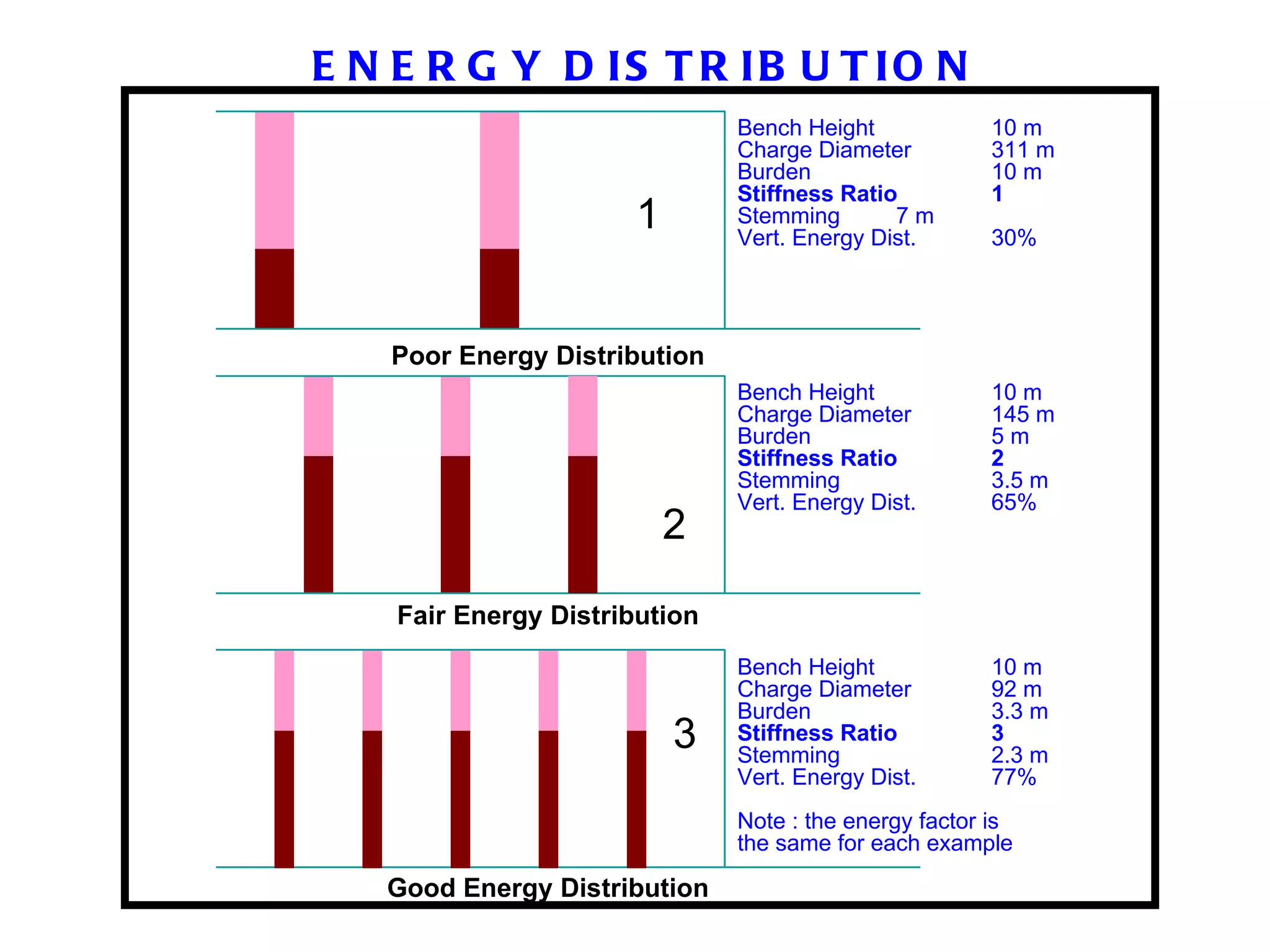
  BENCH HEIGHT If the height is not predetermined : BH (m) >> Blasthole Dia. (mm) / 15 BLASTHOLE DIAMETER To achieve excellent energy distribution : DIA (mm) = Bench Height (m)  x 8 If charge diameter is less than the blast hole diameter, the “decoupling effect” must be taken into account. As blasthole diameters increase the cost of drilling, loading & explosive generally decrease. Smaller blast holes distribute the explosive energy better than large blast holes. BURDEN Burden (m) are normally equal the charge diameter (mm) x (20 – 35). Initial Burden Estimation Guide (see table) BURDEN STIFFNESS RATIO Equal to the Bench height divided by burden << 2   : stiff and poor fragmentation. 2 – 3.5   : good fragmentation. >> 3.5   : excellent fragmentation. BSR can be improved by using smaller hole diameter or greater bench height.                          
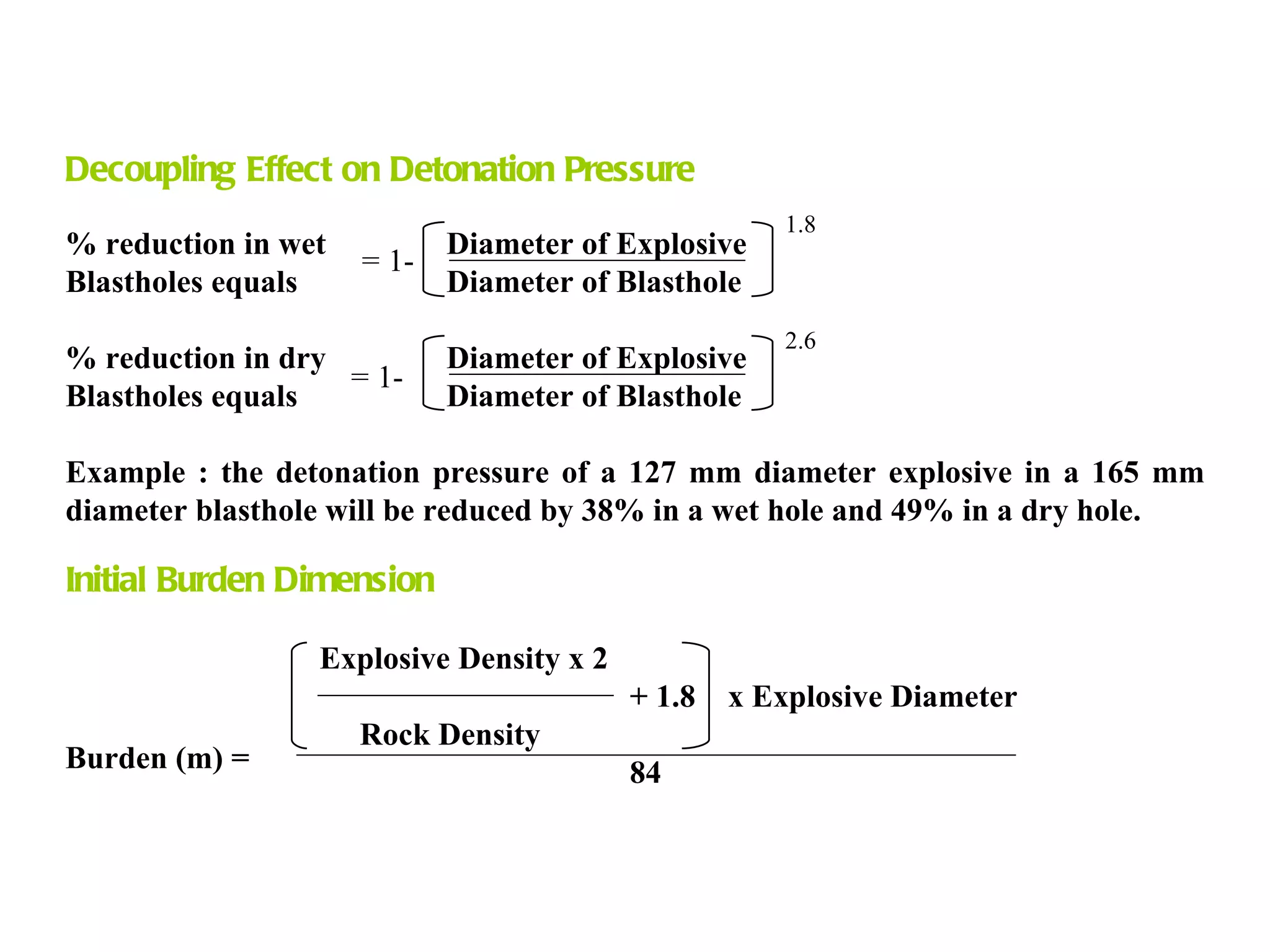
Decoupling Effect on Detonation Pressure % reduction in wet Diameter of Explosive Blastholes equals Diameter of Blasthole % reduction in dry Diameter of Explosive Blastholes equals Diameter of Blasthole Example : the detonation pressure of a 127 mm diameter explosive in a 165 mm diameter blasthole will be reduced by 38% in a wet hole and 49% in a dry hole. Initial Burden Dimension Explosive Density x 2   + 1.8  x Explosive Diameter   Rock Density   84 = 1- = 1- 1.8 2.6 Burden (m) =
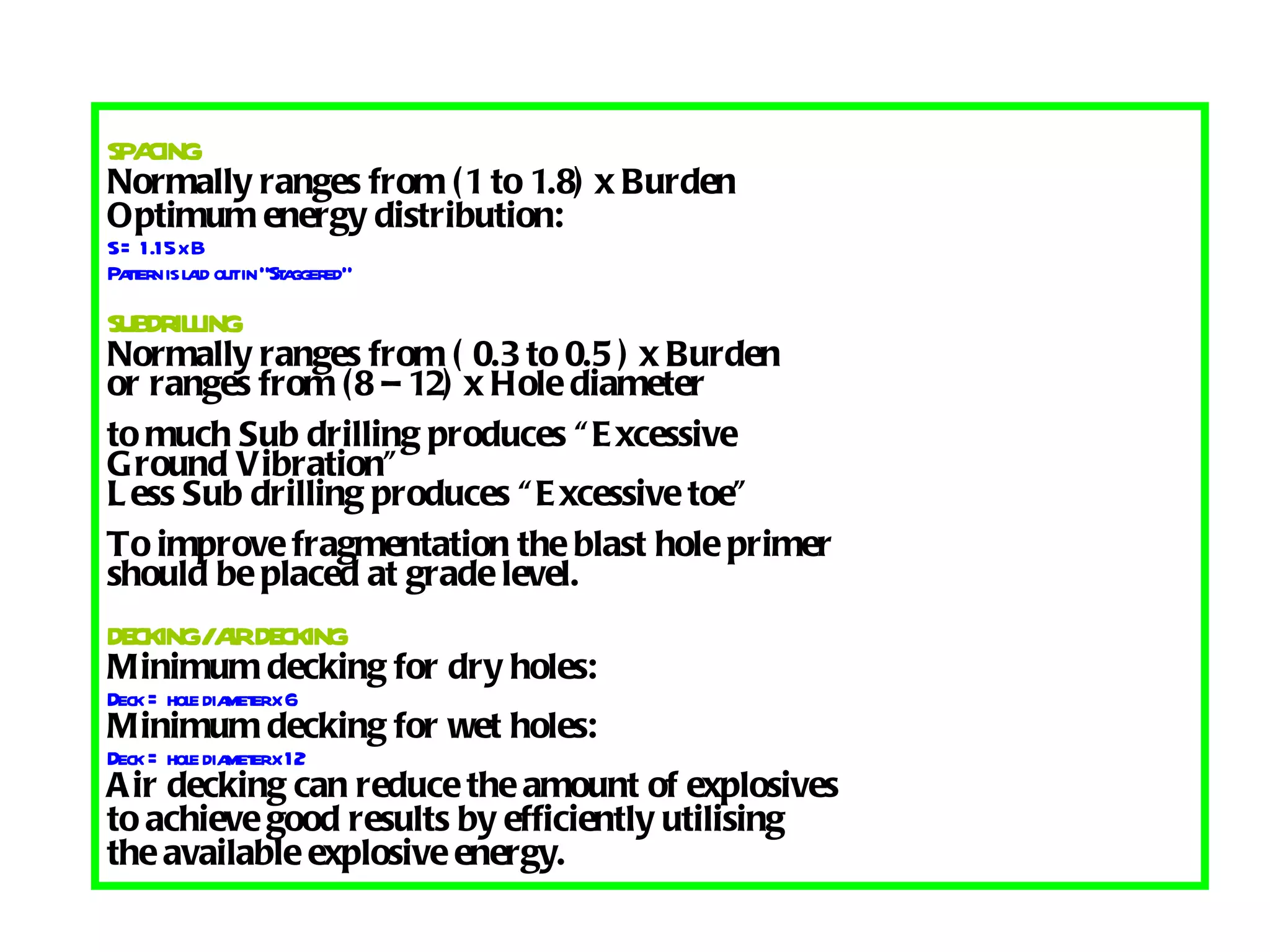
SPACING Normally ranges from (1 to 1.8) x Burden Optimum energy distribution: S = 1.15 x B Pattern is laid out in “Staggered” SUBDRILLING Normally ranges from ( 0.3 to 0.5 ) x Burden or ranges from (8 – 12) x Hole diameter to much Sub drilling produces “Excessive Ground Vibration” Less Sub drilling produces “Excessive toe” To improve fragmentation the blast hole primer should be placed at grade level. DECKING / AIR DECKING Minimum decking for dry holes: Deck = hole diameter x 6 Minimum decking for wet holes: Deck = hole diameter x 12 Air decking can reduce the amount of explosives to achieve good results by efficiently utilising  the available explosive energy.
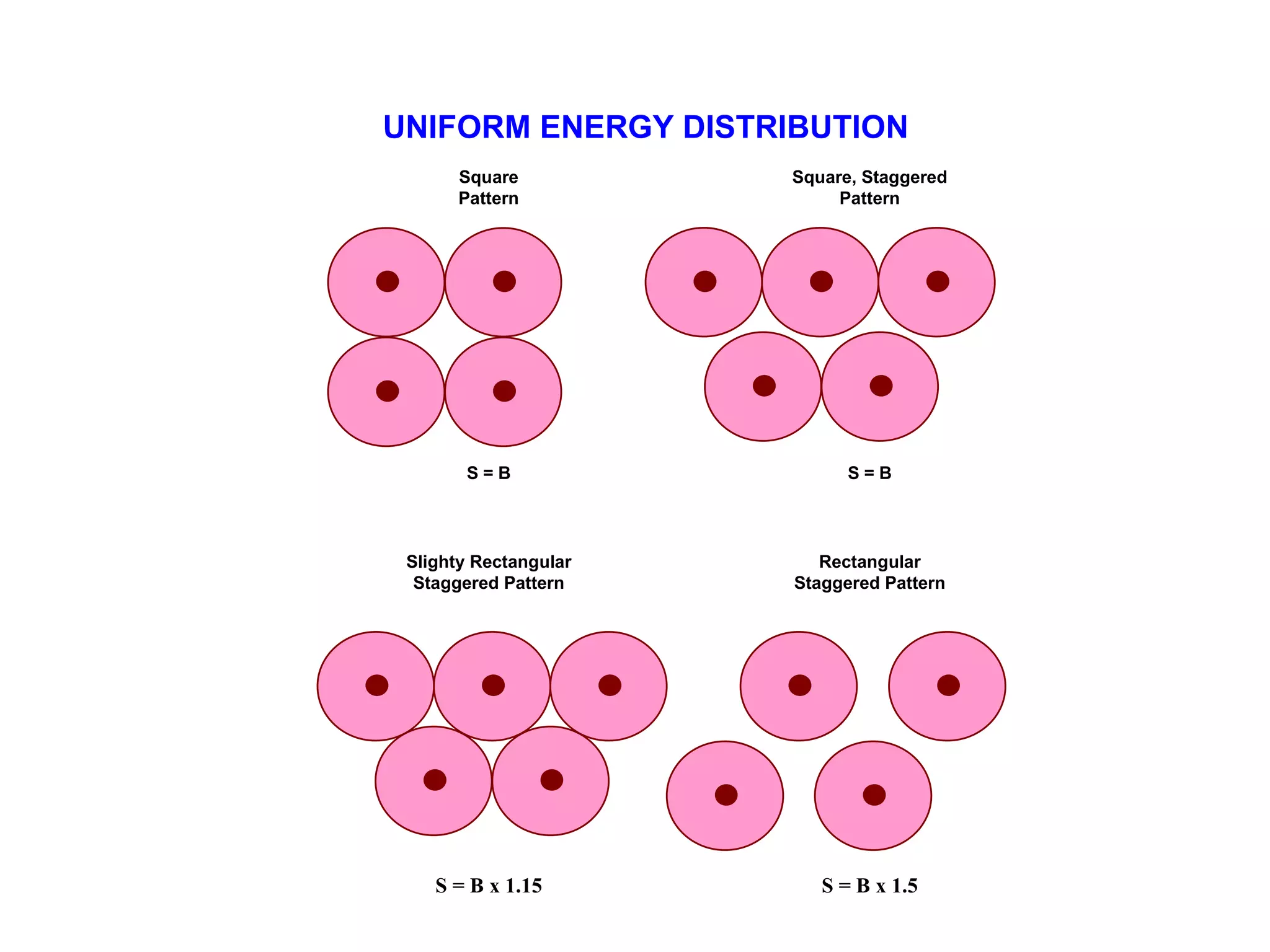
UNIFORM ENERGY DISTRIBUTION          Square Square, Staggered Pattern Pattern                         S = B S = B    Slighty Rectangular Rectangular Staggered Pattern Staggered Pattern               S = B x 1.15 S = B x 1.5
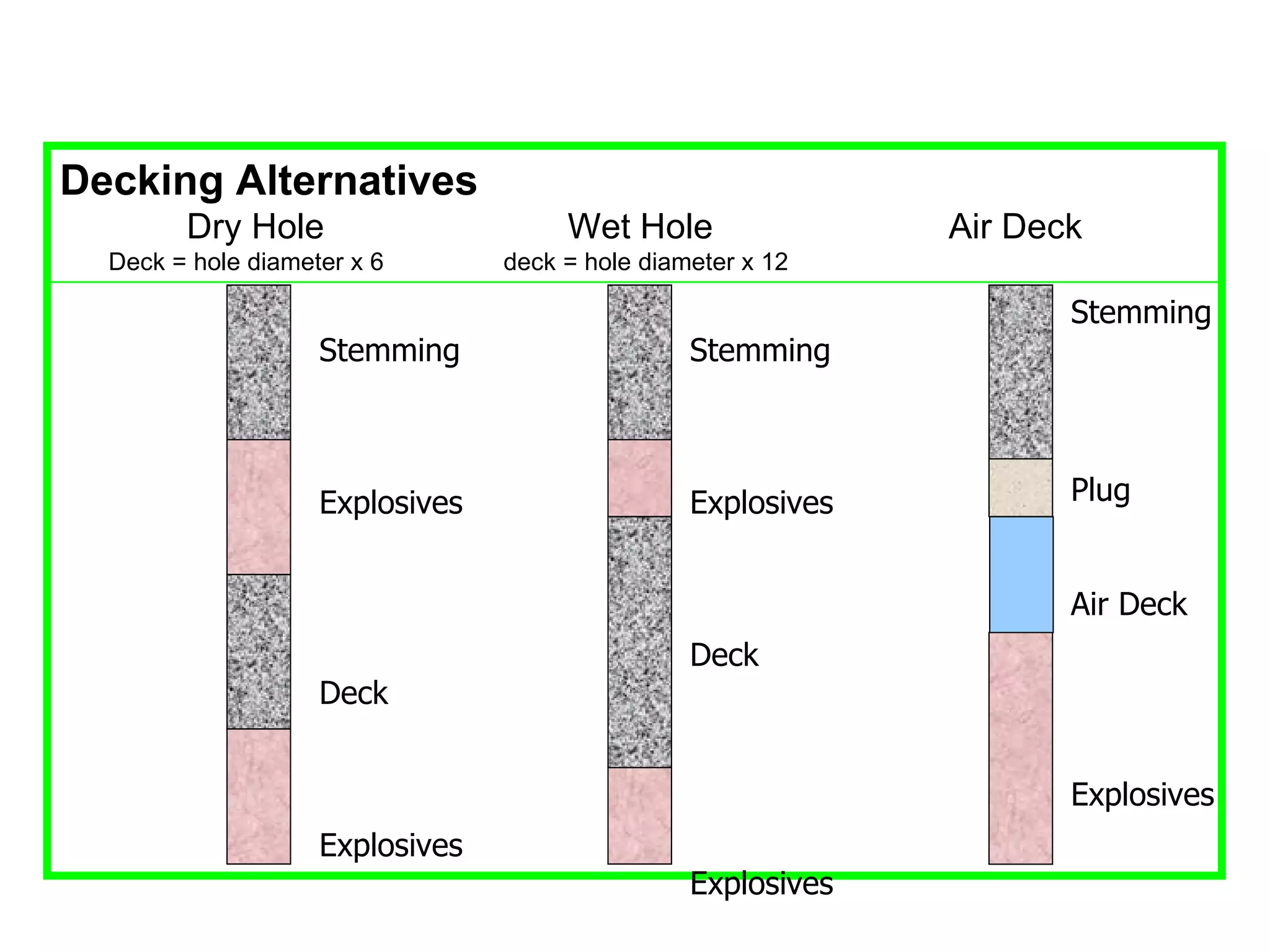
Decking Alternatives Dry Hole Wet Hole Air Deck Deck = hole diameter x 6   deck = hole diameter x 12 Stemming Explosives Deck Explosives Stemming Explosives Deck Explosives Stemming Plug Air Deck Explosives
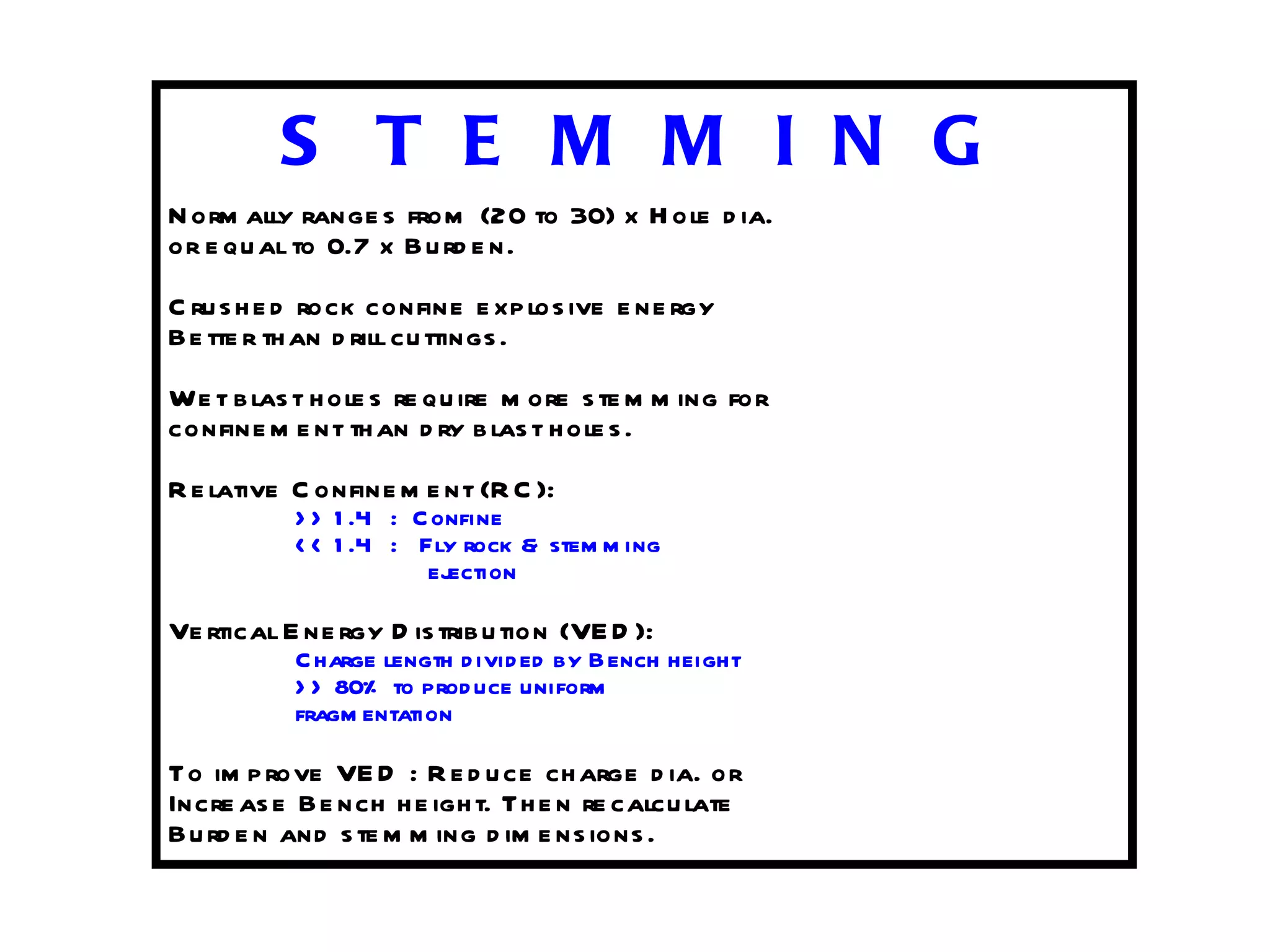
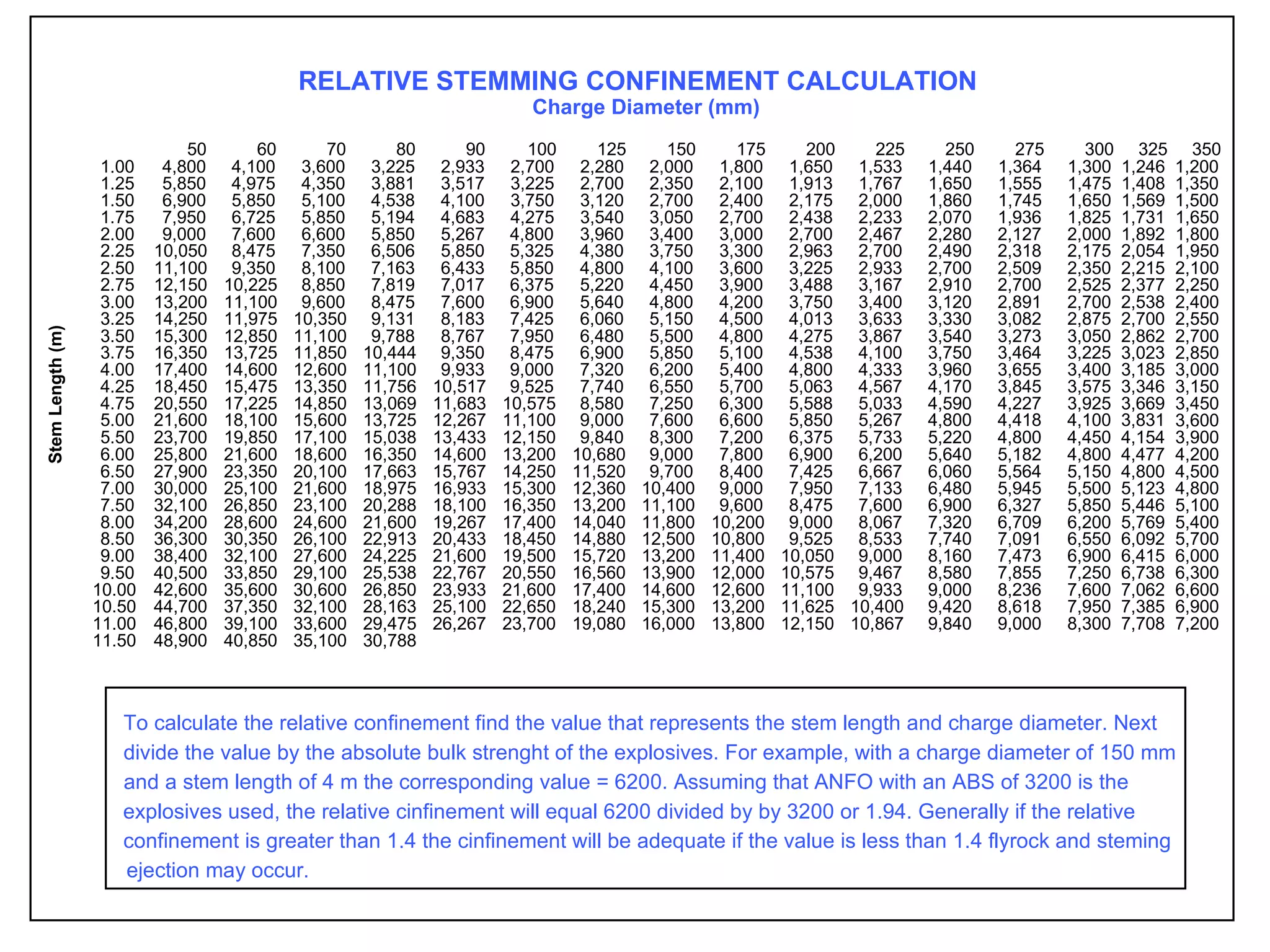
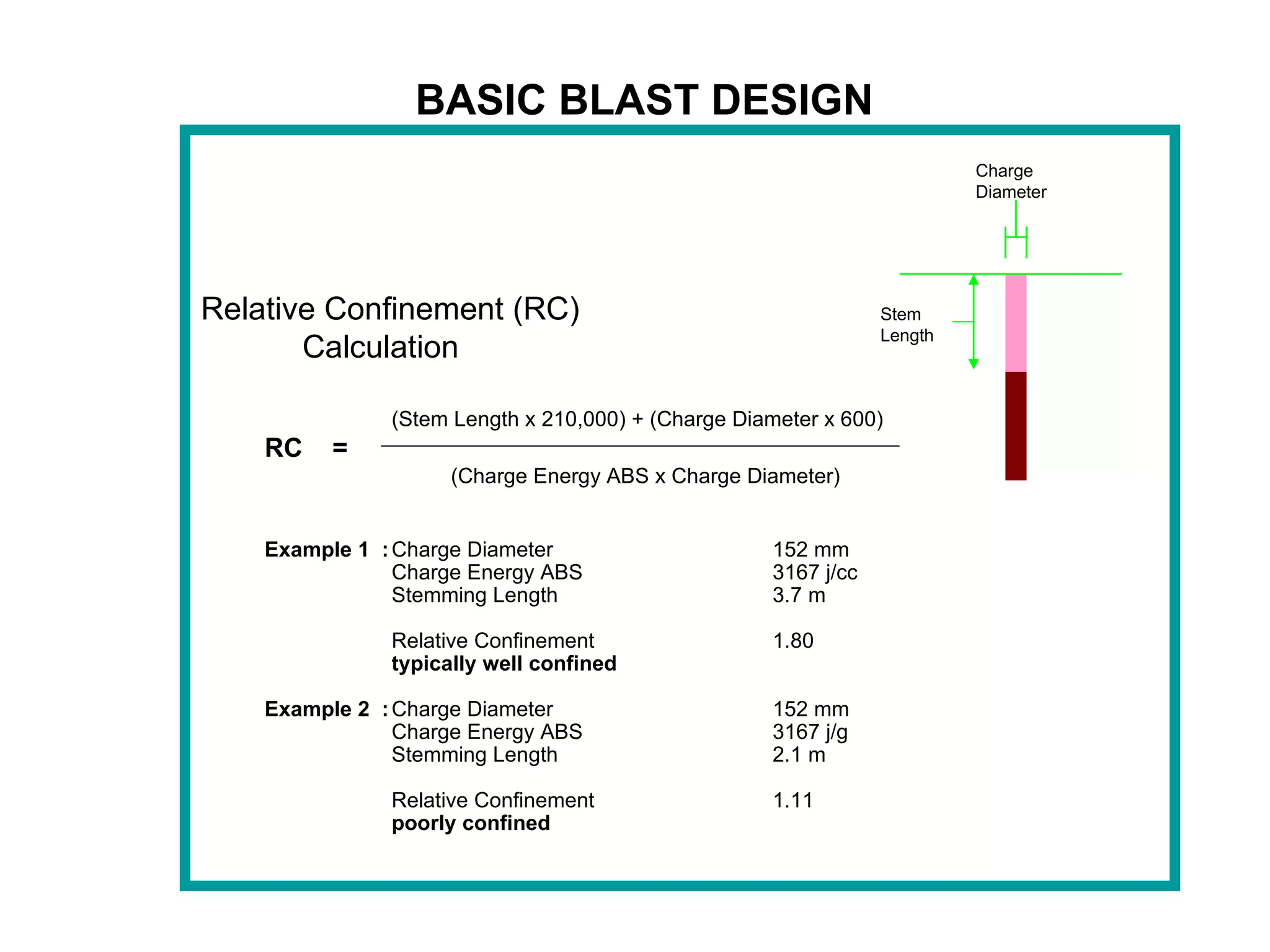
S T E M M I N G Normally ranges from (20 to 30) x Hole dia. or equal to 0.7 x Burden. Crushed rock confine explosive energy Better than drill cuttings. Wet blast holes require more stemming for confinement than dry blast holes. Relative Confinement (RC): >> 1.4  :  Confine << 1.4  :  Fly rock & stemming   ejection Vertical Energy Distribution (VED): Charge length divided by Bench height >> 80% to produce uniform fragmentation To improve VED : Reduce charge dia. or Increase Bench height. Then recalculate Burden and stemming dimensions.
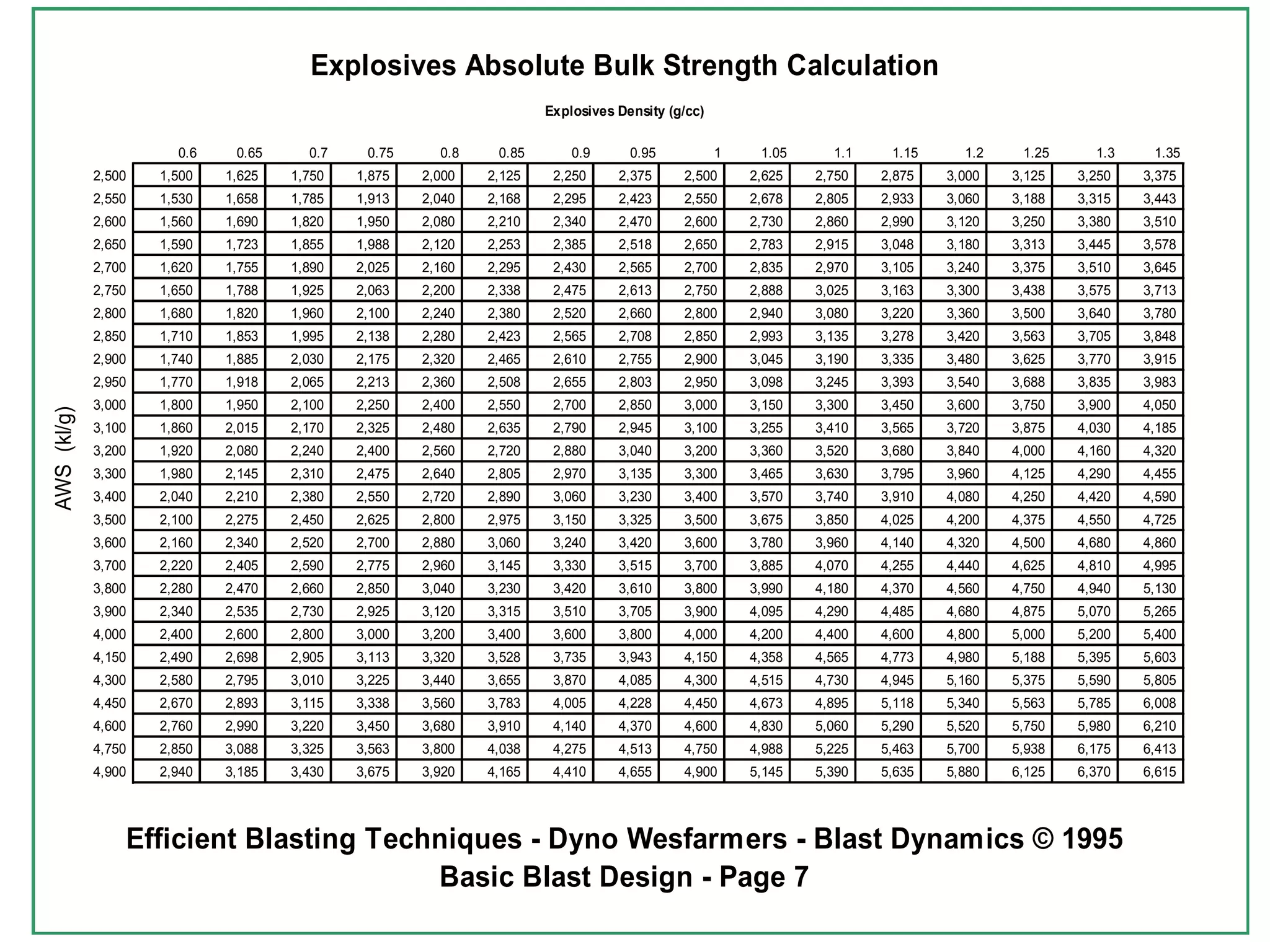
To calculate the relative confinement find the value that represents the stem length and charge diameter. Next  divide the value by the absolute bulk strenght of the explosives. For example, with a charge diameter of 150 mm  and a stem length of 4 m the corresponding value = 6200. Assuming that ANFO with an ABS of 3200 is the  explosives used, the relative cinfinement will equal 6200 divided by by 3200 or 1.94. Generally if the relative  confinement is greater than 1.4 the cinfinement will be adequate if the value is less than 1.4 flyrock and steming  ejection may occur. RELATIVE STEMMING CONFINEMENT CALCULATION Charge Diameter (mm) 50 60 70 80 90 100 125 150 175 200 225 250 275 300 325 350 1.00 4,800 4,100 3,600 3,225 2,933 2,700 2,280 2,000 1,800 1,650 1,533 1,440 1,364 1,300 1,246 1,200 1.25 5,850 4,975 4,350 3,881 3,517 3,225 2,700 2,350 2,100 1,913 1,767 1,650 1,555 1,475 1,408 1,350 1.50 6,900 5,850 5,100 4,538 4,100 3,750 3,120 2,700 2,400 2,175 2,000 1,860 1,745 1,650 1,569 1,500 1.75 7,950 6,725 5,850 5,194 4,683 4,275 3,540 3,050 2,700 2,438 2,233 2,070 1,936 1,825 1,731 1,650 2.00 9,000 7,600 6,600 5,850 5,267 4,800 3,960 3,400 3,000 2,700 2,467 2,280 2,127 2,000 1,892 1,800 2.25 10,050 8,475 7,350 6,506 5,850 5,325 4,380 3,750 3,300 2,963 2,700 2,490 2,318 2,175 2,054 1,950 2.50 11,100 9,350 8,100 7,163 6,433 5,850 4,800 4,100 3,600 3,225 2,933 2,700 2,509 2,350 2,215 2,100 2.75 12,150 10,225 8,850 7,819 7,017 6,375 5,220 4,450 3,900 3,488 3,167 2,910 2,700 2,525 2,377 2,250 3.00 13,200 11,100 9,600 8,475 7,600 6,900 5,640 4,800 4,200 3,750 3,400 3,120 2,891 2,700 2,538 2,400 3.25 14,250 11,975 10,350 9,131 8,183 7,425 6,060 5,150 4,500 4,013 3,633 3,330 3,082 2,875 2,700 2,550 3.50 15,300 12,850 11,100 9,788 8,767 7,950 6,480 5,500 4,800 4,275 3,867 3,540 3,273 3,050 2,862 2,700 3.75 16,350 13,725 11,850 10,444 9,350 8,475 6,900 5,850 5,100 4,538 4,100 3,750 3,464 3,225 3,023 2,850 4.00 17,400 14,600 12,600 11,100 9,933 9,000 7,320 6,200 5,400 4,800 4,333 3,960 3,655 3,400 3,185 3,000 4.25 18,450 15,475 13,350 11,756 10,517 9,525 7,740 6,550 5,700 5,063 4,567 4,170 3,845 3,575 3,346 3,150 4.75 20,550 17,225 14,850 13,069 11,683 10,575 8,580 7,250 6,300 5,588 5,033 4,590 4,227 3,925 3,669 3,450 5.00 21,600 18,100 15,600 13,725 12,267 11,100 9,000 7,600 6,600 5,850 5,267 4,800 4,418 4,100 3,831 3,600 5.50 23,700 19,850 17,100 15,038 13,433 12,150 9,840 8,300 7,200 6,375 5,733 5,220 4,800 4,450 4,154 3,900 6.00 25,800 21,600 18,600 16,350 14,600 13,200 10,680 9,000 7,800 6,900 6,200 5,640 5,182 4,800 4,477 4,200 6.50 27,900 23,350 20,100 17,663 15,767 14,250 11,520 9,700 8,400 7,425 6,667 6,060 5,564 5,150 4,800 4,500 7.00 30,000 25,100 21,600 18,975 16,933 15,300 12,360 10,400 9,000 7,950 7,133 6,480 5,945 5,500 5,123 4,800 7.50 32,100 26,850 23,100 20,288 18,100 16,350 13,200 11,100 9,600 8,475 7,600 6,900 6,327 5,850 5,446 5,100 8.00 34,200 28,600 24,600 21,600 19,267 17,400 14,040 11,800 10,200 9,000 8,067 7,320 6,709 6,200 5,769 5,400 8.50 36,300 30,350 26,100 22,913 20,433 18,450 14,880 12,500 10,800 9,525 8,533 7,740 7,091 6,550 6,092 5,700 9.00 38,400 32,100 27,600 24,225 21,600 19,500 15,720 13,200 11,400 10,050 9,000 8,160 7,473 6,900 6,415 6,000 9.50 40,500 33,850 29,100 25,538 22,767 20,550 16,560 13,900 12,000 10,575 9,467 8,580 7,855 7,250 6,738 6,300 10.00 42,600 35,600 30,600 26,850 23,933 21,600 17,400 14,600 12,600 11,100 9,933 9,000 8,236 7,600 7,062 6,600 10.50 44,700 37,350 32,100 28,163 25,100 22,650 18,240 15,300 13,200 11,625 10,400 9,420 8,618 7,950 7,385 6,900 11.00 46,800 39,100 33,600 29,475 26,267 23,700 19,080 16,000 13,800 12,150 10,867 9,840 9,000 8,300 7,708 7,200 11.50 48,900 40,850 35,100 30,788 Stem Length (m)
Stem Length Charge Diameter BASIC BLAST DESIGN            Relative Confinement (RC) Calculation   (Stem Length x 210,000) + (Charge Diameter x 600) RC  =   (Charge Energy ABS x Charge Diameter)    Example 1   : Charge Diameter 152 mm Charge Energy ABS 3167 j/cc Stemming Length 3.7 m Relative Confinement 1.80 typically well confined   Example 2   : Charge Diameter 152 mm Charge Energy ABS 3167 j/g Stemming Length 2.1 m   Relative Confinement 1.11 poorly confined
 
          1          Poor Energy Distribution               2       Fair Energy Distribution            3         Good Energy Distribution ENERGY DISTRIBUTION Bench Height 10  m Charge Diameter 311  m Burden 10 m Stiffness Ratio 1 Stemming 7 m Vert. Energy Dist. 30% Bench Height 10  m Charge Diameter 145  m Burden 5 m Stiffness Ratio 2 Stemming 3.5 m Vert. Energy Dist. 65% Bench Height 10  m Charge Diameter 92  m Burden 3.3 m Stiffness Ratio 3 Stemming 2.3 m Vert. Energy Dist. 77%   Note : the energy factor is the same for each example
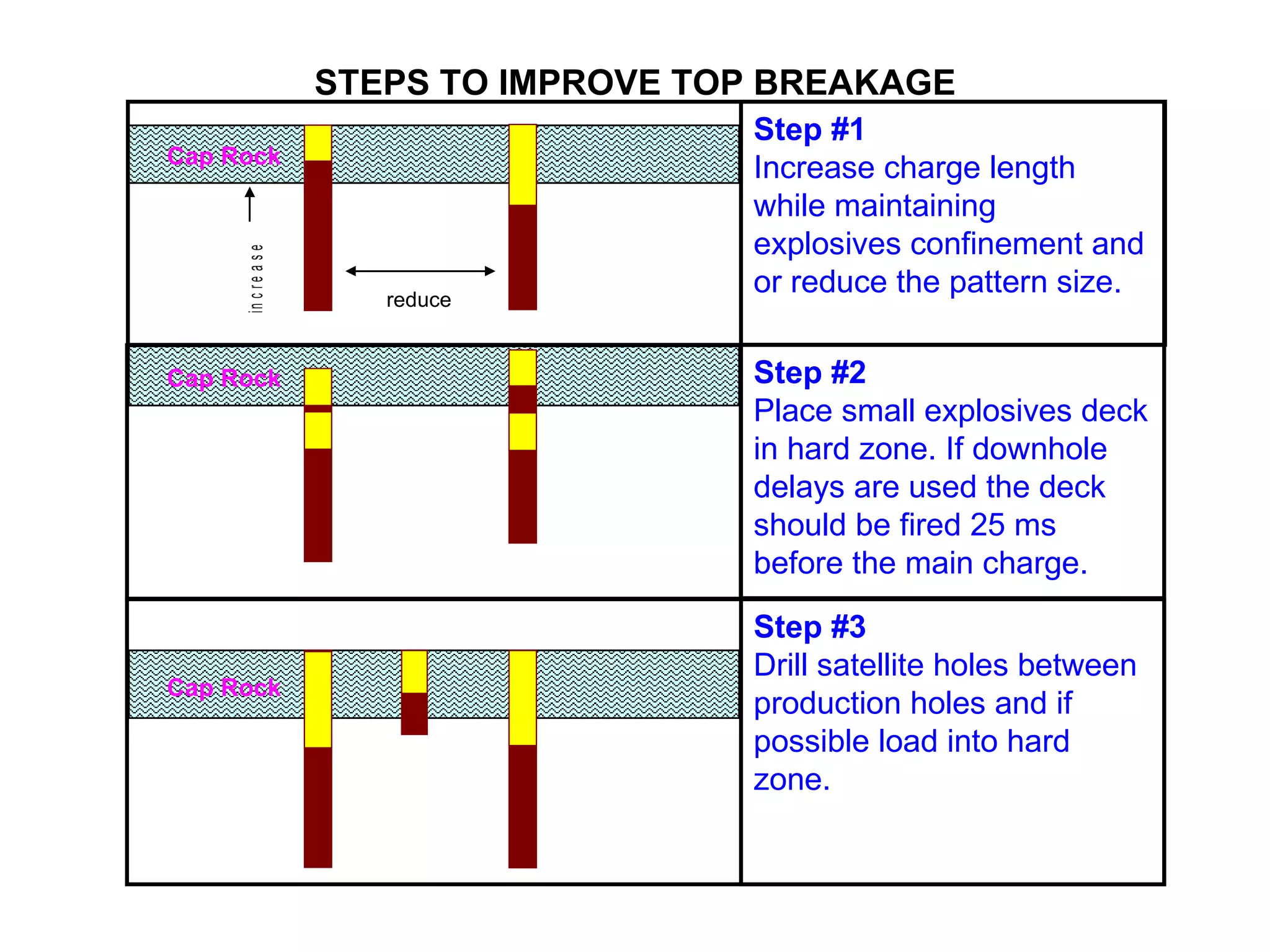
  Step #2 Place small explosives deck in hard zone. If downhole delays are used the deck should be fired 25 ms before the main charge. Cap Rock    Step #3 Drill satellite holes between production holes and if possible load into hard zone.                  reduce Step #1 Increase charge length  while maintaining explosives confinement and or reduce the pattern size. STEPS TO IMPROVE TOP BREAKAGE Cap Rock Cap Rock
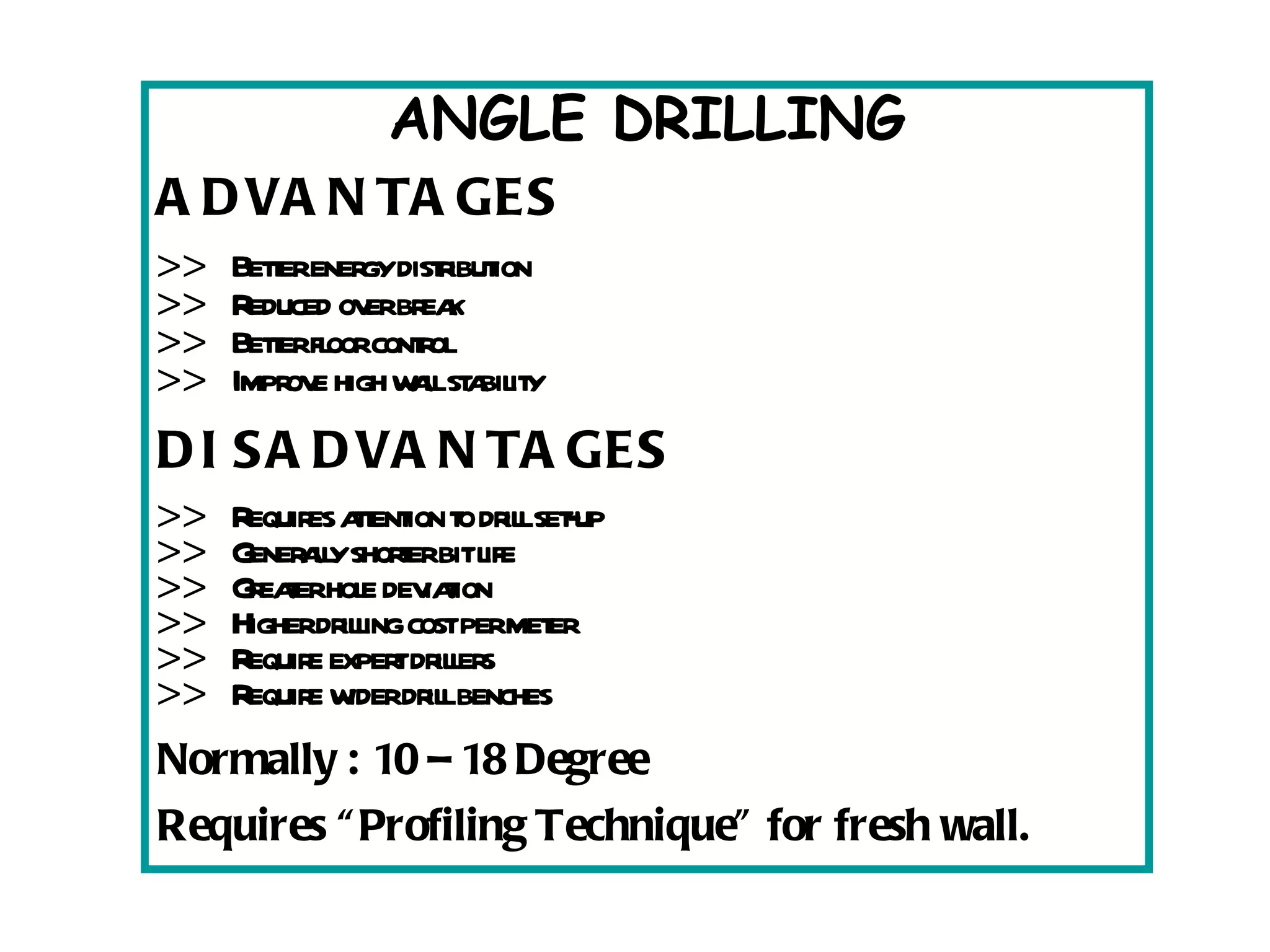
ANGLE DRILLING ADVANTAGES >>  Better energy distribution >>  Reduced over break >>  Better floor control >>  Improve high wall stability DISADVANTAGES >>  Requires attention to drill set-up >>  Generally shorter bit life >>  Greater hole deviation >>  Higher drilling cost per meter >>  Require expert drillers >>  Require wider drill benches Normally : 10 – 18 Degree Requires “Profiling Technique” for fresh wall.
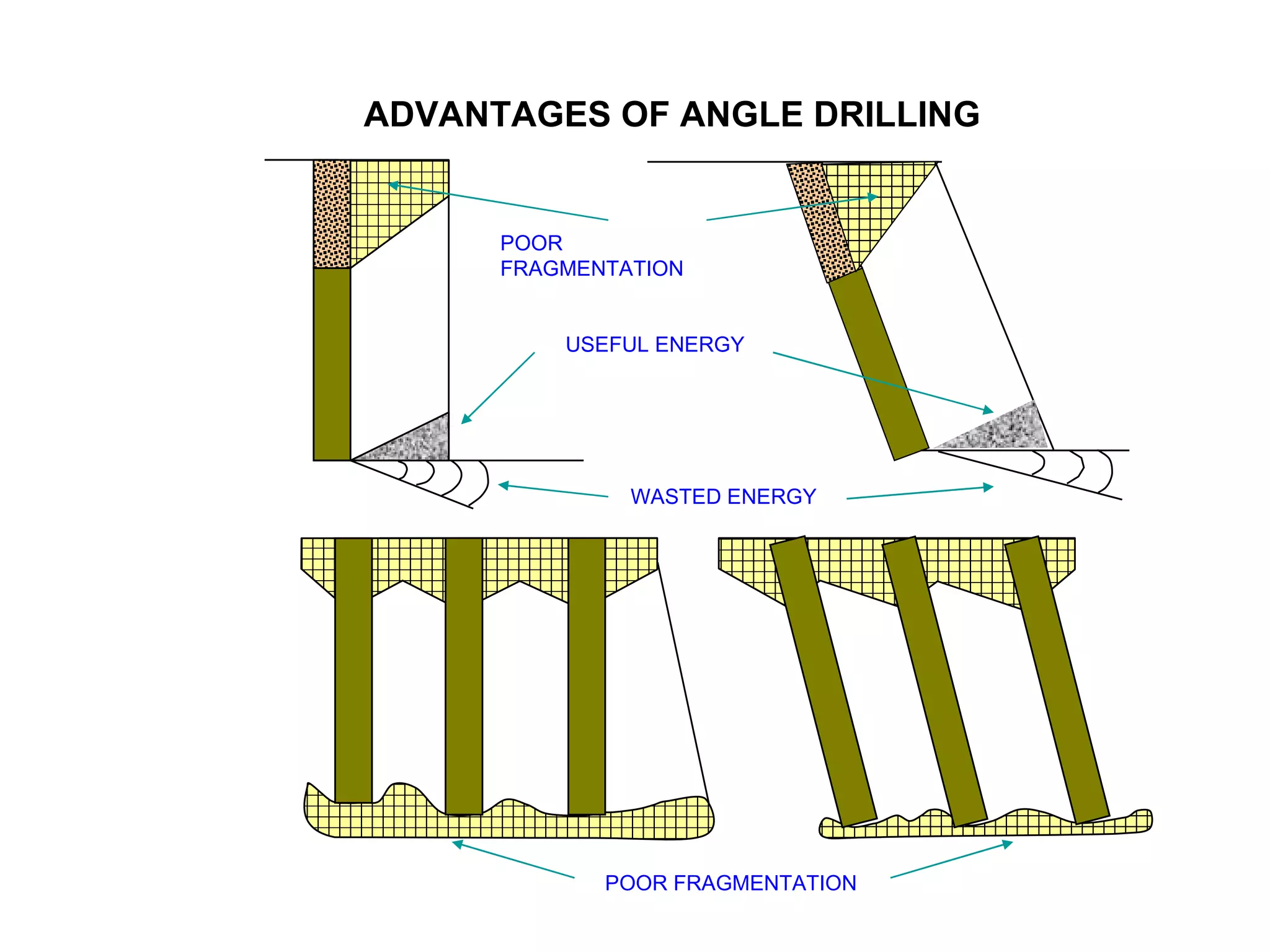
ADVANTAGES OF ANGLE DRILLING     POOR FRAGMENTATION         USEFUL ENERGY      WASTED ENERGY   POOR FRAGMENTATION
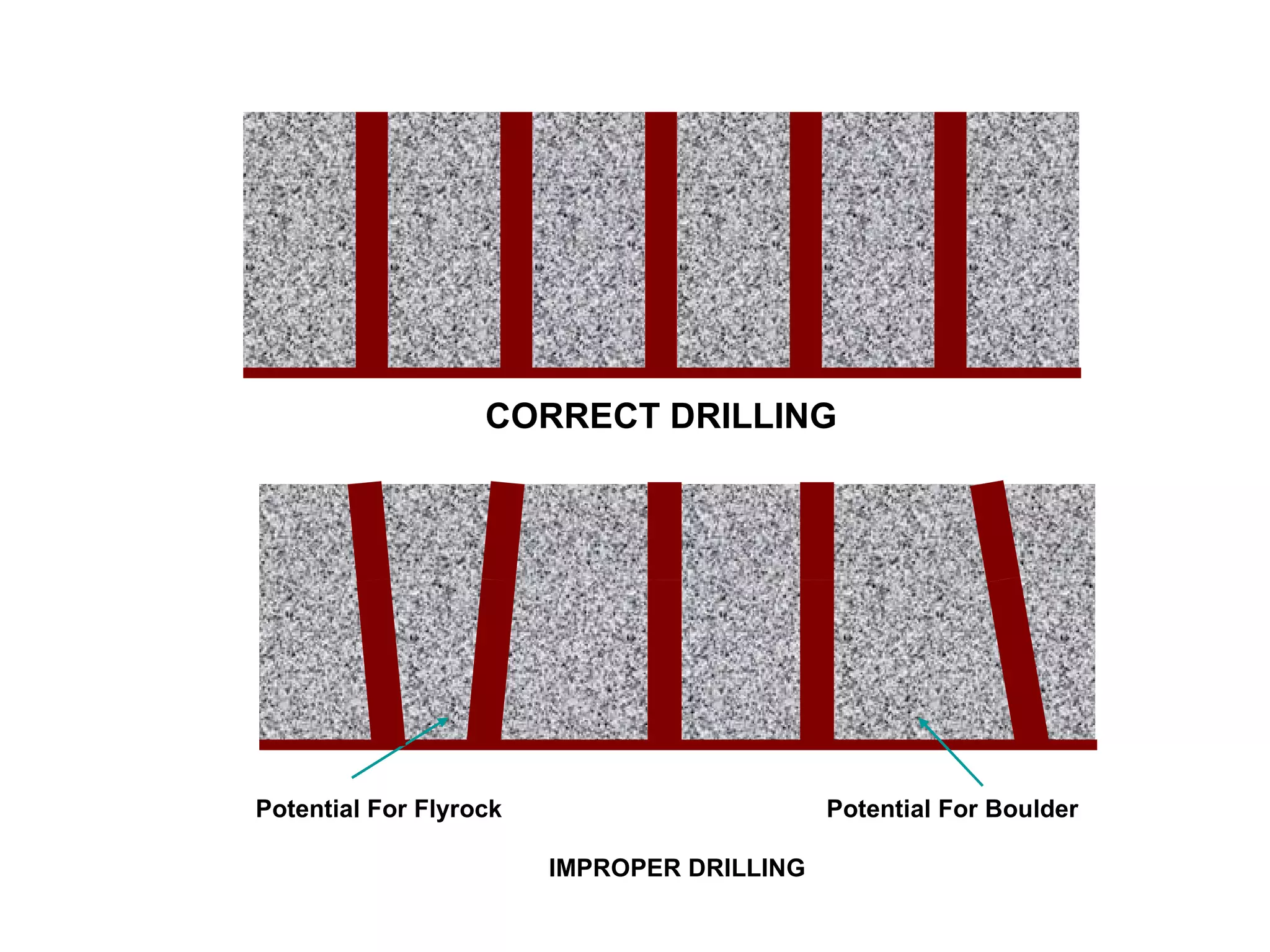
Potential For Flyrock    Potential For Boulder IMPROPER DRILLING CORRECT DRILLING
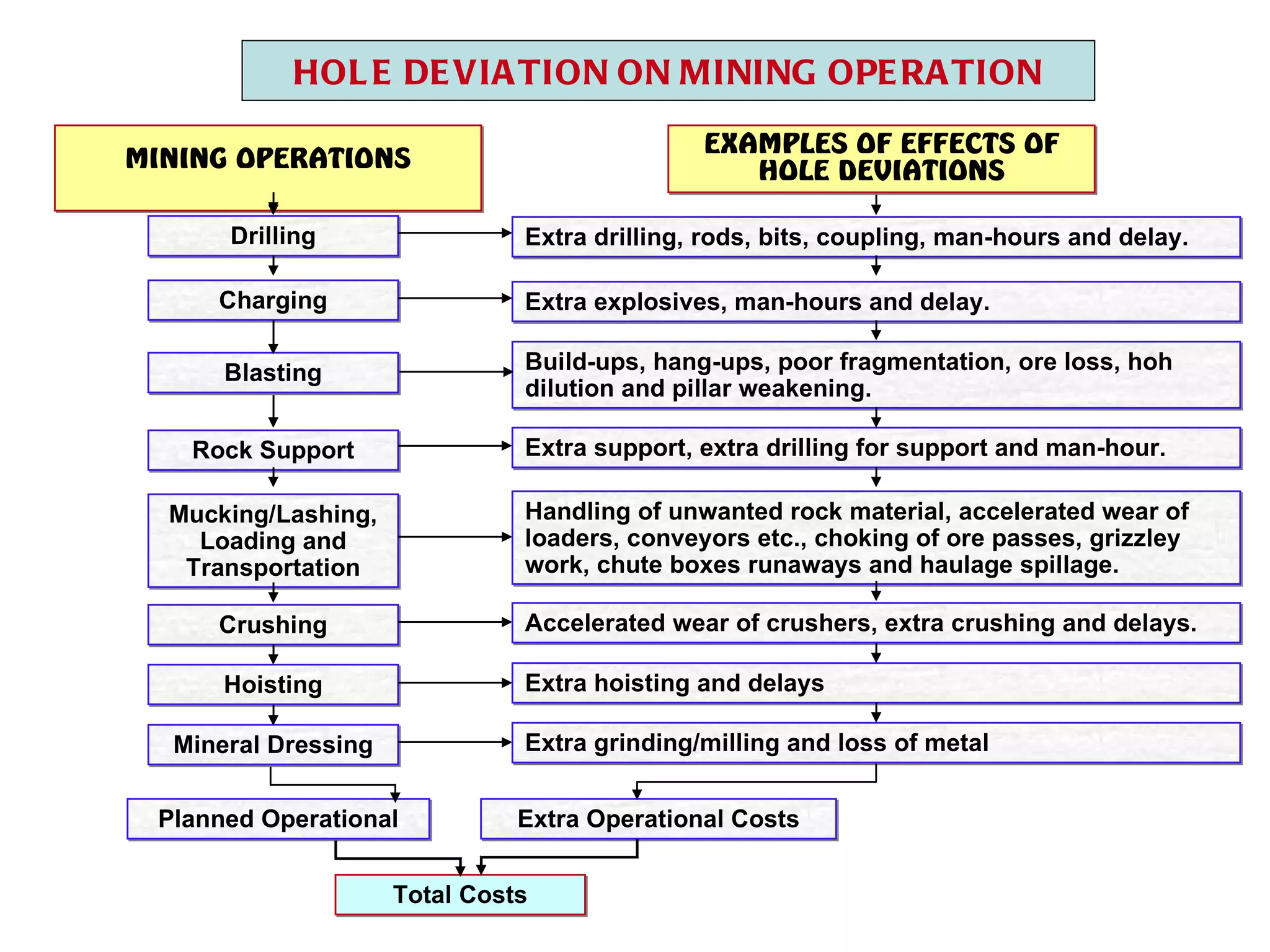
HOLE DEVIATION ON MINING OPERATION MINING OPERATIONS EXAMPLES OF EFFECTS OF HOLE DEVIATIONS Extra drilling, rods, bits, coupling, man-hours and delay. Extra explosives, man-hours and delay. Build-ups, hang-ups, poor fragmentation, ore loss, hoh dilution and pillar weakening. Handling of unwanted rock material, accelerated wear of loaders, conveyors etc., choking of ore passes, grizzley work, chute boxes runaways and haulage spillage. Extra support, extra drilling for support and man-hour. Accelerated wear of crushers, extra crushing and delays. Extra hoisting and delays Extra grinding/milling and loss of metal Total Costs Drilling Charging Blasting Rock Support Mucking/Lashing, Loading and Transportation Crushing Hoisting Mineral Dressing Planned Operational Extra Operational Costs
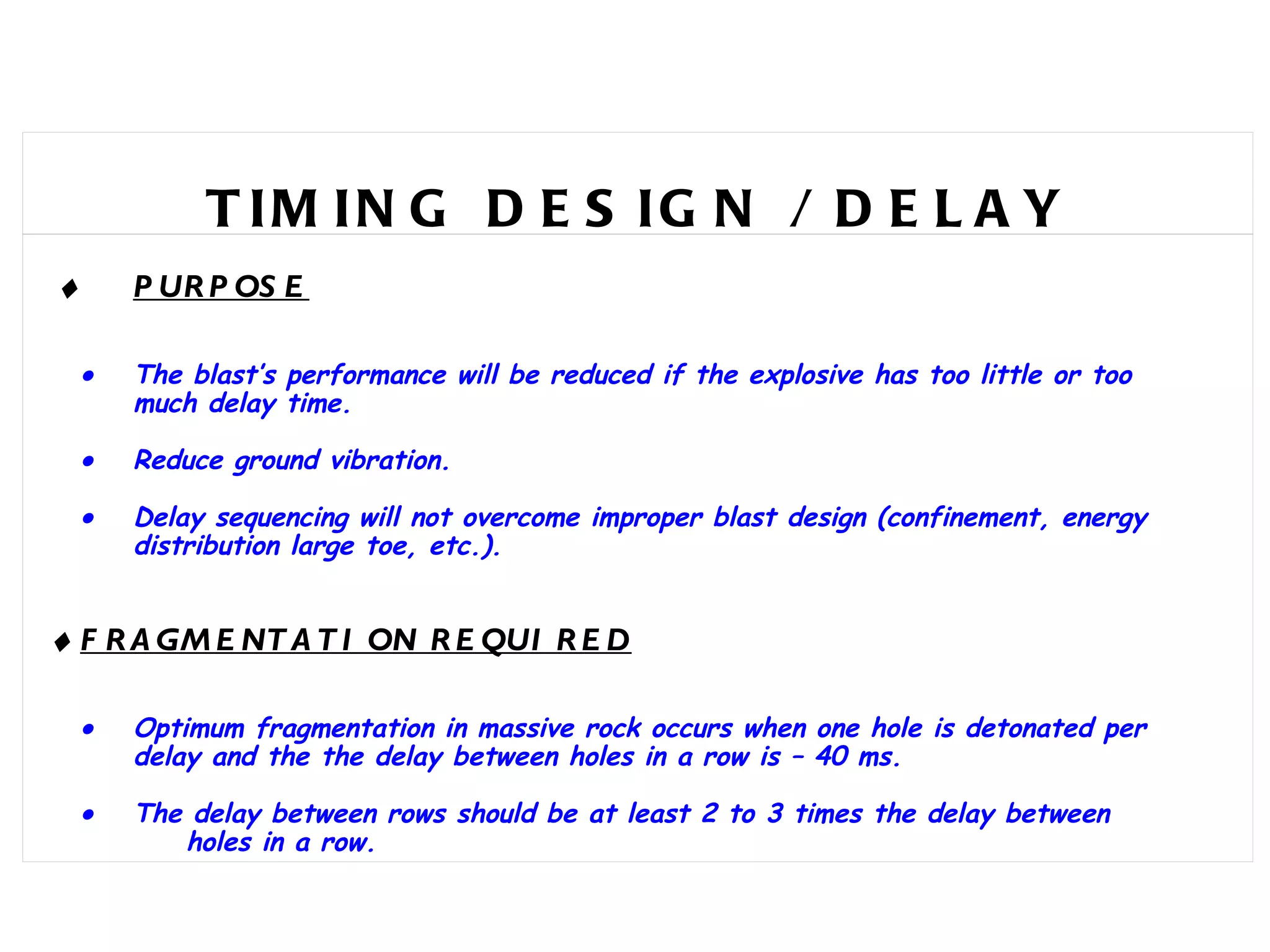
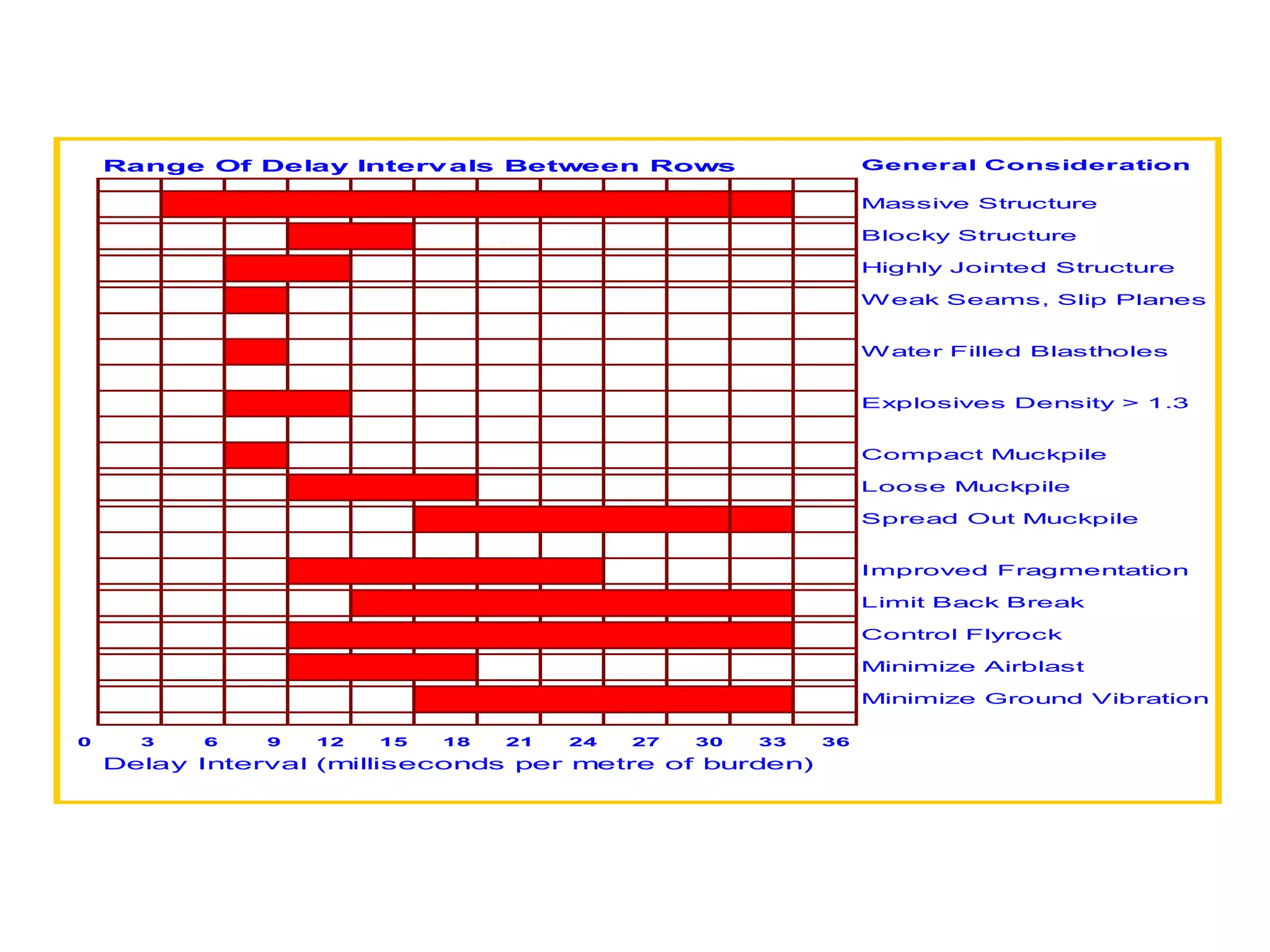
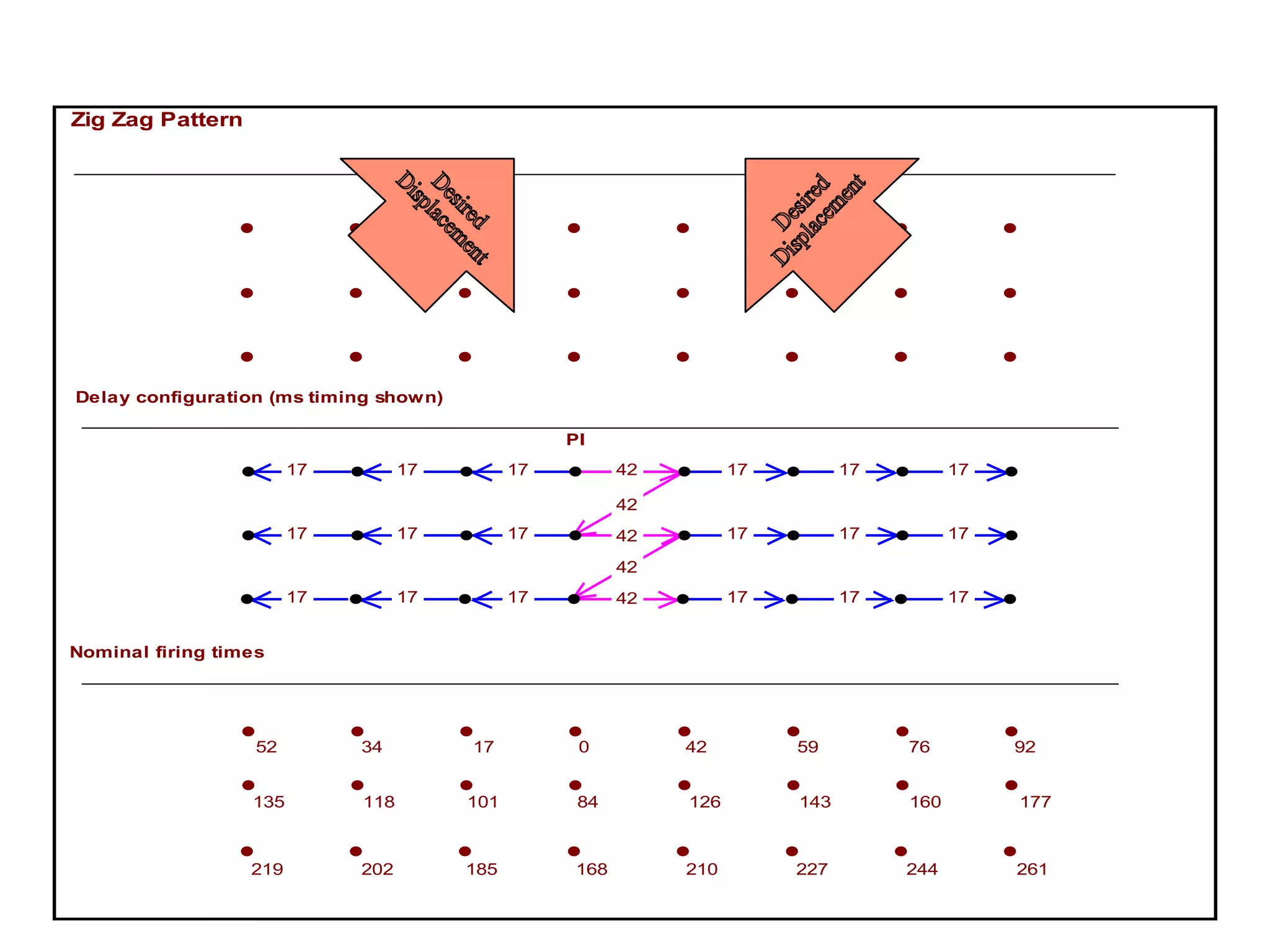
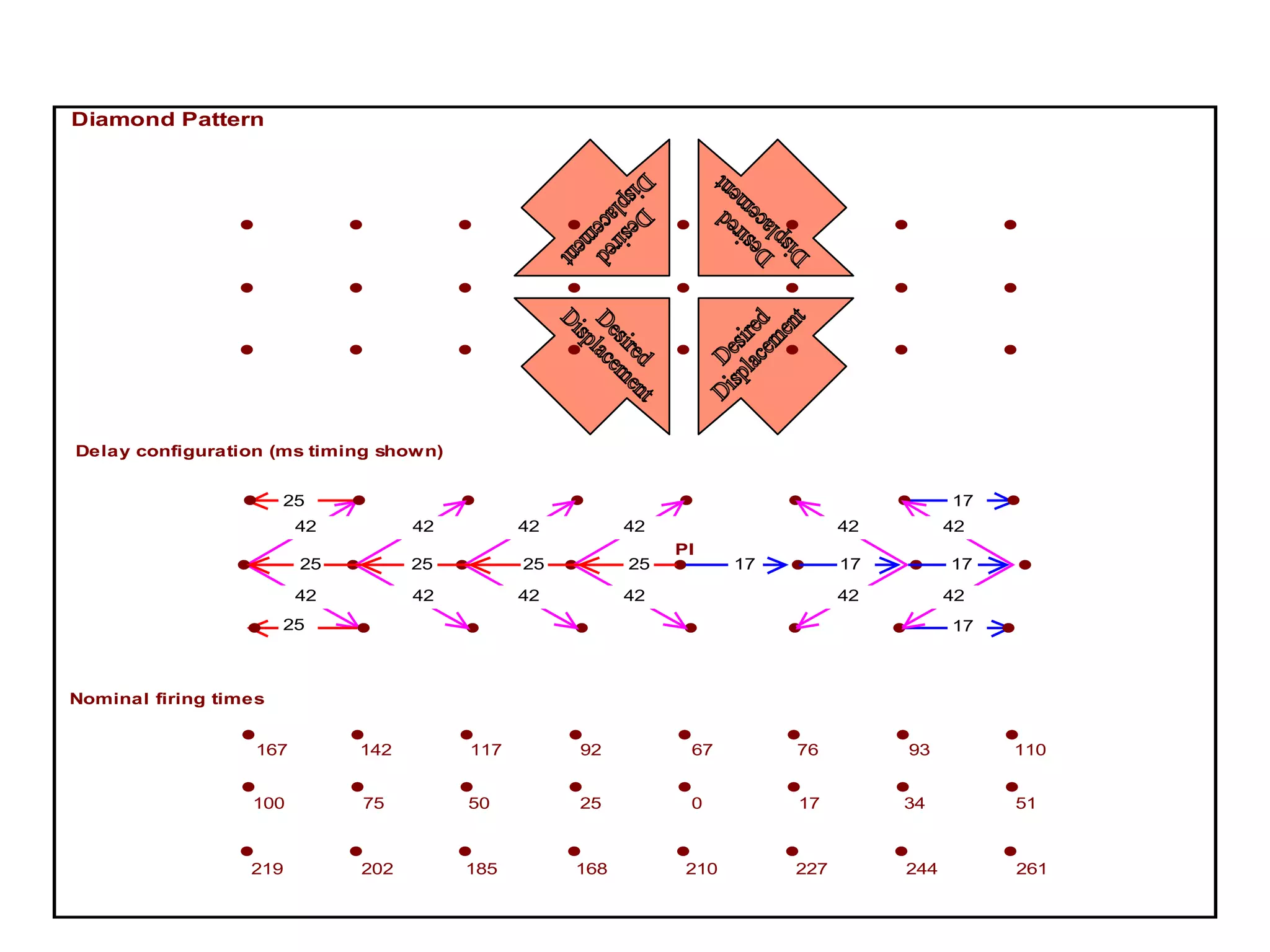
TIMING DESIGN / DELAY     PURPOSE    The blast’s performance will be reduced if the explosive has too little or too  much delay time.  Reduce ground vibration.  Delay sequencing will not overcome improper blast design (confinement, energy  distribution large toe, etc.).    FRAGMENTATION REQUIRED  Optimum fragmentation in massive rock occurs when one hole is detonated per  delay and the the delay between holes in a row is – 40 ms.  The delay between rows should be at least 2 to 3 times the delay between  holes in a row.  
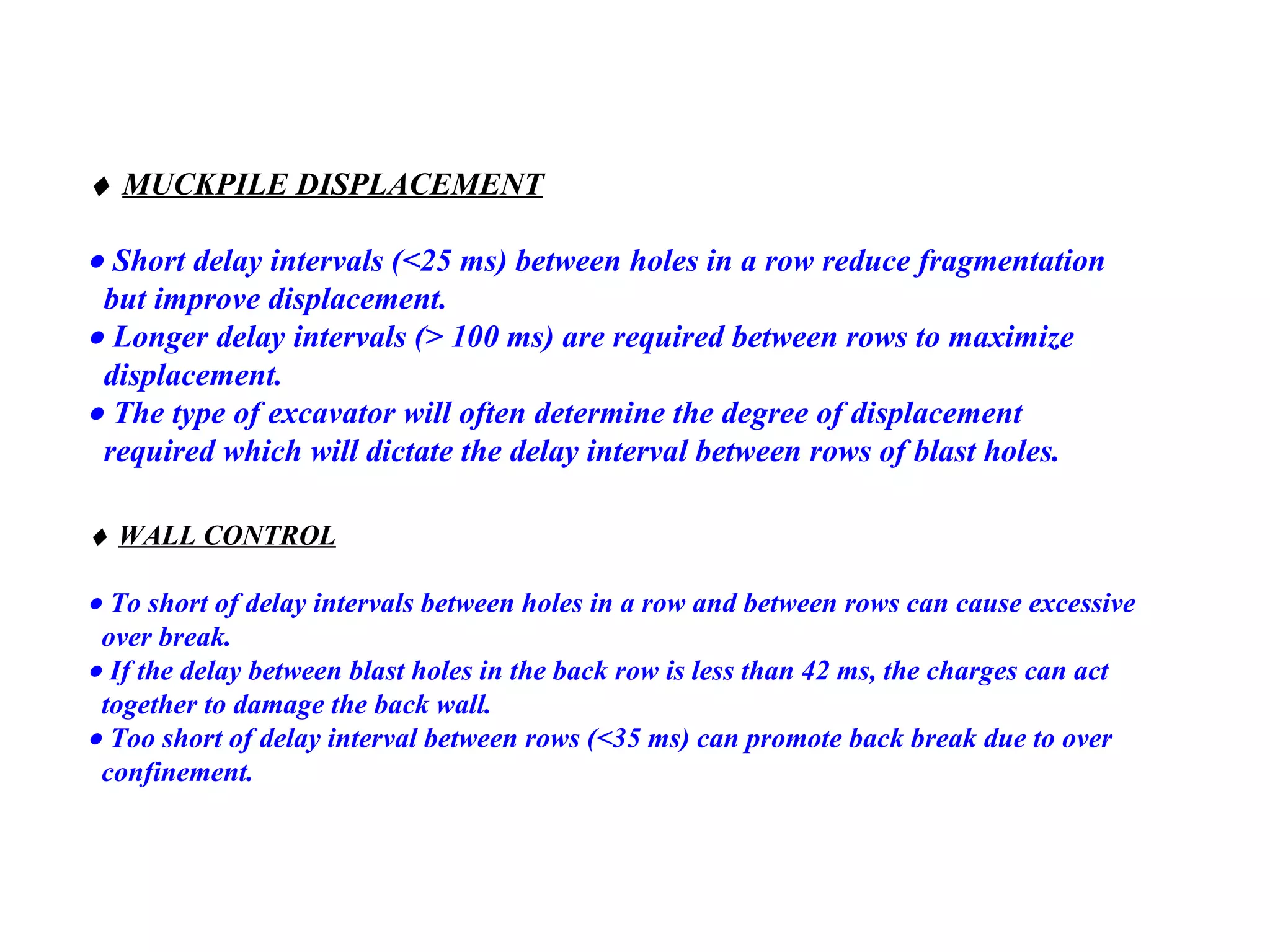
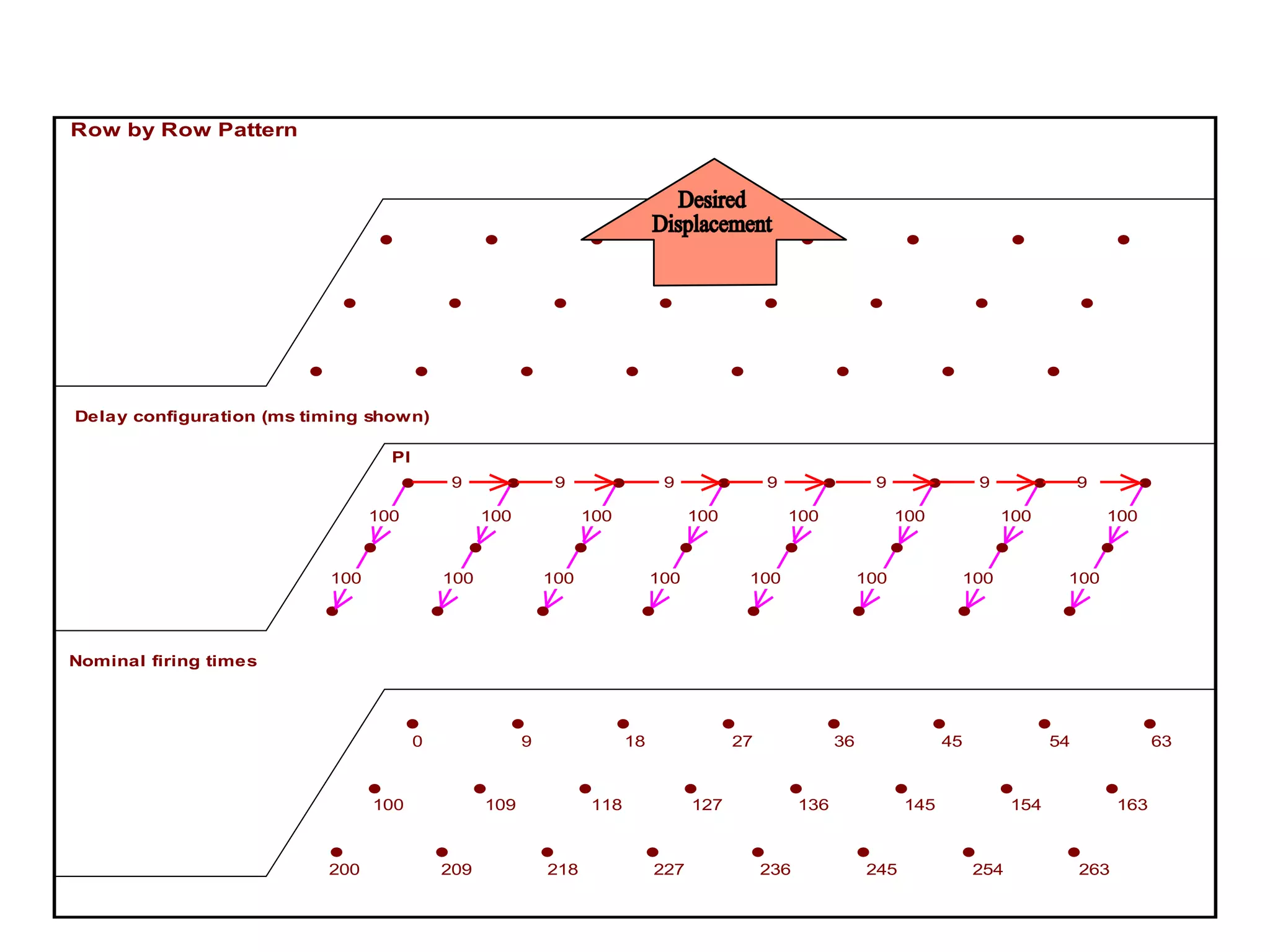
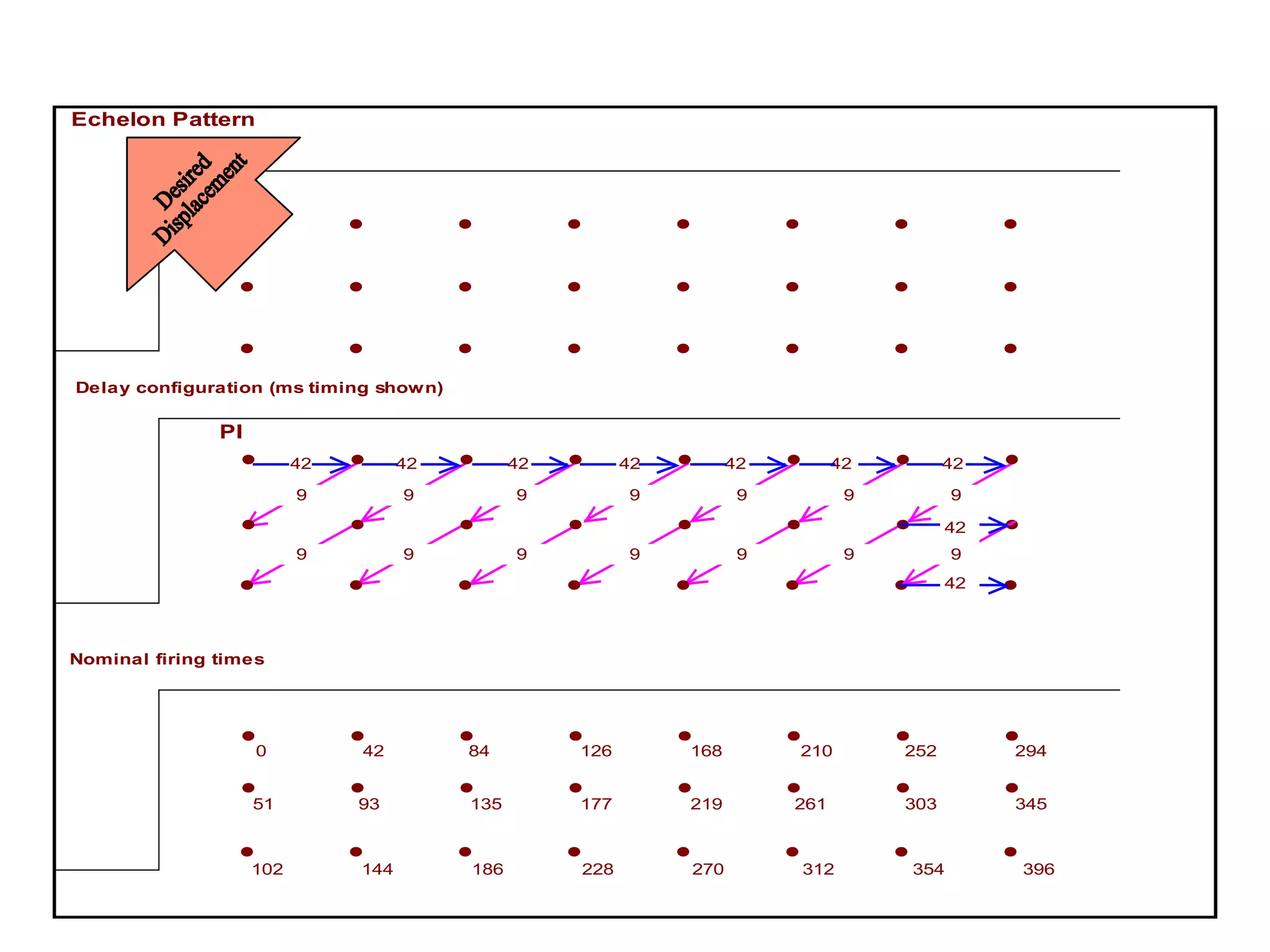
   MUCKPILE DISPLACEMENT    Short delay intervals (<25 ms) between holes in a row reduce fragmentation  but improve displacement.    Longer delay intervals (> 100 ms) are required between rows to maximize displacement.    The type of excavator will often determine the degree of displacement required which will dictate the delay interval between rows of blast   holes.    WALL CONTROL      To short of delay intervals between holes in a row   and between rows can   cause excessive  over break.    If the delay between blast holes in the back row is   less than 42 ms, the   charges can act  together to damage the back wall.    Too short of delay interval between rows (<35 ms) can promote back   break due to over  confinement.
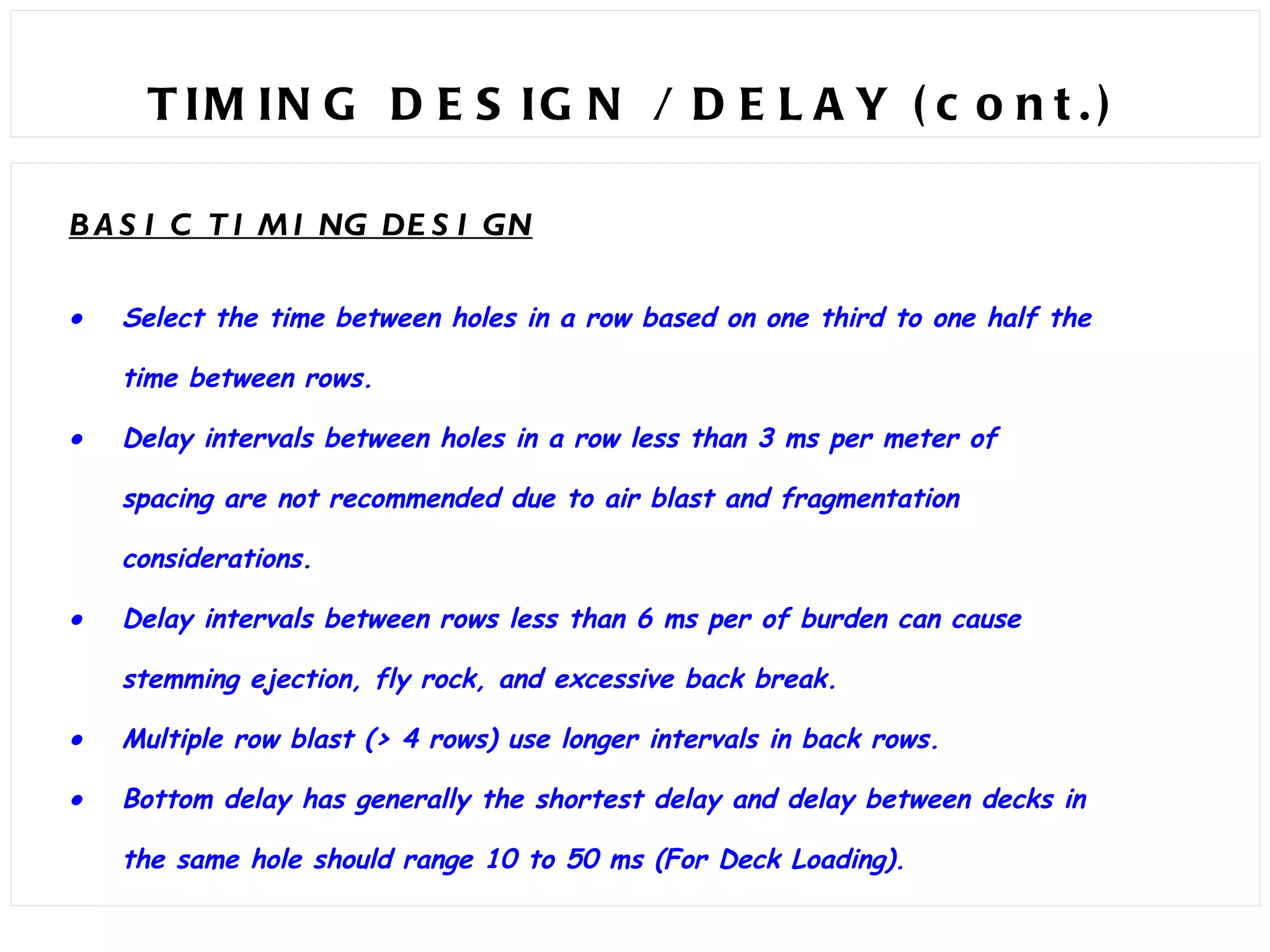
TIMING DESIGN / DELAY (cont.)  BASIC TIMING DESIGN  Select the time between holes in a row based on one third to one half the time between rows.  Delay intervals between holes in a row less than 3 ms per meter of spacing are not recommended due to air blast and fragmentation considerations.  Delay intervals between rows less than 6 ms per of burden can cause stemming ejection, fly rock, and excessive back break.  Multiple row blast (> 4 rows) use longer intervals in back rows.  Bottom delay has generally the shortest delay and delay between decks in the same hole should range 10 to 50 ms (For Deck Loading).
 
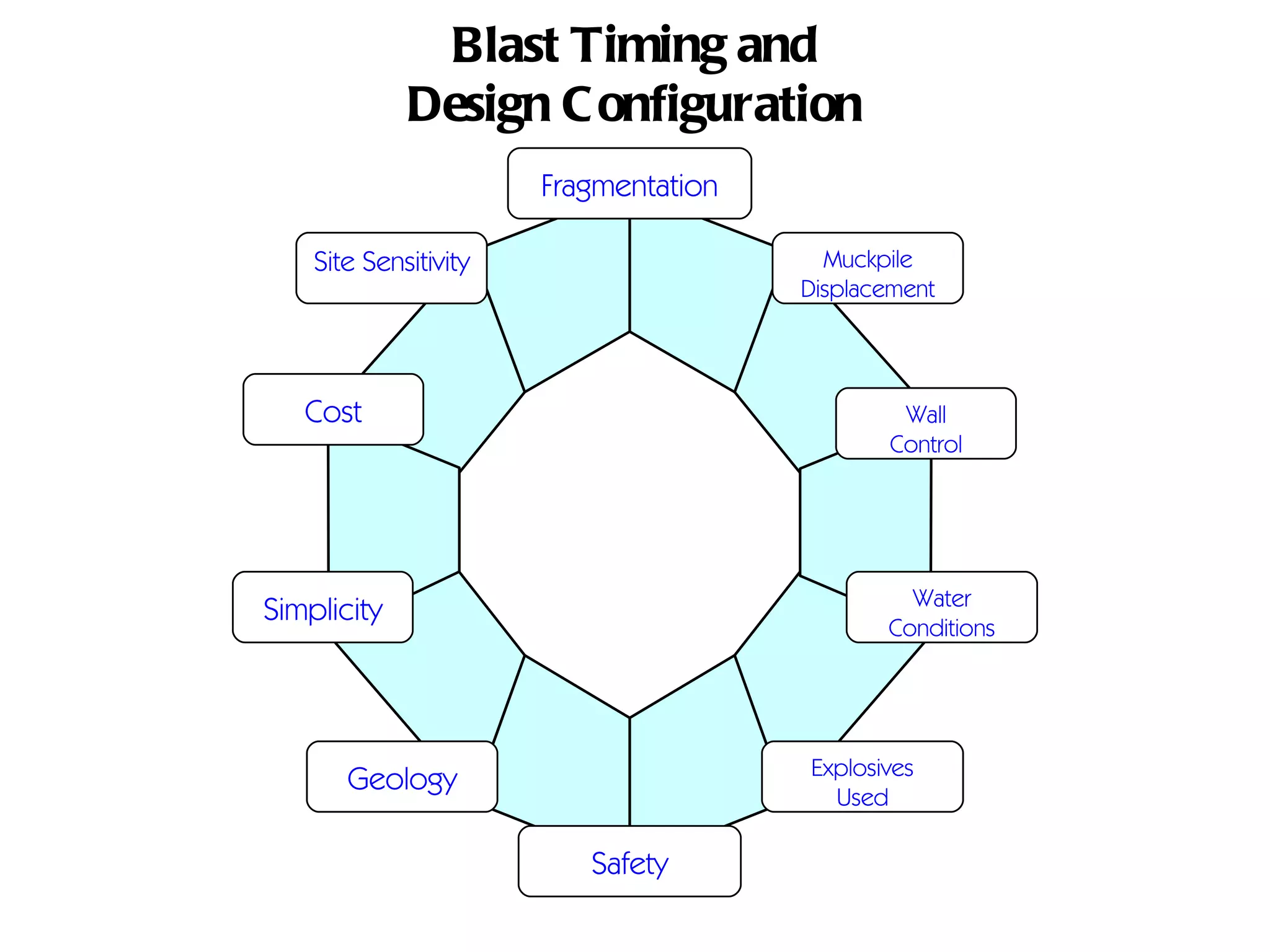
Blast Timing and Design Configuration   Simplicity   Cost Site   Sensitivity   Fragmentation Muckpile Displacement Wall Control Water Conditions Explosives Used   Geology   Safety
Desired Displacement
Desired Displacement Desired Displacement
Desired Displacement Desired Displacement Desired Displacement Desired Displacement
 

Basic blasting

  • 1.
    PELEDAKAN TAMBANG TERBUKADisajikan dalam : RAKER INTERNAL PT. BUMA (11 - 12 Oktober 2004) oleh : DEDY IRAWAN DIVISI TAMBANG UMUM PT. DAHANA (PERSERO) S A M A R I N D A KALIMANTAN TIMUR 2 0 0 4
  • 2.
    MATERI PEMBORANDAN PELEDAKAN TEKNIK PELEDAKAN TEKNIK PEMBORAN EKONOMI PELEDAKAN DAMPAK PELEDAKAN SAFE BLASTING
  • 3.
  • 4.
    MAJOR FACTORS INFLUENCINGBLAST EFFICIENCY  ATTITUDE  COMMUNICATION  BLAST DESIGN  GEOLOGICAL EFFECTS
  • 5.
    ATTITUDE  PAYING ATTENTION TO DETAILS  EACH OPERATION MUST BE COMPLETED AS PRECISELY AS POSSIBLE  TOTAL QUALITY MANAGEMENT (T.Q.M)  GROUP EFFORT
  • 6.
    COMMUNICATION  )SAFE BLASTING PRACTICES REQUIRE GOOD COMMUNICATION.  ) COMMUNICATION BETWEEN MEMBERS OF SAME GROUP AND BETWEEN GROUPS.  ) OPTIMUM BLAST DESIGNS DEPEND ON INPUT FROM EACH GROUP.
  • 7.
    KEYS TO EFFICIENTBLAST DESIGN UNIFORM ENERGY DISTRIBUTION APPROPRIATE ENERGY CONFINEMENT PROPER ENERGY LEVEL ADJUSMENT OF DESIGN TO MEET - EXISTING CONDITIONS
  • 8.
    APPROACH TO ACHIEVINGOPTIMUM BLAST EFFIENCY Blast Design Design Refinement Bench Preparation Performance Evaluation Pattern Layout   Firing Drilling Blast Loading Optimum Blast Performance
  • 9.
  • 10.
    GEOLOGICAL EFFECTS  Blasting results are influenced more by rock properties than explosive properties . Rock properties: Compressive strength >> Tensile strength    Rock Structure:  Rock fragmentation is primarily controlled by bedding, jointing, and faulting.  Smaller drill pattern minimize the adverse effects of bedding and fractures but increase drill and blast costs.  Explosives with high gas production (ANFO) are appropriate for highly jointed or fractured rock.  The orientation of the free face to the joints sets is also a key consideration for fragmentation and wall control.  
  • 11.
     W at e r  Static water  Dynamic water  Multiple priming is advised in wet blast hole GEOLOGICAL EFFECTS
  • 12.
    Dipping seams offactures into pit:  unstable walls  excessive backbreak Dipping seams into rockmass:  unbroken toe  overhang potential Joints parallel to free face:  good wall control  can be best orientation Joints angled to free face:  blocky face  excessive end break
  • 13.
    Simplified blocky rockmass  poor fragmentation f ree face zone                    expanded pattern prevents even energy distribution     uniform fragmentation                    tight pattern promotes even energy distribution
  • 14.
    bench Spacing shouldbe reduced Presplit Evaluation open pit open pit bench Spacing can be expanded
  • 15.
    EXPLOSIVES     Hard massive rock – High density explosive    Soft / Fractured rock – Low density explosive    Explosive with high gas production (such as ANFO) for D isplacement are appropriate for highly jointed or fractured rock.    Water resistance    Chemical stability    Fume characteristics    Bulk ANFO :
  • 16.
    Zero Oxygen Balance= 94.3% AN + 5.7% FO  Over fuel mix, example: 92% AN + 8% FO Prod. 6% less energy CO  Under fuel mix, example: 96% AN + 4% FO Prod. 18% less energy N O2 Increase sensitivity  It’s generally better to over fuel ANFO rather than under fuel it.   P r i m e r s :  Primer diameter should closely match hole dia.  Two primers are recommended for blasthole over 15 meters deep [ANFO] & 10 meters deep [Emulsion Blend].    
  • 17.
        BASICDRILL / BLAST DESIGN      BENCH HEIGHT  BLASTHOLE DIAMETER  BURDEN  BURDEN STIFFNESS RATIO  SPACING  SUBDRILLING  STEMMING  DECKING / AIR DECKING  ANGLE DRILLING  TIMING DESIGN / DELAY      
  • 18.
    Spacing Burden cresttoe Explosives Coloumn Sudut Pemboran Sub Drilling Stemming Kedalaman Pemboran Tinggi Bench SURFACE BLASTING GEOMETRY
  • 19.
      BENCH HEIGHTIf the height is not predetermined : BH (m) >> Blasthole Dia. (mm) / 15 BLASTHOLE DIAMETER To achieve excellent energy distribution : DIA (mm) = Bench Height (m) x 8 If charge diameter is less than the blast hole diameter, the “decoupling effect” must be taken into account. As blasthole diameters increase the cost of drilling, loading & explosive generally decrease. Smaller blast holes distribute the explosive energy better than large blast holes. BURDEN Burden (m) are normally equal the charge diameter (mm) x (20 – 35). Initial Burden Estimation Guide (see table) BURDEN STIFFNESS RATIO Equal to the Bench height divided by burden << 2 : stiff and poor fragmentation. 2 – 3.5 : good fragmentation. >> 3.5 : excellent fragmentation. BSR can be improved by using smaller hole diameter or greater bench height.                          
  • 20.
    Decoupling Effect onDetonation Pressure % reduction in wet Diameter of Explosive Blastholes equals Diameter of Blasthole % reduction in dry Diameter of Explosive Blastholes equals Diameter of Blasthole Example : the detonation pressure of a 127 mm diameter explosive in a 165 mm diameter blasthole will be reduced by 38% in a wet hole and 49% in a dry hole. Initial Burden Dimension Explosive Density x 2 + 1.8 x Explosive Diameter Rock Density 84 = 1- = 1- 1.8 2.6 Burden (m) =
  • 21.
    SPACING Normally rangesfrom (1 to 1.8) x Burden Optimum energy distribution: S = 1.15 x B Pattern is laid out in “Staggered” SUBDRILLING Normally ranges from ( 0.3 to 0.5 ) x Burden or ranges from (8 – 12) x Hole diameter to much Sub drilling produces “Excessive Ground Vibration” Less Sub drilling produces “Excessive toe” To improve fragmentation the blast hole primer should be placed at grade level. DECKING / AIR DECKING Minimum decking for dry holes: Deck = hole diameter x 6 Minimum decking for wet holes: Deck = hole diameter x 12 Air decking can reduce the amount of explosives to achieve good results by efficiently utilising the available explosive energy.
  • 22.
    UNIFORM ENERGY DISTRIBUTION         Square Square, Staggered Pattern Pattern                         S = B S = B    Slighty Rectangular Rectangular Staggered Pattern Staggered Pattern               S = B x 1.15 S = B x 1.5
  • 23.
    Decking Alternatives DryHole Wet Hole Air Deck Deck = hole diameter x 6 deck = hole diameter x 12 Stemming Explosives Deck Explosives Stemming Explosives Deck Explosives Stemming Plug Air Deck Explosives
  • 24.
    S T EM M I N G Normally ranges from (20 to 30) x Hole dia. or equal to 0.7 x Burden. Crushed rock confine explosive energy Better than drill cuttings. Wet blast holes require more stemming for confinement than dry blast holes. Relative Confinement (RC): >> 1.4 : Confine << 1.4 : Fly rock & stemming ejection Vertical Energy Distribution (VED): Charge length divided by Bench height >> 80% to produce uniform fragmentation To improve VED : Reduce charge dia. or Increase Bench height. Then recalculate Burden and stemming dimensions.
  • 25.
    To calculate therelative confinement find the value that represents the stem length and charge diameter. Next divide the value by the absolute bulk strenght of the explosives. For example, with a charge diameter of 150 mm and a stem length of 4 m the corresponding value = 6200. Assuming that ANFO with an ABS of 3200 is the explosives used, the relative cinfinement will equal 6200 divided by by 3200 or 1.94. Generally if the relative confinement is greater than 1.4 the cinfinement will be adequate if the value is less than 1.4 flyrock and steming ejection may occur. RELATIVE STEMMING CONFINEMENT CALCULATION Charge Diameter (mm) 50 60 70 80 90 100 125 150 175 200 225 250 275 300 325 350 1.00 4,800 4,100 3,600 3,225 2,933 2,700 2,280 2,000 1,800 1,650 1,533 1,440 1,364 1,300 1,246 1,200 1.25 5,850 4,975 4,350 3,881 3,517 3,225 2,700 2,350 2,100 1,913 1,767 1,650 1,555 1,475 1,408 1,350 1.50 6,900 5,850 5,100 4,538 4,100 3,750 3,120 2,700 2,400 2,175 2,000 1,860 1,745 1,650 1,569 1,500 1.75 7,950 6,725 5,850 5,194 4,683 4,275 3,540 3,050 2,700 2,438 2,233 2,070 1,936 1,825 1,731 1,650 2.00 9,000 7,600 6,600 5,850 5,267 4,800 3,960 3,400 3,000 2,700 2,467 2,280 2,127 2,000 1,892 1,800 2.25 10,050 8,475 7,350 6,506 5,850 5,325 4,380 3,750 3,300 2,963 2,700 2,490 2,318 2,175 2,054 1,950 2.50 11,100 9,350 8,100 7,163 6,433 5,850 4,800 4,100 3,600 3,225 2,933 2,700 2,509 2,350 2,215 2,100 2.75 12,150 10,225 8,850 7,819 7,017 6,375 5,220 4,450 3,900 3,488 3,167 2,910 2,700 2,525 2,377 2,250 3.00 13,200 11,100 9,600 8,475 7,600 6,900 5,640 4,800 4,200 3,750 3,400 3,120 2,891 2,700 2,538 2,400 3.25 14,250 11,975 10,350 9,131 8,183 7,425 6,060 5,150 4,500 4,013 3,633 3,330 3,082 2,875 2,700 2,550 3.50 15,300 12,850 11,100 9,788 8,767 7,950 6,480 5,500 4,800 4,275 3,867 3,540 3,273 3,050 2,862 2,700 3.75 16,350 13,725 11,850 10,444 9,350 8,475 6,900 5,850 5,100 4,538 4,100 3,750 3,464 3,225 3,023 2,850 4.00 17,400 14,600 12,600 11,100 9,933 9,000 7,320 6,200 5,400 4,800 4,333 3,960 3,655 3,400 3,185 3,000 4.25 18,450 15,475 13,350 11,756 10,517 9,525 7,740 6,550 5,700 5,063 4,567 4,170 3,845 3,575 3,346 3,150 4.75 20,550 17,225 14,850 13,069 11,683 10,575 8,580 7,250 6,300 5,588 5,033 4,590 4,227 3,925 3,669 3,450 5.00 21,600 18,100 15,600 13,725 12,267 11,100 9,000 7,600 6,600 5,850 5,267 4,800 4,418 4,100 3,831 3,600 5.50 23,700 19,850 17,100 15,038 13,433 12,150 9,840 8,300 7,200 6,375 5,733 5,220 4,800 4,450 4,154 3,900 6.00 25,800 21,600 18,600 16,350 14,600 13,200 10,680 9,000 7,800 6,900 6,200 5,640 5,182 4,800 4,477 4,200 6.50 27,900 23,350 20,100 17,663 15,767 14,250 11,520 9,700 8,400 7,425 6,667 6,060 5,564 5,150 4,800 4,500 7.00 30,000 25,100 21,600 18,975 16,933 15,300 12,360 10,400 9,000 7,950 7,133 6,480 5,945 5,500 5,123 4,800 7.50 32,100 26,850 23,100 20,288 18,100 16,350 13,200 11,100 9,600 8,475 7,600 6,900 6,327 5,850 5,446 5,100 8.00 34,200 28,600 24,600 21,600 19,267 17,400 14,040 11,800 10,200 9,000 8,067 7,320 6,709 6,200 5,769 5,400 8.50 36,300 30,350 26,100 22,913 20,433 18,450 14,880 12,500 10,800 9,525 8,533 7,740 7,091 6,550 6,092 5,700 9.00 38,400 32,100 27,600 24,225 21,600 19,500 15,720 13,200 11,400 10,050 9,000 8,160 7,473 6,900 6,415 6,000 9.50 40,500 33,850 29,100 25,538 22,767 20,550 16,560 13,900 12,000 10,575 9,467 8,580 7,855 7,250 6,738 6,300 10.00 42,600 35,600 30,600 26,850 23,933 21,600 17,400 14,600 12,600 11,100 9,933 9,000 8,236 7,600 7,062 6,600 10.50 44,700 37,350 32,100 28,163 25,100 22,650 18,240 15,300 13,200 11,625 10,400 9,420 8,618 7,950 7,385 6,900 11.00 46,800 39,100 33,600 29,475 26,267 23,700 19,080 16,000 13,800 12,150 10,867 9,840 9,000 8,300 7,708 7,200 11.50 48,900 40,850 35,100 30,788 Stem Length (m)
  • 26.
    Stem Length ChargeDiameter BASIC BLAST DESIGN            Relative Confinement (RC) Calculation (Stem Length x 210,000) + (Charge Diameter x 600) RC = (Charge Energy ABS x Charge Diameter)    Example 1 : Charge Diameter 152 mm Charge Energy ABS 3167 j/cc Stemming Length 3.7 m Relative Confinement 1.80 typically well confined   Example 2 : Charge Diameter 152 mm Charge Energy ABS 3167 j/g Stemming Length 2.1 m   Relative Confinement 1.11 poorly confined
  • 27.
  • 28.
             1          Poor Energy Distribution             2       Fair Energy Distribution          3         Good Energy Distribution ENERGY DISTRIBUTION Bench Height 10 m Charge Diameter 311 m Burden 10 m Stiffness Ratio 1 Stemming 7 m Vert. Energy Dist. 30% Bench Height 10 m Charge Diameter 145 m Burden 5 m Stiffness Ratio 2 Stemming 3.5 m Vert. Energy Dist. 65% Bench Height 10 m Charge Diameter 92 m Burden 3.3 m Stiffness Ratio 3 Stemming 2.3 m Vert. Energy Dist. 77%   Note : the energy factor is the same for each example
  • 29.
      Step #2Place small explosives deck in hard zone. If downhole delays are used the deck should be fired 25 ms before the main charge. Cap Rock   Step #3 Drill satellite holes between production holes and if possible load into hard zone.                  reduce Step #1 Increase charge length while maintaining explosives confinement and or reduce the pattern size. STEPS TO IMPROVE TOP BREAKAGE Cap Rock Cap Rock
  • 30.
    ANGLE DRILLING ADVANTAGES>> Better energy distribution >> Reduced over break >> Better floor control >> Improve high wall stability DISADVANTAGES >> Requires attention to drill set-up >> Generally shorter bit life >> Greater hole deviation >> Higher drilling cost per meter >> Require expert drillers >> Require wider drill benches Normally : 10 – 18 Degree Requires “Profiling Technique” for fresh wall.
  • 31.
    ADVANTAGES OF ANGLEDRILLING     POOR FRAGMENTATION       USEFUL ENERGY      WASTED ENERGY   POOR FRAGMENTATION
  • 32.
    Potential For Flyrock Potential For Boulder IMPROPER DRILLING CORRECT DRILLING
  • 33.
    HOLE DEVIATION ONMINING OPERATION MINING OPERATIONS EXAMPLES OF EFFECTS OF HOLE DEVIATIONS Extra drilling, rods, bits, coupling, man-hours and delay. Extra explosives, man-hours and delay. Build-ups, hang-ups, poor fragmentation, ore loss, hoh dilution and pillar weakening. Handling of unwanted rock material, accelerated wear of loaders, conveyors etc., choking of ore passes, grizzley work, chute boxes runaways and haulage spillage. Extra support, extra drilling for support and man-hour. Accelerated wear of crushers, extra crushing and delays. Extra hoisting and delays Extra grinding/milling and loss of metal Total Costs Drilling Charging Blasting Rock Support Mucking/Lashing, Loading and Transportation Crushing Hoisting Mineral Dressing Planned Operational Extra Operational Costs
  • 34.
    TIMING DESIGN /DELAY     PURPOSE    The blast’s performance will be reduced if the explosive has too little or too much delay time.  Reduce ground vibration.  Delay sequencing will not overcome improper blast design (confinement, energy distribution large toe, etc.).    FRAGMENTATION REQUIRED  Optimum fragmentation in massive rock occurs when one hole is detonated per delay and the the delay between holes in a row is – 40 ms.  The delay between rows should be at least 2 to 3 times the delay between holes in a row.  
  • 35.
    MUCKPILE DISPLACEMENT  Short delay intervals (<25 ms) between holes in a row reduce fragmentation but improve displacement.  Longer delay intervals (> 100 ms) are required between rows to maximize displacement.  The type of excavator will often determine the degree of displacement required which will dictate the delay interval between rows of blast holes.  WALL CONTROL    To short of delay intervals between holes in a row and between rows can cause excessive over break.  If the delay between blast holes in the back row is less than 42 ms, the charges can act together to damage the back wall.  Too short of delay interval between rows (<35 ms) can promote back break due to over confinement.
  • 36.
    TIMING DESIGN /DELAY (cont.)  BASIC TIMING DESIGN  Select the time between holes in a row based on one third to one half the time between rows.  Delay intervals between holes in a row less than 3 ms per meter of spacing are not recommended due to air blast and fragmentation considerations.  Delay intervals between rows less than 6 ms per of burden can cause stemming ejection, fly rock, and excessive back break.  Multiple row blast (> 4 rows) use longer intervals in back rows.  Bottom delay has generally the shortest delay and delay between decks in the same hole should range 10 to 50 ms (For Deck Loading).
  • 37.
  • 38.
    Blast Timing andDesign Configuration   Simplicity   Cost Site Sensitivity   Fragmentation Muckpile Displacement Wall Control Water Conditions Explosives Used   Geology   Safety
  • 39.
  • 40.
  • 41.
  • 42.
    Desired Displacement DesiredDisplacement Desired Displacement Desired Displacement
  • 43.