Ensuring World Class Civic Amenities In
Urban India
Team Members Details:
Mihir Rambhia, Kartik Kapoor, Kashish Gandhi, Abhijeet Patel, Hardik Soni
Civil Engineering,
Pandit Deendayal Petroleum University, Gandhinagar.
CARBON NEUTRAL MUNICIPALITIES
A step towards “Zero Emission City”
SCENARIO
 Urbanization is Booming !!
 The cities have emerged as the growth engines of productivity and economic growth for India.
 30 % urban population = 60 % contribution in GDP = 90 % contribution in government revenues.
 India’s urban population will soar from 391 million in 2012 to 590 million in 2030 and this
urban expansion will happen at a speed quite unlike anything India has seen before. – McKinsey Global Institute.
 Environment is Degrading !!
 India is the world’s fourth largest carbon dioxide (CO2) emitter with emissions amounting to 1.34 billion tonnes per annum.
 3 of India’s cities: Delhi, Kolkata and Mumbai figure among the 10 most polluted cities in the world.
 60 to 75 percent of total energy is consumed in urban areas.
 Urban Infrastructure is Crumbling !!
 Mumbai’s suburban railway system, originally designed for a capacity of 1,700 people per 9-car train, runs with super-dense
capacities of almost 5,000 people per train during peak time.
 About 30 to 50 percent households do not have sewerage connections and less than 20 percent of total waste water is treated.
WHAT IS THE ROOT CAUSE??
 Urban Local Bodies(ULBs) which bear the primary
responsibility of providing basic civic amenities are
experiencing a number of constraints such as poor
revenues, inefficient organisational and human
resources, lack of supportive environment etc.
 User charges are most important sources of non-tax
revenues for ULBs. There has been a tendency to
charge for various services at rates that are much lower
than the actual costs. This has lead to poor cost
recovery, poor maintenance and inadequate
investments in the infrastructure.
 There is a growing realisation therefore, that the
problems associated with urbanisation emanates from
poor city management and finances rather than being
endemic to city growth per se.
Not enough
revenue' s
Poor
Infrastructure
Investment
Poor
Maintenance
Poor User-
Experience
Users not
ready to
pay more
revenues
SNAPSHOT OF SOLUTION PROPOSED
GOAL: Improving a city's Financial Sustainability and Ecological Footprint by using renewable
energy sources for municipal electrical consumption.
Rooftop Solar
Project
Common Solar-
Thermal Plant &
Wind Mills
Waste to
Electricity
• Waste Segregation at source.
• Recyclable waste to be sent to
recycling units.
• Organic waste to be treated in
biogas plant for producing Biogas
and Organic Manure.
• Non-Recyclable waste to be
converted to palettes which are
used as fuel in various industries.
• Biogas to be supplied to nearby
semi-urban areas.
• Solar panels to be installed on the
roof top of each public building.
• Electricity produced needs to be
connected with the smart-grid
network.
• Transmission cost and Land space
can be saved by this model.
• Pay back period of such system
varies between 7-10 years.
• This model can be extended for
entire city on PPP basis.
• Solar thermal plants or Wind mills
can be built up after a proper
study of the amount of energy
required by municipality, solar
radiation (in case of solar plant),
wind velocities (in case of wind
mill), distance between different
cities, etc.,
• This plants are constructed in the
outskirts of city, so land
availability is not an issue.
CURRENT PRACTICES- MUNICIPAL WORKS
"During this financial year, the AMC has paid a total of Rs 149.11 crore towards the electricity bill, the expenditure of which
comes to around five per cent of our total budget," - Ahmedabad Municipal Commissioner (2012)
Problems in current Practices:
• Large amount of energy is consumed in pumping water for water supply, and sewage for the disposal.
• Street Lights also consume lot of energy if sodium lights are used.
• Municipal Administrative buildings also consume huge energy due to artificial lightings, air-conditioning, inefficient
electronic appliances etc.,
SOLUTION- SOLAR PLANT & WIND MILLS
• The Capacity Utilization Factor of Solar PV is
14%, whereas it is 23% in case of Solar Thermal.
• India has a huge potential of solar energy, as it
has an excellent solar radiation and shining
days up to 330 days a year !!
• India has a coastline of 7517 km’s, which is a clear
indicator that it has a huge wind energy potential.
• With the advancement in technology, the
payback period has reduced to as low as 7 years,
and is expected to decrease in further years.
• So, a Common Solar Power Plant (CSPP) or Common Wind Mill Station (CWMS) can be set up in such a way that 3-4
municipalities will share the stake holding in the project, and will share the benefits in a similar way.
• This system will work similarly as Common Effluent Treatment Plant (CETP), which is a great success.
- Suitable Site
HOW THE SYSTEM WILL WORK ?
• Thus we can see the cluster of cities/towns located very
nearby. Generally one big city and 2-3 small towns.
• Thus a suitable location can be selected considering solar
radiation, shining days, distance from each city etc., for
setting up a Common Solar Thermal Plant.
Benefits:
• As it will be a joint venture, so large capacity will be
required, thus overall project cost will be reduced.
• Also as this is located in outskirts part of the city, the land
will be available at cheaper price, so the cost is less.
• A 3 MW capacity Solar Thermal power plant, considering
300 shining days, it can be operated at 23% plant
utilization factor, and will produce 51,84,000 units power
per year. The cost of this development would be Rs. 40 -
44 Crores and land required would be 4-5 Ha. This much
energy can satisfy the need of 5 towns.
CURRENT PRACTICE – WASTE MANAGEMENT
All kind of waste is
collected in a
common dustbin.
Waste is transported
collected from the
source in mini trucks.
Some waste in INCINERATED in open.
Rest of the waste is dumped at DUMP SITE.
Problems in current Practices:
• Zero Cost Recovery.
• Large area of Land is occupied and is converted to wasteland.
• High chances of infection to the nearby localities.
• Rate of degradation is very slow, so requirement of more and more land.
SOLUTION- ENERGY FROM WASTE
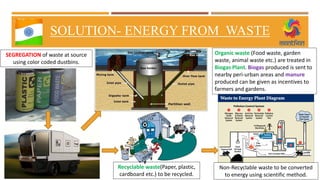
SEGREGATION of waste at source
using color coded dustbins.
Organic waste (Food waste, garden
waste, animal waste etc.) are treated in
Biogas Plant. Biogas produced is sent to
nearby peri-urban areas and manure
produced can be given as incentives to
farmers and gardens.
Recyclable waste(Paper, plastic,
cardboard etc.) to be recycled.
Non-Recyclable waste to be converted
to energy using scientific method.
ROOFTOP SOLAR PROJECT
CURRENT PRACTICE
• Under this Scheme Solar pane are set up on each house on PPP model.
• Electricity generated by this panels is added to the grid network, and
the house-owner gets the equivalent incentives of Rs- 3 per kWh of
energy produced.
• A typical house of plot size 200 Sq. m. and having a Built up area of
120 sq. mt can generate 540 kWh of energy. Thus a monthly discount
of 1620 Rs can be obtained by the house owner.
• Such scheme not only help in reducing transmission cost, but also
decrease the pressure on the government to fulfill the energy demand
of the increasing population.
SOLUTION
CHALLENGES & RISKS V/S MITIGATION FACTORS
CHALLENGES
• Users may no co-operate in source
segregation, and may continue with their
traditional practices.
• Municipalities may not see viability in adopting
renewable energy as a tool to financial
sustainability.
• Municipalities may not be able to fund the
projects.
• Transmission cost may increase if number of
cities increases.
MITIGATION FACTORS
• Continuous awareness programs need to be conducted,
in order to make the people conscious about the
importance of segregating waste.
• A detailed feasibility study can be done and shown to
the stake holders, including the pay back period and
cost recovery mechanism.
• Projects can be carried out on PPP model to support
the projects. Also Government schemes can be
modelled to support this projects.
• Project should be implemented considering the
population.
REFERENCES
 URBANISATION & SUSTAINABILITY IN INDIA : AN INTERDEPENDENT AGENDA by Mirabilis Advisory
 PROPOSAL FOR CARBON NEUTRALTOWNS- SHWETAL SHAH.
 WORLD DATA BANK-WORLD DEVELOPMENTAL INDICATORS.
 AHMEDABAD MUNICIPAL CORPORATION- SOLID WASTE MANAGEMENT PROFILE
 HTTP://WWW.WATERGYMEX.ORG/WATERGY%20TOOLKIT/RESOURCES/ACTIVITIES-SSM-CASE10.HTM
THANK YOU !!
GO GREEN !! DREAM GREEN !! 

DreamGreen

  • 1.
    Ensuring World ClassCivic Amenities In Urban India Team Members Details: Mihir Rambhia, Kartik Kapoor, Kashish Gandhi, Abhijeet Patel, Hardik Soni Civil Engineering, Pandit Deendayal Petroleum University, Gandhinagar. CARBON NEUTRAL MUNICIPALITIES A step towards “Zero Emission City”
  • 2.
    SCENARIO  Urbanization isBooming !!  The cities have emerged as the growth engines of productivity and economic growth for India.  30 % urban population = 60 % contribution in GDP = 90 % contribution in government revenues.  India’s urban population will soar from 391 million in 2012 to 590 million in 2030 and this urban expansion will happen at a speed quite unlike anything India has seen before. – McKinsey Global Institute.  Environment is Degrading !!  India is the world’s fourth largest carbon dioxide (CO2) emitter with emissions amounting to 1.34 billion tonnes per annum.  3 of India’s cities: Delhi, Kolkata and Mumbai figure among the 10 most polluted cities in the world.  60 to 75 percent of total energy is consumed in urban areas.  Urban Infrastructure is Crumbling !!  Mumbai’s suburban railway system, originally designed for a capacity of 1,700 people per 9-car train, runs with super-dense capacities of almost 5,000 people per train during peak time.  About 30 to 50 percent households do not have sewerage connections and less than 20 percent of total waste water is treated.
  • 3.
    WHAT IS THEROOT CAUSE??  Urban Local Bodies(ULBs) which bear the primary responsibility of providing basic civic amenities are experiencing a number of constraints such as poor revenues, inefficient organisational and human resources, lack of supportive environment etc.  User charges are most important sources of non-tax revenues for ULBs. There has been a tendency to charge for various services at rates that are much lower than the actual costs. This has lead to poor cost recovery, poor maintenance and inadequate investments in the infrastructure.  There is a growing realisation therefore, that the problems associated with urbanisation emanates from poor city management and finances rather than being endemic to city growth per se. Not enough revenue' s Poor Infrastructure Investment Poor Maintenance Poor User- Experience Users not ready to pay more revenues
  • 4.
    SNAPSHOT OF SOLUTIONPROPOSED GOAL: Improving a city's Financial Sustainability and Ecological Footprint by using renewable energy sources for municipal electrical consumption. Rooftop Solar Project Common Solar- Thermal Plant & Wind Mills Waste to Electricity • Waste Segregation at source. • Recyclable waste to be sent to recycling units. • Organic waste to be treated in biogas plant for producing Biogas and Organic Manure. • Non-Recyclable waste to be converted to palettes which are used as fuel in various industries. • Biogas to be supplied to nearby semi-urban areas. • Solar panels to be installed on the roof top of each public building. • Electricity produced needs to be connected with the smart-grid network. • Transmission cost and Land space can be saved by this model. • Pay back period of such system varies between 7-10 years. • This model can be extended for entire city on PPP basis. • Solar thermal plants or Wind mills can be built up after a proper study of the amount of energy required by municipality, solar radiation (in case of solar plant), wind velocities (in case of wind mill), distance between different cities, etc., • This plants are constructed in the outskirts of city, so land availability is not an issue.
  • 5.
    CURRENT PRACTICES- MUNICIPALWORKS "During this financial year, the AMC has paid a total of Rs 149.11 crore towards the electricity bill, the expenditure of which comes to around five per cent of our total budget," - Ahmedabad Municipal Commissioner (2012) Problems in current Practices: • Large amount of energy is consumed in pumping water for water supply, and sewage for the disposal. • Street Lights also consume lot of energy if sodium lights are used. • Municipal Administrative buildings also consume huge energy due to artificial lightings, air-conditioning, inefficient electronic appliances etc.,
  • 6.
    SOLUTION- SOLAR PLANT& WIND MILLS • The Capacity Utilization Factor of Solar PV is 14%, whereas it is 23% in case of Solar Thermal. • India has a huge potential of solar energy, as it has an excellent solar radiation and shining days up to 330 days a year !! • India has a coastline of 7517 km’s, which is a clear indicator that it has a huge wind energy potential. • With the advancement in technology, the payback period has reduced to as low as 7 years, and is expected to decrease in further years. • So, a Common Solar Power Plant (CSPP) or Common Wind Mill Station (CWMS) can be set up in such a way that 3-4 municipalities will share the stake holding in the project, and will share the benefits in a similar way. • This system will work similarly as Common Effluent Treatment Plant (CETP), which is a great success.
  • 7.
    - Suitable Site HOWTHE SYSTEM WILL WORK ? • Thus we can see the cluster of cities/towns located very nearby. Generally one big city and 2-3 small towns. • Thus a suitable location can be selected considering solar radiation, shining days, distance from each city etc., for setting up a Common Solar Thermal Plant. Benefits: • As it will be a joint venture, so large capacity will be required, thus overall project cost will be reduced. • Also as this is located in outskirts part of the city, the land will be available at cheaper price, so the cost is less. • A 3 MW capacity Solar Thermal power plant, considering 300 shining days, it can be operated at 23% plant utilization factor, and will produce 51,84,000 units power per year. The cost of this development would be Rs. 40 - 44 Crores and land required would be 4-5 Ha. This much energy can satisfy the need of 5 towns.
  • 8.
    CURRENT PRACTICE –WASTE MANAGEMENT All kind of waste is collected in a common dustbin. Waste is transported collected from the source in mini trucks. Some waste in INCINERATED in open. Rest of the waste is dumped at DUMP SITE. Problems in current Practices: • Zero Cost Recovery. • Large area of Land is occupied and is converted to wasteland. • High chances of infection to the nearby localities. • Rate of degradation is very slow, so requirement of more and more land.
  • 9.
    SOLUTION- ENERGY FROMWASTE SEGREGATION of waste at source using color coded dustbins. Organic waste (Food waste, garden waste, animal waste etc.) are treated in Biogas Plant. Biogas produced is sent to nearby peri-urban areas and manure produced can be given as incentives to farmers and gardens. Recyclable waste(Paper, plastic, cardboard etc.) to be recycled. Non-Recyclable waste to be converted to energy using scientific method.
  • 10.
    ROOFTOP SOLAR PROJECT CURRENTPRACTICE • Under this Scheme Solar pane are set up on each house on PPP model. • Electricity generated by this panels is added to the grid network, and the house-owner gets the equivalent incentives of Rs- 3 per kWh of energy produced. • A typical house of plot size 200 Sq. m. and having a Built up area of 120 sq. mt can generate 540 kWh of energy. Thus a monthly discount of 1620 Rs can be obtained by the house owner. • Such scheme not only help in reducing transmission cost, but also decrease the pressure on the government to fulfill the energy demand of the increasing population. SOLUTION
  • 11.
    CHALLENGES & RISKSV/S MITIGATION FACTORS CHALLENGES • Users may no co-operate in source segregation, and may continue with their traditional practices. • Municipalities may not see viability in adopting renewable energy as a tool to financial sustainability. • Municipalities may not be able to fund the projects. • Transmission cost may increase if number of cities increases. MITIGATION FACTORS • Continuous awareness programs need to be conducted, in order to make the people conscious about the importance of segregating waste. • A detailed feasibility study can be done and shown to the stake holders, including the pay back period and cost recovery mechanism. • Projects can be carried out on PPP model to support the projects. Also Government schemes can be modelled to support this projects. • Project should be implemented considering the population.
  • 12.
    REFERENCES  URBANISATION &SUSTAINABILITY IN INDIA : AN INTERDEPENDENT AGENDA by Mirabilis Advisory  PROPOSAL FOR CARBON NEUTRALTOWNS- SHWETAL SHAH.  WORLD DATA BANK-WORLD DEVELOPMENTAL INDICATORS.  AHMEDABAD MUNICIPAL CORPORATION- SOLID WASTE MANAGEMENT PROFILE  HTTP://WWW.WATERGYMEX.ORG/WATERGY%20TOOLKIT/RESOURCES/ACTIVITIES-SSM-CASE10.HTM THANK YOU !! GO GREEN !! DREAM GREEN !! 