Future Cities
“A Carbon neutral city is my dream….”
-Dr. APJ Abdul Kalam
Aditya Yadav (TC), Akshita Joshi, Shreshthi Prasad, Simran Sappal, Manish Kharkwal
“Ensuring World Class Civic Amenities in Urban India”
The Sustainable City
A milepost to the Future
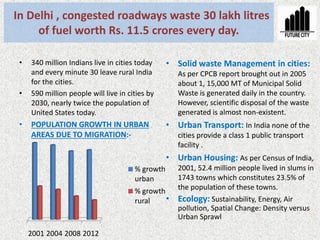
In Delhi , congested roadways waste 30 lakh litres
of fuel worth Rs. 11.5 crores every day.
• 340 million Indians live in cities today
and every minute 30 leave rural India
for the cities.
• 590 million people will live in cities by
2030, nearly twice the population of
United States today.
• POPULATION GROWTH IN URBAN
AREAS DUE TO MIGRATION:-
• Solid waste Management in cities:
As per CPCB report brought out in 2005
about 1, 15,000 MT of Municipal Solid
Waste is generated daily in the country.
However, scientific disposal of the waste
generated is almost non-existent.
• Urban Transport: In India none of the
cities provide a class 1 public transport
facility .
• Urban Housing: As per Census of India,
2001, 52.4 million people lived in slums in
1743 towns which constitutes 23.5% of
the population of these towns.
• Ecology: Sustainability, Energy, Air
pollution, Spatial Change: Density versus
Urban Sprawl
2001 2004 2008 2012
% growth
urban
% growth
rural
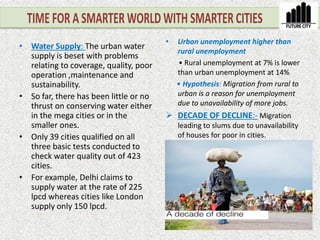
• Urban unemployment higher than
rural unemployment
• Rural unemployment at 7% is lower
than urban unemployment at 14%
• Hypothesis: Migration from rural to
urban is a reason for unemployment
due to unavailability of more jobs.
 DECADE OF DECLINE:- Migration
leading to slums due to unavailability
of houses for poor in cities.
• Water Supply: The urban water
supply is beset with problems
relating to coverage, quality, poor
operation ,maintenance and
sustainability.
• So far, there has been little or no
thrust on conserving water either
in the mega cities or in the
smaller ones.
• Only 39 cities qualified on all
three basic tests conducted to
check water quality out of 423
cities.
• For example, Delhi claims to
supply water at the rate of 225
lpcd whereas cities like London
supply only 150 lpcd.
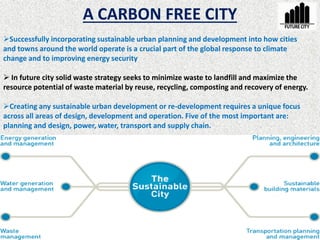
A CARBON FREE CITY
Successfully incorporating sustainable urban planning and development into how cities
and towns around the world operate is a crucial part of the global response to climate
change and to improving energy security
 In future city solid waste strategy seeks to minimize waste to landfill and maximize the
resource potential of waste material by reuse, recycling, composting and recovery of energy.
Creating any sustainable urban development or re-development requires a unique focus
across all areas of design, development and operation. Five of the most important are:
planning and design, power, water, transport and supply chain.
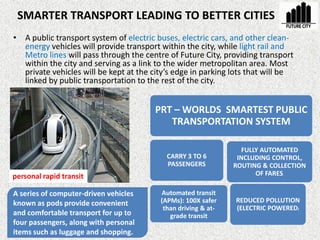
SMARTER TRANSPORT LEADING TO BETTER CITIES
• A public transport system of electric buses, electric cars, and other clean-
energy vehicles will provide transport within the city, while light rail and
Metro lines will pass through the centre of Future City, providing transport
within the city and serving as a link to the wider metropolitan area. Most
private vehicles will be kept at the city’s edge in parking lots that will be
linked by public transportation to the rest of the city.
PRT – WORLDS SMARTEST PUBLIC
TRANSPORTATION SYSTEM
CARRY 3 TO 6
PASSENGERS
REDUCED POLLUTION
(ELECTRIC POWERED)
FULLY AUTOMATED
INCLUDING CONTROL,
ROUTING & COLLECTION
OF FARES.
Automated transit
(APMs): 100X safer
than driving & at-
grade transit
personal rapid transit
A series of computer-driven vehicles
known as pods provide convenient
and comfortable transport for up to
four passengers, along with personal
items such as luggage and shopping.
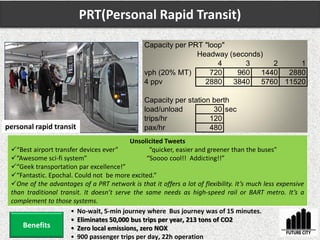
PRT(Personal Rapid Transit)
• .
• No-wait, 5-min journey where Bus journey was of 15 minutes.
• Eliminates 50,000 bus trips per year, 213 tons of CO2
• Zero local emissions, zero NOX
• 900 passenger trips per day, 22h operation
Benefits
Unsolicited Tweets
“Best airport transfer devices ever” “quicker, easier and greener than the buses”
“Awesome sci-fi system” “Soooo cool!! Addicting!!”
“Geek transportation par excellence!”
“Fantastic. Epochal. Could not be more excited.”
One of the advantages of a PRT network is that it offers a lot of flexibility. It’s much less expensive
than traditional transit. It doesn’t serve the same needs as high-speed rail or BART metro. It’s a
complement to those systems.
Capacity per PRT "loop"
Headway (seconds)
4 3 2 1
vph (20% MT) 720 960 1440 2880
4 ppv 2880 3840 5760 11520
Capacity per station berth
load/unload 30 sec
trips/hr 120
pax/hr 480personal rapid transit
$7M - $15M Cost per KM
• Cost function = f
• {
– System size (larger is cheaper because of
fixed costs)
– Station Density (more stations/mile =>
higher cost)
– Peak hour trip demand (more demand =>
more vehicles)
– Guide way:
• Elevated
• At-grade
• Tunnel
• Culvert
• Cantilever
• Bi-directional
• Seismic requirements
• “Curviness”
– Stations: “fancy” costs more
– Vehicle customizations.
– Desired average passenger wait
time (shorter wait => more vehicles)
• }.
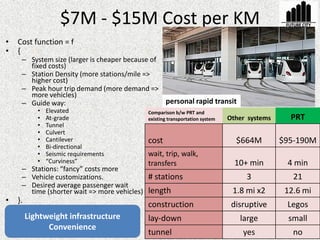
Comparison b/w PRT and
existing transportation system Other systems PRT
cost $664M $95-190M
wait, trip, walk,
transfers 10+ min 4 min
# stations 3 21
length 1.8 mi x2 12.6 mi
construction disruptive Legos
lay-down large small
tunnel yes no
personal rapid transit
Lightweight infrastructure
Convenience
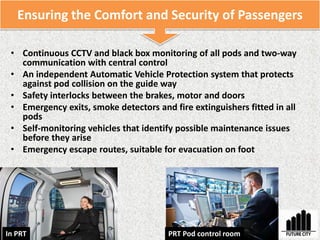
• Continuous CCTV and black box monitoring of all pods and two-way
communication with central control
• An independent Automatic Vehicle Protection system that protects
against pod collision on the guide way
• Safety interlocks between the brakes, motor and doors
• Emergency exits, smoke detectors and fire extinguishers fitted in all
pods
• Self-monitoring vehicles that identify possible maintenance issues
before they arise
• Emergency escape routes, suitable for evacuation on foot
Ensuring the Comfort and Security of Passengers
PRT Pod control roomIn PRT
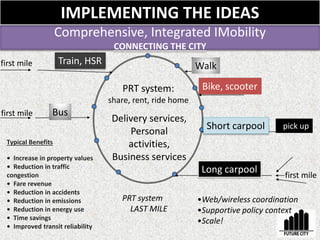
first mile Train, HSR
first mile Bus
PRT system:
share, rent, ride home
Delivery services,
Personal
activities,
Business services
PRT system
LAST MILE
Walk
Bike, scooter
Short carpool pick up
first mile
Long carpool
•Web/wireless coordination
•Supportive policy context
•Scale!
Typical Benefits
• Increase in property values
• Reduction in traffic
congestion
• Fare revenue
• Reduction in accidents
• Reduction in emissions
• Reduction in energy use
• Time savings
• Improved transit reliability
Comprehensive, Integrated IMobility
CONNECTING THE CITY
IMPLEMENTING THE IDEAS
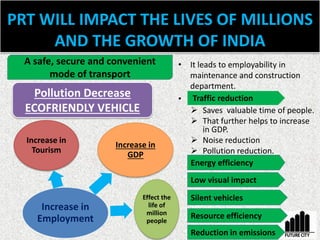
PRT WILL IMPACT THE LIVES OF MILLIONS
AND THE GROWTH OF INDIA
Increase in
Employment
Increase in
GDP
Effect the
life of
million
people
Increase in
Tourism
Pollution Decrease
ECOFRIENDLY VEHICLE
• It leads to employability in
maintenance and construction
department.
• Traffic reduction :-
 Saves valuable time of people.
 That further helps to increase
in GDP.
 Noise reduction
 Pollution reduction.
Traffic reduction
Reduction in emissions
Silent vehicles
Low visual impact
Resource efficiency
Energy efficiency
A safe, secure and convenient
mode of transport
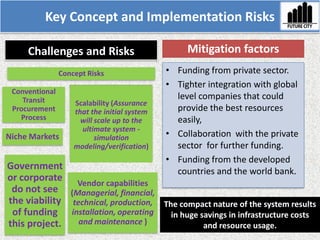
Key Concept and Implementation Risks
Challenges and Risks Mitigation factors
• Funding from private sector.
• Tighter integration with global
level companies that could
provide the best resources
easily,
• Collaboration with the private
sector for further funding.
• Funding from the developed
countries and the world bank.
Concept Risks
Government
or corporate
do not see
the viability
of funding
this project.
Conventional
Transit
Procurement
Process
Scalability (Assurance
that the initial system
will scale up to the
ultimate system -
simulation
modeling/verification)
Niche Markets
Vendor capabilities
(Managerial, financial,
technical, production,
installation, operating
and maintenance )
The compact nature of the system results
in huge savings in infrastructure costs
and resource usage.
•Wikipedia
•Hindustan Construction Company Ltd
•Mott MacDonald Limited
•Mubadala Development Company
•WORLDBANK
•ECONOMICTIMES.INDIATIMES.COM
•THE TIMES OF INDIA
•Ultra Global Prt
Reference

COMMIX

  • 1.
    Future Cities “A Carbonneutral city is my dream….” -Dr. APJ Abdul Kalam Aditya Yadav (TC), Akshita Joshi, Shreshthi Prasad, Simran Sappal, Manish Kharkwal “Ensuring World Class Civic Amenities in Urban India” The Sustainable City A milepost to the Future
  • 2.
    In Delhi ,congested roadways waste 30 lakh litres of fuel worth Rs. 11.5 crores every day. • 340 million Indians live in cities today and every minute 30 leave rural India for the cities. • 590 million people will live in cities by 2030, nearly twice the population of United States today. • POPULATION GROWTH IN URBAN AREAS DUE TO MIGRATION:- • Solid waste Management in cities: As per CPCB report brought out in 2005 about 1, 15,000 MT of Municipal Solid Waste is generated daily in the country. However, scientific disposal of the waste generated is almost non-existent. • Urban Transport: In India none of the cities provide a class 1 public transport facility . • Urban Housing: As per Census of India, 2001, 52.4 million people lived in slums in 1743 towns which constitutes 23.5% of the population of these towns. • Ecology: Sustainability, Energy, Air pollution, Spatial Change: Density versus Urban Sprawl 2001 2004 2008 2012 % growth urban % growth rural
  • 3.
    • Urban unemploymenthigher than rural unemployment • Rural unemployment at 7% is lower than urban unemployment at 14% • Hypothesis: Migration from rural to urban is a reason for unemployment due to unavailability of more jobs.  DECADE OF DECLINE:- Migration leading to slums due to unavailability of houses for poor in cities. • Water Supply: The urban water supply is beset with problems relating to coverage, quality, poor operation ,maintenance and sustainability. • So far, there has been little or no thrust on conserving water either in the mega cities or in the smaller ones. • Only 39 cities qualified on all three basic tests conducted to check water quality out of 423 cities. • For example, Delhi claims to supply water at the rate of 225 lpcd whereas cities like London supply only 150 lpcd.
  • 4.
    A CARBON FREECITY Successfully incorporating sustainable urban planning and development into how cities and towns around the world operate is a crucial part of the global response to climate change and to improving energy security  In future city solid waste strategy seeks to minimize waste to landfill and maximize the resource potential of waste material by reuse, recycling, composting and recovery of energy. Creating any sustainable urban development or re-development requires a unique focus across all areas of design, development and operation. Five of the most important are: planning and design, power, water, transport and supply chain.
  • 5.
    SMARTER TRANSPORT LEADINGTO BETTER CITIES • A public transport system of electric buses, electric cars, and other clean- energy vehicles will provide transport within the city, while light rail and Metro lines will pass through the centre of Future City, providing transport within the city and serving as a link to the wider metropolitan area. Most private vehicles will be kept at the city’s edge in parking lots that will be linked by public transportation to the rest of the city. PRT – WORLDS SMARTEST PUBLIC TRANSPORTATION SYSTEM CARRY 3 TO 6 PASSENGERS REDUCED POLLUTION (ELECTRIC POWERED) FULLY AUTOMATED INCLUDING CONTROL, ROUTING & COLLECTION OF FARES. Automated transit (APMs): 100X safer than driving & at- grade transit personal rapid transit A series of computer-driven vehicles known as pods provide convenient and comfortable transport for up to four passengers, along with personal items such as luggage and shopping.
  • 6.
    PRT(Personal Rapid Transit) •. • No-wait, 5-min journey where Bus journey was of 15 minutes. • Eliminates 50,000 bus trips per year, 213 tons of CO2 • Zero local emissions, zero NOX • 900 passenger trips per day, 22h operation Benefits Unsolicited Tweets “Best airport transfer devices ever” “quicker, easier and greener than the buses” “Awesome sci-fi system” “Soooo cool!! Addicting!!” “Geek transportation par excellence!” “Fantastic. Epochal. Could not be more excited.” One of the advantages of a PRT network is that it offers a lot of flexibility. It’s much less expensive than traditional transit. It doesn’t serve the same needs as high-speed rail or BART metro. It’s a complement to those systems. Capacity per PRT "loop" Headway (seconds) 4 3 2 1 vph (20% MT) 720 960 1440 2880 4 ppv 2880 3840 5760 11520 Capacity per station berth load/unload 30 sec trips/hr 120 pax/hr 480personal rapid transit
  • 7.
    $7M - $15MCost per KM • Cost function = f • { – System size (larger is cheaper because of fixed costs) – Station Density (more stations/mile => higher cost) – Peak hour trip demand (more demand => more vehicles) – Guide way: • Elevated • At-grade • Tunnel • Culvert • Cantilever • Bi-directional • Seismic requirements • “Curviness” – Stations: “fancy” costs more – Vehicle customizations. – Desired average passenger wait time (shorter wait => more vehicles) • }. Comparison b/w PRT and existing transportation system Other systems PRT cost $664M $95-190M wait, trip, walk, transfers 10+ min 4 min # stations 3 21 length 1.8 mi x2 12.6 mi construction disruptive Legos lay-down large small tunnel yes no personal rapid transit Lightweight infrastructure Convenience
  • 8.
    • Continuous CCTVand black box monitoring of all pods and two-way communication with central control • An independent Automatic Vehicle Protection system that protects against pod collision on the guide way • Safety interlocks between the brakes, motor and doors • Emergency exits, smoke detectors and fire extinguishers fitted in all pods • Self-monitoring vehicles that identify possible maintenance issues before they arise • Emergency escape routes, suitable for evacuation on foot Ensuring the Comfort and Security of Passengers PRT Pod control roomIn PRT
  • 9.
    first mile Train,HSR first mile Bus PRT system: share, rent, ride home Delivery services, Personal activities, Business services PRT system LAST MILE Walk Bike, scooter Short carpool pick up first mile Long carpool •Web/wireless coordination •Supportive policy context •Scale! Typical Benefits • Increase in property values • Reduction in traffic congestion • Fare revenue • Reduction in accidents • Reduction in emissions • Reduction in energy use • Time savings • Improved transit reliability Comprehensive, Integrated IMobility CONNECTING THE CITY IMPLEMENTING THE IDEAS
  • 10.
    PRT WILL IMPACTTHE LIVES OF MILLIONS AND THE GROWTH OF INDIA Increase in Employment Increase in GDP Effect the life of million people Increase in Tourism Pollution Decrease ECOFRIENDLY VEHICLE • It leads to employability in maintenance and construction department. • Traffic reduction :-  Saves valuable time of people.  That further helps to increase in GDP.  Noise reduction  Pollution reduction. Traffic reduction Reduction in emissions Silent vehicles Low visual impact Resource efficiency Energy efficiency A safe, secure and convenient mode of transport
  • 11.
    Key Concept andImplementation Risks Challenges and Risks Mitigation factors • Funding from private sector. • Tighter integration with global level companies that could provide the best resources easily, • Collaboration with the private sector for further funding. • Funding from the developed countries and the world bank. Concept Risks Government or corporate do not see the viability of funding this project. Conventional Transit Procurement Process Scalability (Assurance that the initial system will scale up to the ultimate system - simulation modeling/verification) Niche Markets Vendor capabilities (Managerial, financial, technical, production, installation, operating and maintenance ) The compact nature of the system results in huge savings in infrastructure costs and resource usage.
  • 12.
    •Wikipedia •Hindustan Construction CompanyLtd •Mott MacDonald Limited •Mubadala Development Company •WORLDBANK •ECONOMICTIMES.INDIATIMES.COM •THE TIMES OF INDIA •Ultra Global Prt Reference