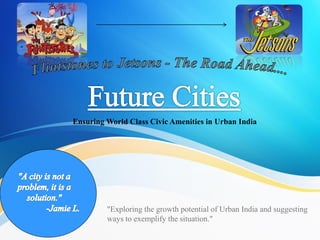
Ensuring World Class Civic Amenities in Urban India
"Exploring the growth potential of Urban India and suggesting
ways to exemplify the situation."
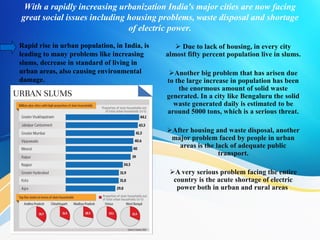
With a rapidly increasing urbanization India's major cities are now facing
great social issues including housing problems, waste disposal and shortage
of electric power.
 Due to lack of housing, in every city
almost fifty percent population live in slums.
Another big problem that has arisen due
to the large increase in population has been
the enormous amount of solid waste
generated. In a city like Bengaluru the solid
waste generated daily is estimated to be
around 5000 tons, which is a serious threat.
After housing and waste disposal, another
major problem faced by people in urban
areas is the lack of adequate public
transport.
A very serious problem facing the entire
country is the acute shortage of electric
power both in urban and rural areas.
Rapid rise in urban population, in India, is
leading to many problems like increasing
slums, decrease in standard of living in
urban areas, also causing environmental
damage.
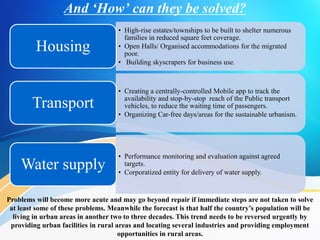
And ‘How’ can they be solved?
• High-rise estates/townships to be built to shelter numerous
families in reduced square feet coverage.
• Open Halls/ Organised accommodations for the migrated
poor.
• Building skyscrapers for business use.
Housing
• Creating a centrally-controlled Mobile app to track the
availability and stop-by-stop reach of the Public transport
vehicles, to reduce the waiting time of passengers.
• Organizing Car-free days/areas for the sustainable urbanism.
Transport
• Performance monitoring and evaluation against agreed
targets.
• Corporatized entity for delivery of water supply.
Water supply
Problems will become more acute and may go beyond repair if immediate steps are not taken to solve
at least some of these problems. Meanwhile the forecast is that half the country’s population will be
living in urban areas in another two to three decades. This trend needs to be reversed urgently by
providing urban facilities in rural areas and locating several industries and providing employment
opportunities in rural areas.
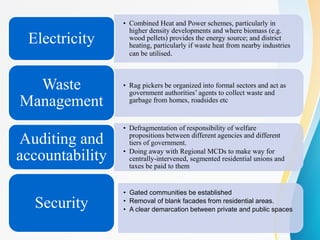
• Combined Heat and Power schemes, particularly in
higher density developments and where biomass (e.g.
wood pellets) provides the energy source; and district
heating, particularly if waste heat from nearby industries
can be utilised.
Electricity
• Rag pickers be organized into formal sectors and act as
government authorities’ agents to collect waste and
garbage from homes, roadsides etc
Waste
Management
• Defragmentation of responsibility of welfare
propositions between different agencies and different
tiers of government.
• Doing away with Regional MCDs to make way for
centrally-intervened, segmented residential unions and
taxes be paid to them
Auditing and
accountability
Security
• Gated communities be established
• Removal of blank facades from residential areas.
• A clear demarcation between private and public spaces
Implementation: Living the solution
Urban administrators face huge challenges to make cities more sustainable. From traffic jams
and inefficient buildings to social inequality and housing, the problems are complex and hard
to tackle — but not insurmountable.
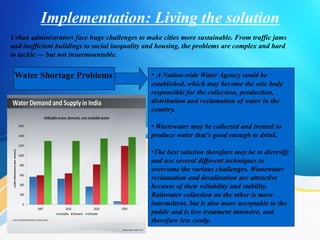
Water Shortage Problems • A Nation-wide Water Agency could be
established, which may become the sole body
responsible for the collection, production,
distribution and reclamation of water in the
country.
• Wastewater may be collected and treated to
produce water that's good enough to drink.
•The best solution therefore may be to diversify
and use several different techniques to
overcome the various challenges. Wastewater
reclamation and desalination are attractive
because of their reliability and stability.
Rainwater collection on the other is more
intermittent, but is also more acceptable to the
public and is less treatment intensive, and
therefore less costly.
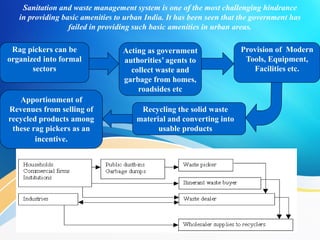
Sanitation and waste management system is one of the most challenging hindrance
in providing basic amenities to urban India. It has been seen that the government has
failed in providing such basic amenities in urban areas.
Rag pickers can be
organized into formal
sectors
Acting as government
authorities’ agents to
collect waste and
garbage from homes,
roadsides etc
Provision of Modern
Tools, Equipment,
Facilities etc.
Recycling the solid waste
material and converting into
usable products
Apportionment of
Revenues from selling of
recycled products among
these rag pickers as an
incentive.
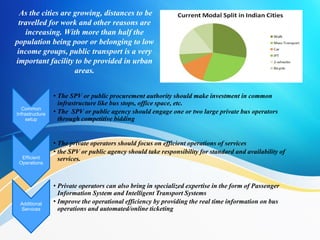
As the cities are growing, distances to be
travelled for work and other reasons are
increasing. With more than half the
population being poor or belonging to low
income groups, public transport is a very
important facility to be provided in urban
areas.
Common
Infrastructure
setup
• The SPV or public procurement authority should make investment in common
infrastructure like bus stops, office space, etc.
• The SPV or public agency should engage one or two large private bus operators
through competitive bidding
Efficient
Operations
• The private operators should focus on efficient operations of services
• the SPV or public agency should take responsibility for standard and availability of
services.
Additional
Services
• Private operators can also bring in specialized expertise in the form of Passenger
Information System and Intelligent Transport Systems
• Improve the operational efficiency by providing the real time information on bus
operations and automated/online ticketing
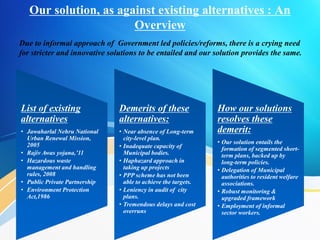
Our solution, as against existing alternatives : An
Overview
List of existing
alternatives
• Jawaharlal Nehru National
Urban Renewal Mission,
2005
• Rajiv Awas yojana,’11
• Hazardous waste
management and handling
rules, 2008
• Public Private Partnership
• Environment Protection
Act,1986
Demerits of these
alternatives:
• Near absence of Long-term
city-level plan.
• Inadequate capacity of
Municipal bodies.
• Haphazard approach in
taking up projects
• PPP scheme has not been
able to achieve the targets.
• Leniency in audit of city
plans.
• Tremendous delays and cost
overruns
How our solutions
resolves these
demerit:
• Our solution entails the
formation of segmented short-
term plans, backed up by
long-term policies.
• Delegation of Municipal
authorities to resident welfare
associations.
• Robust monitoring &
upgraded framework
• Employment of informal
sector workers.
Due to informal approach of Government led policies/reforms, there is a crying need
for stricter and innovative solutions to be entailed and our solution provides the same.
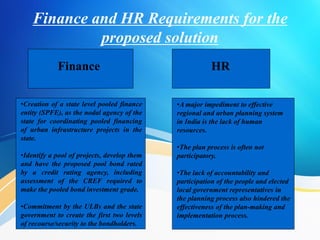
Finance and HR Requirements for the
proposed solution
Finance
•Creation of a state level pooled finance
entity (SPFE), as the nodal agency of the
state for coordinating pooled financing
of urban infrastructure projects in the
state.
•Identify a pool of projects, develop them
and have the proposed pool bond rated
by a credit rating agency, including
assessment of the CREF required to
make the pooled bond investment grade.
•Commitment by the ULBs and the state
government to create the first two levels
of recourse/security to the bondholders.
HR
•A major impediment to effective
regional and urban planning system
in India is the lack of human
resources.
•The plan process is often not
participatory.
•The lack of accountability and
participation of the people and elected
local government representatives in
the planning process also hindered the
effectiveness of the plan-making and
implementation process.
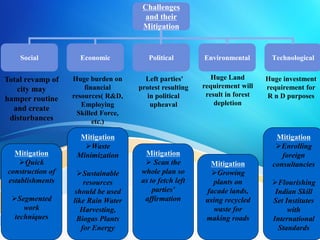
Challenges
and their
Mitigation
Social Environmental TechnologicalPoliticalEconomic
Total revamp of
city may
hamper routine
and create
disturbances
Huge burden on
financial
resources( R&D,
Employing
Skilled Force,
etc.)
Left parties'
protest resulting
in political
upheaval
Huge Land
requirement will
result in forest
depletion
Huge investment
requirement for
R n D purposes
Mitigation
Quick
construction of
establishments
Segmented
work
techniques
Mitigation
Waste
Minimization
Sustainable
resources
should be used
like Rain Water
Harvesting,
Biogas Plants
for Energy
Mitigation
Enrolling
foreign
consultancies
Flourishing
Indian Skill
Set Institutes
with
International
Standards
Mitigation
Growing
plants on
facade lands,
using recycled
waste for
making roads
Mitigation
 Scan the
whole plan so
as to fetch left
parties'
affirmation
Conclusion
Since recent globalization, the migration of rural mass to urban areas in
search of employment and better living standards has been quite a concern.
And after being able to exemplify the whole situation, the proposed solution i.e.
the whole concept of ‘Satellite cities’, may appear quite speculative in
consequence. Being a state subject, the funding has to be initiated by the
government itself, in the form of huge capital investment on establishment and
innovative renewal, which will ,in not so distant future be segmented to Private
and Public-Private holdings. This whole concept would require a whole lot of
funding capacity, backed up with stricter implementation and auditing
practices. Management of the ‘Master Plan’ would definitely be the facilitator
but what needs to be kept in mind, is that its affordability and credibility would
matter the most, as for instance, until and unless the housing facility is
affordable, the slum dwellers won’t shift from their normal place of dwelling.
Hence, in conclusion, it will be apt to mention that such ambitious, yet so
practically suited plans, are though the need of the hour, but still, in absence of
what we call “Proper Management”, the whole idea would flunk as is the case
with most other “revolutionary” reforms. Not that it’s good to be pessimistic in
approach , but only wariness would ensure the sustainability of such a plan,
which once executed would not only help ensure the civic amenities to Urban
India, but would also built a land never dreamt of.
Appendix
1. Wikipedia, The Free Encyclopedia. http://www.wikipedia.org/
2. Delhi Master Plan 2021. http://delhi-masterplan.com/
3. Ministry of Urban Development. http://moud.gov.in/
4. Research Study. http://www.urbanindia.nic.in/
5. Report on Urban Infrastuructre. http://www.niua.org/
6. Planning Commission. http://planningcommission.nic.in/
Here we present the team;
• Team Coordinator- Damneet Kalra
Jai Sehgal
Gagandeep Kaur Bhamra
Gurveen Kaur
Ramneek Kaur
-Thanks-

SGGSCC1993

  • 1.
    Ensuring World ClassCivic Amenities in Urban India "Exploring the growth potential of Urban India and suggesting ways to exemplify the situation."
  • 2.
    With a rapidlyincreasing urbanization India's major cities are now facing great social issues including housing problems, waste disposal and shortage of electric power.  Due to lack of housing, in every city almost fifty percent population live in slums. Another big problem that has arisen due to the large increase in population has been the enormous amount of solid waste generated. In a city like Bengaluru the solid waste generated daily is estimated to be around 5000 tons, which is a serious threat. After housing and waste disposal, another major problem faced by people in urban areas is the lack of adequate public transport. A very serious problem facing the entire country is the acute shortage of electric power both in urban and rural areas. Rapid rise in urban population, in India, is leading to many problems like increasing slums, decrease in standard of living in urban areas, also causing environmental damage.
  • 3.
    And ‘How’ canthey be solved? • High-rise estates/townships to be built to shelter numerous families in reduced square feet coverage. • Open Halls/ Organised accommodations for the migrated poor. • Building skyscrapers for business use. Housing • Creating a centrally-controlled Mobile app to track the availability and stop-by-stop reach of the Public transport vehicles, to reduce the waiting time of passengers. • Organizing Car-free days/areas for the sustainable urbanism. Transport • Performance monitoring and evaluation against agreed targets. • Corporatized entity for delivery of water supply. Water supply Problems will become more acute and may go beyond repair if immediate steps are not taken to solve at least some of these problems. Meanwhile the forecast is that half the country’s population will be living in urban areas in another two to three decades. This trend needs to be reversed urgently by providing urban facilities in rural areas and locating several industries and providing employment opportunities in rural areas.
  • 4.
    • Combined Heatand Power schemes, particularly in higher density developments and where biomass (e.g. wood pellets) provides the energy source; and district heating, particularly if waste heat from nearby industries can be utilised. Electricity • Rag pickers be organized into formal sectors and act as government authorities’ agents to collect waste and garbage from homes, roadsides etc Waste Management • Defragmentation of responsibility of welfare propositions between different agencies and different tiers of government. • Doing away with Regional MCDs to make way for centrally-intervened, segmented residential unions and taxes be paid to them Auditing and accountability Security • Gated communities be established • Removal of blank facades from residential areas. • A clear demarcation between private and public spaces
  • 5.
    Implementation: Living thesolution Urban administrators face huge challenges to make cities more sustainable. From traffic jams and inefficient buildings to social inequality and housing, the problems are complex and hard to tackle — but not insurmountable. Water Shortage Problems • A Nation-wide Water Agency could be established, which may become the sole body responsible for the collection, production, distribution and reclamation of water in the country. • Wastewater may be collected and treated to produce water that's good enough to drink. •The best solution therefore may be to diversify and use several different techniques to overcome the various challenges. Wastewater reclamation and desalination are attractive because of their reliability and stability. Rainwater collection on the other is more intermittent, but is also more acceptable to the public and is less treatment intensive, and therefore less costly.
  • 6.
    Sanitation and wastemanagement system is one of the most challenging hindrance in providing basic amenities to urban India. It has been seen that the government has failed in providing such basic amenities in urban areas. Rag pickers can be organized into formal sectors Acting as government authorities’ agents to collect waste and garbage from homes, roadsides etc Provision of Modern Tools, Equipment, Facilities etc. Recycling the solid waste material and converting into usable products Apportionment of Revenues from selling of recycled products among these rag pickers as an incentive.
  • 7.
    As the citiesare growing, distances to be travelled for work and other reasons are increasing. With more than half the population being poor or belonging to low income groups, public transport is a very important facility to be provided in urban areas. Common Infrastructure setup • The SPV or public procurement authority should make investment in common infrastructure like bus stops, office space, etc. • The SPV or public agency should engage one or two large private bus operators through competitive bidding Efficient Operations • The private operators should focus on efficient operations of services • the SPV or public agency should take responsibility for standard and availability of services. Additional Services • Private operators can also bring in specialized expertise in the form of Passenger Information System and Intelligent Transport Systems • Improve the operational efficiency by providing the real time information on bus operations and automated/online ticketing
  • 8.
    Our solution, asagainst existing alternatives : An Overview List of existing alternatives • Jawaharlal Nehru National Urban Renewal Mission, 2005 • Rajiv Awas yojana,’11 • Hazardous waste management and handling rules, 2008 • Public Private Partnership • Environment Protection Act,1986 Demerits of these alternatives: • Near absence of Long-term city-level plan. • Inadequate capacity of Municipal bodies. • Haphazard approach in taking up projects • PPP scheme has not been able to achieve the targets. • Leniency in audit of city plans. • Tremendous delays and cost overruns How our solutions resolves these demerit: • Our solution entails the formation of segmented short- term plans, backed up by long-term policies. • Delegation of Municipal authorities to resident welfare associations. • Robust monitoring & upgraded framework • Employment of informal sector workers. Due to informal approach of Government led policies/reforms, there is a crying need for stricter and innovative solutions to be entailed and our solution provides the same.
  • 9.
    Finance and HRRequirements for the proposed solution Finance •Creation of a state level pooled finance entity (SPFE), as the nodal agency of the state for coordinating pooled financing of urban infrastructure projects in the state. •Identify a pool of projects, develop them and have the proposed pool bond rated by a credit rating agency, including assessment of the CREF required to make the pooled bond investment grade. •Commitment by the ULBs and the state government to create the first two levels of recourse/security to the bondholders. HR •A major impediment to effective regional and urban planning system in India is the lack of human resources. •The plan process is often not participatory. •The lack of accountability and participation of the people and elected local government representatives in the planning process also hindered the effectiveness of the plan-making and implementation process.
  • 10.
    Challenges and their Mitigation Social EnvironmentalTechnologicalPoliticalEconomic Total revamp of city may hamper routine and create disturbances Huge burden on financial resources( R&D, Employing Skilled Force, etc.) Left parties' protest resulting in political upheaval Huge Land requirement will result in forest depletion Huge investment requirement for R n D purposes Mitigation Quick construction of establishments Segmented work techniques Mitigation Waste Minimization Sustainable resources should be used like Rain Water Harvesting, Biogas Plants for Energy Mitigation Enrolling foreign consultancies Flourishing Indian Skill Set Institutes with International Standards Mitigation Growing plants on facade lands, using recycled waste for making roads Mitigation  Scan the whole plan so as to fetch left parties' affirmation
  • 11.
    Conclusion Since recent globalization,the migration of rural mass to urban areas in search of employment and better living standards has been quite a concern. And after being able to exemplify the whole situation, the proposed solution i.e. the whole concept of ‘Satellite cities’, may appear quite speculative in consequence. Being a state subject, the funding has to be initiated by the government itself, in the form of huge capital investment on establishment and innovative renewal, which will ,in not so distant future be segmented to Private and Public-Private holdings. This whole concept would require a whole lot of funding capacity, backed up with stricter implementation and auditing practices. Management of the ‘Master Plan’ would definitely be the facilitator but what needs to be kept in mind, is that its affordability and credibility would matter the most, as for instance, until and unless the housing facility is affordable, the slum dwellers won’t shift from their normal place of dwelling. Hence, in conclusion, it will be apt to mention that such ambitious, yet so practically suited plans, are though the need of the hour, but still, in absence of what we call “Proper Management”, the whole idea would flunk as is the case with most other “revolutionary” reforms. Not that it’s good to be pessimistic in approach , but only wariness would ensure the sustainability of such a plan, which once executed would not only help ensure the civic amenities to Urban India, but would also built a land never dreamt of.
  • 12.
    Appendix 1. Wikipedia, TheFree Encyclopedia. http://www.wikipedia.org/ 2. Delhi Master Plan 2021. http://delhi-masterplan.com/ 3. Ministry of Urban Development. http://moud.gov.in/ 4. Research Study. http://www.urbanindia.nic.in/ 5. Report on Urban Infrastuructre. http://www.niua.org/ 6. Planning Commission. http://planningcommission.nic.in/
  • 13.
    Here we presentthe team; • Team Coordinator- Damneet Kalra Jai Sehgal Gagandeep Kaur Bhamra Gurveen Kaur Ramneek Kaur -Thanks-