
LOGO


       THE SOLAR CITY
        LINZ, AUSTRIA
LOGO


 Prepared by:

 1- YOUSEF HASANIN   P62306
 2- MUSTAFA TALIB    P60915
 3-SAHAR ABD ALI     P65295

 presented to :
 PROF.IR.DR. RIZAATIQ RAHMAT
Location


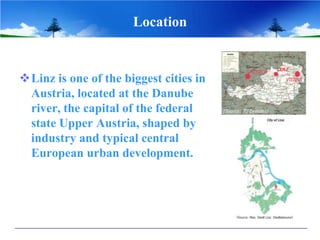
Linz is one of the biggest cities in
 Austria, located at the Danube
 river, the capital of the federal
 state Upper Austria, shaped by
 industry and typical central
 European urban development.
Scope


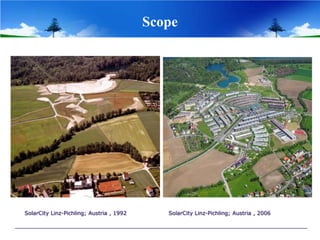
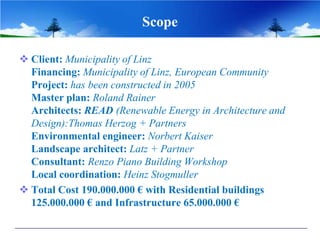
SolarCity Linz-Pichling; Austria , 1992      SolarCity Linz-Pichling; Austria , 2006
Scope

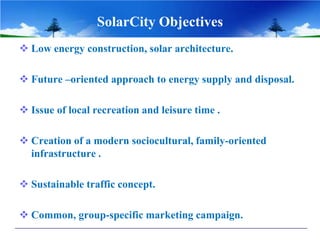
 Client: Municipality of Linz
  Financing: Municipality of Linz, European Community
  Project: has been constructed in 2005
  Master plan: Roland Rainer
  Architects: READ (Renewable Energy in Architecture and
  Design):Thomas Herzog + Partners
  Environmental engineer: Norbert Kaiser
  Landscape architect: Latz + Partner
  Consultant: Renzo Piano Building Workshop
  Local coordination: Heinz Stogmuller
 Total Cost 190.000.000 € with Residential buildings
  125.000.000 € and Infrastructure 65.000.000 €
SolarCity Objectives
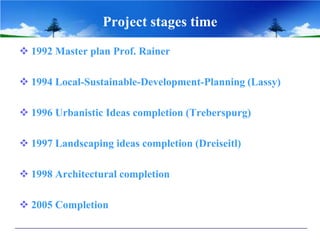
 Low energy construction, solar architecture.

 Future –oriented approach to energy supply and disposal.

 Issue of local recreation and leisure time .

 Creation of a modern sociocultural, family-oriented
  infrastructure .

 Sustainable traffic concept.

 Common, group-specific marketing campaign.
Project stages time
 1992 Master plan Prof. Rainer

 1994 Local-Sustainable-Development-Planning (Lassy)

 1996 Urbanistic Ideas completion (Treberspurg)

 1997 Landscaping ideas completion (Dreiseitl)

 1998 Architectural completion

 2005 Completion
Urban Planning
 The SolarCity designed within 1300 apartments + central
  infrastructure ( local shops, sociocultural facilities, school
  center, kindergarten, pastoral center, sports park).

 Central tram stop ( max. walking-distance 300 m to
  apartments).

 Building designed of 2-4 stories high and the orientation to
  the south, avoidance of shadowing.

 Part of green spaces 60%, distance to the nature protection
  area “Traun-Danube-Alluvial meadows” 50-80m.
Project organization
 The following organisational measures have been taken to
  deal with inter-entrepreneurial activities:
• Installation of a project supervisory board as consulting
  organ during the planning phase.
• A central office coordinates the entire operational process.
• The Advisory Council is composed of top-level of politics,
  administration, associations and enterprises .
• Development of a computer-assisted communications and
  administration network via email and Internet.
• Documentation of the entire course of the project.
• Determination of the project objectives and contents, and
  the project organisation structure in a project contract.
The visualization

 The visualization was developed with the goal of
  promoting the interactive involvement of all relevant
  parties (municipal administration, architects, housing
  developers, neighboring residents, future residents) in the
  planning and realization process at an early stage as a
  virtual realty model of the SolarCity project.
 Center model …
 Kindergarten model….
Solar Architecture

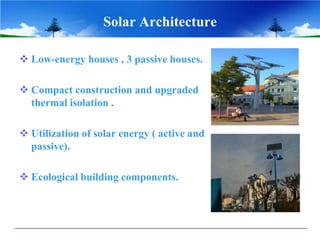
 Low-energy houses , 3 passive houses.

 Compact construction and upgraded
  thermal isolation .

 Utilization of solar energy ( active and
  passive).

 Ecological building components.
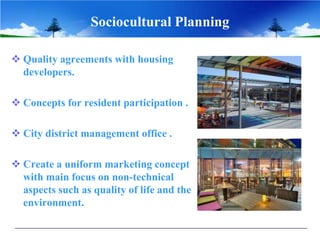
Sociocultural Planning

 Quality agreements with housing
  developers.

 Concepts for resident participation .

 City district management office .

 Create a uniform marketing concept
  with main focus on non-technical
  aspects such as quality of life and the
  environment.
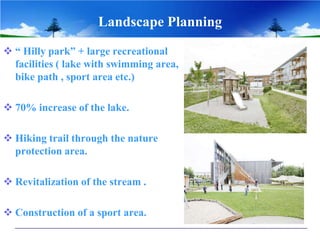
Landscape Planning
 “ Hilly park” + large recreational
  facilities ( lake with swimming area,
  bike path , sport area etc.)

 70% increase of the lake.

 Hiking trail through the nature
  protection area.

 Revitalization of the stream .

 Construction of a sport area.
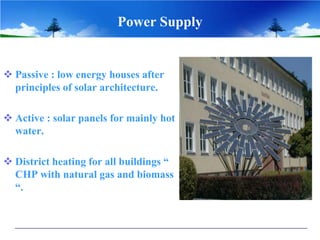
Power Supply


 Passive : low energy houses after
  principles of solar architecture.

 Active : solar panels for mainly hot
  water.

 District heating for all buildings “
  CHP with natural gas and biomass
  “.
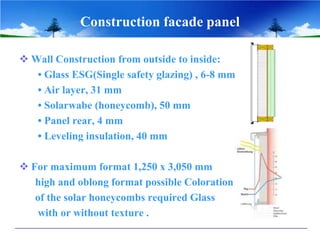
Construction facade panel

 Wall Construction from outside to inside:
   • Glass ESG(Single safety glazing) , 6-8 mm
   • Air layer, 31 mm
   • Solarwabe (honeycomb), 50 mm
   • Panel rear, 4 mm
   • Leveling insulation, 40 mm

 For maximum format 1,250 x 3,050 mm
   high and oblong format possible Coloration
   of the solar honeycombs required Glass
    with or without texture .
The solar facade functional principle

 The honeycomb cellulose act as a solar absorber

 At low position of the sun(winter) the solar load penetrates
  into the solar honeycomb and heat up.

 At high position of the sun(summer) the honeycomb shade
  itself.

 An additional mechanical sun-shading isn't needed.

 The temperature difference between living space to outer
  climate is balanced
Wall Units


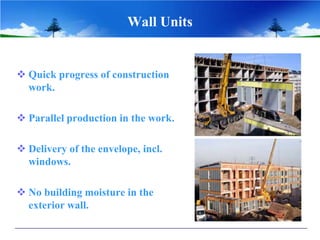
 Quick progress of construction
  work.

 Parallel production in the work.

 Delivery of the envelope, incl.
  windows.

 No building moisture in the
  exterior wall.
Sound proofing


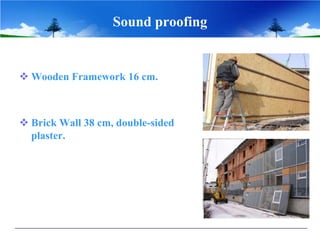
 Wooden Framework 16 cm.


 Brick Wall 38 cm, double-sided
  plaster.
Fire protection system
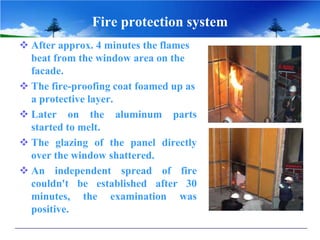
 After approx. 4 minutes the flames
  beat from the window area on the
  facade.
 The fire-proofing coat foamed up as
  a protective layer.
 Later on the aluminum parts
  started to melt.
 The glazing of the panel directly
  over the window shattered.
 An independent spread of fire
  couldn't be established after 30
  minutes, the examination was
  positive.
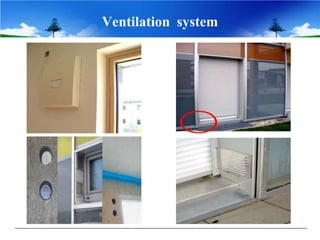
Ventilation system
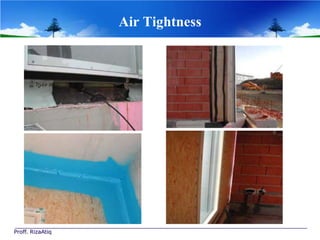
Air Tightness


Proff. RizaAtiq
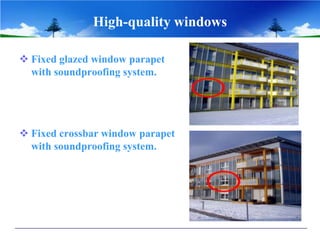
High-quality windows

 Fixed glazed window parapet
  with soundproofing system.


 Fixed crossbar window parapet
  with soundproofing system.
Disposal of wastewater for the SolarCity

 Recovering nutrients of waste water instead of flushing
  them away by using them in agriculture.
 Fertilizer for agricultural purposes.
 The black water and grey water are filtered in a
  vermicomposting tank where, after the addition of
  sufficient bulking material, the solids are pre-composted.
 The rest is used for compost
 The overflow from the vermicomposting tank is clarified in
  a constructed wetland post-composting is carried out at a
  compost site after one year and the mature compost can be
  used in gardening and landscaping or as fertilizer for
  farming.
The Rainwater Concept

 Rainwater is dealt with as and where it occurs, in a
  surface-oriented, decentralized system that makes the
  natural rainwater cycle visible and comprehensible.
 The drainage, collection and disposal of rainwater is
  achieved mainly by means of gutters, retention hollows and
  vegetated swales.
 These are integrated into a coherent, interconnected
  system that uses the Millstream as a receiving water body
  in the southern part of the district and the alluvial
  meadows as a recipient in the northern part.
 The aforementioned elements of rainwater management
  are an integral part of the planning of the open spaces.
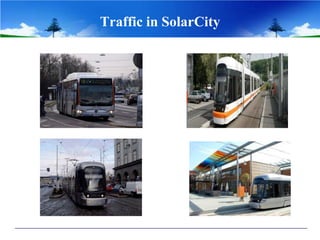
Traffic in SolarCity
Mobility
 Path network for pedestrians and bikers.

 Reduction of car traffic : nearly car-free area,
  underground car-parks.

 Local public transports :
  - linking the tram line directly to the city center of Linz.
  - bus line is extended.

 Railway connection .

 Bypass road Ebelsberg.
Traffic

 Implemented these principles consistently:
• constructing all buildings in accordance with low-energy.
• providing underground parking for the 3.000 residents of
  the SolarCity as well as an adequate number of parking
  places for visitors.
• Motor vehicle traffic was reduced to an unobtrusive
  minimum by routing it only along the promenade and to
  the individual underground parking lots in order to
  protect the dwelling environment and the children.
• Within the settlement, maximum priority shall be given to
  pedestrian and cycle traffic.
Conclusion

 Linz; Good Sustainable Practice as specified by the United
  Nations and the international community at large as
  successful initiatives which:

• Have a demonstrable effect and tangible impact on
  improving people’s quality of life;

• Are the result of effective partnership between the public,
  private, and civic sectors of society;

• Are socially, culturally, economically and environmentally
  sustainable.
LOGO

The solar city

  • 1.
    LOGO THE SOLAR CITY LINZ, AUSTRIA
  • 2.
    LOGO Prepared by: 1- YOUSEF HASANIN P62306 2- MUSTAFA TALIB P60915 3-SAHAR ABD ALI P65295 presented to : PROF.IR.DR. RIZAATIQ RAHMAT
  • 3.
    Location Linz is oneof the biggest cities in Austria, located at the Danube river, the capital of the federal state Upper Austria, shaped by industry and typical central European urban development.
  • 4.
    Scope SolarCity Linz-Pichling; Austria, 1992 SolarCity Linz-Pichling; Austria , 2006
  • 5.
    Scope  Client: Municipalityof Linz Financing: Municipality of Linz, European Community Project: has been constructed in 2005 Master plan: Roland Rainer Architects: READ (Renewable Energy in Architecture and Design):Thomas Herzog + Partners Environmental engineer: Norbert Kaiser Landscape architect: Latz + Partner Consultant: Renzo Piano Building Workshop Local coordination: Heinz Stogmuller  Total Cost 190.000.000 € with Residential buildings 125.000.000 € and Infrastructure 65.000.000 €
  • 6.
    SolarCity Objectives  Lowenergy construction, solar architecture.  Future –oriented approach to energy supply and disposal.  Issue of local recreation and leisure time .  Creation of a modern sociocultural, family-oriented infrastructure .  Sustainable traffic concept.  Common, group-specific marketing campaign.
  • 7.
    Project stages time 1992 Master plan Prof. Rainer  1994 Local-Sustainable-Development-Planning (Lassy)  1996 Urbanistic Ideas completion (Treberspurg)  1997 Landscaping ideas completion (Dreiseitl)  1998 Architectural completion  2005 Completion
  • 8.
    Urban Planning  TheSolarCity designed within 1300 apartments + central infrastructure ( local shops, sociocultural facilities, school center, kindergarten, pastoral center, sports park).  Central tram stop ( max. walking-distance 300 m to apartments).  Building designed of 2-4 stories high and the orientation to the south, avoidance of shadowing.  Part of green spaces 60%, distance to the nature protection area “Traun-Danube-Alluvial meadows” 50-80m.
  • 9.
    Project organization  Thefollowing organisational measures have been taken to deal with inter-entrepreneurial activities: • Installation of a project supervisory board as consulting organ during the planning phase. • A central office coordinates the entire operational process. • The Advisory Council is composed of top-level of politics, administration, associations and enterprises . • Development of a computer-assisted communications and administration network via email and Internet. • Documentation of the entire course of the project. • Determination of the project objectives and contents, and the project organisation structure in a project contract.
  • 10.
    The visualization  Thevisualization was developed with the goal of promoting the interactive involvement of all relevant parties (municipal administration, architects, housing developers, neighboring residents, future residents) in the planning and realization process at an early stage as a virtual realty model of the SolarCity project.  Center model …  Kindergarten model….
  • 11.
    Solar Architecture  Low-energyhouses , 3 passive houses.  Compact construction and upgraded thermal isolation .  Utilization of solar energy ( active and passive).  Ecological building components.
  • 12.
    Sociocultural Planning  Qualityagreements with housing developers.  Concepts for resident participation .  City district management office .  Create a uniform marketing concept with main focus on non-technical aspects such as quality of life and the environment.
  • 13.
    Landscape Planning  “Hilly park” + large recreational facilities ( lake with swimming area, bike path , sport area etc.)  70% increase of the lake.  Hiking trail through the nature protection area.  Revitalization of the stream .  Construction of a sport area.
  • 14.
    Power Supply  Passive: low energy houses after principles of solar architecture.  Active : solar panels for mainly hot water.  District heating for all buildings “ CHP with natural gas and biomass “.
  • 15.
    Construction facade panel Wall Construction from outside to inside: • Glass ESG(Single safety glazing) , 6-8 mm • Air layer, 31 mm • Solarwabe (honeycomb), 50 mm • Panel rear, 4 mm • Leveling insulation, 40 mm  For maximum format 1,250 x 3,050 mm high and oblong format possible Coloration of the solar honeycombs required Glass with or without texture .
  • 16.
    The solar facadefunctional principle  The honeycomb cellulose act as a solar absorber  At low position of the sun(winter) the solar load penetrates into the solar honeycomb and heat up.  At high position of the sun(summer) the honeycomb shade itself.  An additional mechanical sun-shading isn't needed.  The temperature difference between living space to outer climate is balanced
  • 17.
    Wall Units  Quickprogress of construction work.  Parallel production in the work.  Delivery of the envelope, incl. windows.  No building moisture in the exterior wall.
  • 18.
    Sound proofing  WoodenFramework 16 cm.  Brick Wall 38 cm, double-sided plaster.
  • 19.
    Fire protection system After approx. 4 minutes the flames beat from the window area on the facade.  The fire-proofing coat foamed up as a protective layer.  Later on the aluminum parts started to melt.  The glazing of the panel directly over the window shattered.  An independent spread of fire couldn't be established after 30 minutes, the examination was positive.
  • 20.
  • 21.
  • 22.
    High-quality windows  Fixedglazed window parapet with soundproofing system.  Fixed crossbar window parapet with soundproofing system.
  • 23.
    Disposal of wastewaterfor the SolarCity  Recovering nutrients of waste water instead of flushing them away by using them in agriculture.  Fertilizer for agricultural purposes. The black water and grey water are filtered in a vermicomposting tank where, after the addition of sufficient bulking material, the solids are pre-composted.  The rest is used for compost The overflow from the vermicomposting tank is clarified in a constructed wetland post-composting is carried out at a compost site after one year and the mature compost can be used in gardening and landscaping or as fertilizer for farming.
  • 24.
    The Rainwater Concept Rainwater is dealt with as and where it occurs, in a surface-oriented, decentralized system that makes the natural rainwater cycle visible and comprehensible.  The drainage, collection and disposal of rainwater is achieved mainly by means of gutters, retention hollows and vegetated swales.  These are integrated into a coherent, interconnected system that uses the Millstream as a receiving water body in the southern part of the district and the alluvial meadows as a recipient in the northern part.  The aforementioned elements of rainwater management are an integral part of the planning of the open spaces.
  • 25.
  • 26.
    Mobility  Path networkfor pedestrians and bikers.  Reduction of car traffic : nearly car-free area, underground car-parks.  Local public transports : - linking the tram line directly to the city center of Linz. - bus line is extended.  Railway connection .  Bypass road Ebelsberg.
  • 27.
    Traffic  Implemented theseprinciples consistently: • constructing all buildings in accordance with low-energy. • providing underground parking for the 3.000 residents of the SolarCity as well as an adequate number of parking places for visitors. • Motor vehicle traffic was reduced to an unobtrusive minimum by routing it only along the promenade and to the individual underground parking lots in order to protect the dwelling environment and the children. • Within the settlement, maximum priority shall be given to pedestrian and cycle traffic.
  • 28.
    Conclusion  Linz; GoodSustainable Practice as specified by the United Nations and the international community at large as successful initiatives which: • Have a demonstrable effect and tangible impact on improving people’s quality of life; • Are the result of effective partnership between the public, private, and civic sectors of society; • Are socially, culturally, economically and environmentally sustainable.
  • 29.