
FLAVA Conference 2014 –
Language Matters
Drama Techniques: A
Powerful Tool in
Language Learning
Dr. Mónica Mulholland, Ph.D.
Department of Modern and Classical
Languages
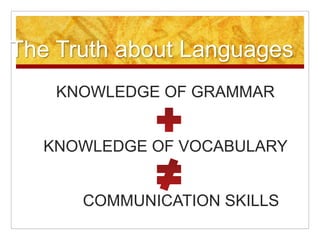
The Truth about Languages
KNOWLEDGE OF GRAMMAR
KNOWLEDGE OF VOCABULARY
COMMUNICATION SKILLS
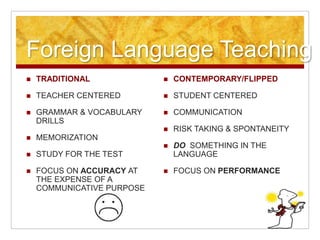
Foreign Language Teaching
 TRADITIONAL
 TEACHER CENTERED
 GRAMMAR & VOCABULARY
DRILLS
 MEMORIZATION
 STUDY FOR THE TEST
 FOCUS ON ACCURACY AT
THE EXPENSE OF A
COMMUNICATIVE PURPOSE
 CONTEMPORARY/FLIPPED
 STUDENT CENTERED
 COMMUNICATION
 RISK TAKING & SPONTANEITY
 DO SOMETHING IN THE
LANGUAGE
 FOCUS ON PERFORMANCE
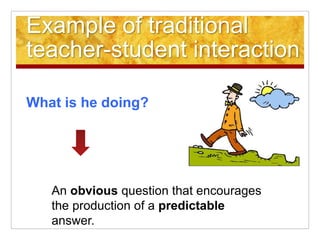
Example of traditional
teacher-student interaction
What is he doing?
An obvious question that encourages
the production of a predictable
answer.
The result?
BOREDOM & PAIN
Drama Techniques
 Are language teaching techniques derived from
acting training.
 Engage the whole person: body, voice, mind, and
emotions
 Boost self-confidence
 Draw on the imagination
 Promote interpersonal interaction and intra-
personal skills such as reflection and
introspection
 Relate to real life
Drama Techniques
Go beyond grammar and vocabulary
to engage higher-order thinking
skills such as problem solving and
interpretation.
Crucial XXI Century Skills
Drama Techniques
In using children’s games as an
approach to drama training, one gets
completely away from the concept of
teaching someone a set of skills he or
she does not possess, and knows does
not possess, all of which produces
anxiety. Through games, one goes back
to the root processes of learning, which
are generally associated with pleasure,
and often delight, and which, in most
cases, were free from anxiety. This
method substitutes for the pain of
learning the joy of re-discovery. With
plenty of practice in this method, the
actor or the actress is lead to the
optimum use of his or her mind and body
resources (Clive Barker).
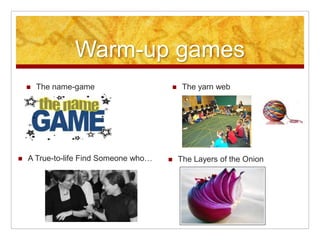
Warm-up games
 The yarn web
 A True-to-life Find Someone who…
 The name-game
 The Layers of the Onion
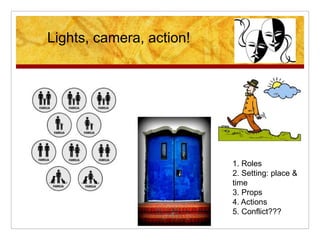
Lights, camera, action!
1. Roles
2. Setting: place &
time
3. Props
4. Actions
5. Conflict???
Bibliography
 Barker, Clive, and Dick McCaw. Theatre Games: A New Approach to
Drama Training. London: Methuen Drama, 2010. Print.
 Bowen, José A. Teaching Naked: How Moving Technology Out of Your
College Classroom Will Improve Student Learning. San Francisco:
Jossey-Bass, a Wiley imprint, 2012. Print.
 Jensen, Eric. Teaching with the Brain in Mind. Alexandria, Va:
Association for Supervision and Curriculum Development, 2005. Print.
 Maley, Alan, and Alan Duff. Drama Techniques in Language Learning: A
Resource Book of Communication Activities for Language Teachers.
Cambridge: CUP, 1982. Print.
 Winston, Joe. Second Language Learning Through Drama: Practical
Techniques and Applications. London: Routledge, 2012. Print.
Questions? Comments?
Mónica Mulholland
George Mason
University
mmulholl@gmu.edu

Drama Techniques: A Powerful Tool in Language Learning

  • 1.
    FLAVA Conference 2014– Language Matters Drama Techniques: A Powerful Tool in Language Learning Dr. Mónica Mulholland, Ph.D. Department of Modern and Classical Languages
  • 2.
    The Truth aboutLanguages KNOWLEDGE OF GRAMMAR KNOWLEDGE OF VOCABULARY COMMUNICATION SKILLS
  • 3.
    Foreign Language Teaching TRADITIONAL  TEACHER CENTERED  GRAMMAR & VOCABULARY DRILLS  MEMORIZATION  STUDY FOR THE TEST  FOCUS ON ACCURACY AT THE EXPENSE OF A COMMUNICATIVE PURPOSE  CONTEMPORARY/FLIPPED  STUDENT CENTERED  COMMUNICATION  RISK TAKING & SPONTANEITY  DO SOMETHING IN THE LANGUAGE  FOCUS ON PERFORMANCE
  • 4.
    Example of traditional teacher-studentinteraction What is he doing? An obvious question that encourages the production of a predictable answer.
  • 5.
  • 6.
    Drama Techniques  Arelanguage teaching techniques derived from acting training.  Engage the whole person: body, voice, mind, and emotions  Boost self-confidence  Draw on the imagination  Promote interpersonal interaction and intra- personal skills such as reflection and introspection  Relate to real life
  • 7.
    Drama Techniques Go beyondgrammar and vocabulary to engage higher-order thinking skills such as problem solving and interpretation. Crucial XXI Century Skills
  • 8.
    Drama Techniques In usingchildren’s games as an approach to drama training, one gets completely away from the concept of teaching someone a set of skills he or she does not possess, and knows does not possess, all of which produces anxiety. Through games, one goes back to the root processes of learning, which are generally associated with pleasure, and often delight, and which, in most cases, were free from anxiety. This method substitutes for the pain of learning the joy of re-discovery. With plenty of practice in this method, the actor or the actress is lead to the optimum use of his or her mind and body resources (Clive Barker).
  • 9.
    Warm-up games  Theyarn web  A True-to-life Find Someone who…  The name-game  The Layers of the Onion
  • 10.
    Lights, camera, action! 1.Roles 2. Setting: place & time 3. Props 4. Actions 5. Conflict???
  • 11.
    Bibliography  Barker, Clive,and Dick McCaw. Theatre Games: A New Approach to Drama Training. London: Methuen Drama, 2010. Print.  Bowen, José A. Teaching Naked: How Moving Technology Out of Your College Classroom Will Improve Student Learning. San Francisco: Jossey-Bass, a Wiley imprint, 2012. Print.  Jensen, Eric. Teaching with the Brain in Mind. Alexandria, Va: Association for Supervision and Curriculum Development, 2005. Print.  Maley, Alan, and Alan Duff. Drama Techniques in Language Learning: A Resource Book of Communication Activities for Language Teachers. Cambridge: CUP, 1982. Print.  Winston, Joe. Second Language Learning Through Drama: Practical Techniques and Applications. London: Routledge, 2012. Print.
  • 12.
    Questions? Comments? Mónica Mulholland GeorgeMason University mmulholl@gmu.edu