Drainage of Agricultural Lands
www.TheStuffPoint.Com
Abu Bakar
Soomro
Basic Concept
• Drainage is the removal of excess water from the land or
from the root zone of crop.
• Sustained accumulation of water over land leads to water
logging, which necessitates land drainage.
• Over irrigation and excessive precipitations are most
general causes of waterlogging.
• Pakistan has well distributed structures of main and link
canals. Seepage losses from canals is also contributing to
rise of water table.
• In these situation drainage of water is necessary to create
favorable conditions for plant growth.
Benefits/Purposes of Land Drainage
• Reclamation of the waterlogged soil in order to make it feasible for agricultural use
• To enhance movement of capillary moisture.
• To improve soil structure.
• Provide aeration within the rootzone.
• Make the soil warmer.
• Prevent the erosion hazards.
• Minimize effect of drought conditions.
• Prevent freezing out.
• Improve physical condition of the soil to allow farm operations.
• Improve the drainage conditions of the agricultural land and allowing soil air and
moisture favourable for agricultural production.
Land Drainage Requirements
Land drainage is very important for proper
agricultural production.
Proper agricultural drainage requires that several
factors should be well known before designing a
drainage system.
These parameters are soil type, rainfall, soil salinity
level, watertable depth, groundwater quantiity,
topographic conditions and groundwater quality.
Types of Drainage Systems
Surface or Open Drainage systems
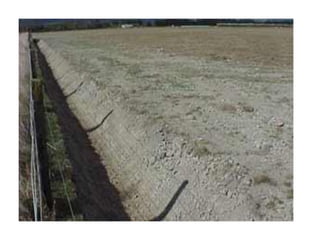
• The surface drainage is achieved by land forming and
smoothing for removal of isolated depressions, or by
construction of parallel ditches.
• Ditches and the furrow bottoms are gently graded and
discharged into the main drains at field boundary.
• Although the ditches and furrows are projected
primarily to convey the excess surface runoff, there is
also some seepage through soil to ditches, depending
on position of existing watertable which is relevant to
bed of the draining channels..
Pipe Drainage Systems
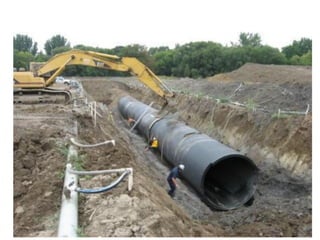
A pipe drain is basically a pipe buried in soil (regardless of material, size or
shape) which receives excess groundwater and then conveys to control
the existing watertable at any desired depth.
The advantages of pipe drainage are:
• The land can be farmed over the drain without loss of the farming area.
• Maintenance requirements are the minimal if system is properly
designed and constructed.
• Pipe drainage system is installed in soil below the plough layer
(normally > 0.70 m depth), and it has the advantage of interference
with the farm operation.
• Types of Pipe Drainage System
• Pipe drainage systems may be divided into
• (i) Singular systems (ii) Composite systems.
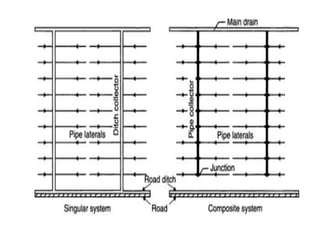
Singular systems
In this drainage system, the field drains comprise
of buried perforated pipe laterals which
discharge into the open ditch collector drains.
Composite System
In the composite pipe drainage system, the
collector drain also consists of closed pipe that
in turn discharges into the open main drain
either by pumping or by gravity.
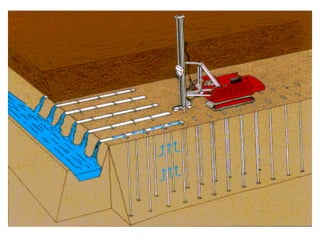
Vertical Drainage System
A well, pipe, bore, or pit in porous, underground strata into
which the drainage water can be discharged without any
contamination in groundwater resources.
It provides outlet for the drainage water from a surface or
subsurface drainage system.
The efficiency of vertical drainage is dependent upon many
factors like physical properties of the subsurface aquifers
and hydrologic conditions of the site.
Vertical drains should penetrate the aquifer which is absorbing
the drainage flow.
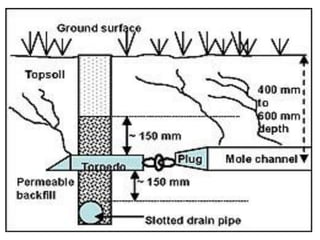
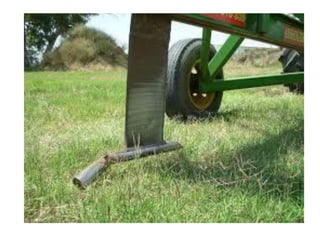
Mole Drain
Mole drain is basically an unlined underground drainage water
channel, which is formed by pulling solid object, usually the
solid cylinder with wedge shaped point located at the end,
through the soil at proper slope and depth, without a trench.
Mole drainage is applied under very specific conditions,
mainly in the stable clayey soils.
The mole drainage is rapid removal of the excess water from
surface layers, rather than at controlling of watertable only.
However, mole drain has a life span of only a few years and
has to be renewed frequently.
• Waterlogging refers to the saturation of soil
with water. Soil may be regarded as
waterlogged when the water table of the
groundwater is too high to conveniently permit
an anticipated activity, like agriculture.
Thanks
www.TheStuffPoint.Com

Drainag thestuffpoint.co m

  • 1.
    Drainage of AgriculturalLands www.TheStuffPoint.Com Abu Bakar Soomro
  • 2.
    Basic Concept • Drainageis the removal of excess water from the land or from the root zone of crop. • Sustained accumulation of water over land leads to water logging, which necessitates land drainage. • Over irrigation and excessive precipitations are most general causes of waterlogging. • Pakistan has well distributed structures of main and link canals. Seepage losses from canals is also contributing to rise of water table. • In these situation drainage of water is necessary to create favorable conditions for plant growth.
  • 3.
    Benefits/Purposes of LandDrainage • Reclamation of the waterlogged soil in order to make it feasible for agricultural use • To enhance movement of capillary moisture. • To improve soil structure. • Provide aeration within the rootzone. • Make the soil warmer. • Prevent the erosion hazards. • Minimize effect of drought conditions. • Prevent freezing out. • Improve physical condition of the soil to allow farm operations. • Improve the drainage conditions of the agricultural land and allowing soil air and moisture favourable for agricultural production.
  • 4.
    Land Drainage Requirements Landdrainage is very important for proper agricultural production. Proper agricultural drainage requires that several factors should be well known before designing a drainage system. These parameters are soil type, rainfall, soil salinity level, watertable depth, groundwater quantiity, topographic conditions and groundwater quality.
  • 5.
  • 6.
    Surface or OpenDrainage systems • The surface drainage is achieved by land forming and smoothing for removal of isolated depressions, or by construction of parallel ditches. • Ditches and the furrow bottoms are gently graded and discharged into the main drains at field boundary. • Although the ditches and furrows are projected primarily to convey the excess surface runoff, there is also some seepage through soil to ditches, depending on position of existing watertable which is relevant to bed of the draining channels..
  • 8.
    Pipe Drainage Systems Apipe drain is basically a pipe buried in soil (regardless of material, size or shape) which receives excess groundwater and then conveys to control the existing watertable at any desired depth. The advantages of pipe drainage are: • The land can be farmed over the drain without loss of the farming area. • Maintenance requirements are the minimal if system is properly designed and constructed. • Pipe drainage system is installed in soil below the plough layer (normally > 0.70 m depth), and it has the advantage of interference with the farm operation.
  • 10.
    • Types ofPipe Drainage System • Pipe drainage systems may be divided into • (i) Singular systems (ii) Composite systems.
  • 11.
    Singular systems In thisdrainage system, the field drains comprise of buried perforated pipe laterals which discharge into the open ditch collector drains. Composite System In the composite pipe drainage system, the collector drain also consists of closed pipe that in turn discharges into the open main drain either by pumping or by gravity.
  • 13.
    Vertical Drainage System Awell, pipe, bore, or pit in porous, underground strata into which the drainage water can be discharged without any contamination in groundwater resources. It provides outlet for the drainage water from a surface or subsurface drainage system. The efficiency of vertical drainage is dependent upon many factors like physical properties of the subsurface aquifers and hydrologic conditions of the site. Vertical drains should penetrate the aquifer which is absorbing the drainage flow.
  • 15.
    Mole Drain Mole drainis basically an unlined underground drainage water channel, which is formed by pulling solid object, usually the solid cylinder with wedge shaped point located at the end, through the soil at proper slope and depth, without a trench. Mole drainage is applied under very specific conditions, mainly in the stable clayey soils. The mole drainage is rapid removal of the excess water from surface layers, rather than at controlling of watertable only. However, mole drain has a life span of only a few years and has to be renewed frequently.
  • 18.
    • Waterlogging refersto the saturation of soil with water. Soil may be regarded as waterlogged when the water table of the groundwater is too high to conveniently permit an anticipated activity, like agriculture.
  • 19.