Using learning analytics to
uncover learning strategies
Dragan Gašević
@dgasevic
Shape of Educational Data Meeting
April 7, 2016, Fairfax, VA
Growing role of technology to
flip classrooms
Freeman, S., Eddy, S. L., McDonough, M., Smith, M. K., Okoroafor, N., Jordt, H., & Wenderoth, M. P. (2014). Active
learning increases student performance in science, engineering, and mathematics. Proceedings of the National
Academy of Sciences, 201319030.
How do students study with
technology?
BACKGROUND
Categorization
Deep and surface approaches to learning
Trigwell, K., & Prosser, M. (1991). Relating approaches to study and quality of learning outcomes at the course
level. British Journal of Educational Psychology, 61(3), 265-275.
Poor choices of
learning tactics and strategies
Bjork, R. A., Dunlosky, J., & Kornell, N. (2013). Self-regulated learning: Beliefs, techniques, and illusions. Annual review
of psychology, 64, 417-444.
Significant role of instructions on
approaches to learning
Trigwell, K., Prosser, M., & Waterhouse, F. (1999). Relations between teachers’ approaches to teaching and students’
approaches to learning. Higher Education, 37(1), 57–70.
Role of course design
To prompt active engagement and
challenge higher order thinking
Bryson, C., & Hand, L. (2007). The role of engagement in inspiring teaching and learning. Innovations in Education
and Teaching International, 44(4), 349–362.
Student profiling
Unsupervised approaches
Lust, G., Elen, J., & Clarebout, G. (2013). Students’ tool-use within a web enhanced course: Explanatory
mechanisms of students’ tool-use pattern. Computers in Human Behavior, 29(5).
Sequences of activities
Sequence or process mining, HMMs, etc.
Reimann, P., Markauskaite, L., Bannert, M. (2014). e-Research and learning theory: What do sequence and process
mining methods contribute? British Journal of Educational Technology, 45(3), 528-540.
What learning strategies do
students follow
while using technology?
Do learning strategies of students
change over time
while using technology?
FLIPPED CLASSROOM STUDY
Study context
Freshman course in computer systems at USyd
Enrolment: ~300 students
Assessment: midterm + final + project
Flipped learning design
Redesigned lecture – an active learning session
requiring students’ preparation
Flipped learning design
Videos with multiple-choice questions (MCQs)
Documents with embedded MCQs
Problem (exercise) sequences
Exploratory sequence analysis
[1] (CONTENT_ACCESS,3)
[2] (EXE_IN,3)-(EXE_CO,1)-(EXE_IN,1)-(EXE_CO,1)-(EXE_IN,2)
[3] (CONTENT_ACCESS,3)-(EXE_IN,4)
[4] (MC_EVAL,4)
[5] (EXE_IN,5)-(EXE_CO,1)-(EXE_IN,3)-(EXE_CO,1)-(EXE_IN,2)-
(EXE_CO,1)-(EXE_IN,9)-(EXE_CO,4)-(EXE_IN,4)-(EXE_CO,1)-
(EXE_IN,2)-(EXE_CO,2)-(EXE_IN,3)-(EXE_CO,3)-(EXE_IN,1)-
(EXE_CO,2)-(EXE_IN,1)
[6] (CONTENT_ACCESS,2)
Gabadinho, A., Ritschard, G., Müller, N.S. & Studer, M. (2011). Analyzing and visualizing state sequences in R with
TraMineR, Journal of Statistical Software, 40(4), 1-37.
Agglomerative hierarchical clustering of sequences based on
Ward’s algorithm and Levenshtein’s edit distance
Clusters of learning sequences
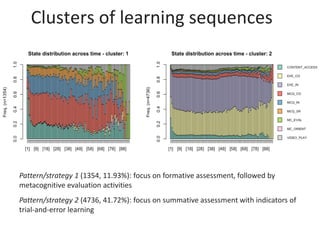
Pattern/strategy 1 (1354, 11.93%): focus on formative assessment, followed by
metacognitive evaluation activities
Pattern/strategy 2 (4736, 41.72%): focus on summative assessment with indicators of
trial-and-error learning
Clusters of learning sequences
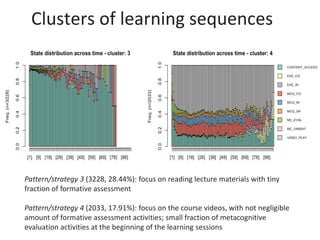
Pattern/strategy 3 (3228, 28.44%): focus on reading lecture materials with tiny
fraction of formative assessment
Pattern/strategy 4 (2033, 17.91%): focus on the course videos, with not negligible
amount of formative assessment activities; small fraction of metacognitive
evaluation activities at the beginning of the learning sessions
Student clustering
based on sequence clusters
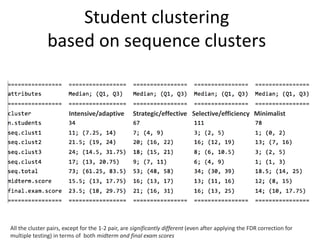
All the cluster pairs, except for the 1-2 pair, are significantly different (even after applying the FDR correction for
multiple testing) in terms of both midterm and final exam scores
Intensive/adaptive Strategic/effective Selective/efficiency Minimalist
Changes in learning strategy
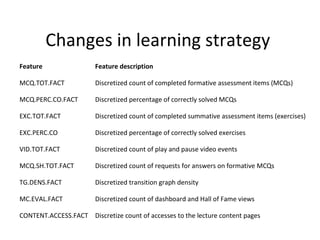
Feature Feature description
MCQ.TOT.FACT Discretized count of completed formative assessment items (MCQs)
MCQ.PERC.CO.FACT Discretized percentage of correctly solved MCQs
EXC.TOT.FACT Discretized count of completed summative assessment items (exercises)
EXC.PERC.CO Discretized percentage of correctly solved exercises
VID.TOT.FACT Discretized count of play and pause video events
MCQ.SH.TOT.FACT Discretized count of requests for answers on formative MCQs
TG.DENS.FACT Discretized transition graph density
MC.EVAL.FACT Discretized count of dashboard and Hall of Fame views
CONTENT.ACCESS.FACT Discretize count of accesses to the lecture content pages
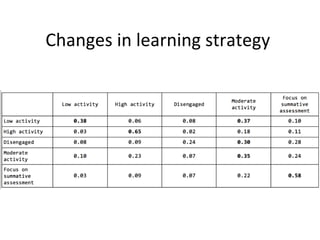
Changes in learning strategy
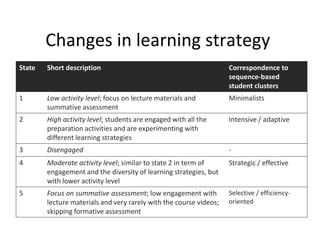
State Short description Correspondence to
sequence-based
student clusters
1 Low activity level; focus on lecture materials and
summative assessment
Minimalists
2 High activity level; students are engaged with all the
preparation activities and are experimenting with
different learning strategies
Intensive / adaptive
3 Disengaged -
4 Moderate activity level; similar to state 2 in term of
engagement and the diversity of learning strategies, but
with lower activity level
Strategic / effective
5 Focus on summative assessment; low engagement with
lecture materials and very rarely with the course videos;
skipping formative assessment
Selective / efficiency-
oriented
Changes in learning strategy
CONCLUSION
Learning approaches consistent
with the literature
Effective vs ineffective
learning strategies
Please, don’t confuse this with
learning styles
Pet peeve!
Students don’t follow
the same approach all the time
Process nature of learning
- beyond coding and counting -
van der Aalst, W. (2012). Process mining: Overview and opportunities. ACM Transactions on Management
Information Systems (TMIS), 3(2), 7.
Critical role of course design and
contextual variables
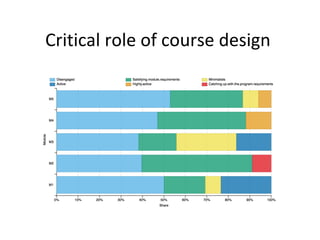
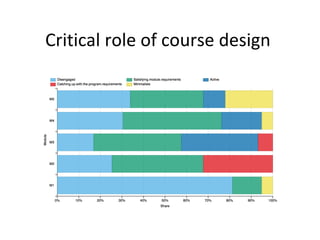
Critical role of course design
Trace data about
internal conditions needed
Thanks you!

Dragan Gasevic SOED 2016

  • 1.
    Using learning analyticsto uncover learning strategies Dragan Gašević @dgasevic Shape of Educational Data Meeting April 7, 2016, Fairfax, VA
  • 2.
    Growing role oftechnology to flip classrooms
  • 3.
    Freeman, S., Eddy,S. L., McDonough, M., Smith, M. K., Okoroafor, N., Jordt, H., & Wenderoth, M. P. (2014). Active learning increases student performance in science, engineering, and mathematics. Proceedings of the National Academy of Sciences, 201319030.
  • 4.
    How do studentsstudy with technology?
  • 5.
  • 6.
    Categorization Deep and surfaceapproaches to learning Trigwell, K., & Prosser, M. (1991). Relating approaches to study and quality of learning outcomes at the course level. British Journal of Educational Psychology, 61(3), 265-275.
  • 7.
    Poor choices of learningtactics and strategies Bjork, R. A., Dunlosky, J., & Kornell, N. (2013). Self-regulated learning: Beliefs, techniques, and illusions. Annual review of psychology, 64, 417-444.
  • 8.
    Significant role ofinstructions on approaches to learning Trigwell, K., Prosser, M., & Waterhouse, F. (1999). Relations between teachers’ approaches to teaching and students’ approaches to learning. Higher Education, 37(1), 57–70.
  • 9.
    Role of coursedesign To prompt active engagement and challenge higher order thinking Bryson, C., & Hand, L. (2007). The role of engagement in inspiring teaching and learning. Innovations in Education and Teaching International, 44(4), 349–362.
  • 10.
    Student profiling Unsupervised approaches Lust,G., Elen, J., & Clarebout, G. (2013). Students’ tool-use within a web enhanced course: Explanatory mechanisms of students’ tool-use pattern. Computers in Human Behavior, 29(5).
  • 11.
    Sequences of activities Sequenceor process mining, HMMs, etc. Reimann, P., Markauskaite, L., Bannert, M. (2014). e-Research and learning theory: What do sequence and process mining methods contribute? British Journal of Educational Technology, 45(3), 528-540.
  • 12.
    What learning strategiesdo students follow while using technology?
  • 13.
    Do learning strategiesof students change over time while using technology?
  • 14.
  • 15.
    Study context Freshman coursein computer systems at USyd Enrolment: ~300 students Assessment: midterm + final + project
  • 16.
    Flipped learning design Redesignedlecture – an active learning session requiring students’ preparation
  • 17.
    Flipped learning design Videoswith multiple-choice questions (MCQs) Documents with embedded MCQs Problem (exercise) sequences
  • 18.
    Exploratory sequence analysis [1](CONTENT_ACCESS,3) [2] (EXE_IN,3)-(EXE_CO,1)-(EXE_IN,1)-(EXE_CO,1)-(EXE_IN,2) [3] (CONTENT_ACCESS,3)-(EXE_IN,4) [4] (MC_EVAL,4) [5] (EXE_IN,5)-(EXE_CO,1)-(EXE_IN,3)-(EXE_CO,1)-(EXE_IN,2)- (EXE_CO,1)-(EXE_IN,9)-(EXE_CO,4)-(EXE_IN,4)-(EXE_CO,1)- (EXE_IN,2)-(EXE_CO,2)-(EXE_IN,3)-(EXE_CO,3)-(EXE_IN,1)- (EXE_CO,2)-(EXE_IN,1) [6] (CONTENT_ACCESS,2) Gabadinho, A., Ritschard, G., Müller, N.S. & Studer, M. (2011). Analyzing and visualizing state sequences in R with TraMineR, Journal of Statistical Software, 40(4), 1-37. Agglomerative hierarchical clustering of sequences based on Ward’s algorithm and Levenshtein’s edit distance
  • 19.
    Clusters of learningsequences Pattern/strategy 1 (1354, 11.93%): focus on formative assessment, followed by metacognitive evaluation activities Pattern/strategy 2 (4736, 41.72%): focus on summative assessment with indicators of trial-and-error learning
  • 20.
    Clusters of learningsequences Pattern/strategy 3 (3228, 28.44%): focus on reading lecture materials with tiny fraction of formative assessment Pattern/strategy 4 (2033, 17.91%): focus on the course videos, with not negligible amount of formative assessment activities; small fraction of metacognitive evaluation activities at the beginning of the learning sessions
  • 21.
    Student clustering based onsequence clusters All the cluster pairs, except for the 1-2 pair, are significantly different (even after applying the FDR correction for multiple testing) in terms of both midterm and final exam scores Intensive/adaptive Strategic/effective Selective/efficiency Minimalist
  • 22.
    Changes in learningstrategy Feature Feature description MCQ.TOT.FACT Discretized count of completed formative assessment items (MCQs) MCQ.PERC.CO.FACT Discretized percentage of correctly solved MCQs EXC.TOT.FACT Discretized count of completed summative assessment items (exercises) EXC.PERC.CO Discretized percentage of correctly solved exercises VID.TOT.FACT Discretized count of play and pause video events MCQ.SH.TOT.FACT Discretized count of requests for answers on formative MCQs TG.DENS.FACT Discretized transition graph density MC.EVAL.FACT Discretized count of dashboard and Hall of Fame views CONTENT.ACCESS.FACT Discretize count of accesses to the lecture content pages
  • 23.
    Changes in learningstrategy State Short description Correspondence to sequence-based student clusters 1 Low activity level; focus on lecture materials and summative assessment Minimalists 2 High activity level; students are engaged with all the preparation activities and are experimenting with different learning strategies Intensive / adaptive 3 Disengaged - 4 Moderate activity level; similar to state 2 in term of engagement and the diversity of learning strategies, but with lower activity level Strategic / effective 5 Focus on summative assessment; low engagement with lecture materials and very rarely with the course videos; skipping formative assessment Selective / efficiency- oriented
  • 24.
  • 25.
  • 26.
  • 27.
  • 28.
    Please, don’t confusethis with learning styles Pet peeve!
  • 29.
    Students don’t follow thesame approach all the time
  • 30.
    Process nature oflearning - beyond coding and counting - van der Aalst, W. (2012). Process mining: Overview and opportunities. ACM Transactions on Management Information Systems (TMIS), 3(2), 7.
  • 31.
    Critical role ofcourse design and contextual variables
  • 32.
    Critical role ofcourse design
  • 33.
    Critical role ofcourse design
  • 34.
    Trace data about internalconditions needed
  • 35.