Oral Habits
By -
Sudeep Madhusudan Chaudhari
MDS 2nd Year
Dept of Paedodontics & Preventive Dentistry
2
Contents
●Introduction
●Definitions
●Classification
●Prevalence of habit
1) Thumb sucking
2) Pacifier habit
3) Tongue thrusting
4) Mouth breathing
5) Bruxism
3
3)Tongue thrusting :-
Definitions :-
Tongue thrust is the forward most placement of tongue tip between
teeth to meet the lower lip during deglutition and in sounds of
speech, so the tongue becomes interdental.
-Tulley (1969)
It is the placement of the tongue tip forward between incisors during
swallowing.
-Profitt (1972)
4
Tongue thrust is the condition in which the tongue protrudes between
anterior and posterior teeth during swallowing with or without
affecting tooth position.
-Norton & Gellin (1978)
5
Classifications of tongue thrusting-
1) Physiologic - This comprises of the normal tongue thrust swallow of
infancy
2) Habitual - The tongue thrust swallow is present as a habit even after
the correction of the malocclusion.
3) Functional - When the tongue thrust mechanism is an adaptive
behaviour developed to achieve an oral seal, it can be grouped as
functional.
4) Anatomic - Persons having enlarged tongue can have an anterior
tongue posture.
6
James Braner and Holt classification (1965)
Type 1: Non-deforming tongue thrust
Type 2: Deforming anterior tongue thrust
Sub group 1: Anterior open bite
Sub group 2: Associated procumbency of anterior teeth
Sub group 3: Associated posterior cross bite
7
Type 3: Deforming lateral tongue thrust
Sub group 1: Posterior open bite
Sub group 2: Posterior cross bite
Sub group 3: Deep overbite
Type 4: Deforming anterior and lateral tongue thrust
Sub group 1: Anterior and posterior open bite
Sub group 2: Proclination of anterior teeth
Sub group 3: Posterior cross bite
8
Moyers classification-
9
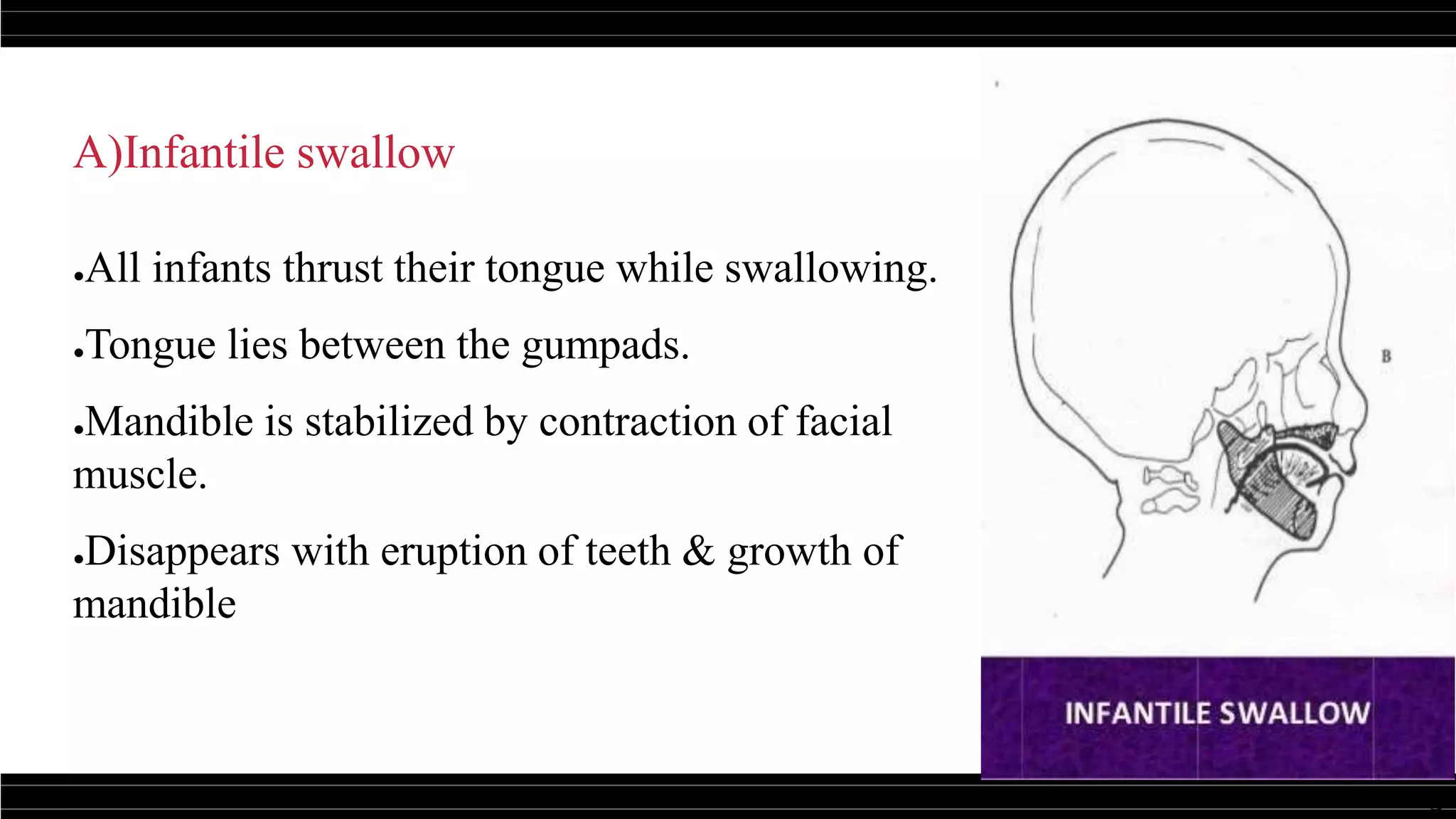
A)Infantile swallow
●All infants thrust their tongue while swallowing.
●Tongue lies between the gumpads.
●Mandible is stabilized by contraction of facial
muscle.
●Disappears with eruption of teeth & growth of
mandible
10
Mechanism of infantile swallow-
Infant lips closed around the areola of the breast
Tongue protrudes to the lower lip & forms a
spoon like closure around nipple
relaxation of the elevator muscle of
mandible
mouth is open wide, milk directed to the
pharynx
11
B)Adult swallow
●As a person swallows, tip of the tongue contacts the
palatal rugae area posterior to the maxillary anterior
teeth.
●Midportion contacts the hard palate & posterior
aspect assumes a 45° angulation against the posterior
pharyngeal wall to permit the bolus of food to move
into the digestive tract.
12
1)Simple tongue thrust -
Simple tongue thrust is usually associated with a history of digit sucking
that has led to open bite. According to Moyers, in simple tongue thrust
the teeth are in occlusion during swallowing, some muscle contraction
can be seen and correction of malocclusion will correct the habit.
13
2)Complex tongue thrust -
● Complex tongue thrust is a more complicated type of swallowing
pattern associated with chronic nasorespiratory issues such as mouth
breathing, tonsillitis, or pharyngitis.
● When the tonsil is inflamed and enlarged, the root of the tongue exerts
force on the tonsil and causes pain.
● To avoid this force and resulting pain, the mandible will drop
reflexively, separating the maxillary and mandibular teeth, enlarging
the freeway space, and providing more room for the tongue to move
forward.
14
●This will create a more comfortable position during swallowing and a
more adequate airway. The forward position of the tongue exerts
continuous light force on the anterior teeth and alveoli, which will result
in dental or dentoalveolar protrusion, interdental spacing and open bite.
● Open bite might not be limited to anterior teeth. Treatment of this type
of tongue thrust is more complicated; myofunctional therapy might
also be required.
15
3)Retained infantile swallow
● Infant gum pads are not brought together in function, because the
mouth is designed for suckle feeding at this stage and the space
between the gum pads is occupied by the tongue.
● At this age, the tongue is advanced in development and is relatively
larger than the surrounding jaws to facilitate suckling. The transition
from the infantile swallowing pattern to an adult swallowing behavior
occurs after 6 months, with tooth eruption.
16
●Moyers states that retained infantile swallow is an abnormal swallowing
pattern in which the infantile swallow remains and the transition to an
adult swallowing behavior has not occurred.
● Open bite is more severe in patients with this type of swallowing and
may not be confined to the anterior segment. Treatment is also more
complicated and may include orthognathic surgery and myofunctional
therapy.
17
Etiology -
● Hereditary factors, such as a large tongue.
● Vertical skeletal problems such as a steep mandible or wide gonial
angle.
● Thumb or other finger sucking.
● Short lingual frenum (tongue-tie).
● Mouth breathing, which might be due to many factors that cause nasal
obstruction, such as allergies, nasal congestion, deviated conchae or
large adenoid.
18
●Sore throat, enlarged tonsils, or adenoids that cause difficulty in
swallowing.
● Premature loss of primary teeth and abnormal tongue adaptation.
● Muscular, neurologic or other physiologic abnormalities, such as loss
of muscle coordination
19
Different types of tongue thrust
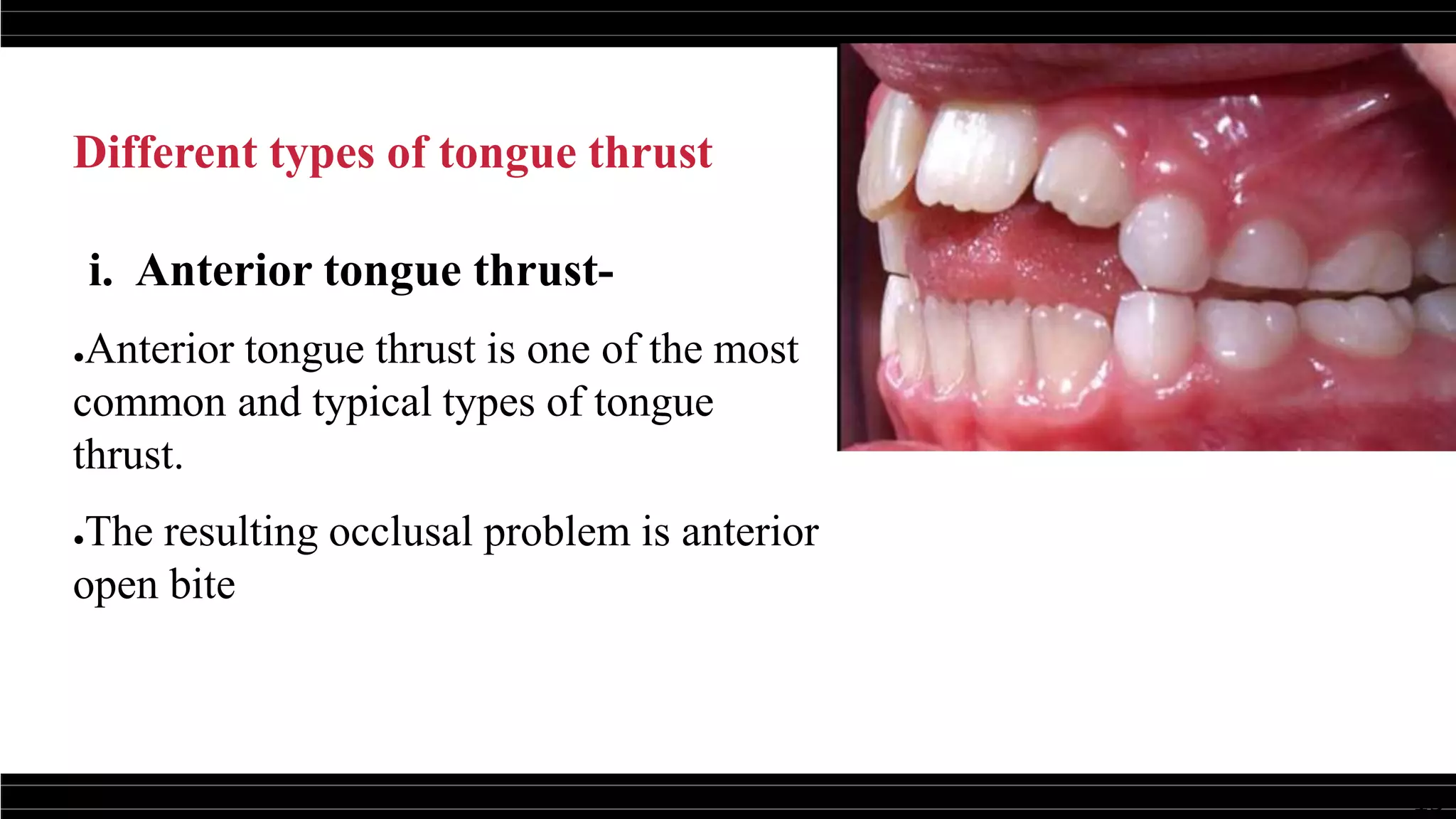
i. Anterior tongue thrust-
●Anterior tongue thrust is one of the most
common and typical types of tongue
thrust.
●The resulting occlusal problem is anterior
open bite
20
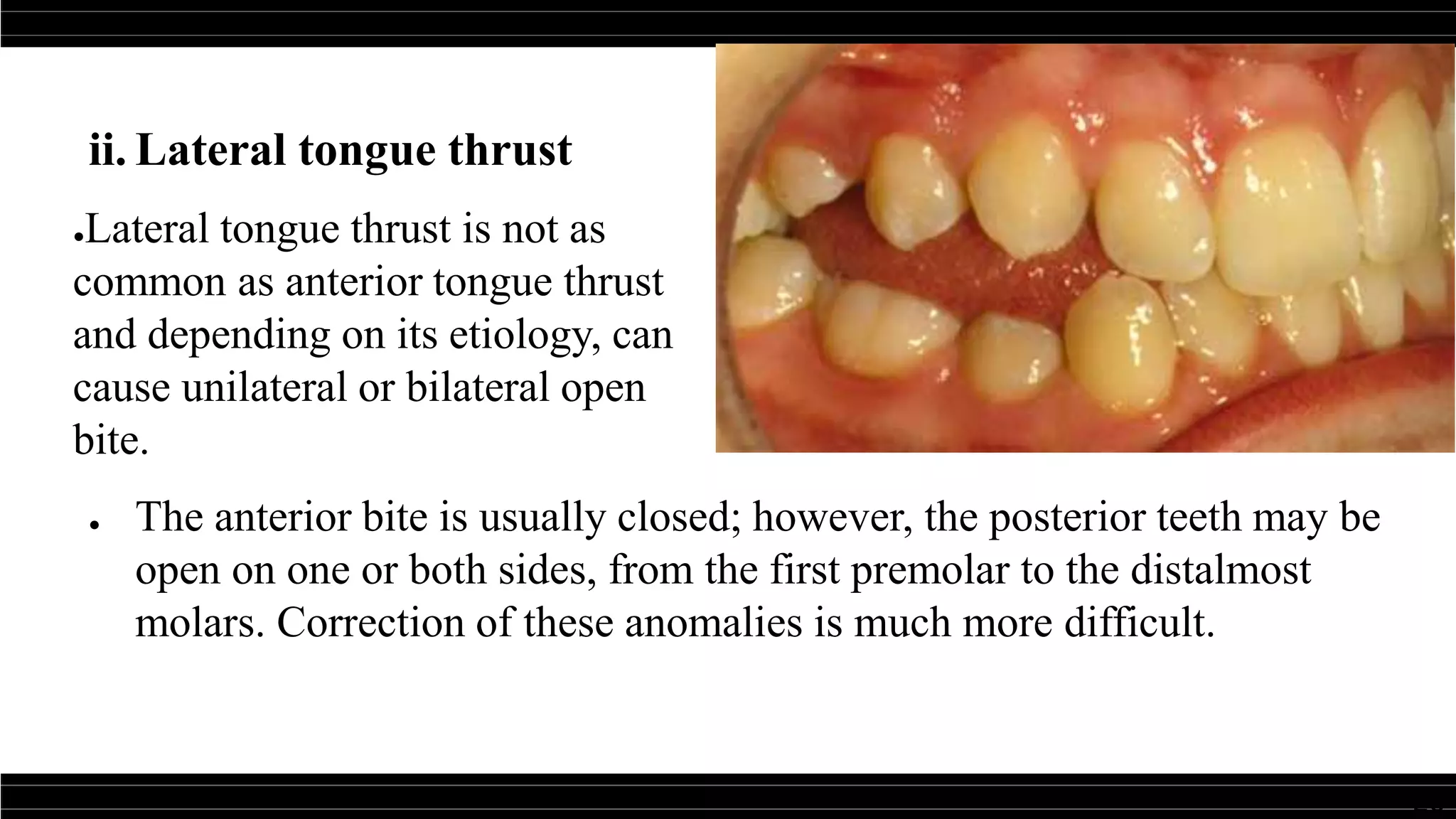
ii. Lateral tongue thrust
●Lateral tongue thrust is not as
common as anterior tongue thrust
and depending on its etiology, can
cause unilateral or bilateral open
bite.
● The anterior bite is usually closed; however, the posterior teeth may be
open on one or both sides, from the first premolar to the distalmost
molars. Correction of these anomalies is much more difficult.
21
Clinical features
1)Simple tongue thrust-
● Intra oral findings:
→ Proclined & spaced upper incisor
→ Retroclined or proclined lower incisor
→ Anterior open bite
22
→Posterior cross bite
→Normal tooth contact during swallowing
→ Tongue is thrust forward during swallowing to establish
anterior lip seal .
23
● Extra Oral Findings :
→Dolicocephalic face
→ Increase lower anterior facial height
→ Incompetent lips
→ Exression less face
→ Speech problems
→ Abnormal mentalis muscle activity
24
2) Complex tongue thrust :
➔Proclination of anterior teeth
➔Generalized open bite
➔Absence of temporalis muscle contriction during
swallowing
➔Contraction of lip, facial & mentalis muscle
25
●Poor occlusion
● Posterior cross bite
26
3) Lateral tongue thrust
➔May be unilateral or bilateral
➔Lateral open bite is seen.
27
Diagnosis:
● Case history
● Examination of the tongue thrusting :
– Check for size, shape & movement
28
1) Functional examination -
●Observe the tongue position, while the mandible is in the rest
position.
●Observe the tongue during various swallows :
➢ Concious swallow
➢ Command swallow of saliva
➢ Command swallow of water
➢ Concious swallow during mastication
29
2) Palpatory examination -
●Place water beneath the patient’s tongue tip & ask him to swallow
➔ Constriction of lips & facial muscles in tongue thrusting.
● Place hand over temporalis muscle & ask to swallow
➔ No temporalis contraction in tongue thrusting
● Hold the lip & ask the patient to swallow
➔ Patient can not complete swallow.
30
Treatment
● Age
Tongue thrust often self-corrects by 8 or 9 years of age by the time the
permanent anterior teeth completely erupt. The self-correction occurs
because of an improved muscular balance during swallowing as the
mature swallow is adopted.
However it is seen that orthodontic interception is usually more
successful than correction if initiated during the early mixed dentition
stage of dental development or between ages 9-11 years.
31
Treatment is generally not recommended when tongue thrust
is present without malocclusion or a speech problem. If
the tongue thrust is present with malocclusion but no
speech problem orthodontic correction of the
malocclusion will usually eliminate the tongue thrust.
If the tongue thrust is present along with malocclusion and a
speech problem, speech-and orthodontic correction are
needed.
32
1)Management of simple tongue thrust -
The management of tongue thrust involves interception of the habit i.e.,
to remove the etiology followed by treatment to correct the
malocclusion. Once the habit is intercepted the malocclusion
associated with the tongue thrust is treated using removable or fixed
orthodontic appliances.
33
● The treatment of tongue thrust can be divided into various steps:
I. Training of correct swallow and posture of the tongue
II.Appliances to guide the correct positioning of tongue
III.Mechano therapy
34
I. Training of correct swallow and posture of the tongue
a. Myofunctional exercises -
Educate the patient about normal swallowing by asking the patient to
keep the tongue tip against the junction of soft and hard palate.
Various muscle exercise of the tongue can help in training it to adapt
to the new swallowing pattern.
35
i. The child is asked to place the tip of the tongue in the rugae area for 5
minutes and is asked to swallow.
ii. The tongue tip against the palate can hold small orthodontic elastics
during swallowing. If the swallow is correct the elastic will be
retained in position.
iii.4S exercises - This includes identifying the spot by tongue, salivating,
squeezing the spot and swallowing.
36
II. Appliances to guide the correct positioning of tongue-
Once the patient is familiar with the new tongue position an appliance is
given for training the correct positioning of the tongue.
37
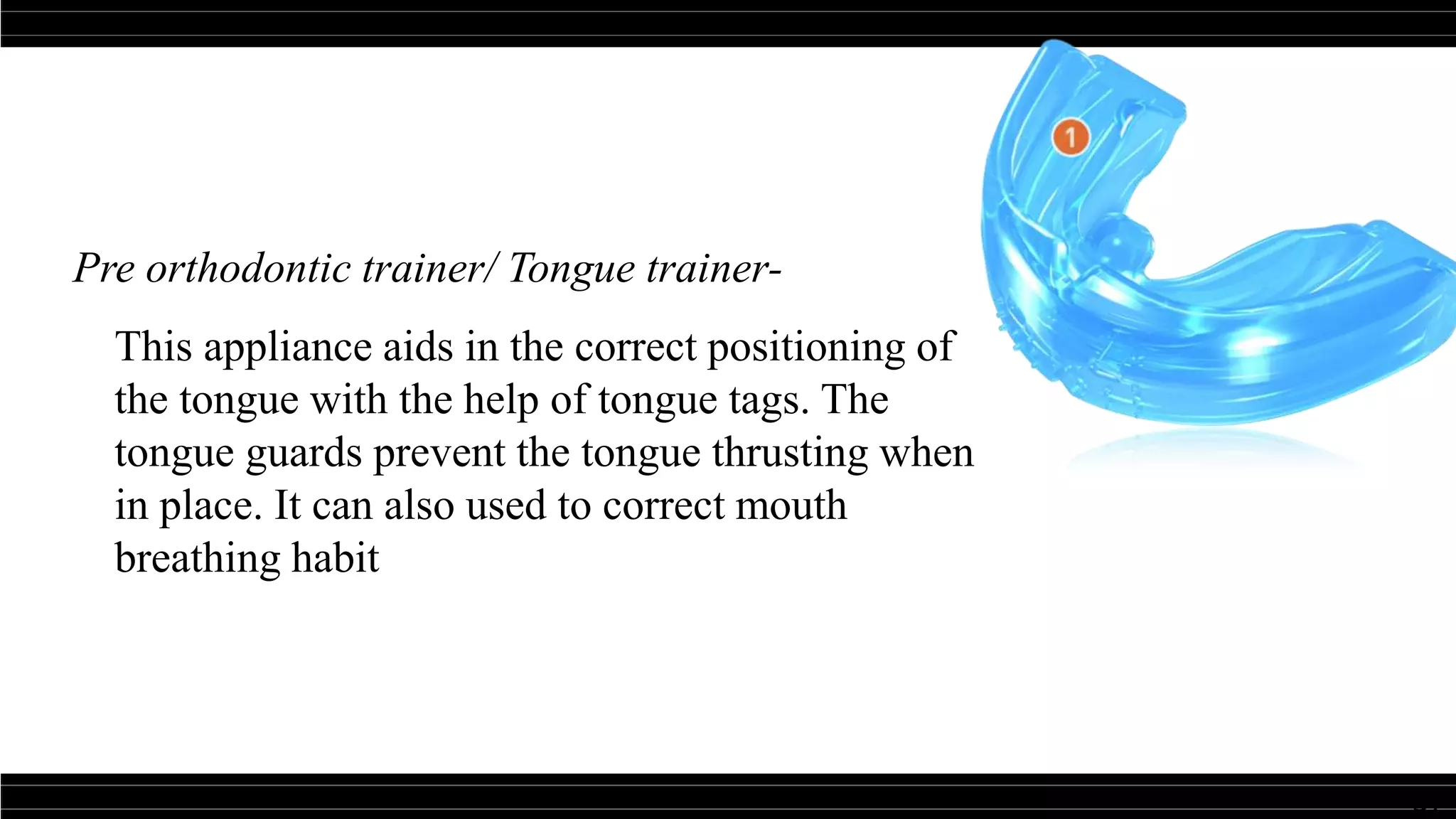
Pre orthodontic trainer/ Tongue trainer-
This appliance aids in the correct positioning of
the tongue with the help of tongue tags. The
tongue guards prevent the tongue thrusting when
in place. It can also used to correct mouth
breathing habit
38
III. Mechano therapy -
Both fixed and removable appliances (cribs or rakes ) can be fabricated
to restrain anterior tongue movement during swallowing with the
objective of retraining the tongue to a more posterior superior position
in the oral cavity. Both fixed and removable are valuable aids in
breaking the habit.
39
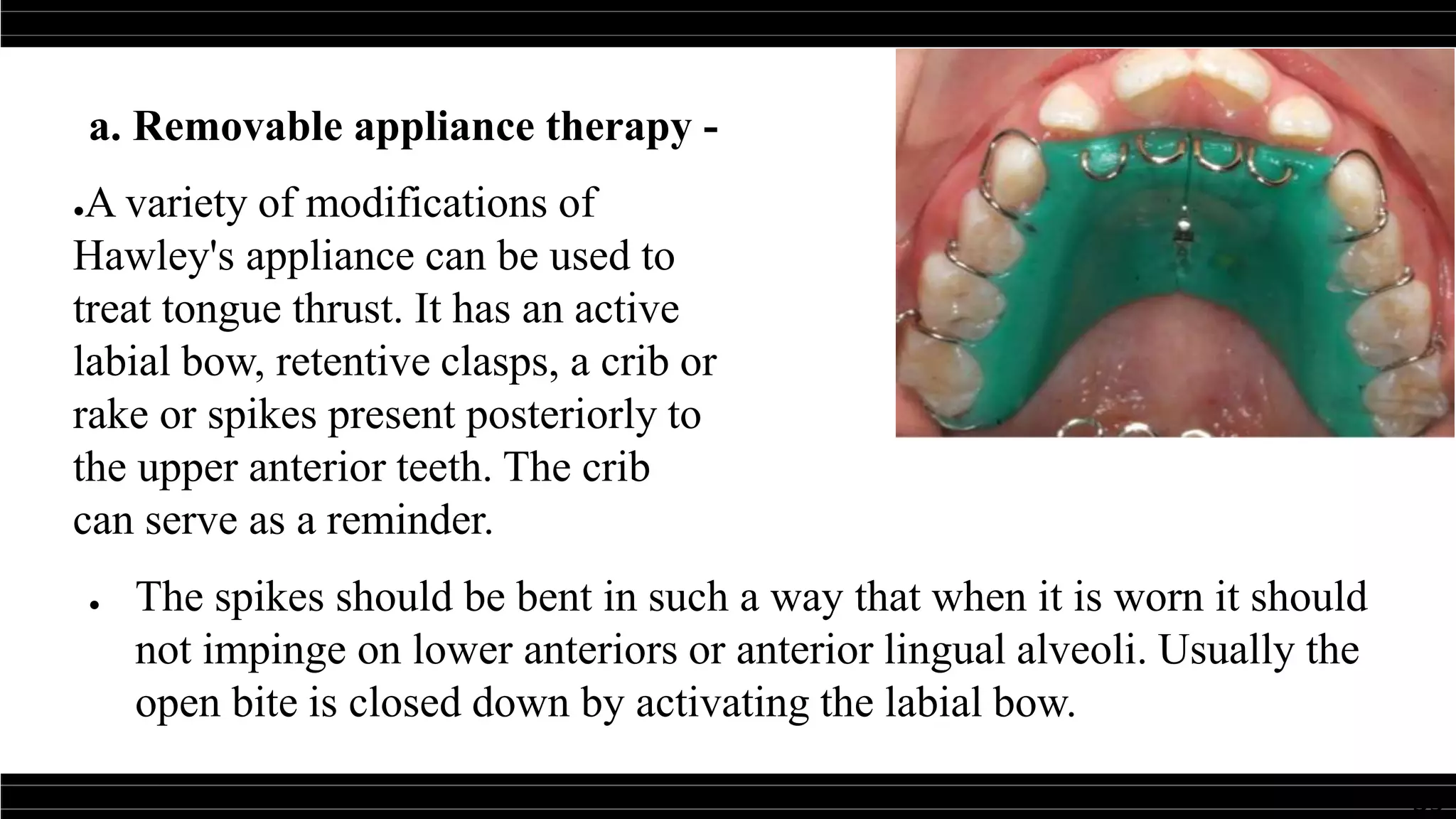
a. Removable appliance therapy -
●A variety of modifications of
Hawley's appliance can be used to
treat tongue thrust. It has an active
labial bow, retentive clasps, a crib or
rake or spikes present posteriorly to
the upper anterior teeth. The crib
can serve as a reminder.
● The spikes should be bent in such a way that when it is worn it should
not impinge on lower anteriors or anterior lingual alveoli. Usually the
open bite is closed down by activating the labial bow.
40
●Activation of labial bow reduces the proclination of the upper anterior
teeth. The acrylic should be trimmed off from the gingival marginal area
of the lingual surfaces of the maxillary anteriors to allow the incisors to be
move palatally.
● The loops of the tongue crib are removed one by one as the patient is
weaned from the habit appliance over a 6 month period.
41
b. Fixed Habit breaking appliance-
● Bands are adopted on the first permanent molar and a 0.040 inch
stainless steel 'U'– shaped wire is adopted from one molar to another
molar of the opposite side. After the base bar is fabricated the crib can
be formed and soldered to the base. Depending on the severity of the
open bite, 6-12 months may be required for the autonomous correction
of the malocclusion.
42
●The cribs acts by walling off the tongue from
the dentoalveolar structures. They acts as
remainders to the tongue when ever it tries to
thrust forwards. A new engram is created by the
nervous system so that the tongue learns proper
position in long term. Thus this appliances
create a new neuromuscular behavior.
● The cribs can be fabricated along with expansion devices like
quadhelix and expansion screw if the arch is constricted.
43
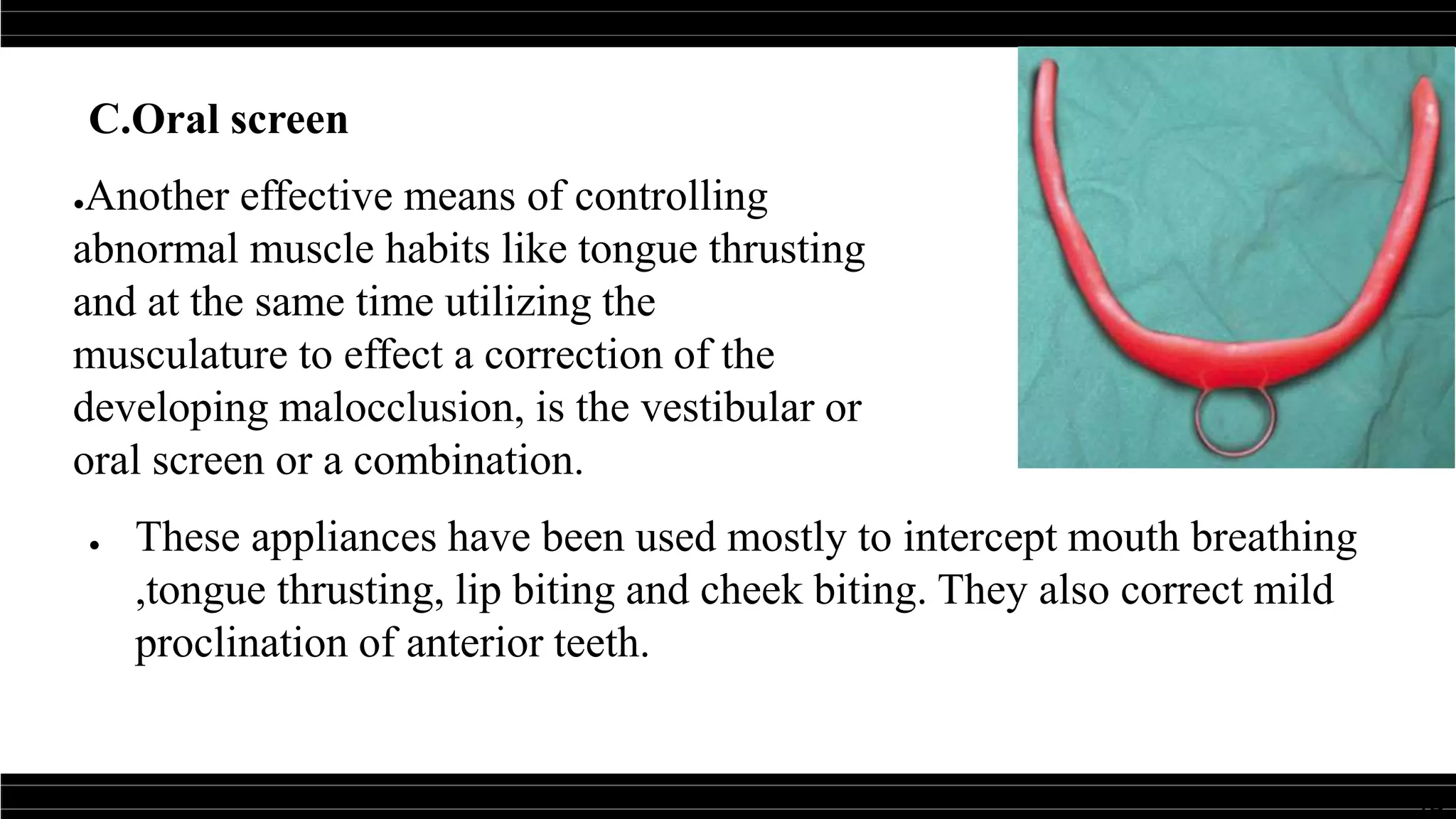
C.Oral screen
●Another effective means of controlling
abnormal muscle habits like tongue thrusting
and at the same time utilizing the
musculature to effect a correction of the
developing malocclusion, is the vestibular or
oral screen or a combination.
● These appliances have been used mostly to intercept mouth breathing
,tongue thrusting, lip biting and cheek biting. They also correct mild
proclination of anterior teeth.
44
2)Management of complex tongue thrust
● The prognosis of complex tongue thrust will not be that much good
when compared to simple tongue thrust if it is of neuromuscular
origin.
● The two reflexes involved are
1. Abnormal occlusal reflex
2. Abnormal swallow
45
● TREATMENT PROTOCOL
1. Treat the occlusion first with contemporary fixed orthodontic
appliance followed by careful equilibration.
2. The muscle training then begun is similar to that for a simple tongue
thrust with minor modification.
3. Great emphasis must be placed on keeping the teeth together during
swallowing.
4. A maxillary lingual archwire with short, sharp spurs may be used as
retainer.
5. It is important to do meticulous teeth positioning and careful
equilibration followed by persistent myotherapy.

Oral habits (part 2) tongue thrusting

  • 1.
    Oral Habits By - SudeepMadhusudan Chaudhari MDS 2nd Year Dept of Paedodontics & Preventive Dentistry
  • 2.
    2 Contents ●Introduction ●Definitions ●Classification ●Prevalence of habit 1)Thumb sucking 2) Pacifier habit 3) Tongue thrusting 4) Mouth breathing 5) Bruxism
  • 3.
    3 3)Tongue thrusting :- Definitions:- Tongue thrust is the forward most placement of tongue tip between teeth to meet the lower lip during deglutition and in sounds of speech, so the tongue becomes interdental. -Tulley (1969) It is the placement of the tongue tip forward between incisors during swallowing. -Profitt (1972)
  • 4.
    4 Tongue thrust isthe condition in which the tongue protrudes between anterior and posterior teeth during swallowing with or without affecting tooth position. -Norton & Gellin (1978)
  • 5.
    5 Classifications of tonguethrusting- 1) Physiologic - This comprises of the normal tongue thrust swallow of infancy 2) Habitual - The tongue thrust swallow is present as a habit even after the correction of the malocclusion. 3) Functional - When the tongue thrust mechanism is an adaptive behaviour developed to achieve an oral seal, it can be grouped as functional. 4) Anatomic - Persons having enlarged tongue can have an anterior tongue posture.
  • 6.
    6 James Braner andHolt classification (1965) Type 1: Non-deforming tongue thrust Type 2: Deforming anterior tongue thrust Sub group 1: Anterior open bite Sub group 2: Associated procumbency of anterior teeth Sub group 3: Associated posterior cross bite
  • 7.
    7 Type 3: Deforminglateral tongue thrust Sub group 1: Posterior open bite Sub group 2: Posterior cross bite Sub group 3: Deep overbite Type 4: Deforming anterior and lateral tongue thrust Sub group 1: Anterior and posterior open bite Sub group 2: Proclination of anterior teeth Sub group 3: Posterior cross bite
  • 8.
  • 9.
    9 A)Infantile swallow ●All infantsthrust their tongue while swallowing. ●Tongue lies between the gumpads. ●Mandible is stabilized by contraction of facial muscle. ●Disappears with eruption of teeth & growth of mandible
  • 10.
    10 Mechanism of infantileswallow- Infant lips closed around the areola of the breast Tongue protrudes to the lower lip & forms a spoon like closure around nipple relaxation of the elevator muscle of mandible mouth is open wide, milk directed to the pharynx
  • 11.
    11 B)Adult swallow ●As aperson swallows, tip of the tongue contacts the palatal rugae area posterior to the maxillary anterior teeth. ●Midportion contacts the hard palate & posterior aspect assumes a 45° angulation against the posterior pharyngeal wall to permit the bolus of food to move into the digestive tract.
  • 12.
    12 1)Simple tongue thrust- Simple tongue thrust is usually associated with a history of digit sucking that has led to open bite. According to Moyers, in simple tongue thrust the teeth are in occlusion during swallowing, some muscle contraction can be seen and correction of malocclusion will correct the habit.
  • 13.
    13 2)Complex tongue thrust- ● Complex tongue thrust is a more complicated type of swallowing pattern associated with chronic nasorespiratory issues such as mouth breathing, tonsillitis, or pharyngitis. ● When the tonsil is inflamed and enlarged, the root of the tongue exerts force on the tonsil and causes pain. ● To avoid this force and resulting pain, the mandible will drop reflexively, separating the maxillary and mandibular teeth, enlarging the freeway space, and providing more room for the tongue to move forward.
  • 14.
    14 ●This will createa more comfortable position during swallowing and a more adequate airway. The forward position of the tongue exerts continuous light force on the anterior teeth and alveoli, which will result in dental or dentoalveolar protrusion, interdental spacing and open bite. ● Open bite might not be limited to anterior teeth. Treatment of this type of tongue thrust is more complicated; myofunctional therapy might also be required.
  • 15.
    15 3)Retained infantile swallow ●Infant gum pads are not brought together in function, because the mouth is designed for suckle feeding at this stage and the space between the gum pads is occupied by the tongue. ● At this age, the tongue is advanced in development and is relatively larger than the surrounding jaws to facilitate suckling. The transition from the infantile swallowing pattern to an adult swallowing behavior occurs after 6 months, with tooth eruption.
  • 16.
    16 ●Moyers states thatretained infantile swallow is an abnormal swallowing pattern in which the infantile swallow remains and the transition to an adult swallowing behavior has not occurred. ● Open bite is more severe in patients with this type of swallowing and may not be confined to the anterior segment. Treatment is also more complicated and may include orthognathic surgery and myofunctional therapy.
  • 17.
    17 Etiology - ● Hereditaryfactors, such as a large tongue. ● Vertical skeletal problems such as a steep mandible or wide gonial angle. ● Thumb or other finger sucking. ● Short lingual frenum (tongue-tie). ● Mouth breathing, which might be due to many factors that cause nasal obstruction, such as allergies, nasal congestion, deviated conchae or large adenoid.
  • 18.
    18 ●Sore throat, enlargedtonsils, or adenoids that cause difficulty in swallowing. ● Premature loss of primary teeth and abnormal tongue adaptation. ● Muscular, neurologic or other physiologic abnormalities, such as loss of muscle coordination
  • 19.
    19 Different types oftongue thrust i. Anterior tongue thrust- ●Anterior tongue thrust is one of the most common and typical types of tongue thrust. ●The resulting occlusal problem is anterior open bite
  • 20.
    20 ii. Lateral tonguethrust ●Lateral tongue thrust is not as common as anterior tongue thrust and depending on its etiology, can cause unilateral or bilateral open bite. ● The anterior bite is usually closed; however, the posterior teeth may be open on one or both sides, from the first premolar to the distalmost molars. Correction of these anomalies is much more difficult.
  • 21.
    21 Clinical features 1)Simple tonguethrust- ● Intra oral findings: → Proclined & spaced upper incisor → Retroclined or proclined lower incisor → Anterior open bite
  • 22.
    22 →Posterior cross bite →Normaltooth contact during swallowing → Tongue is thrust forward during swallowing to establish anterior lip seal .
  • 23.
    23 ● Extra OralFindings : →Dolicocephalic face → Increase lower anterior facial height → Incompetent lips → Exression less face → Speech problems → Abnormal mentalis muscle activity
  • 24.
    24 2) Complex tonguethrust : ➔Proclination of anterior teeth ➔Generalized open bite ➔Absence of temporalis muscle contriction during swallowing ➔Contraction of lip, facial & mentalis muscle
  • 25.
  • 26.
    26 3) Lateral tonguethrust ➔May be unilateral or bilateral ➔Lateral open bite is seen.
  • 27.
    27 Diagnosis: ● Case history ●Examination of the tongue thrusting : – Check for size, shape & movement
  • 28.
    28 1) Functional examination- ●Observe the tongue position, while the mandible is in the rest position. ●Observe the tongue during various swallows : ➢ Concious swallow ➢ Command swallow of saliva ➢ Command swallow of water ➢ Concious swallow during mastication
  • 29.
    29 2) Palpatory examination- ●Place water beneath the patient’s tongue tip & ask him to swallow ➔ Constriction of lips & facial muscles in tongue thrusting. ● Place hand over temporalis muscle & ask to swallow ➔ No temporalis contraction in tongue thrusting ● Hold the lip & ask the patient to swallow ➔ Patient can not complete swallow.
  • 30.
    30 Treatment ● Age Tongue thrustoften self-corrects by 8 or 9 years of age by the time the permanent anterior teeth completely erupt. The self-correction occurs because of an improved muscular balance during swallowing as the mature swallow is adopted. However it is seen that orthodontic interception is usually more successful than correction if initiated during the early mixed dentition stage of dental development or between ages 9-11 years.
  • 31.
    31 Treatment is generallynot recommended when tongue thrust is present without malocclusion or a speech problem. If the tongue thrust is present with malocclusion but no speech problem orthodontic correction of the malocclusion will usually eliminate the tongue thrust. If the tongue thrust is present along with malocclusion and a speech problem, speech-and orthodontic correction are needed.
  • 32.
    32 1)Management of simpletongue thrust - The management of tongue thrust involves interception of the habit i.e., to remove the etiology followed by treatment to correct the malocclusion. Once the habit is intercepted the malocclusion associated with the tongue thrust is treated using removable or fixed orthodontic appliances.
  • 33.
    33 ● The treatmentof tongue thrust can be divided into various steps: I. Training of correct swallow and posture of the tongue II.Appliances to guide the correct positioning of tongue III.Mechano therapy
  • 34.
    34 I. Training ofcorrect swallow and posture of the tongue a. Myofunctional exercises - Educate the patient about normal swallowing by asking the patient to keep the tongue tip against the junction of soft and hard palate. Various muscle exercise of the tongue can help in training it to adapt to the new swallowing pattern.
  • 35.
    35 i. The childis asked to place the tip of the tongue in the rugae area for 5 minutes and is asked to swallow. ii. The tongue tip against the palate can hold small orthodontic elastics during swallowing. If the swallow is correct the elastic will be retained in position. iii.4S exercises - This includes identifying the spot by tongue, salivating, squeezing the spot and swallowing.
  • 36.
    36 II. Appliances toguide the correct positioning of tongue- Once the patient is familiar with the new tongue position an appliance is given for training the correct positioning of the tongue.
  • 37.
    37 Pre orthodontic trainer/Tongue trainer- This appliance aids in the correct positioning of the tongue with the help of tongue tags. The tongue guards prevent the tongue thrusting when in place. It can also used to correct mouth breathing habit
  • 38.
    38 III. Mechano therapy- Both fixed and removable appliances (cribs or rakes ) can be fabricated to restrain anterior tongue movement during swallowing with the objective of retraining the tongue to a more posterior superior position in the oral cavity. Both fixed and removable are valuable aids in breaking the habit.
  • 39.
    39 a. Removable appliancetherapy - ●A variety of modifications of Hawley's appliance can be used to treat tongue thrust. It has an active labial bow, retentive clasps, a crib or rake or spikes present posteriorly to the upper anterior teeth. The crib can serve as a reminder. ● The spikes should be bent in such a way that when it is worn it should not impinge on lower anteriors or anterior lingual alveoli. Usually the open bite is closed down by activating the labial bow.
  • 40.
    40 ●Activation of labialbow reduces the proclination of the upper anterior teeth. The acrylic should be trimmed off from the gingival marginal area of the lingual surfaces of the maxillary anteriors to allow the incisors to be move palatally. ● The loops of the tongue crib are removed one by one as the patient is weaned from the habit appliance over a 6 month period.
  • 41.
    41 b. Fixed Habitbreaking appliance- ● Bands are adopted on the first permanent molar and a 0.040 inch stainless steel 'U'– shaped wire is adopted from one molar to another molar of the opposite side. After the base bar is fabricated the crib can be formed and soldered to the base. Depending on the severity of the open bite, 6-12 months may be required for the autonomous correction of the malocclusion.
  • 42.
    42 ●The cribs actsby walling off the tongue from the dentoalveolar structures. They acts as remainders to the tongue when ever it tries to thrust forwards. A new engram is created by the nervous system so that the tongue learns proper position in long term. Thus this appliances create a new neuromuscular behavior. ● The cribs can be fabricated along with expansion devices like quadhelix and expansion screw if the arch is constricted.
  • 43.
    43 C.Oral screen ●Another effectivemeans of controlling abnormal muscle habits like tongue thrusting and at the same time utilizing the musculature to effect a correction of the developing malocclusion, is the vestibular or oral screen or a combination. ● These appliances have been used mostly to intercept mouth breathing ,tongue thrusting, lip biting and cheek biting. They also correct mild proclination of anterior teeth.
  • 44.
    44 2)Management of complextongue thrust ● The prognosis of complex tongue thrust will not be that much good when compared to simple tongue thrust if it is of neuromuscular origin. ● The two reflexes involved are 1. Abnormal occlusal reflex 2. Abnormal swallow
  • 45.
    45 ● TREATMENT PROTOCOL 1.Treat the occlusion first with contemporary fixed orthodontic appliance followed by careful equilibration. 2. The muscle training then begun is similar to that for a simple tongue thrust with minor modification. 3. Great emphasis must be placed on keeping the teeth together during swallowing. 4. A maxillary lingual archwire with short, sharp spurs may be used as retainer. 5. It is important to do meticulous teeth positioning and careful equilibration followed by persistent myotherapy.