DOWNY MILDEWS
 CONTENTS
 Introduction
Symptoms
Pathogen
Causal organism
Disease cycle
Development of Disease
Disease Control
 WHAT IS DOWNY MILDEW ?
 Downy mildews are primarily foliage blights .
They attack and spread rapidly in young,
tender green leaf, twig, and fruit tissues.
They develop and are severe when a film of
water is present on the plant tissues and the
relative humidity in the air is high during cool
or warm, but not, periods. Downy mildews
can severe losses in short periods of time.
DOWNY MILDEWS OF GRAPES
 Downy mildew of grape occurs in most parts
of the world where grapes are grown.
Although the pathogen is native to north
America, where it attacks native grape vines,
it does not affect them very seriously.
 Downy mildew affects the leaves, fruit, and
shoots of grapevines.
 It causes losses through killing of leaf tissues
and defoliation, through production of low –
quality , unsightly , or entirely destroyed
grapes ,and through weakening, dwarfing, and
killing of young shoots.
 When the whether is favorable and no
protection against the disease is provided,
downy mildew can easily destroy 50 to 75% of
the crop in one season.
 SYMPTOMS:
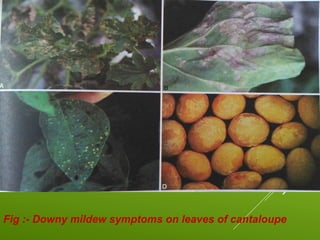
 At first, small, pale yellow, irregular spots
appear on the upper surface of the leaves,
and a white downy growth of the
sporangiophores of the oomycete appears on
the underside of the spots.
• Later, the infected leaf areas are killed and
turn brown, while the sporangiophores of the
oomycete turn gray. The spots often enlarge,
coalesce to from large dead areas on the leaf
frequently result in premature defoliation.
Fig.
Fig :- Downy mildew symptoms on leaves of cantaloupe
 PATHOGEN:-
 Plasmopara viticola.
The mycelium diameter varies from
1to60 micrometers because the
hyphae take the shape of the
intercellular spaces of the infected
tissues.
 Globose haustoria grow into the
cells.
 CAUSAL ORGANISM
 The causal fungus overwinters in soil as
Microsclerotia which are clusters of thick
walled cells that collectively are no larger
then finally ground paper.
 Microsclerotia are produced abundantly In
cortical tissues and rhizobium nodules of
infected peanut roots.
 As infected tissues decompose
Microsclerotia are released in to soil.
 Moment of this structure in plant Debreis
and soil represent the primary avenue for
disease spread.
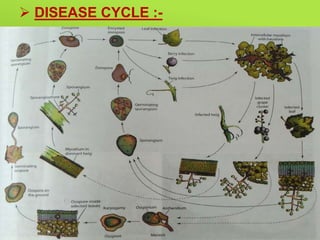
 DISEASE CYCLE :-
 Figure:
DEVELOPMENT OF
DISEASE :
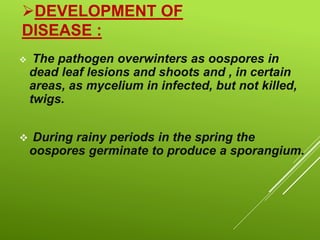
 The pathogen overwinters as oospores in
dead leaf lesions and shoots and , in certain
areas, as mycelium in infected, but not killed,
twigs.
 During rainy periods in the spring the
oospores germinate to produce a sporangium.
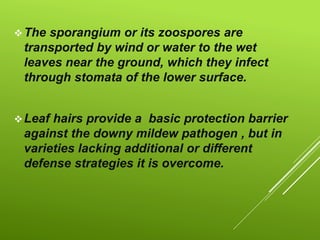
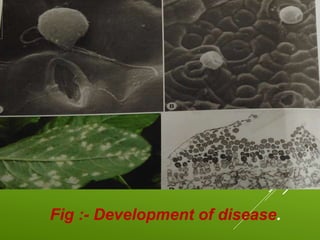
The sporangium or its zoospores are
transported by wind or water to the wet
leaves near the ground, which they infect
through stomata of the lower surface.
Leaf hairs provide a basic protection barrier
against the downy mildew pathogen , but in
varieties lacking additional or different
defense strategies it is overcome.
Fig.
Fig :- Development of disease.
 DISEASE CONTROL :-
Serveral American grape varieties show
considerable resistance to downy mildew,
but most European varieties are quite
susceptible.
Even the relatively resistant varieties,
however , require protection through
chemicals.
The most effective fungicides for the control
of downy mildew have been copper-based
products such as the bordeaux mixture,
some broad- spectrum protective
fungicides, and several systemic fungisides.
The application begin before bloom and are
continued at 7 - to 10 - day intervals or,
depending on the frequency and duration of
rainfall, during the growing season.
 Disease prediction systems, based on the
duration of leaf wetness, relative humidity ,and
temperature, are used to identify infection
periods and to time fungicide applications.
 In recent years, sprays of systemic fungicides
in combination with copper or board- spectrum
preventive fungicides have given excellent
control of grape downy mildew.
 REFERENCE:-
 PLANT PHATHOLOGY by George N.
Agrios.
 Google.com.in
 Downy mildew symptoms on leaves of
cantaloupe in image.
 Disease cycle in image.com.
 Development of disease in image. Com.
in
Downy mildews

Downy mildews

  • 1.
  • 2.
     CONTENTS  Introduction Symptoms Pathogen Causalorganism Disease cycle Development of Disease Disease Control
  • 3.
     WHAT ISDOWNY MILDEW ?  Downy mildews are primarily foliage blights . They attack and spread rapidly in young, tender green leaf, twig, and fruit tissues. They develop and are severe when a film of water is present on the plant tissues and the relative humidity in the air is high during cool or warm, but not, periods. Downy mildews can severe losses in short periods of time.
  • 4.
    DOWNY MILDEWS OFGRAPES  Downy mildew of grape occurs in most parts of the world where grapes are grown. Although the pathogen is native to north America, where it attacks native grape vines, it does not affect them very seriously.  Downy mildew affects the leaves, fruit, and shoots of grapevines.
  • 5.
     It causeslosses through killing of leaf tissues and defoliation, through production of low – quality , unsightly , or entirely destroyed grapes ,and through weakening, dwarfing, and killing of young shoots.  When the whether is favorable and no protection against the disease is provided, downy mildew can easily destroy 50 to 75% of the crop in one season.
  • 6.
     SYMPTOMS:  Atfirst, small, pale yellow, irregular spots appear on the upper surface of the leaves, and a white downy growth of the sporangiophores of the oomycete appears on the underside of the spots. • Later, the infected leaf areas are killed and turn brown, while the sporangiophores of the oomycete turn gray. The spots often enlarge, coalesce to from large dead areas on the leaf frequently result in premature defoliation.
  • 7.
    Fig. Fig :- Downymildew symptoms on leaves of cantaloupe
  • 8.
     PATHOGEN:-  Plasmoparaviticola. The mycelium diameter varies from 1to60 micrometers because the hyphae take the shape of the intercellular spaces of the infected tissues.  Globose haustoria grow into the cells.
  • 9.
     CAUSAL ORGANISM The causal fungus overwinters in soil as Microsclerotia which are clusters of thick walled cells that collectively are no larger then finally ground paper.  Microsclerotia are produced abundantly In cortical tissues and rhizobium nodules of infected peanut roots.  As infected tissues decompose Microsclerotia are released in to soil.  Moment of this structure in plant Debreis and soil represent the primary avenue for disease spread.
  • 10.
     DISEASE CYCLE:-  Figure:
  • 11.
    DEVELOPMENT OF DISEASE : The pathogen overwinters as oospores in dead leaf lesions and shoots and , in certain areas, as mycelium in infected, but not killed, twigs.  During rainy periods in the spring the oospores germinate to produce a sporangium.
  • 12.
    The sporangium orits zoospores are transported by wind or water to the wet leaves near the ground, which they infect through stomata of the lower surface. Leaf hairs provide a basic protection barrier against the downy mildew pathogen , but in varieties lacking additional or different defense strategies it is overcome.
  • 13.
  • 14.
     DISEASE CONTROL:- Serveral American grape varieties show considerable resistance to downy mildew, but most European varieties are quite susceptible. Even the relatively resistant varieties, however , require protection through chemicals.
  • 15.
    The most effectivefungicides for the control of downy mildew have been copper-based products such as the bordeaux mixture, some broad- spectrum protective fungicides, and several systemic fungisides. The application begin before bloom and are continued at 7 - to 10 - day intervals or, depending on the frequency and duration of rainfall, during the growing season.
  • 16.
     Disease predictionsystems, based on the duration of leaf wetness, relative humidity ,and temperature, are used to identify infection periods and to time fungicide applications.  In recent years, sprays of systemic fungicides in combination with copper or board- spectrum preventive fungicides have given excellent control of grape downy mildew.
  • 17.
     REFERENCE:-  PLANTPHATHOLOGY by George N. Agrios.  Google.com.in  Downy mildew symptoms on leaves of cantaloupe in image.  Disease cycle in image.com.  Development of disease in image. Com. in

Editor's Notes