Economical importance
Scab ofapple has been the most dreaded disease on all commercial cultivars
of apple in Kashmir valley.
It has been receiving a worldwide attention on account of involving high
expenses to restrict economic losses.
It was first reported from Sweden (1819) and India reported on Ambri
variety in Kashmir valley (1935).
10.
Symptoms
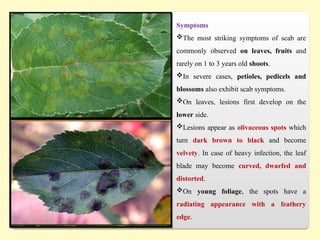
The most strikingsymptoms of scab are
commonly observed on leaves, fruits and
rarely on 1 to 3 years old shoots.
In severe cases, petioles, pedicels and
blossoms also exhibit scab symptoms.
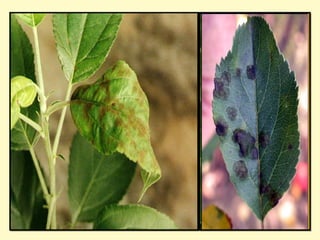
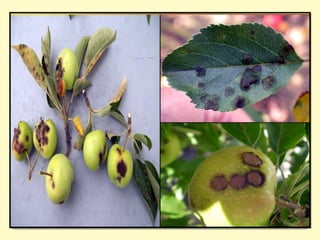
On leaves, lesions first develop on the
lower side.
Lesions appear as olivaceous spots which
turn dark brown to black and become
velvety. In case of heavy infection, the leaf
blade may become curved, dwarfed and
distorted.
On young foliage, the spots have a
radiating appearance with a feathery
edge.
11.
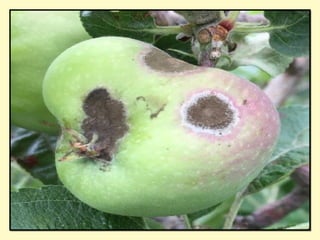
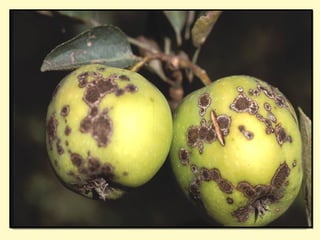
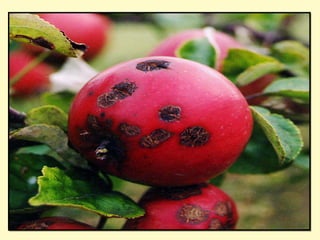
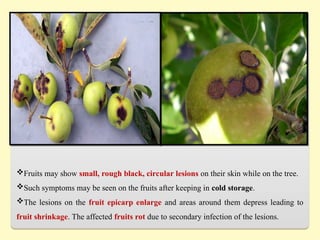
Fruits may showsmall, rough black, circular lesions on their skin while on the tree.
Such symptoms may be seen on the fruits after keeping in cold storage.
The lesions on the fruit epicarp enlarge and areas around them depress leading to
fruit shrinkage. The affected fruits rot due to secondary infection of the lesions.
12.
Causal organism: Venturiainaequalis (Cke.) Wint. (Imperfect stage: Spilocaea pomi Fr.).
Etiology
1.Mycelium is septate and is at first light in colour but later becomes grey in culture and
brownish in host tissues.
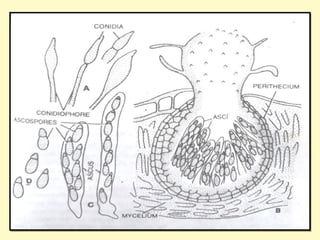
2.The conidiophores arise from the hyphal strands or from the more compact stroma. They
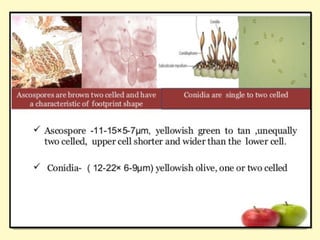
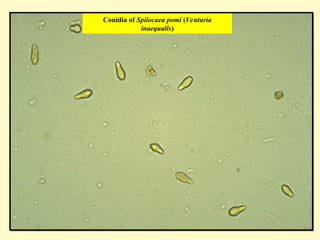
are brown continuous or rarely septate and vary in length. The conidia are generally
unicellular but often they become 2 celled through septation. They are ovate to lanceolate,
with a truncate base and somewhat pointed apex and smoky brown at maturity. They measures
12 to 22 x 6 to 9 µm.
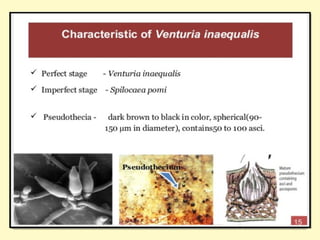
3.Ascus development occurs through the formation of crosiers. Mature ascocarps are 90 to
150 µm in diameter, spherical, dark brown to black with a short beak and distinct
ostiole around which single celled setae are present. The asci vary from 50 to 100 per
ascocarp. The ascus is slightly spatulate in shape and is thin walled with short stalk. Each
ascus contains 8 ascospores which are arranged in a single row in the lower part.
15.
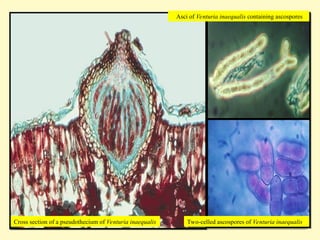
Asci of Venturiainaequalis containing ascospores
Two-celled ascospores of Venturia inaequalis
Cross section of a pseudothecium of Venturia inaequalis
Perpetuation
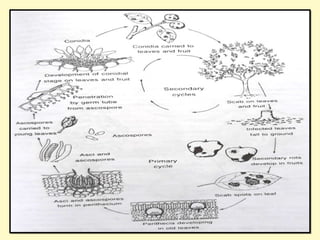
Pseudothecia formed inautumn and winter mature in spring to produce
ascospores, the chief inoculum for primary infection. The secondary spread is
through conidia.
Epidemiology
Cool and moist climate conditions due to rain or snow at higher
elevations and in shady portions of the orchards are congenial for the
development of pseudothecia in the overwintering leaves. When moisture is
not a limiting factor and the fallen leaves remain pliable, fungus starts
producing pseudothecia even at low temperatures of 4 and 80
C. But such
pseudothecia develop slowly throughout the winter, attain full size and mature
at an optimum temperature of 150
C.
20.
Management
1)Clean cultivation reducesprimary infection. Fallen leaves should be collected and
destroyed along with pruned materials.
2)Spraying of Captan 0.2 per cent or Dodine 0.25 per cent Captan 0.2 per cent at petal
fall.
3)Spraying with 5 per cent urea suppresses the pseudothecial production and
accelerates decomposition of leaves.
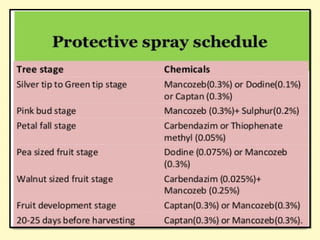
4)Spray schedule: 1st
spray - Silver tip stage: 0.2% Captofol (or) 0.3% Captan, IInd
spray pink bud: 0.2% Captan (or) 0.3% Mancozeb, IIIrd
spray at petal fall: 0.5%
Carbendazim, IVth
spray: after 10 days - 0.2% Captan, Vth
spray: 15 days after -
Mancozeb 0.3% and Fruit set - 0.15% Captafol.
5)Resistant varieties like Emira and Red free and new apple hybrids like Ambstarking,
Ambroyal, Ambrich and Ambred may be grown.
Economic importance
Powdery mildewis a major and serious foliar disease of apple
affecting new growth of young seedling and adult plants.
The disease was first recorded on apple seedlings in 1877 from
USA.
The disease is found in all apple growing countries of the world
such as Japan, India, Australia and Europe.
26.
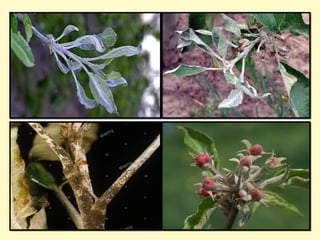
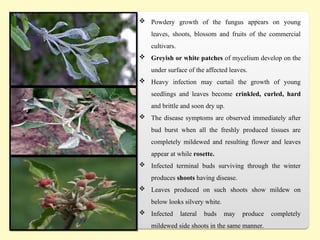
Powdery growthof the fungus appears on young
leaves, shoots, blossom and fruits of the commercial
cultivars.
Greyish or white patches of mycelium develop on the
under surface of the affected leaves.
Heavy infection may curtail the growth of young
seedlings and leaves become crinkled, curled, hard
and brittle and soon dry up.
The disease symptoms are observed immediately after
bud burst when all the freshly produced tissues are
completely mildewed and resulting flower and leaves
appear at while rosette.
Infected terminal buds surviving through the winter
produces shoots having disease.
Leaves produced on such shoots show mildew on
below looks silvery white.
Infected lateral buds may produce completely
mildewed side shoots in the same manner.
27.
Causal organism: Podosphaeraleucotricha (Ell. and Ev.) E.S. Salmon
Etiology
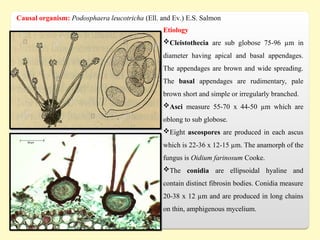
Cleistothecia are sub globose 75-96 µm in
diameter having apical and basal appendages.
The appendages are brown and wide spreading.
The basal appendages are rudimentary, pale
brown short and simple or irregularly branched.
Asci measure 55-70 x 44-50 µm which are
oblong to sub globose.
Eight ascospores are produced in each ascus
which is 22-36 x 12-15 µm. The anamorph of the
fungus is Oidium farinosum Cooke.
The conidia are ellipsoidal hyaline and
contain distinct fibrosin bodies. Conidia measure
20-38 x 12 µm and are produced in long chains
on thin, amphigenous mycelium.
29.
Perpetuation
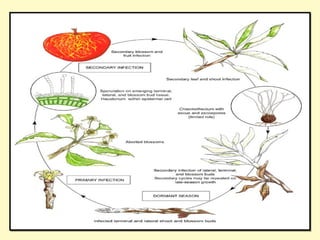
The fungus isan obligate parasite and over winters in the form of mycelium
in the vegetative buds, the spring season at bud burst stage, the fungus becomes
active and can be seen growing on the emerging leaf tissues.
Perithecia are also produced on different parts of the plant but their role in
primary infection is not known. Once the infection starts, it keeps on spreading
especially during the early season.
Favourable conditions
1.The disease is serious in hot and dry season whereas in others it is stated to
be encouraged by warm and moist summers.
2.Mean April temperature exceeding 110
C, 60-70 per cent relative humidity
(R.H) and short periods of rainfall favour disease development.
30.
Control measures
1. Removalof affected twigs, mildewed shoots and leaves helps in reducing severity of
the disease in the current season growth as well as reduces the load of primary
inoculum for the next season.
2. Application of wettable sulphur fungicides like Cosan, Solbar and Thiovit are
found effective in reducing the disease. Four sprays of Carbendazim (0.05%),
Binapacryl (0.1%), Morocide (0.1%) given at dormant, bud swell, petal fall and fruit
development stages have more effect in reducing the disease than single spray.
Fungicides like Tridemorph and Fenarimol sprayed once caused maximum
reduction in the number of conidia development.
3. Growing plant resistant varieties namely; Delicious, Golden delicious, Gala,
Firmgold, R4oyal Gala, Romus, Pionier, Vionea, Generos has been developed
through crossing breeding method.
4. Control of disease through coccinellid hauseri feeds on the mycelium of
Podosphaera leucotricha and provides 95 % reduced disease incidence.
Economical importance
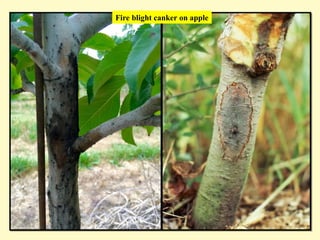
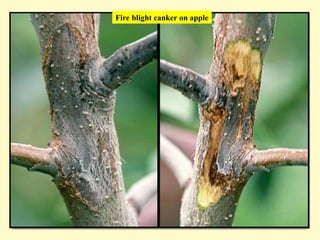
1)Fire blightis a destructive bacterial disease of apples. The first incidence of
fire bight in Canada occurred in 1865.
2)Fire blight now occurs worldwide and is found in many of the important
countries for pome fruit production.
Symptoms
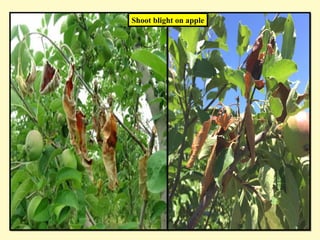
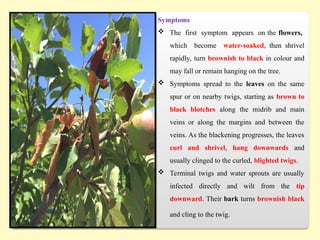
The firstsymptom appears on the flowers,
which become water-soaked, then shrivel
rapidly, turn brownish to black in colour and
may fall or remain hanging on the tree.
Symptoms spread to the leaves on the same
spur or on nearby twigs, starting as brown to
black blotches along the midrib and main
veins or along the margins and between the
veins. As the blackening progresses, the leaves
curl and shrivel, hang downwards and
usually clinged to the curled, blighted twigs.
Terminal twigs and water sprouts are usually
infected directly and wilt from the tip
downward. Their bark turns brownish black
and cling to the twig.
39.
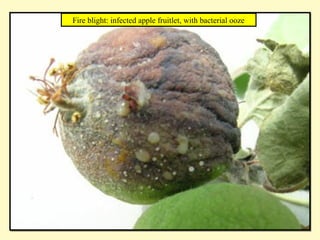
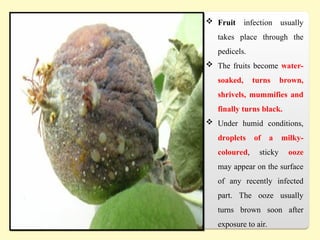
Fruit infectionusually
takes place through the
pedicels.
The fruits become water-
soaked, turns brown,
shrivels, mummifies and
finally turns black.
Under humid conditions,
droplets of a milky-
coloured, sticky ooze
may appear on the surface
of any recently infected
part. The ooze usually
turns brown soon after
exposure to air.
40.
Causal organism: Erwiniaamylovora (Burrill) Winslow et al.
Etiology
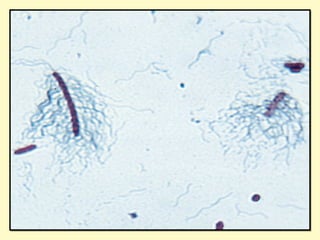
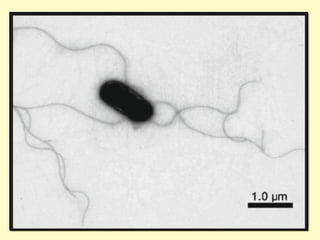
The bacterium is rod shaped and 1.0 to 2.0 x 0.8 to 1.2 µm in size. It is motile by
peritrichous flagella. Bacterium occurs usually singly but pairs or chains of 3 to 4
bacteria also exist. Each bacterial cell is enclosed in a capsule.
Perpetuation
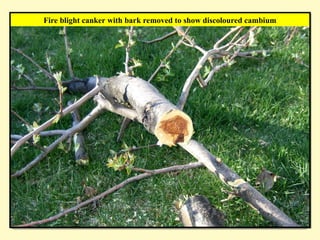
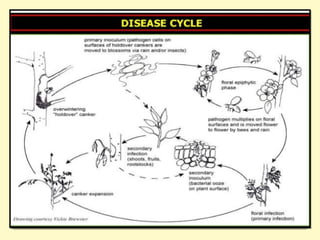
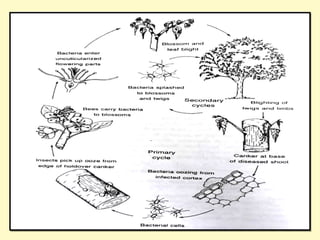
The bacterium overwinters at the margin of cankers formed during previous season. They
survive most often in large branches and seldom in twigs less than 1 cm in diameter.
Flies, wasps and honey bees and rain splashes, spread the bacteria. Sucking insects
like aphids and leaf hoppers act as inoculating agents because they insert bacteria into
fleshy wounded tissues inside the leaf.
Epidemiology
Temperature above 240
C and heavy rain favour infection and rapid spread of the disease.
44.
Management
During winter allthe blighted twigs, branches and cankers should be cut out about 10
cm below the last point of visible infection and burnt.
Cutting of blighted twigs, suckers and root sprouts in the summer reduces the
inoculum and prevents production of large cankers on the branches.
Best insect control programme should be followed to reduce or eliminate spread of
bacteria by insects.
Resistant varieties should be planted in new areas.
Use Bordeaux mixture (2.6:100) or Strepromycine 550 or 1000 ppm are the effective
blossom sprays.
Four sprayings of Streptomycin should be applied either when maximum temperature
are above 180
C or during night.
Symptoms
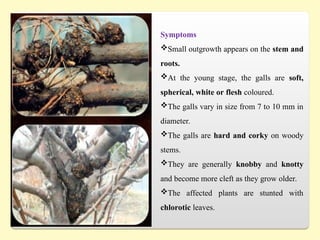
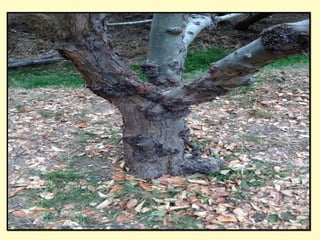
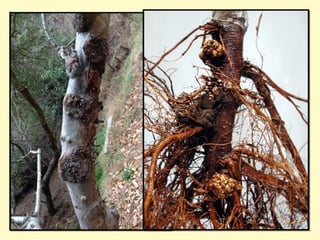
Small outgrowth appearson the stem and
roots.
At the young stage, the galls are soft,
spherical, white or flesh coloured.
The galls vary in size from 7 to 10 mm in
diameter.
The galls are hard and corky on woody
stems.
They are generally knobby and knotty
and become more cleft as they grow older.
The affected plants are stunted with
chlorotic leaves.
50.
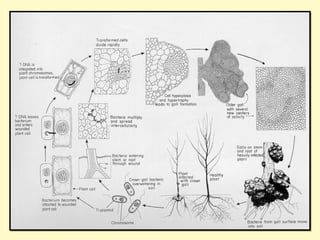
Causal organism: Agrobacteriumtumefaciens (Smith and Townsend) Conn.
Etiology
It is a Gram-negative rod and 0.7 to 0.8 x 2.5 to 3.0 µm. The bacterium can
grow on relatively simple medium but its isolation from soil requires selective
media. The bacterium consists of a heterogeneous group of strains.
Perpetuation
The bacterium is soil borne.
S.S.I- bacterium spread through irrigation and rain flash.
53.
Management
1.Pruning infected brancheswell back into healthy tissue will serve as an
effective means of control when galls are limited to the above ground portions.
2.Cutting tools should be disinfested with 10% household bleach, 70% alcohol
or Lysol between each cut in order to prevent transmitting the bacteria from
one cutting to the next.
3.Plant removal and destruction may be necessary when crown gall infections
are extensive, especially on the lower stem and roots.
4.Avoid replanting the site with trees or shrubs known to be susceptible to
crown gall.
Economical importance
1.Apple oneof the most widely grown fruit crops worldwide is a sensitive
host to the infection of Apple mosaic virus (ApMV), which is an economically
important and common pathogen in commercial apple cultivars.
2.The virus has no vector and is not pollen or seedborne.
58.
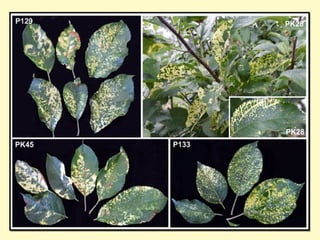
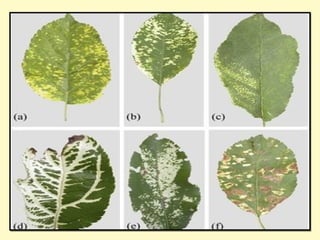
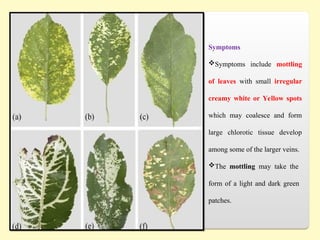
Symptoms
Symptoms include mottling
ofleaves with small irregular
creamy white or Yellow spots
which may coalesce and form
large chlorotic tissue develop
among some of the larger veins.
The mottling may take the
form of a light and dark green
patches.
59.
Causal organism: Applemosaic virus (AMV).
Etiology
The virus particles are isometric and 25 and 29 nm in diameter. The thermal
inactivation point is 540
C (in extracts stabilized with mercaptoethanol). Longevity in vitro
is 0.1 to 0.2 days. Dilution end point is 10-3
(in stabilized 2- mercaptoethanol sap diluted in
water).
Perpetuation
The disease is transmitted by natural root grafting, budding and tap root
grafting. It is not transmitted through sap, seed or aphids but probably transmitted by
pollen to the pollinated plant.
60.
Management
1.It is possibleto cure infected budding by exposing them to a
temperature of 360
C for about 4 weeks.
2.Apple moasic virus is inactivated in seedlings maintained at 37
and 400
C for 27 and 20 days, respectively.
3.Affected bud wood material when treated at 500
C (hot water)
for a period of 15 minutes and at 700
C (warm vapour) for a
period of 10 minutes completely inactivated the virus.