



1© 2016 Scaled Agile, Inc. All Rights Reserved.V4.0.0© 2016 Scaled Agile, Inc. All Rights Reserved.
Transformational Leadership
What every DevOps leader needs to know
Steve Mayner
SAFe® Senior Program Consultant
Scaled Agile, Inc.
steve.mayner@scaledagile.com
November 8, 2016
2© 2016 Scaled Agile, Inc. All Rights Reserved. 2
The DevOps Adoption Challenge
3© 2016 Scaled Agile, Inc. All Rights Reserved.
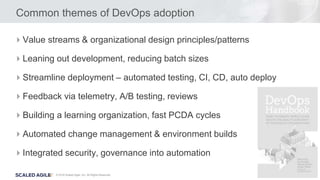
Common themes of DevOps adoption
Value streams & organizational design principles/patterns
Leaning out development, reducing batch sizes
Streamline deployment – automated testing, CI, CD, auto deploy
Feedback via telemetry, A/B testing, reviews
Building a learning organization, fast PCDA cycles
Automated change management & environment builds
Integrated security, governance into automation
4© 2016 Scaled Agile, Inc. All Rights Reserved.
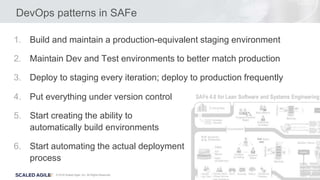
DevOps patterns in SAFe
1. Build and maintain a production-equivalent staging environment
2. Maintain Dev and Test environments to better match production
3. Deploy to staging every iteration; deploy to production frequently
4. Put everything under version control
5. Start creating the ability to
automatically build environments
6. Start automating the actual deployment
process
5© 2016 Scaled Agile, Inc. All Rights Reserved. 5© 2016 Scaled Agile, Inc. All Rights Reserved.
DevOps adoption -> organizational change
6© 2016 Scaled Agile, Inc. All Rights Reserved.
Change is hard
7© 2016 Scaled Agile, Inc. All Rights Reserved.
70% of change initiatives fail
Kotter, J. P. (1996). Leading change. Boston, MA: Harvard Business School Press.
- John Kotter
8© 2016 Scaled Agile, Inc. All Rights Reserved.
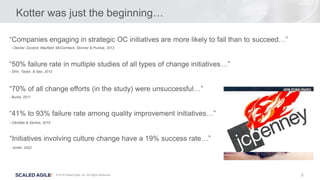
“Companies engaging in strategic OC initiatives are more likely to fail than to succeed…”
“50% failure rate in multiple studies of all types of change initiatives…”
“70% of all change efforts (in the study) were unsuccessful…”
“41% to 93% failure rate among quality improvement initiatives…”
- Decker, Durand, Mayfield, McCormack, Skinner & Purdue, 2012
- Shin, Taylor, & Seo, 2012
- Burke, 2011
- Cândido & Santos, 2015
Kotter was just the beginning…
“Initiatives involving culture change have a 19% success rate…”
- Smith, 2002
9© 2016 Scaled Agile, Inc. All Rights Reserved. 9© 2016 Scaled Agile, Inc. All Rights Reserved.
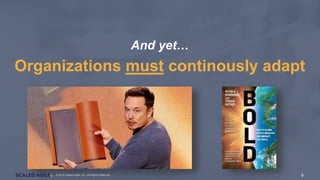
And yet…
Organizations must continously adapt
10© 2016 Scaled Agile, Inc. All Rights Reserved.
Adapt or die
“Since 2000, 52 percent of the names on the
Fortune 500 list are gone, either as a result
of mergers, acquisitions or bankruptcies.”
— Teresa Novellino | New York Business Journal
Novellino, 2015
11© 2016 Scaled Agile, Inc. All Rights Reserved.
Why does organizational change fail?
Resistance to change
Low readiness for change
Inadequate communications
Poor planning
Lack of training
Institutional inertia (process, structure)
Technology gaps
Lack of organizational alignment
History of change failures
Lack of employee involvement
Bureaucracy, politics, conflict
Poor strategy / wrong change
Unrealistic expectations
Low transparency and trust
- Decker, Durand, Mayfield, McCormack, Skinner & Purdue, 2012
12© 2016 Scaled Agile, Inc. All Rights Reserved. 12
Transformational Leadership &
Organizational Change
13© 2016 Scaled Agile, Inc. All Rights Reserved.
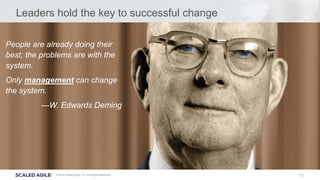
Leaders hold the key to successful change
People are already doing their
best; the problems are with the
system.
Only management can change
the system.
—W. Edwards Deming
14© 2016 Scaled Agile, Inc. All Rights Reserved.
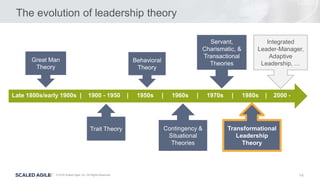
The evolution of leadership theory
Great Man
Theory
Trait Theory
Late 1800s/early 1900s | 1900 - 1950 | 1950s | 1960s | 1970s | 1980s | 2000 -
Behavioral
Theory
Contingency &
Situational
Theories
Servant,
Charismatic, &
Transactional
Theories
Transformational
Leadership
Theory
Integrated
Leader-Manager,
Adaptive
Leadership, …
15© 2016 Scaled Agile, Inc. All Rights Reserved.
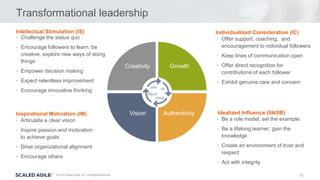
Transformational leadership
‣ Offer support, coaching, and
encouragement to individual followers
‣ Keep lines of communication open
‣ Offer direct recognition for
contributions of each follower
‣ Exhibit genuine care and concern
GrowthCreativity
Vision Authenticity
‣ Be a role model; set the example
‣ Be a lifelong learner; gain the
knowledge
‣ Create an environment of trust and
respect
‣ Act with integrity
‣ Articulate a clear vision
‣ Inspire passion and motivation
to achieve goals
‣ Drive organizational alignment
‣ Encourage others
‣ Challenge the status quo
‣ Encourage followers to learn, be
creative, explore new ways of doing
things
‣ Empower decision making
‣ Expect relentless improvement
‣ Encourage innovative thinking
plan do
adjust
check
Inspirational Motivation (IM) Idealized Influence (IIA/IIB)
Individualized Consideration (IC)Intellectual Stimulation (IS)
16© 2016 Scaled Agile, Inc. All Rights Reserved. 16© 2016 Scaled Agile, Inc. All Rights Reserved.
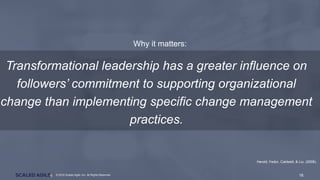
Why it matters:
Herold, Fedor, Caldwell, & Liu. (2008).
Transformational leadership has a greater influence on
followers’ commitment to supporting organizational
change than implementing specific change management
practices.
17© 2016 Scaled Agile, Inc. All Rights Reserved.
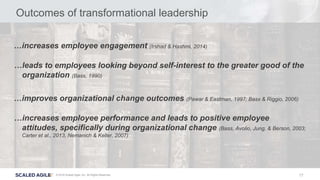
Outcomes of transformational leadership
…increases employee engagement (Irshad & Hashmi, 2014)
…leads to employees looking beyond self-interest to the greater good of the
organization (Bass, 1990)
…improves organizational change outcomes (Pawar & Eastman, 1997; Bass & Riggio, 2006)
…increases employee performance and leads to positive employee
attitudes, specifically during organizational change (Bass, Avolio, Jung, & Berson, 2003;
Carter et al., 2013, Nemanich & Keller, 2007)
18© 2016 Scaled Agile, Inc. All Rights Reserved.
Here’s the good news…
Transformational leadership can be learned!
Avolio & Bass, 1994; Bass, 1998; Dvir et al., 2002; Parry & Sinha, 2005
19© 2016 Scaled Agile, Inc. All Rights Reserved. 19
The Experiment
20© 2016 Scaled Agile, Inc. All Rights Reserved.
The experiment…
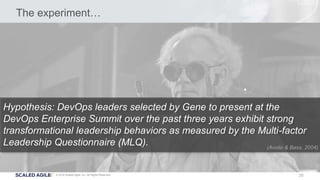
Hypothesis: DevOps leaders selected by Gene to present at the
DevOps Enterprise Summit over the past three years exhibit strong
transformational leadership behaviors as measured by the Multi-factor
Leadership Questionnaire (MLQ). (Avolio & Bass, 2004)
21© 2016 Scaled Agile, Inc. All Rights Reserved.
The results…
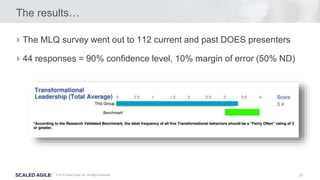
The MLQ survey went out to 112 current and past DOES presenters
44 responses = 90% confidence level, 10% margin of error (50% ND)
22© 2016 Scaled Agile, Inc. All Rights Reserved.
The results…
23© 2016 Scaled Agile, Inc. All Rights Reserved.
The results…
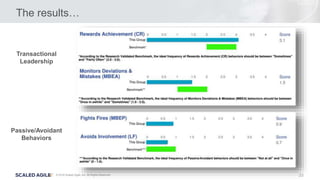
Transactional
Leadership
Passive/Avoidant
Behaviors
24© 2016 Scaled Agile, Inc. All Rights Reserved.© 2016 Scaled Agile, Inc. All Rights Reserved. 24
Organizational change is hard and prone to failure, especially when it leads to altering the
culture
Lean-Agile and DevOps adoption frequently involves organizational and cultural change
Knowledge workers involved in DevOps adoption are working hard and want to do well… the
challenges are with the system
Leaders are the only ones who can ultimately change the system, and how they lead through
that change can have a direct influence on successful organizational change outcomes
Transformational Leadership behaviors by Lean-Agile Leaders can have a positive influence
on the factors that contribute to successful organizational change
Anyone can learn to be a transformational leader!
DOES presenters from the last three conferences demonstrated strong transformational
leadership behaviors in the MLQ survey conducted leading up to this conference
Here’s what we’ve learned…
25© 2016 Scaled Agile, Inc. All Rights Reserved.
Bibliography
Avolio, B.J. and Bass, B.M. (1994). Evaluate the impact of transformational leadership training at individual, group, organizational and community levels. Final Report
to the W.K. Kellogg Foundation, Binghamton University, Binghamton, NY.
Avolio, B. J. & Bass, B. M. (2004). Multifactor Leadership Questionnaire. Manual and sampler set. (3rd ed.). Redwood City, CA: Mind Garden.
Bass, B.M. (1990). From transactional to transformational leadership: Learning to share the vision. Organizational Dynamics, (Winter), 19-31.
Bass, B.M. (1998), Transformational leadership: Industrial, military, and educational impact. Mahwah, NJ: Lawrence Erlbaum Associates.
Bass, B. M., Avolio, B. J., Jung, D. I., & Berson, Y. (2003). Predicting unit performance by assessing transformational and transactional leadership. Journal of Applied
Psychology, 88(2), 207-218.
Bass, B. M., & Riggio, R. E. (2006). Transformational leadership. Mahwah, NJ: Erlbaum.
Burke, W. W. (2011). A perspective on the field of organization development and change: The Zeigarnik effect. Journal of Applied Behavioral Science, 47(2), 143-
167.
Cândido, C. J.F., & S.P. Santos. (2015). Strategy implementation: What is the failure rate? Journal of Management & Organization, 21(2), 237-262.
Carter, M. Z., Armenakis, A. A., Feild, H. S., & Mossholder, K. W. (2013). Transformational leadership, relationship quality, and employee performance during
continuous incremental organizational change. Journal of Organizational Behavior, 34(7), 942-958.
Decker, P., Durand, R., Mayfield, C. O., McCormack, C., Skinner, D., & Perdue, G. (2012). Predicting implementation failure in organization change. Journal of
Organizational Culture, Communications & Conflict, 16(2), 39-59.
Deming, W.E. (2000). Out of the crisis (reprint). Cambridge, MA: The MIT Press.
Dvir, T., Eden, D., Avolio, B.J. and Shamir, B. (2002). Impact of transformational leadership on follower development and performance: A field experiment. Academy
of Management Journal, 45(4), 735-744.
Edelman, D., Marston, N., & Willmott, P. (2015, October). How to scale your own digital disruption [Web log post]. McKinsey & Company.
26© 2016 Scaled Agile, Inc. All Rights Reserved.
Bibliography
Herold, Fedor, Caldwell, & Liu. (2008). The effects of transformational and change leadership on employees’ commitment to a change: A multi-level study. Journal of
Applied Psychology, 93(2), 346-357.
Irshad, R., & Hashmi, M. S. (2014). How transformational leadership is related to organizational citizenship behavior? The mediating role of emotional
intelligence. Pakistan Journal of Commerce & Social Sciences, 8(2), 413-425.
Kotter, J. P. (1996). Leading change. Boston, MA: Harvard Business School Press.
Nemanich, L. A., & Keller, R. T. (2007). Transformational leadership in an acquisition: A field study of employees. Leadership Quarterly, 18(1), 49-68.
Novellino, T. (2015, June 4). Don’t get cozy, Fortune 500: It’s do-or-die time for digital disruption [Web log post]. New York Business Journal.
Parry, K. W., & Sinha, P. N. (2005). Researching the trainability of transformational organizational leadership. Human Resource Development International, 8(2),
165-183.
Pawar, B. S., & Eastman, K. K. (1997). The nature and implications of contextual influences on transformational leadership: A conceptual examination. Academy of
Management Review, 22, 80–109.
Shin, J., Taylor, M. S., & Seo, M.-G. (2012). Resources for change: The relationships of organizational inducements and psychological resilience to employees’
attitudes and behaviors toward organizational change. Academy of Management Journal, 55, 727-748.
Smith, M. E. (2002). Success rates for different types of organizational change. Performance Improvement, 41(1), 26-33.
27© 2016 Scaled Agile, Inc. All Rights Reserved. 27© 2016 Scaled Agile, Inc. All Rights Reserved.
Questions?

DOES SFO 2016 - Steve Mayner - Transformational Leadership

  • 1.
    1© 2016 ScaledAgile, Inc. All Rights Reserved.V4.0.0© 2016 Scaled Agile, Inc. All Rights Reserved. Transformational Leadership What every DevOps leader needs to know Steve Mayner SAFe® Senior Program Consultant Scaled Agile, Inc. steve.mayner@scaledagile.com November 8, 2016
  • 2.
    2© 2016 ScaledAgile, Inc. All Rights Reserved. 2 The DevOps Adoption Challenge
  • 3.
    3© 2016 ScaledAgile, Inc. All Rights Reserved. Common themes of DevOps adoption Value streams & organizational design principles/patterns Leaning out development, reducing batch sizes Streamline deployment – automated testing, CI, CD, auto deploy Feedback via telemetry, A/B testing, reviews Building a learning organization, fast PCDA cycles Automated change management & environment builds Integrated security, governance into automation
  • 4.
    4© 2016 ScaledAgile, Inc. All Rights Reserved. DevOps patterns in SAFe 1. Build and maintain a production-equivalent staging environment 2. Maintain Dev and Test environments to better match production 3. Deploy to staging every iteration; deploy to production frequently 4. Put everything under version control 5. Start creating the ability to automatically build environments 6. Start automating the actual deployment process
  • 5.
    5© 2016 ScaledAgile, Inc. All Rights Reserved. 5© 2016 Scaled Agile, Inc. All Rights Reserved. DevOps adoption -> organizational change
  • 6.
    6© 2016 ScaledAgile, Inc. All Rights Reserved. Change is hard
  • 7.
    7© 2016 ScaledAgile, Inc. All Rights Reserved. 70% of change initiatives fail Kotter, J. P. (1996). Leading change. Boston, MA: Harvard Business School Press. - John Kotter
  • 8.
    8© 2016 ScaledAgile, Inc. All Rights Reserved. “Companies engaging in strategic OC initiatives are more likely to fail than to succeed…” “50% failure rate in multiple studies of all types of change initiatives…” “70% of all change efforts (in the study) were unsuccessful…” “41% to 93% failure rate among quality improvement initiatives…” - Decker, Durand, Mayfield, McCormack, Skinner & Purdue, 2012 - Shin, Taylor, & Seo, 2012 - Burke, 2011 - Cândido & Santos, 2015 Kotter was just the beginning… “Initiatives involving culture change have a 19% success rate…” - Smith, 2002
  • 9.
    9© 2016 ScaledAgile, Inc. All Rights Reserved. 9© 2016 Scaled Agile, Inc. All Rights Reserved. And yet… Organizations must continously adapt
  • 10.
    10© 2016 ScaledAgile, Inc. All Rights Reserved. Adapt or die “Since 2000, 52 percent of the names on the Fortune 500 list are gone, either as a result of mergers, acquisitions or bankruptcies.” — Teresa Novellino | New York Business Journal Novellino, 2015
  • 11.
    11© 2016 ScaledAgile, Inc. All Rights Reserved. Why does organizational change fail? Resistance to change Low readiness for change Inadequate communications Poor planning Lack of training Institutional inertia (process, structure) Technology gaps Lack of organizational alignment History of change failures Lack of employee involvement Bureaucracy, politics, conflict Poor strategy / wrong change Unrealistic expectations Low transparency and trust - Decker, Durand, Mayfield, McCormack, Skinner & Purdue, 2012
  • 12.
    12© 2016 ScaledAgile, Inc. All Rights Reserved. 12 Transformational Leadership & Organizational Change
  • 13.
    13© 2016 ScaledAgile, Inc. All Rights Reserved. Leaders hold the key to successful change People are already doing their best; the problems are with the system. Only management can change the system. —W. Edwards Deming
  • 14.
    14© 2016 ScaledAgile, Inc. All Rights Reserved. The evolution of leadership theory Great Man Theory Trait Theory Late 1800s/early 1900s | 1900 - 1950 | 1950s | 1960s | 1970s | 1980s | 2000 - Behavioral Theory Contingency & Situational Theories Servant, Charismatic, & Transactional Theories Transformational Leadership Theory Integrated Leader-Manager, Adaptive Leadership, …
  • 15.
    15© 2016 ScaledAgile, Inc. All Rights Reserved. Transformational leadership ‣ Offer support, coaching, and encouragement to individual followers ‣ Keep lines of communication open ‣ Offer direct recognition for contributions of each follower ‣ Exhibit genuine care and concern GrowthCreativity Vision Authenticity ‣ Be a role model; set the example ‣ Be a lifelong learner; gain the knowledge ‣ Create an environment of trust and respect ‣ Act with integrity ‣ Articulate a clear vision ‣ Inspire passion and motivation to achieve goals ‣ Drive organizational alignment ‣ Encourage others ‣ Challenge the status quo ‣ Encourage followers to learn, be creative, explore new ways of doing things ‣ Empower decision making ‣ Expect relentless improvement ‣ Encourage innovative thinking plan do adjust check Inspirational Motivation (IM) Idealized Influence (IIA/IIB) Individualized Consideration (IC)Intellectual Stimulation (IS)
  • 16.
    16© 2016 ScaledAgile, Inc. All Rights Reserved. 16© 2016 Scaled Agile, Inc. All Rights Reserved. Why it matters: Herold, Fedor, Caldwell, & Liu. (2008). Transformational leadership has a greater influence on followers’ commitment to supporting organizational change than implementing specific change management practices.
  • 17.
    17© 2016 ScaledAgile, Inc. All Rights Reserved. Outcomes of transformational leadership …increases employee engagement (Irshad & Hashmi, 2014) …leads to employees looking beyond self-interest to the greater good of the organization (Bass, 1990) …improves organizational change outcomes (Pawar & Eastman, 1997; Bass & Riggio, 2006) …increases employee performance and leads to positive employee attitudes, specifically during organizational change (Bass, Avolio, Jung, & Berson, 2003; Carter et al., 2013, Nemanich & Keller, 2007)
  • 18.
    18© 2016 ScaledAgile, Inc. All Rights Reserved. Here’s the good news… Transformational leadership can be learned! Avolio & Bass, 1994; Bass, 1998; Dvir et al., 2002; Parry & Sinha, 2005
  • 19.
    19© 2016 ScaledAgile, Inc. All Rights Reserved. 19 The Experiment
  • 20.
    20© 2016 ScaledAgile, Inc. All Rights Reserved. The experiment… Hypothesis: DevOps leaders selected by Gene to present at the DevOps Enterprise Summit over the past three years exhibit strong transformational leadership behaviors as measured by the Multi-factor Leadership Questionnaire (MLQ). (Avolio & Bass, 2004)
  • 21.
    21© 2016 ScaledAgile, Inc. All Rights Reserved. The results… The MLQ survey went out to 112 current and past DOES presenters 44 responses = 90% confidence level, 10% margin of error (50% ND)
  • 22.
    22© 2016 ScaledAgile, Inc. All Rights Reserved. The results…
  • 23.
    23© 2016 ScaledAgile, Inc. All Rights Reserved. The results… Transactional Leadership Passive/Avoidant Behaviors
  • 24.
    24© 2016 ScaledAgile, Inc. All Rights Reserved.© 2016 Scaled Agile, Inc. All Rights Reserved. 24 Organizational change is hard and prone to failure, especially when it leads to altering the culture Lean-Agile and DevOps adoption frequently involves organizational and cultural change Knowledge workers involved in DevOps adoption are working hard and want to do well… the challenges are with the system Leaders are the only ones who can ultimately change the system, and how they lead through that change can have a direct influence on successful organizational change outcomes Transformational Leadership behaviors by Lean-Agile Leaders can have a positive influence on the factors that contribute to successful organizational change Anyone can learn to be a transformational leader! DOES presenters from the last three conferences demonstrated strong transformational leadership behaviors in the MLQ survey conducted leading up to this conference Here’s what we’ve learned…
  • 25.
    25© 2016 ScaledAgile, Inc. All Rights Reserved. Bibliography Avolio, B.J. and Bass, B.M. (1994). Evaluate the impact of transformational leadership training at individual, group, organizational and community levels. Final Report to the W.K. Kellogg Foundation, Binghamton University, Binghamton, NY. Avolio, B. J. & Bass, B. M. (2004). Multifactor Leadership Questionnaire. Manual and sampler set. (3rd ed.). Redwood City, CA: Mind Garden. Bass, B.M. (1990). From transactional to transformational leadership: Learning to share the vision. Organizational Dynamics, (Winter), 19-31. Bass, B.M. (1998), Transformational leadership: Industrial, military, and educational impact. Mahwah, NJ: Lawrence Erlbaum Associates. Bass, B. M., Avolio, B. J., Jung, D. I., & Berson, Y. (2003). Predicting unit performance by assessing transformational and transactional leadership. Journal of Applied Psychology, 88(2), 207-218. Bass, B. M., & Riggio, R. E. (2006). Transformational leadership. Mahwah, NJ: Erlbaum. Burke, W. W. (2011). A perspective on the field of organization development and change: The Zeigarnik effect. Journal of Applied Behavioral Science, 47(2), 143- 167. Cândido, C. J.F., & S.P. Santos. (2015). Strategy implementation: What is the failure rate? Journal of Management & Organization, 21(2), 237-262. Carter, M. Z., Armenakis, A. A., Feild, H. S., & Mossholder, K. W. (2013). Transformational leadership, relationship quality, and employee performance during continuous incremental organizational change. Journal of Organizational Behavior, 34(7), 942-958. Decker, P., Durand, R., Mayfield, C. O., McCormack, C., Skinner, D., & Perdue, G. (2012). Predicting implementation failure in organization change. Journal of Organizational Culture, Communications & Conflict, 16(2), 39-59. Deming, W.E. (2000). Out of the crisis (reprint). Cambridge, MA: The MIT Press. Dvir, T., Eden, D., Avolio, B.J. and Shamir, B. (2002). Impact of transformational leadership on follower development and performance: A field experiment. Academy of Management Journal, 45(4), 735-744. Edelman, D., Marston, N., & Willmott, P. (2015, October). How to scale your own digital disruption [Web log post]. McKinsey & Company.
  • 26.
    26© 2016 ScaledAgile, Inc. All Rights Reserved. Bibliography Herold, Fedor, Caldwell, & Liu. (2008). The effects of transformational and change leadership on employees’ commitment to a change: A multi-level study. Journal of Applied Psychology, 93(2), 346-357. Irshad, R., & Hashmi, M. S. (2014). How transformational leadership is related to organizational citizenship behavior? The mediating role of emotional intelligence. Pakistan Journal of Commerce & Social Sciences, 8(2), 413-425. Kotter, J. P. (1996). Leading change. Boston, MA: Harvard Business School Press. Nemanich, L. A., & Keller, R. T. (2007). Transformational leadership in an acquisition: A field study of employees. Leadership Quarterly, 18(1), 49-68. Novellino, T. (2015, June 4). Don’t get cozy, Fortune 500: It’s do-or-die time for digital disruption [Web log post]. New York Business Journal. Parry, K. W., & Sinha, P. N. (2005). Researching the trainability of transformational organizational leadership. Human Resource Development International, 8(2), 165-183. Pawar, B. S., & Eastman, K. K. (1997). The nature and implications of contextual influences on transformational leadership: A conceptual examination. Academy of Management Review, 22, 80–109. Shin, J., Taylor, M. S., & Seo, M.-G. (2012). Resources for change: The relationships of organizational inducements and psychological resilience to employees’ attitudes and behaviors toward organizational change. Academy of Management Journal, 55, 727-748. Smith, M. E. (2002). Success rates for different types of organizational change. Performance Improvement, 41(1), 26-33.
  • 27.
    27© 2016 ScaledAgile, Inc. All Rights Reserved. 27© 2016 Scaled Agile, Inc. All Rights Reserved. Questions?

Editor's Notes

  • #2 How many
  • #6 How many would agree that transitioning to DevOps and Lean IT leads to organizational change?
  • #7 It’s something we all know, but seeing just how hard change can be in organization after organization that we’ve coached through Agile and DevOps implementations led me to a learning journey that is the reason why Gene invited me to present at this year’s summit. I became fascinated with this with this classic case of an irresistible force and an immovable object… the desperate need to change the way we build, maintain, and enhance our IT systems struggling against this inherent nature we have to resist change.
  • #8 How many of you are familiar with John Kotter’s famous “70% failure rate” in change initiatives? If we believe that DevOps adoption leads to organizational change, then Kotter’s claim should serve as a warning for us that we have to know how to effectively manage organizational change if we want our DevOps implementation to be successful.
  • #9 A lot of additional research has reinforced Kotter’s claim. We are also familiar with many very public failures that illustrate just how difficult change can be. (Go through list quickly).
  • #10 So we know that implementing DevOps and managing the organizational change it brings is challenging… and yet we also know that in today’s environment organizations MUST be able to continuously adapt to survive. How many of you have read the book Bold? Whether you agree with their call to action or not, what Diamandis and Kotler did a great job of in the first part of their book was to catalog all of the external factors that are literally changing the marketplace in front of our eyes on a daily basis, and the pace of change is accelerating. They talk about advances like artificial intelligence, big data, driverless cars, internet of things, EVERYTHING as a service, breakthroughs in bio science… the list goes on and on. And then last week… how many saw Elon Musk’s announcement regarding solar panel rooftops that look like regular shingles? Caught the entire energy industry by surprise. This is just one example of why organizations have no choice… the ability to change and adapt is now a core competency.
  • #11 The evidence shows that companies who can’t adapt are not going to be around long. This report published last year in the New York Business Journal highlighted the fact that in just 15 years over HALF of the Fortune 500 from the year 2000 are now gone… not just off the list… GONE. That turnover rate in the Fortune 500, S&P, Dow, etc. if you graph it out is accelerating on an exponential curve.
  • #12 So if we know we have to be able to rapidly adapt in our organizations, but that change initiatives frequently fail, where do we go from there? The next step in my journey was to dig into the reasons scholarly researchers found for why change initiatives were failing. This study by Decker et al actually was a study of studies… to survey all of the research at the time to see what patterns they could find. Here are the most frequently cited reasons for change failure… see if any of these look familiar. (Go through list quickly). That brings us back to our Captain Obvious moment. Nothing here is revolutionary or new… we know this. The real answer I was seeking to find was… what do we do about it? How do we counter these factors and become one of those exceptional companies model organizational agility?
  • #14 © 2007 Trail Ridge Consulting, LLC
  • #15 The question is, are all approaches to leadership created equal? What leadership behaviors are most effective for Lean-Agile leaders? As I began to explore that question I discovered the wealth of research around transformational leadership, and it really resonated as a set of leadership patterns that synergize well with Lean IT.
  • #16 Quickly point out the four key behaviors of transformational leaders (build slide)
  • #17 Change management models are good and useful, but the research indicates that HOW leaders lead can actually be more effective at creating an environment where employees embrace change.
  • #18 Other articles document a variety of very positive outcomes that have been connected to transformational leadership behaviors.
  • #19 Here’s the good news… these behaviors can be taught, and they can be learned! That means all of us in this room can adapt our leadership approach to incorporate the elements of transformational leadership!
  • #21 Over the last two or three years I’ve discussed my research with Gene, and as we were chatting about this presentation for this conference, we had this idea to form an experiment based on this hypothesis… that the people Gene had picked to be presenters over the last three years at the DevOps Summit would demonstrate high levels of transformational leadership behavior. To test that hypothesis, we asked this group to complete the de facto standard in the research community for measuring transformational leadership – the multi-factor leadership questionnaire.
  • #22 Overall our sample of 30 responses from the presenters at DOES supports our hypothesis… the green is the range you would expect for transformational leaders, and our group was right in the middle of the target.
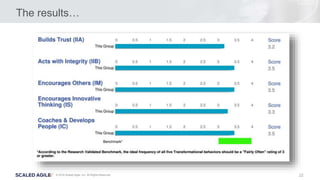
  • #23 This shows you the breakdown by the individual behaviors within transformational leadership…
  • #24 The same survey also tested two other sets of leadership behaviors… transactional and passive/avoidant. We would expect transformational leaders to score lower on these questions as shown by the green indicators. Again, our sample group scored right where we would expect transformational leaders to score.
  • #25 So here’s a quick review of what we’
  • #26 For those who are curious and want to dig into the resources cited in this presentation, I’ve also included the bibliography for your research enjoyment!
  • #28 I’m happy to answer any questions you might have about transformational leadership or about SAFe… feel free to stop by the Scaled Agile booth in the exhibit hall… I will be there throughout the conference.