

consulting | research | contracting
Ignore middle-managers at your peril!
Why middle-managers hold the key to successful Agile
transformations
Biase De Gregorio
@biased77
2
From: Ken Schwaber To: XXX XXXXX, CEO for XXXXXXX Corporation
On one hand, Scrum offers some very attractive possibilities increased productivity, a better working
environment, increased competitiveness, and a higher quality product. On the other hand, it is hard
to implement. The amount of change engendered by a Scrum implementation is significant and
difficult.
Even though the change is difficult for the developers and customers (product owners), they have
immediate payback through increased job satisfaction. This helps them through times of stress and
anxiety. Middle management, however, is stressed without immediate reward. They are asked to help
transition an organisation from traditional approaches to leaner approaches without a clear vision of a
personal end point what will I do and where will I fit into the new organisation. This question is
particularly difficult and fraught with danger since middle management will be fashioning the new
organisation. The potential for conflict and politics is daunting.
My experience with top-down, enterprise implementations of Scrum has led me to believe that the
differentiator between success and failure is you. Your ability to vision the future and help
communicate it to your management, your ability to patiently guide them through the change, and
your ability to assure your middle management of their value and form them into a team will
differentiate your ability to absorb the change and realize the benefits, or not.”
Ken Schwaber: A CIO’s Playbook for Adopting the Scrum Method of Achieving Software Agility With Dean Leffingwell & Hubert Smits
3
5
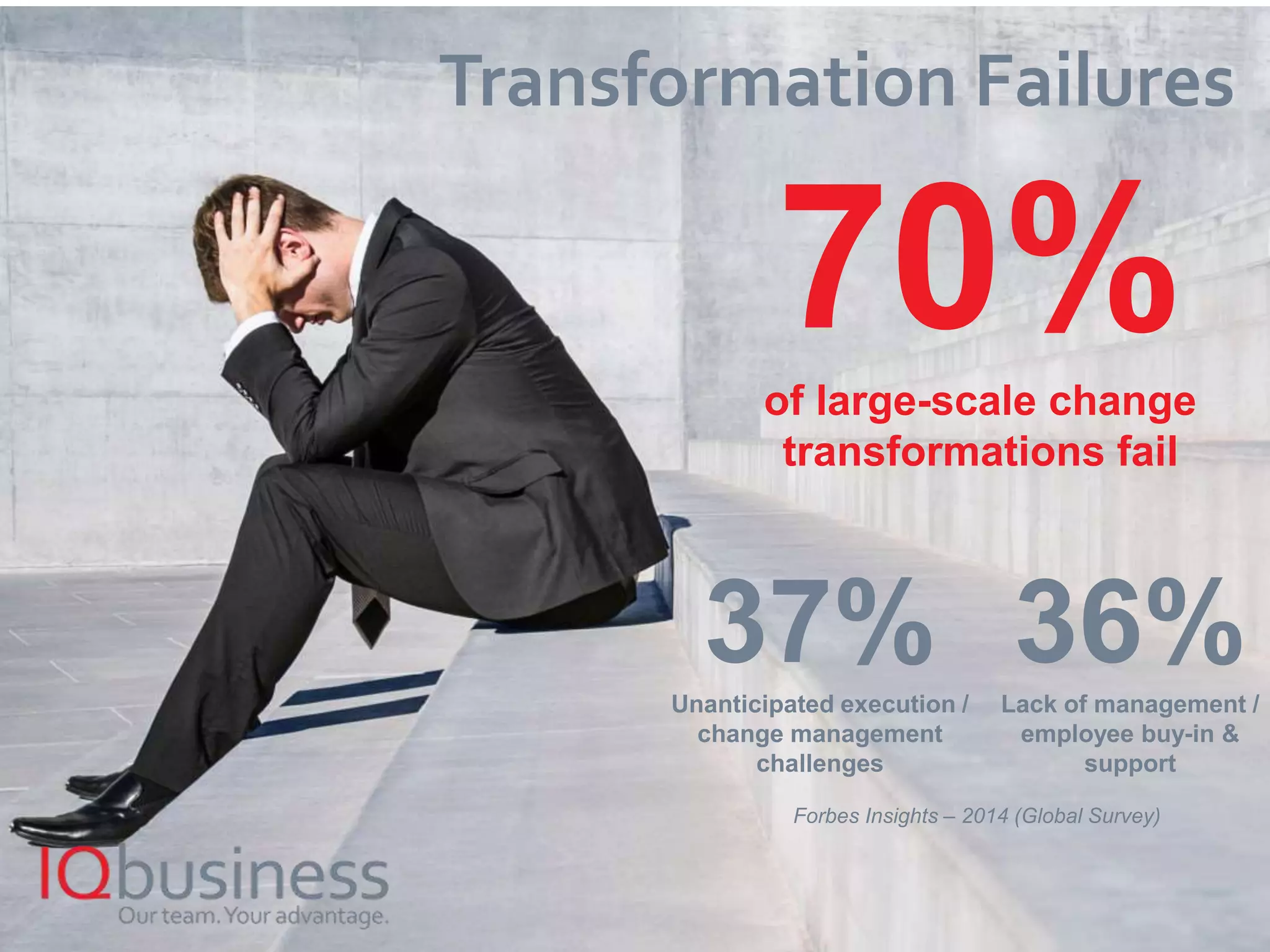
Transformation Failures
70%of large-scale change
transformations fail
37%Unanticipated execution /
change management
challenges
36%Lack of management /
employee buy-in &
support
Forbes Insights – 2014 (Global Survey)
6
What about Agile transformations?
"I spent $174 million on a website and all I got was this bad press.“
Someone, somewhere in the U.S. Department of Health and Human Services
(HHS)
For many organisations a second wave of agile adoption is starting to happen,
with a focus on the disciplines and technical practices and an emphasis on “do it
properly this time”
InfoQ
7
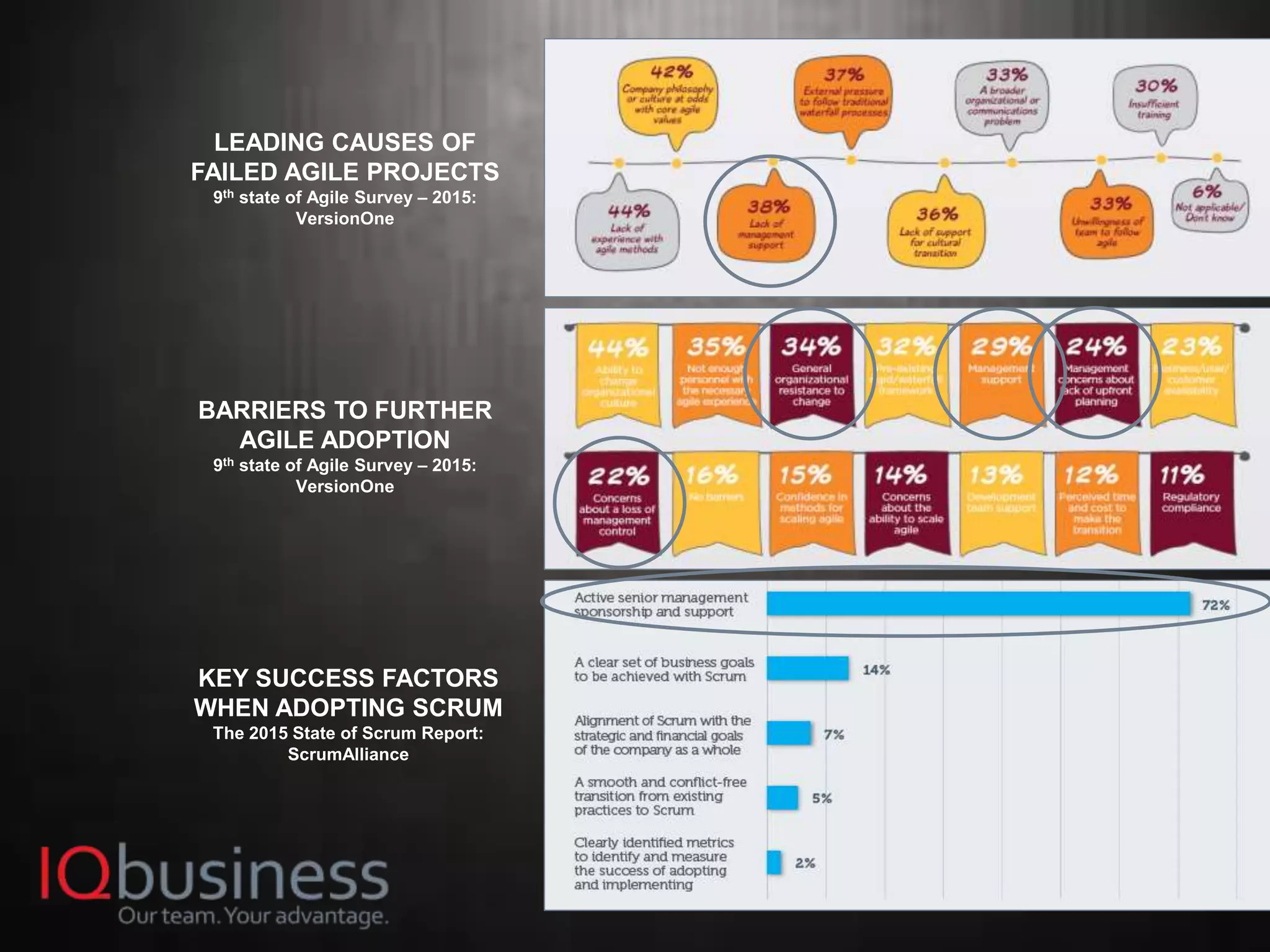
LEADING CAUSES OF
FAILED AGILE PROJECTS
9th state of Agile Survey – 2015:
VersionOne
BARRIERS TO FURTHER
AGILE ADOPTION
9th state of Agile Survey – 2015:
VersionOne
KEY SUCCESS FACTORS
WHEN ADOPTING SCRUM
The 2015 State of Scrum Report:
ScrumAlliance
8
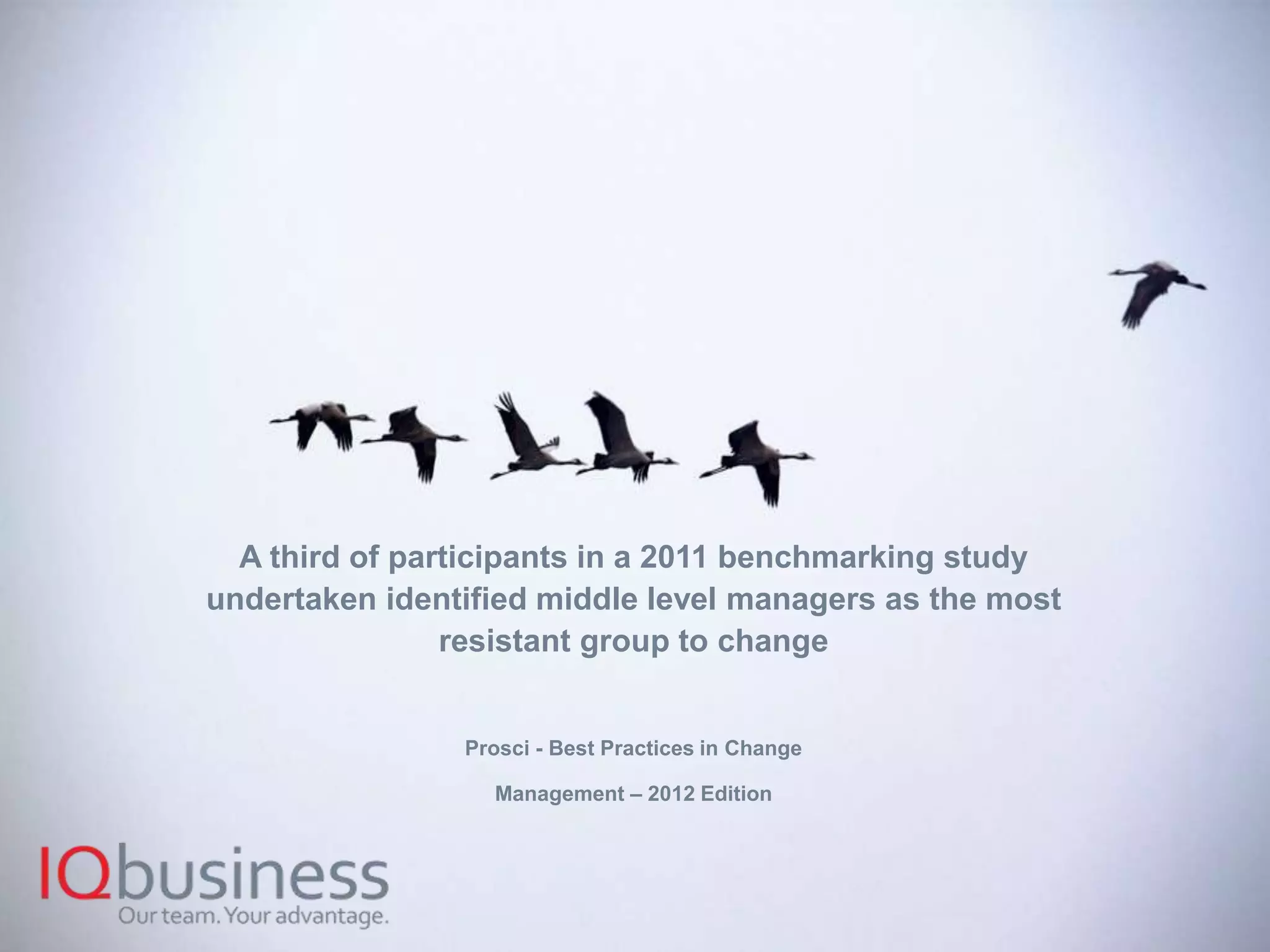
A third of participants in a 2011 benchmarking study
undertaken identified middle level managers as the most
resistant group to change
Prosci - Best Practices in Change
Management – 2012 Edition
9
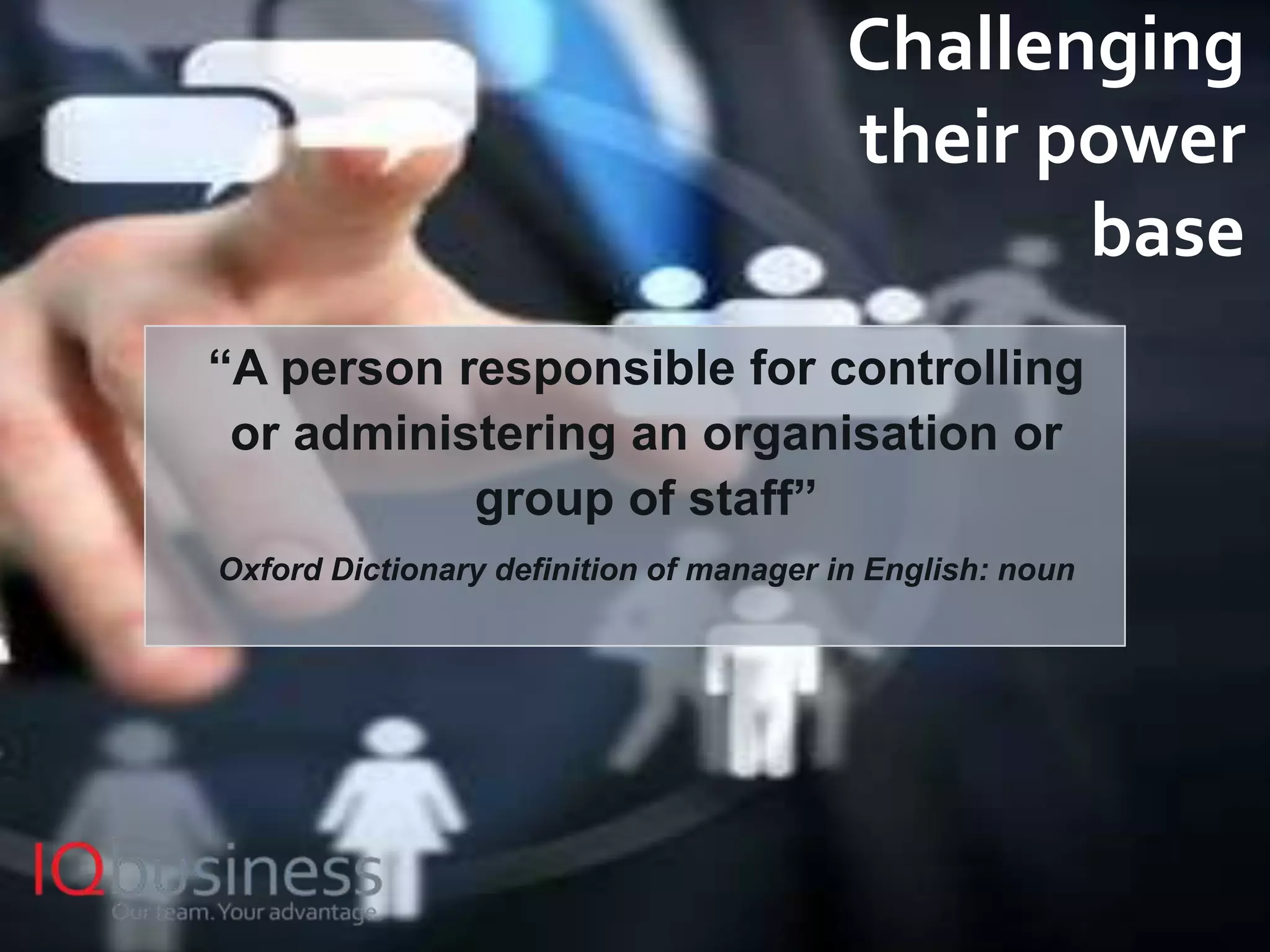
Challenging
their power
base
“A person responsible for controlling
or administering an organisation or
group of staff”
Oxford Dictionary definition of manager in English: noun
10
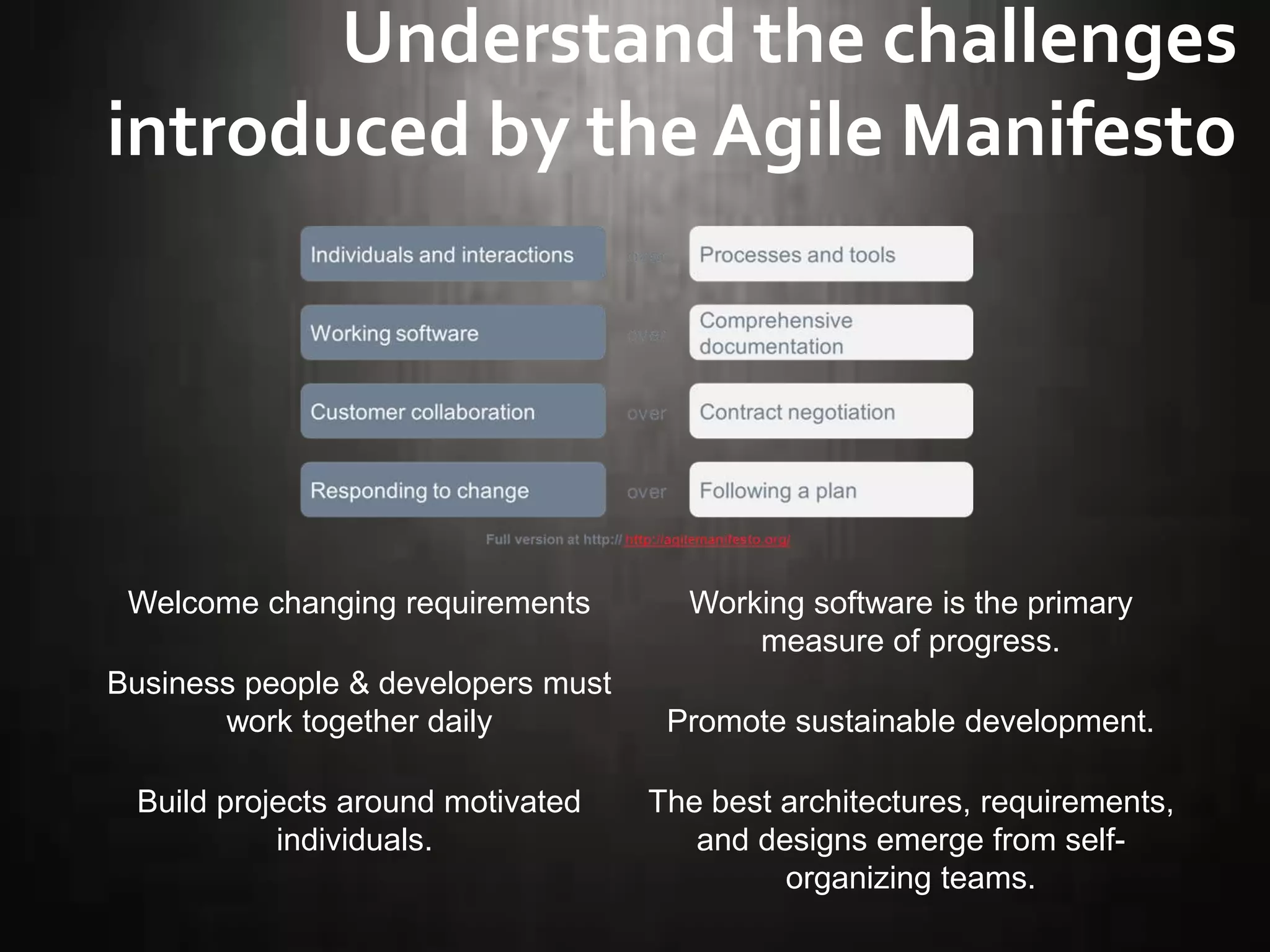
Understand the challenges
introduced by the Agile Manifesto
Welcome changing requirements
Business people & developers must
work together daily
Build projects around motivated
individuals.
Working software is the primary
measure of progress.
Promote sustainable development.
The best architectures, requirements,
and designs emerge from self-
organizing teams.
11
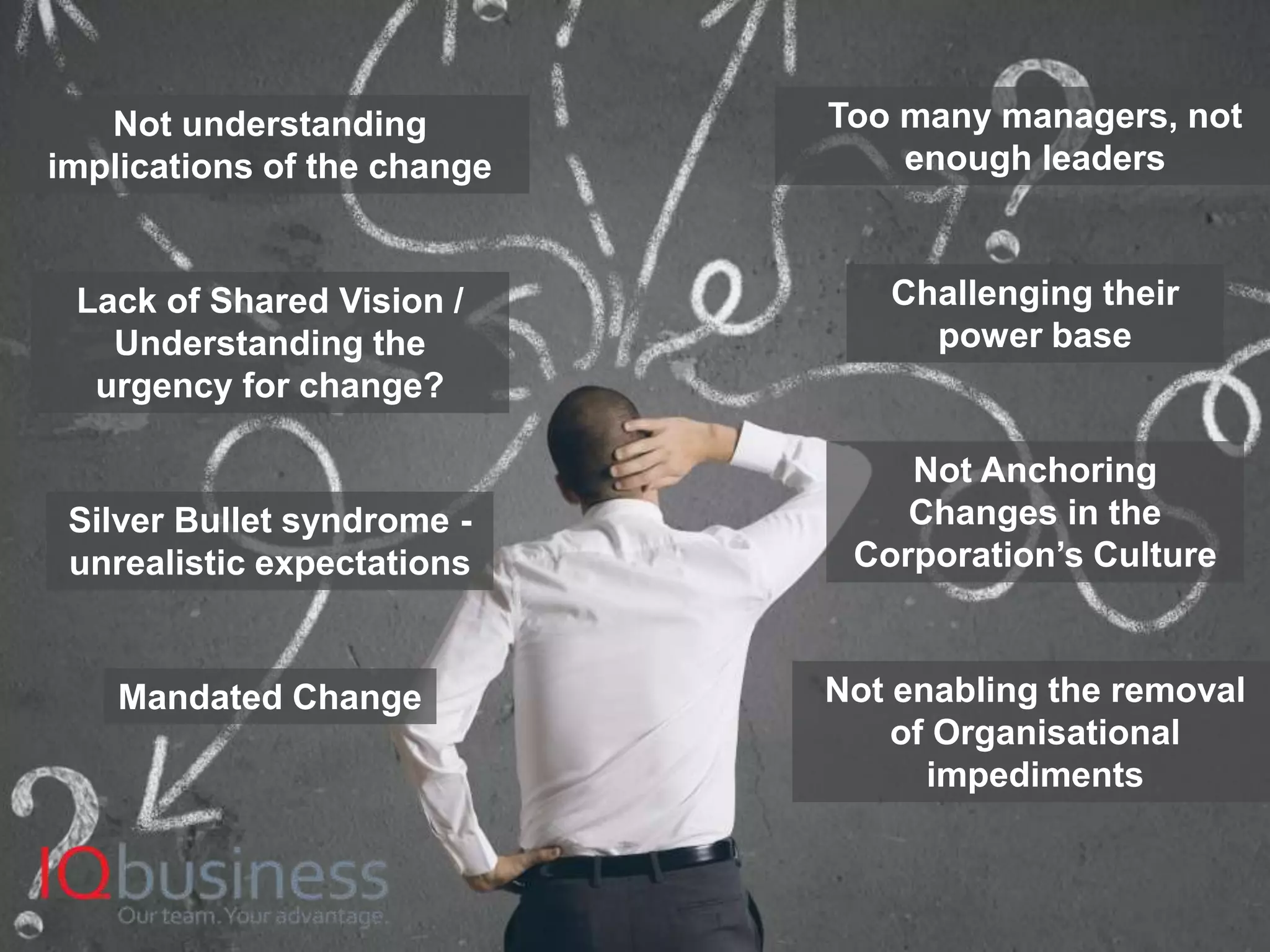
Not understanding
implications of the change
Mandated Change
Silver Bullet syndrome -
unrealistic expectations
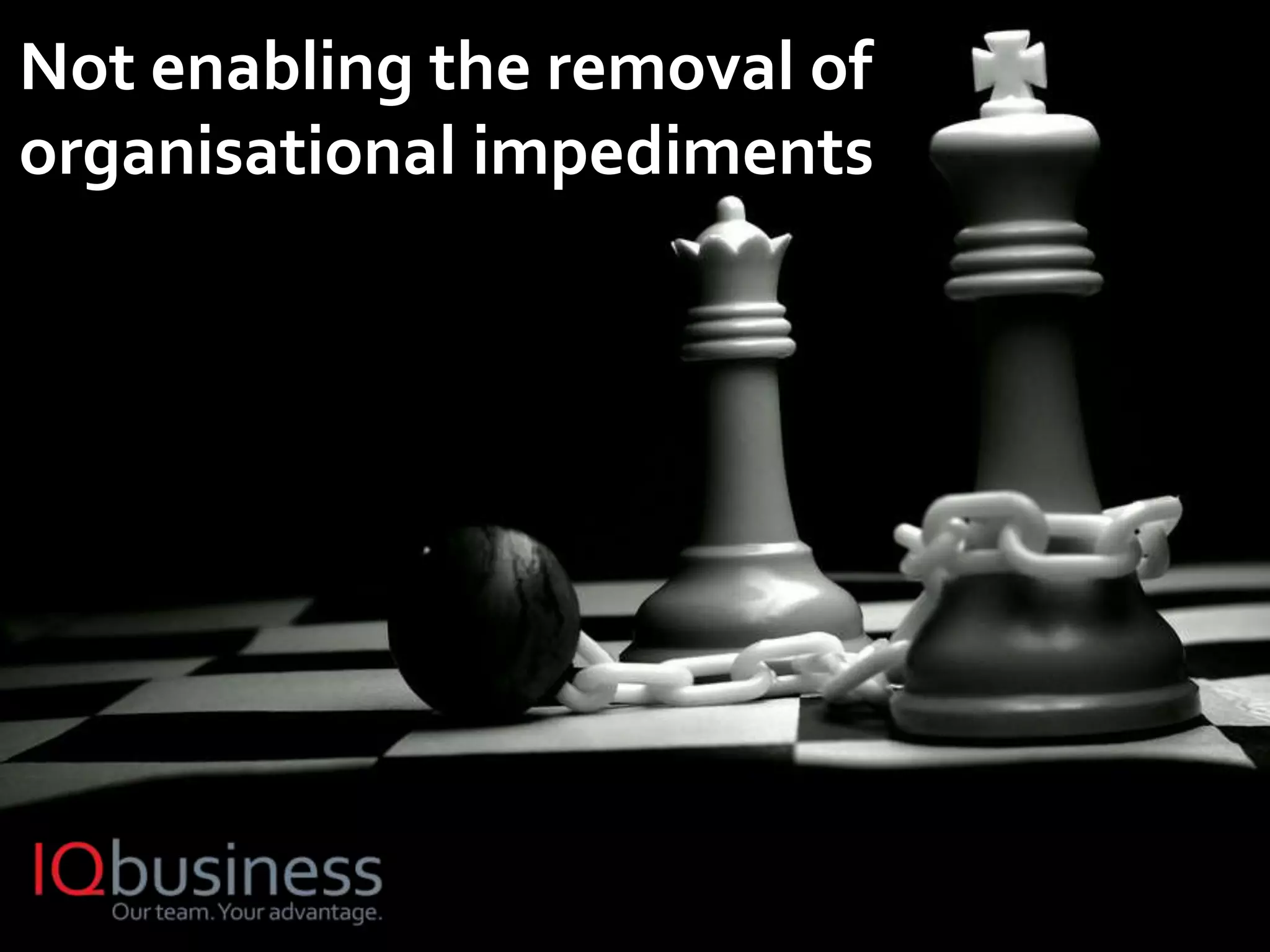
Not enabling the removal
of Organisational
impediments
Challenging their
power base
Not Anchoring
Changes in the
Corporation’s Culture
Too many managers, not
enough leaders
Lack of Shared Vision /
Understanding the
urgency for change?
12
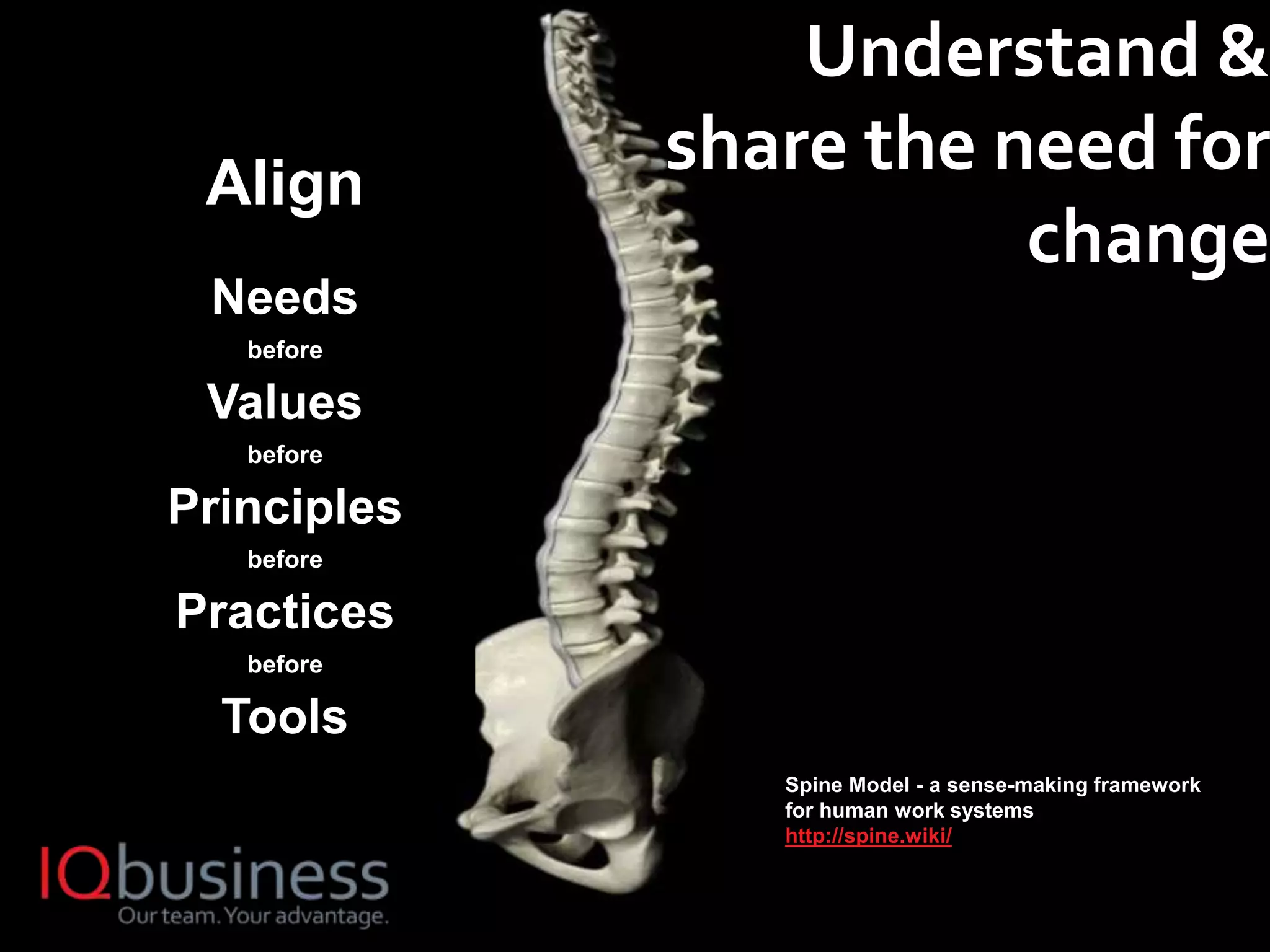
Understand &
share the need for
change
Spine Model - a sense-making framework
for human work systems
http://spine.wiki/
Align
Needs
before
Values
before
Principles
before
Practices
before
Tools
13
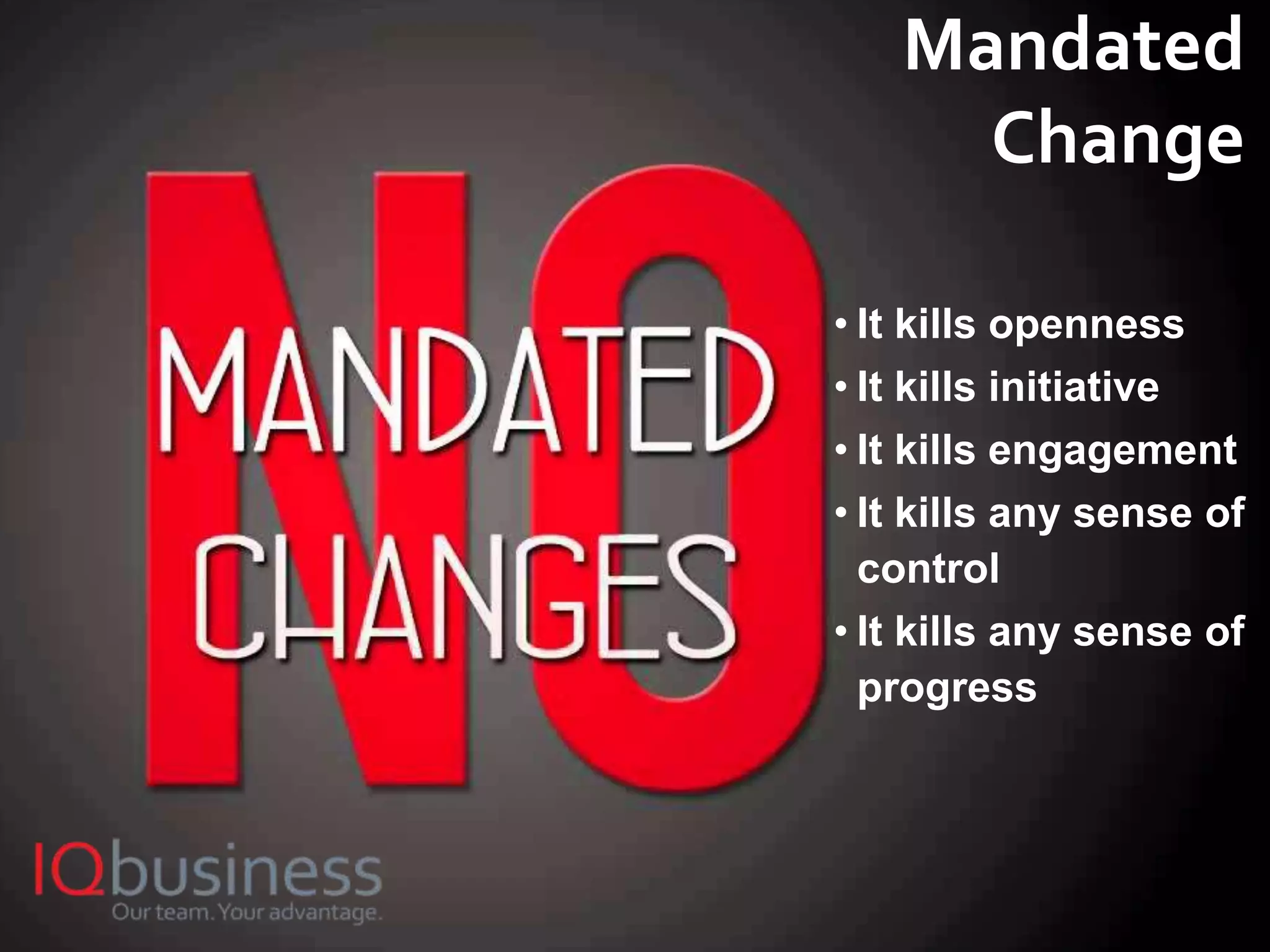
• It kills openness
• It kills initiative
• It kills engagement
• It kills any sense of
control
• It kills any sense of
progress
Mandated
Change
14
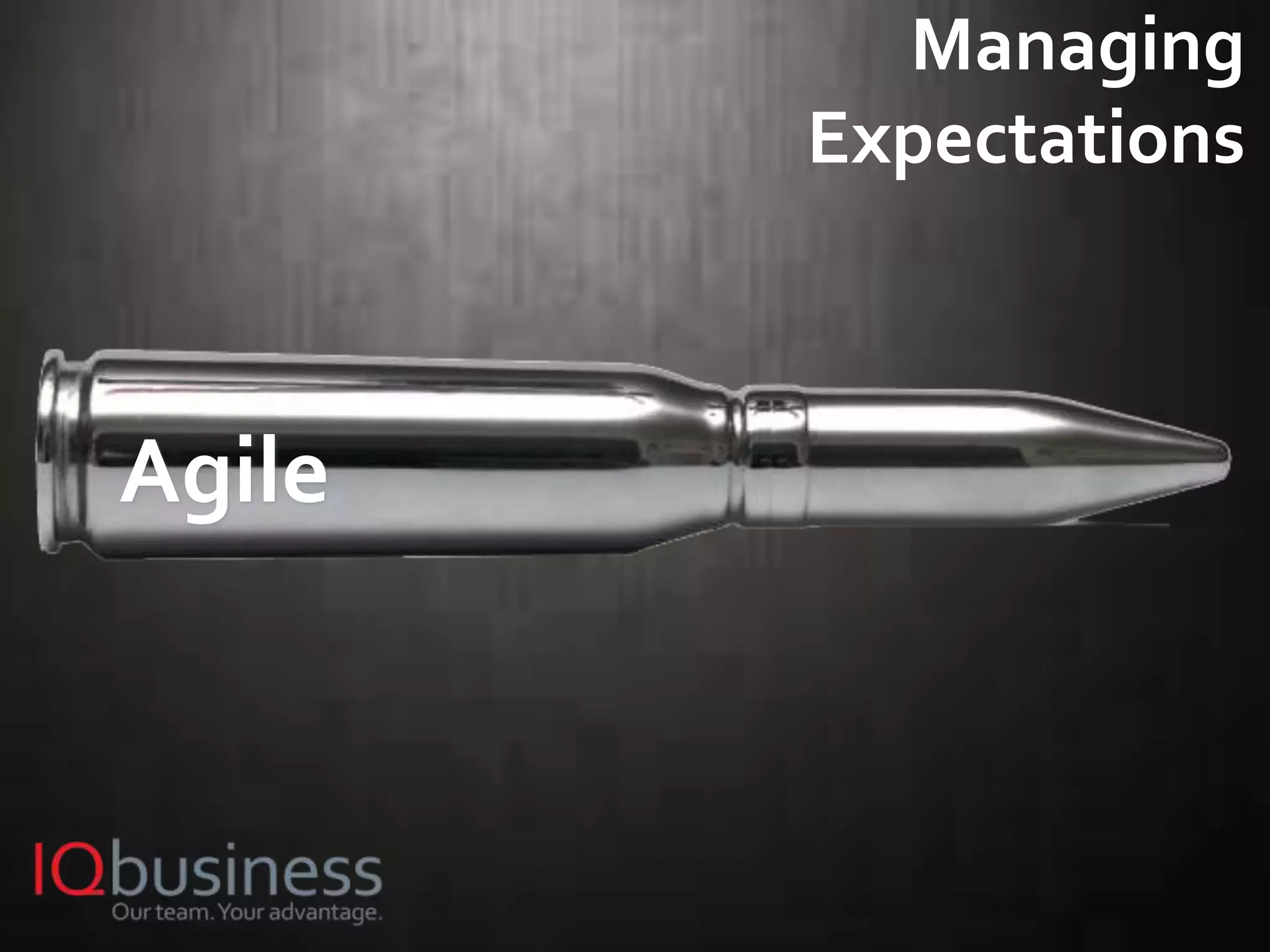
Agile
Managing
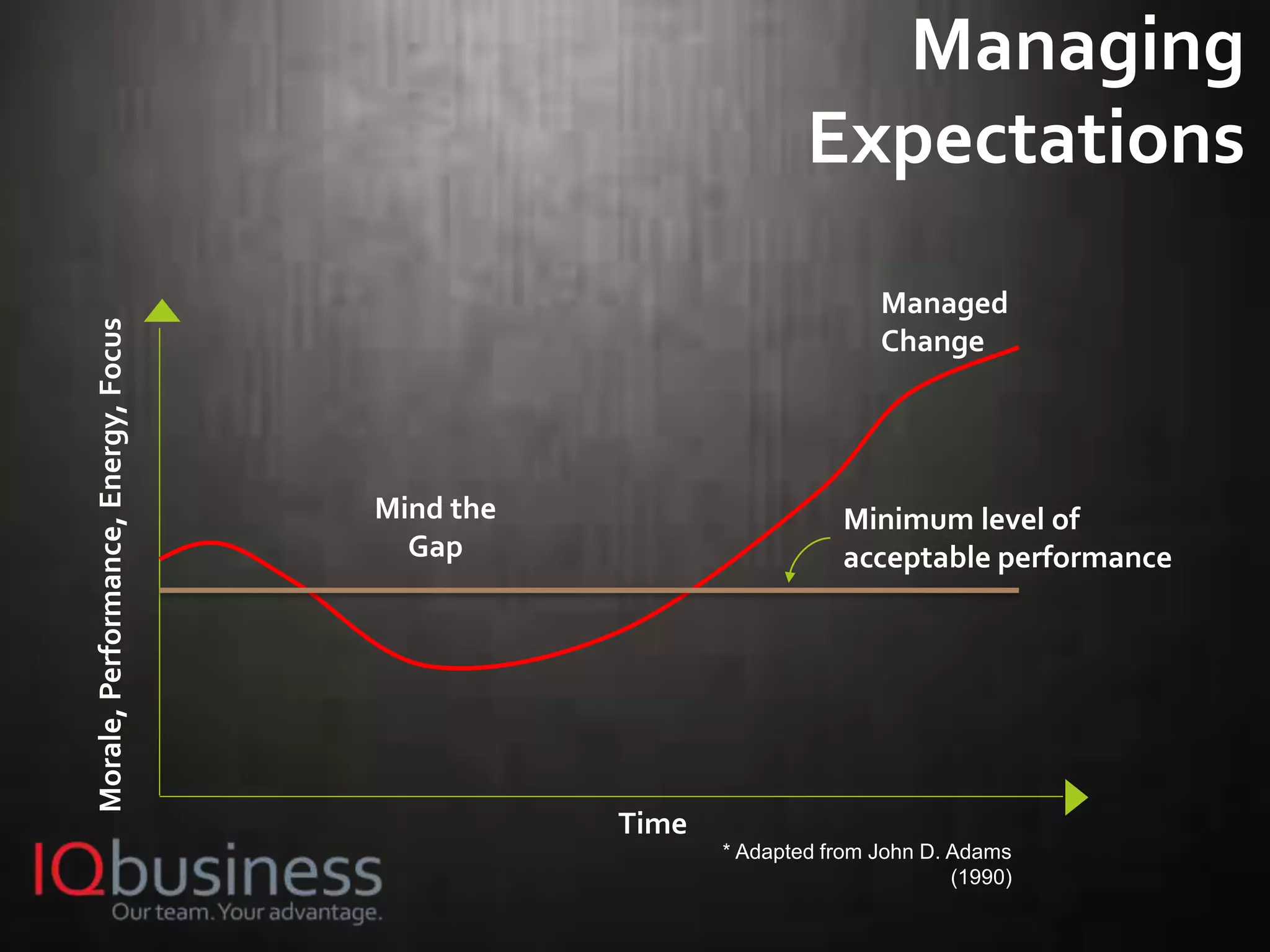
Expectations
15
Time
Morale,Performance,Energy,Focus
Managed
Change
Minimum level of
acceptable performance
Mind the
Gap
* Adapted from John D. Adams
(1990)
Managing
Expectations
16
Not enabling the removal of
organisational impediments
17
It’s all about
the people
18
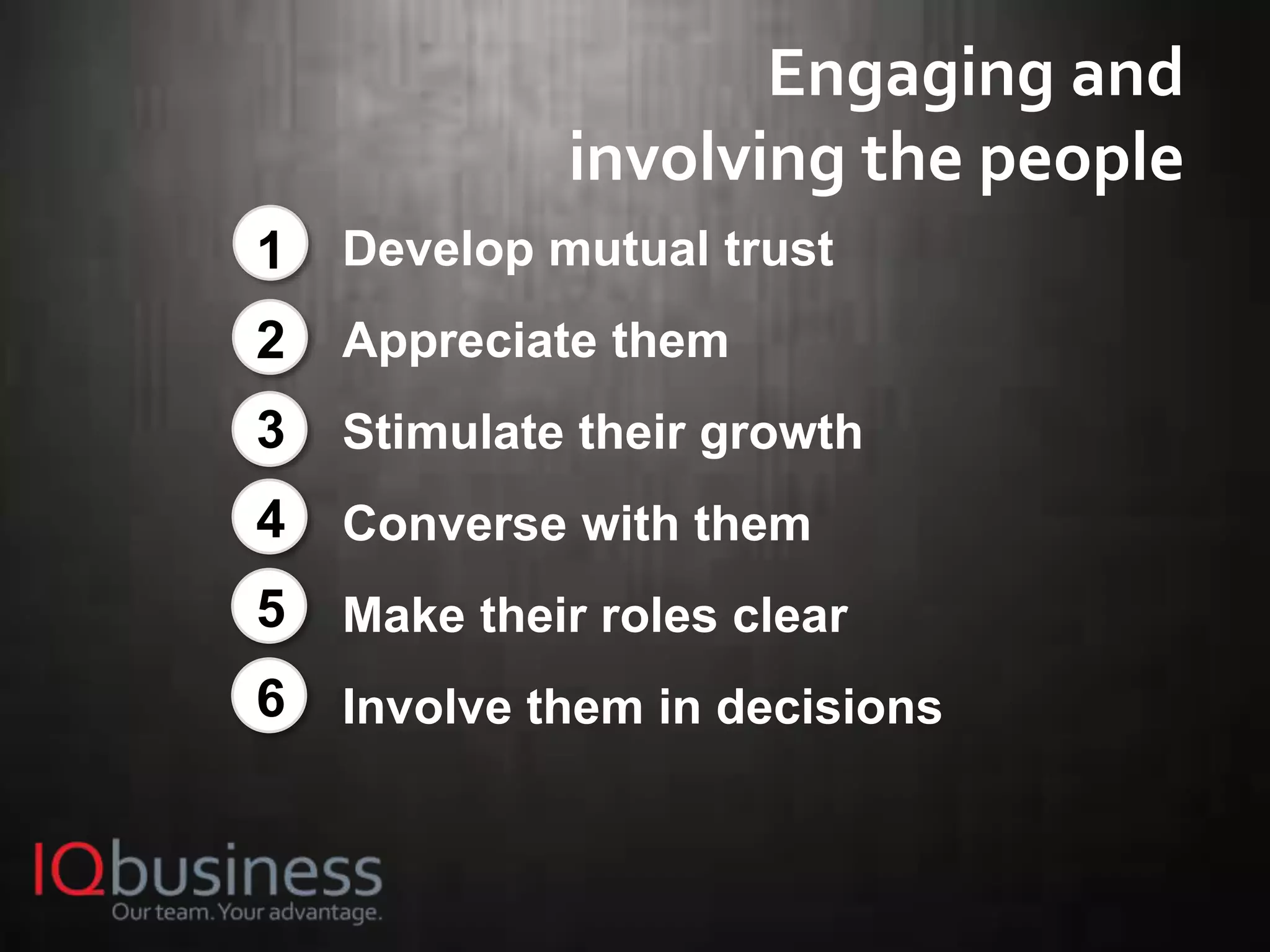
Engaging and
involving the people
Develop mutual trust
Appreciate them
Stimulate their growth
Converse with them
Make their roles clear
Involve them in decisions
1
2
3
4
5
6
19
Persistent & Transient
Change Management
20
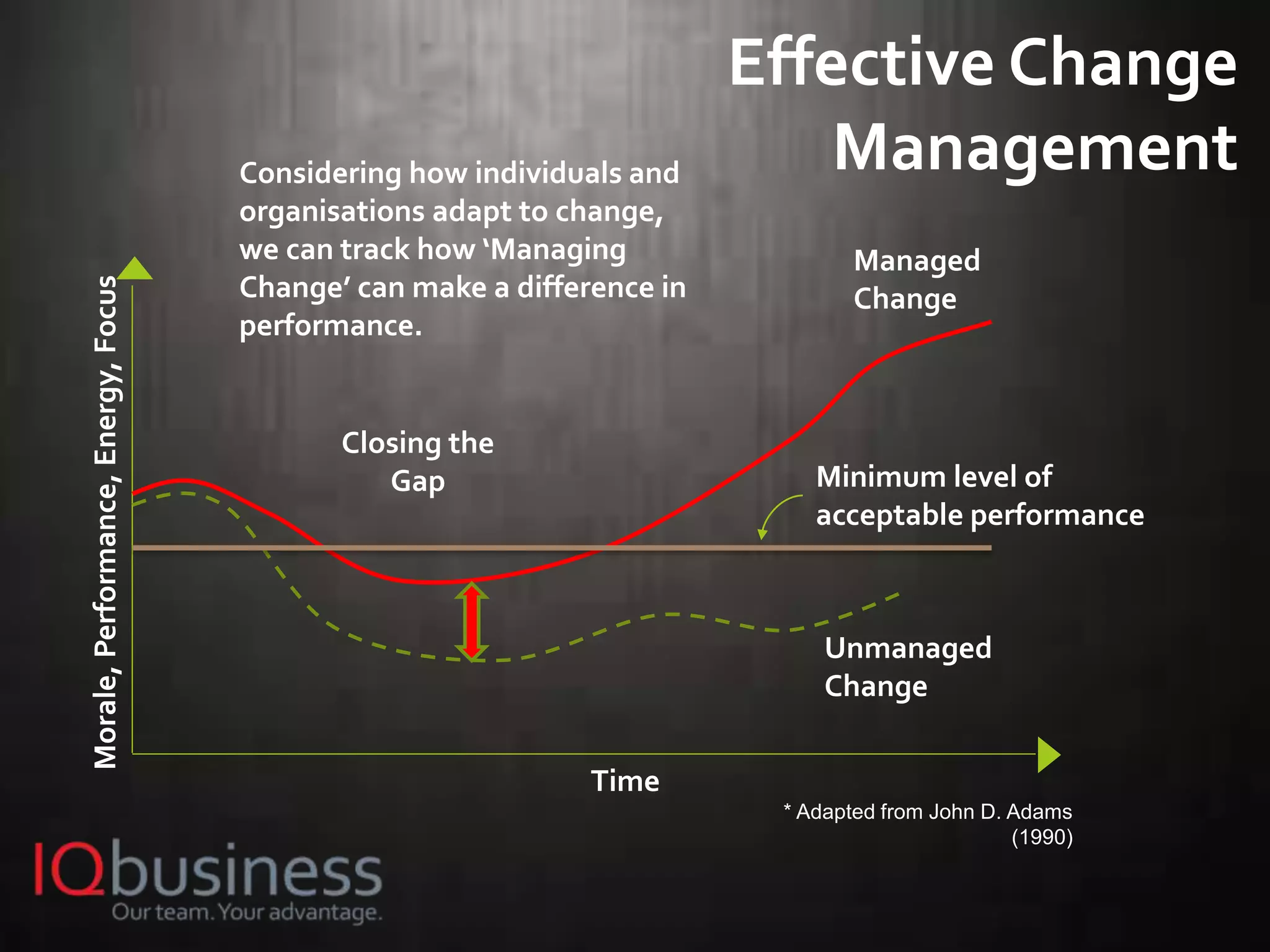
Considering how individuals and
organisations adapt to change,
we can track how ‘Managing
Change’ can make a difference in
performance.
Time
Morale,Performance,Energy,Focus
Managed
Change
Unmanaged
Change
Minimum level of
acceptable performance
Closing the
Gap
* Adapted from John D. Adams
(1990)
Effective Change
Management
21
The Philosophy of
Change
Individual
Behaviour
Organisational
Change
Expected
Outcome of the
change
1. Change the
individual
behaviour
2. Change the
‘Organisational
Way’
3. Increased Revenue,
Reduced costs,
Happier customers
Grow Change from
an Individual Level
You want to
affect
organisational
change…
…but you have to start at an individual level.
22
Executive
Leadership
Individual
Change
Network
First
‘Top
Down’
Then
‘Bottom
Up’
Sponsor
Change
Team
Middle
Ensure
Alignment
23
• Any transformations are
challenging including Agile
• Middle management are the
biggest resistors – challenging
their power base
• Agile is not the outcome – it’s the
enabler
• Not just about the process – very
much about the people
• Adopt an Agile persistent and
transient change management
approach
• As Agile coaches we are change agents
• Manage expectations of the change
• Understand individual implications of
the change - “What’s in it for me?”
• To change organisational culture we
need to start with individual behaviours
24
@biased77
bdegregorio@iqbusiness.net
http://agility.iqbusiness.net
25
Principles of Lean-
Agile Leadership
Take a Systems View
Embrace the Agile Manifesto
Implement Product Development Flow
Unlock the Intrinsic Motivation of
Knowledge Workers
1
2
3
4

Ignore middle managers at your peril!!!. Why middle managers hold the key to successful Agile transformations

  • 1.
    consulting | research| contracting Ignore middle-managers at your peril! Why middle-managers hold the key to successful Agile transformations Biase De Gregorio @biased77
  • 2.
    2 From: Ken SchwaberTo: XXX XXXXX, CEO for XXXXXXX Corporation On one hand, Scrum offers some very attractive possibilities increased productivity, a better working environment, increased competitiveness, and a higher quality product. On the other hand, it is hard to implement. The amount of change engendered by a Scrum implementation is significant and difficult. Even though the change is difficult for the developers and customers (product owners), they have immediate payback through increased job satisfaction. This helps them through times of stress and anxiety. Middle management, however, is stressed without immediate reward. They are asked to help transition an organisation from traditional approaches to leaner approaches without a clear vision of a personal end point what will I do and where will I fit into the new organisation. This question is particularly difficult and fraught with danger since middle management will be fashioning the new organisation. The potential for conflict and politics is daunting. My experience with top-down, enterprise implementations of Scrum has led me to believe that the differentiator between success and failure is you. Your ability to vision the future and help communicate it to your management, your ability to patiently guide them through the change, and your ability to assure your middle management of their value and form them into a team will differentiate your ability to absorb the change and realize the benefits, or not.” Ken Schwaber: A CIO’s Playbook for Adopting the Scrum Method of Achieving Software Agility With Dean Leffingwell & Hubert Smits
  • 3.
  • 4.
    5 Transformation Failures 70%of large-scalechange transformations fail 37%Unanticipated execution / change management challenges 36%Lack of management / employee buy-in & support Forbes Insights – 2014 (Global Survey)
  • 5.
    6 What about Agiletransformations? "I spent $174 million on a website and all I got was this bad press.“ Someone, somewhere in the U.S. Department of Health and Human Services (HHS) For many organisations a second wave of agile adoption is starting to happen, with a focus on the disciplines and technical practices and an emphasis on “do it properly this time” InfoQ
  • 6.
    7 LEADING CAUSES OF FAILEDAGILE PROJECTS 9th state of Agile Survey – 2015: VersionOne BARRIERS TO FURTHER AGILE ADOPTION 9th state of Agile Survey – 2015: VersionOne KEY SUCCESS FACTORS WHEN ADOPTING SCRUM The 2015 State of Scrum Report: ScrumAlliance
  • 7.
    8 A third ofparticipants in a 2011 benchmarking study undertaken identified middle level managers as the most resistant group to change Prosci - Best Practices in Change Management – 2012 Edition
  • 8.
    9 Challenging their power base “A personresponsible for controlling or administering an organisation or group of staff” Oxford Dictionary definition of manager in English: noun
  • 9.
    10 Understand the challenges introducedby the Agile Manifesto Welcome changing requirements Business people & developers must work together daily Build projects around motivated individuals. Working software is the primary measure of progress. Promote sustainable development. The best architectures, requirements, and designs emerge from self- organizing teams.
  • 10.
    11 Not understanding implications ofthe change Mandated Change Silver Bullet syndrome - unrealistic expectations Not enabling the removal of Organisational impediments Challenging their power base Not Anchoring Changes in the Corporation’s Culture Too many managers, not enough leaders Lack of Shared Vision / Understanding the urgency for change?
  • 11.
    12 Understand & share theneed for change Spine Model - a sense-making framework for human work systems http://spine.wiki/ Align Needs before Values before Principles before Practices before Tools
  • 12.
    13 • It killsopenness • It kills initiative • It kills engagement • It kills any sense of control • It kills any sense of progress Mandated Change
  • 13.
  • 14.
    15 Time Morale,Performance,Energy,Focus Managed Change Minimum level of acceptableperformance Mind the Gap * Adapted from John D. Adams (1990) Managing Expectations
  • 15.
    16 Not enabling theremoval of organisational impediments
  • 16.
  • 17.
    18 Engaging and involving thepeople Develop mutual trust Appreciate them Stimulate their growth Converse with them Make their roles clear Involve them in decisions 1 2 3 4 5 6
  • 18.
  • 19.
    20 Considering how individualsand organisations adapt to change, we can track how ‘Managing Change’ can make a difference in performance. Time Morale,Performance,Energy,Focus Managed Change Unmanaged Change Minimum level of acceptable performance Closing the Gap * Adapted from John D. Adams (1990) Effective Change Management
  • 20.
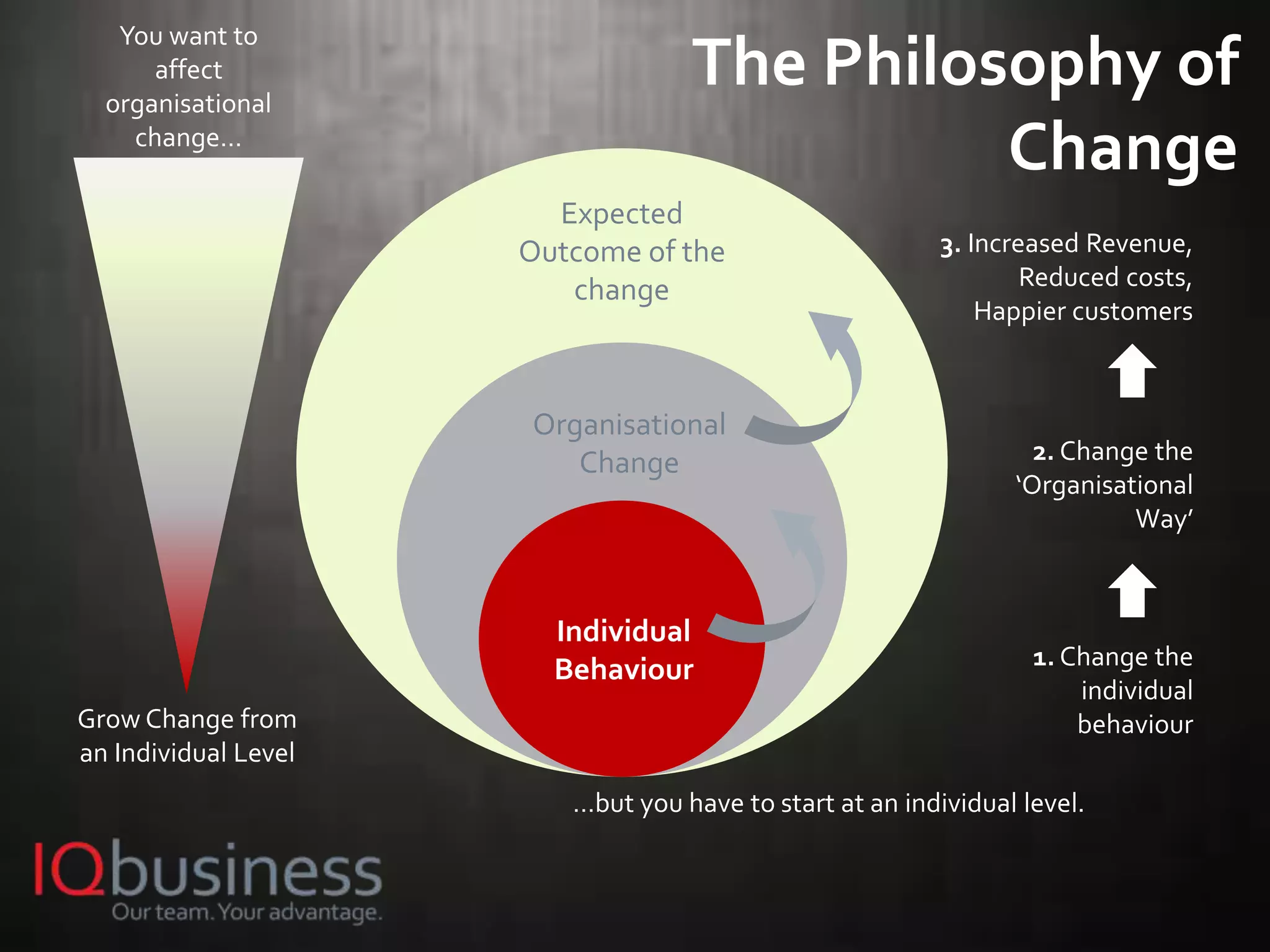
    21 The Philosophy of Change Individual Behaviour Organisational Change Expected Outcomeof the change 1. Change the individual behaviour 2. Change the ‘Organisational Way’ 3. Increased Revenue, Reduced costs, Happier customers Grow Change from an Individual Level You want to affect organisational change… …but you have to start at an individual level.
  • 21.
  • 22.
    23 • Any transformationsare challenging including Agile • Middle management are the biggest resistors – challenging their power base • Agile is not the outcome – it’s the enabler • Not just about the process – very much about the people • Adopt an Agile persistent and transient change management approach • As Agile coaches we are change agents • Manage expectations of the change • Understand individual implications of the change - “What’s in it for me?” • To change organisational culture we need to start with individual behaviours
  • 23.
  • 24.
    25 Principles of Lean- AgileLeadership Take a Systems View Embrace the Agile Manifesto Implement Product Development Flow Unlock the Intrinsic Motivation of Knowledge Workers 1 2 3 4

Editor's Notes

  • #6 Based on statistics and research, most large-scale transformations fail. Statistics vary from the 60% to 70% of large scale transformations fail… The report from McKinsey in 2008 indicated that 70% fail with the 2 main reasons relating to 1) Employee resistance to change and 2) Management behaviour that doesn’t support the change I have found a 2014 survey done by Forbes. http://www.forbes.com/forbesinsights/oracle_eppm/index.html It doesnt say how many transformations fail, but does say top reason for failure is Inefficient Execution (41%) - maybe good for the 2nd wave of agile slide? Also notes Lack of change management acumen as 28% and Lack of support from leadership as 26%. Top reasons for success = Support from leadership is 51%. Biggest challneges in executiing = Unanticipated execution/ change management challenges is 37%, Lack of management/ employee buyin support = 36%. I like that this survey talks a lot more about change management.
  • #7  In my research, I must be honest, I was struggling to case studies, papers or articles of large-scale agile transformation failures, however, we know that being in the industry, most are severely challenged. I did manage to find an article about the largest failed agile project - HealthCare.gov The costs of building the website and data hub also spun out of control, according to the report. From September 2011 to February 2014, estimated costs for developing the health insurance marketplace increased from an initial $56 million to more than $209 million. The cost of building the data hub increased from an initial contract obligation of $30 million to almost $85 million. Altogether, the report notes that IT-related “obligations” for the project, including spending on software and hardware, came out to about $946 million from fiscal year 2010 until March 2014. What I have also found is the notion of the 2nd wave of Agile transformations. This means that the first one didn’t succeed and therefore would have failed… Organisations are now understanding that they are not getting the full value of what Agile can offer and therefore want to do it again, but this time propertly Over the past several years many large-scale software development organisations have embraced agile. In this time we have also been privileged enough to study several large organisations some with more than 10 years of agile history. The prognosis for many of these companies is not good. The sad truth is some of the largest and most Agile companies are evolving into the easiest solutions not the best ones. This realization has brought about what we are calling the second wave of agile adoption. With this second wave comes a new focus on scaled agile adoption patterns and a back to basics approach to agile. Companies that are adopting agile are forced to come to grips with the reality that to be successful at agile at scale we must eventually make the hard organisational choices that are needed to create the agile revolution they need. Companies willing to go “all-in” are reaping immense rewards, even the ones who have been agile for many years. Steve Wolf
  • #9 But most people believe that the number 1 reason is lack of executive support. The Prosci report to Best Practices in Change management for the first time in 2011 indicated that middle managers are the most resistant to change. This overtook the previous top factor of lack of executive support for the first time in 7 years. In the several agile transformations that I have been exposed to, I can definitely validate this finding. In most organisations, senior executives or leaders buy into the agile transformation. Truth be told, most of them will not be involved in the actual transformation activities, but act mainly as sponsorships… So they leave it to their management team to affect the transformation. Think about the impact to the middle management. Most of them are already struggling with managing their own capacity, and now they have been asked to transform the organisation to a more Agile way of operating whilst still delivering on projects. Actually, not delivering on projects, but delivering them faster, better quality and cheaper… Isnt that what Agile offers?
  • #11 You are pretty much challenging their power base. The definition of manager in itself indicates controlling or administering an organisation or people. Now you are introducing this fluffy stuff that allows for autonomy of the team, self-organisation, little control as we are now introducing less formal plans, no detailed documentation to manage the customer relationship… How am I supposed to manage the delivery of the projects / programmes by giving away some of my control????? I don’t really understand what it takes to be a servant leader and I am too busy with delivery and BAU stuff that I don’t have the time to understand agile either… I will send my team to training so that they can apply it, but I still want them to meet deadlines with all the fixed scope and costs?? Unfortunately, this is not true… The manager’s sense of significance is somehow wrapped up in the decision-making control. Due to this strict, centralized control, decisions are not as informed as they could be as they are not always the best to make the decisions. Also, waiting for a decision because of centralized control wastes time and human potential and ultimately lowers morale and fosters cynicism. When a manager tells the team what to do, there’s a false sense of success via control. When a manager powers through difficult circumstances regardless of the impact on the team, they leave the wisdom and the morale of the team behind. Such a management style is a classic Agile transformation failure mode. All the team-level Agile practices in the world mean nothing if the manager doesn’t embrace a behavior that is more in service to the team than control of the team. Robert Greenleaf’s work identifies the characteristics of what he calls a “servant leader”: one who serves by leading, and leads by serving
  • #12 Through my experience and observations, I have found several common themes are challenges to middle management responsible for Agile transformations. Excuse me if I am generalising, but over the last 5 years involved in Agile, these come up frequently. There may be others, but the important themes are more prevalent The next few slides may cover 1 or several of the themes.
  • #13 Lack of Shared Vision / Understanding the urgency for change? Not Anchoring Changes in the Corporation’s Culture This is the Spine Model that has been used by Kevin Tretheway and we use it often in our Agile training. Agile is not a methodology with a set of practices, tools and techniques… Agile is also not the outcome… Executives don’t buy Agile to be Agile… it is to improve customer service, improve revenue, get faster, cheaper etc… Remaining relevant in an ever-increasing competitive landscape ----Not sure which theme this is referring to on slide 9? It could belong to a few. Do you want it to match, or not really? Might elp your audience with their journey through your talk. Agile is the enabler to get to that outcome. It sits within the Values and Principles and in fact the Agile Manifesto written in 2001 provides the values and principles that need to be adopted in an organisation. This is very much a cultural change in an organisation… It is a mind-set change and therefore requires significant people change management to be affective.
  • #14 The other impact is that most of the Agile transformations have been mandated change. In other words a top-down decision from the top…CEO announces – We are going Agile by July 2016. What actually happens is that people resist change because they don’t like when things are pushed on them in the first place—the loss of autonomy is de-motivating. What are the problems with mandated change / What is the unintended consequences: Forced Collaboration It kills openness It kills initiative It kills engagement It kills any senses of control people have It kills any sense of progress Think about it, forcing people to change is a very anti-agile way of approaching it. Daniel Mezick has a movement around Open Agile Adoption where he invites people to the change. They adopt an agile way of transformation by running sprints of experiments with the organisation… Getting people involved in an open collaboration forum… This way people have change done with them instead of to them.
  • #15 We often fall in love with what Agile can provide and that Agile is the silver bullet… We expect that it will fix all our problems. It sounds so simple and common sense that it is must be easy to implement. Unfortunately, to do it properly is extremely difficult. The #1 competitor to Agile is Bad Agile… Also, I have often overheard managers saying things like… we have gone Agile, why are we not faster… In fact, the #1 reason most organisations adopt agile is to be faster to market… The same managers set performance targets of the teams… E.g. They need to deliver X every sprint, however, we don’t always understand the implications of the change and the organisational impediments that may be slowing the teams down.
  • #16 This is a large scale change and has a massive impact on performance in the short term before productivity will improve. However, we are still measuring the teams and individuals on the same metrics and expectations. Unfortunately, at best, without the executive’s continued engagement, the organisation will only have pockets of Agile success, typically limited to the team level. The organisation will probably grow to blame Agile (and each other) for decreased quality and productivity. How do we prevent this failure? Leaders must accept that a successful transformation is a journey. Along this journey, leaders seek guidance for a transformation with a broad, sustainable impact. As part of the transformation they make a personal commitment to their teams, and in turn they recognize the personal commitment they are asking of their employees. Executives commit to measuring success differently from before, because the work is different from before. Success now favors value delivery, and time for learning is built into the transformation. Ultimately, success is celebrated across the organisation and setbacks are seen not as failures or cause for blame, but as opportunities for learning and growth. Unfortunately, that puts you as the manager in the uncomfortable position of submitting budget/schedule variances and/or cutting scope when you're original estimate is proven to be inaccurate. Hence, you've failed at managing the project and therefore.......”this agile thing doesn't work
  • #17 In many of our boot camps and training, most people say… this stuff that you are saying is awesome, but it wont work in our environment because X,Y,Z Most teams can be successful if they operate independently. The biggest challenge in a corporate environment are the organisational constraints and impediments. In my experience there are always common themes around challenges in adopting Agile – even at a team, programme or portfolio level…never mind at enterprise level. These can include People, Process and Technology impacts: Waterfall-based funding Working with existing bureaucratic and highly rigourous governance processes Integration with existing infrastructure or architecture Integration with other teams that are waterfall Infrastructure support including procurement etc. Lack of understanding of what the roles of Agile entails Lack of portfolio and enterprise prioritisation Performance management Middle management are key to unblocking these impediments, however, they need to be given a mandate to do so. If they become enablers to the organisation their value will be immense. They will also see the fruits of their labour and be less likely to resist the change.
  • #18 To be honest… it’s all about the people… We are knowledge workers and need to acknowledge that we cannot run Software development as a factory….We work with people and have to have effective relationships with people… We should stop calling them resources and start calling them what they are: People? So how do we address this massive impact on the people…
  • #21 Taking the original picture, if we don’t manage the change effectively, the trough of disillusionment will be even greater. How do implement People change that is sustainable.
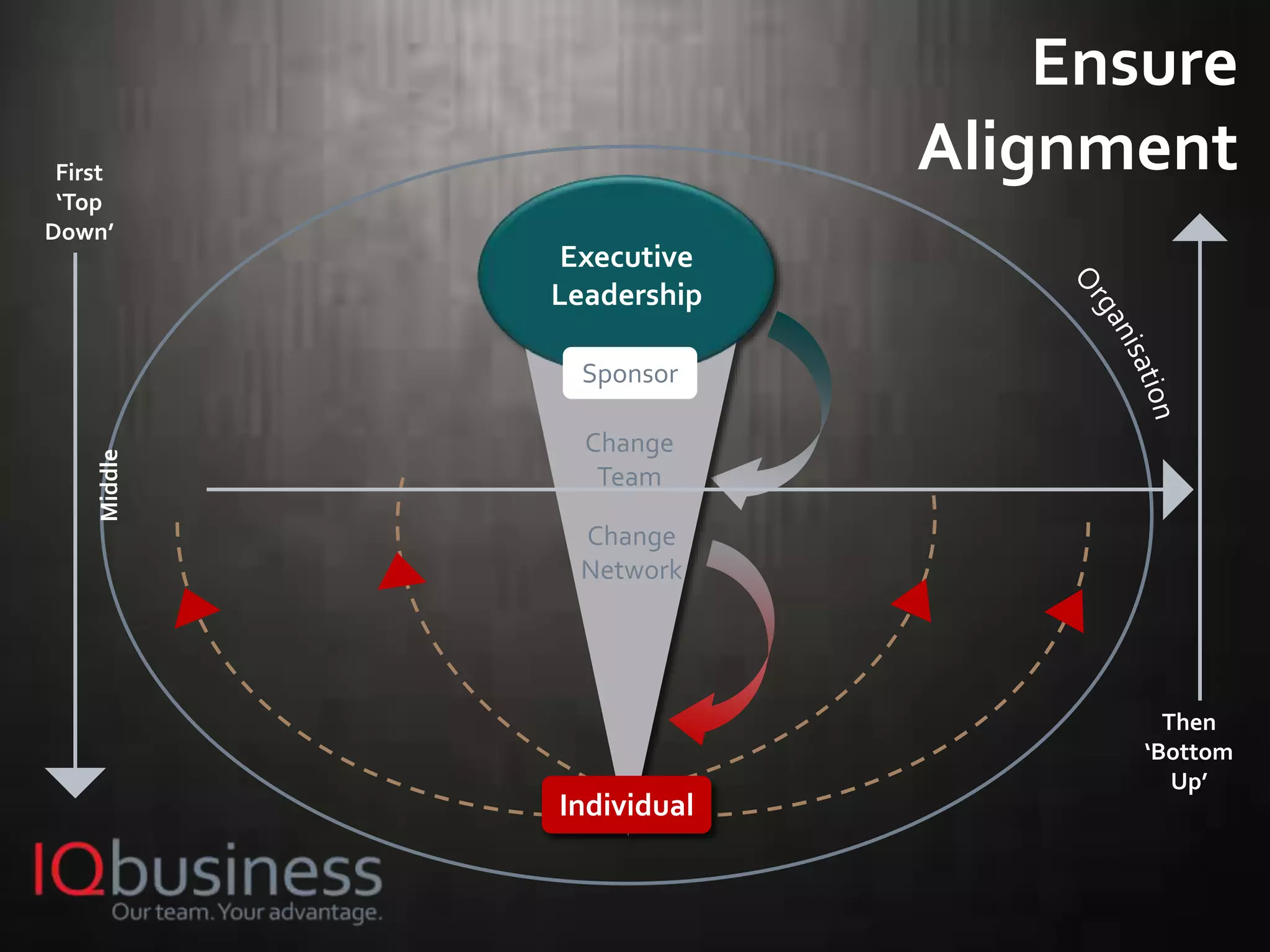
  • #22 So we need to take a bit of a bottom-up and top-down view. We need to understand the implication of the change at an individual level… At all levels including Middle-management… You need to be able to influence the individual behaviour… Through the change in the behaviour so the organisation can adopt a new way of working… a new culture -----I think you need to supplement this section with examples of how to tackle the themes you referred to earlier.
  • #23 Before you begin, the purpose is to ensure alignment, before you reach the individual and expand it to the organisation You will need to get buy in from the executives to be the guiding coalition. To determine the urgency for the change and provide the team with the vision for change. They need to understand the vision and business imperative for moving from the current state of ‘where we are now’ put into some perspective. It follows with this contextualisation that managers want to be involved at the outset of the change initiative. Managers want to feel that that the change is happening with them; not to them. Being involved means they need to understand what is expected of them during the change transition. How the change process is being measured and what the personal and professional benefits of the initiative are. Involvement necessitates asking these middle managers for feedback on the change project plan. As subject experts and those closest in the organisation to the front line staff this feedback is often invaluable. Make these managers into the friends of change. The Yays. And remember it is a natural feeling to want to resist change. So, expect resistance, plan for it and reduce its impact Middle managers may have the most challenging role in any company. It’s difficult for them to manage expectations of those above and below them, and they’re often not fully understood or accepted by either. At the same time, they’re crucial in keeping the company together and moving it forward. Despite this, they are often overlooked when it comes to training and development and can feel forgotten about, even though they are so difficult to replace. It’s time to fire up your middle tier, and get the most out of them.  Therefore, you should: