THE FEMALE
PELVIS
INTRODUCTION
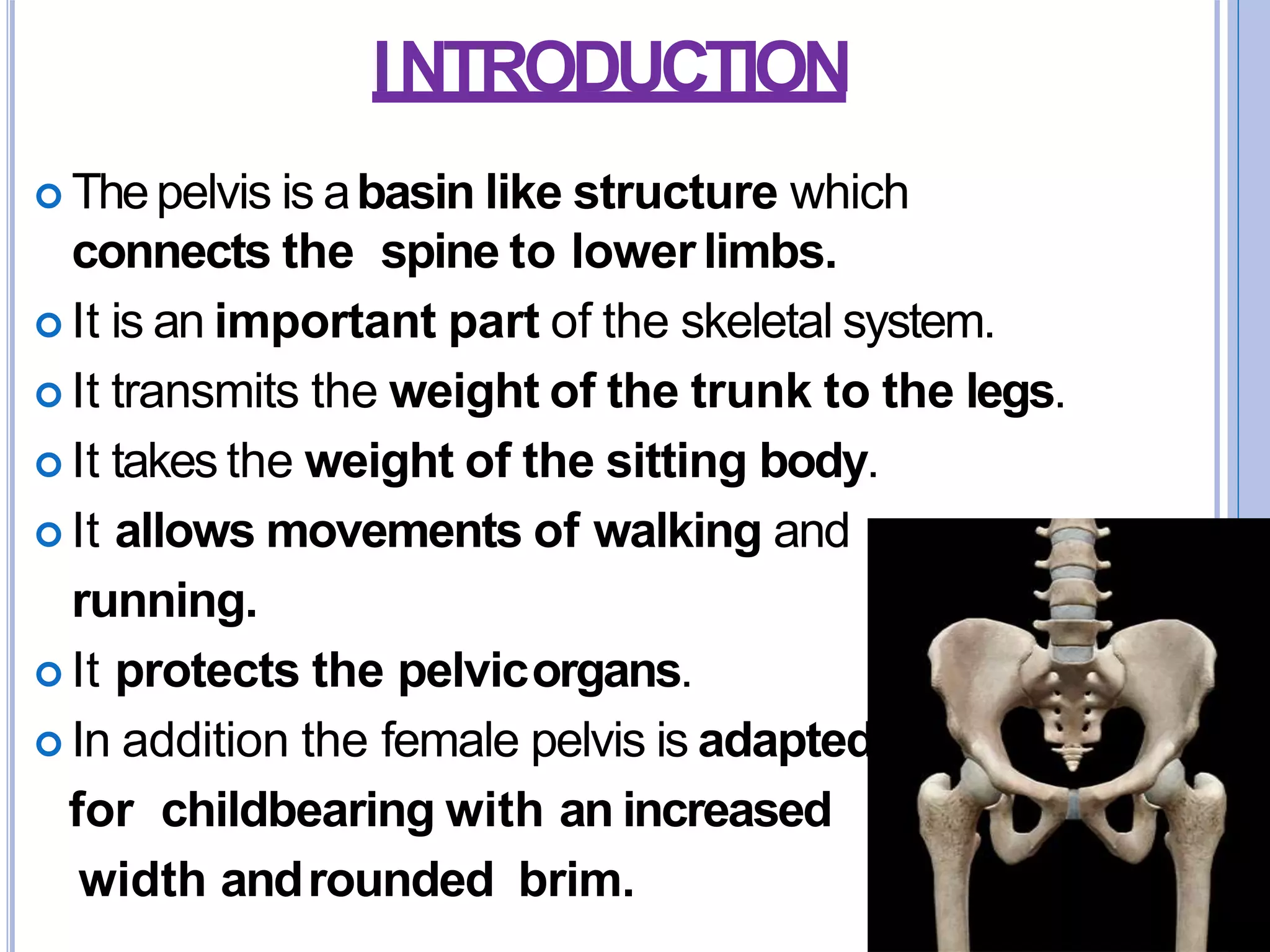
 Thepelvis is abasin like structure which
connects the spine to lowerlimbs.
 It is an important part of the skeletal system.
 It transmits the weight of the trunk to the legs.
 It takes the weight of the sitting body.
 It allows movements of walking and
running.
 It protects the pelvicorgans.
 In addition the female pelvis is adapted
for childbearing with an increased
width androunded brim.
DEFINITION
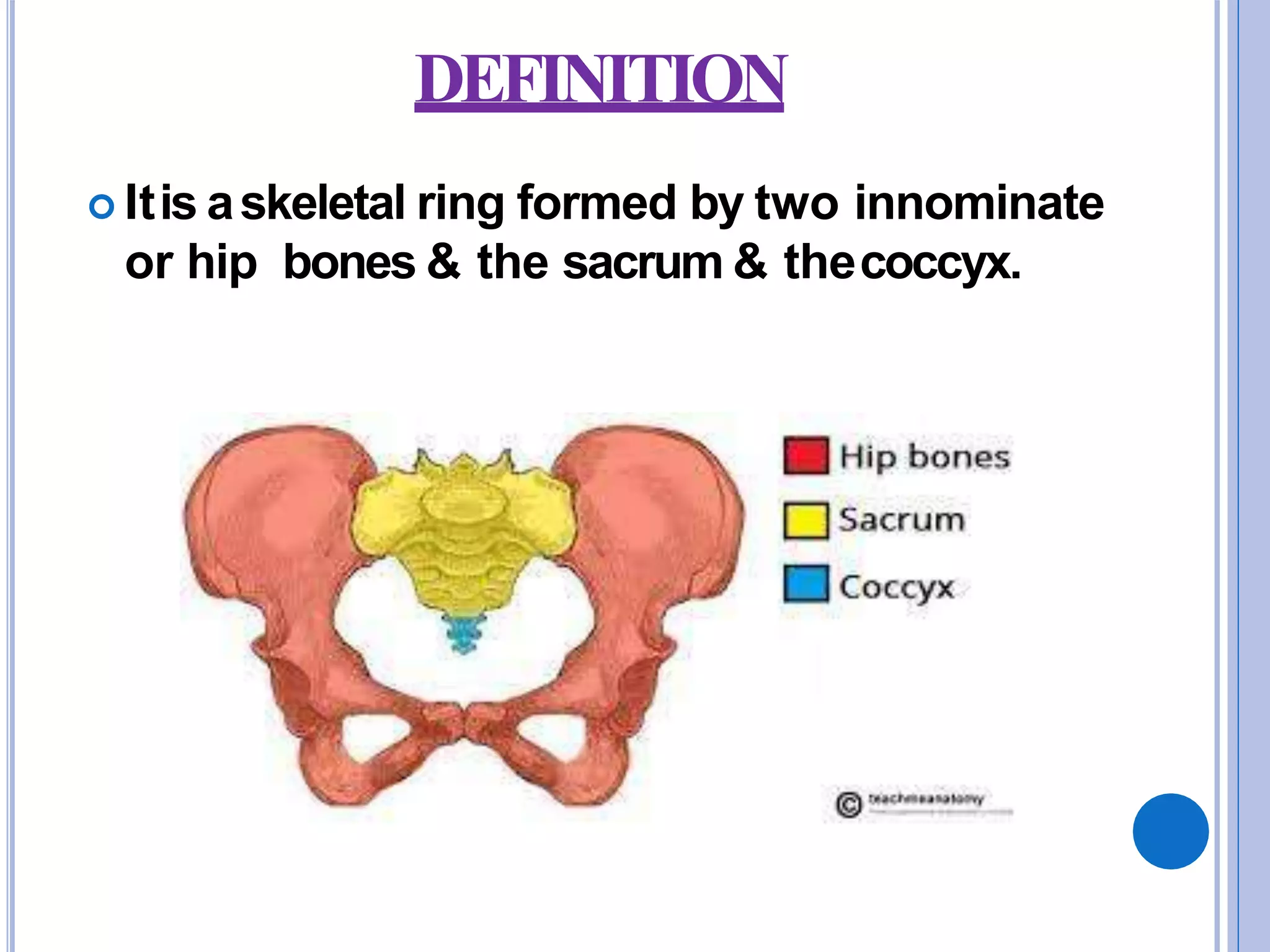
 Itis askeletal ring formed by two innominate
or hip bones & the sacrum & thecoccyx.
TYPES OF PELVIC BONES
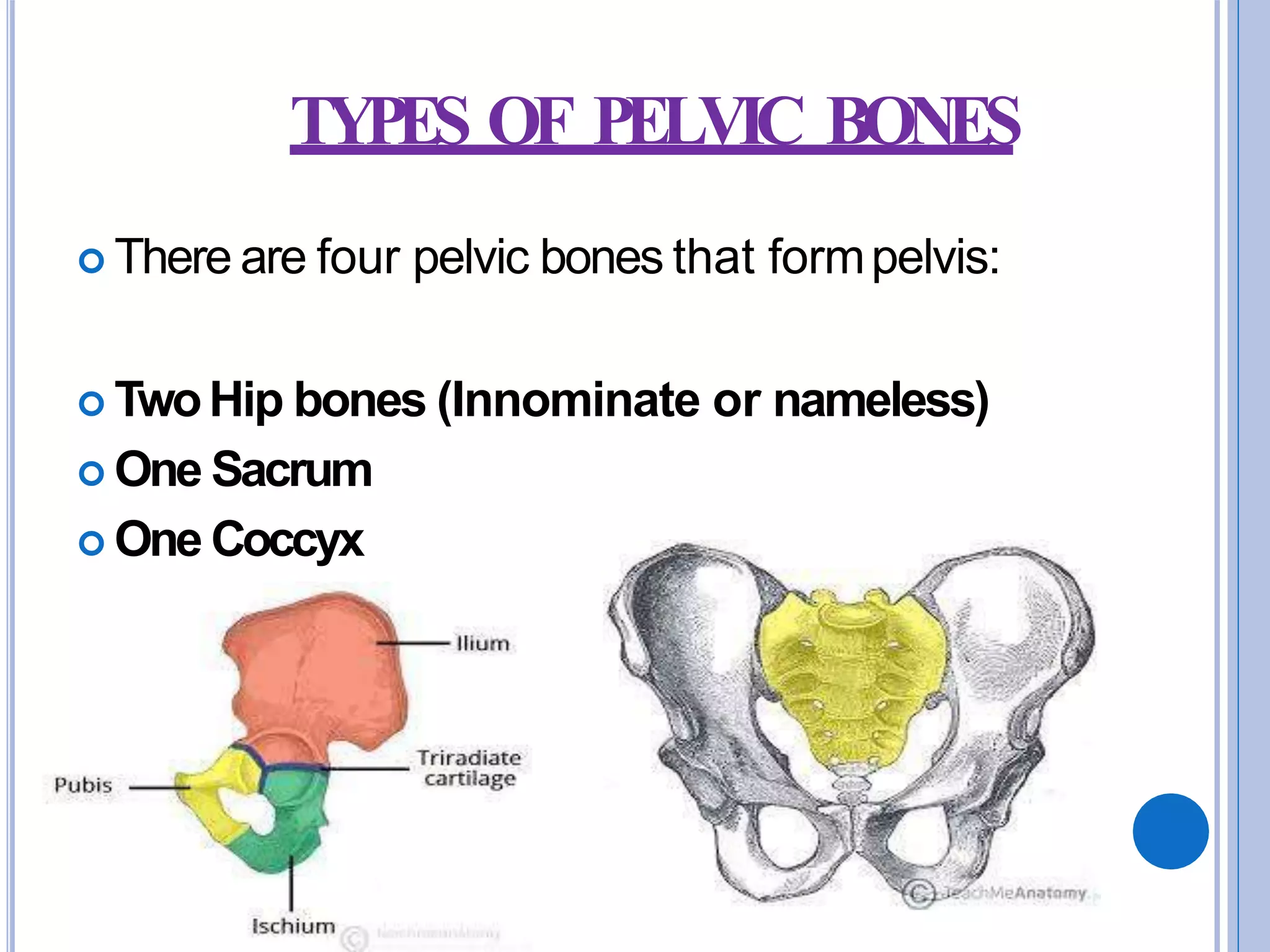
 There are four pelvic bones that formpelvis:
 TwoHip bones (Innominate or nameless)
 One Sacrum
 One Coccyx
1.TWOINNOMINATEBONES
innominate bone is made up of threebones
 Ilium
 ischium
 pubic bone
ILIUM
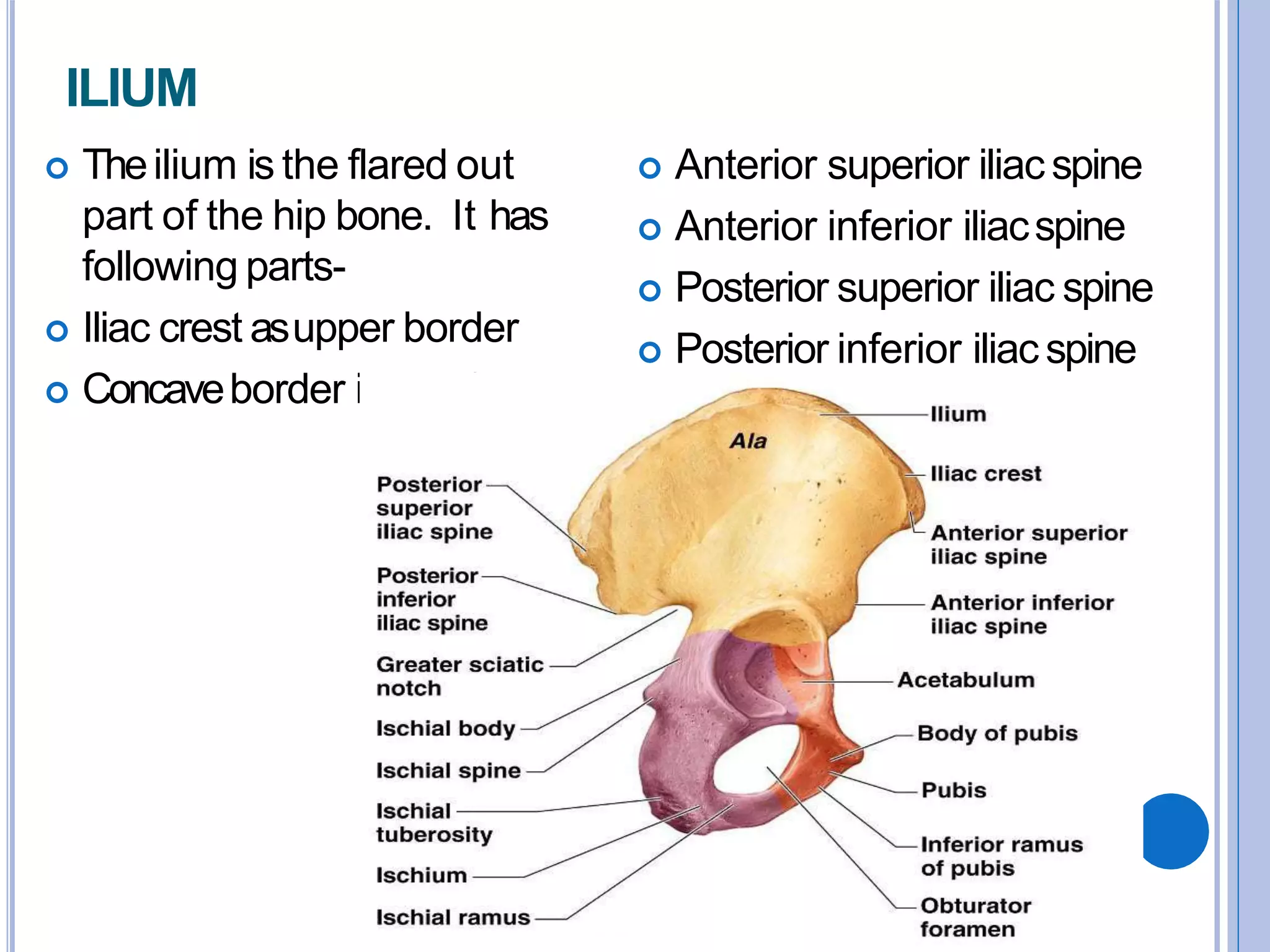
 Theilium is the flared out
part of the hip bone. It has
following parts-
 Iliac crest asupper border
 Concaveborder is iliac fossa
 Anterior superior iliac spine
 Anterior inferior iliacspine
 Posterior superior iliac spine
 Posterior inferior iliac spine
ISCHIUM
 The ischium is the thick lower part of the hip bone. It
hasfollowing parts-
 Acetabulum
 Ischial tuberosity
 Ischial spine: location in relation tofetal head,
i.e. above (-), below (+) or at (zerostation)
 Greater sciatic Notch: extends from Sacroiliac joint
to ischial spine
 LesserSciatic Notch: extends from ischial spine
to ischial tuberosity
 Obturator foramen: passageof pelvic nervefibres
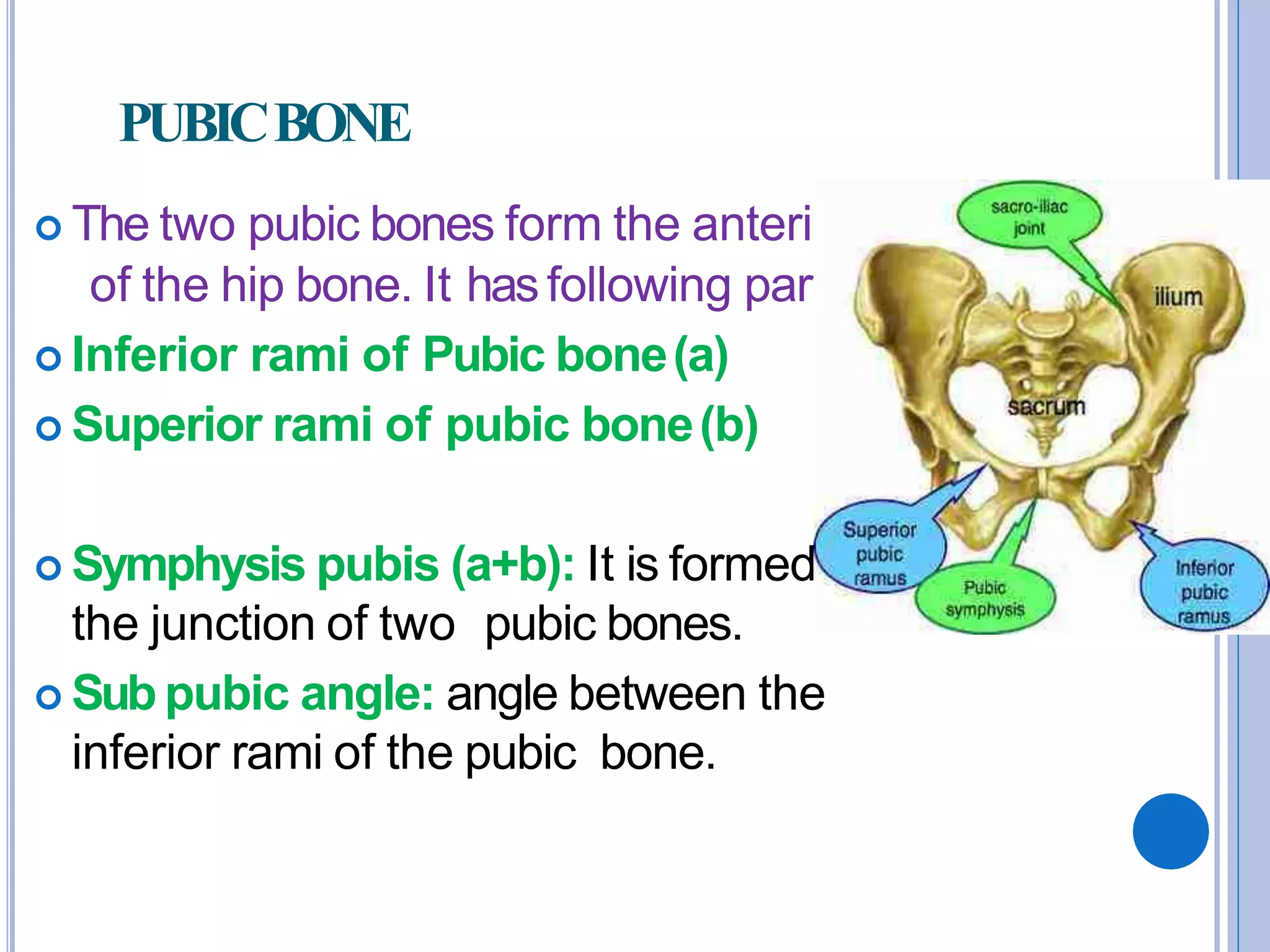
PUBICBONE
 The two pubic bones form the anterior part
of the hip bone. It hasfollowing parts-
 Inferior rami of Pubic bone(a)
 Superior rami of pubic bone(b)
 Symphysis pubis (a+b): It is formed at
the junction of two pubic bones.
 Sub pubic angle: angle between the
inferior rami of the pubic bone.
2.SACRUM
 It is awedge shaped bone made up of fivefused
bones.
It has following parts-
 Sacral promontory: it is prominent upper margin
of first sacral vertebrae, projects inwards
 Sacroiliac joint
 Wings of Sacrum or Ala of Sacrum
 Hollow of the Sacrum:concave
Sacralpromontory
 Sacroiliac joint
AlaofSacrum AlaofSacrum
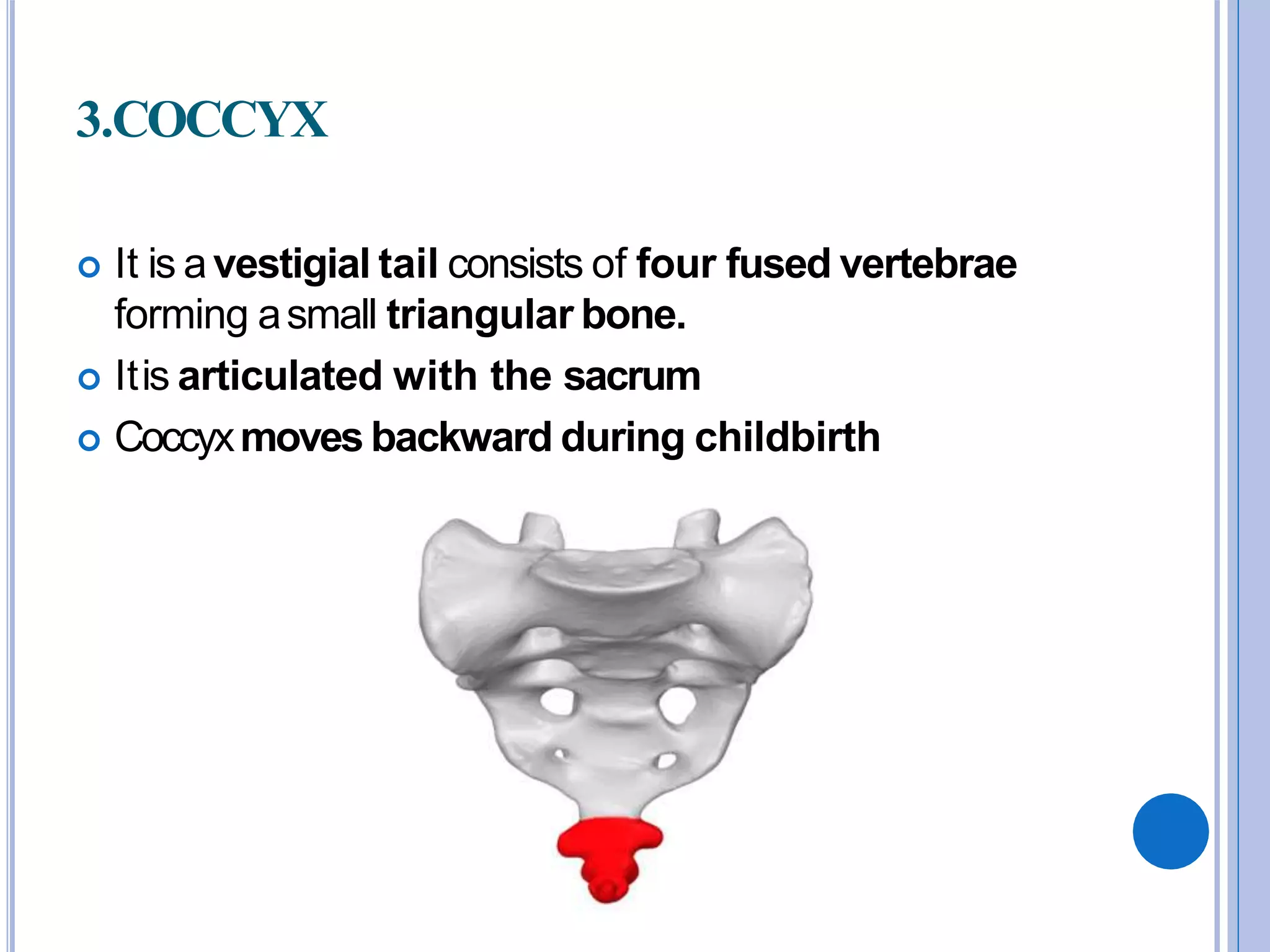
3.COCCYX
 It is avestigial tail consists of four fused vertebrae
forming asmall triangular bone.
 Itis articulated with the sacrum
 Coccyxmoves backward during childbirth
PELVIC JOINTS
There are four pelvicjoints:
 Twosacroiliac joints
 Onepubic symphysis joint
 Onesacrococcygeal joint
Sacrococcygeal joint
TWO SACROILIACJOINTS
 Theseare slightly movable joints formed where
the ilium joints, first two sacral vertebrae on
either side.
 Theyconnect the spine to the pelvis & are the
strongestjoints in body.
ONE PUBIC SYMPHYSIS JOINT
It is acartilaginous joint between two
pubic bones.
ONE SACROCOCCYGEAL JOINT
 It is ahinge joint between sacrum & coccyx.
PELVIC LIGAMENTS
 Thepelvic bones are held together with ligaments.
 Sacroiliac ligament- it pass in front of and behind
each sacroiliac joint.
 Pubicligament- it connect the top of pubicbones.
 Sacrotuberous ligament- one ligament on each side ,
run from sacrum to the ischialtuberosity
 Sacrospinous ligament- one ligament on each side of
the sacrum & the ischialspine.
 Sacro coccygeal ligament-one ligament on each side
from sacrum to coccyx.
STRUCTUREOF PEL
VIS
FALES PELVIS
TRUE PEL
VIS
FALSEPELVIS
 It is formed by the upper flared out portion of the
ilium.
 Laterally- iliac fossae,Posterior- fifth lumbar
vertebrae,
 Anteriorly – the abdominal walland inguinal
ligament
 It protects the abdominal organs.
 It has no obstetrical importance except that it
provides certain landmarks for externalpelvimetry.
TRUEPEL
VIS
 Thetrue pelvis is the bony canal throughwhich
the fetus passesduring birth.
 It hasthree parts-
BRIM CA
VITY OUTLET
THE PELVIC BRIMOR INLET
 It is formed by the sacrum posteriorly, the iliac
bones laterally and the pubic bonesanterior.
 Shape: it is almost rounded with anterio
posterior diameter being the shortest.
 Its boundaries are the sacral promontory and
wings of the sacrum behind the iliac bones on
the sides and the pubic bones infront.
LANDMARKSOFTHEBRIM
 Sacralpromontory
 Sacralala or sacral
wing
 Sacroiliac joint
 Iliopectineal line
 Iliopubic eminence
 Pectineal line
 Pubic tubercle
 Pubic Crest
 Symphysis pubis
DIAMETERSOFTHE BRIM
Anterio posterior
Transverse
Oblique
ANTERIOPOSTERIOR(11CM)
 It is aline from the sacral promontory to the upper border of
symphysis pubis. Thisdiameter is of threetypes-
 Diagonal conjugate- distance between lower border of
symphysis pubis to mid point on sacral promontory it is 12
cm.
 Obstetrical conjugate- it is distance between midpoint of
sacral promontory to prominent bony projection in mid line
of symphysis pubis. it measures 10cm
 Trueconjugate - it extends from the sacral promontory to the
top of the symphysis pubis. Its normal measurement is 11 cm
or more.
Transverse(13cm)–
it is the distance between the two farthest points on
the pelvic brim over the Iliopectineallines.
Oblique(12cm) –
it starts from the sacroiliac joint to the opposite
iliopubic eminence.
THEPELVICCAVITY
 Thecavity extends from the brim above tothe
outlet below.
 Shape: its shape is almost rounded.
It consistof-
 Anterior border: Symphysispubis
 Posterior border: Sacralhollow
 Lateral border: Softtissues
 All diameters- measure12cms.
DIAMETERS
i. Antereo-posterior (12cm) : It measures from
the mid-point on the posterior surface of the
symphysis pubis to the junction of 2nd and
3rd sacral vertebrae
ii. Transverse (12cm) : It cannot be precisely
measured as the points lie over the soft tissues
covering the sacro-sciatic notches and
obturator foramina.
THE PELVIC OUTLET
ANATOMICALOUTLET
:
 It consists of the lower border of all bonesand Sacro
tuberous ligament.
 It consistsof lower border ofsymphysispubis, Sacro
coccygealjoint and Sacroischial spine.
 Shape:it isantero –posteriorlyoval.
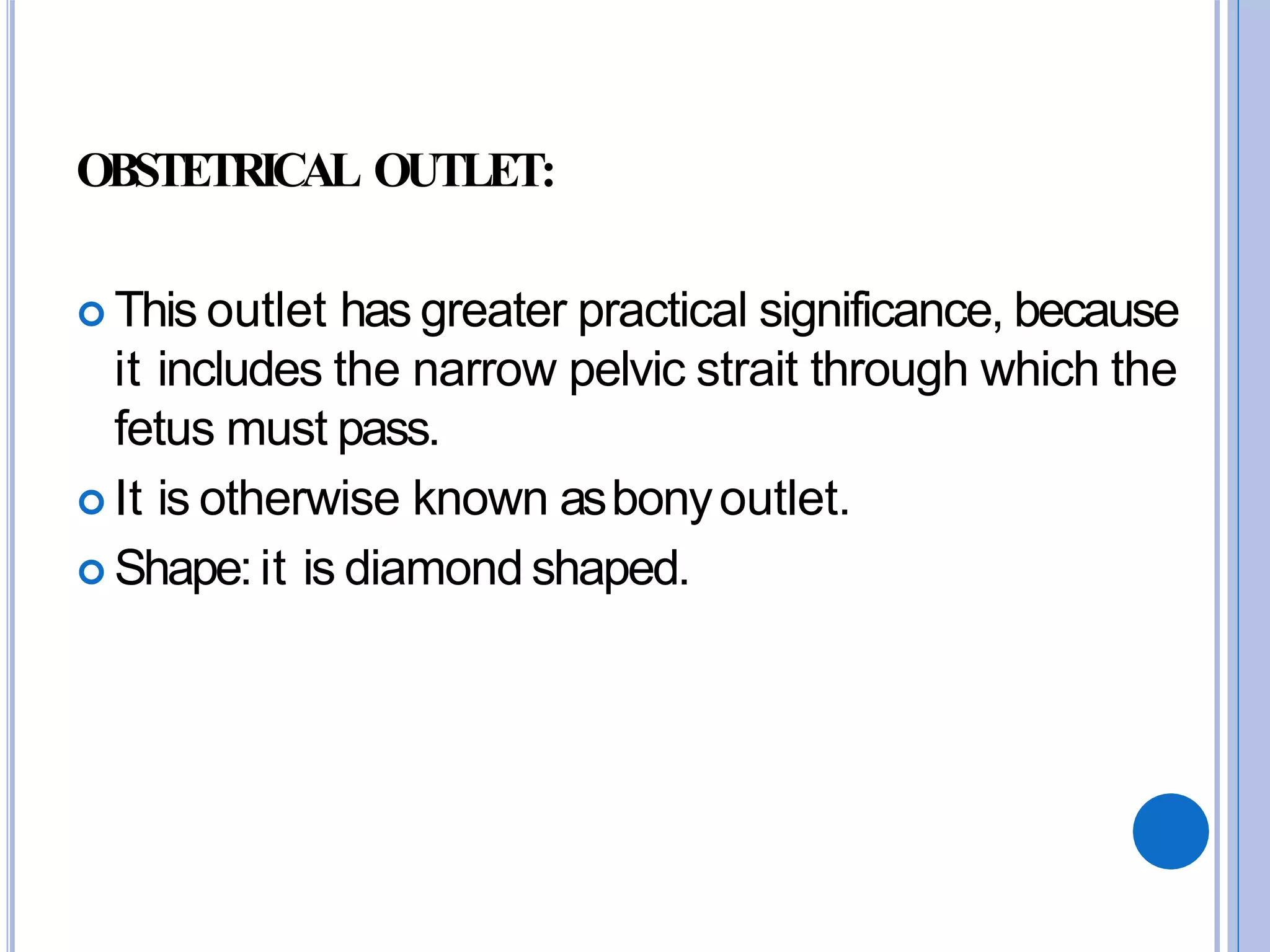
OBSTETRICAL OUTLET:
 This outlet has greater practical significance, because
it includes the narrow pelvic strait through which the
fetus must pass.
 It is otherwise known asbonyoutlet.
 Shape:it is diamond shaped.
DIAMETERS OF OUTLET:
 Antero-posterior diameter (13cm): it Extend
from lower border of symphysis pubis to the tip
of coccyx.
 Oblique diameter (12): itextend from Rt. & Lt.
Sacrospinous ligament to Obturator
foramen
 Transversediameter (11cm): between
the ischial spines.
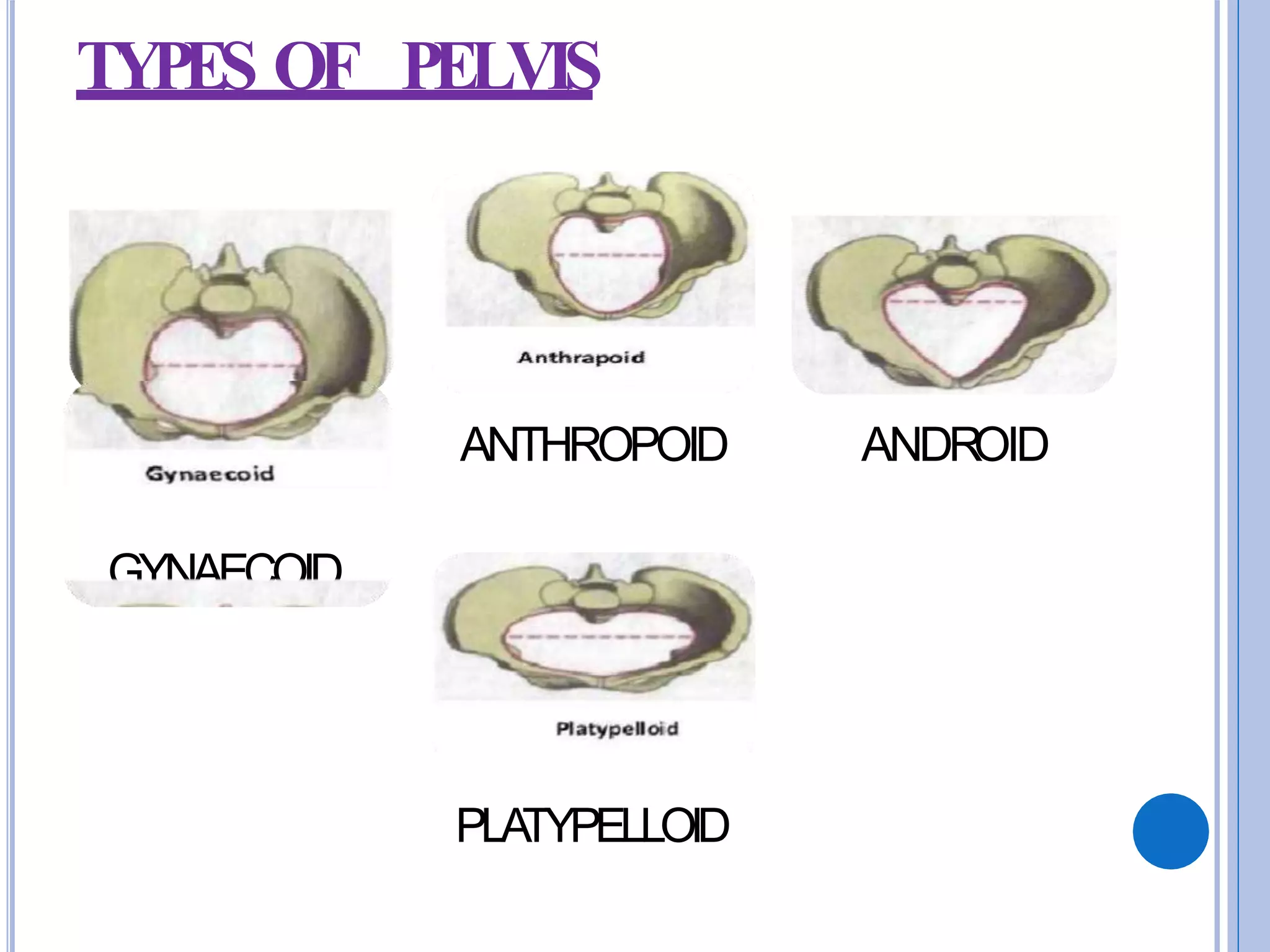
TYPES OF PELVIS
GYNAECOID
ANTHROPOID ANDROID
PLA
TYPELLOID
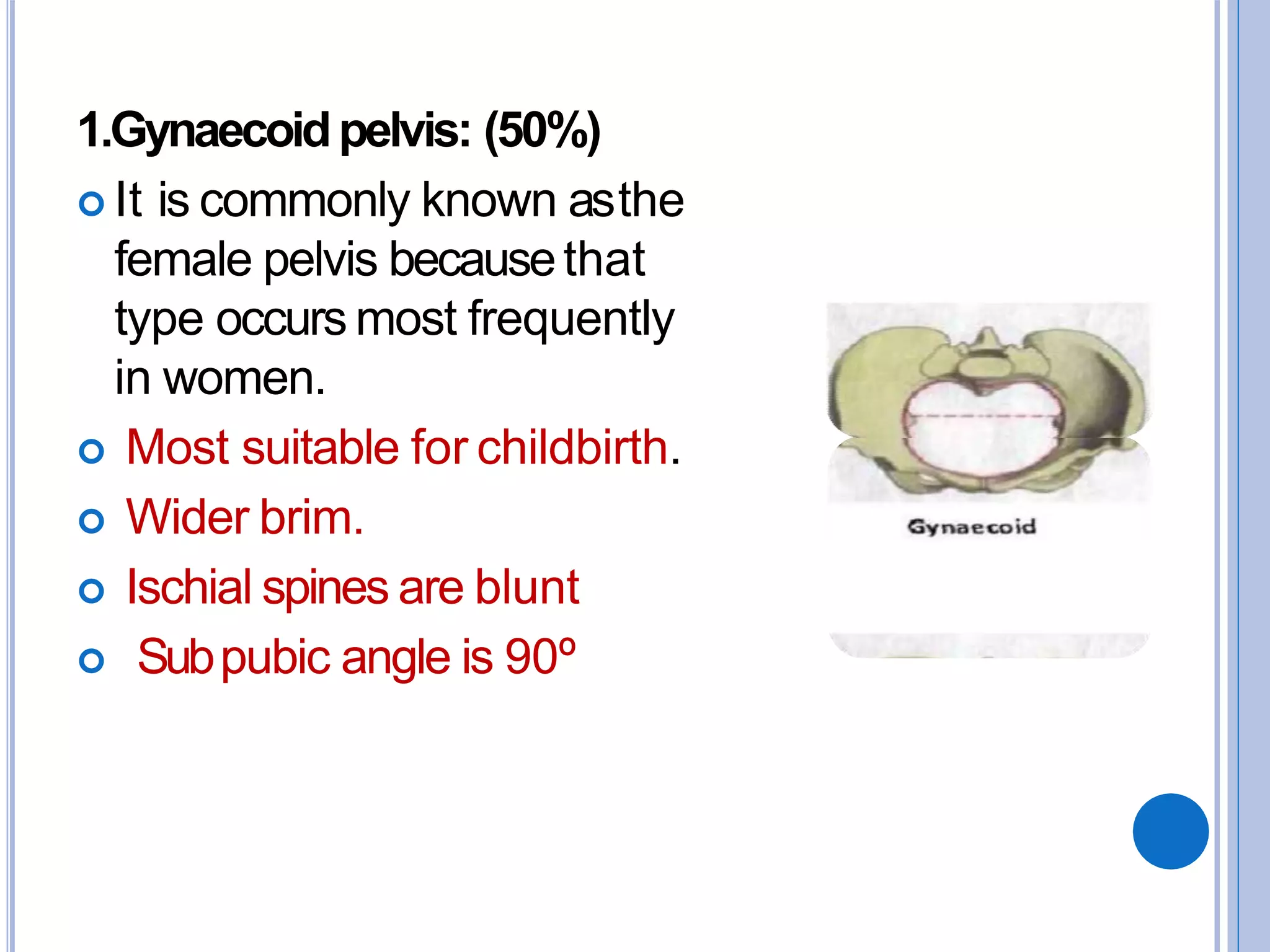
1.Gynaecoidpelvis: (50%)
 It is commonly known asthe
female pelvis becausethat
type occurs most frequently
in women.
 Most suitable for childbirth.
 Wider brim.
 Ischial spines are blunt
 Subpubic angle is 90º
2.Anthropoid pelvis: (25%)
 It favors aposterior positionof
the fetus.
 Oval in shape
 Transversediameter is shorter
 Seenin tall womenwith
narrow shoulders
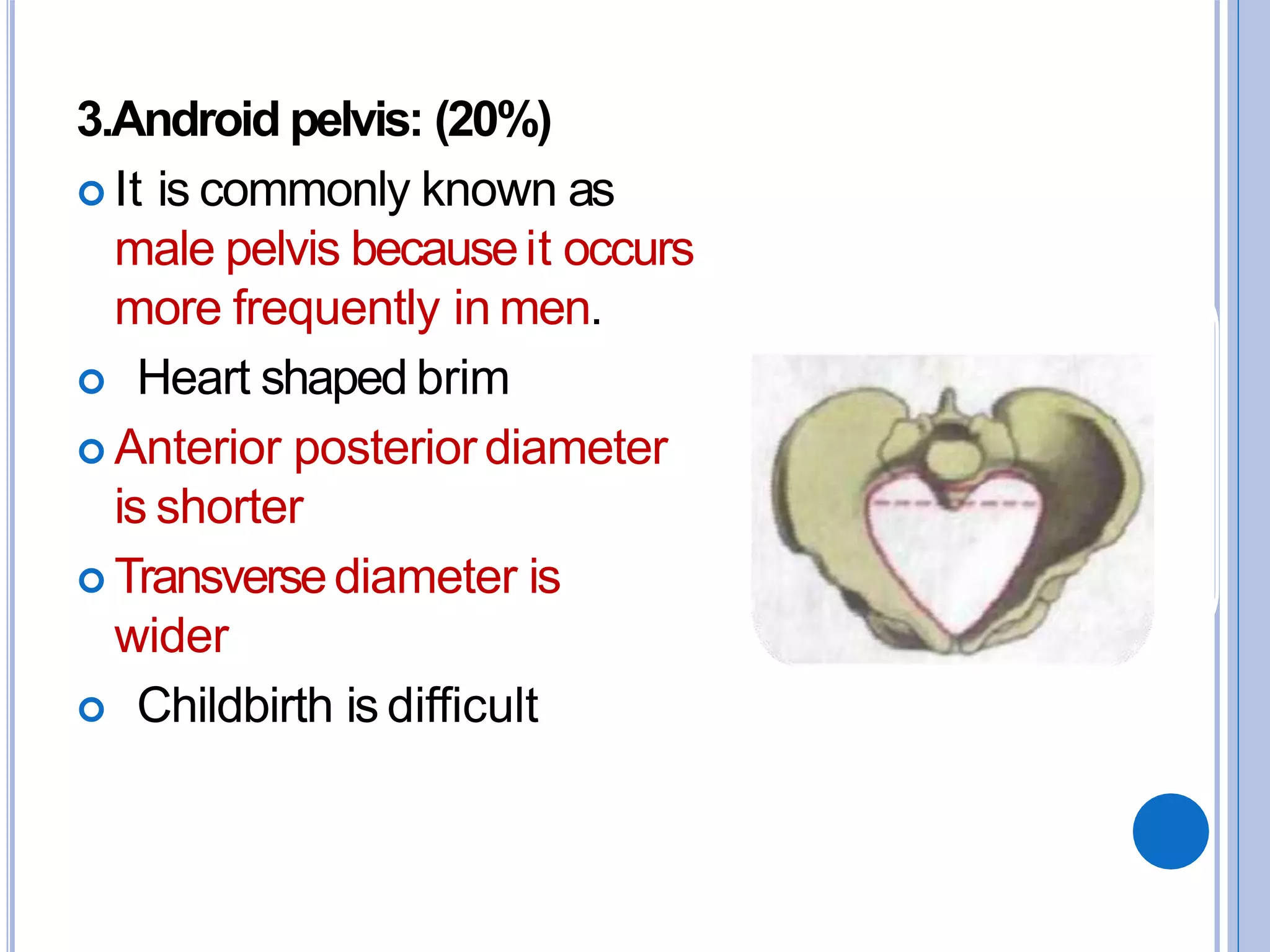
3.Android pelvis: (20%)
 It is commonly known as
male pelvis becauseit occurs
more frequently in men.
 Heart shaped brim
 Anterior posteriordiameter
is shorter
 Transversediameter is
wider
 Childbirth is difficult
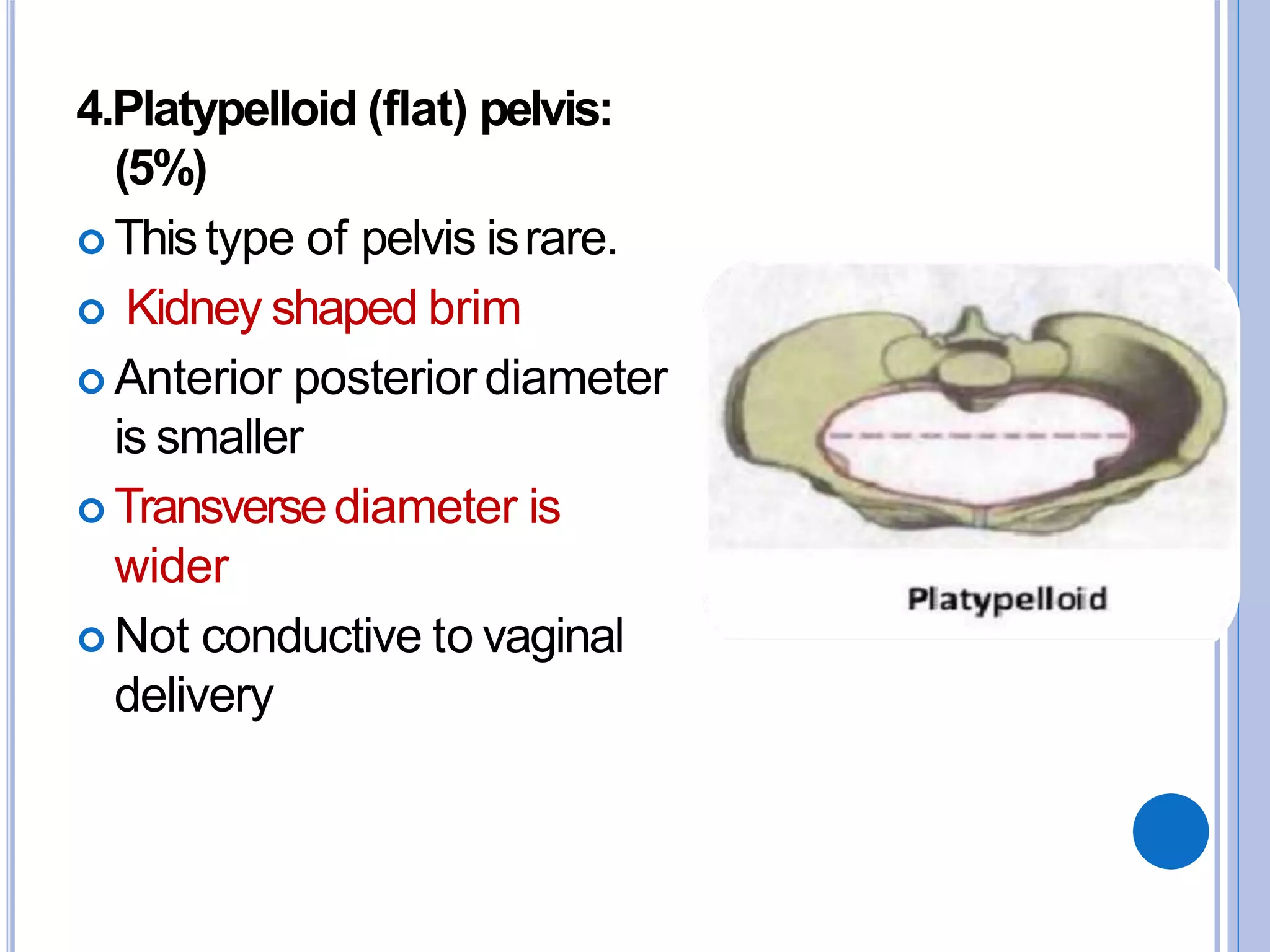
4.Platypelloid (flat) pelvis:
(5%)
 Thistype of pelvis israre.
 Kidney shaped brim
 Anterior posteriordiameter
is smaller
 Transversediameter is
wider
 Not conductive to vaginal
delivery
DEFORMITIES OF PELVIS
 Contracted pelvis
 Rachitic pelvis
 Asymmetrical pelvis
 Robertspelvis
 Nagelespelvis
 Osteomalacis / maacosteonpelvis
 Assimilation pelvis
 Others- Kyphosis,scoliosis, spondylosisthesis
female pelvis (1).pptx

female pelvis (1).pptx

  • 1.
  • 2.
    INTRODUCTION  Thepelvis isabasin like structure which connects the spine to lowerlimbs.  It is an important part of the skeletal system.  It transmits the weight of the trunk to the legs.  It takes the weight of the sitting body.  It allows movements of walking and running.  It protects the pelvicorgans.  In addition the female pelvis is adapted for childbearing with an increased width androunded brim.
  • 3.
    DEFINITION  Itis askeletalring formed by two innominate or hip bones & the sacrum & thecoccyx.
  • 4.
    TYPES OF PELVICBONES  There are four pelvic bones that formpelvis:  TwoHip bones (Innominate or nameless)  One Sacrum  One Coccyx
  • 5.
    1.TWOINNOMINATEBONES innominate bone ismade up of threebones  Ilium  ischium  pubic bone
  • 7.
    ILIUM  Theilium isthe flared out part of the hip bone. It has following parts-  Iliac crest asupper border  Concaveborder is iliac fossa  Anterior superior iliac spine  Anterior inferior iliacspine  Posterior superior iliac spine  Posterior inferior iliac spine
  • 8.
    ISCHIUM  The ischiumis the thick lower part of the hip bone. It hasfollowing parts-  Acetabulum  Ischial tuberosity  Ischial spine: location in relation tofetal head, i.e. above (-), below (+) or at (zerostation)  Greater sciatic Notch: extends from Sacroiliac joint to ischial spine  LesserSciatic Notch: extends from ischial spine to ischial tuberosity  Obturator foramen: passageof pelvic nervefibres
  • 10.
    PUBICBONE  The twopubic bones form the anterior part of the hip bone. It hasfollowing parts-  Inferior rami of Pubic bone(a)  Superior rami of pubic bone(b)  Symphysis pubis (a+b): It is formed at the junction of two pubic bones.  Sub pubic angle: angle between the inferior rami of the pubic bone.
  • 11.
    2.SACRUM  It isawedge shaped bone made up of fivefused bones. It has following parts-  Sacral promontory: it is prominent upper margin of first sacral vertebrae, projects inwards  Sacroiliac joint  Wings of Sacrum or Ala of Sacrum  Hollow of the Sacrum:concave
  • 12.
  • 13.
    3.COCCYX  It isavestigial tail consists of four fused vertebrae forming asmall triangular bone.  Itis articulated with the sacrum  Coccyxmoves backward during childbirth
  • 14.
    PELVIC JOINTS There arefour pelvicjoints:  Twosacroiliac joints  Onepubic symphysis joint  Onesacrococcygeal joint Sacrococcygeal joint
  • 15.
    TWO SACROILIACJOINTS  Theseareslightly movable joints formed where the ilium joints, first two sacral vertebrae on either side.  Theyconnect the spine to the pelvis & are the strongestjoints in body.
  • 16.
    ONE PUBIC SYMPHYSISJOINT It is acartilaginous joint between two pubic bones.
  • 17.
    ONE SACROCOCCYGEAL JOINT It is ahinge joint between sacrum & coccyx.
  • 18.
    PELVIC LIGAMENTS  Thepelvicbones are held together with ligaments.  Sacroiliac ligament- it pass in front of and behind each sacroiliac joint.  Pubicligament- it connect the top of pubicbones.  Sacrotuberous ligament- one ligament on each side , run from sacrum to the ischialtuberosity  Sacrospinous ligament- one ligament on each side of the sacrum & the ischialspine.  Sacro coccygeal ligament-one ligament on each side from sacrum to coccyx.
  • 20.
  • 21.
    FALSEPELVIS  It isformed by the upper flared out portion of the ilium.  Laterally- iliac fossae,Posterior- fifth lumbar vertebrae,  Anteriorly – the abdominal walland inguinal ligament  It protects the abdominal organs.  It has no obstetrical importance except that it provides certain landmarks for externalpelvimetry.
  • 22.
    TRUEPEL VIS  Thetrue pelvisis the bony canal throughwhich the fetus passesduring birth.  It hasthree parts- BRIM CA VITY OUTLET
  • 23.
    THE PELVIC BRIMORINLET  It is formed by the sacrum posteriorly, the iliac bones laterally and the pubic bonesanterior.  Shape: it is almost rounded with anterio posterior diameter being the shortest.  Its boundaries are the sacral promontory and wings of the sacrum behind the iliac bones on the sides and the pubic bones infront.
  • 25.
    LANDMARKSOFTHEBRIM  Sacralpromontory  Sacralalaor sacral wing  Sacroiliac joint  Iliopectineal line  Iliopubic eminence  Pectineal line  Pubic tubercle  Pubic Crest  Symphysis pubis
  • 26.
  • 28.
    ANTERIOPOSTERIOR(11CM)  It isaline from the sacral promontory to the upper border of symphysis pubis. Thisdiameter is of threetypes-  Diagonal conjugate- distance between lower border of symphysis pubis to mid point on sacral promontory it is 12 cm.  Obstetrical conjugate- it is distance between midpoint of sacral promontory to prominent bony projection in mid line of symphysis pubis. it measures 10cm  Trueconjugate - it extends from the sacral promontory to the top of the symphysis pubis. Its normal measurement is 11 cm or more.
  • 30.
    Transverse(13cm)– it is thedistance between the two farthest points on the pelvic brim over the Iliopectineallines. Oblique(12cm) – it starts from the sacroiliac joint to the opposite iliopubic eminence.
  • 31.
    THEPELVICCAVITY  Thecavity extendsfrom the brim above tothe outlet below.  Shape: its shape is almost rounded. It consistof-  Anterior border: Symphysispubis  Posterior border: Sacralhollow  Lateral border: Softtissues  All diameters- measure12cms.
  • 32.
    DIAMETERS i. Antereo-posterior (12cm): It measures from the mid-point on the posterior surface of the symphysis pubis to the junction of 2nd and 3rd sacral vertebrae ii. Transverse (12cm) : It cannot be precisely measured as the points lie over the soft tissues covering the sacro-sciatic notches and obturator foramina.
  • 33.
    THE PELVIC OUTLET ANATOMICALOUTLET : It consists of the lower border of all bonesand Sacro tuberous ligament.  It consistsof lower border ofsymphysispubis, Sacro coccygealjoint and Sacroischial spine.  Shape:it isantero –posteriorlyoval.
  • 34.
    OBSTETRICAL OUTLET:  Thisoutlet has greater practical significance, because it includes the narrow pelvic strait through which the fetus must pass.  It is otherwise known asbonyoutlet.  Shape:it is diamond shaped.
  • 35.
    DIAMETERS OF OUTLET: Antero-posterior diameter (13cm): it Extend from lower border of symphysis pubis to the tip of coccyx.  Oblique diameter (12): itextend from Rt. & Lt. Sacrospinous ligament to Obturator foramen  Transversediameter (11cm): between the ischial spines.
  • 37.
  • 38.
    1.Gynaecoidpelvis: (50%)  Itis commonly known asthe female pelvis becausethat type occurs most frequently in women.  Most suitable for childbirth.  Wider brim.  Ischial spines are blunt  Subpubic angle is 90º
  • 39.
    2.Anthropoid pelvis: (25%) It favors aposterior positionof the fetus.  Oval in shape  Transversediameter is shorter  Seenin tall womenwith narrow shoulders
  • 40.
    3.Android pelvis: (20%) It is commonly known as male pelvis becauseit occurs more frequently in men.  Heart shaped brim  Anterior posteriordiameter is shorter  Transversediameter is wider  Childbirth is difficult
  • 41.
    4.Platypelloid (flat) pelvis: (5%) Thistype of pelvis israre.  Kidney shaped brim  Anterior posteriordiameter is smaller  Transversediameter is wider  Not conductive to vaginal delivery
  • 42.
    DEFORMITIES OF PELVIS Contracted pelvis  Rachitic pelvis  Asymmetrical pelvis  Robertspelvis  Nagelespelvis  Osteomalacis / maacosteonpelvis  Assimilation pelvis  Others- Kyphosis,scoliosis, spondylosisthesis