U-BOOT
TECHNOLOGY
BY
A.MOUNIKA
ANNAMACHARYA INSTITUTE OF TECHNOLOGY AND SCIENCES
RAJAMPET
U-BOOT TECHNOLOGY
ABSTRACT:
U-boot beton is a formwork made of recycled polypropylene, designed to create lightened
intermediate slabs and raft foundations in reinforced concrete. The use of U-boot formworks
permits to build specific mushroom slabs: the mushroom is part of the slab thickness. U-boot
remains dip into the concrete casting. Thus, a grid of orthogonal beams, superiorly and
inferiorly closed by plane slabs of different heights, is obtained without executing two
distinct concrete castings, all that implies a remarkable saving of concrete and reinforcement.
INTRODUCTION:
U-boot is used for structural elements of
different types such as slabs or foundation
grants solution preformation considerable
designing technical and economic.
Disposable formwork for two-way voided
slabs in reinforced concrete cast on site. U-
Boot Beton is a recycled polypropylene
formwork that was designed to create two-
way voided slabs and rafts. U-Boot Beton
is used to create slabs with large span or
that are able to support large loads without
beams
A lightweight, cellular concrete made by
infusing an unhardened concrete mixture
with prepared foam or by generating gases
within the mixture.
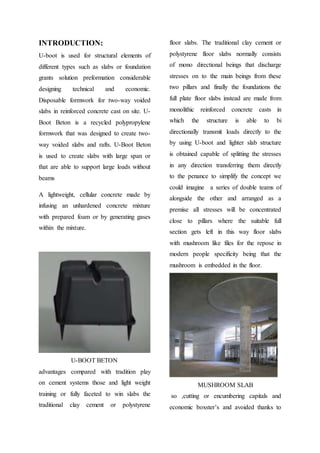
U-BOOT BETON
advantages compared with tradition play
on cement systems those and light weight
training or fully faceted to win slabs the
traditional clay cement or polystyrene
floor slabs. The traditional clay cement or
polystyrene floor slabs normally consists
of mono directional beings that discharge
stresses on to the main beings from these
two pillars and finally the foundations the
full plate floor slabs instead are made from
monolithic reinforced concrete casts in
which the structure is able to bi
directionally transmit loads directly to the
by using U-boot and lighter slab structure
is obtained capable of splitting the stresses
in any direction transferring them directly
to the penance to simplify the concept we
could imagine a series of double teams of
alongside the other and arranged as a
premise all stresses will be concentrated
close to pillars where the suitable full
section gets left in this way floor slabs
with mushroom like files for the repose in
modern people specificity being that the
mushroom is embedded in the floor.
MUSHROOM SLAB
so ,cutting or encumbering capitals and
economic boxster’s and avoided thanks to
the lightness of the structure doing away
lightness of the work the passage of
utilities and the layout of internal wards U-
boot will make it possible to optimise the
plan layout of pillars without having to
keep the specific distributed limitations as
well as reducing their number benefiting
for more extension spans and without
encumbrances the overall thickness of the
floor slabs will also be considerably
reduced and as a result they use full saving
in height will be obtained for each
individual forum is the possibility for
tower buildings of gaining an extra floor
with the same that involved compared
floor with a full slab the wind saving will
favourably influence the dimensioning of
pillars and foundations and the thickness
to be reduced in vocations the foundations
will be less important and less stressed
also behaviour under in case of fire the
building greater lightness high inertia and
reduced surface area reduced surface area
exposed to the effects of heat confer
autumn resistances to find from acoustic
specific tests guarantee that a floor slab
use U-boot technology provides insulation
performances that are superior compared
with traditional clay or cement systems
lightweight polystyrene zing’s a benefit of
no mass importance is the better quality of
the concrete surface finish to be left visible
or ready for the skimming without further
processing to the numerous advantages
link to the work itself economic logistic
and building site advantages are added for
construction firms is processing less
consumption of concrete and steel less
handling n ground and over ground this
encumbrance with in the parameters of the
site there’s transport and storage changes
all things to a material is stackable tough
and able to withstand all weather
conditions first an hour will be handling a
product that is safe from the light non
ssoiling and easy to use u-boot is the ideal
solution for all buildings in which judging
beams structures would need to be
avoided typically slab solution is sort
together with savings in those concrete and
weak the U-boot beton building system is
particularly suitable for the construction of
high-rise village hospitals commercial
centres school buildings parking
management residential and industrial
buildings.
In case of raft foundations having a greater
inertia U-boot makes it possible to
implement sweaters with a better
performance given the same concrete used
the grounds are found to have a low
carrying capacity furthermore be possible
to eliminate or reduce complex and costly
foundation pockets.
Laying of avoided two-way elements is
swift and simple the reinforcement and U-
boot elements are laid out on top of the
decade according to design specifications
ready to receive the concrete casting the
layout does not require specialised
personal the correct distance between the
elements is assured by a spacer jumped
equipped with a graduated scale by means
of which the widths the o beams being
formed with the casting can be rapidly
determined at the top this joint gets
inserted in specific looking for difference
provided on the upper surface of the U-
boot the entire operation is precise handy
and rapid once the concrete is poured
avoided structure is permanently
embedded providing the structure with the
desired shape on the technical timing for
the setting having last the backing will be
dismantled the intros service will prove to
be completely smooth formwork can also
be used in combination with predominate
facing the voided load directly on te plains
and completing the finishing casting.
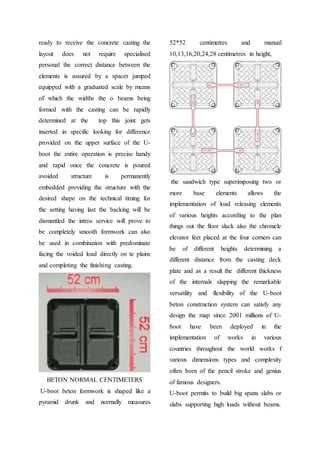
BETON NORMAL CENTIMETERS
U-boot beton formwork is shaped like a
pyramid drunk and normally measures
52*52 centimetres and manual
10,13,16,20,24,28 centimetres in height,
the sandwich type superimposing two or
more base elements allows the
implementation of load releasing elements
of various heights according to the plan
things out the floor slack also the chronicle
elevator feet placed at the four corners can
be of different heights determining a
different distance from the casting deck
plate and as a result the different thickness
of the internals slapping the remarkable
versatility and flexibility of the U-boot
beton construction system can satisfy any
design the map since 2001 millions of U-
boot have been deployed in the
implementation of works in various
countries throughout the world works f
various dimensions types and complexity
often born of the pencil stroke and genius
of famous designers.
U-boot permits to build big spans slabs or
slabs supporting high loads without beams.
Light and easy to pose, the draftsman can
change the geometrical parameters of the
slab, in order to suit any kind of situation
.U-boot is used in all applications that
require a plate structural solution ,along
with concrete-savings and therefore
weight-savings.
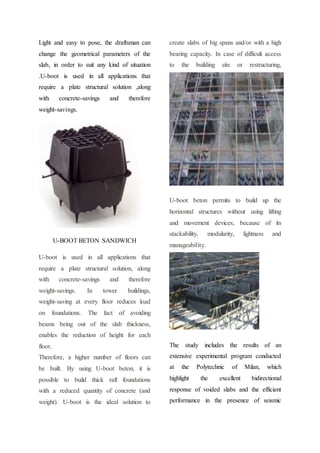
U-BOOT BETON SANDWICH
U-boot is used in all applications that
require a plate structural solution, along
with concrete-savings and therefore
weight-savings. In tower buildings,
weight-saving at every floor reduces load
on foundations. The fact of avoiding
beams being out of the slab thickness,
enables the reduction of height for each
floor.
Therefore, a higher number of floors can
be built. By using U-boot beton, it is
possible to build thick raft foundations
with a reduced quantity of concrete (and
weight). U-boot is the ideal solution to
create slabs of big spans and/or with a high
bearing capacity. In case of difficult access
to the building site or restructuring,
U-boot beton permits to build up the
horizontal structures without using lifting
and movement devices, because of its
stackability, modularity, lightness and
manageability.
The study includes the results of an
extensive experimental program conducted
at the Polytechnic of Milan, which
highlight the excellent bidirectional
response of voided slabs and the efficient
performance in the presence of seismic
actions. The experimental results here
presented are supported by advanced
numerical models
POSING:
The U-boot system particularly fits
structures that need significant open
spaces, like bureaus , industrial and
commercial buildings, and civil
constructions as well. The system also
allows a more irregular distribution of
pillars, since beams are not necessary
U-boot beton formwork is an easy to use
product. First, a flat and complete surface
has to be prepared with a wooden deck or
any other similar system.
Then, the inferior steel reinforcement has
to be posed in the two orthogonal
directions, as designed in the executive
project; the lattices are finally posed in
order to space out upper reinforcements.
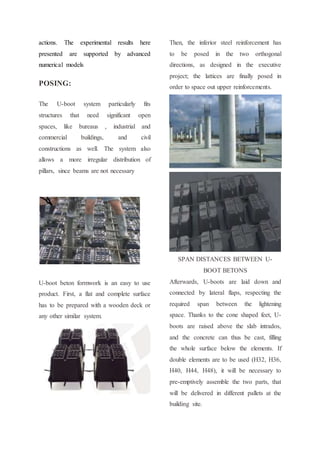
SPAN DISTANCES BETWEEN U-
BOOT BETONS
Afterwards, U-boots are laid down and
connected by lateral flaps, respecting the
required span between the lightening
space. Thanks to the cone shaped feet, U-
boots are raised above the slab intrados,
and the concrete can thus be cast, filling
the whole surface below the elements. If
double elements are to be used (H32, H36,
H40, H44, H48), it will be necessary to
pre-emptively assemble the two parts, that
will be delivered in different pallets at the
building site.
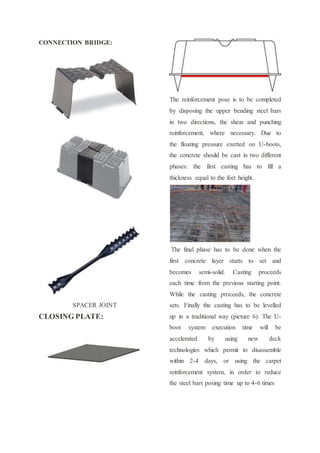
CONNECTION BRIDGE:
SPACER JOINT
CLOSING PLATE:
The reinforcement pose is to be completed
by disposing the upper bending steel bars
in two directions, the shear and punching
reinforcement, where necessary. Due to
the floating pressure exerted on U-boots,
the concrete should be cast in two different
phases: the first casting has to fill a
thickness equal to the feet height.
The final phase has to be done when the
first concrete layer starts to set and
becomes semi-solid. Casting proceeds
each time from the previous starting point.
While the casting proceeds, the concrete
sets. Finally the casting has to be levelled
up in a traditional way (picture 6). The U-
boot system execution time will be
accelerated by using new deck
technologies which permit to disassemble
within 2-4 days, or using the carpet
reinforcement system, in order to reduce
the steel bars posing time up to 4-6 times
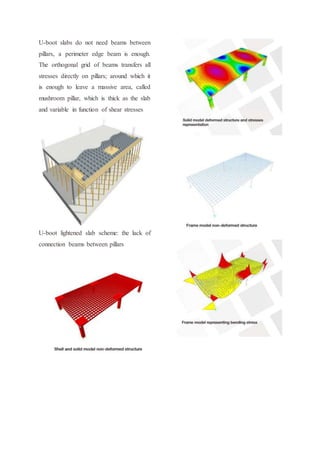
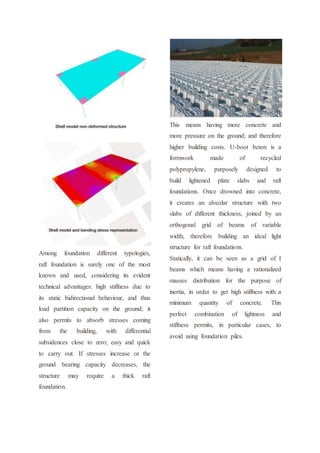
U-boot slabs do not need beams between
pillars, a perimeter edge beam is enough.
The orthogonal grid of beams transfers all
stresses directly on pillars; around which it
is enough to leave a massive area, called
mushroom pillar, which is thick as the slab
and variable in function of shear stresses
U-boot lightened slab scheme: the lack of
connection beams between pillars
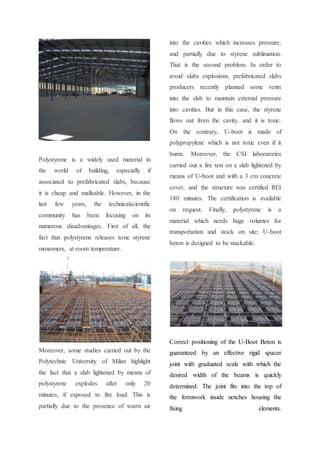
Among foundation different typologies,
raft foundation is surely one of the most
known and used, considering its evident
technical advantages: high stiffness due to
its static bidirectional behaviour, and thus
load partition capacity on the ground; it
also permits to absorb stresses coming
from the building, with differential
subsidences close to zero; easy and quick
to carry out. If stresses increase or the
ground bearing capacity decreases, the
structure may require a thick raft
foundation.
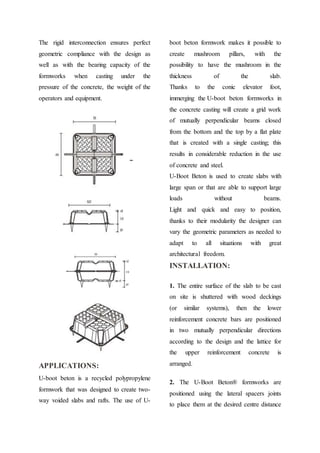
This means having more concrete and
more pressure on the ground; and therefore
higher building costs. U-boot beton is a
formwork made of recycled
polypropylene, purposely designed to
build lightened plate slabs and raft
foundations. Once drowned into concrete,
it creates an alveolar structure with two
slabs of different thickness, joined by an
orthogonal grid of beams of variable
width, therefore building an ideal light
structure for raft foundations.
Statically, it can be seen as a grid of I
beams which means having a rationalized
masses distribution for the purpose of
inertia, in order to get high stiffness with a
minimum quantity of concrete. This
perfect combination of lightness and
stiffness permits, in particular cases, to
avoid using foundation piles.
Polystyrene is a widely used material in
the world of building, especially if
associated to prefabricated slabs, because
it is cheap and malleable. However, in the
last few years, the technicalscientific
community has been focusing on its
numerous disadvantages. First of all, the
fact that polystyrene releases toxic styrene
monomers, at room temperature.
Moreover, some studies carried out by the
Polytechnic University of Milan highlight
the fact that a slab lightened by means of
polystyrene explodes after only 20
minutes, if exposed to fire load. This is
partially due to the presence of warm air
into the cavities which increases pressure,
and partially due to styrene sublimation.
That is the second problem. In order to
avoid slabs explosions, prefabricated slabs
producers recently planned some vents
into the slab to maintain external pressure
into cavities. But in this case, the styrene
flows out from the cavity, and it is toxic.
On the contrary, U-boot is made of
polypropylene which is not toxic even if it
burns. Moreover, the CSI laboratories
carried out a fire test on a slab lightened by
means of U-boot and with a 3 cm concrete
cover, and the structure was certified REI
180 minutes. The certification is available
on request. Finally, polystyrene is a
material which needs huge volumes for
transportation and stock on site; U-boot
beton is designed to be stackable.
Correct positioning of the U-Boot Beton is
guaranteed by an effective rigid spacer
joint with graduated scale with which the
desired width of the beams is quickly
determined. The joint fits into the top of
the formwork inside notches housing the
fixing elements.
The rigid interconnection ensures perfect
geometric compliance with the design as
well as with the bearing capacity of the
formworks when casting under the
pressure of the concrete, the weight of the
operators and equipment.
APPLICATIONS:
U-boot beton is a recycled polypropylene
formwork that was designed to create two-
way voided slabs and rafts. The use of U-
boot beton formwork makes it possible to
create mushroom pillars, with the
possibility to have the mushroom in the
thickness of the slab.
Thanks to the conic elevator foot,
immerging the U-boot beton formworks in
the concrete casting will create a grid work
of mutually perpendicular beams closed
from the bottom and the top by a flat plate
that is created with a single casting; this
results in considerable reduction in the use
of concrete and steel.
U-Boot Beton is used to create slabs with
large span or that are able to support large
loads without beams.
Light and quick and easy to position,
thanks to their modularity the designer can
vary the geometric parameters as needed to
adapt to all situations with great
architectural freedom.
INSTALLATION:
1. The entire surface of the slab to be cast
on site is shuttered with wood deckings
(or similar systems), then the lower
reinforcement concrete bars are positioned
in two mutually perpendicular directions
according to the design and the lattice for
the upper reinforcement concrete is
arranged.
2. The U-Boot Beton® formworks are
positioned using the lateral spacers joints
to place them at the desired centre distance
that will determine the beam width.
Thanks to the conic elevator foot, theU-
Boot Beton® formworks will be lifted
from the surface, making it possible for the
lower slab to be formed. If double or triple
elements are used, these elements must
first be assembled, which will be supplied
on distinct pallets in the yard.
3. The positioning of the reinforconcretes
is completed by placing above the U-Boot
Beton® formwork the upper bars in the
two directions as well as the reinforcement
for shear and punching where necessary,
according to the design.
4. The concrete casting must be performed
in two phases to prevent the floatation of
the formworks: an initial layer will be cast
to fill a thickness equal to the height of the
elevator foot. Casting will continue for this
first portion of the slab until the concrete
starts to set and become semi fluid.
5. Once suitably set, the casting can be
restarted from the starting point,
completely burying the U-Boot Beton. The
casting is then levelled and smoothed in a
traditional manner.
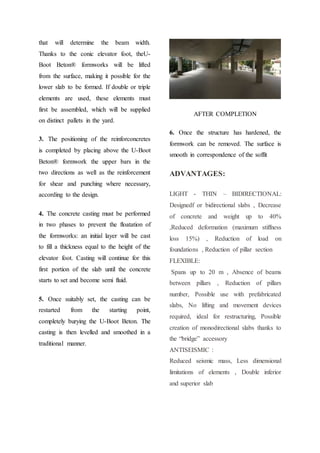
AFTER COMPLETION
6. Once the structure has hardened, the
formwork can be removed. The surface is
smooth in correspondence of the soffit
ADVANTAGES:
LIGHT - THIN – BIDIRECTIONAL:
Designedf or bidirectional slabs , Decrease
of concrete and weight up to 40%
,Reduced deformation (maximum stiffness
loss 15%) , Reduction of load on
foundations , Reduction of pillar section
FLEXIBLE:
Spans up to 20 m , Absence of beams
between pillars , Reduction of pillars
number, Possible use with prefabricated
slabs, No lifting and movement devices
required, ideal for restructuring, Possible
creation of monodirectional slabs thanks to
the “bridge” accessory
ANTISEISMIC :
Reduced seismic mass, Less dimensional
limitations of elements , Double inferior
and superior slab
OPEN SPACES :
More spacious rooms , Bigger architectural
freedom , Easier change of use
ECONOMIC:
Less concrete incidence, thickness being
equal , Less steel incidence , Usable height
saving on each floor, since avoiding beams
being out of the slab thickness enables a
higher number of floors, height being
equal (tower buildings) , Rapidity and
easiness of pose (unique twophased
casting) , Possibility of big spans, load
being equal , Possibility of high bearing
capacity, spans being equal , Economical
transport and easy stocking, since it is
stackable, Ready to smooth once the deck
is taken off, the intrados is a plane surface
which do not require false ceilings at an
aesthetical level , If a false ceiling is
necessary, pose is made more rapidly
SAFE:
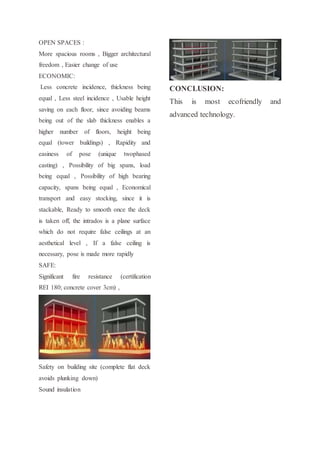
Significant fire resistance (certification
REI 180; concrete cover 3cm) ,
Safety on building site (complete flat deck
avoids plunking down)
Sound insulation
CONCLUSION:
This is most ecofriendly and
advanced technology.

Document

  • 1.
  • 2.
    U-BOOT TECHNOLOGY ABSTRACT: U-boot betonis a formwork made of recycled polypropylene, designed to create lightened intermediate slabs and raft foundations in reinforced concrete. The use of U-boot formworks permits to build specific mushroom slabs: the mushroom is part of the slab thickness. U-boot remains dip into the concrete casting. Thus, a grid of orthogonal beams, superiorly and inferiorly closed by plane slabs of different heights, is obtained without executing two distinct concrete castings, all that implies a remarkable saving of concrete and reinforcement.
  • 3.
    INTRODUCTION: U-boot is usedfor structural elements of different types such as slabs or foundation grants solution preformation considerable designing technical and economic. Disposable formwork for two-way voided slabs in reinforced concrete cast on site. U- Boot Beton is a recycled polypropylene formwork that was designed to create two- way voided slabs and rafts. U-Boot Beton is used to create slabs with large span or that are able to support large loads without beams A lightweight, cellular concrete made by infusing an unhardened concrete mixture with prepared foam or by generating gases within the mixture. U-BOOT BETON advantages compared with tradition play on cement systems those and light weight training or fully faceted to win slabs the traditional clay cement or polystyrene floor slabs. The traditional clay cement or polystyrene floor slabs normally consists of mono directional beings that discharge stresses on to the main beings from these two pillars and finally the foundations the full plate floor slabs instead are made from monolithic reinforced concrete casts in which the structure is able to bi directionally transmit loads directly to the by using U-boot and lighter slab structure is obtained capable of splitting the stresses in any direction transferring them directly to the penance to simplify the concept we could imagine a series of double teams of alongside the other and arranged as a premise all stresses will be concentrated close to pillars where the suitable full section gets left in this way floor slabs with mushroom like files for the repose in modern people specificity being that the mushroom is embedded in the floor. MUSHROOM SLAB so ,cutting or encumbering capitals and economic boxster’s and avoided thanks to
  • 4.
    the lightness ofthe structure doing away lightness of the work the passage of utilities and the layout of internal wards U- boot will make it possible to optimise the plan layout of pillars without having to keep the specific distributed limitations as well as reducing their number benefiting for more extension spans and without encumbrances the overall thickness of the floor slabs will also be considerably reduced and as a result they use full saving in height will be obtained for each individual forum is the possibility for tower buildings of gaining an extra floor with the same that involved compared floor with a full slab the wind saving will favourably influence the dimensioning of pillars and foundations and the thickness to be reduced in vocations the foundations will be less important and less stressed also behaviour under in case of fire the building greater lightness high inertia and reduced surface area reduced surface area exposed to the effects of heat confer autumn resistances to find from acoustic specific tests guarantee that a floor slab use U-boot technology provides insulation performances that are superior compared with traditional clay or cement systems lightweight polystyrene zing’s a benefit of no mass importance is the better quality of the concrete surface finish to be left visible or ready for the skimming without further processing to the numerous advantages link to the work itself economic logistic and building site advantages are added for construction firms is processing less consumption of concrete and steel less handling n ground and over ground this encumbrance with in the parameters of the site there’s transport and storage changes all things to a material is stackable tough and able to withstand all weather conditions first an hour will be handling a product that is safe from the light non ssoiling and easy to use u-boot is the ideal solution for all buildings in which judging beams structures would need to be avoided typically slab solution is sort together with savings in those concrete and weak the U-boot beton building system is particularly suitable for the construction of high-rise village hospitals commercial centres school buildings parking management residential and industrial buildings. In case of raft foundations having a greater inertia U-boot makes it possible to implement sweaters with a better performance given the same concrete used the grounds are found to have a low carrying capacity furthermore be possible to eliminate or reduce complex and costly foundation pockets. Laying of avoided two-way elements is swift and simple the reinforcement and U- boot elements are laid out on top of the decade according to design specifications
  • 5.
    ready to receivethe concrete casting the layout does not require specialised personal the correct distance between the elements is assured by a spacer jumped equipped with a graduated scale by means of which the widths the o beams being formed with the casting can be rapidly determined at the top this joint gets inserted in specific looking for difference provided on the upper surface of the U- boot the entire operation is precise handy and rapid once the concrete is poured avoided structure is permanently embedded providing the structure with the desired shape on the technical timing for the setting having last the backing will be dismantled the intros service will prove to be completely smooth formwork can also be used in combination with predominate facing the voided load directly on te plains and completing the finishing casting. BETON NORMAL CENTIMETERS U-boot beton formwork is shaped like a pyramid drunk and normally measures 52*52 centimetres and manual 10,13,16,20,24,28 centimetres in height, the sandwich type superimposing two or more base elements allows the implementation of load releasing elements of various heights according to the plan things out the floor slack also the chronicle elevator feet placed at the four corners can be of different heights determining a different distance from the casting deck plate and as a result the different thickness of the internals slapping the remarkable versatility and flexibility of the U-boot beton construction system can satisfy any design the map since 2001 millions of U- boot have been deployed in the implementation of works in various countries throughout the world works f various dimensions types and complexity often born of the pencil stroke and genius of famous designers. U-boot permits to build big spans slabs or slabs supporting high loads without beams.
  • 6.
    Light and easyto pose, the draftsman can change the geometrical parameters of the slab, in order to suit any kind of situation .U-boot is used in all applications that require a plate structural solution ,along with concrete-savings and therefore weight-savings. U-BOOT BETON SANDWICH U-boot is used in all applications that require a plate structural solution, along with concrete-savings and therefore weight-savings. In tower buildings, weight-saving at every floor reduces load on foundations. The fact of avoiding beams being out of the slab thickness, enables the reduction of height for each floor. Therefore, a higher number of floors can be built. By using U-boot beton, it is possible to build thick raft foundations with a reduced quantity of concrete (and weight). U-boot is the ideal solution to create slabs of big spans and/or with a high bearing capacity. In case of difficult access to the building site or restructuring, U-boot beton permits to build up the horizontal structures without using lifting and movement devices, because of its stackability, modularity, lightness and manageability. The study includes the results of an extensive experimental program conducted at the Polytechnic of Milan, which highlight the excellent bidirectional response of voided slabs and the efficient performance in the presence of seismic
  • 7.
    actions. The experimentalresults here presented are supported by advanced numerical models POSING: The U-boot system particularly fits structures that need significant open spaces, like bureaus , industrial and commercial buildings, and civil constructions as well. The system also allows a more irregular distribution of pillars, since beams are not necessary U-boot beton formwork is an easy to use product. First, a flat and complete surface has to be prepared with a wooden deck or any other similar system. Then, the inferior steel reinforcement has to be posed in the two orthogonal directions, as designed in the executive project; the lattices are finally posed in order to space out upper reinforcements. SPAN DISTANCES BETWEEN U- BOOT BETONS Afterwards, U-boots are laid down and connected by lateral flaps, respecting the required span between the lightening space. Thanks to the cone shaped feet, U- boots are raised above the slab intrados, and the concrete can thus be cast, filling the whole surface below the elements. If double elements are to be used (H32, H36, H40, H44, H48), it will be necessary to pre-emptively assemble the two parts, that will be delivered in different pallets at the building site.
  • 8.
    CONNECTION BRIDGE: SPACER JOINT CLOSINGPLATE: The reinforcement pose is to be completed by disposing the upper bending steel bars in two directions, the shear and punching reinforcement, where necessary. Due to the floating pressure exerted on U-boots, the concrete should be cast in two different phases: the first casting has to fill a thickness equal to the feet height. The final phase has to be done when the first concrete layer starts to set and becomes semi-solid. Casting proceeds each time from the previous starting point. While the casting proceeds, the concrete sets. Finally the casting has to be levelled up in a traditional way (picture 6). The U- boot system execution time will be accelerated by using new deck technologies which permit to disassemble within 2-4 days, or using the carpet reinforcement system, in order to reduce the steel bars posing time up to 4-6 times
  • 9.
    U-boot slabs donot need beams between pillars, a perimeter edge beam is enough. The orthogonal grid of beams transfers all stresses directly on pillars; around which it is enough to leave a massive area, called mushroom pillar, which is thick as the slab and variable in function of shear stresses U-boot lightened slab scheme: the lack of connection beams between pillars
  • 10.
    Among foundation differenttypologies, raft foundation is surely one of the most known and used, considering its evident technical advantages: high stiffness due to its static bidirectional behaviour, and thus load partition capacity on the ground; it also permits to absorb stresses coming from the building, with differential subsidences close to zero; easy and quick to carry out. If stresses increase or the ground bearing capacity decreases, the structure may require a thick raft foundation. This means having more concrete and more pressure on the ground; and therefore higher building costs. U-boot beton is a formwork made of recycled polypropylene, purposely designed to build lightened plate slabs and raft foundations. Once drowned into concrete, it creates an alveolar structure with two slabs of different thickness, joined by an orthogonal grid of beams of variable width, therefore building an ideal light structure for raft foundations. Statically, it can be seen as a grid of I beams which means having a rationalized masses distribution for the purpose of inertia, in order to get high stiffness with a minimum quantity of concrete. This perfect combination of lightness and stiffness permits, in particular cases, to avoid using foundation piles.
  • 11.
    Polystyrene is awidely used material in the world of building, especially if associated to prefabricated slabs, because it is cheap and malleable. However, in the last few years, the technicalscientific community has been focusing on its numerous disadvantages. First of all, the fact that polystyrene releases toxic styrene monomers, at room temperature. Moreover, some studies carried out by the Polytechnic University of Milan highlight the fact that a slab lightened by means of polystyrene explodes after only 20 minutes, if exposed to fire load. This is partially due to the presence of warm air into the cavities which increases pressure, and partially due to styrene sublimation. That is the second problem. In order to avoid slabs explosions, prefabricated slabs producers recently planned some vents into the slab to maintain external pressure into cavities. But in this case, the styrene flows out from the cavity, and it is toxic. On the contrary, U-boot is made of polypropylene which is not toxic even if it burns. Moreover, the CSI laboratories carried out a fire test on a slab lightened by means of U-boot and with a 3 cm concrete cover, and the structure was certified REI 180 minutes. The certification is available on request. Finally, polystyrene is a material which needs huge volumes for transportation and stock on site; U-boot beton is designed to be stackable. Correct positioning of the U-Boot Beton is guaranteed by an effective rigid spacer joint with graduated scale with which the desired width of the beams is quickly determined. The joint fits into the top of the formwork inside notches housing the fixing elements.
  • 12.
    The rigid interconnectionensures perfect geometric compliance with the design as well as with the bearing capacity of the formworks when casting under the pressure of the concrete, the weight of the operators and equipment. APPLICATIONS: U-boot beton is a recycled polypropylene formwork that was designed to create two- way voided slabs and rafts. The use of U- boot beton formwork makes it possible to create mushroom pillars, with the possibility to have the mushroom in the thickness of the slab. Thanks to the conic elevator foot, immerging the U-boot beton formworks in the concrete casting will create a grid work of mutually perpendicular beams closed from the bottom and the top by a flat plate that is created with a single casting; this results in considerable reduction in the use of concrete and steel. U-Boot Beton is used to create slabs with large span or that are able to support large loads without beams. Light and quick and easy to position, thanks to their modularity the designer can vary the geometric parameters as needed to adapt to all situations with great architectural freedom. INSTALLATION: 1. The entire surface of the slab to be cast on site is shuttered with wood deckings (or similar systems), then the lower reinforcement concrete bars are positioned in two mutually perpendicular directions according to the design and the lattice for the upper reinforcement concrete is arranged. 2. The U-Boot Beton® formworks are positioned using the lateral spacers joints to place them at the desired centre distance
  • 13.
    that will determinethe beam width. Thanks to the conic elevator foot, theU- Boot Beton® formworks will be lifted from the surface, making it possible for the lower slab to be formed. If double or triple elements are used, these elements must first be assembled, which will be supplied on distinct pallets in the yard. 3. The positioning of the reinforconcretes is completed by placing above the U-Boot Beton® formwork the upper bars in the two directions as well as the reinforcement for shear and punching where necessary, according to the design. 4. The concrete casting must be performed in two phases to prevent the floatation of the formworks: an initial layer will be cast to fill a thickness equal to the height of the elevator foot. Casting will continue for this first portion of the slab until the concrete starts to set and become semi fluid. 5. Once suitably set, the casting can be restarted from the starting point, completely burying the U-Boot Beton. The casting is then levelled and smoothed in a traditional manner. AFTER COMPLETION 6. Once the structure has hardened, the formwork can be removed. The surface is smooth in correspondence of the soffit ADVANTAGES: LIGHT - THIN – BIDIRECTIONAL: Designedf or bidirectional slabs , Decrease of concrete and weight up to 40% ,Reduced deformation (maximum stiffness loss 15%) , Reduction of load on foundations , Reduction of pillar section FLEXIBLE: Spans up to 20 m , Absence of beams between pillars , Reduction of pillars number, Possible use with prefabricated slabs, No lifting and movement devices required, ideal for restructuring, Possible creation of monodirectional slabs thanks to the “bridge” accessory ANTISEISMIC : Reduced seismic mass, Less dimensional limitations of elements , Double inferior and superior slab
  • 14.
    OPEN SPACES : Morespacious rooms , Bigger architectural freedom , Easier change of use ECONOMIC: Less concrete incidence, thickness being equal , Less steel incidence , Usable height saving on each floor, since avoiding beams being out of the slab thickness enables a higher number of floors, height being equal (tower buildings) , Rapidity and easiness of pose (unique twophased casting) , Possibility of big spans, load being equal , Possibility of high bearing capacity, spans being equal , Economical transport and easy stocking, since it is stackable, Ready to smooth once the deck is taken off, the intrados is a plane surface which do not require false ceilings at an aesthetical level , If a false ceiling is necessary, pose is made more rapidly SAFE: Significant fire resistance (certification REI 180; concrete cover 3cm) , Safety on building site (complete flat deck avoids plunking down) Sound insulation CONCLUSION: This is most ecofriendly and advanced technology.