Dept. Of Civil Engineering,CIEM 1 | P a g e
U-BOOT BETON TECHNOLOGY
A seminar report
submitted in partial fulfillment of the requirements for the degree of
Bachelor of Technology
in Civil Engineering
By
AMISH RAJ HARI
Univ. Roll no:-1650115003
Univ. Reg.no:-151650110189
Under the supervision of
Mr. Riddha Chaudhuri
Designation, Department of Civil Engineering
CALCUTTA INSTITUTE OF ENGINEERING AND MANAGEMENT
24/1A CHANDI GHOSH ROAD KOLKATA - 700040
Dept. Of Civil Engineering,CIEM 2 | P a g e
CERTIFICATE OF APPROVAL
This foregoing seminar report is hereby approved as a credible study of an
engineering subject carried out and presented in a manner satisfactory to
warrant its acceptance as a prerequisite to the degree for which it has been
submitted. It is understood thatby this approvalthe undersigned donot endorse
or approve anystatement made, opinion expressed or conclusion drawn therein
but approve the seminar report only for the purpose for which it has been
submitted.
Boardof Seminar ReportExaminers:
1. _____________________________
_
2. _____________________________
_
3. _____________________________
_
4. _____________________________
_
5. _____________________________
_
6. _____________________________
_
Dept. Of Civil Engineering,CIEM 3 | P a g e
CERTIFICATE OF SUPERVISOR
I hereby recommend that the Seminar presented based on the seminar report submitted under
my supervision by AMISH RAJ HARI (University Roll No-16501315003.) entitled “U-
BOOT BETON TECHNOLOGY” be accepted in partial fulfilment of the requirements for
the degree of Bachelor of Technology in Civil Engineering.
___________________________
Signature of the Supervisor
Dept. Of Civil Engineering,CIEM 4 | P a g e
Acknowledgement
At the very outset, I would be taking the opportunity to convey my cordial and earnest
regards to my supervisors (Mr. Riddha Choudhari, Assistantprofessor), Department of
Civil Engineering, Calcutta Institute of Engineering and Management, under whose
supervision and guidance this work has been carried out. It would have been impossible to
carry out this seminar work with confidence without his wholehearted involvement, advice,
support and constant encouragement throughout.
I would also like to thank all the supporting staff of the Dept. of Civil Engineering and
all other departments who have been helpful directly or indirectly in making this endeavour a
success.
I would also like to acknowledge advises and helping attitudes of my friends who have
helped my way out to the timely completion of this project.
..........................................................
( AMISH RAJ HARI)
Univ. Roll No :-16501315003
Dept. Of Civil Engineering,CIEM 5 | P a g e
Contents
PAGE NO.
CERTIFICATE OF APPROVAL
CERTIFICATE OF SUPERVISOR
ACKNOWLEDGMENT
ABSTRACT
1. INTRODUCTION 06
1.1.PARTS OF U-BETON 09
2. INSTALLATION 21
3. APPLICATION 25
3.1. IN RAFT FOUNDATION 27
4. ADVANTAGE 28
5. REFERENCE 30
Dept. Of Civil Engineering,CIEM 6 | P a g e
1 Introduction
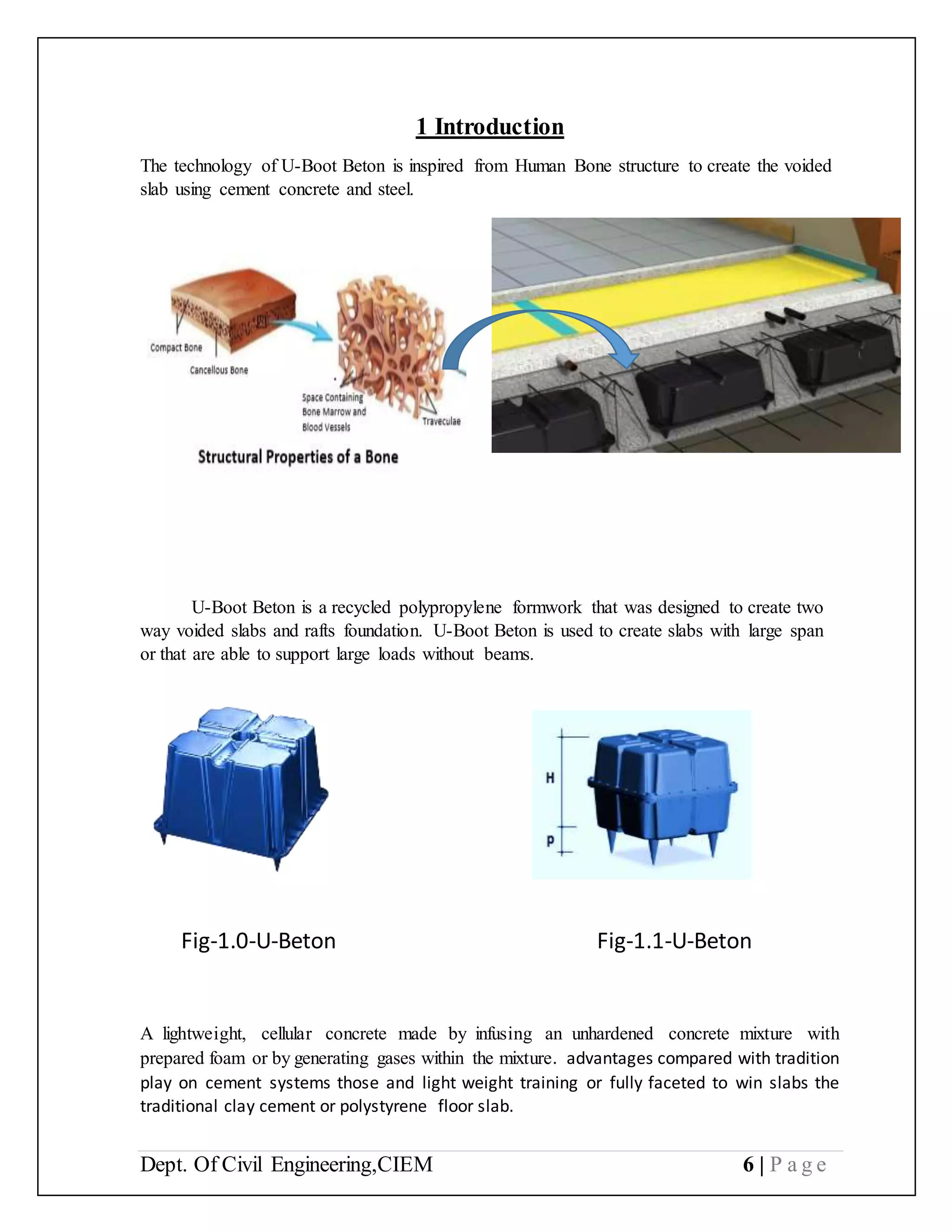
The technology of U-Boot Beton is inspired from Human Bone structure to create the voided
slab using cement concrete and steel.
U-Boot Beton is a recycled polypropylene formwork that was designed to create two
way voided slabs and rafts foundation. U-Boot Beton is used to create slabs with large span
or that are able to support large loads without beams.
A lightweight, cellular concrete made by infusing an unhardened concrete mixture with
prepared foam or by generating gases within the mixture. advantages compared with tradition
play on cement systems those and light weight training or fully faceted to win slabs the
traditional clay cement or polystyrene floor slab.
Fig-1.0-U-Beton Fig-1.1-U-Beton
Dept. Of Civil Engineering,CIEM 7 | P a g e
The traditional clay cement or polystyrene floor slabs normally consists of mono directional
beings that discharge stresses on to the main beings from these two pillars and finally the
foundations the full plate floor slabs instead are made from monolithic reinforced concrete
casts in which the structure is able to bi-directionally transmit loads directly to the by using
U-boot and lighter slab structure is obtained capable of splitting the stresses in any direction
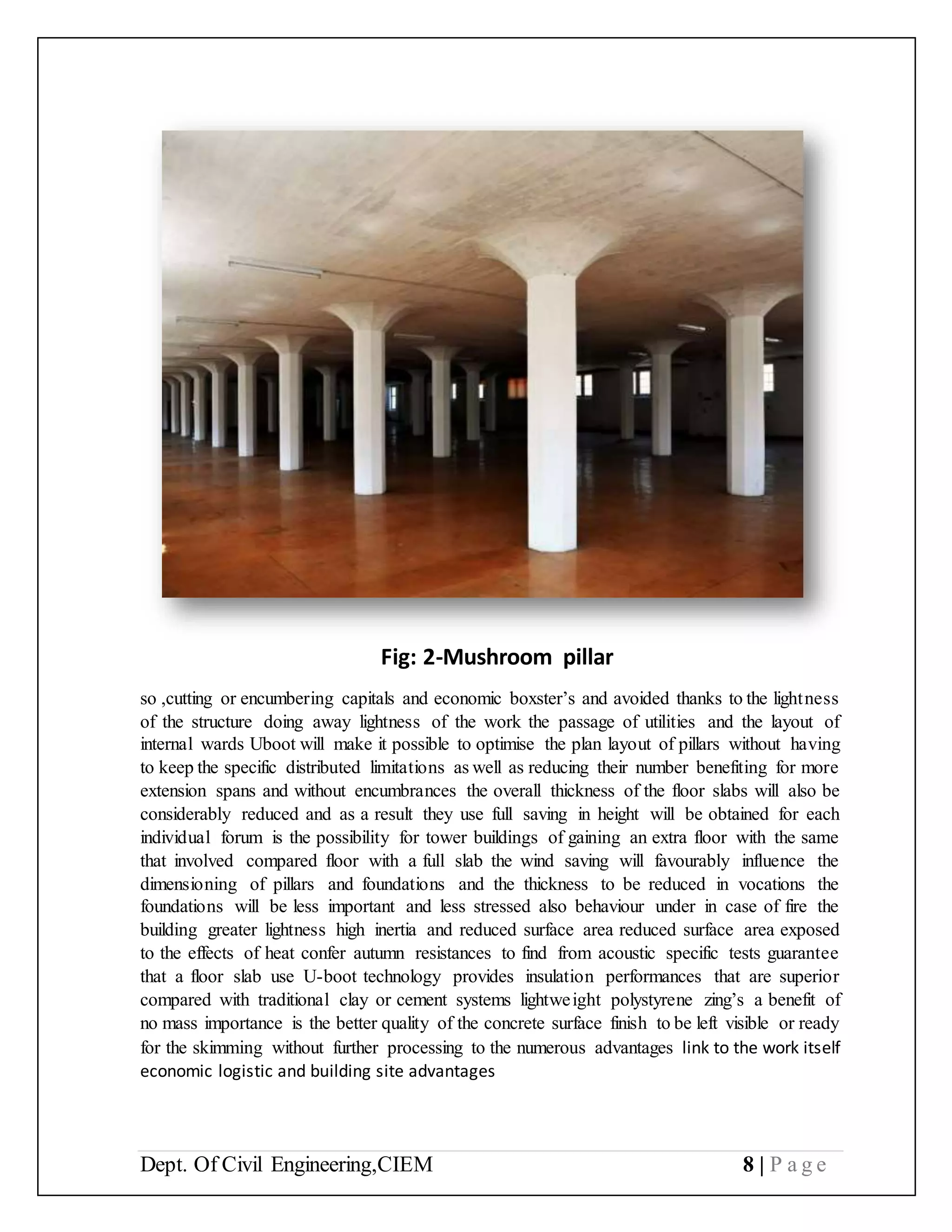
transferring them directly to the penance to simplify the concept we could imagine a series
of double teams of alongside the other and arranged as a premise all stresses will be
concentrated close to pillars where the suitable full section gets left in this way floor slabs
with mushroom like files for the repose in modern people specificity being that the
mushroom is embedded in the floor.
Dept. Of Civil Engineering,CIEM 8 | P a g e
Fig: 2-Mushroom pillar
so ,cutting or encumbering capitals and economic boxster’s and avoided thanks to the lightness
of the structure doing away lightness of the work the passage of utilities and the layout of
internal wards Uboot will make it possible to optimise the plan layout of pillars without having
to keep the specific distributed limitations as well as reducing their number benefiting for more
extension spans and without encumbrances the overall thickness of the floor slabs will also be
considerably reduced and as a result they use full saving in height will be obtained for each
individual forum is the possibility for tower buildings of gaining an extra floor with the same
that involved compared floor with a full slab the wind saving will favourably influence the
dimensioning of pillars and foundations and the thickness to be reduced in vocations the
foundations will be less important and less stressed also behaviour under in case of fire the
building greater lightness high inertia and reduced surface area reduced surface area exposed
to the effects of heat confer autumn resistances to find from acoustic specific tests guarantee
that a floor slab use U-boot technology provides insulation performances that are superior
compared with traditional clay or cement systems lightweight polystyrene zing’s a benefit of
no mass importance is the better quality of the concrete surface finish to be left visible or ready
for the skimming without further processing to the numerous advantages link to the work itself
economic logistic and building site advantages
Dept. Of Civil Engineering,CIEM 9 | P a g e
are added for construction firms is processing less consumption of concrete and steel less
handling n ground and over ground this encumbrance with in the parameters of the site
there’s transport and storage changes all things to a material is stackable tough and able to
withstand all weather conditions first an hour will be handling a product that is safe from the
light non ssoiling and easy to use u-boot is the ideal solution for all buildings in which judging
beams structures would need to be avoided typically slab solution is sort together with
savings in those concrete and weak the U-boot beton building system is particularly suitable
for the construction of high-rise village hospitals commercial centres school buildings parking
management residential and industrial buildings.
In case of raft foundations having a greater inertia U-boot makes it possible to implement
sweaters with a better performance given the same concrete used the grounds are found to
have a low carrying capacity furthermore be possible to eliminate or reduce complex and
costly foundation pockets. Laying of avoided two-way elements is swift and simple the
reinforcement and Uboot elements are laid out on top of the decade according to design
specifications ready to receive the concrete casting the layout does not require specialised
personal the correct distance between the elements is assured by a spacer jumped equipped
with a graduated scale by means of which the widths the o beams being formed with the
casting can be rapidly determined at the top this joint gets inserted in specific looking for
difference provided on the upper surface of the Uboot the entire operation is precise handy
and rapid once the concrete is poured avoided structure is permanently embedded providing
the structure with the desired shape on the technical timing for the setting having last the
backing will be dismantled the intros service will prove to be completely smooth formwork
can alsobe used in combination with predominate facing the voided load directly on te plains
and completing the finishing casting.
1.1 Parts of U-Beton
The U-Boot beton is named of the whole element which is used in the slab,but they have
some parts which is used to connect two consecutive U-Beton structure while installing the U-
beton.
There are mainly three parts, of U-Beton system
I. Spacer:-Spacer is used to connect two consecutive U-Beton while installing the
Beton ,Which helps to fix the position of U-Beton.
The rigid interconnection ensures perfect geometric compliance with the
design as well as with the bearing capacity of the formworks when of the operators
casting under the pressure of the concrete, the weight of the operators and equipment.
Dept. Of Civil Engineering,CIEM 10 |
P a g e
Fig:3.1-Spacer Joint. Fig:3.2-connected U-Beton by Spacer
The joint fits into the top of the formwork inside notches housing the fixing elements.
II. ConnectionBridge:- The connection bridge is use only of height 16/24cm.
Fig:4.1-connectionBridge Fig:4.1-connectionbridge over U-Beton
III. Closing plate:-
Dept. Of Civil Engineering,CIEM 11 |
P a g e
Types of U-Beton
Generally there are two types of u-beton,
I Single U-Beton.
II Double U-beton.
I Single U-beton
Where,
H = height of up beton.
P = height of foot.
Fig:-5.1-Single U-Beton
Single U-Beton is available of various up beton height and foot height of dimension
(52 cm x 52 cm).
1.1 Table no.:-single U-Beton in various Dimension.
Height
H
(cm)
Dimensions
(cm)
Foot
height
p
(cm)
Weight
per
piece
(kg)
Piece
volume
(m3
)
Pallet
dimensions*
(cm)
Pallet
pieces*
(pcs/PAL)
Pallet
weight*
(kg/PAL)
H 10
cm
52 x 52
0-5-6-
7-8-9-
10
1,150 0,0213
110 x 110 x
240
720 840
H 13
cm
52 x 52
0-5-6-
7-8-9-
10
1,240 0,0280
110 x 110 x
250
600 920
H 16
cm
52 x 52
0-5-6-
7-8-9-
10
1,430 0,0350
110 x 110 x
250
440 850
H 18
cm
52 x 52
0-5-6-
7-8-9-
10-12
1,610 0,0396
110 x 110 x
250
460 750
H 20
cm
52 x 52
0-5-6-
7-8-9-
10
1,660 0,0430
110 x 110 x
250
460 790
H 22
cm
52 x 52
0-5-6-
7-8-9-
10-12
1,720 0,0470
110 x 110 x
250
460 800
Dept. Of Civil Engineering,CIEM 12 |
P a g e
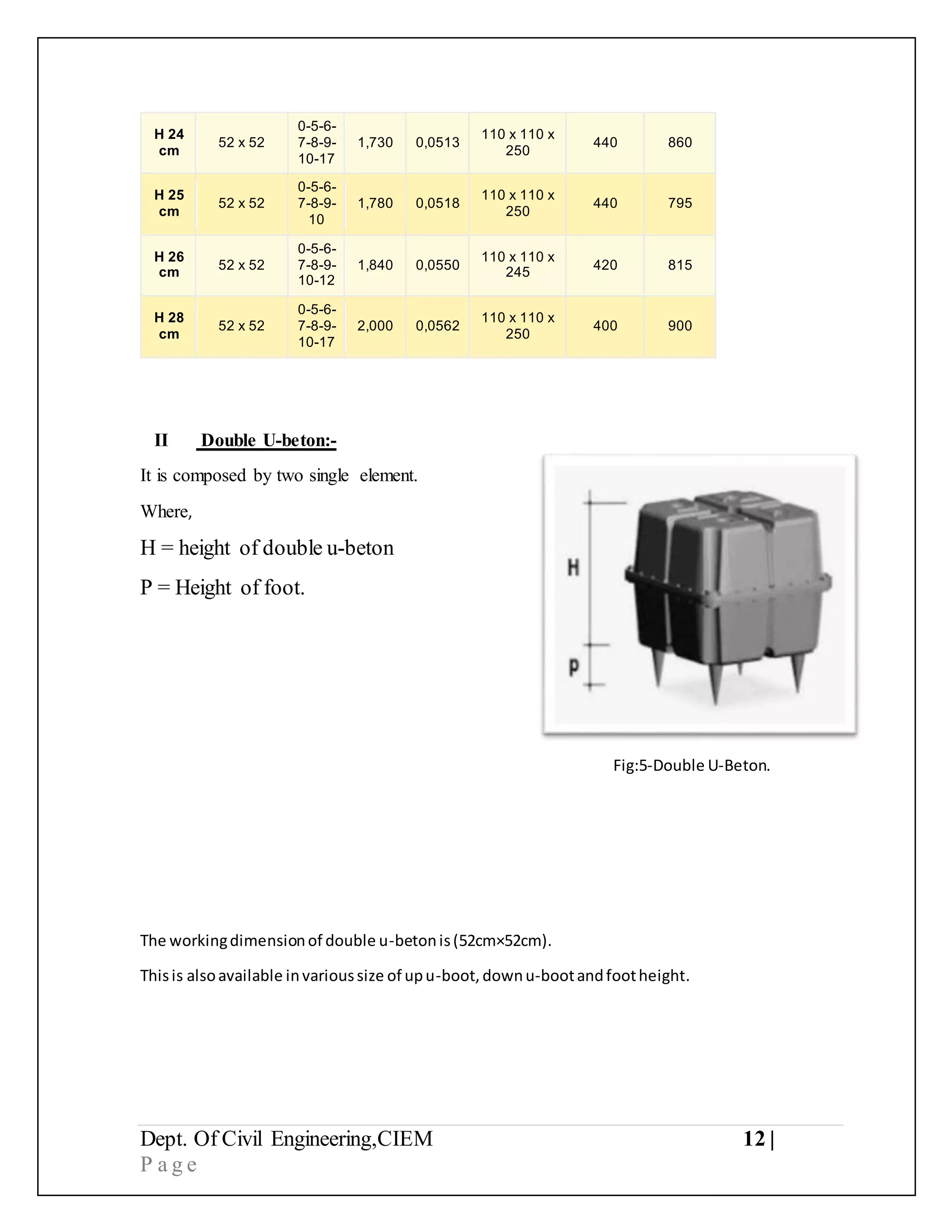
H 24
cm
52 x 52
0-5-6-
7-8-9-
10-17
1,730 0,0513
110 x 110 x
250
440 860
H 25
cm
52 x 52
0-5-6-
7-8-9-
10
1,780 0,0518
110 x 110 x
250
440 795
H 26
cm
52 x 52
0-5-6-
7-8-9-
10-12
1,840 0,0550
110 x 110 x
245
420 815
H 28
cm
52 x 52
0-5-6-
7-8-9-
10-17
2,000 0,0562
110 x 110 x
250
400 900
II Double U-beton:-
It is composed by two single element.
Where,
H = height of double u-beton
P = Height of foot.
Fig:5-Double U-Beton.
The workingdimensionof double u-betonis(52cm×52cm).
Thisis alsoavailable invarioussize of upu-boot, downu-bootandfootheight.
Dept. Of Civil Engineering,CIEM 13 |
P a g e
1.2 Table no.:-Double U-Beton in various Dimension.
Height H
(cm)
Dimensions
(cm)
Foot height p
(cm)
Piece volume
(m3
)
Composed of
(H cm)
U-Boot UP
U-
Boot
DOWN
H 20 cm 52 x 52 0-5-6-7-8-9-10-15 0,0426 10 10
H 23 cm 52 x 52 0-5-6-7-8-9-10-15 0,0493 13 10
H 26 cm 52 x 52 0-5-6-7-8-9-10-15 0,0563 13* 13*
H 28 cm 52 x 52 0-5-6-7-8-9-10-15 0,0609 18 10
H 29 cm 52 x 52 0-5-6-7-8-9-10-15 0,0630 16 13
H 30 cm 52 x 52 0-5-6-7-8-9-10-15 0,0643 20 10
H 31 cm 52 x 52 0-5-6-7-8-9-10-15 0,0676 18 13
H 32 cm 52 x 52 0-5-6-7-8-9-10-15 0,0700 22* 10*
H 33 cm 52 x 52 0-5-6-7-8-9-10-15 0,0710 20 13
H 34 cm 52 x 52 0-5-6-7-8-9-10-15 0,0746 24* 10*
H 35 cm 52 x 52 0-5-6-7-8-9-10-15 0,0750 22* 13*
H 36 cm 52 x 52 0-5-6-7-8-9-10-15 0,0792 26* 10*
H 37 cm 52 x 52 0-5-6-7-8-9-10-15 0,0793 24 13
H 38 cm 52 x 52 0-5-6-7-8-9-10-15 0,0826 25* 13*
H 39 cm 52 x 52 0-5-6-7-8-9-10-15 0,0830 26 13
H 40 cm 52 x 52 0-5-6-7-8-9-10-12 0,0866 22* 18*
H 41 cm 52 x 52 0-5-6-7-8-9-10-15 0,0868 28* 13*
H 42 cm 52 x 52 0-5-6-7-8-9-10-12 0,0909 24* 18*
H 43 cm 52 x 52 0-5-6-7-8-9-10-12 0,0914 25 18
Dept. Of Civil Engineering,CIEM 14 |
P a g e
H 44 cm 52 x 52 0-5-6-7-8-9-10-12 0,0946 26* 18*
H 45 cm 52 x 52 0-5-6-7-8-9-10 0,0948 25 20
H 46 cm 52 x 52 0-5-6-7-8-9-10-12 0,0983 24* 22*
H 47 cm 52 x 52 0-5-6-7-8-9-10-12 0,0988 25 22
H 48 cm 52 x 52 0-5-6-7-8-9-10 0,1026 24* 24*
H 49 cm 52 x 52 0-5-6-7-8-9-10 0,1031 25 24
H 50 cm 52 x 52 0-5-6-7-8-9-10 0,1063 26* 24*
H 51 cm 52 x 52 0-5-6-7-8-9-10 0,1068 26 25
H 52 cm 52 x 52 0-5-6-7-8-9-10 0,1075 28 24
H 53 cm 52 x 52 0-5-6-7-8-9-10 0,1080 28 25
H 54 cm 52 x 52 0-5-6-7-8-9-10-17 0,1112 26 28
H 56 cm 52 x 52 0-5-6-7-8-9-10-17 0,1124 28 28
PARAMETER AND CONSUMPTION TABLE
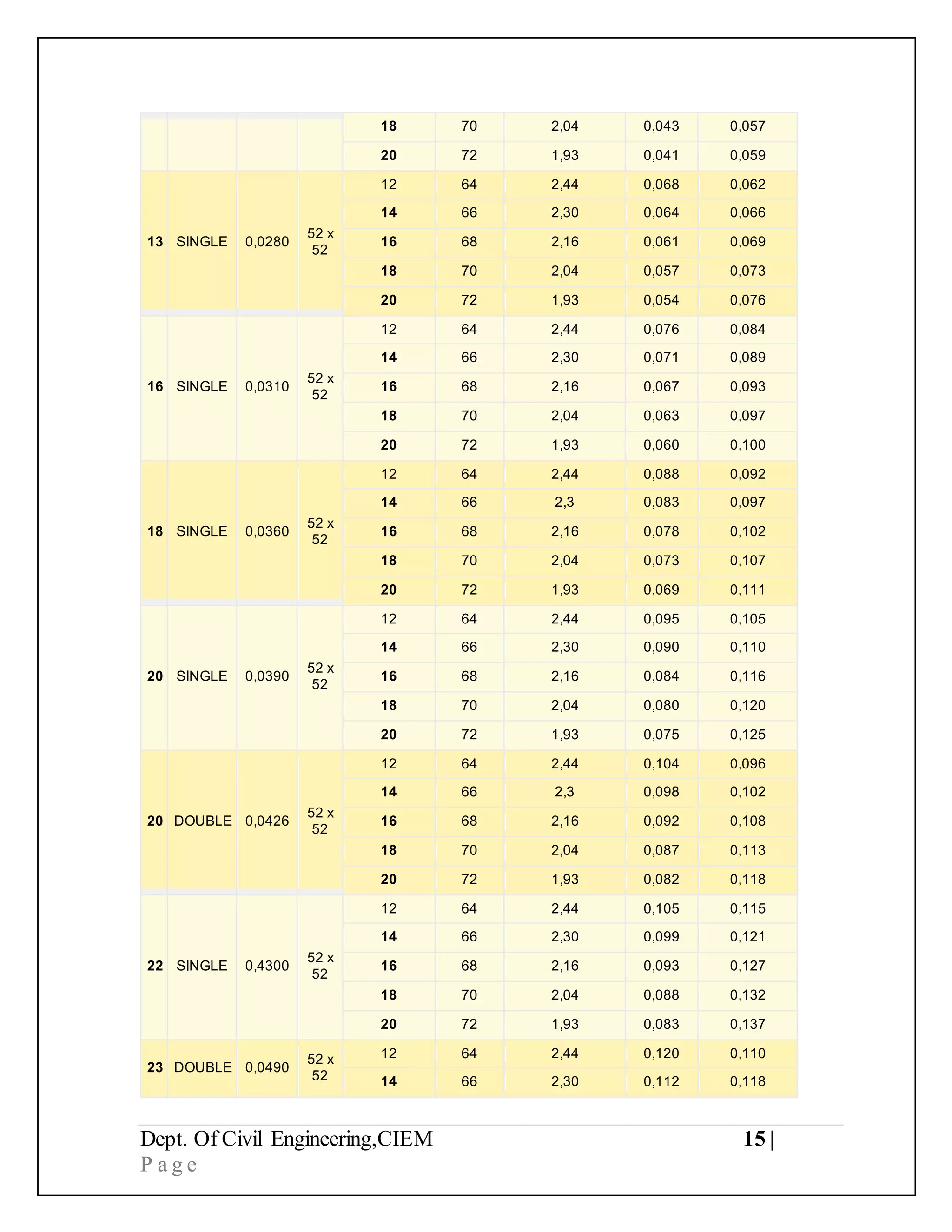
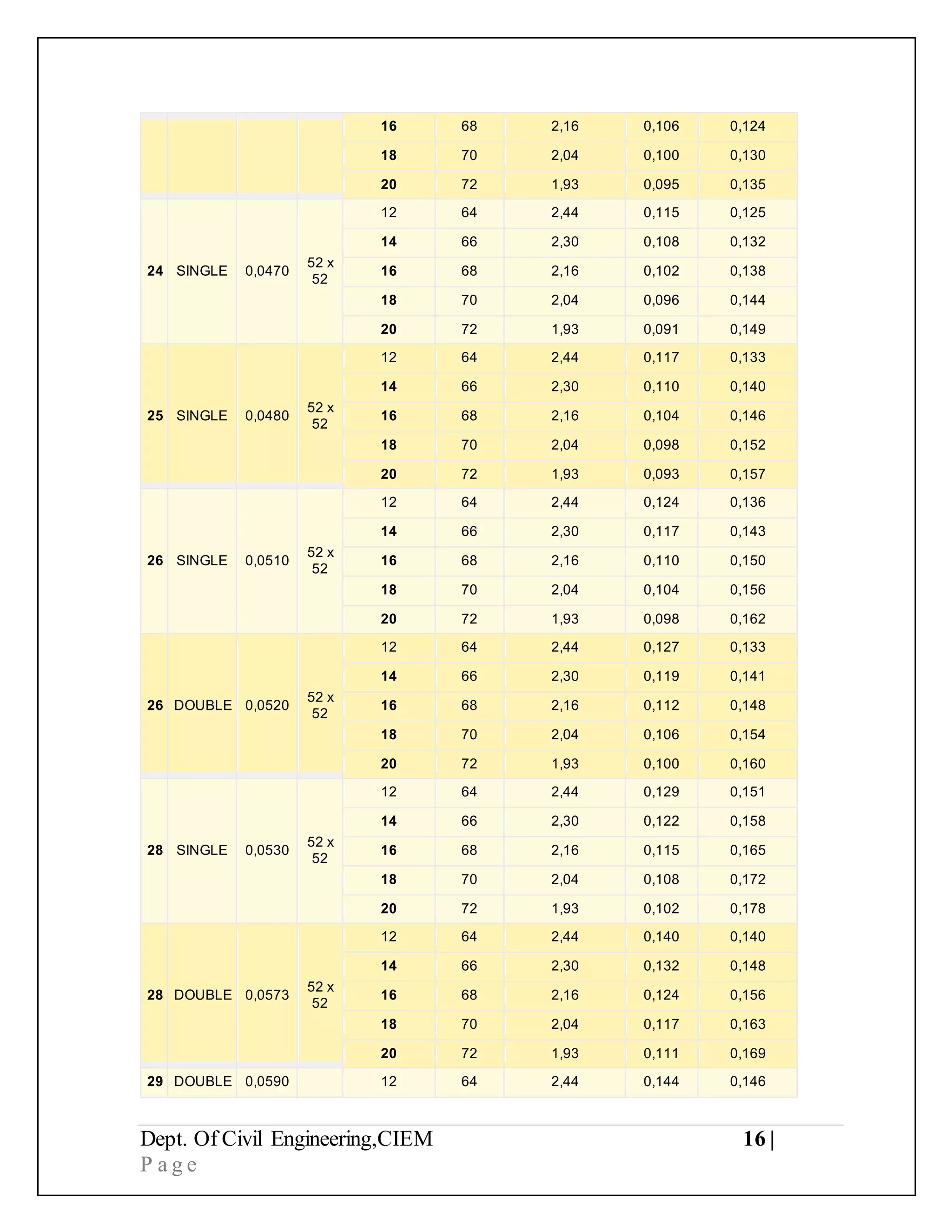
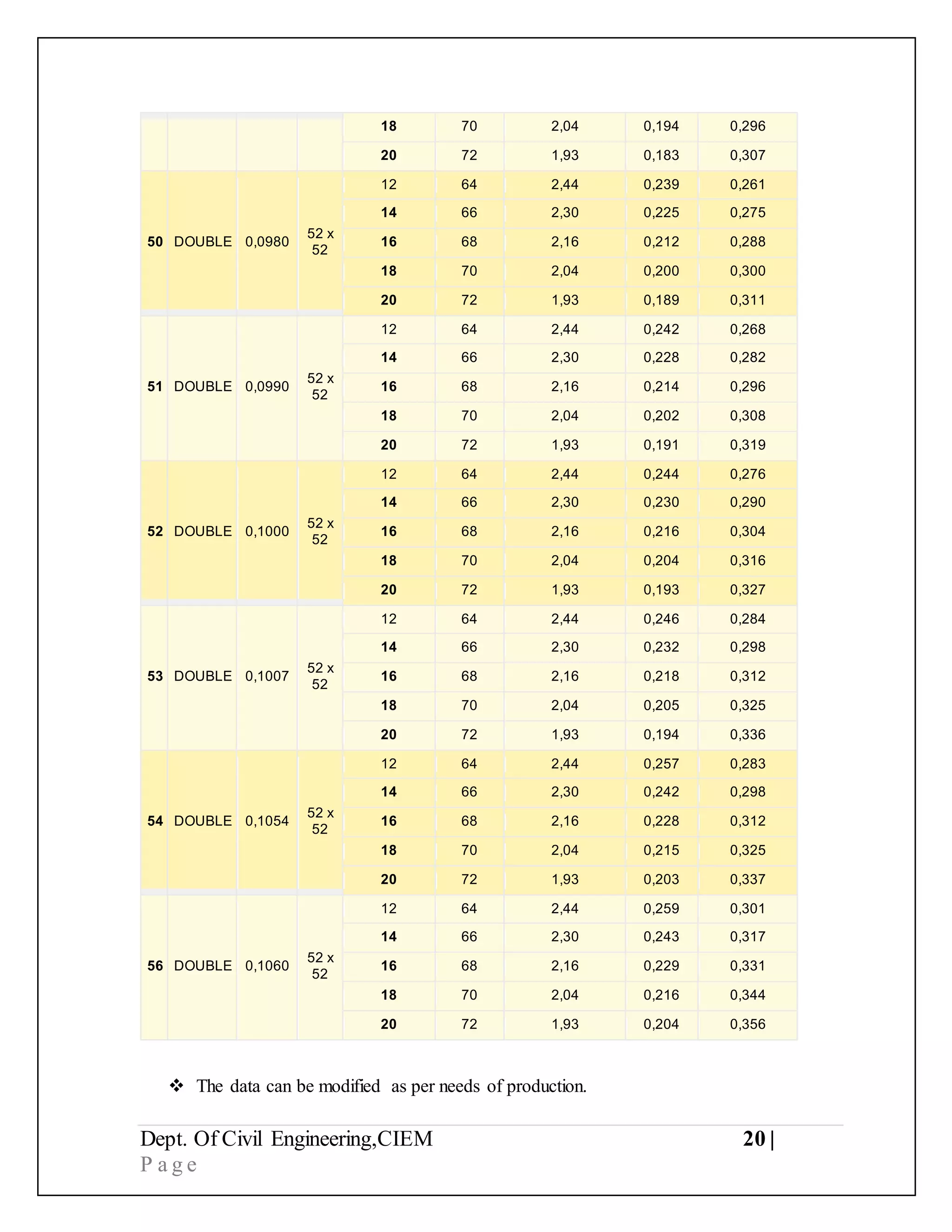
The Consumption of concrete and concrete saving in double and single u-beton is given as
below as per data of (https://www.daliform.com/en/disposable-formwork-for-two-way-
lightened-voided-slabs/u-boot-beton-technical-data/) is given as below.
The consumption of concrete in are varies with the total volume of different type of U-beton
system.
1.2 Table no.:-Consumption of concrete with different volume of
U-Beton .
PARAMETER AND CONSUMPTION TABLE
Formwork H
Piece
volume
Base Joist width
Joist
centre
distance
U-Boot
Beton®
incidence
Concrete
saving
Concrete
consumption
cm m3
cm cm cm pcsm2
m3
/pcs m3
/m2
10 SINGLE 0,0210
52 x
52
12 64 2,44 0,051 0,049
14 66 2,30 0,048 0,052
16 68 2,16 0,045 0,055
Dept. Of Civil Engineering,CIEM 15 |
P a g e
18 70 2,04 0,043 0,057
20 72 1,93 0,041 0,059
13 SINGLE 0,0280
52 x
52
12 64 2,44 0,068 0,062
14 66 2,30 0,064 0,066
16 68 2,16 0,061 0,069
18 70 2,04 0,057 0,073
20 72 1,93 0,054 0,076
16 SINGLE 0,0310
52 x
52
12 64 2,44 0,076 0,084
14 66 2,30 0,071 0,089
16 68 2,16 0,067 0,093
18 70 2,04 0,063 0,097
20 72 1,93 0,060 0,100
18 SINGLE 0,0360
52 x
52
12 64 2,44 0,088 0,092
14 66 2,3 0,083 0,097
16 68 2,16 0,078 0,102
18 70 2,04 0,073 0,107
20 72 1,93 0,069 0,111
20 SINGLE 0,0390
52 x
52
12 64 2,44 0,095 0,105
14 66 2,30 0,090 0,110
16 68 2,16 0,084 0,116
18 70 2,04 0,080 0,120
20 72 1,93 0,075 0,125
20 DOUBLE 0,0426
52 x
52
12 64 2,44 0,104 0,096
14 66 2,3 0,098 0,102
16 68 2,16 0,092 0,108
18 70 2,04 0,087 0,113
20 72 1,93 0,082 0,118
22 SINGLE 0,4300
52 x
52
12 64 2,44 0,105 0,115
14 66 2,30 0,099 0,121
16 68 2,16 0,093 0,127
18 70 2,04 0,088 0,132
20 72 1,93 0,083 0,137
23 DOUBLE 0,0490
52 x
52
12 64 2,44 0,120 0,110
14 66 2,30 0,112 0,118
Dept. Of Civil Engineering,CIEM 16 |
P a g e
16 68 2,16 0,106 0,124
18 70 2,04 0,100 0,130
20 72 1,93 0,095 0,135
24 SINGLE 0,0470
52 x
52
12 64 2,44 0,115 0,125
14 66 2,30 0,108 0,132
16 68 2,16 0,102 0,138
18 70 2,04 0,096 0,144
20 72 1,93 0,091 0,149
25 SINGLE 0,0480
52 x
52
12 64 2,44 0,117 0,133
14 66 2,30 0,110 0,140
16 68 2,16 0,104 0,146
18 70 2,04 0,098 0,152
20 72 1,93 0,093 0,157
26 SINGLE 0,0510
52 x
52
12 64 2,44 0,124 0,136
14 66 2,30 0,117 0,143
16 68 2,16 0,110 0,150
18 70 2,04 0,104 0,156
20 72 1,93 0,098 0,162
26 DOUBLE 0,0520
52 x
52
12 64 2,44 0,127 0,133
14 66 2,30 0,119 0,141
16 68 2,16 0,112 0,148
18 70 2,04 0,106 0,154
20 72 1,93 0,100 0,160
28 SINGLE 0,0530
52 x
52
12 64 2,44 0,129 0,151
14 66 2,30 0,122 0,158
16 68 2,16 0,115 0,165
18 70 2,04 0,108 0,172
20 72 1,93 0,102 0,178
28 DOUBLE 0,0573
52 x
52
12 64 2,44 0,140 0,140
14 66 2,30 0,132 0,148
16 68 2,16 0,124 0,156
18 70 2,04 0,117 0,163
20 72 1,93 0,111 0,169
29 DOUBLE 0,0590 12 64 2,44 0,144 0,146
Dept. Of Civil Engineering,CIEM 17 |
P a g e
52 x
52
14 66 2,30 0,135 0,155
16 68 2,16 0,128 0,162
18 70 2,04 0,120 0,170
20 72 1,93 0,114 0,176
30 DOUBLE 0,0600
52 x
52
12 64 2,44 0,146 0,154
14 66 2,30 0,138 0,162
16 68 2,16 0,130 0,170
18 70 2,04 0,122 0,178
20 72 1,93 0,116 0,184
31 DOUBLE 0,0639
52 x
52
12 64 2,44 0,156 0,154
14 66 2,30 0,147 0,163
16 68 2,16 0,138 0,172
18 70 2,04 0,130 0,180
20 72 1,93 0,123 0,187
32 DOUBLE 0,0620
52 x
52
12 64 2,44 0,151 0,169
14 66 2,30 0,142 0,178
16 68 2,16 0,134 0,186
18 70 2,04 0,127 0,193
20 72 1,93 0,120 0,200
33 DOUBLE 0,0670
52 x
52
12 64 2,44 0,164 0,166
14 66 2,30 0,154 0,176
16 68 2,16 0,145 0,185
18 70 2,04 0,137 0,193
20 72 1,93 0,129 0,201
34 DOUBLE 0,0680
52 x
52
12 64 2,44 0,166 0,174
14 66 2,30 0,156 0,184
16 68 2,16 0,147 0,193
18 70 2,04 0,139 0,201
20 72 1,93 0,131 0,209
35 DOUBLE 0,0709
52 x
52
12 64 2,44 0,1730 0,177
14 66 2,30 0,1631 0,187
16 68 2,16 0,1531 0,197
18 70 2,04 0,1446 0,205
20 72 1,93 0,1368 0,213
Dept. Of Civil Engineering,CIEM 18 |
P a g e
36 DOUBLE 0,0700
52 x
52
12 64 2,44 0,171 0,189
14 66 2,30 0,161 0,199
16 68 2,16 0,151 0,209
18 70 2,04 0,143 0,217
20 72 1,93 0,135 0,225
37 DOUBLE 0,0750
52 x
52
12 64 2,44 0,183 0,187
14 66 2,30 0,172 0,198
16 68 2,16 0,162 0,208
18 70 2,04 0,153 0,217
20 72 1,93 0,145 0,225
38 DOUBLE 0,0740
52 x
52
12 64 2,44 0,181 0,199
14 66 2,30 0,170 0,210
16 68 2,16 0,160 0,220
18 70 2,04 0,151 0,229
20 72 1,93 0,143 0,237
39 DOUBLE 0,0789
52 x
52
12 64 2,44 0,193 0,197
14 66 2,30 0,181 0,209
16 68 2,16 0,170 0,220
18 70 2,04 0,161 0,229
20 72 1,93 0,152 0,238
40 DOUBLE 0,0780
52 x
52
12 64 2,44 0,190 0,210
14 66 2,30 0,179 0,221
16 68 2,16 0,169 0,231
18 70 2,04 0,159 0,241
20 72 1,93 0,150 0,250
41 DOUBLE 0,0810
52 x
52
12 64 2,44 0,198 0,212
14 66 2,30 0,186 0,224
16 68 2,16 0,175 0,235
18 70 2,04 0,165 0,245
20 72 1,93 0,156 0,254
42 DOUBLE 0,0830
52 x
52
12 64 2,44 0,203 0,217
14 66 2,30 0,191 0,229
16 68 2,16 0,179 0,241
18 70 2,04 0,169 0,251
Dept. Of Civil Engineering,CIEM 19 |
P a g e
20 72 1,93 0,160 0,260
43 DOUBLE 0,0840
52 x
52
12 64 2,44 0,205 0,225
14 66 2,30 0,193 0,237
16 68 2,16 0,181 0,249
18 70 2,04 0,171 0,259
20 72 1,93 0,162 0,268
44 DOUBLE 0,0860
52 x
52
12 64 2,44 0,210 0,230
14 66 2,30 0,197 0,243
16 68 2,16 0,186 0,254
18 70 2,04 0,176 0,264
20 72 1,93 0,166 0,274
45 DOUBLE 0,0870
52 x
52
12 64 2,44 0,212 0,238
14 66 2,30 0,200 0,250
16 68 2,16 0,188 0,262
18 70 2,04 0,177 0,273
20 72 1,93 0,168 0,282
46 DOUBLE 0,0900
52 x
52
12 64 2,44 0,220 0,240
14 66 2,30 0,207 0,253
16 68 2,16 0,194 0,266
18 70 2,04 0,184 0,276
20 72 1,93 0,174 0,286
47 DOUBLE 0,0910
52 x
52
12 64 2,44 0,222 0,248
14 66 2,30 0,209 0,261
16 68 2,16 0,197 0,273
18 70 2,04 0,186 0,284
20 72 1,93 0,176 0,294
48 DOUBLE 0,0940
52 x
52
12 64 2,44 0,229 0,251
14 66 2,30 0,216 0,264
16 68 2,16 0,203 0,277
18 70 2,04 0,192 0,288
20 72 1,93 0,181 0,299
49 DOUBLE 0,0950
52 x
52
12 64 2,44 0,232 0,258
14 66 2,30 0,219 0,272
16 68 2,16 0,205 0,285
Dept. Of Civil Engineering,CIEM 20 |
P a g e
18 70 2,04 0,194 0,296
20 72 1,93 0,183 0,307
50 DOUBLE 0,0980
52 x
52
12 64 2,44 0,239 0,261
14 66 2,30 0,225 0,275
16 68 2,16 0,212 0,288
18 70 2,04 0,200 0,300
20 72 1,93 0,189 0,311
51 DOUBLE 0,0990
52 x
52
12 64 2,44 0,242 0,268
14 66 2,30 0,228 0,282
16 68 2,16 0,214 0,296
18 70 2,04 0,202 0,308
20 72 1,93 0,191 0,319
52 DOUBLE 0,1000
52 x
52
12 64 2,44 0,244 0,276
14 66 2,30 0,230 0,290
16 68 2,16 0,216 0,304
18 70 2,04 0,204 0,316
20 72 1,93 0,193 0,327
53 DOUBLE 0,1007
52 x
52
12 64 2,44 0,246 0,284
14 66 2,30 0,232 0,298
16 68 2,16 0,218 0,312
18 70 2,04 0,205 0,325
20 72 1,93 0,194 0,336
54 DOUBLE 0,1054
52 x
52
12 64 2,44 0,257 0,283
14 66 2,30 0,242 0,298
16 68 2,16 0,228 0,312
18 70 2,04 0,215 0,325
20 72 1,93 0,203 0,337
56 DOUBLE 0,1060
52 x
52
12 64 2,44 0,259 0,301
14 66 2,30 0,243 0,317
16 68 2,16 0,229 0,331
18 70 2,04 0,216 0,344
20 72 1,93 0,204 0,356
 The data can be modified as per needs of production.
Dept. Of Civil Engineering,CIEM 21 |
P a g e
2 Installation process
The installation process of u-boot system is mention below as.
Step:1- The entire slab surface is covered on a mold surface with wood cover (or similar
systems).
Now place the lower reinforcement over the formwork .
Fig:12-reinforcement done over formwork.
Fig:11-formwork ready with lowerreinforcement
Dept. Of Civil Engineering,CIEM 22 |
P a g e
Step:2- Now the place the U-boot system above the lower reinforcement at the specified
interval provided by the horizontal lik connector or by spacer.
Be assured that beton system is connected by spacer, which held he position of beton system
is fix that helps to distribute the stress equally over whole span.
Fig:13-Placing ofbeton systemdone over lower reinforcement.
Fig:12-placedu-beton over lowerreinforcement
Dept. Of Civil Engineering,CIEM 23 |
P a g e
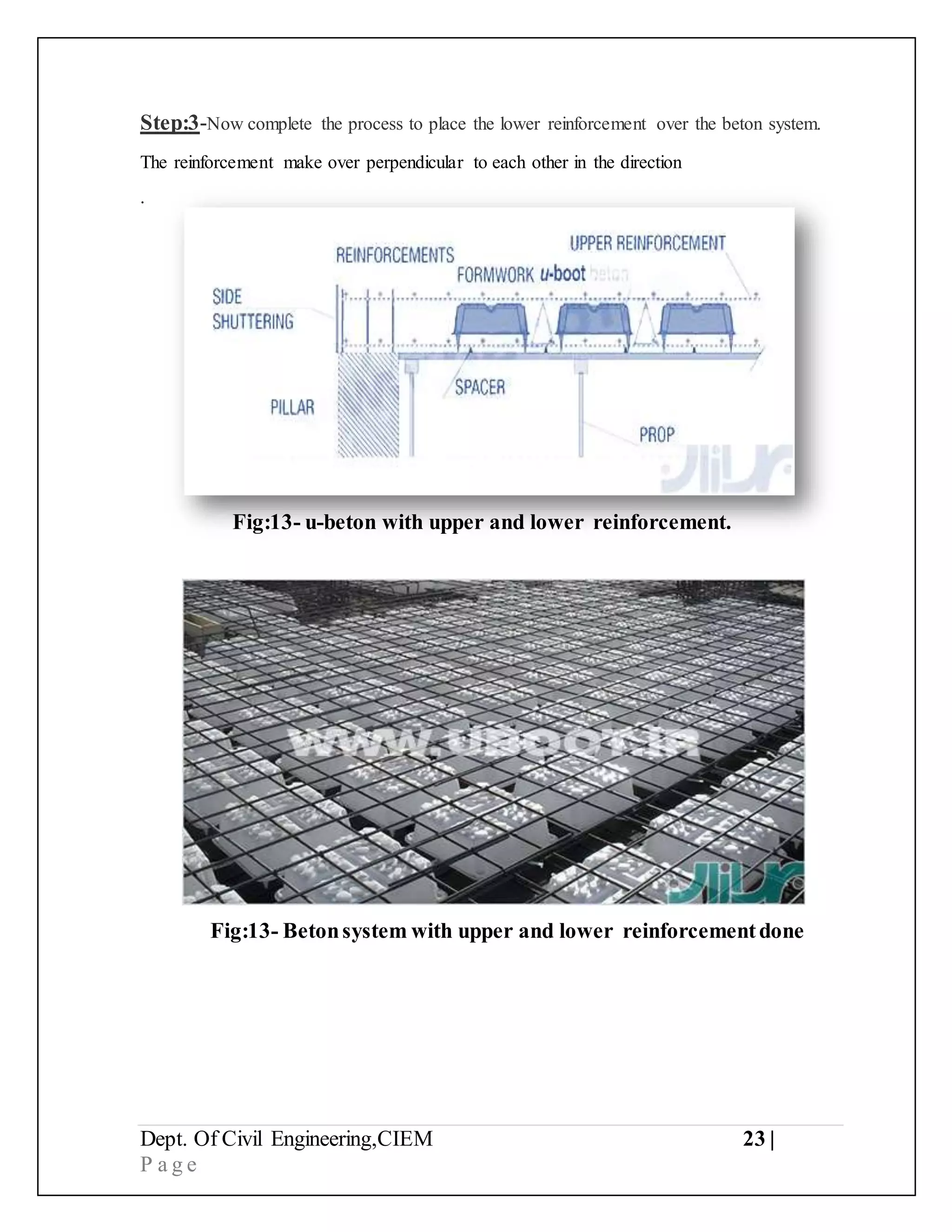
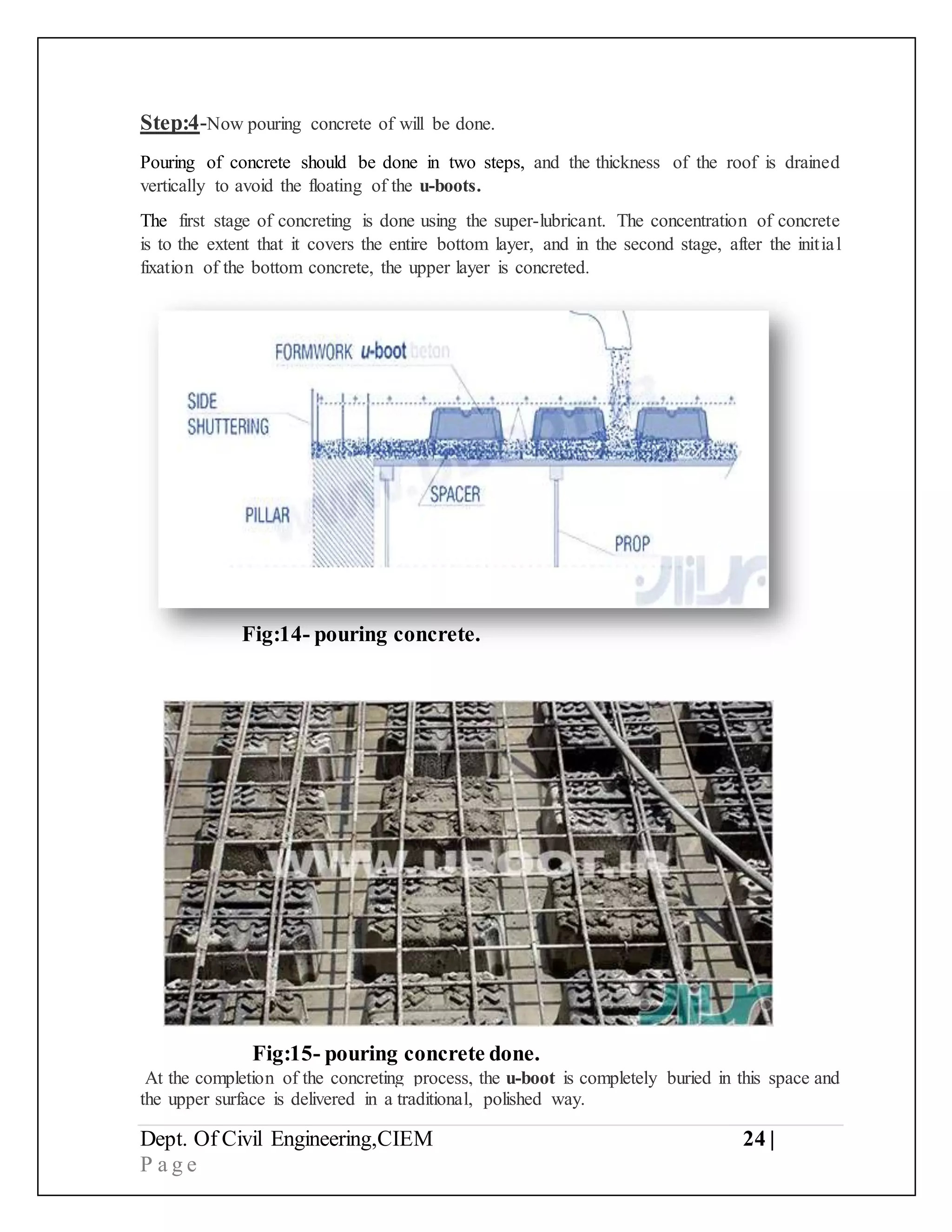
Step:3-Now complete the process to place the lower reinforcement over the beton system.
The reinforcement make over perpendicular to each other in the direction
.
Fig:13- Betonsystem with upper and lower reinforcementdone
Fig:13- u-beton with upper and lower reinforcement.
Dept. Of Civil Engineering,CIEM 24 |
P a g e
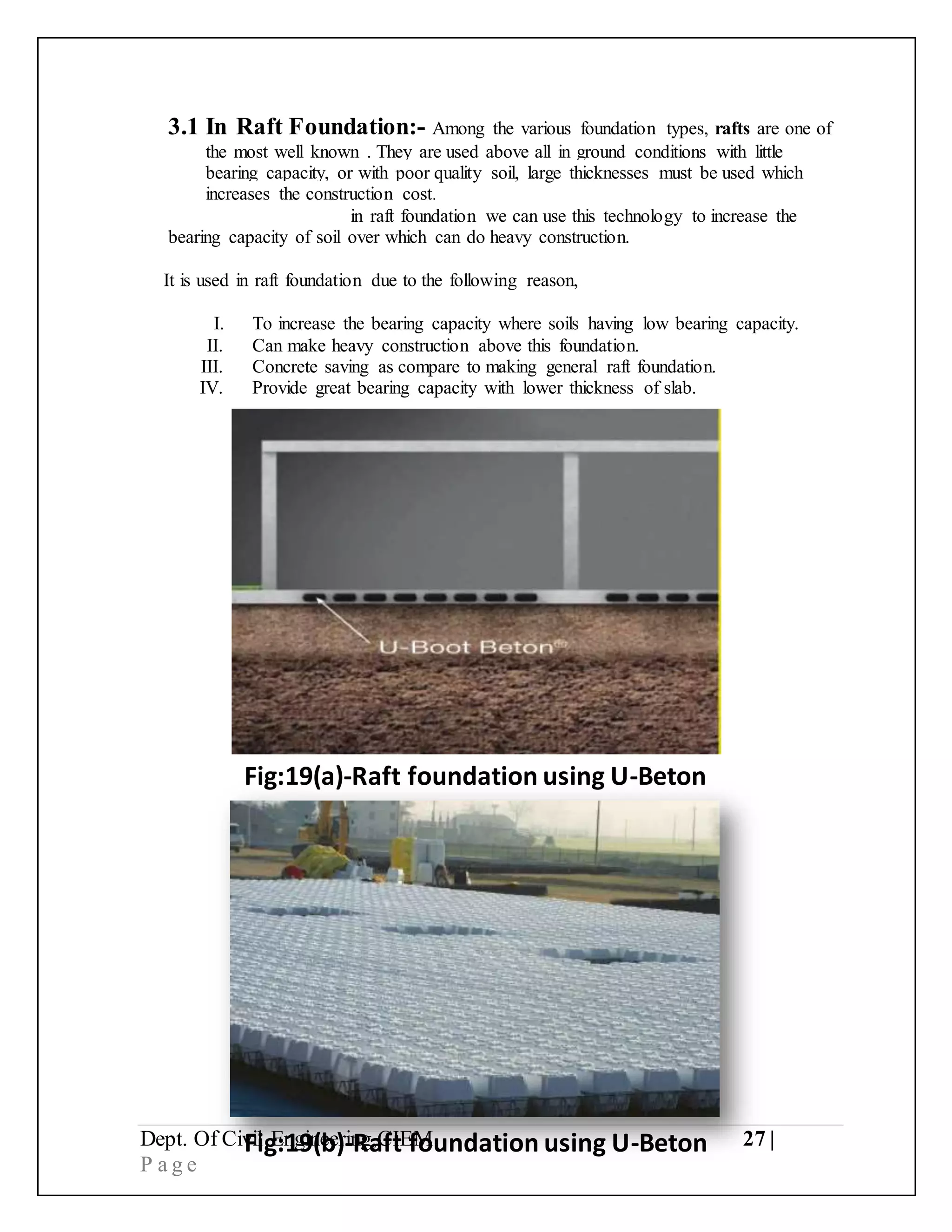
Step:4-Now pouring concrete of will be done.
Pouring of concrete should be done in two steps, and the thickness of the roof is drained
vertically to avoid the floating of the u-boots.
The first stage of concreting is done using the super-lubricant. The concentration of concrete
is to the extent that it covers the entire bottom layer, and in the second stage, after the initial
fixation of the bottom concrete, the upper layer is concreted.
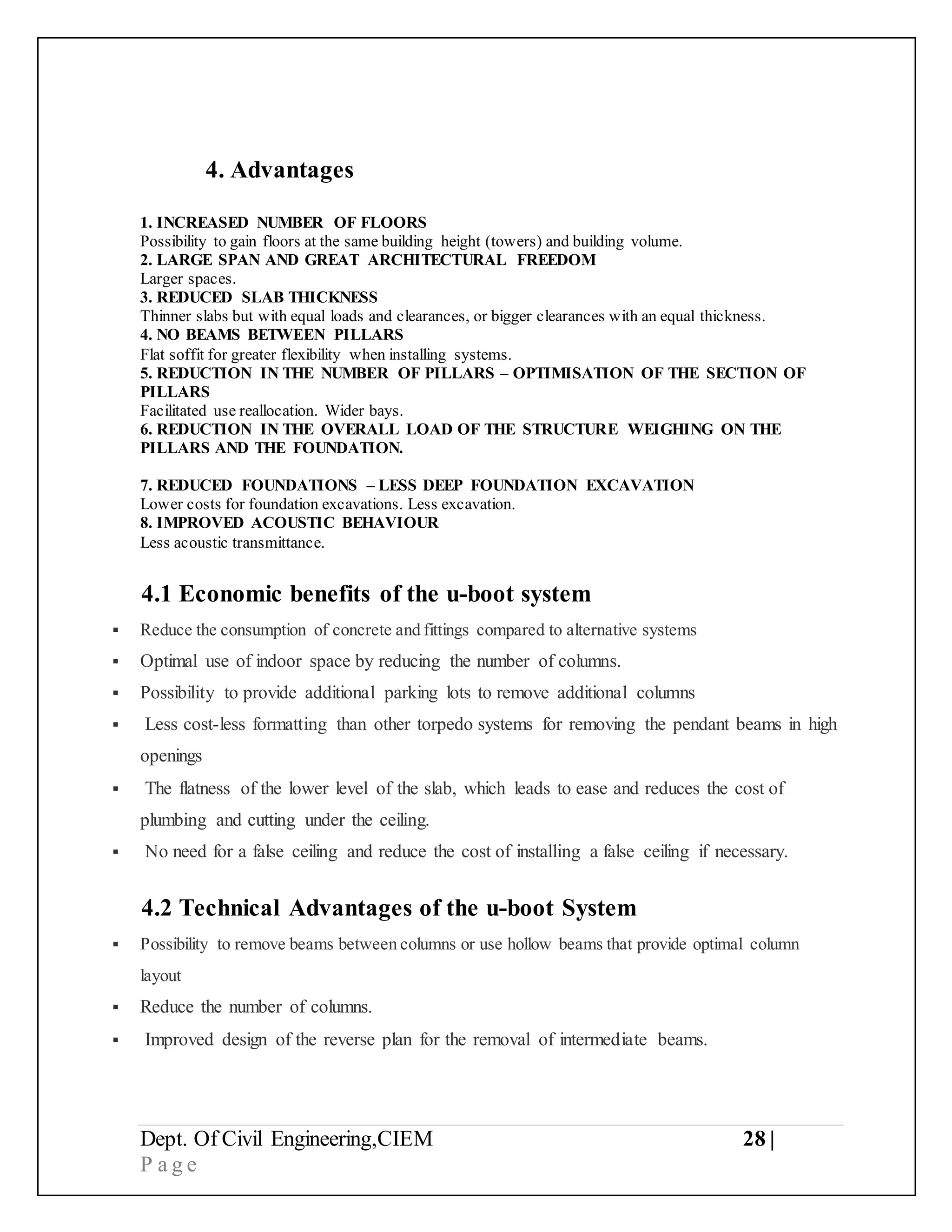
Fig:15- pouring concrete done.
At the completion of the concreting process, the u-boot is completely buried in this space and
the upper surface is delivered in a traditional, polished way.
Fig:14- pouring concrete.
Dept. Of Civil Engineering,CIEM 25 |
P a g e
3 Applications
This technology is used to create the slab of high Rise Building, Commercial Building,
hospitals, Multilevel parking building and etc.
This is also used in the construction of Raft Foundation,where the soil have low bearing
capacity. By using this in raft foundation it’s gave great bearing capacity over which can do
heavy construction .
Fig:16-Multilevel parking Building
Dept. Of Civil Engineering,CIEM 26 |
P a g e
Fig:17- High Rise Building.
Dept. Of Civil Engineering,CIEM 27 |
P a g e
3.1 In Raft Foundation:- Among the various foundation types, rafts are one of
the most well known . They are used above all in ground conditions with little
bearing capacity, or with poor quality soil, large thicknesses must be used which
increases the construction cost.
in raft foundation we can use this technology to increase the
bearing capacity of soil over which can do heavy construction.
It is used in raft foundation due to the following reason,
I. To increase the bearing capacity where soils having low bearing capacity.
II. Can make heavy construction above this foundation.
III. Concrete saving as compare to making general raft foundation.
IV. Provide great bearing capacity with lower thickness of slab.
Fig:19(a)-Raft foundation using U-Beton
Fig:19(b)-Raft foundation using U-Beton
Dept. Of Civil Engineering,CIEM 28 |
P a g e
4. Advantages
1. INCREASED NUMBER OF FLOORS
Possibility to gain floors at the same building height (towers) and building volume.
2. LARGE SPAN AND GREAT ARCHITECTURAL FREEDOM
Larger spaces.
3. REDUCED SLAB THICKNESS
Thinner slabs but with equal loads and clearances, or bigger clearances with an equal thickness.
4. NO BEAMS BETWEEN PILLARS
Flat soffit for greater flexibility when installing systems.
5. REDUCTION IN THE NUMBER OF PILLARS – OPTIMISATION OF THE SECTION OF
PILLARS
Facilitated use reallocation. Wider bays.
6. REDUCTION IN THE OVERALL LOAD OF THE STRUCTURE WEIGHING ON THE
PILLARS AND THE FOUNDATION.
7. REDUCED FOUNDATIONS – LESS DEEP FOUNDATION EXCAVATION
Lower costs for foundation excavations. Less excavation.
8. IMPROVED ACOUSTIC BEHAVIOUR
Less acoustic transmittance.
systemboot-utheofbenefitsEconomic4.1
 Reduce the consumption of concrete and fittings compared to alternative systems
 Optimal use of indoor space by reducing the number of columns.
 Possibility to provide additional parking lots to remove additional columns
 Less cost-less formatting than other torpedo systems for removing the pendant beams in high
openings
 The flatness of the lower level of the slab, which leads to ease and reduces the cost of
plumbing and cutting under the ceiling.
 No need for a false ceiling and reduce the cost of installing a false ceiling if necessary.
Systemtboo-utheofAdvantagesTechnical4.2
 Possibility to remove beams between columns or use hollow beams that provide optimal column
layout
 Reduce the number of columns.
 Improved design of the reverse plan for the removal of intermediate beams.
Dept. Of Civil Engineering,CIEM 29 |
P a g e
 The significant increase in the hardness of the roof slab with its slight weight gain makes it
easier to control the ceiling, allowing the spacing of the columns and the implementation of
large span structures.
 Improved roof performance in terms of sound insulation and plate vibration.
 Reducing loads on the soil (if used in the foundation of the U-boot ) and the possibility of
removing or reducing the number and dimensions of the piles in loose soil
Benefits of the architecture of the u-boot system
 Provide larger spaces Freedom to act more in architectural design.
 Possibility to change user spaces after design and construction.
Dept. Of Civil Engineering,CIEM 30 |
P a g e
REFERENCE
BubbleDeck.com
Martina Schnellenbach-Held,StefanEhmann,KarstenPfeffer:“BubbleDeck - New
Ways inConcrete Building”.Technische UniversitätDarmstadt,DACON Volume 13,
1998
Martina Schnellenbach-Held,KarstenPfeffer:“BubbleDeckDesignof BiaxialHollow
Slabs”.Technische UniversitätDarmstadt,DACON Volume 14,1999
BubbleDeckReportfromA+U ResearchInstitute /ProfessorKleinmann - the
EindhovenUniversityof Technology/the Netherlands,1999
BubbleDeckTestReportbyKoning&Bienfaitb.v./The Netherlands,1998
Reportof BubbleDeckfromTechnischeUniversitaetinCottbus
Reportfrom the EindhovenUniversityof Technology/the Netherlands:”Broad
comparisonof concrete floorsystems”.December1997
BubbleDeckReportfromTechnical Universityof Denmark,2003
Reportfrom AdviesbureauPeutz&Associesb.v.:”Comparisonof BubbleDeckvs.
Hollowcore”.Netherlands,1997
"Optimisingof Concrete Constructions"; - The EngineeringSchool inHorsens/
Denmark,2000
BubbleDeck.nl:CUR-aanbeveling86-01
Martina Schnellenbach-Held,HeikoDenk:“BubbleDeckTime-DependentBehaviour,
Local PunchingAdditional Experimental Tests”.Technische UniversitätDarmstadt,
DACON Volume 14,1999
Schnellenbach-Held,M.,Pfeffer,K.:“Tragverhaltenzweiachsiger
Hohlkörperdecken,Beton- undStahlbetonbau”96 [9],573-578 (2001)
Pfeffer,K.:“UntersuchungzumBiege-undDurchstanztragverhaltenvon
zweiachsigenHohlkörperdecken”.Fortschritt-Berichte VDI,VDI-Verlag,Düsseldorf
2002
"PunchingShearStrengthof BubbleDeck" - The Technical Universityof Denmark,
2002
BubbleDeckTestreportfromUniversityof DarmstadtbyMarkus Aldejohann,
Martina Schnellenbach-Held,2003
BubbleDeckReportfromAECConsultingEngineersLtd./ProfessorM.P.Nielsen -
The Technical Universityof Denmark,1993
BubbleDeck TestreportfromUniversityof DarmstadtbyMarkus Aldejohannand
Martina Schnellenbach-Held,2002
TNO-ReportonBubbleDeckforthe WeenaTower/Rotterdam/ the Netherlands,
1997
TNO-Reportfor230 mm BubbleDeck:”Fire-safe in120 minutes”the Netherlands,
1999
German TestCertificate NumberP-SAC02/IV-065accordingto DIN 4102-2
concerningBubbleDeck® slabs,2001
Dept. Of Civil Engineering,CIEM 31 |
P a g e
BubbleDeckTestReportfromIanSharlandLtd Airborne andImpactSound
Insulation”.November2005
BubbleDeckTestReportfromAdviesbureauPeutz&Associesb.v.:”Sound
Resistance”.March2004
Reporton buildingsystemsinrelationtoseismicbehaviour
"Investigationof seismicbehaviourof hollow-core slabsbyvariousmethods"byDr.
M.R. Adlparvaretal.,Azad UniversityTehranSouthUnit
Reportfrom AmericanSocietyof Civil Engineers:"Structural engineers,
sustainabilityandLEED",p. 33, byDiana Klein
Read,Jonesand Christoffersen:BubbleDeckLEEDpointsinNorth America
Reportfrom AmericanSocietyof Civil Engineers:"Structural engineers,
sustainabilityandLEED",p. 39 by DianaKlein
ReportsfromEuropeanConcrete Platform:"Concrete forenergy-efficientbuildings
- The benefitsof thermal mass"
"Coolingandheatingof buildingsbyactivatingtheirthermal masswithembedded
hydronicpipe systems"byBjarne W.Olesen,Ph.D.andD.F.Liedelt,Technical
Universityof Denmark
Article fromConcretethinkerz:"RadiantFloors"
"Radiantheatingandcoolingbyembeddedwater-basedsystems"byBjarne W.
Olesen,PH.D.,Technical Universityof Denmark
"Thermal advantagesof concret - a Europeanstudy"by JesperSandDamtoft,
ReportfromTeknologiskInstitut
"Heatingand coolingwiththermoactive hydronicelements"ReportfromCOWI,
2006
(inItalian) Soluzioni innovative perl'edilizia-
"Eindhovenairportparkinggarage collapses,weeksbeforeopeningdate by
dutchnews.nl,2017
"Investigationresultsknownof technical cause partial collapse EindhovenAirport
parkinggarage by BAMGroup, 2017
1.https://www.daliform.com/en/disposable-formwork-for-two-way-lightened-
voided-slabs/u-boot-beton-installation/
2. http://www.iglumalta.com/ubootstructure.html

Report sheet on u boot beton

  • 1.
    Dept. Of CivilEngineering,CIEM 1 | P a g e U-BOOT BETON TECHNOLOGY A seminar report submitted in partial fulfillment of the requirements for the degree of Bachelor of Technology in Civil Engineering By AMISH RAJ HARI Univ. Roll no:-1650115003 Univ. Reg.no:-151650110189 Under the supervision of Mr. Riddha Chaudhuri Designation, Department of Civil Engineering CALCUTTA INSTITUTE OF ENGINEERING AND MANAGEMENT 24/1A CHANDI GHOSH ROAD KOLKATA - 700040
  • 2.
    Dept. Of CivilEngineering,CIEM 2 | P a g e CERTIFICATE OF APPROVAL This foregoing seminar report is hereby approved as a credible study of an engineering subject carried out and presented in a manner satisfactory to warrant its acceptance as a prerequisite to the degree for which it has been submitted. It is understood thatby this approvalthe undersigned donot endorse or approve anystatement made, opinion expressed or conclusion drawn therein but approve the seminar report only for the purpose for which it has been submitted. Boardof Seminar ReportExaminers: 1. _____________________________ _ 2. _____________________________ _ 3. _____________________________ _ 4. _____________________________ _ 5. _____________________________ _ 6. _____________________________ _
  • 3.
    Dept. Of CivilEngineering,CIEM 3 | P a g e CERTIFICATE OF SUPERVISOR I hereby recommend that the Seminar presented based on the seminar report submitted under my supervision by AMISH RAJ HARI (University Roll No-16501315003.) entitled “U- BOOT BETON TECHNOLOGY” be accepted in partial fulfilment of the requirements for the degree of Bachelor of Technology in Civil Engineering. ___________________________ Signature of the Supervisor
  • 4.
    Dept. Of CivilEngineering,CIEM 4 | P a g e Acknowledgement At the very outset, I would be taking the opportunity to convey my cordial and earnest regards to my supervisors (Mr. Riddha Choudhari, Assistantprofessor), Department of Civil Engineering, Calcutta Institute of Engineering and Management, under whose supervision and guidance this work has been carried out. It would have been impossible to carry out this seminar work with confidence without his wholehearted involvement, advice, support and constant encouragement throughout. I would also like to thank all the supporting staff of the Dept. of Civil Engineering and all other departments who have been helpful directly or indirectly in making this endeavour a success. I would also like to acknowledge advises and helping attitudes of my friends who have helped my way out to the timely completion of this project. .......................................................... ( AMISH RAJ HARI) Univ. Roll No :-16501315003
  • 5.
    Dept. Of CivilEngineering,CIEM 5 | P a g e Contents PAGE NO. CERTIFICATE OF APPROVAL CERTIFICATE OF SUPERVISOR ACKNOWLEDGMENT ABSTRACT 1. INTRODUCTION 06 1.1.PARTS OF U-BETON 09 2. INSTALLATION 21 3. APPLICATION 25 3.1. IN RAFT FOUNDATION 27 4. ADVANTAGE 28 5. REFERENCE 30
  • 6.
    Dept. Of CivilEngineering,CIEM 6 | P a g e 1 Introduction The technology of U-Boot Beton is inspired from Human Bone structure to create the voided slab using cement concrete and steel. U-Boot Beton is a recycled polypropylene formwork that was designed to create two way voided slabs and rafts foundation. U-Boot Beton is used to create slabs with large span or that are able to support large loads without beams. A lightweight, cellular concrete made by infusing an unhardened concrete mixture with prepared foam or by generating gases within the mixture. advantages compared with tradition play on cement systems those and light weight training or fully faceted to win slabs the traditional clay cement or polystyrene floor slab. Fig-1.0-U-Beton Fig-1.1-U-Beton
  • 7.
    Dept. Of CivilEngineering,CIEM 7 | P a g e The traditional clay cement or polystyrene floor slabs normally consists of mono directional beings that discharge stresses on to the main beings from these two pillars and finally the foundations the full plate floor slabs instead are made from monolithic reinforced concrete casts in which the structure is able to bi-directionally transmit loads directly to the by using U-boot and lighter slab structure is obtained capable of splitting the stresses in any direction transferring them directly to the penance to simplify the concept we could imagine a series of double teams of alongside the other and arranged as a premise all stresses will be concentrated close to pillars where the suitable full section gets left in this way floor slabs with mushroom like files for the repose in modern people specificity being that the mushroom is embedded in the floor.
  • 8.
    Dept. Of CivilEngineering,CIEM 8 | P a g e Fig: 2-Mushroom pillar so ,cutting or encumbering capitals and economic boxster’s and avoided thanks to the lightness of the structure doing away lightness of the work the passage of utilities and the layout of internal wards Uboot will make it possible to optimise the plan layout of pillars without having to keep the specific distributed limitations as well as reducing their number benefiting for more extension spans and without encumbrances the overall thickness of the floor slabs will also be considerably reduced and as a result they use full saving in height will be obtained for each individual forum is the possibility for tower buildings of gaining an extra floor with the same that involved compared floor with a full slab the wind saving will favourably influence the dimensioning of pillars and foundations and the thickness to be reduced in vocations the foundations will be less important and less stressed also behaviour under in case of fire the building greater lightness high inertia and reduced surface area reduced surface area exposed to the effects of heat confer autumn resistances to find from acoustic specific tests guarantee that a floor slab use U-boot technology provides insulation performances that are superior compared with traditional clay or cement systems lightweight polystyrene zing’s a benefit of no mass importance is the better quality of the concrete surface finish to be left visible or ready for the skimming without further processing to the numerous advantages link to the work itself economic logistic and building site advantages
  • 9.
    Dept. Of CivilEngineering,CIEM 9 | P a g e are added for construction firms is processing less consumption of concrete and steel less handling n ground and over ground this encumbrance with in the parameters of the site there’s transport and storage changes all things to a material is stackable tough and able to withstand all weather conditions first an hour will be handling a product that is safe from the light non ssoiling and easy to use u-boot is the ideal solution for all buildings in which judging beams structures would need to be avoided typically slab solution is sort together with savings in those concrete and weak the U-boot beton building system is particularly suitable for the construction of high-rise village hospitals commercial centres school buildings parking management residential and industrial buildings. In case of raft foundations having a greater inertia U-boot makes it possible to implement sweaters with a better performance given the same concrete used the grounds are found to have a low carrying capacity furthermore be possible to eliminate or reduce complex and costly foundation pockets. Laying of avoided two-way elements is swift and simple the reinforcement and Uboot elements are laid out on top of the decade according to design specifications ready to receive the concrete casting the layout does not require specialised personal the correct distance between the elements is assured by a spacer jumped equipped with a graduated scale by means of which the widths the o beams being formed with the casting can be rapidly determined at the top this joint gets inserted in specific looking for difference provided on the upper surface of the Uboot the entire operation is precise handy and rapid once the concrete is poured avoided structure is permanently embedded providing the structure with the desired shape on the technical timing for the setting having last the backing will be dismantled the intros service will prove to be completely smooth formwork can alsobe used in combination with predominate facing the voided load directly on te plains and completing the finishing casting. 1.1 Parts of U-Beton The U-Boot beton is named of the whole element which is used in the slab,but they have some parts which is used to connect two consecutive U-Beton structure while installing the U- beton. There are mainly three parts, of U-Beton system I. Spacer:-Spacer is used to connect two consecutive U-Beton while installing the Beton ,Which helps to fix the position of U-Beton. The rigid interconnection ensures perfect geometric compliance with the design as well as with the bearing capacity of the formworks when of the operators casting under the pressure of the concrete, the weight of the operators and equipment.
  • 10.
    Dept. Of CivilEngineering,CIEM 10 | P a g e Fig:3.1-Spacer Joint. Fig:3.2-connected U-Beton by Spacer The joint fits into the top of the formwork inside notches housing the fixing elements. II. ConnectionBridge:- The connection bridge is use only of height 16/24cm. Fig:4.1-connectionBridge Fig:4.1-connectionbridge over U-Beton III. Closing plate:-
  • 11.
    Dept. Of CivilEngineering,CIEM 11 | P a g e Types of U-Beton Generally there are two types of u-beton, I Single U-Beton. II Double U-beton. I Single U-beton Where, H = height of up beton. P = height of foot. Fig:-5.1-Single U-Beton Single U-Beton is available of various up beton height and foot height of dimension (52 cm x 52 cm). 1.1 Table no.:-single U-Beton in various Dimension. Height H (cm) Dimensions (cm) Foot height p (cm) Weight per piece (kg) Piece volume (m3 ) Pallet dimensions* (cm) Pallet pieces* (pcs/PAL) Pallet weight* (kg/PAL) H 10 cm 52 x 52 0-5-6- 7-8-9- 10 1,150 0,0213 110 x 110 x 240 720 840 H 13 cm 52 x 52 0-5-6- 7-8-9- 10 1,240 0,0280 110 x 110 x 250 600 920 H 16 cm 52 x 52 0-5-6- 7-8-9- 10 1,430 0,0350 110 x 110 x 250 440 850 H 18 cm 52 x 52 0-5-6- 7-8-9- 10-12 1,610 0,0396 110 x 110 x 250 460 750 H 20 cm 52 x 52 0-5-6- 7-8-9- 10 1,660 0,0430 110 x 110 x 250 460 790 H 22 cm 52 x 52 0-5-6- 7-8-9- 10-12 1,720 0,0470 110 x 110 x 250 460 800
  • 12.
    Dept. Of CivilEngineering,CIEM 12 | P a g e H 24 cm 52 x 52 0-5-6- 7-8-9- 10-17 1,730 0,0513 110 x 110 x 250 440 860 H 25 cm 52 x 52 0-5-6- 7-8-9- 10 1,780 0,0518 110 x 110 x 250 440 795 H 26 cm 52 x 52 0-5-6- 7-8-9- 10-12 1,840 0,0550 110 x 110 x 245 420 815 H 28 cm 52 x 52 0-5-6- 7-8-9- 10-17 2,000 0,0562 110 x 110 x 250 400 900 II Double U-beton:- It is composed by two single element. Where, H = height of double u-beton P = Height of foot. Fig:5-Double U-Beton. The workingdimensionof double u-betonis(52cm×52cm). Thisis alsoavailable invarioussize of upu-boot, downu-bootandfootheight.
  • 13.
    Dept. Of CivilEngineering,CIEM 13 | P a g e 1.2 Table no.:-Double U-Beton in various Dimension. Height H (cm) Dimensions (cm) Foot height p (cm) Piece volume (m3 ) Composed of (H cm) U-Boot UP U- Boot DOWN H 20 cm 52 x 52 0-5-6-7-8-9-10-15 0,0426 10 10 H 23 cm 52 x 52 0-5-6-7-8-9-10-15 0,0493 13 10 H 26 cm 52 x 52 0-5-6-7-8-9-10-15 0,0563 13* 13* H 28 cm 52 x 52 0-5-6-7-8-9-10-15 0,0609 18 10 H 29 cm 52 x 52 0-5-6-7-8-9-10-15 0,0630 16 13 H 30 cm 52 x 52 0-5-6-7-8-9-10-15 0,0643 20 10 H 31 cm 52 x 52 0-5-6-7-8-9-10-15 0,0676 18 13 H 32 cm 52 x 52 0-5-6-7-8-9-10-15 0,0700 22* 10* H 33 cm 52 x 52 0-5-6-7-8-9-10-15 0,0710 20 13 H 34 cm 52 x 52 0-5-6-7-8-9-10-15 0,0746 24* 10* H 35 cm 52 x 52 0-5-6-7-8-9-10-15 0,0750 22* 13* H 36 cm 52 x 52 0-5-6-7-8-9-10-15 0,0792 26* 10* H 37 cm 52 x 52 0-5-6-7-8-9-10-15 0,0793 24 13 H 38 cm 52 x 52 0-5-6-7-8-9-10-15 0,0826 25* 13* H 39 cm 52 x 52 0-5-6-7-8-9-10-15 0,0830 26 13 H 40 cm 52 x 52 0-5-6-7-8-9-10-12 0,0866 22* 18* H 41 cm 52 x 52 0-5-6-7-8-9-10-15 0,0868 28* 13* H 42 cm 52 x 52 0-5-6-7-8-9-10-12 0,0909 24* 18* H 43 cm 52 x 52 0-5-6-7-8-9-10-12 0,0914 25 18
  • 14.
    Dept. Of CivilEngineering,CIEM 14 | P a g e H 44 cm 52 x 52 0-5-6-7-8-9-10-12 0,0946 26* 18* H 45 cm 52 x 52 0-5-6-7-8-9-10 0,0948 25 20 H 46 cm 52 x 52 0-5-6-7-8-9-10-12 0,0983 24* 22* H 47 cm 52 x 52 0-5-6-7-8-9-10-12 0,0988 25 22 H 48 cm 52 x 52 0-5-6-7-8-9-10 0,1026 24* 24* H 49 cm 52 x 52 0-5-6-7-8-9-10 0,1031 25 24 H 50 cm 52 x 52 0-5-6-7-8-9-10 0,1063 26* 24* H 51 cm 52 x 52 0-5-6-7-8-9-10 0,1068 26 25 H 52 cm 52 x 52 0-5-6-7-8-9-10 0,1075 28 24 H 53 cm 52 x 52 0-5-6-7-8-9-10 0,1080 28 25 H 54 cm 52 x 52 0-5-6-7-8-9-10-17 0,1112 26 28 H 56 cm 52 x 52 0-5-6-7-8-9-10-17 0,1124 28 28 PARAMETER AND CONSUMPTION TABLE The Consumption of concrete and concrete saving in double and single u-beton is given as below as per data of (https://www.daliform.com/en/disposable-formwork-for-two-way- lightened-voided-slabs/u-boot-beton-technical-data/) is given as below. The consumption of concrete in are varies with the total volume of different type of U-beton system. 1.2 Table no.:-Consumption of concrete with different volume of U-Beton . PARAMETER AND CONSUMPTION TABLE Formwork H Piece volume Base Joist width Joist centre distance U-Boot Beton® incidence Concrete saving Concrete consumption cm m3 cm cm cm pcsm2 m3 /pcs m3 /m2 10 SINGLE 0,0210 52 x 52 12 64 2,44 0,051 0,049 14 66 2,30 0,048 0,052 16 68 2,16 0,045 0,055
  • 15.
    Dept. Of CivilEngineering,CIEM 15 | P a g e 18 70 2,04 0,043 0,057 20 72 1,93 0,041 0,059 13 SINGLE 0,0280 52 x 52 12 64 2,44 0,068 0,062 14 66 2,30 0,064 0,066 16 68 2,16 0,061 0,069 18 70 2,04 0,057 0,073 20 72 1,93 0,054 0,076 16 SINGLE 0,0310 52 x 52 12 64 2,44 0,076 0,084 14 66 2,30 0,071 0,089 16 68 2,16 0,067 0,093 18 70 2,04 0,063 0,097 20 72 1,93 0,060 0,100 18 SINGLE 0,0360 52 x 52 12 64 2,44 0,088 0,092 14 66 2,3 0,083 0,097 16 68 2,16 0,078 0,102 18 70 2,04 0,073 0,107 20 72 1,93 0,069 0,111 20 SINGLE 0,0390 52 x 52 12 64 2,44 0,095 0,105 14 66 2,30 0,090 0,110 16 68 2,16 0,084 0,116 18 70 2,04 0,080 0,120 20 72 1,93 0,075 0,125 20 DOUBLE 0,0426 52 x 52 12 64 2,44 0,104 0,096 14 66 2,3 0,098 0,102 16 68 2,16 0,092 0,108 18 70 2,04 0,087 0,113 20 72 1,93 0,082 0,118 22 SINGLE 0,4300 52 x 52 12 64 2,44 0,105 0,115 14 66 2,30 0,099 0,121 16 68 2,16 0,093 0,127 18 70 2,04 0,088 0,132 20 72 1,93 0,083 0,137 23 DOUBLE 0,0490 52 x 52 12 64 2,44 0,120 0,110 14 66 2,30 0,112 0,118
  • 16.
    Dept. Of CivilEngineering,CIEM 16 | P a g e 16 68 2,16 0,106 0,124 18 70 2,04 0,100 0,130 20 72 1,93 0,095 0,135 24 SINGLE 0,0470 52 x 52 12 64 2,44 0,115 0,125 14 66 2,30 0,108 0,132 16 68 2,16 0,102 0,138 18 70 2,04 0,096 0,144 20 72 1,93 0,091 0,149 25 SINGLE 0,0480 52 x 52 12 64 2,44 0,117 0,133 14 66 2,30 0,110 0,140 16 68 2,16 0,104 0,146 18 70 2,04 0,098 0,152 20 72 1,93 0,093 0,157 26 SINGLE 0,0510 52 x 52 12 64 2,44 0,124 0,136 14 66 2,30 0,117 0,143 16 68 2,16 0,110 0,150 18 70 2,04 0,104 0,156 20 72 1,93 0,098 0,162 26 DOUBLE 0,0520 52 x 52 12 64 2,44 0,127 0,133 14 66 2,30 0,119 0,141 16 68 2,16 0,112 0,148 18 70 2,04 0,106 0,154 20 72 1,93 0,100 0,160 28 SINGLE 0,0530 52 x 52 12 64 2,44 0,129 0,151 14 66 2,30 0,122 0,158 16 68 2,16 0,115 0,165 18 70 2,04 0,108 0,172 20 72 1,93 0,102 0,178 28 DOUBLE 0,0573 52 x 52 12 64 2,44 0,140 0,140 14 66 2,30 0,132 0,148 16 68 2,16 0,124 0,156 18 70 2,04 0,117 0,163 20 72 1,93 0,111 0,169 29 DOUBLE 0,0590 12 64 2,44 0,144 0,146
  • 17.
    Dept. Of CivilEngineering,CIEM 17 | P a g e 52 x 52 14 66 2,30 0,135 0,155 16 68 2,16 0,128 0,162 18 70 2,04 0,120 0,170 20 72 1,93 0,114 0,176 30 DOUBLE 0,0600 52 x 52 12 64 2,44 0,146 0,154 14 66 2,30 0,138 0,162 16 68 2,16 0,130 0,170 18 70 2,04 0,122 0,178 20 72 1,93 0,116 0,184 31 DOUBLE 0,0639 52 x 52 12 64 2,44 0,156 0,154 14 66 2,30 0,147 0,163 16 68 2,16 0,138 0,172 18 70 2,04 0,130 0,180 20 72 1,93 0,123 0,187 32 DOUBLE 0,0620 52 x 52 12 64 2,44 0,151 0,169 14 66 2,30 0,142 0,178 16 68 2,16 0,134 0,186 18 70 2,04 0,127 0,193 20 72 1,93 0,120 0,200 33 DOUBLE 0,0670 52 x 52 12 64 2,44 0,164 0,166 14 66 2,30 0,154 0,176 16 68 2,16 0,145 0,185 18 70 2,04 0,137 0,193 20 72 1,93 0,129 0,201 34 DOUBLE 0,0680 52 x 52 12 64 2,44 0,166 0,174 14 66 2,30 0,156 0,184 16 68 2,16 0,147 0,193 18 70 2,04 0,139 0,201 20 72 1,93 0,131 0,209 35 DOUBLE 0,0709 52 x 52 12 64 2,44 0,1730 0,177 14 66 2,30 0,1631 0,187 16 68 2,16 0,1531 0,197 18 70 2,04 0,1446 0,205 20 72 1,93 0,1368 0,213
  • 18.
    Dept. Of CivilEngineering,CIEM 18 | P a g e 36 DOUBLE 0,0700 52 x 52 12 64 2,44 0,171 0,189 14 66 2,30 0,161 0,199 16 68 2,16 0,151 0,209 18 70 2,04 0,143 0,217 20 72 1,93 0,135 0,225 37 DOUBLE 0,0750 52 x 52 12 64 2,44 0,183 0,187 14 66 2,30 0,172 0,198 16 68 2,16 0,162 0,208 18 70 2,04 0,153 0,217 20 72 1,93 0,145 0,225 38 DOUBLE 0,0740 52 x 52 12 64 2,44 0,181 0,199 14 66 2,30 0,170 0,210 16 68 2,16 0,160 0,220 18 70 2,04 0,151 0,229 20 72 1,93 0,143 0,237 39 DOUBLE 0,0789 52 x 52 12 64 2,44 0,193 0,197 14 66 2,30 0,181 0,209 16 68 2,16 0,170 0,220 18 70 2,04 0,161 0,229 20 72 1,93 0,152 0,238 40 DOUBLE 0,0780 52 x 52 12 64 2,44 0,190 0,210 14 66 2,30 0,179 0,221 16 68 2,16 0,169 0,231 18 70 2,04 0,159 0,241 20 72 1,93 0,150 0,250 41 DOUBLE 0,0810 52 x 52 12 64 2,44 0,198 0,212 14 66 2,30 0,186 0,224 16 68 2,16 0,175 0,235 18 70 2,04 0,165 0,245 20 72 1,93 0,156 0,254 42 DOUBLE 0,0830 52 x 52 12 64 2,44 0,203 0,217 14 66 2,30 0,191 0,229 16 68 2,16 0,179 0,241 18 70 2,04 0,169 0,251
  • 19.
    Dept. Of CivilEngineering,CIEM 19 | P a g e 20 72 1,93 0,160 0,260 43 DOUBLE 0,0840 52 x 52 12 64 2,44 0,205 0,225 14 66 2,30 0,193 0,237 16 68 2,16 0,181 0,249 18 70 2,04 0,171 0,259 20 72 1,93 0,162 0,268 44 DOUBLE 0,0860 52 x 52 12 64 2,44 0,210 0,230 14 66 2,30 0,197 0,243 16 68 2,16 0,186 0,254 18 70 2,04 0,176 0,264 20 72 1,93 0,166 0,274 45 DOUBLE 0,0870 52 x 52 12 64 2,44 0,212 0,238 14 66 2,30 0,200 0,250 16 68 2,16 0,188 0,262 18 70 2,04 0,177 0,273 20 72 1,93 0,168 0,282 46 DOUBLE 0,0900 52 x 52 12 64 2,44 0,220 0,240 14 66 2,30 0,207 0,253 16 68 2,16 0,194 0,266 18 70 2,04 0,184 0,276 20 72 1,93 0,174 0,286 47 DOUBLE 0,0910 52 x 52 12 64 2,44 0,222 0,248 14 66 2,30 0,209 0,261 16 68 2,16 0,197 0,273 18 70 2,04 0,186 0,284 20 72 1,93 0,176 0,294 48 DOUBLE 0,0940 52 x 52 12 64 2,44 0,229 0,251 14 66 2,30 0,216 0,264 16 68 2,16 0,203 0,277 18 70 2,04 0,192 0,288 20 72 1,93 0,181 0,299 49 DOUBLE 0,0950 52 x 52 12 64 2,44 0,232 0,258 14 66 2,30 0,219 0,272 16 68 2,16 0,205 0,285
  • 20.
    Dept. Of CivilEngineering,CIEM 20 | P a g e 18 70 2,04 0,194 0,296 20 72 1,93 0,183 0,307 50 DOUBLE 0,0980 52 x 52 12 64 2,44 0,239 0,261 14 66 2,30 0,225 0,275 16 68 2,16 0,212 0,288 18 70 2,04 0,200 0,300 20 72 1,93 0,189 0,311 51 DOUBLE 0,0990 52 x 52 12 64 2,44 0,242 0,268 14 66 2,30 0,228 0,282 16 68 2,16 0,214 0,296 18 70 2,04 0,202 0,308 20 72 1,93 0,191 0,319 52 DOUBLE 0,1000 52 x 52 12 64 2,44 0,244 0,276 14 66 2,30 0,230 0,290 16 68 2,16 0,216 0,304 18 70 2,04 0,204 0,316 20 72 1,93 0,193 0,327 53 DOUBLE 0,1007 52 x 52 12 64 2,44 0,246 0,284 14 66 2,30 0,232 0,298 16 68 2,16 0,218 0,312 18 70 2,04 0,205 0,325 20 72 1,93 0,194 0,336 54 DOUBLE 0,1054 52 x 52 12 64 2,44 0,257 0,283 14 66 2,30 0,242 0,298 16 68 2,16 0,228 0,312 18 70 2,04 0,215 0,325 20 72 1,93 0,203 0,337 56 DOUBLE 0,1060 52 x 52 12 64 2,44 0,259 0,301 14 66 2,30 0,243 0,317 16 68 2,16 0,229 0,331 18 70 2,04 0,216 0,344 20 72 1,93 0,204 0,356  The data can be modified as per needs of production.
  • 21.
    Dept. Of CivilEngineering,CIEM 21 | P a g e 2 Installation process The installation process of u-boot system is mention below as. Step:1- The entire slab surface is covered on a mold surface with wood cover (or similar systems). Now place the lower reinforcement over the formwork . Fig:12-reinforcement done over formwork. Fig:11-formwork ready with lowerreinforcement
  • 22.
    Dept. Of CivilEngineering,CIEM 22 | P a g e Step:2- Now the place the U-boot system above the lower reinforcement at the specified interval provided by the horizontal lik connector or by spacer. Be assured that beton system is connected by spacer, which held he position of beton system is fix that helps to distribute the stress equally over whole span. Fig:13-Placing ofbeton systemdone over lower reinforcement. Fig:12-placedu-beton over lowerreinforcement
  • 23.
    Dept. Of CivilEngineering,CIEM 23 | P a g e Step:3-Now complete the process to place the lower reinforcement over the beton system. The reinforcement make over perpendicular to each other in the direction . Fig:13- Betonsystem with upper and lower reinforcementdone Fig:13- u-beton with upper and lower reinforcement.
  • 24.
    Dept. Of CivilEngineering,CIEM 24 | P a g e Step:4-Now pouring concrete of will be done. Pouring of concrete should be done in two steps, and the thickness of the roof is drained vertically to avoid the floating of the u-boots. The first stage of concreting is done using the super-lubricant. The concentration of concrete is to the extent that it covers the entire bottom layer, and in the second stage, after the initial fixation of the bottom concrete, the upper layer is concreted. Fig:15- pouring concrete done. At the completion of the concreting process, the u-boot is completely buried in this space and the upper surface is delivered in a traditional, polished way. Fig:14- pouring concrete.
  • 25.
    Dept. Of CivilEngineering,CIEM 25 | P a g e 3 Applications This technology is used to create the slab of high Rise Building, Commercial Building, hospitals, Multilevel parking building and etc. This is also used in the construction of Raft Foundation,where the soil have low bearing capacity. By using this in raft foundation it’s gave great bearing capacity over which can do heavy construction . Fig:16-Multilevel parking Building
  • 26.
    Dept. Of CivilEngineering,CIEM 26 | P a g e Fig:17- High Rise Building.
  • 27.
    Dept. Of CivilEngineering,CIEM 27 | P a g e 3.1 In Raft Foundation:- Among the various foundation types, rafts are one of the most well known . They are used above all in ground conditions with little bearing capacity, or with poor quality soil, large thicknesses must be used which increases the construction cost. in raft foundation we can use this technology to increase the bearing capacity of soil over which can do heavy construction. It is used in raft foundation due to the following reason, I. To increase the bearing capacity where soils having low bearing capacity. II. Can make heavy construction above this foundation. III. Concrete saving as compare to making general raft foundation. IV. Provide great bearing capacity with lower thickness of slab. Fig:19(a)-Raft foundation using U-Beton Fig:19(b)-Raft foundation using U-Beton
  • 28.
    Dept. Of CivilEngineering,CIEM 28 | P a g e 4. Advantages 1. INCREASED NUMBER OF FLOORS Possibility to gain floors at the same building height (towers) and building volume. 2. LARGE SPAN AND GREAT ARCHITECTURAL FREEDOM Larger spaces. 3. REDUCED SLAB THICKNESS Thinner slabs but with equal loads and clearances, or bigger clearances with an equal thickness. 4. NO BEAMS BETWEEN PILLARS Flat soffit for greater flexibility when installing systems. 5. REDUCTION IN THE NUMBER OF PILLARS – OPTIMISATION OF THE SECTION OF PILLARS Facilitated use reallocation. Wider bays. 6. REDUCTION IN THE OVERALL LOAD OF THE STRUCTURE WEIGHING ON THE PILLARS AND THE FOUNDATION. 7. REDUCED FOUNDATIONS – LESS DEEP FOUNDATION EXCAVATION Lower costs for foundation excavations. Less excavation. 8. IMPROVED ACOUSTIC BEHAVIOUR Less acoustic transmittance. systemboot-utheofbenefitsEconomic4.1  Reduce the consumption of concrete and fittings compared to alternative systems  Optimal use of indoor space by reducing the number of columns.  Possibility to provide additional parking lots to remove additional columns  Less cost-less formatting than other torpedo systems for removing the pendant beams in high openings  The flatness of the lower level of the slab, which leads to ease and reduces the cost of plumbing and cutting under the ceiling.  No need for a false ceiling and reduce the cost of installing a false ceiling if necessary. Systemtboo-utheofAdvantagesTechnical4.2  Possibility to remove beams between columns or use hollow beams that provide optimal column layout  Reduce the number of columns.  Improved design of the reverse plan for the removal of intermediate beams.
  • 29.
    Dept. Of CivilEngineering,CIEM 29 | P a g e  The significant increase in the hardness of the roof slab with its slight weight gain makes it easier to control the ceiling, allowing the spacing of the columns and the implementation of large span structures.  Improved roof performance in terms of sound insulation and plate vibration.  Reducing loads on the soil (if used in the foundation of the U-boot ) and the possibility of removing or reducing the number and dimensions of the piles in loose soil Benefits of the architecture of the u-boot system  Provide larger spaces Freedom to act more in architectural design.  Possibility to change user spaces after design and construction.
  • 30.
    Dept. Of CivilEngineering,CIEM 30 | P a g e REFERENCE BubbleDeck.com Martina Schnellenbach-Held,StefanEhmann,KarstenPfeffer:“BubbleDeck - New Ways inConcrete Building”.Technische UniversitätDarmstadt,DACON Volume 13, 1998 Martina Schnellenbach-Held,KarstenPfeffer:“BubbleDeckDesignof BiaxialHollow Slabs”.Technische UniversitätDarmstadt,DACON Volume 14,1999 BubbleDeckReportfromA+U ResearchInstitute /ProfessorKleinmann - the EindhovenUniversityof Technology/the Netherlands,1999 BubbleDeckTestReportbyKoning&Bienfaitb.v./The Netherlands,1998 Reportof BubbleDeckfromTechnischeUniversitaetinCottbus Reportfrom the EindhovenUniversityof Technology/the Netherlands:”Broad comparisonof concrete floorsystems”.December1997 BubbleDeckReportfromTechnical Universityof Denmark,2003 Reportfrom AdviesbureauPeutz&Associesb.v.:”Comparisonof BubbleDeckvs. Hollowcore”.Netherlands,1997 "Optimisingof Concrete Constructions"; - The EngineeringSchool inHorsens/ Denmark,2000 BubbleDeck.nl:CUR-aanbeveling86-01 Martina Schnellenbach-Held,HeikoDenk:“BubbleDeckTime-DependentBehaviour, Local PunchingAdditional Experimental Tests”.Technische UniversitätDarmstadt, DACON Volume 14,1999 Schnellenbach-Held,M.,Pfeffer,K.:“Tragverhaltenzweiachsiger Hohlkörperdecken,Beton- undStahlbetonbau”96 [9],573-578 (2001) Pfeffer,K.:“UntersuchungzumBiege-undDurchstanztragverhaltenvon zweiachsigenHohlkörperdecken”.Fortschritt-Berichte VDI,VDI-Verlag,Düsseldorf 2002 "PunchingShearStrengthof BubbleDeck" - The Technical Universityof Denmark, 2002 BubbleDeckTestreportfromUniversityof DarmstadtbyMarkus Aldejohann, Martina Schnellenbach-Held,2003 BubbleDeckReportfromAECConsultingEngineersLtd./ProfessorM.P.Nielsen - The Technical Universityof Denmark,1993 BubbleDeck TestreportfromUniversityof DarmstadtbyMarkus Aldejohannand Martina Schnellenbach-Held,2002 TNO-ReportonBubbleDeckforthe WeenaTower/Rotterdam/ the Netherlands, 1997 TNO-Reportfor230 mm BubbleDeck:”Fire-safe in120 minutes”the Netherlands, 1999 German TestCertificate NumberP-SAC02/IV-065accordingto DIN 4102-2 concerningBubbleDeck® slabs,2001
  • 31.
    Dept. Of CivilEngineering,CIEM 31 | P a g e BubbleDeckTestReportfromIanSharlandLtd Airborne andImpactSound Insulation”.November2005 BubbleDeckTestReportfromAdviesbureauPeutz&Associesb.v.:”Sound Resistance”.March2004 Reporton buildingsystemsinrelationtoseismicbehaviour "Investigationof seismicbehaviourof hollow-core slabsbyvariousmethods"byDr. M.R. Adlparvaretal.,Azad UniversityTehranSouthUnit Reportfrom AmericanSocietyof Civil Engineers:"Structural engineers, sustainabilityandLEED",p. 33, byDiana Klein Read,Jonesand Christoffersen:BubbleDeckLEEDpointsinNorth America Reportfrom AmericanSocietyof Civil Engineers:"Structural engineers, sustainabilityandLEED",p. 39 by DianaKlein ReportsfromEuropeanConcrete Platform:"Concrete forenergy-efficientbuildings - The benefitsof thermal mass" "Coolingandheatingof buildingsbyactivatingtheirthermal masswithembedded hydronicpipe systems"byBjarne W.Olesen,Ph.D.andD.F.Liedelt,Technical Universityof Denmark Article fromConcretethinkerz:"RadiantFloors" "Radiantheatingandcoolingbyembeddedwater-basedsystems"byBjarne W. Olesen,PH.D.,Technical Universityof Denmark "Thermal advantagesof concret - a Europeanstudy"by JesperSandDamtoft, ReportfromTeknologiskInstitut "Heatingand coolingwiththermoactive hydronicelements"ReportfromCOWI, 2006 (inItalian) Soluzioni innovative perl'edilizia- "Eindhovenairportparkinggarage collapses,weeksbeforeopeningdate by dutchnews.nl,2017 "Investigationresultsknownof technical cause partial collapse EindhovenAirport parkinggarage by BAMGroup, 2017 1.https://www.daliform.com/en/disposable-formwork-for-two-way-lightened- voided-slabs/u-boot-beton-installation/ 2. http://www.iglumalta.com/ubootstructure.html