KING GEORGE’S MEDICAL UNIVERSITY
KING GEORGE’S ,COLLEGE OF NURSING
SEMINAR ON
END OF LIFE CARE
SUBMITTED TO: SUBMITTED BY:
MRS. PRIYANKA SINGH DIVYA PAL
CLINICAL INSTRUCTOR M.SC. N. 1ST YEAR
K.G.M.U. COLLEGE OF NURSING K.G.M.U. COLLEGE OF NURSING
1
OUTLINES
• Introduction
• Definition of end of life care
• Terminologies
• Types of grief
• Theories of grief
• Indications of death
• Psychosocial manifestation of approaching death
• Physical manifestation of approaching death
• Care of the body after death
2
INTRODUCTION
End –of -life care includes physical, emotional, social and spiritual support for
patients and their families. The goal of end -of -life care is to control pain and other
symptoms so the patient can be as comfortable as possible.
3
DEFINITION
“End-of –life care refers to health care, not only of patients in the final hours or
days of their lives, but more broadly care of all those with a terminal illness or
terminal disease condition that has become advanced ,progressive and incurable.”
4
TERMINOLOGIES
Loss:- an aspect of self no longer available to a person.
Death:- cessation of life.
Grief:- pattern of physical and emotional responses to bereavement.
End of life:- final phase of a patient’s illness when death is imminent.
Death rattle:- a sound that is something heard coming from a dying person’s
throat or chest.
Palliative care:- making life as easy as possible for patients and families living
with serious illness.
5
Hospice care:- Hospice care is given when there is life expectancy of 6 months
or less.
6
DEFINITION OF GRIEF
Grief is a strong sometime overwhelming emotion for people, regardless of
whether their sadness stems from the loss of a loved one or from a terminal
diagnosis they or someone they love have received.
7
TYPES OF GRIEF
Normal grief:- Complex emotional, social, physical, behavioural and spiritual
responses to loss and death.
Anticipatory grief:- Associated with the normal grief response before the loss
actually occurs.
Delayed or inhibited grief:- Absence of evidence of grief when it ordinarily
would be expected.
Distorted grief:- Symptoms associated with normal grieving are exaggerated.
8
Chronic or prolonged grief:- Maintaining personal possessions aimed at keeping
a lost loved one alive.
Disenfranchised grief:- When relationship to the decreased person is not socially
sactioned.
9
Ambiguous loss:- The lost person is physically present but not psychologically
available.
Complicated grief:- Prolonged or significantly difficult time moving forward
after a loss.
Masked grief:- Disruptive behaviour due to loss and ineffective grief resolutions.
10
KUBLER-ROSS THEORY
5 STAGES OF GRIEVING(1969):- The five stages of grief model or the kubler ross
model is popularly known as a model that describes a series of emotions
experienced by people who are grieving:-
DENIAL
ANGER
BARGAINING
DEPRESSION
ACCEPTANCE
11
12
BOWLBY 4 PHASES OF MOURNING (1980)
Bowlby and markes (1980) identify four phases of mourning :-
 Numbing
 Yearning and searching
 Disorganization and despair
 Reorganization
NUMBING:- feeling “stunned” or “unreal” can be interrupted by periods of
intense emotion. 13
YEARNING AND SEARCHING:- Full effects of emotional outbursts and
uncontrollable crying.
DISORGANIZATION AND DESPAIR:- Evaluation of loss, may become angry at
perceived person at fault.
REORGANIZATION:- Person begins to move forward with life, roles , skills and
relationships.
14
WORDEN’S FOUR TASKS OF MOURNING
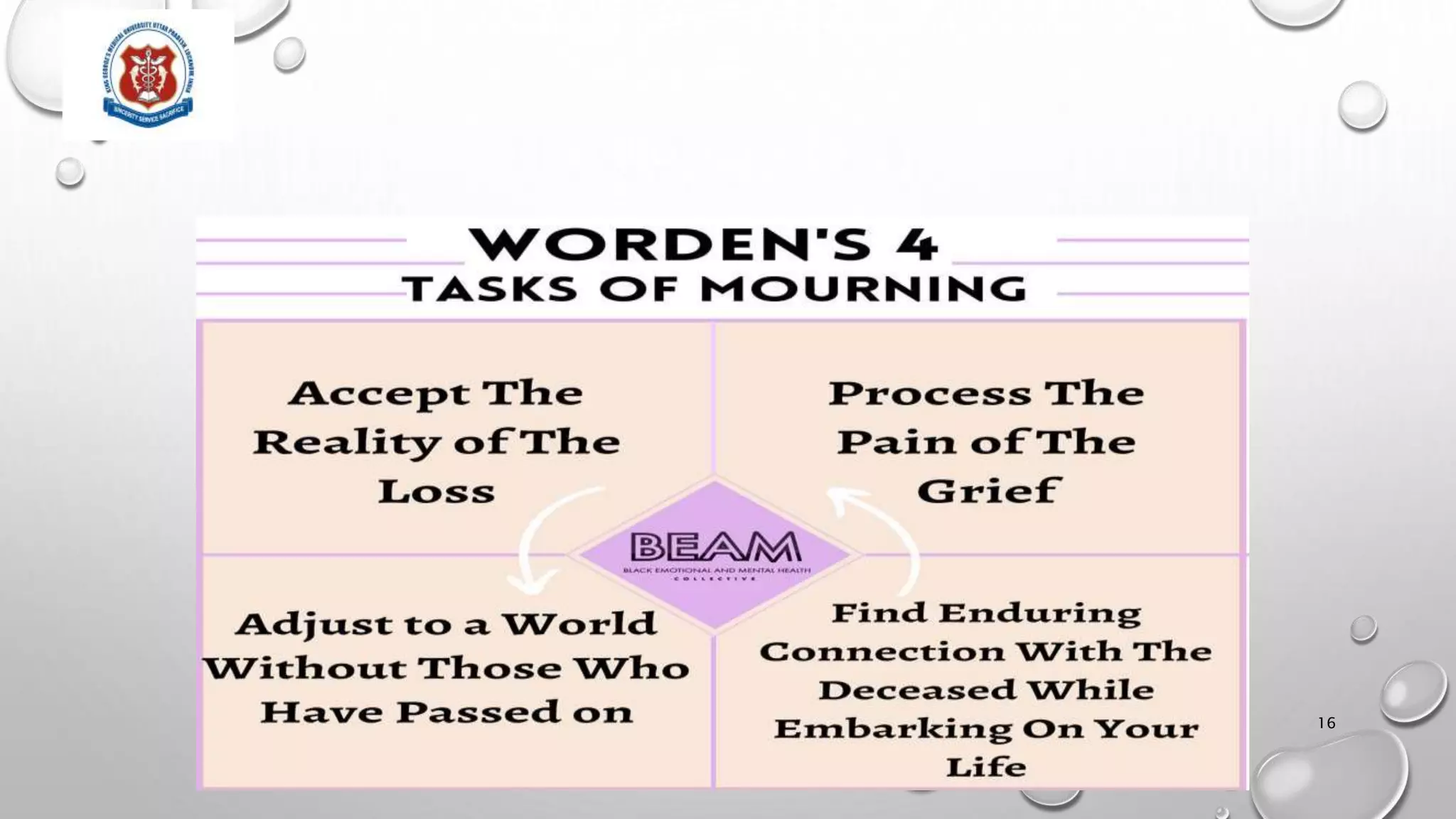
WORDEN’S FOUR TASKS OF MOURNING(1991):-
Task 1:- To accept the reality of the loss.
Task 2:- To work through the pain and grief.
Task 3:- To adjust to the environment in which the decreased is missing.
Task 4:- To emotionally relocate the decreased and move on with life.
15
16
INDICATIONS OF DEATH
Relaxed muscles
No pulse
No breathing
Fixed eyes
Total lack of response to external stimuli.
No muscular movement , especially breathing.
No reflexes
A bowel or bladder release
No response
17
PSYCHOSOCIAL MANIFESTATIONS OF APPROACHING DEATH
Altered decision making
Anxiety
Helplessness
Life review
Peacefulness
Unfinished business
18
Restlessness
Saying goodbyes
Decreased socialization
Fear of loneliness
Fear of meaninglessness
Unusual communication of one’s life
Fear of pain
Vision like experience
19
PHYSICAL MANIFESTATION OF APPROACHING DEATH
Sensory:- decreased sensation , perception, blurring of vision, siking and glazing
of eyes, blink reflex absent, eyelids remain half open.
Integumentary:-mottling on hands ,feet, arms and legs , cold, clammy skin,
cyanosis on nose, nail beds, knees , wax like skin when very near to death.
Respiratory:- increased respiratory rate , chyne-stokes respiration , inability to
cough or clear respiration , secretions resulting in grunting , gurgling.
20
Urinary:- decreased urine output , urinary incontinence, unable to urinate.
Gastrointestinal :-accumulation of gas, distension, nausea , loss of sphincter
control.
Musculoskeletal :- inability to move, sagging of jaw , difficulty in swallowing ,
difficulty in maintaining posture and alignment , loss of gag reflex, jerking.
Cardiovascular:- increased heart rate, slower and weakening pulse, irregular
rhythm . decreased in blood pressure , delayed absorption of drugs.
21
CARE OF BODY AFTER DEATH
PROCEDURAL GUIDELINES:-
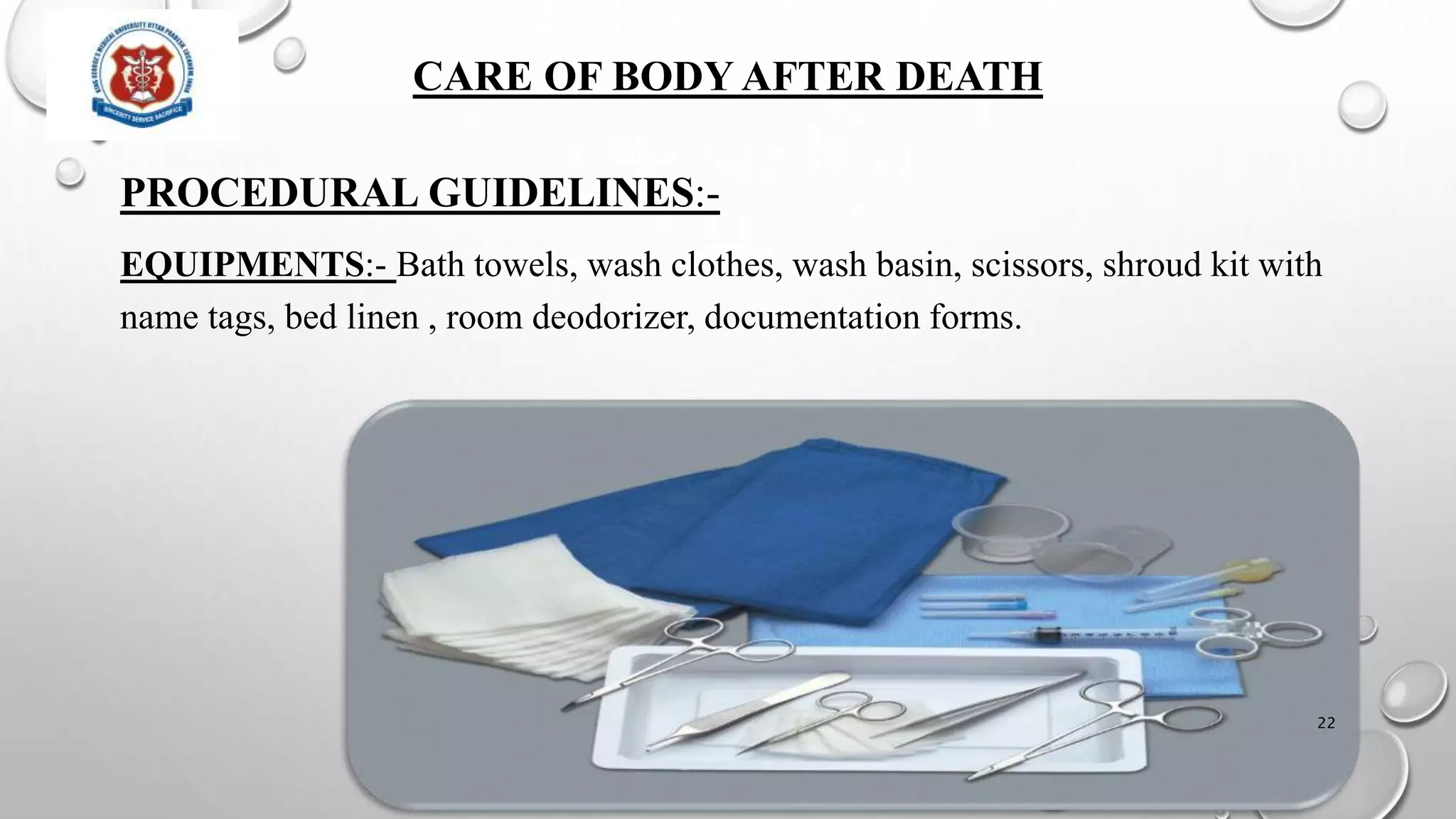
EQUIPMENTS:- Bath towels, wash clothes, wash basin, scissors, shroud kit with
name tags, bed linen , room deodorizer, documentation forms.
22
NURSES:-
 Make arrangements for staff, spiritual advisor or other to stay with the family
while the body is prepared for viewing.
Prepare the death care tray.
23
Cleanse body thoroughly, apply clean sheets.
Brush and comb clients hair.
Encourage family to say good bye through both touch and talk.
24
Do not rush good bye process.
Remove all equipments and ornaments.
Clarify the personal belongingness to handover the personal objects and body.
Do not discard items found after the family is gone, tell them what is found. 25
Apply name tags.
Cover the body while shifting on the death trolly.
Complete documentation
Follow all protocols and policies to meet all legal requirements in caring for the body.
26
APPROPRIATE DOCUMENTATION
Time of death and actions taken to prevent or cardiac arrest record if applicable.
Name of the person that pronounced the client’s death.
Make special preparation and type of donation , including time, staff, company.
27
The name of the family member or friend who was called and who came to the
hospital- donor organization, morgue, funeral home, chaplain.
Time of discharge and destination of the body , location of the name tags on the
body, special requests .
 Made by the family ,any other statements that might be needed to clarify the
situation.
28
29

end of life care

  • 1.
    KING GEORGE’S MEDICALUNIVERSITY KING GEORGE’S ,COLLEGE OF NURSING SEMINAR ON END OF LIFE CARE SUBMITTED TO: SUBMITTED BY: MRS. PRIYANKA SINGH DIVYA PAL CLINICAL INSTRUCTOR M.SC. N. 1ST YEAR K.G.M.U. COLLEGE OF NURSING K.G.M.U. COLLEGE OF NURSING 1
  • 2.
    OUTLINES • Introduction • Definitionof end of life care • Terminologies • Types of grief • Theories of grief • Indications of death • Psychosocial manifestation of approaching death • Physical manifestation of approaching death • Care of the body after death 2
  • 3.
    INTRODUCTION End –of -lifecare includes physical, emotional, social and spiritual support for patients and their families. The goal of end -of -life care is to control pain and other symptoms so the patient can be as comfortable as possible. 3
  • 4.
    DEFINITION “End-of –life carerefers to health care, not only of patients in the final hours or days of their lives, but more broadly care of all those with a terminal illness or terminal disease condition that has become advanced ,progressive and incurable.” 4
  • 5.
    TERMINOLOGIES Loss:- an aspectof self no longer available to a person. Death:- cessation of life. Grief:- pattern of physical and emotional responses to bereavement. End of life:- final phase of a patient’s illness when death is imminent. Death rattle:- a sound that is something heard coming from a dying person’s throat or chest. Palliative care:- making life as easy as possible for patients and families living with serious illness. 5
  • 6.
    Hospice care:- Hospicecare is given when there is life expectancy of 6 months or less. 6
  • 7.
    DEFINITION OF GRIEF Griefis a strong sometime overwhelming emotion for people, regardless of whether their sadness stems from the loss of a loved one or from a terminal diagnosis they or someone they love have received. 7
  • 8.
    TYPES OF GRIEF Normalgrief:- Complex emotional, social, physical, behavioural and spiritual responses to loss and death. Anticipatory grief:- Associated with the normal grief response before the loss actually occurs. Delayed or inhibited grief:- Absence of evidence of grief when it ordinarily would be expected. Distorted grief:- Symptoms associated with normal grieving are exaggerated. 8
  • 9.
    Chronic or prolongedgrief:- Maintaining personal possessions aimed at keeping a lost loved one alive. Disenfranchised grief:- When relationship to the decreased person is not socially sactioned. 9
  • 10.
    Ambiguous loss:- Thelost person is physically present but not psychologically available. Complicated grief:- Prolonged or significantly difficult time moving forward after a loss. Masked grief:- Disruptive behaviour due to loss and ineffective grief resolutions. 10
  • 11.
    KUBLER-ROSS THEORY 5 STAGESOF GRIEVING(1969):- The five stages of grief model or the kubler ross model is popularly known as a model that describes a series of emotions experienced by people who are grieving:- DENIAL ANGER BARGAINING DEPRESSION ACCEPTANCE 11
  • 12.
  • 13.
    BOWLBY 4 PHASESOF MOURNING (1980) Bowlby and markes (1980) identify four phases of mourning :-  Numbing  Yearning and searching  Disorganization and despair  Reorganization NUMBING:- feeling “stunned” or “unreal” can be interrupted by periods of intense emotion. 13
  • 14.
    YEARNING AND SEARCHING:-Full effects of emotional outbursts and uncontrollable crying. DISORGANIZATION AND DESPAIR:- Evaluation of loss, may become angry at perceived person at fault. REORGANIZATION:- Person begins to move forward with life, roles , skills and relationships. 14
  • 15.
    WORDEN’S FOUR TASKSOF MOURNING WORDEN’S FOUR TASKS OF MOURNING(1991):- Task 1:- To accept the reality of the loss. Task 2:- To work through the pain and grief. Task 3:- To adjust to the environment in which the decreased is missing. Task 4:- To emotionally relocate the decreased and move on with life. 15
  • 16.
  • 17.
    INDICATIONS OF DEATH Relaxedmuscles No pulse No breathing Fixed eyes Total lack of response to external stimuli. No muscular movement , especially breathing. No reflexes A bowel or bladder release No response 17
  • 18.
    PSYCHOSOCIAL MANIFESTATIONS OFAPPROACHING DEATH Altered decision making Anxiety Helplessness Life review Peacefulness Unfinished business 18
  • 19.
    Restlessness Saying goodbyes Decreased socialization Fearof loneliness Fear of meaninglessness Unusual communication of one’s life Fear of pain Vision like experience 19
  • 20.
    PHYSICAL MANIFESTATION OFAPPROACHING DEATH Sensory:- decreased sensation , perception, blurring of vision, siking and glazing of eyes, blink reflex absent, eyelids remain half open. Integumentary:-mottling on hands ,feet, arms and legs , cold, clammy skin, cyanosis on nose, nail beds, knees , wax like skin when very near to death. Respiratory:- increased respiratory rate , chyne-stokes respiration , inability to cough or clear respiration , secretions resulting in grunting , gurgling. 20
  • 21.
    Urinary:- decreased urineoutput , urinary incontinence, unable to urinate. Gastrointestinal :-accumulation of gas, distension, nausea , loss of sphincter control. Musculoskeletal :- inability to move, sagging of jaw , difficulty in swallowing , difficulty in maintaining posture and alignment , loss of gag reflex, jerking. Cardiovascular:- increased heart rate, slower and weakening pulse, irregular rhythm . decreased in blood pressure , delayed absorption of drugs. 21
  • 22.
    CARE OF BODYAFTER DEATH PROCEDURAL GUIDELINES:- EQUIPMENTS:- Bath towels, wash clothes, wash basin, scissors, shroud kit with name tags, bed linen , room deodorizer, documentation forms. 22
  • 23.
    NURSES:-  Make arrangementsfor staff, spiritual advisor or other to stay with the family while the body is prepared for viewing. Prepare the death care tray. 23
  • 24.
    Cleanse body thoroughly,apply clean sheets. Brush and comb clients hair. Encourage family to say good bye through both touch and talk. 24
  • 25.
    Do not rushgood bye process. Remove all equipments and ornaments. Clarify the personal belongingness to handover the personal objects and body. Do not discard items found after the family is gone, tell them what is found. 25
  • 26.
    Apply name tags. Coverthe body while shifting on the death trolly. Complete documentation Follow all protocols and policies to meet all legal requirements in caring for the body. 26
  • 27.
    APPROPRIATE DOCUMENTATION Time ofdeath and actions taken to prevent or cardiac arrest record if applicable. Name of the person that pronounced the client’s death. Make special preparation and type of donation , including time, staff, company. 27
  • 28.
    The name ofthe family member or friend who was called and who came to the hospital- donor organization, morgue, funeral home, chaplain. Time of discharge and destination of the body , location of the name tags on the body, special requests .  Made by the family ,any other statements that might be needed to clarify the situation. 28
  • 29.