Eleanor Tanno, M.D.
Family Medicine
www.AdvanceDirectiveMD.com
โ€ข What is an advance directive?
โ€ข Why is it important?
โ€ข Common medical illnesses where an AD is needed
โ€ข How do you get started?
โ€ข What are the important documents to complete?
โ€ข Your primary care doctor/nurse practitioner are available
for individual sessions
โ€ข An AD is a set of instructions you create to guide a
designated person in the kind of medical care you would
want if you were not able to speak for yourself.
โ€ข This designated person is called your medical power of
attorney (POA).
Advance Directive = Part 1: Naming POA + Part 2:
your medical wishes
โ€ข This is someone you choose whom you trust to make
your medical decisions for you.
โ€ข Often, this is a spouse or adult child, but can be a non-
relative.
โ€ข It is helpful for this to be someone who can easily travel
to you if needed.
โ€ข If you do not name a POA, the default is a spouse (even
if estranged), adult children, then next available family
members. If you do not have any of these family
members, a court will name a guardian (very
complicated)
โ€ข any medical situation where you are not able to make
your own medical decisions.
โ€ข Examples:
โ€ข Traumatic accident
โ€ข Infection where you are confused/delirious
โ€ข Unable to speak (such as a stroke)
โ€ข Unconscious
โ€ข On ventilator
โ€ข Advanced dementia
โ€ข No!
โ€ข In this day, medical care has become much more
advanced. It is rarely black and white. It is more of a
cascade of decisions to make at end of life.
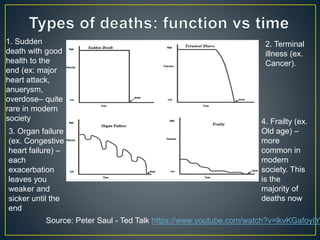
Source: Peter Saul - Ted Talk https://www.youtube.com/watch?v=lkvKGafoyIY
1. Sudden
death with good
health to the
end (ex: major
heart attack,
anuerysm,
overdoseโ€“ quite
rare in modern
society
2. Terminal
illness (ex.
Cancer).
3. Organ failure
(ex. Congestive
heart failure) โ€“
each
exacerbation
leaves you
weaker and
sicker until the
end
4. Frailty (ex.
Old age) โ€“
more
common in
modern
society. This
is the
majority of
deaths now
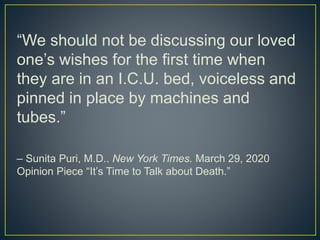
โ€œWe should not be discussing our loved
oneโ€™s wishes for the first time when
they are in an I.C.U. bed, voiceless and
pinned in place by machines and
tubes.โ€
โ€“ Sunita Puri, M.D.. New York Times. March 29, 2020
Opinion Piece โ€œItโ€™s Time to Talk about Death.โ€
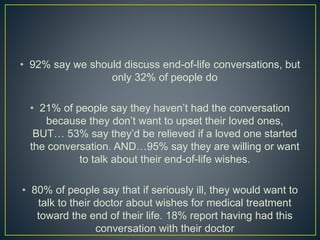
โ€ข 92% say we should discuss end-of-life conversations, but
only 32% of people do
โ€ข 21% of people say they havenโ€™t had the conversation
because they donโ€™t want to upset their loved ones,
BUTโ€ฆ 53% say theyโ€™d be relieved if a loved one started
the conversation. ANDโ€ฆ95% say they are willing or want
to talk about their end-of-life wishes.
โ€ข 80% of people say that if seriously ill, they would want to
talk to their doctor about wishes for medical treatment
toward the end of their life. 18% report having had this
conversation with their doctor
โ€ข The MOST important part is the CONVERSATION you
have with your family/POA.
โ€ข This is a conversation about your VALUES.
โ€ข Online tools to help:
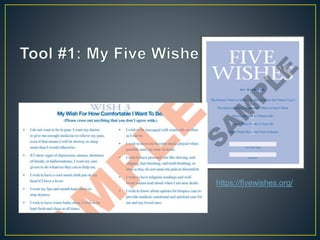
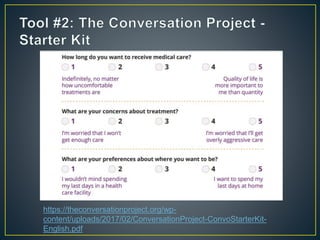
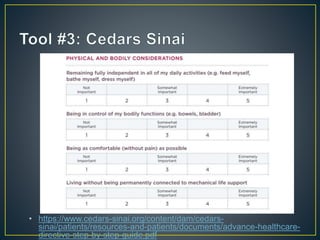
โ€ข 1. My Five Wishes
โ€ข 2. The Conversation Project
โ€ข 3. Cedars Sinai step-by-step guide
https://fivewishes.org/
https://theconversationproject.org/wp-
content/uploads/2017/02/ConversationProject-ConvoStarterKit-
English.pdf
โ€ข https://www.cedars-sinai.org/content/dam/cedars-
sinai/patients/resources-and-patients/documents/advance-healthcare-
directive-step-by-step-guide.pdf
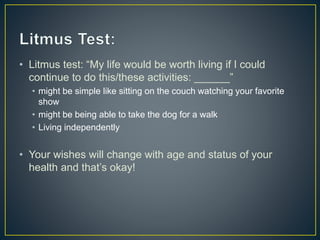
โ€ข Litmus test: โ€œMy life would be worth living if I could
continue to do this/these activities: ______โ€
โ€ข might be simple like sitting on the couch watching your favorite
show
โ€ข might be being able to take the dog for a walk
โ€ข Living independently
โ€ข Your wishes will change with age and status of your
health and thatโ€™s okay!
After talking to family, thinking
about your values, what next?
โ€ข Your physician may even do this as a virtual visit!
โ€ข Feel free to invite your spouse or medical confidante to
join
โ€ข Covered by Medicare and other commercial insurances
โ€ข It is not a simple conversation so helpful to do a visit just
for this.
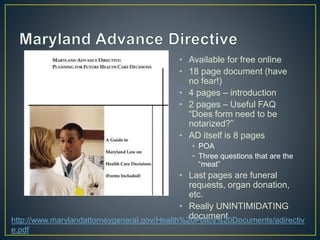
โ€ข Available for free online
โ€ข 18 page document (have
no fear!)
โ€ข 4 pages โ€“ introduction
โ€ข 2 pages โ€“ Useful FAQ
โ€œDoes form need to be
notarized?โ€
โ€ข AD itself is 8 pages
โ€ข POA
โ€ข Three questions that are the
โ€œmeatโ€
โ€ข Last pages are funeral
requests, organ donation,
etc.
โ€ข Really UNINTIMIDATING
document
http://www.marylandattorneygeneral.gov/Health%20Policy%20Documents/adirectiv
e.pdf
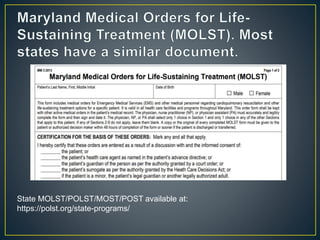
State MOLST/POLST/MOST/POST available at:
https://polst.org/state-programs/
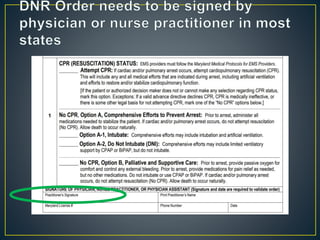
โ€ข A DNR order states that in the scenario where you have *died* (no heart
beat and not breathing), you do NOT want emergency personnel to
perform cardiopulmonary resuscitation (CPR) including chest
compressions, electrical shocks, artificial breaths. After CPR, you are
transported to the ICU and usually placed on a ventilator.
โ€ข In most states, everyone is defaulted to be a โ€œfull codeโ€ (WILL get CPR
in event you have died) UNLESS you have a signed DNR order by
physician.
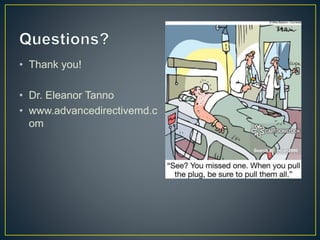
โ€ข DNR โ‰  โ€œpull the plug.โ€ DNR means you were never connected to a
machine that needed a plug to be pulled!
โ€ข https://www.youtube.com/watch?v=yUV2oGDGZn0
โ€ข Rates of survival after CPR - <10% people resuscitated in community
recover to leave hospital, but typically at lower level physical health.
25% of patients who have CPR in hospital leave the hospital.
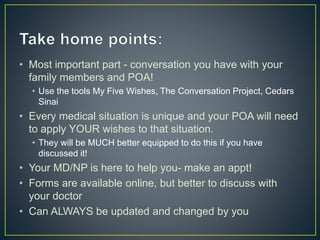
โ€ข Most important part - conversation you have with your
family members and POA!
โ€ข Use the tools My Five Wishes, The Conversation Project, Cedars
Sinai
โ€ข Every medical situation is unique and your POA will need
to apply YOUR wishes to that situation.
โ€ข They will be MUCH better equipped to do this if you have
discussed it!
โ€ข Your MD/NP is here to help you- make an appt!
โ€ข Forms are available online, but better to discuss with
your doctor
โ€ข Can ALWAYS be updated and changed by you
โ€ข My website: www.advancedirectivemd.com
โ€ข New York Times article https://www.nytimes.com/2020/03/27/opinion/covid-end-
of-life.html
โ€ข Peter Saul, M.D. - Ted Talk with graphs
https://www.youtube.com/watch?v=lkvKGafoyIY
โ€ข Youtube video showing a cardiac arrest that shows CPR (happy ending)
https://www.youtube.com/watch?v=yUV2oGDGZn0
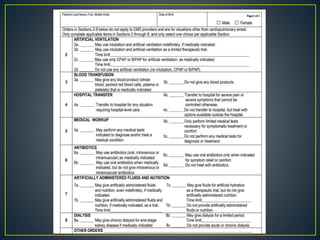
โ€ข MOLST form (includes DNR order)
โ€ข https://marylandmolst.org/docs/MOLST%20MM3%202013%20FINAL%20PROP
OSED%2072613%20POSTED%2021714-no-instructions.pdf
โ€ข Maryland Advance Directive Form
โ€ข http://www.marylandattorneygeneral.gov/Health%20Policy%20Documents/adirec
tive.pdf
โ€ข Cedars Sinai Hospital step-by-step guide https://www.cedars-
sinai.org/content/dam/cedars-sinai/patients/resources-and-
patients/documents/advance-healthcare-directive-step-by-step-guide.pdf
โ€ข Conversation Project
โ€ข Conversation project - https://www.theconversationproject.org/
โ€ข My Five Wishes https://fivewishes.org/
โ€ข Thank you!
โ€ข Dr. Eleanor Tanno
โ€ข www.advancedirectivemd.c
om

Creating an Advance Directive

  • 1.
    Eleanor Tanno, M.D. FamilyMedicine www.AdvanceDirectiveMD.com
  • 2.
    โ€ข What isan advance directive? โ€ข Why is it important? โ€ข Common medical illnesses where an AD is needed โ€ข How do you get started? โ€ข What are the important documents to complete? โ€ข Your primary care doctor/nurse practitioner are available for individual sessions
  • 4.
    โ€ข An ADis a set of instructions you create to guide a designated person in the kind of medical care you would want if you were not able to speak for yourself. โ€ข This designated person is called your medical power of attorney (POA). Advance Directive = Part 1: Naming POA + Part 2: your medical wishes
  • 5.
    โ€ข This issomeone you choose whom you trust to make your medical decisions for you. โ€ข Often, this is a spouse or adult child, but can be a non- relative. โ€ข It is helpful for this to be someone who can easily travel to you if needed. โ€ข If you do not name a POA, the default is a spouse (even if estranged), adult children, then next available family members. If you do not have any of these family members, a court will name a guardian (very complicated)
  • 6.
    โ€ข any medicalsituation where you are not able to make your own medical decisions. โ€ข Examples: โ€ข Traumatic accident โ€ข Infection where you are confused/delirious โ€ข Unable to speak (such as a stroke) โ€ข Unconscious โ€ข On ventilator โ€ข Advanced dementia
  • 7.
    โ€ข No! โ€ข Inthis day, medical care has become much more advanced. It is rarely black and white. It is more of a cascade of decisions to make at end of life.
  • 8.
    Source: Peter Saul- Ted Talk https://www.youtube.com/watch?v=lkvKGafoyIY 1. Sudden death with good health to the end (ex: major heart attack, anuerysm, overdoseโ€“ quite rare in modern society 2. Terminal illness (ex. Cancer). 3. Organ failure (ex. Congestive heart failure) โ€“ each exacerbation leaves you weaker and sicker until the end 4. Frailty (ex. Old age) โ€“ more common in modern society. This is the majority of deaths now
  • 9.
    โ€œWe should notbe discussing our loved oneโ€™s wishes for the first time when they are in an I.C.U. bed, voiceless and pinned in place by machines and tubes.โ€ โ€“ Sunita Puri, M.D.. New York Times. March 29, 2020 Opinion Piece โ€œItโ€™s Time to Talk about Death.โ€
  • 10.
    โ€ข 92% saywe should discuss end-of-life conversations, but only 32% of people do โ€ข 21% of people say they havenโ€™t had the conversation because they donโ€™t want to upset their loved ones, BUTโ€ฆ 53% say theyโ€™d be relieved if a loved one started the conversation. ANDโ€ฆ95% say they are willing or want to talk about their end-of-life wishes. โ€ข 80% of people say that if seriously ill, they would want to talk to their doctor about wishes for medical treatment toward the end of their life. 18% report having had this conversation with their doctor
  • 11.
    โ€ข The MOSTimportant part is the CONVERSATION you have with your family/POA. โ€ข This is a conversation about your VALUES. โ€ข Online tools to help: โ€ข 1. My Five Wishes โ€ข 2. The Conversation Project โ€ข 3. Cedars Sinai step-by-step guide
  • 12.
  • 13.
  • 14.
  • 15.
    โ€ข Litmus test:โ€œMy life would be worth living if I could continue to do this/these activities: ______โ€ โ€ข might be simple like sitting on the couch watching your favorite show โ€ข might be being able to take the dog for a walk โ€ข Living independently โ€ข Your wishes will change with age and status of your health and thatโ€™s okay!
  • 16.
    After talking tofamily, thinking about your values, what next?
  • 17.
    โ€ข Your physicianmay even do this as a virtual visit! โ€ข Feel free to invite your spouse or medical confidante to join โ€ข Covered by Medicare and other commercial insurances โ€ข It is not a simple conversation so helpful to do a visit just for this.
  • 19.
    โ€ข Available forfree online โ€ข 18 page document (have no fear!) โ€ข 4 pages โ€“ introduction โ€ข 2 pages โ€“ Useful FAQ โ€œDoes form need to be notarized?โ€ โ€ข AD itself is 8 pages โ€ข POA โ€ข Three questions that are the โ€œmeatโ€ โ€ข Last pages are funeral requests, organ donation, etc. โ€ข Really UNINTIMIDATING document http://www.marylandattorneygeneral.gov/Health%20Policy%20Documents/adirectiv e.pdf
  • 20.
    State MOLST/POLST/MOST/POST availableat: https://polst.org/state-programs/
  • 21.
    โ€ข A DNRorder states that in the scenario where you have *died* (no heart beat and not breathing), you do NOT want emergency personnel to perform cardiopulmonary resuscitation (CPR) including chest compressions, electrical shocks, artificial breaths. After CPR, you are transported to the ICU and usually placed on a ventilator. โ€ข In most states, everyone is defaulted to be a โ€œfull codeโ€ (WILL get CPR in event you have died) UNLESS you have a signed DNR order by physician. โ€ข DNR โ‰  โ€œpull the plug.โ€ DNR means you were never connected to a machine that needed a plug to be pulled! โ€ข https://www.youtube.com/watch?v=yUV2oGDGZn0 โ€ข Rates of survival after CPR - <10% people resuscitated in community recover to leave hospital, but typically at lower level physical health. 25% of patients who have CPR in hospital leave the hospital.
  • 24.
    โ€ข Most importantpart - conversation you have with your family members and POA! โ€ข Use the tools My Five Wishes, The Conversation Project, Cedars Sinai โ€ข Every medical situation is unique and your POA will need to apply YOUR wishes to that situation. โ€ข They will be MUCH better equipped to do this if you have discussed it! โ€ข Your MD/NP is here to help you- make an appt! โ€ข Forms are available online, but better to discuss with your doctor โ€ข Can ALWAYS be updated and changed by you
  • 25.
    โ€ข My website:www.advancedirectivemd.com โ€ข New York Times article https://www.nytimes.com/2020/03/27/opinion/covid-end- of-life.html โ€ข Peter Saul, M.D. - Ted Talk with graphs https://www.youtube.com/watch?v=lkvKGafoyIY โ€ข Youtube video showing a cardiac arrest that shows CPR (happy ending) https://www.youtube.com/watch?v=yUV2oGDGZn0 โ€ข MOLST form (includes DNR order) โ€ข https://marylandmolst.org/docs/MOLST%20MM3%202013%20FINAL%20PROP OSED%2072613%20POSTED%2021714-no-instructions.pdf โ€ข Maryland Advance Directive Form โ€ข http://www.marylandattorneygeneral.gov/Health%20Policy%20Documents/adirec tive.pdf โ€ข Cedars Sinai Hospital step-by-step guide https://www.cedars- sinai.org/content/dam/cedars-sinai/patients/resources-and- patients/documents/advance-healthcare-directive-step-by-step-guide.pdf โ€ข Conversation Project โ€ข Conversation project - https://www.theconversationproject.org/ โ€ข My Five Wishes https://fivewishes.org/
  • 26.
    โ€ข Thank you! โ€ขDr. Eleanor Tanno โ€ข www.advancedirectivemd.c om

Editor's Notes

  • #2ย Intro Thanks for tuning in Please mute Slides should be posted later, session is recorded Will take questions at the end โ€“ can submit to chat โ€œpublicallyโ€ or submit to Q/A โ€œprivatelyโ€ May want to have a pen and paper to take notes
  • #4ย It used to be that when you got sick, you died. Medical advances mean that we have treatments that can keep you alive, but often you are not alert to make your own medical decisions. If you are not alert to make these decisions, your family or other designated people will be asked to make them for you. Therefore, it is very important they know your wishes. An advance directive is a document where you record these wishes in writing. Seems simple, but while 97% of people say it is important to put their wishes in writing, only 30% have done so in the form of an advance directive
  • #5ย SLIDE โ€“ what is an advance directive
  • #6ย AKA surrogate = healthcare proxy = medical POA Daughter in California phenomenon If complicated family dynamics, it is especially important to name a POA in AD
  • #7ย Trauma โ€“ car accident, fall, skiing accident
  • #8ย โ€œpersistent vegetative stateโ€ is extraordinarily rare When I look at ADs made with estate lawyers, they often have this language, which is not typically applicable in the hospital setting. This is why ADs so important
  • #9ย Credit to Dr. Peter Saul TED talk These are different mechanisms of death Sudden death โ€“ old days, major MI, major stroke, aneurysm Terminal illness โ€“ cancer, ALS Organ failure โ€“ MI, kidney failure, liver failure, stroke Frailty โ€“ much more common these days โ€“ general decline in old age filled with falls, some cognitive decline, assisted living, nursing home, until finally, death Soโ€ฆan AD is much more important these days given that the most common scenario is one of a slow decline, and dependence on family members to be making decisions for you at the end of life. HOWEVER, a lot of people are not having these conversations in advance.
  • #10ย https://www.nytimes.com/2020/03/27/opinion/covid-end-of-life.html โ€œItโ€™s Time to Talk About Deathโ€ Sunita Puri, M.D. March 27, 2020 My passion? Barriers to having these conversations and documents โ€“ it is uncomfortable! We are not a culture that likes to talk about death. While 92% of people say that talking with their loved ones about end-of-life care is important. 32% have actually done so (conversation project) 21% of people say they havenโ€™t had the conversation because they donโ€™t want to upset their loved ones, BUTโ€ฆ 53% say theyโ€™d be relieved if a loved one started the conversation. 95% say they are willing or want to talk about their end-of-life wishes. (conversation project) 80% of people say that if seriously ill, they would want to talk to their doctor about wishes for medical treatment toward the end of their life. 18% report having had this conversation with their doctor (California Healthcare Foundation and Kaiser Family Foundation via conversation project)
  • #11ย While 92% of people say that talking with their loved ones about end-of-life care is important. 32% have actually done so (conversation project) 21% of people say they havenโ€™t had the conversation because they donโ€™t want to upset their loved ones, BUTโ€ฆ 53% say theyโ€™d be relieved if a loved one started the conversation. 95% say they are willing or want to talk about their end-of-life wishes. (conversation project) 80% of people say that if seriously ill, they would want to talk to their doctor about wishes for medical treatment toward the end of their life. 18% report having had this conversation with their doctor (California Healthcare Foundation and Kaiser Family Foundation via conversation project)
  • #12ย How do I get started in making an advance directive and talking to family? A conversation about AD is not a conversation about dying, it is a conversation about how you would like to live up until your death. It is a conversation about life and your VALUES
  • #13ย Tool #3: My Five Wishes $5 each, can order in bulk too https://fivewishes.org/ My Five Wishes is a user friendly blank AD that once completed is considered a legal document in many states, including Maryland. Gets the โ€œspiritโ€ of you medical wishes across
  • #14ย https://theconversationproject.org/wp-content/uploads/2017/02/ConversationProject-ConvoStarterKit-English.pdf A great tool on how to get started in preparing for conversation with family โ€“ i.e. โ€œsetting the stageโ€ This tool focuses on values
  • #15ย Cedars Sinai https://www.cedars-sinai.org/content/dam/cedars-sinai/patients/resources-and-patients/documents/advance-healthcare-directive-step-by-step-guide.pdf This tool is more medically specific Of the three, likely the most helpful to doctors
  • #16ย If nothing else, the litmus test. โ€œKeep pursuing aggressive medical treatment as long as at the end, you think I would be able to do ____โ€
  • #17ย After talking to family, thinking about your values, what next?
  • #18ย Your PCP can talk to you about things and provide you with necessary forms to fill out. This advance directive visit is covered by medicare. It is not a simple conversation so helpful to do a visit just for this.
  • #19ย Forms to complete after discussing with family and doctor
  • #20ย http://www.marylandattorneygeneral.gov/Health%20Policy%20Documents/adirective.pdf Does NOT need to be notarized. Do not need lawyer Strength of this document - great for documenting POA Drawback - medical scenarios are much more ill defined โ€“ refers to persistent vegetative state Best if used in conjunction with other documents for the medical wishes
  • #21ย https://marylandmolst.org/docs/MOLST%20MM3%202013%20FINAL%20PROPOSED%2072613%20POSTED%2021714-no-instructions.pdf A MOLST is a two page form with a list of specific medical orders that guide doctors if you cannot speak for yourself. This is a great form. You donโ€™t need a lawyer, you donโ€™t need to pay for it. you donโ€™t need it notarized. let me explain the 2 pages -- the first page is for emergency situations and this is for DNR โ€“ some of you heard of this. I will talk about more about DNR in a moment. --The second page is for non emergent scenarios (think of the graphs with the frailty) โ€“ concerns decisions about ventilators, feeding tubes, dialysis, etc. Will come back to this too.
  • #22ย  https://www.youtube.com/watch?v=yUV2oGDGZn0
  • #23ย  From the first page of the MOLST This is the DNR order The MOLST form does NOT need to be signed by a physician/NP EXCEPT if you would like to be DNR.
  • #24ย https://marylandmolst.org/docs/MOLST%20MM3%202013%20FINAL%20PROPOSED%2072613%20POSTED%2021714.pdf The second page is for non emergent scenarios - slower and you have more time. --the case of persistent vegetative state is very rare. That is not what usually happens. More commonly, we do not know what is going to happen and we are not sure if you're going to recover. The second page is much more the kind of decisions your family will make. Think about the graph with the frailty or organ system decline Take a look at MOLST (google MOLST), take a pencil, come back once you've looked at it. Schedule a visit and we'll do it together. Medicare pays for a visit just to do this together.