Outreach: A critical intersection of
           libraries and technology
                                            Kristi Holmes, PhD
                                             Bioinformaticist
                                          Becker Medical Library

                                     http://vivo.wustl.edu/display/n4754
                                            Twitter: @kristiholmes
                                              December 6, 2011


Outreach: A critical intersection of libraries and technology by Kristi L. Holmes is licensed under a Creative Commons Attribution-
                                          NonCommercial-ShareAlike 3.0 Unported License.
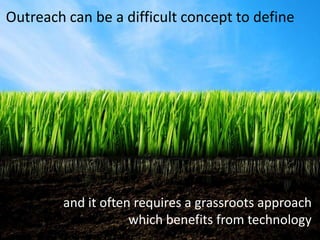
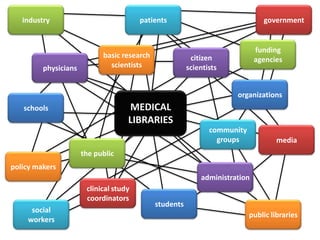
Outreach can be a difficult concept to define


        and it often requires a grassroots approach
                    which benefits from technology
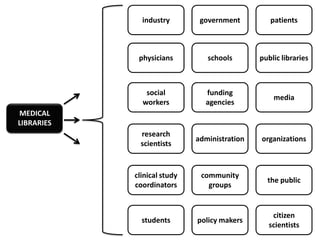
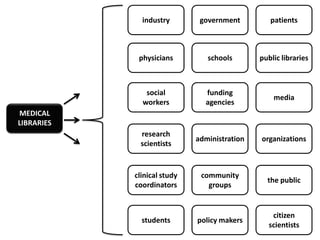
industry        government         patients


             physicians         schools       public libraries


               social          funding
                                                  media
              workers          agencies
MEDICAL
LIBRARIES
             research
                             administration   organizations
             scientists


            clinical study    community
                                                the public
            coordinators        groups


                                                 citizen
              students       policy makers
                                                scientists
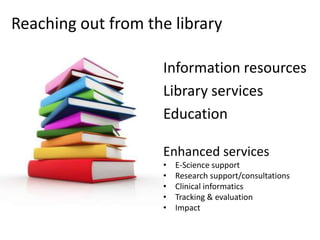
Reaching out from the library

                    Information resources
                    Library services
                    Education

                    Enhanced services
                    •   E-Science support
                    •   Research support/consultations
                    •   Clinical informatics
                    •   Tracking & evaluation
                    •   Impact
Outreach and engagement on medical
campuses is definitely becoming more
              complex.
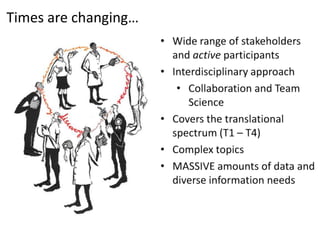
Times are changing…
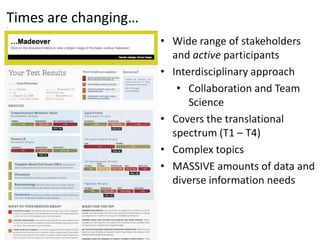
Times are changing…


   Binary Battle Apps for
      Science Contest
industry        government         patients


             physicians         schools       public libraries


               social          funding
                                                  media
              workers          agencies
MEDICAL
LIBRARIES
             research
                             administration   organizations
             scientists


            clinical study    community
                                                the public
            coordinators        groups


                                                 citizen
              students       policy makers
                                                scientists
industry                             patients                               government


                                                                             funding
                            basic research               citizen             agencies
         physicians           scientists                scientists


                                                                      organizations
   schools                          MEDICAL
                                    LIBRARIES
                                                               community
                                                                 groups            media
                      the public
policy makers
                                                            administration
                       clinical study
                       coordinators
                                             students
     social
                                                                           public libraries
    workers
Communicate
     Build teams
 Improve workflows
 Enhance efficiencies
Reuse & Dissemination
Outreach and Technology


                  Researcher Networking 
Researcher Networking
What is it?
Ideal role for libraries
• Information organization, instruction, usability, subject
  expertise, ontologies and controlled vocabularies
• Have a tradition of service and support
• Strive to serve all missions of the institution
• Have close, trusted relationships with our clients
• Understand user needs
• Understand the importance of collaboration and know
  how to bring people together
• Have knowledge of institution, research, education,
  technology, and clinical landscapes

                                  RN Adoption and Outreach, VIVO SF wiki
Researcher Networking and the
Semantic Web
 • Increasing recognition of the value of semantic web
   standards
 • Increasing momentum in support of semantic web
   technologies to facilitate research discovery
 • Recommendations for researcher networking recently
   endorsed by the CTSA Consortium Steering Committee
   represent a new standard in researcher networking.
    – Read more at http://vivoweb.org/blog
 • Examples of applications that consume these rich data
   include: visualizations, enhanced multi-site search, and
   VIVO Searchlight. Other utilities are in development
   across a wide range of topic areas.
VIVO
  Enables collaboration and
discovery across an institution
    and among institutions

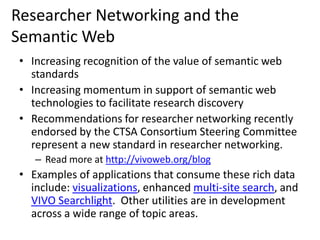
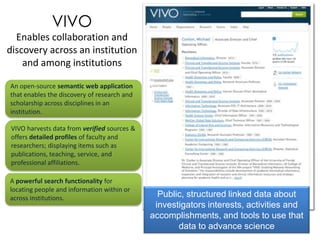
An open-source semantic web application
that enables the discovery of research and
scholarship across disciplines in an
institution.

 VIVO harvests data from verified sources &
 offers detailed profiles of faculty and
 researchers; displaying items such as
 publications, teaching, service, and
 professional affiliations.

A powerful search functionality for
locating people and information within or
across institutions.                            Public, structured linked data about
                                               investigators interests, activities and
                                              accomplishments, and tools to use that
                                                     data to advance science
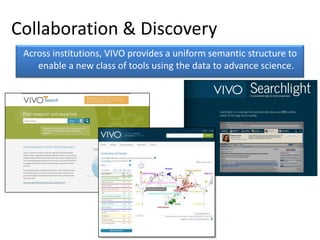
Collaboration & Discovery
 Across institutions, VIVO provides a uniform semantic structure to
    enable a new class of tools using the data to advance science.
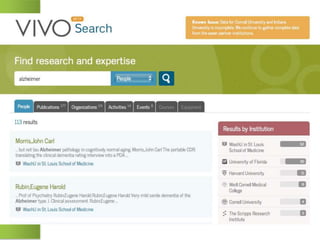
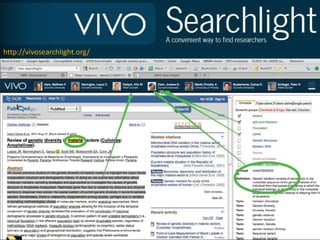
Community-Wide Semantic Search
http://vivosearchlight.org/
@mileswortho
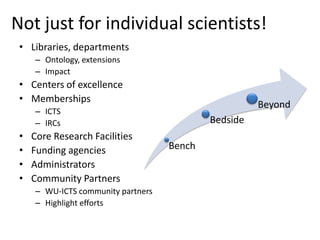
Not just for individual scientists!
 • Libraries, departments
     – Ontology, extensions
     – Impact
 • Centers of excellence
 • Memberships
                                                      Beyond
     – ICTS
     – IRCs                                 Bedside
 •   Core Research Facilities
 •   Funding agencies               Bench
 •   Administrators
 •   Community Partners
     – WU-ICTS community partners
     – Highlight efforts
The library is a conduit
     to information, collaboration,
             and discovery

and tools like VIVO can help make
  this work easier for everyone.

(so we can all spend our time on more interesting
                   endeavors!)
Acknowledgements
Funding:                                Collaborations:
• VIVO, NIH award U24 RR029822          • Washington University
• Washington University Institute          ICTS, Departments
  of Clinical and Translational         • VIVO colleagues from around
  Sciences, NIH award UL1                  the world
  RR024992                              • Becker Library colleagues
Questions:                              • Library colleagues everywhere
• holmeskr@wustl.edu
• Twitter: @kristiholmes
• http://vivo.wustl.edu/display/n4754       Thank you!
Images and site credits
 Images
 • http://www.maxnd.com/assets/bookstacksm.jpg
 • http://wallpaperswide.com/grassroots-wallpapers.html
 • http://www.flickr.com/photos/cphilruns/2475175675/
 • http://www.nature.com/nature/journal/v454/n7202/images/454274b-i1.0.jpg
 • http://bioinformatics.genomics.org.cn/image/1000genomes.jpg

 Websites, resources
 • http://www.mendeley.com/blog/design-research-tools/winners-of-the-first-binary-battle-apps-for-
    science-contest/
 • http://online.wsj.com/article/SB10001424052970204621904577014330551132036.html
 • http://www.1000genomes.org/
 • http://www.nytimes.com/2011/12/01/business/dna-sequencing-caught-in-deluge-of-data.html
 • http://www.wired.com/magazine/2010/11/ff_bloodwork/all/1
 • http://vivoweb.org/
 • http://vivo.sourceforge.net/
 • http://vivosearch.org/
 • http://vivosearchlight.org/
 • http://vivo.cns.iu.edu/gallery.html/
 • http://sourceforge.net/apps/mediawiki/vivo/index.php?title=Adoption_and_Outreach
 • http://www.science3point0.com/socialdisruption/2011/11/22/data-curation-is-the-new-black/

Outreach: A critical intersection of libraries and technology

  • 1.
    Outreach: A criticalintersection of libraries and technology Kristi Holmes, PhD Bioinformaticist Becker Medical Library http://vivo.wustl.edu/display/n4754 Twitter: @kristiholmes December 6, 2011 Outreach: A critical intersection of libraries and technology by Kristi L. Holmes is licensed under a Creative Commons Attribution- NonCommercial-ShareAlike 3.0 Unported License.
  • 2.
    Outreach can bea difficult concept to define and it often requires a grassroots approach which benefits from technology
  • 3.
    industry government patients physicians schools public libraries social funding media workers agencies MEDICAL LIBRARIES research administration organizations scientists clinical study community the public coordinators groups citizen students policy makers scientists
  • 4.
    Reaching out fromthe library Information resources Library services Education Enhanced services • E-Science support • Research support/consultations • Clinical informatics • Tracking & evaluation • Impact
  • 5.
    Outreach and engagementon medical campuses is definitely becoming more complex.
  • 6.
  • 7.
    Times are changing… Binary Battle Apps for Science Contest
  • 8.
    industry government patients physicians schools public libraries social funding media workers agencies MEDICAL LIBRARIES research administration organizations scientists clinical study community the public coordinators groups citizen students policy makers scientists
  • 9.
    industry patients government funding basic research citizen agencies physicians scientists scientists organizations schools MEDICAL LIBRARIES community groups media the public policy makers administration clinical study coordinators students social public libraries workers
  • 10.
    Communicate Build teams Improve workflows Enhance efficiencies Reuse & Dissemination
  • 11.
    Outreach and Technology Researcher Networking 
  • 12.
    Researcher Networking What isit? Ideal role for libraries • Information organization, instruction, usability, subject expertise, ontologies and controlled vocabularies • Have a tradition of service and support • Strive to serve all missions of the institution • Have close, trusted relationships with our clients • Understand user needs • Understand the importance of collaboration and know how to bring people together • Have knowledge of institution, research, education, technology, and clinical landscapes RN Adoption and Outreach, VIVO SF wiki
  • 13.
    Researcher Networking andthe Semantic Web • Increasing recognition of the value of semantic web standards • Increasing momentum in support of semantic web technologies to facilitate research discovery • Recommendations for researcher networking recently endorsed by the CTSA Consortium Steering Committee represent a new standard in researcher networking. – Read more at http://vivoweb.org/blog • Examples of applications that consume these rich data include: visualizations, enhanced multi-site search, and VIVO Searchlight. Other utilities are in development across a wide range of topic areas.
  • 14.
    VIVO Enablescollaboration and discovery across an institution and among institutions An open-source semantic web application that enables the discovery of research and scholarship across disciplines in an institution. VIVO harvests data from verified sources & offers detailed profiles of faculty and researchers; displaying items such as publications, teaching, service, and professional affiliations. A powerful search functionality for locating people and information within or across institutions. Public, structured linked data about investigators interests, activities and accomplishments, and tools to use that data to advance science
  • 15.
    Collaboration & Discovery Across institutions, VIVO provides a uniform semantic structure to enable a new class of tools using the data to advance science.
  • 16.
  • 17.
  • 18.
    Not just forindividual scientists! • Libraries, departments – Ontology, extensions – Impact • Centers of excellence • Memberships Beyond – ICTS – IRCs Bedside • Core Research Facilities • Funding agencies Bench • Administrators • Community Partners – WU-ICTS community partners – Highlight efforts
  • 19.
    The library isa conduit to information, collaboration, and discovery and tools like VIVO can help make this work easier for everyone. (so we can all spend our time on more interesting endeavors!)
  • 20.
    Acknowledgements Funding: Collaborations: • VIVO, NIH award U24 RR029822 • Washington University • Washington University Institute ICTS, Departments of Clinical and Translational • VIVO colleagues from around Sciences, NIH award UL1 the world RR024992 • Becker Library colleagues Questions: • Library colleagues everywhere • holmeskr@wustl.edu • Twitter: @kristiholmes • http://vivo.wustl.edu/display/n4754 Thank you!
  • 21.
    Images and sitecredits Images • http://www.maxnd.com/assets/bookstacksm.jpg • http://wallpaperswide.com/grassroots-wallpapers.html • http://www.flickr.com/photos/cphilruns/2475175675/ • http://www.nature.com/nature/journal/v454/n7202/images/454274b-i1.0.jpg • http://bioinformatics.genomics.org.cn/image/1000genomes.jpg Websites, resources • http://www.mendeley.com/blog/design-research-tools/winners-of-the-first-binary-battle-apps-for- science-contest/ • http://online.wsj.com/article/SB10001424052970204621904577014330551132036.html • http://www.1000genomes.org/ • http://www.nytimes.com/2011/12/01/business/dna-sequencing-caught-in-deluge-of-data.html • http://www.wired.com/magazine/2010/11/ff_bloodwork/all/1 • http://vivoweb.org/ • http://vivo.sourceforge.net/ • http://vivosearch.org/ • http://vivosearchlight.org/ • http://vivo.cns.iu.edu/gallery.html/ • http://sourceforge.net/apps/mediawiki/vivo/index.php?title=Adoption_and_Outreach • http://www.science3point0.com/socialdisruption/2011/11/22/data-curation-is-the-new-black/

Editor's Notes

  • #3 People like to consume information on their terms, on their schedule, and in a manner that “works” for them.
  • #4 Notice the direction of the message, traditional activities and services which libraries are well-known for.
  • #5 Enhanced services – becoming more prominent at a number of libraries – e-science support, research support/consultations by subject specialists, clinical informatics, tracking and evaluation activities, impact
  • #6 In terms of:People engaging each otherWhat they’re connecting about
  • #7 Consider one area of effort that is on everyone’s minds these days – genomicsCitizen scientists, community clinicsComplexity, topics, funding requirements - Necessitate collaborative approach
  • #8 Consider one area of effort that is on everyone’s minds these days – genomicsWith openSNP, you can share your personal genome from 23andMe or deCODEme to find the latest relevant research and let scientists discover new genetic associations. (Mendeleyannouncemen)Citizen scientists, community clinicsComplexity, topics, funding requirements - Necessitate collaborative approach
  • #9 Notice the direction of the message, traditional activities and services which libraries are well-known for.
  • #10 Really – complex beautiful multi-directional web of interactions and collaboration – and the library is poised perfectly to play as large of role as ever in the information ecosystemIt is just a matter of connecting the right people
  • #12 Libraries are always ahead of the curve on technology – there isn’t a lot that I can tell you about twitter, facebookblogging that you aren’t doing in your libraries already. However, there are technologies that are becoming more prevalent and accepted in the library community and beyond which can be leveraged for outreach –Specifically the Semantic Web, Libraries and the semantic web – resources at the end of the presentation (MARC records being the most recent and most significant SemWeb news out of the library world.
  • #13 What is Researcher Networking?Why Libraries?
  • #15 ONTOLOGY SUPPORTS A VARIETY OF OUTPUTS AND MODES OF DISSEMINATIONVIVO enables collaboration and understanding across an institution and among institutionsVIVO harvests much of its data automatically from verified sources so it is accurate and current, reducing the need for manual input.The rich information in VIVO profiles can be repurposed and shared with other institutional web pages and consumers, reducing cost and increasing efficiencies across the institution. Data is housed and maintained at the local institutions. There it can be updated on a regular basis. Search results are faceted so information can be located rapidly and with less time spent sorting through information.Profiles are largely created via automated data feeds, but can be customized to suit the needs of the individual.Profiles are richer in content than typical [web pages or] social networking sites and will rank higher in general internet searches. Each institution provides its own VIVO system and data. Local governance determines data to be provided.
  • #16  Across institutions VIVO provides a uniform semantic structure to enable a new class of tools using the data to advance science. visualizations, search, discovery, etc
  • #17 DEEP SEMANTIC SEARCHWhile searches for people are an obvious requirement for researcher networking, we don't want to limit ourselves to searching for people. VIVO's ontology-based data model is not limited to profiles of people, but includes organizations, events, publications, grants, and many other types of data. This enables VIVO to represent the relationships among people and other types of data as an interconnected network that can be accessed in many ways.
  • #18 Miles WorthingtonImage from Dr. Barend Mons, Scientific Director of the Netherlands Bioinformatics InstituteAllows experts to be found, but also ties the object to specific concepts