#TXCME15
Brian S McGowan, PhD
Chief Learning Officer
ArcheMedX, Inc.
@briansmcgowan
Do CME Learners Really
Differ Across Generations?
#TXCME15
Objectives:
Following this session attendees should be prepared to:
1. explore (through an interactive discussion) the question, how do CME
learners really learn?
2. describe 4 natural actions learners rely on while consuming educational
content
3. identify best practices to mitigate the extraneous load learners confront in
traditional learning environments
4. design critical strategies that can be incorporated into your educational
program/activities to support more effective and efficient learning
5. recognize similarities and differences of learners across generations
#TXCME15
Critical Take-Aways:
1. The Cognitive Load of learners is a critical bottleneck that limits
the impact of educational interventions or learning experiences.
2. The Learning Actions Model is an novel instructional design
technique that frees up working memory by minimizing
extraneous load
3. Leveraging Agile Education Design ensures that the learning
experience and the learning environment are refined and
optimized over time
4. …apply these insights to decide whether generational differences
materially impact learning effectiveness
#TXCME154
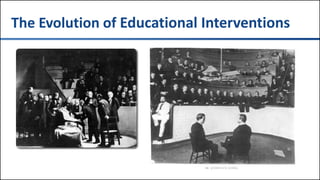
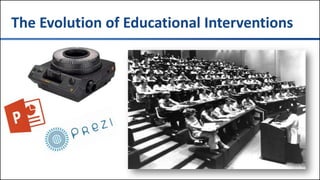
The Evolution of Educational Interventions
#TXCME155
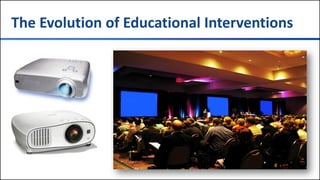
The Evolution of Educational Interventions
#TXCME156
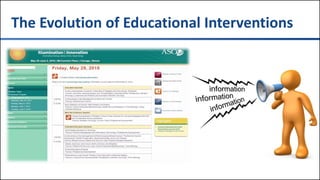
The Evolution of Educational Interventions
#TXCME157
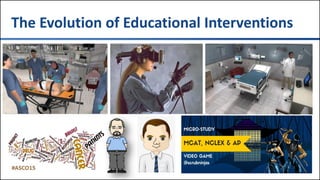
The Evolution of Educational Interventions
#TXCME158
The Evolution of Educational Interventions
#TXCME15
The Challenges of Cognitive Load
#TXCME15
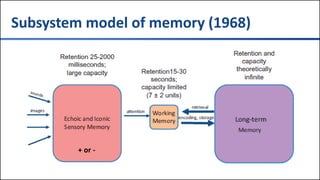
Subsystem model of memory (1968)
+ or -
#TXCME15
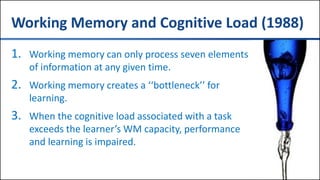
Working Memory and Cognitive Load (1988)
1. Working memory can only process seven elements
of information at any given time.
2. Working memory creates a ‘‘bottleneck’’ for
learning.
3. When the cognitive load associated with a task
exceeds the learner’s WM capacity, performance
and learning is impaired.
#TXCME15
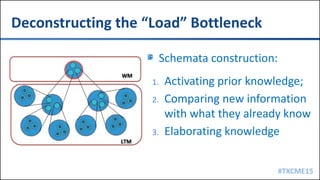
Deconstructing the “Load” Bottleneck
Schemata construction:
1. Activating prior knowledge;
2. Comparing new information
with what they already know
3. Elaborating knowledge
#TXCME15
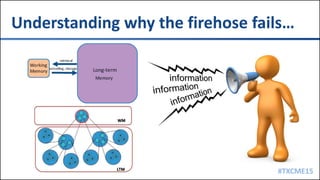
Understanding why the firehose fails…
#TXCME15
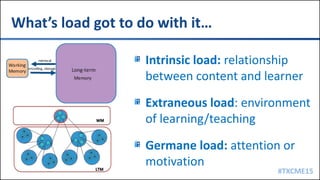
What’s load got to do with it…
Intrinsic load: relationship
between content and learner
Extraneous load: environment
of learning/teaching
Germane load: attention or
motivation
#TXCME15
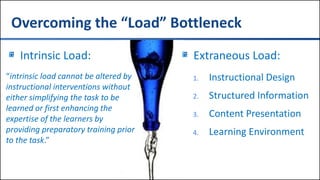
Overcoming the “Load” Bottleneck
Intrinsic Load:
“intrinsic load cannot be altered by
instructional interventions without
either simplifying the task to be
learned or first enhancing the
expertise of the learners by
providing preparatory training prior
to the task.”
Extraneous Load:
1. Instructional Design
2. Structured Information
3. Content Presentation
4. Learning Environment
#TXCME15
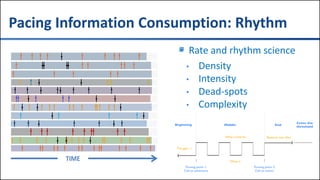
Pacing Information Consumption: Rhythm
Rate and rhythm science
• Density
• Intensity
• Dead-spots
• Complexity
#TXCME15
Reflection Point #1
Do you believe that the memory
science is affected by
age/generational differences?
#TXCME15
Extraneous Load and
The Natural Learning Actions
#TXCME15
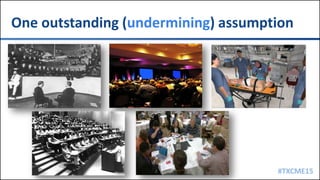
One outstanding (undermining) assumption
#TXCME15
Do Learners Know
How to Learn?
#TXCME15
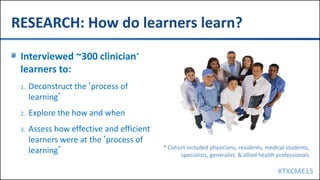
RESEARCH: How do learners learn?
Interviewed ~300 clinician*
learners to:
1. Deconstruct the‘process of
learning’
2. Explore the how and when
3. Assess how effective and efficient
learners were at the‘process of
learning’ * Cohort included physicians, residents, medical students,
specialists, generalist, & allied health professionals
#TXCME15
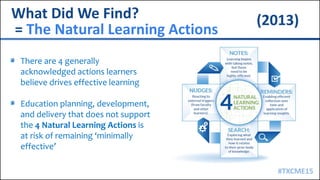
What Did We Find?
= The Natural Learning Actions
There are 4 generally
acknowledged actions learners
believe drives effective learning
Education planning, development,
and delivery that does not support
the 4 Natural Learning Actions is
at risk of remaining ‘minimally
effective’
(2013)
#TXCME15
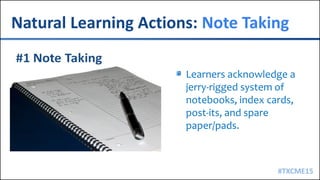
Natural Learning Actions: Note Taking
Learners acknowledge a
jerry-rigged system of
notebooks, index cards,
post-its, and spare
paper/pads.
#TXCME15
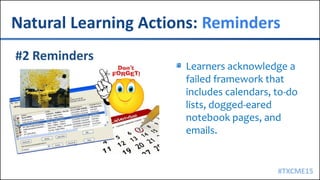
Natural Learning Actions: Reminders
Learners acknowledge a
failed framework that
includes calendars, to-do
lists, dogged-eared
notebook pages, and
emails.
#TXCME15
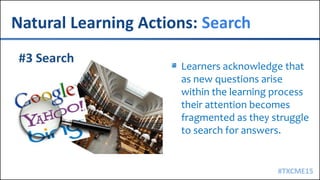
Natural Learning Actions: Search
Learners acknowledge that
as new questions arise
within the learning process
their attention becomes
fragmented as they struggle
to search for answers.
#TXCME15
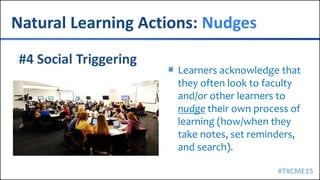
Natural Learning Actions: Nudges
Learners acknowledge that
they often look to faculty
and/or other learners to
nudge their own process of
learning (how/when they
take notes, set reminders,
and search).
#TXCME15
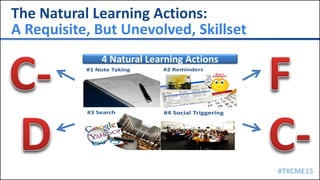
The Natural Learning Actions:
A Requisite, But Unevolved, Skillset
4 Natural Learning Actions
#TXCME15
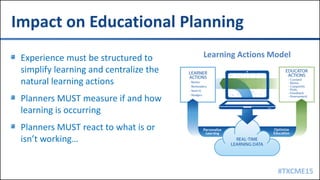
Impact on Educational Planning
Experience must be structured to
simplify learning and centralize the
natural learning actions
Planners MUST measure if and how
learning is occurring
Planners MUST react to what is or
isn’t working…
Learning Actions Model
#TXCME15
Reflection Point #2
Do you believe that the process of
learning is affected by
age/generational differences?
#TXCME15
Getting Better Over Time:
The Advent of Agile Educational Design
#TXCME15
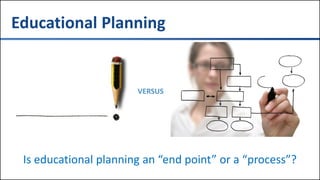
Educational Planning
Is educational planning an “end point” or a “process”?
VERSUS
#TXCME15
There’s never been a perfect activity…
Given the challenges of the cognitive learning
process (i.e., intrinsic load, extraneous load,
germane load…)
Given the complexity of instructional design,
structured information, content presentation,
learning environment, and unevolved natural
learning actions
Given the heterogeneity of audiences, teams,
and/or culture
Our activities will NEVER be perfect right out
of the gate… ergo, it is a process!
#TXCME15
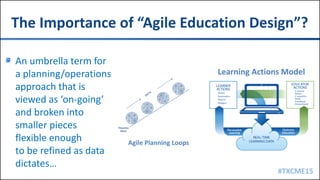
The Importance of “Agile Education Design”?
Agile Planning Loops
An umbrella term for
a planning/operations
approach that is
viewed as ‘on-going’
and broken into
smaller pieces
flexible enough
to be refined as data
dictates…
Learning Actions Model
#TXCME15
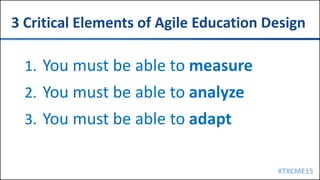
1. You must be able to measure
2. You must be able to analyze
3. You must be able to adapt
3 Critical Elements of Agile Education Design
1. You must be able to measure
2. You must be able to analyze
3. You must be able to adapt
#TXCME15
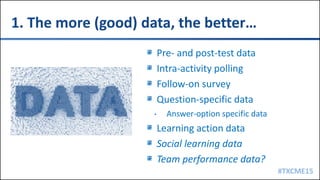
1. The more (good) data, the better…
Pre- and post-test data
Intra-activity polling
Follow-on survey
Question-specific data
• Answer-option specific data
Learning action data
Social learning data
Team performance data?
#TXCME15
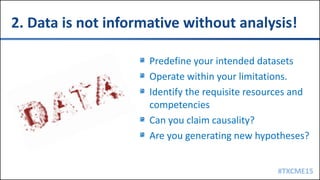
2. Data is not informative without analysis!
Predefine your intended datasets
Operate within your limitations.
Identify the requisite resources and
competencies
Can you claim causality?
Are you generating new hypotheses?
#TXCME15
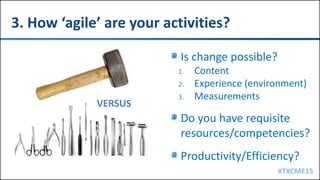
3. How ‘agile’ are your activities?
Is change possible?
1. Content
2. Experience (environment)
3. Measurements
Do you have requisite
resources/competencies?
Productivity/Efficiency?
VERSUS
#TXCME15
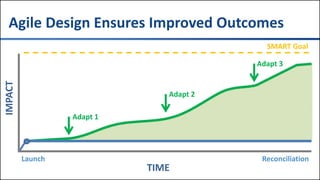
Agile Design Ensures Improved Outcomes
Launch
Adapt 1
Adapt 2
Adapt 3
SMART Goal
Reconciliation
TIME
IMPACT
#TXCME15
Summarize Agile Education Design in IPE
1. Measure – the more (good) data, the better
2. Analyze – but only if you are prepared to
analyze and interpret these data
3. Adapt – and only if you are able to refine and
enhance the activities
#TXCME15
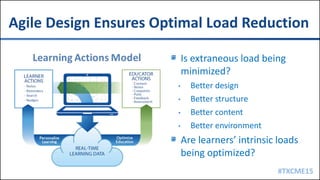
Agile Design Ensures Optimal Load Reduction
Is extraneous load being
minimized?
• Better design
• Better structure
• Better content
• Better environment
Are learners’ intrinsic loads
being optimized?
#TXCME15
Reflection Point #3
Do you believe that an agile
educational planning process can be
used to identify, verify, and address
age/generational differences
(efficiently)?
#TXCME15
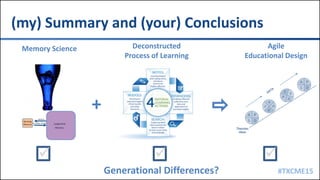
(my) Summary and (your) Conclusions
Memory Science Deconstructed
Process of Learning
Agile
Educational Design
+
  
Generational Differences?
#TXCME15
Brian S McGowan, PhD
Chief Learning Officer
ArcheMedX, Inc.
@briansmcgowan
Do CME Learners Really
Differ Across Generations?

Do Learners Really Differ Across Generations - McGowan #TXCME15 061115

  • 1.
    #TXCME15 Brian S McGowan,PhD Chief Learning Officer ArcheMedX, Inc. @briansmcgowan Do CME Learners Really Differ Across Generations?
  • 2.
    #TXCME15 Objectives: Following this sessionattendees should be prepared to: 1. explore (through an interactive discussion) the question, how do CME learners really learn? 2. describe 4 natural actions learners rely on while consuming educational content 3. identify best practices to mitigate the extraneous load learners confront in traditional learning environments 4. design critical strategies that can be incorporated into your educational program/activities to support more effective and efficient learning 5. recognize similarities and differences of learners across generations
  • 3.
    #TXCME15 Critical Take-Aways: 1. TheCognitive Load of learners is a critical bottleneck that limits the impact of educational interventions or learning experiences. 2. The Learning Actions Model is an novel instructional design technique that frees up working memory by minimizing extraneous load 3. Leveraging Agile Education Design ensures that the learning experience and the learning environment are refined and optimized over time 4. …apply these insights to decide whether generational differences materially impact learning effectiveness
  • 4.
    #TXCME154 The Evolution ofEducational Interventions
  • 5.
    #TXCME155 The Evolution ofEducational Interventions
  • 6.
    #TXCME156 The Evolution ofEducational Interventions
  • 7.
    #TXCME157 The Evolution ofEducational Interventions
  • 8.
    #TXCME158 The Evolution ofEducational Interventions
  • 9.
  • 10.
    #TXCME15 Subsystem model ofmemory (1968) + or -
  • 11.
    #TXCME15 Working Memory andCognitive Load (1988) 1. Working memory can only process seven elements of information at any given time. 2. Working memory creates a ‘‘bottleneck’’ for learning. 3. When the cognitive load associated with a task exceeds the learner’s WM capacity, performance and learning is impaired.
  • 12.
    #TXCME15 Deconstructing the “Load”Bottleneck Schemata construction: 1. Activating prior knowledge; 2. Comparing new information with what they already know 3. Elaborating knowledge
  • 13.
  • 14.
    #TXCME15 What’s load gotto do with it… Intrinsic load: relationship between content and learner Extraneous load: environment of learning/teaching Germane load: attention or motivation
  • 15.
    #TXCME15 Overcoming the “Load”Bottleneck Intrinsic Load: “intrinsic load cannot be altered by instructional interventions without either simplifying the task to be learned or first enhancing the expertise of the learners by providing preparatory training prior to the task.” Extraneous Load: 1. Instructional Design 2. Structured Information 3. Content Presentation 4. Learning Environment
  • 16.
    #TXCME15 Pacing Information Consumption:Rhythm Rate and rhythm science • Density • Intensity • Dead-spots • Complexity
  • 17.
    #TXCME15 Reflection Point #1 Doyou believe that the memory science is affected by age/generational differences?
  • 18.
    #TXCME15 Extraneous Load and TheNatural Learning Actions
  • 19.
  • 20.
  • 21.
    #TXCME15 RESEARCH: How dolearners learn? Interviewed ~300 clinician* learners to: 1. Deconstruct the‘process of learning’ 2. Explore the how and when 3. Assess how effective and efficient learners were at the‘process of learning’ * Cohort included physicians, residents, medical students, specialists, generalist, & allied health professionals
  • 22.
    #TXCME15 What Did WeFind? = The Natural Learning Actions There are 4 generally acknowledged actions learners believe drives effective learning Education planning, development, and delivery that does not support the 4 Natural Learning Actions is at risk of remaining ‘minimally effective’ (2013)
  • 23.
    #TXCME15 Natural Learning Actions:Note Taking Learners acknowledge a jerry-rigged system of notebooks, index cards, post-its, and spare paper/pads.
  • 24.
    #TXCME15 Natural Learning Actions:Reminders Learners acknowledge a failed framework that includes calendars, to-do lists, dogged-eared notebook pages, and emails.
  • 25.
    #TXCME15 Natural Learning Actions:Search Learners acknowledge that as new questions arise within the learning process their attention becomes fragmented as they struggle to search for answers.
  • 26.
    #TXCME15 Natural Learning Actions:Nudges Learners acknowledge that they often look to faculty and/or other learners to nudge their own process of learning (how/when they take notes, set reminders, and search).
  • 27.
    #TXCME15 The Natural LearningActions: A Requisite, But Unevolved, Skillset 4 Natural Learning Actions
  • 28.
    #TXCME15 Impact on EducationalPlanning Experience must be structured to simplify learning and centralize the natural learning actions Planners MUST measure if and how learning is occurring Planners MUST react to what is or isn’t working… Learning Actions Model
  • 29.
    #TXCME15 Reflection Point #2 Doyou believe that the process of learning is affected by age/generational differences?
  • 30.
    #TXCME15 Getting Better OverTime: The Advent of Agile Educational Design
  • 31.
    #TXCME15 Educational Planning Is educationalplanning an “end point” or a “process”? VERSUS
  • 32.
    #TXCME15 There’s never beena perfect activity… Given the challenges of the cognitive learning process (i.e., intrinsic load, extraneous load, germane load…) Given the complexity of instructional design, structured information, content presentation, learning environment, and unevolved natural learning actions Given the heterogeneity of audiences, teams, and/or culture Our activities will NEVER be perfect right out of the gate… ergo, it is a process!
  • 33.
    #TXCME15 The Importance of“Agile Education Design”? Agile Planning Loops An umbrella term for a planning/operations approach that is viewed as ‘on-going’ and broken into smaller pieces flexible enough to be refined as data dictates… Learning Actions Model
  • 34.
    #TXCME15 1. You mustbe able to measure 2. You must be able to analyze 3. You must be able to adapt 3 Critical Elements of Agile Education Design 1. You must be able to measure 2. You must be able to analyze 3. You must be able to adapt
  • 35.
    #TXCME15 1. The more(good) data, the better… Pre- and post-test data Intra-activity polling Follow-on survey Question-specific data • Answer-option specific data Learning action data Social learning data Team performance data?
  • 36.
    #TXCME15 2. Data isnot informative without analysis! Predefine your intended datasets Operate within your limitations. Identify the requisite resources and competencies Can you claim causality? Are you generating new hypotheses?
  • 37.
    #TXCME15 3. How ‘agile’are your activities? Is change possible? 1. Content 2. Experience (environment) 3. Measurements Do you have requisite resources/competencies? Productivity/Efficiency? VERSUS
  • 38.
    #TXCME15 Agile Design EnsuresImproved Outcomes Launch Adapt 1 Adapt 2 Adapt 3 SMART Goal Reconciliation TIME IMPACT
  • 39.
    #TXCME15 Summarize Agile EducationDesign in IPE 1. Measure – the more (good) data, the better 2. Analyze – but only if you are prepared to analyze and interpret these data 3. Adapt – and only if you are able to refine and enhance the activities
  • 40.
    #TXCME15 Agile Design EnsuresOptimal Load Reduction Is extraneous load being minimized? • Better design • Better structure • Better content • Better environment Are learners’ intrinsic loads being optimized?
  • 41.
    #TXCME15 Reflection Point #3 Doyou believe that an agile educational planning process can be used to identify, verify, and address age/generational differences (efficiently)?
  • 42.
    #TXCME15 (my) Summary and(your) Conclusions Memory Science Deconstructed Process of Learning Agile Educational Design +    Generational Differences?
  • 43.
    #TXCME15 Brian S McGowan,PhD Chief Learning Officer ArcheMedX, Inc. @briansmcgowan Do CME Learners Really Differ Across Generations?