EDU120 Principles of
Instructional Design
Stephanie Parlee, MAT, MSCE
Week Overview
 Reading
◦ Chapter 11
◦ Chapter 12
◦ Chapter 13
 Discussion
◦ Motivation
 Discussion
◦ E-Learning Environment
 *** Final Paper ***
Week 5 Learning Outcomes
Explain how to design e-
learning that heightens
motivation.
Understand the techniques
for assuring successful
transference of knowledge.
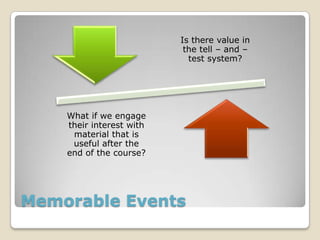
Memorable Events
Is there value in
the tell – and –
test system?
What if we engage
their interest with
material that is
useful after the
end of the course?
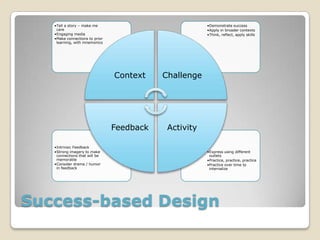
Success-based Design
•Express using different
outlets
•Practice, practice, practice
•Practice over time to
internalize
•Intrinsic Feedback
•Strong imagery to make
connections that will be
memorable
•Consider drama / humor
in feedback
•Demonstrate success
•Apply in broader contexts
•Think, reflect, apply skills
•Tell a story – make me
care
•Engaging media
•Make connections to prior
learning, with mnemonics
Context Challenge
ActivityFeedback
Building Memorable Events
Content -- Strong Story Line
• The author brings in many elements
that affect Content. Far away the
most important factor is to have a
strong story line. Without that
compelling material all of the media
and presentation is just window
dressing.
• Build your foundation first. Know your
material, decide why you think your
audience should care and then
communicate it in a clear and
compelling way.
Building Memorable Events
Challenge -- Utility
• The author describes three attributes that
must be considered with challenges:
• level of difficulty,
• degree of novelty and
• degree of utility.
• First and foremost examine the utility of the
challenge you present. Is this useful to your
learner outside of this classroom?
• Work to ensure that the level of difficulty is
appropriate for the lesson.
• If you are unable to focus on a challenge that
is useful, consider working to make the
experience more memorable through a novel
challenge.
Building Memorable Events
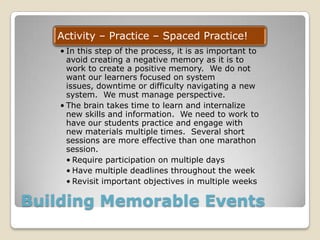
Activity – Practice – Spaced Practice!
• In this step of the process, it is as important to
avoid creating a negative memory as it is to
work to create a positive memory. We do not
want our learners focused on system
issues, downtime or difficulty navigating a new
system. We must manage perspective.
• The brain takes time to learn and internalize
new skills and information. We need to work to
have our students practice and engage with
new materials multiple times. Several short
sessions are more effective than one marathon
session.
• Require participation on multiple days
• Have multiple deadlines throughout the week
• Revisit important objectives in multiple weeks
Building Memorable Events
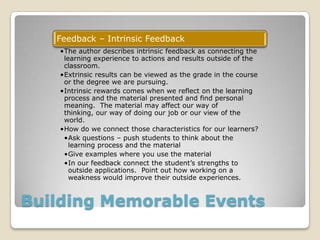
Feedback – Intrinsic Feedback
•The author describes intrinsic feedback as connecting the
learning experience to actions and results outside of the
classroom.
•Extrinsic results can be viewed as the grade in the course
or the degree we are pursuing.
•Intrinsic rewards comes when we reflect on the learning
process and the material presented and find personal
meaning. The material may affect our way of
thinking, our way of doing our job or our view of the
world.
•How do we connect those characteristics for our learners?
•Ask questions – push students to think about the
learning process and the material
•Give examples where you use the material
•In our feedback connect the student’s strengths to
outside applications. Point out how working on a
weakness would improve their outside experiences.
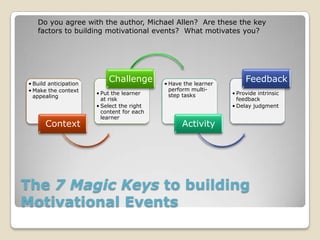
The 7 Magic Keys to building
Motivational Events
• Build anticipation
• Make the context
appealing
Context
• Put the learner
at risk
• Select the right
content for each
learner
Challenge • Have the learner
perform multi-
step tasks
Activity
• Provide intrinsic
feedback
• Delay judgment
Feedback
Do you agree with the author, Michael Allen? Are these the key
factors to building motivational events? What motivates you?
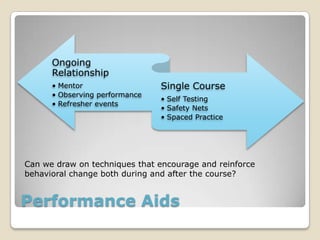
Performance Aids
Ongoing
Relationship
• Mentor
• Observing performance
• Refresher events
Single Course
• Self Testing
• Safety Nets
• Spaced Practice
Can we draw on techniques that encourage and reinforce
behavioral change both during and after the course?
Performance Aids
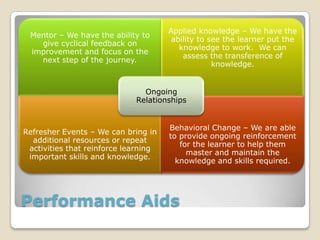
Mentor – We have the ability to
give cyclical feedback on
improvement and focus on the
next step of the journey.
Applied knowledge – We have the
ability to see the learner put the
knowledge to work. We can
assess the transference of
knowledge.
Refresher Events – We can bring in
additional resources or repeat
activities that reinforce learning
important skills and knowledge.
Behavioral Change – We are able
to provide ongoing reinforcement
for the learner to help them
master and maintain the
knowledge and skills required.
Ongoing
Relationships
Performance Aids
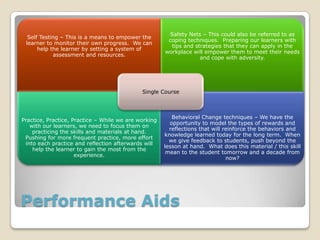
Self Testing – This is a means to empower the
learner to monitor their own progress. We can
help the learner by setting a system of
assessment and resources.
Safety Nets – This could also be referred to as
coping techniques. Preparing our learners with
tips and strategies that they can apply in the
workplace will empower them to meet their needs
and cope with adversity.
Practice, Practice, Practice – While we are working
with our learners, we need to focus them on
practicing the skills and materials at hand.
Pushing for more frequent practice, more effort
into each practice and reflection afterwards will
help the learner to gain the most from the
experience.
Behavioral Change techniques – We have the
opportunity to model the types of rewards and
reflections that will reinforce the behaviors and
knowledge learned today for the long term. When
we give feedback to students, push beyond the
lesson at hand. What does this material / this skill
mean to the student tomorrow and a decade from
now?
Single Course
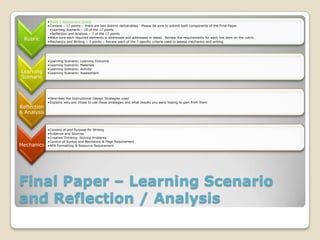
Final Paper – Learning Scenario
and Reflection / Analysis
Rubric
•Week 5 Assignment Rubric
•Content – 17 points – there are two distinct deliverables. Please be sure to submit both components of the Final Paper.
•Learning Scenario – 10 of the 17 points
•Reflection and Analysis – 7 of the 17 points
•Make sure each required elements is addressed and addressed in detail. Review the requirements for each line item on the rubric.
•Mechanics and Writing – 3 points – Review each of the 7 specific criteria used to assess mechanics and writing.
Learning
Scenario
•Learning Scenario: Learning Outcome
•Learning Scenario: Materials
•Learning Scenario: Activity
•Learning Scenario: Assessment
Reflection
& Analysis
•Describes the Instructional Design Strategies used
•Explains why you chose to use these strategies and what results you were hoping to gain from them
Mechanics
•Context of and Purpose for Writing
•Evidence and Sources
•Creative Thinking: Solving Problems
•Control of Syntax and Mechanics & Page Requirement
•APA Formatting & Resource Requirement
Dan Pink– TED Talk
This week we look at motivating learners, creating motivation in others. This is a
big ticket to fill. What works to motivate others? The author stresses intrinsic
rewards over extrinsic rewards. As an educational system, we are often grade
driven, the epitome of extrinsic rewards.
I found a very intriguing TED Talk by Dan Pink called the Puzzle of Motivation. He
looks at the tasks that benefit from extrinsic rewards and those that are actually
harmed by them. Like Michael Allen, he supports the use of intrinsic rewards to
motivate. He lists Autonomy, Mastery and Purpose as key factors in intrinsic
rewards to motivate employees. Can you use this information in your
instructional design?
What do you think of these companies empowering creative employees with 20%
of self directed work time?
Enjoy – and have a great week!
Stephanie

Edu120 week 5 guidance

  • 1.
    EDU120 Principles of InstructionalDesign Stephanie Parlee, MAT, MSCE
  • 2.
    Week Overview  Reading ◦Chapter 11 ◦ Chapter 12 ◦ Chapter 13  Discussion ◦ Motivation  Discussion ◦ E-Learning Environment  *** Final Paper ***
  • 3.
    Week 5 LearningOutcomes Explain how to design e- learning that heightens motivation. Understand the techniques for assuring successful transference of knowledge.
  • 4.
    Memorable Events Is therevalue in the tell – and – test system? What if we engage their interest with material that is useful after the end of the course?
  • 5.
    Success-based Design •Express usingdifferent outlets •Practice, practice, practice •Practice over time to internalize •Intrinsic Feedback •Strong imagery to make connections that will be memorable •Consider drama / humor in feedback •Demonstrate success •Apply in broader contexts •Think, reflect, apply skills •Tell a story – make me care •Engaging media •Make connections to prior learning, with mnemonics Context Challenge ActivityFeedback
  • 6.
    Building Memorable Events Content-- Strong Story Line • The author brings in many elements that affect Content. Far away the most important factor is to have a strong story line. Without that compelling material all of the media and presentation is just window dressing. • Build your foundation first. Know your material, decide why you think your audience should care and then communicate it in a clear and compelling way.
  • 7.
    Building Memorable Events Challenge-- Utility • The author describes three attributes that must be considered with challenges: • level of difficulty, • degree of novelty and • degree of utility. • First and foremost examine the utility of the challenge you present. Is this useful to your learner outside of this classroom? • Work to ensure that the level of difficulty is appropriate for the lesson. • If you are unable to focus on a challenge that is useful, consider working to make the experience more memorable through a novel challenge.
  • 8.
    Building Memorable Events Activity– Practice – Spaced Practice! • In this step of the process, it is as important to avoid creating a negative memory as it is to work to create a positive memory. We do not want our learners focused on system issues, downtime or difficulty navigating a new system. We must manage perspective. • The brain takes time to learn and internalize new skills and information. We need to work to have our students practice and engage with new materials multiple times. Several short sessions are more effective than one marathon session. • Require participation on multiple days • Have multiple deadlines throughout the week • Revisit important objectives in multiple weeks
  • 9.
    Building Memorable Events Feedback– Intrinsic Feedback •The author describes intrinsic feedback as connecting the learning experience to actions and results outside of the classroom. •Extrinsic results can be viewed as the grade in the course or the degree we are pursuing. •Intrinsic rewards comes when we reflect on the learning process and the material presented and find personal meaning. The material may affect our way of thinking, our way of doing our job or our view of the world. •How do we connect those characteristics for our learners? •Ask questions – push students to think about the learning process and the material •Give examples where you use the material •In our feedback connect the student’s strengths to outside applications. Point out how working on a weakness would improve their outside experiences.
  • 10.
    The 7 MagicKeys to building Motivational Events • Build anticipation • Make the context appealing Context • Put the learner at risk • Select the right content for each learner Challenge • Have the learner perform multi- step tasks Activity • Provide intrinsic feedback • Delay judgment Feedback Do you agree with the author, Michael Allen? Are these the key factors to building motivational events? What motivates you?
  • 11.
    Performance Aids Ongoing Relationship • Mentor •Observing performance • Refresher events Single Course • Self Testing • Safety Nets • Spaced Practice Can we draw on techniques that encourage and reinforce behavioral change both during and after the course?
  • 12.
    Performance Aids Mentor –We have the ability to give cyclical feedback on improvement and focus on the next step of the journey. Applied knowledge – We have the ability to see the learner put the knowledge to work. We can assess the transference of knowledge. Refresher Events – We can bring in additional resources or repeat activities that reinforce learning important skills and knowledge. Behavioral Change – We are able to provide ongoing reinforcement for the learner to help them master and maintain the knowledge and skills required. Ongoing Relationships
  • 13.
    Performance Aids Self Testing– This is a means to empower the learner to monitor their own progress. We can help the learner by setting a system of assessment and resources. Safety Nets – This could also be referred to as coping techniques. Preparing our learners with tips and strategies that they can apply in the workplace will empower them to meet their needs and cope with adversity. Practice, Practice, Practice – While we are working with our learners, we need to focus them on practicing the skills and materials at hand. Pushing for more frequent practice, more effort into each practice and reflection afterwards will help the learner to gain the most from the experience. Behavioral Change techniques – We have the opportunity to model the types of rewards and reflections that will reinforce the behaviors and knowledge learned today for the long term. When we give feedback to students, push beyond the lesson at hand. What does this material / this skill mean to the student tomorrow and a decade from now? Single Course
  • 14.
    Final Paper –Learning Scenario and Reflection / Analysis Rubric •Week 5 Assignment Rubric •Content – 17 points – there are two distinct deliverables. Please be sure to submit both components of the Final Paper. •Learning Scenario – 10 of the 17 points •Reflection and Analysis – 7 of the 17 points •Make sure each required elements is addressed and addressed in detail. Review the requirements for each line item on the rubric. •Mechanics and Writing – 3 points – Review each of the 7 specific criteria used to assess mechanics and writing. Learning Scenario •Learning Scenario: Learning Outcome •Learning Scenario: Materials •Learning Scenario: Activity •Learning Scenario: Assessment Reflection & Analysis •Describes the Instructional Design Strategies used •Explains why you chose to use these strategies and what results you were hoping to gain from them Mechanics •Context of and Purpose for Writing •Evidence and Sources •Creative Thinking: Solving Problems •Control of Syntax and Mechanics & Page Requirement •APA Formatting & Resource Requirement
  • 15.
    Dan Pink– TEDTalk This week we look at motivating learners, creating motivation in others. This is a big ticket to fill. What works to motivate others? The author stresses intrinsic rewards over extrinsic rewards. As an educational system, we are often grade driven, the epitome of extrinsic rewards. I found a very intriguing TED Talk by Dan Pink called the Puzzle of Motivation. He looks at the tasks that benefit from extrinsic rewards and those that are actually harmed by them. Like Michael Allen, he supports the use of intrinsic rewards to motivate. He lists Autonomy, Mastery and Purpose as key factors in intrinsic rewards to motivate employees. Can you use this information in your instructional design? What do you think of these companies empowering creative employees with 20% of self directed work time? Enjoy – and have a great week! Stephanie