From Principle to Practice
#LSRNEastMids Nottingham College
@MikeTylerSport
Planning & Curriculum Structure
Pedagogical Content Knowledge
has strong evidence of impact on student outcomes according to Coe (2014)
How do students think about the content?
What are students’ common misconceptions and mistakes?
How do concepts relate, fit together, build on other concepts?
In what order should concepts be taught? Why?
What modes of instruction does this content lend itself to?
Research
Sweller Cognitive Load Theory
ACQUISITION
Kirschner, Sweller & Clark
Why Minimal Guidance During
Instruction Does Not Work
Ebbinghaus Forgetting Curve
RETRIEVAL
Söderström & Björk Learning Versus Performance
ACQUISITION
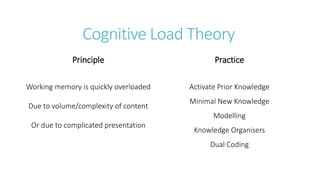
Cognitive Load Theory
Principle Practice
Activate Prior Knowledge
Minimal New Knowledge
Modelling
Knowledge Organisers
Dual Coding
Working memory is quickly overloaded
Due to volume/complexity of content
Or due to complicated presentation
e.g. ‘Live’ exam answer modelling
‘Worked example effect’ enables focus on comprehension
rather than problem solving (reducing WM load)
Teacher can later withdraw/fade scaffold
Gives student insight into expert thought
processes and self-correcting
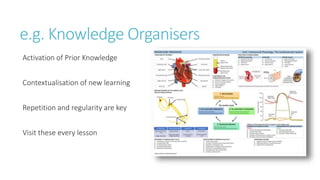
e.g. Knowledge Organisers
Activation of Prior Knowledge
Contextualisation of new learning
Repetition and regularity are key
Visit these every lesson
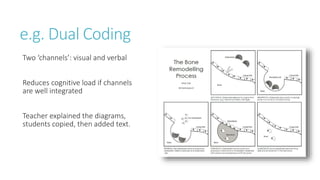
e.g. Dual Coding
Two ‘channels’: visual and verbal
Reduces cognitive load if channels
are well integrated
Teacher explained the diagrams,
students copied, then added text.
RETRIEVAL
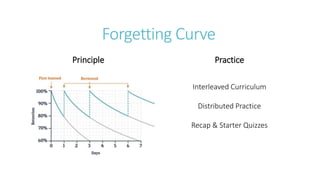
Forgetting Curve
Principle Practice
Interleaved Curriculum
Distributed Practice
Recap & Starter Quizzes
e.g. Starter Quizzes
Diagnostic for teacher and student
Informs teacher of re-teach needs
Directs student to further practice*
Learning Versus Performance
Principle Practice
Interleaved Curriculum
Practice not Plenaries
Learning requires intervals between
acquisition and retrieval
Therefore plenaries probably do not
evidence learning, only performance
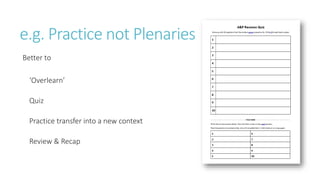
e.g. Practice not Plenaries
Better to
‘Overlearn’
Quiz
Practice transfer into a new context
Review & Recap
Caveats
Constraints Concerns
Timetabling constraints
Part-time teaching
Student ‘engagement’
Am I in a system that
undermines my efforts?!
Am I doing it right?
Is the cost worth it?
Have I missed something?
What’s next?
Acquisition: Threshold Concepts
Retrieval: Online Quiz Bank
From Principle to Practice
#LSRNEastMids Nottingham College
@MikeTylerSport
References
Coe, R., Aloisi, C., Higgins, S, & Elliot Major, L. (2014) What makes great teaching? Review of the
underpinning research. Sutton Trust.
Kirschner, P.A., Sweller, J. & Clark, R.E. (2006) Why Minimal Guidance During Instruction Does Not
Work: An Analysis of the Failure of Constructivist, Discovery, Problem-Based, Experiential, and Inquiry-
Based Teaching. Educational Psychologist, 41(2), 75–86
Soderstrom, N.C. & Bjork, R.A. (2015) Learning Versus Performance: An Integrative Review. Perspectives
on Psychological Science, 10(2), 176–199.
Sweller, J. (2006) The worked example effect and human cognition. Learning and Instruction, 16, 165-
169.

From Principle to Practice

  • 1.
    From Principle toPractice #LSRNEastMids Nottingham College @MikeTylerSport
  • 2.
    Planning & CurriculumStructure Pedagogical Content Knowledge has strong evidence of impact on student outcomes according to Coe (2014) How do students think about the content? What are students’ common misconceptions and mistakes? How do concepts relate, fit together, build on other concepts? In what order should concepts be taught? Why? What modes of instruction does this content lend itself to?
  • 3.
    Research Sweller Cognitive LoadTheory ACQUISITION Kirschner, Sweller & Clark Why Minimal Guidance During Instruction Does Not Work Ebbinghaus Forgetting Curve RETRIEVAL Söderström & Björk Learning Versus Performance
  • 4.
  • 5.
    Cognitive Load Theory PrinciplePractice Activate Prior Knowledge Minimal New Knowledge Modelling Knowledge Organisers Dual Coding Working memory is quickly overloaded Due to volume/complexity of content Or due to complicated presentation
  • 6.
    e.g. ‘Live’ examanswer modelling ‘Worked example effect’ enables focus on comprehension rather than problem solving (reducing WM load) Teacher can later withdraw/fade scaffold Gives student insight into expert thought processes and self-correcting
  • 7.
    e.g. Knowledge Organisers Activationof Prior Knowledge Contextualisation of new learning Repetition and regularity are key Visit these every lesson
  • 8.
    e.g. Dual Coding Two‘channels’: visual and verbal Reduces cognitive load if channels are well integrated Teacher explained the diagrams, students copied, then added text.
  • 9.
  • 10.
    Forgetting Curve Principle Practice InterleavedCurriculum Distributed Practice Recap & Starter Quizzes
  • 11.
    e.g. Starter Quizzes Diagnosticfor teacher and student Informs teacher of re-teach needs Directs student to further practice*
  • 12.
    Learning Versus Performance PrinciplePractice Interleaved Curriculum Practice not Plenaries Learning requires intervals between acquisition and retrieval Therefore plenaries probably do not evidence learning, only performance
  • 13.
    e.g. Practice notPlenaries Better to ‘Overlearn’ Quiz Practice transfer into a new context Review & Recap
  • 14.
    Caveats Constraints Concerns Timetabling constraints Part-timeteaching Student ‘engagement’ Am I in a system that undermines my efforts?! Am I doing it right? Is the cost worth it? Have I missed something?
  • 15.
    What’s next? Acquisition: ThresholdConcepts Retrieval: Online Quiz Bank
  • 16.
    From Principle toPractice #LSRNEastMids Nottingham College @MikeTylerSport
  • 17.
    References Coe, R., Aloisi,C., Higgins, S, & Elliot Major, L. (2014) What makes great teaching? Review of the underpinning research. Sutton Trust. Kirschner, P.A., Sweller, J. & Clark, R.E. (2006) Why Minimal Guidance During Instruction Does Not Work: An Analysis of the Failure of Constructivist, Discovery, Problem-Based, Experiential, and Inquiry- Based Teaching. Educational Psychologist, 41(2), 75–86 Soderstrom, N.C. & Bjork, R.A. (2015) Learning Versus Performance: An Integrative Review. Perspectives on Psychological Science, 10(2), 176–199. Sweller, J. (2006) The worked example effect and human cognition. Learning and Instruction, 16, 165- 169.