



Manual Handling
by
Lee Kennedy
KVF Consultants Ltd.
Introductions
 Introduction
 Health & safety
 Mobile phones
 Breaks
 Behaviour
 Comfort Breaks
Today’s Training Programme
 Causes of Back Pain
 Anatomy and Injury
 Legislation and Risk Assessment
 Correct Body Mechanics and Practical
Techniques
 Video / DVD
 Summary and Test
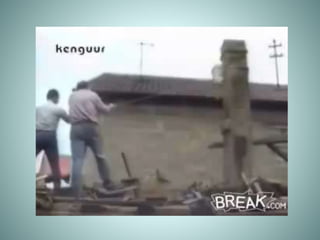
What Risks?
Spot the hazards!
Manual Handling
Definition:
The application of human effort
directly, or indirectly, to transport or
support a load
Manual Handling Operations
Regulations 1992 – amended 2002
 Applies to:
 Lifting, lowering, pulling or pushing
 Inanimate loads – box or trolley
 Animate – animal or person
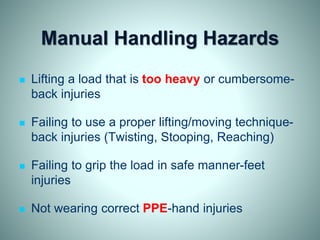
Manual Handling Hazards
 Lifting a load that is too heavy or cumbersome-
back injuries
 Failing to use a proper lifting/moving technique-
back injuries (Twisting, Stooping, Reaching)
 Failing to grip the load in safe manner-feet
injuries
 Not wearing correct PPE-hand injuries
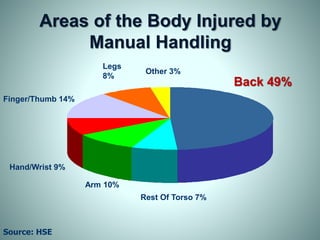
Areas of the Body Injured by
Manual Handling
Finger/Thumb 14%
Back 49%
Rest Of Torso 7%
Arm 10%
Hand/Wrist 9%
Legs
8%
Other 3%
Source: HSE
Why Are Back Problems
Increasing?
Two Key Reasons:
1. Our physical condition
2. Increased Medical Management
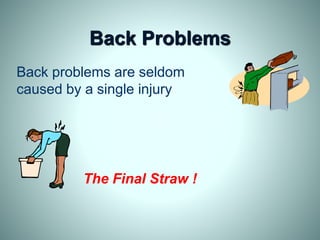
Back Problems
Back problems are seldom
caused by a single injury
The Final Straw !
5 Generic Reasons for Back
Pain
 Poor posture
 Lifting and handling incorrectly
 Stress
 Lifestyle
 Can stem from a poor level of physical
fitness
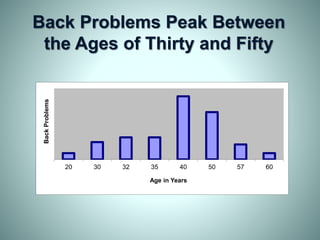
20 30 32 35 40 50 57 60
BackProblems
Age in Years
Back Problems Peak Between
the Ages of Thirty and Fifty
Questions?
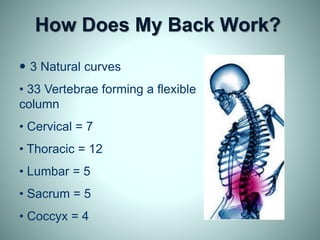
How Does My Back Work?
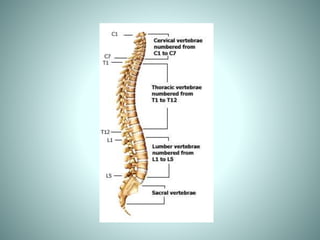
• 3 Natural curves
• 33 Vertebrae forming a flexible
column
• Cervical = 7
• Thoracic = 12
• Lumbar = 5
• Sacrum = 5
• Coccyx = 4
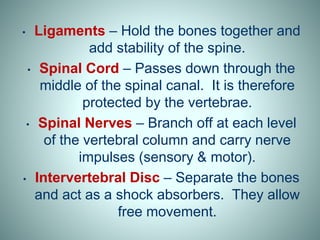
• Ligaments – Hold the bones together and
add stability of the spine.
• Spinal Cord – Passes down through the
middle of the spinal canal. It is therefore
protected by the vertebrae.
• Spinal Nerves – Branch off at each level
of the vertebral column and carry nerve
impulses (sensory & motor).
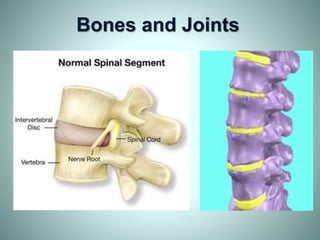
• Intervertebral Disc – Separate the bones
and act as a shock absorbers. They allow
free movement.
Bones and Joints
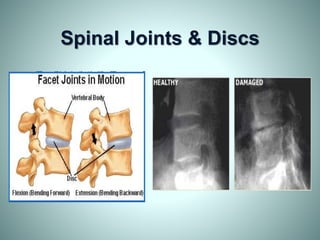
Spinal Joints & Discs
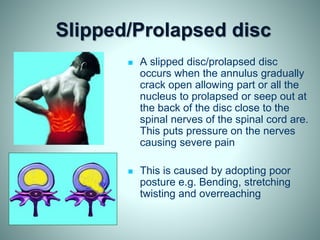
Slipped/Prolapsed disc
 A slipped disc/prolapsed disc
occurs when the annulus gradually
crack open allowing part or all the
nucleus to prolapsed or seep out at
the back of the disc close to the
spinal nerves of the spinal cord are.
This puts pressure on the nerves
causing severe pain
 This is caused by adopting poor
posture e.g. Bending, stretching
twisting and overreaching
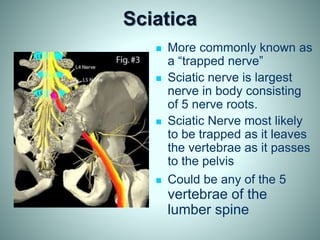
Sciatica
 More commonly known as
a “trapped nerve”
 Sciatic nerve is largest
nerve in body consisting
of 5 nerve roots.
 Sciatic Nerve most likely
to be trapped as it leaves
the vertebrae as it passes
to the pelvis
 Could be any of the 5
vertebrae of the
lumber spine
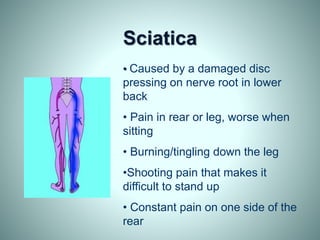
Sciatica
• Caused by a damaged disc
pressing on nerve root in lower
back
• Pain in rear or leg, worse when
sitting
• Burning/tingling down the leg
•Shooting pain that makes it
difficult to stand up
• Constant pain on one side of the
rear
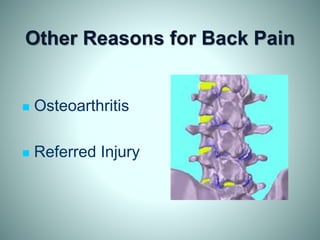
Other Reasons for Back Pain
 Osteoarthritis
 Referred Injury
Risk Factors for Yourselves
 In a rush to do a task
 Awkward / critical lifting
 Cold
 Uncontrolled situations
 Inactivity - sitting
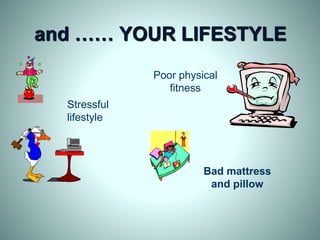
and …… YOUR LIFESTYLE
Stressful
lifestyle
Poor physical
fitness
Bad mattress
and pillow
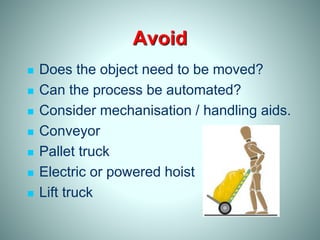
Avoid
 Does the object need to be moved?
 Can the process be automated?
 Consider mechanisation / handling aids.
 Conveyor
 Pallet truck
 Electric or powered hoist
 Lift truck
Assess
Does the task involve?
 Holding loads away from the body
 Twisting, stooping or reaching upwards
 Long carrying distances
 Strenuous pushing or pulling
 Repetitive handling
 Insufficient rest or recovery time
Reduce
 To the lowest level “reasonably
practicable”
 TIME v EFFORT v MONEY in proportion
to the benefits
 Mechanical aids can reduce the risk
 They can also improve productivity
Employees Duties
 Safe systems of work
 Proper use of equipment
 Co-operation with employer
 Inform employer of hazardous activities
 Do not put others at risk
Questions?
Good Handling Technique for
Lifting
 Plan the lift
 Can an aid be used?
 Where’s it going
 Do I need help?
 Will I need to rest?
Good Handling Technique for
Lifting
The 1 minute Risk Assessment
Good Handling Technique for
Lifting
 T - TASK
 I - INDIVIDUAL
 L - LOAD
 E - ENVIRONMENT
Task
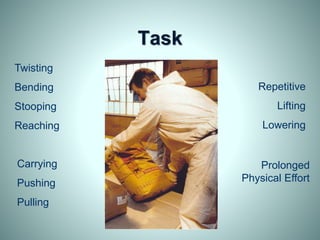
Twisting
Bending
Stooping
Reaching
Carrying
Pushing
Pulling
Repetitive
Lifting
Lowering
Prolonged
Physical Effort
Task – reducing the injury
Can you?
 Use a lifting aid?
 Improve workplace layout?
 Reduce amount of twisting & stooping?
 Avoid lifting from floor to above shoulder
height
 Reduce carrying distances?
 Push rather than Pull
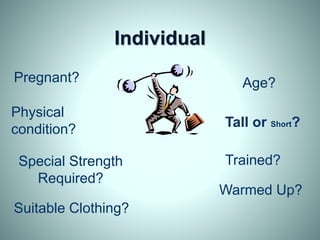
Individual
Pregnant?
Trained?
Physical
condition?
Age?
Special Strength
Required?
Warmed Up?
Suitable Clothing?
Tall or Short?
Individual – reducing the
injury
Can you:
 Pay particular attention to those who have a
physical weakness
 Take extra care of pregnant workers
 Give your colleagues more info. Eg the range of
tasks they are likely to face
 Provide more training
 Get advice from Occupational health if needed
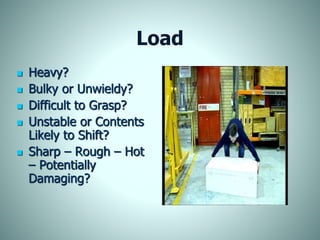
Load
 Heavy?
 Bulky or Unwieldy?
 Difficult to Grasp?
 Unstable or Contents
Likely to Shift?
 Sharp – Rough – Hot
– Potentially
Damaging?
Load – reducing the injury
Can you make the load:
 Lighter or less bulky
 Easier to grasp
 More stable
 Less damaging to hold
 If the load comes from elsewhere, have you
asked the employer to help – handles or
smaller packages
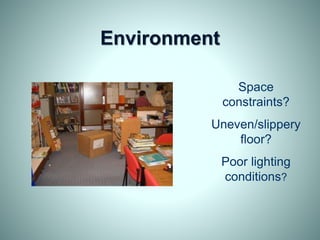
Environment
Space
constraints?
Uneven/slippery
floor?
Poor lighting
conditions?
Environment – reducing the
injury
Can you:
 Remove obstructions to free movement
 Provide better flooring
 Avoid steps & steep ramps
 Prevent extremes of hot & cold
 Wear less restrictive PPE
 Improve lighting
 Ensure PPE is correct for the task
Engage ‘TILE’ to Avoid!
The Brickies?
Questions?
Correct Lifting Procedure
Challenge!!
A volunteer please to show us how
they lift – the rest of the group
decide and we’ll discuss
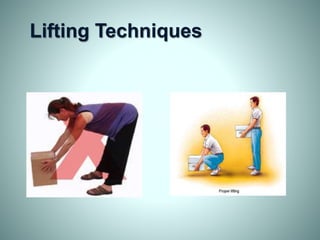
Good Handling Technique for
Lifting
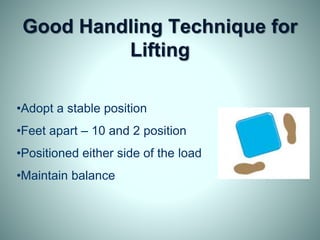
•Adopt a stable position
•Feet apart – 10 and 2 position
•Positioned either side of the load
•Maintain balance
Good Handling Technique for
Lifting
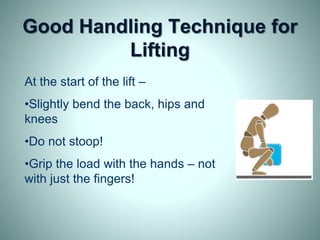
At the start of the lift –
•Slightly bend the back, hips and
knees
•Do not stoop!
•Grip the load with the hands – not
with just the fingers!
Good Handling Technique for
Lifting
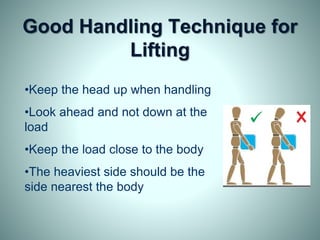
•Keep the head up when handling
•Look ahead and not down at the
load
•Keep the load close to the body
•The heaviest side should be the
side nearest the body
Good Handling Technique for
Lifting
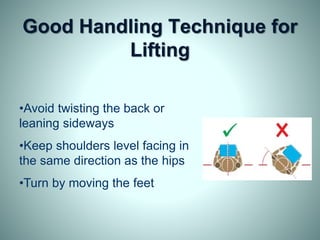
•Avoid twisting the back or
leaning sideways
•Keep shoulders level facing in
the same direction as the hips
•Turn by moving the feet
Good Handling Technique for
Lifting
 Move smoothly
 Do not jerk or snatch the load
 This can be harder to control and can
increase the risk of injury
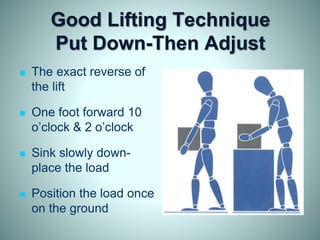
Good Lifting Technique
Put Down-Then Adjust
 The exact reverse of
the lift
 One foot forward 10
o’clock & 2 o’clock
 Sink slowly down-
place the load
 Position the load once
on the ground
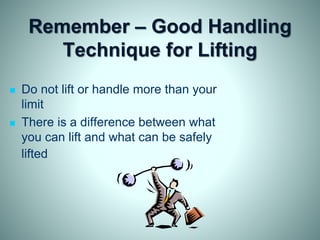
Remember – Good Handling
Technique for Lifting
 Do not lift or handle more than your
limit
 There is a difference between what
you can lift and what can be safely
lifted
Practical Activity
Questions?
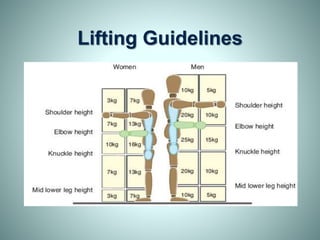
Lifting Guidelines
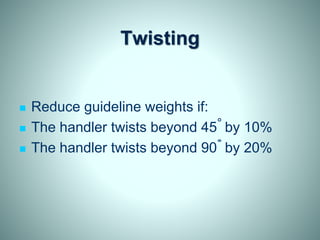
Twisting
 Reduce guideline weights if:
 The handler twists beyond 45 by 10%
 The handler twists beyond 90 by 20%
Frequent Lifting
 Infrequent operators = 30 operations per
hour
 Once or twice per minute reduce by 30%
 5 to 8 per minute reduce by 50%
 More than 12 per minute reduce by 80%
If You Hurt Your Back
 Report the incident to your line manager
as soon as possible
 Seek medical advice if in acute pain or
symptoms last longer than 72 hours
 Contact the Occupational Health
Department for advice
Questions?
Test Time!!
Summary
Remember!
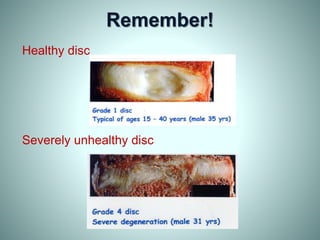
Healthy disc
Severely unhealthy disc
Lifting Techniques
Questions?

Kvf manual handling session

  • 1.
  • 2.
    Introductions  Introduction  Health& safety  Mobile phones  Breaks  Behaviour  Comfort Breaks
  • 3.
    Today’s Training Programme Causes of Back Pain  Anatomy and Injury  Legislation and Risk Assessment  Correct Body Mechanics and Practical Techniques  Video / DVD  Summary and Test
  • 4.
  • 6.
    Manual Handling Definition: The applicationof human effort directly, or indirectly, to transport or support a load
  • 7.
    Manual Handling Operations Regulations1992 – amended 2002  Applies to:  Lifting, lowering, pulling or pushing  Inanimate loads – box or trolley  Animate – animal or person
  • 8.
    Manual Handling Hazards Lifting a load that is too heavy or cumbersome- back injuries  Failing to use a proper lifting/moving technique- back injuries (Twisting, Stooping, Reaching)  Failing to grip the load in safe manner-feet injuries  Not wearing correct PPE-hand injuries
  • 9.
    Areas of theBody Injured by Manual Handling Finger/Thumb 14% Back 49% Rest Of Torso 7% Arm 10% Hand/Wrist 9% Legs 8% Other 3% Source: HSE
  • 10.
    Why Are BackProblems Increasing? Two Key Reasons: 1. Our physical condition 2. Increased Medical Management
  • 11.
    Back Problems Back problemsare seldom caused by a single injury The Final Straw !
  • 12.
    5 Generic Reasonsfor Back Pain  Poor posture  Lifting and handling incorrectly  Stress  Lifestyle  Can stem from a poor level of physical fitness
  • 13.
    20 30 3235 40 50 57 60 BackProblems Age in Years Back Problems Peak Between the Ages of Thirty and Fifty
  • 14.
  • 15.
    How Does MyBack Work? • 3 Natural curves • 33 Vertebrae forming a flexible column • Cervical = 7 • Thoracic = 12 • Lumbar = 5 • Sacrum = 5 • Coccyx = 4
  • 17.
    • Ligaments –Hold the bones together and add stability of the spine. • Spinal Cord – Passes down through the middle of the spinal canal. It is therefore protected by the vertebrae. • Spinal Nerves – Branch off at each level of the vertebral column and carry nerve impulses (sensory & motor). • Intervertebral Disc – Separate the bones and act as a shock absorbers. They allow free movement.
  • 18.
  • 19.
  • 20.
    Slipped/Prolapsed disc  Aslipped disc/prolapsed disc occurs when the annulus gradually crack open allowing part or all the nucleus to prolapsed or seep out at the back of the disc close to the spinal nerves of the spinal cord are. This puts pressure on the nerves causing severe pain  This is caused by adopting poor posture e.g. Bending, stretching twisting and overreaching
  • 21.
    Sciatica  More commonlyknown as a “trapped nerve”  Sciatic nerve is largest nerve in body consisting of 5 nerve roots.  Sciatic Nerve most likely to be trapped as it leaves the vertebrae as it passes to the pelvis  Could be any of the 5 vertebrae of the lumber spine
  • 22.
    Sciatica • Caused bya damaged disc pressing on nerve root in lower back • Pain in rear or leg, worse when sitting • Burning/tingling down the leg •Shooting pain that makes it difficult to stand up • Constant pain on one side of the rear
  • 23.
    Other Reasons forBack Pain  Osteoarthritis  Referred Injury
  • 24.
    Risk Factors forYourselves  In a rush to do a task  Awkward / critical lifting  Cold  Uncontrolled situations  Inactivity - sitting
  • 25.
    and …… YOURLIFESTYLE Stressful lifestyle Poor physical fitness Bad mattress and pillow
  • 26.
    Avoid  Does theobject need to be moved?  Can the process be automated?  Consider mechanisation / handling aids.  Conveyor  Pallet truck  Electric or powered hoist  Lift truck
  • 27.
    Assess Does the taskinvolve?  Holding loads away from the body  Twisting, stooping or reaching upwards  Long carrying distances  Strenuous pushing or pulling  Repetitive handling  Insufficient rest or recovery time
  • 28.
    Reduce  To thelowest level “reasonably practicable”  TIME v EFFORT v MONEY in proportion to the benefits  Mechanical aids can reduce the risk  They can also improve productivity
  • 29.
    Employees Duties  Safesystems of work  Proper use of equipment  Co-operation with employer  Inform employer of hazardous activities  Do not put others at risk
  • 30.
  • 31.
    Good Handling Techniquefor Lifting  Plan the lift  Can an aid be used?  Where’s it going  Do I need help?  Will I need to rest?
  • 32.
    Good Handling Techniquefor Lifting The 1 minute Risk Assessment
  • 33.
    Good Handling Techniquefor Lifting  T - TASK  I - INDIVIDUAL  L - LOAD  E - ENVIRONMENT
  • 34.
  • 35.
    Task – reducingthe injury Can you?  Use a lifting aid?  Improve workplace layout?  Reduce amount of twisting & stooping?  Avoid lifting from floor to above shoulder height  Reduce carrying distances?  Push rather than Pull
  • 36.
  • 37.
    Individual – reducingthe injury Can you:  Pay particular attention to those who have a physical weakness  Take extra care of pregnant workers  Give your colleagues more info. Eg the range of tasks they are likely to face  Provide more training  Get advice from Occupational health if needed
  • 38.
    Load  Heavy?  Bulkyor Unwieldy?  Difficult to Grasp?  Unstable or Contents Likely to Shift?  Sharp – Rough – Hot – Potentially Damaging?
  • 39.
    Load – reducingthe injury Can you make the load:  Lighter or less bulky  Easier to grasp  More stable  Less damaging to hold  If the load comes from elsewhere, have you asked the employer to help – handles or smaller packages
  • 40.
  • 41.
    Environment – reducingthe injury Can you:  Remove obstructions to free movement  Provide better flooring  Avoid steps & steep ramps  Prevent extremes of hot & cold  Wear less restrictive PPE  Improve lighting  Ensure PPE is correct for the task
  • 42.
    Engage ‘TILE’ toAvoid! The Brickies?
  • 44.
  • 45.
    Correct Lifting Procedure Challenge!! Avolunteer please to show us how they lift – the rest of the group decide and we’ll discuss
  • 46.
    Good Handling Techniquefor Lifting •Adopt a stable position •Feet apart – 10 and 2 position •Positioned either side of the load •Maintain balance
  • 47.
    Good Handling Techniquefor Lifting At the start of the lift – •Slightly bend the back, hips and knees •Do not stoop! •Grip the load with the hands – not with just the fingers!
  • 48.
    Good Handling Techniquefor Lifting •Keep the head up when handling •Look ahead and not down at the load •Keep the load close to the body •The heaviest side should be the side nearest the body
  • 49.
    Good Handling Techniquefor Lifting •Avoid twisting the back or leaning sideways •Keep shoulders level facing in the same direction as the hips •Turn by moving the feet
  • 50.
    Good Handling Techniquefor Lifting  Move smoothly  Do not jerk or snatch the load  This can be harder to control and can increase the risk of injury
  • 51.
    Good Lifting Technique PutDown-Then Adjust  The exact reverse of the lift  One foot forward 10 o’clock & 2 o’clock  Sink slowly down- place the load  Position the load once on the ground
  • 52.
    Remember – GoodHandling Technique for Lifting  Do not lift or handle more than your limit  There is a difference between what you can lift and what can be safely lifted
  • 53.
  • 54.
  • 56.
  • 57.
    Twisting  Reduce guidelineweights if:  The handler twists beyond 45 by 10%  The handler twists beyond 90 by 20%
  • 58.
    Frequent Lifting  Infrequentoperators = 30 operations per hour  Once or twice per minute reduce by 30%  5 to 8 per minute reduce by 50%  More than 12 per minute reduce by 80%
  • 59.
    If You HurtYour Back  Report the incident to your line manager as soon as possible  Seek medical advice if in acute pain or symptoms last longer than 72 hours  Contact the Occupational Health Department for advice
  • 60.
  • 61.
  • 62.
  • 63.
  • 64.
  • 65.