Denise Dumont- Bernier, PT, Director
Workplace Health & MGMC Express Care
Ergonomics &
Employee Behavior Change
How To Teach An “Old Dog” New Tricks
Today’s Objectives
What are the 3 essential ergonomics elements?
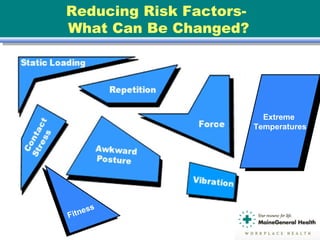
Reducing risk factors- what can be changed?
Understand behavior change process
Set employees up for success
Teaching the “old dogs” new tricks
Summary
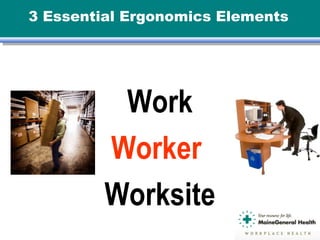
3 Essential Ergonomics Elements
Work
Worker
Worksite
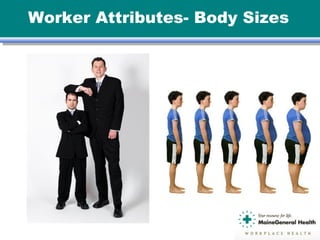
Worker Attributes- Body Sizes
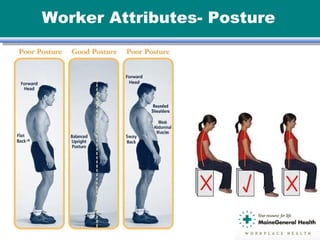
Worker Attributes- Posture
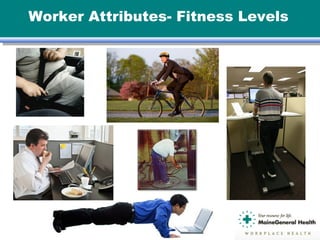
Worker Attributes- Fitness Levels
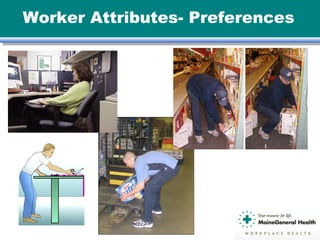
Worker Attributes- Preferences
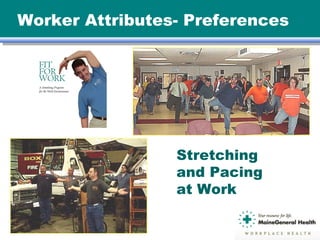
Stretching
and Pacing
at Work
Worker Attributes- Preferences
Reducing Risk Factors-
What Can Be Changed?
Fitness
Extreme
Temperatures
Fitness
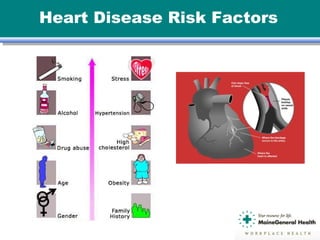
Heart Disease Risk Factors
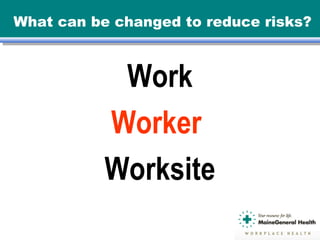
What can be changed to reduce risks?
Work
Worker
Worksite
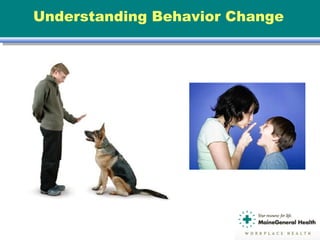
Understanding Behavior Change
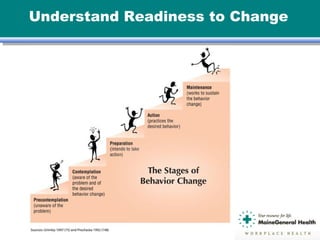
Understand Readiness to Change
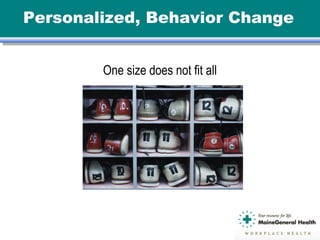
Personalized, Behavior Change
One size does not fit all
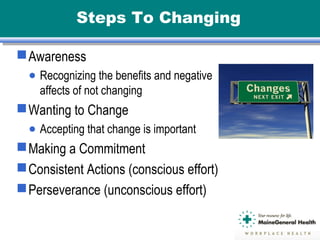
Steps To Changing
Awareness
● Recognizing the benefits and negative
affects of not changing
Wanting to Change
● Accepting that change is important
Making a Commitment
Consistent Actions (conscious effort)
Perseverance (unconscious effort)
Setting Employees Up For Success
Helping them to take better
care of themselves at work
Whose responsibility is it?
Step 1: Raise Awareness and
Educate
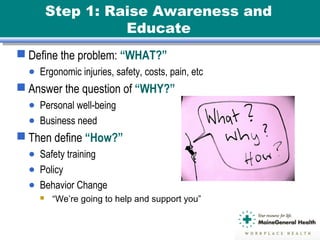
 Define the problem: “WHAT?”
● Ergonomic injuries, safety, costs, pain, etc
 Answer the question of “WHY?”
● Personal well-being
● Business need
 Then define “How?”
● Safety training
● Policy
● Behavior Change
 “We’re going to help and support you”
Step 2: Resolve Ambivalence
Specific Tools- MI
Motivational interviewing (MI)
● Client-centered counseling that explores
and resolves ambivalence
Pros & cons exercise
Assess importance and confidence
● Should I? and Could I?
Looking back/looking forward
Exploring goals “right sized steps”
Step 3: Take Action
 Set clear expectations
 Emphasize “why” it’s important
 Begin practicing (conscious effort)
 Positive reinforcements- messaging
● If wrong behaviors are observed, just remind
them that you liked what you saw earlier when
they were doing__X___
● Don’t say: “I need to STOP lifting with my back”
● Say: “ I need to START lifting with my legs”
 Work on consistency
● Consider carrots rather than sticks
● Provide prompts
Teaching The “Old Dogs”
Understanding of how
ergonomic injuries occur
How to prevent injuries
Personal responsibility
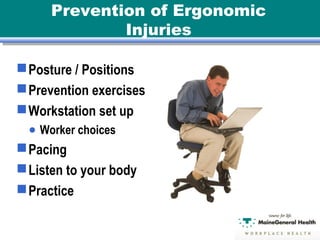
Prevention of Ergonomic
Injuries
Posture / Positions
Prevention exercises
Workstation set up
● Worker choices
Pacing
Listen to your body
Practice
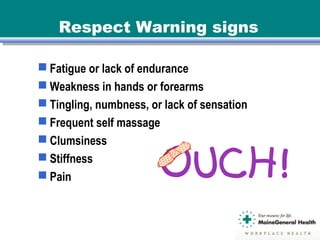
Respect Warning signs
 Fatigue or lack of endurance
 Weakness in hands or forearms
 Tingling, numbness, or lack of sensation
 Frequent self massage
 Clumsiness
 Stiffness
 Pain
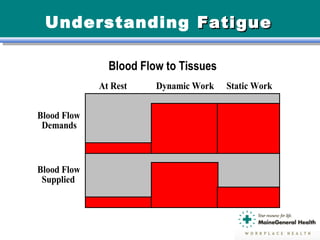
Understanding FatigueFatigue
Blood Flow to Tissues
At Rest Dynamic Work Static Work
Blood Flow
Demands
Blood Flow
Supplied
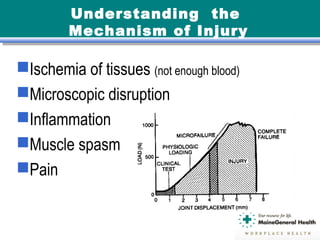
Understanding the
Mechanism of Injury
Ischemia of tissues (not enough blood)
Microscopic disruption
Inflammation
Muscle spasm
Pain
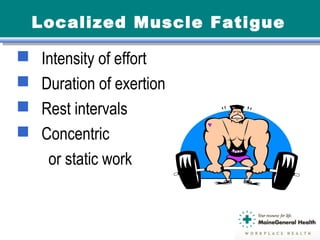
Localized Muscle Fatigue
 Intensity of effort
 Duration of exertion
 Rest intervals
 Concentric
or static work
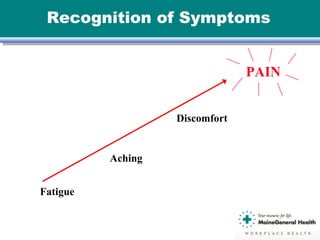
Recognition of Symptoms
Fatigue
Aching
Discomfort
PAIN
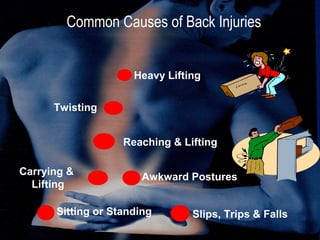
Common Causes of Back Injuries
Heavy Lifting
Sitting or Standing
Awkward Postures
Carrying &
Lifting
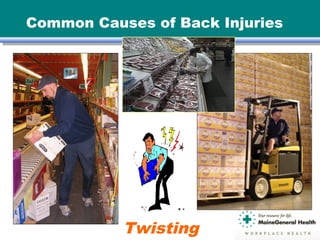
Twisting
Reaching & Lifting
Slips, Trips & Falls
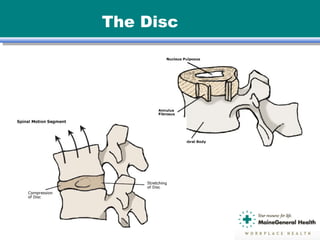
The Disc
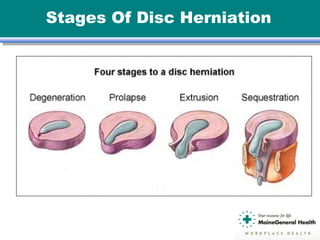
Stages Of Disc Herniation
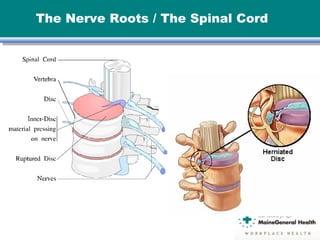
The Nerve Roots / The Spinal Cord
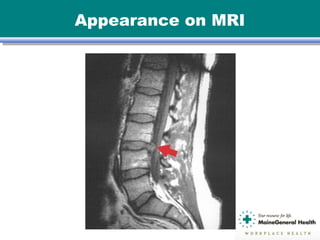
Appearance on MRI
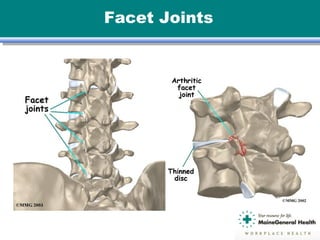
Facet Joints
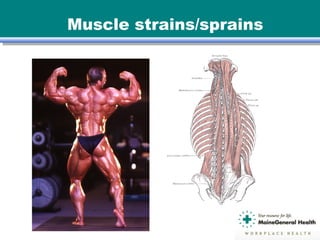
Muscle strains/sprains
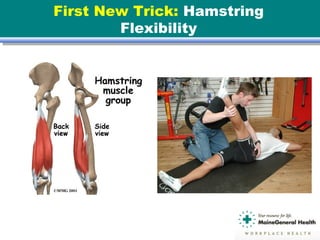
First New Trick: Hamstring
Flexibility
Common Causes of Back Injuries
Twisting
Common Causes of Back Injuries
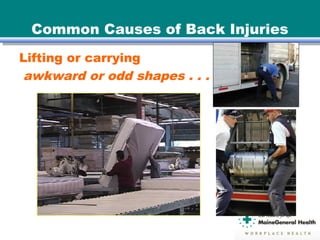
Lifting or carrying
awkward or odd shapes . . . .
Common Causes of Back Injuries
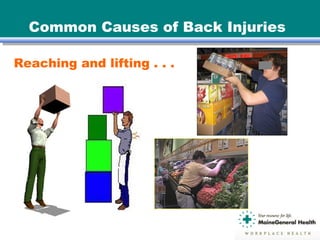
Reaching and lifting . . .
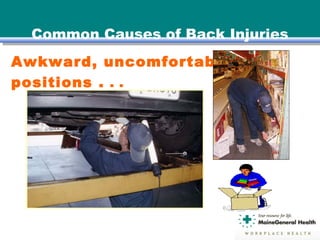
Common Causes of Back Injuries
Awkward, uncomfortable
positions . . .
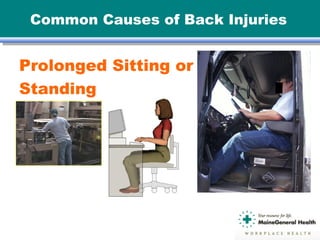
Common Causes of Back Injuries
Prolonged Sitting or
Standing
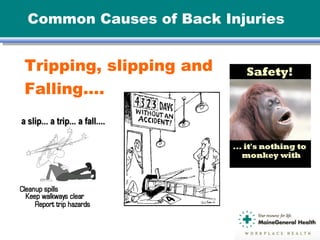
Common Causes of Back Injuries
Tripping, slipping and
Falling….
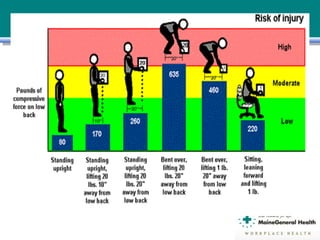
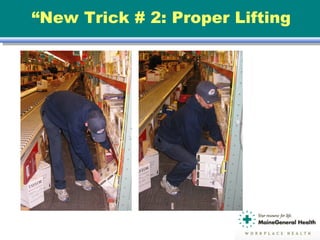
“New Trick # 2: Proper Lifting
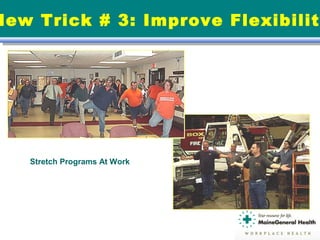
New Trick # 3: Improve Flexibility
Stretch Programs At Work
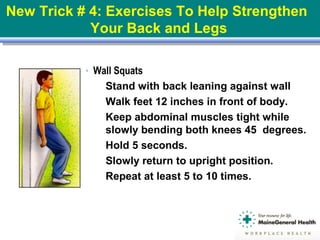
● Wall Squats
 Stand with back leaning against wall
 Walk feet 12 inches in front of body.
 Keep abdominal muscles tight while
slowly bending both knees 45 degrees.
 Hold 5 seconds.
 Slowly return to upright position.
 Repeat at least 5 to 10 times.
New Trick # 4: Exercises To Help Strengthen
Your Back and Legs
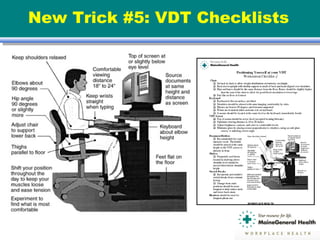
New Trick #5: VDT Checklists
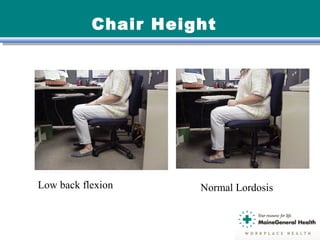
Chair Height
Low back flexion Normal Lordosis
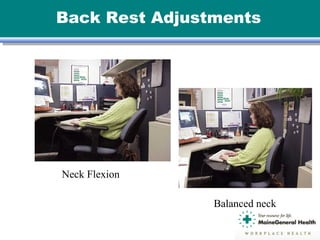
Back Rest Adjustments
Neck Flexion
Balanced neck
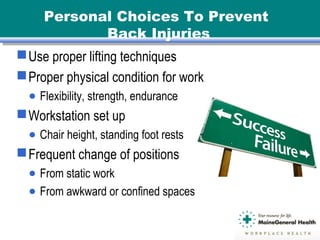
Personal Choices To Prevent
Back Injuries
Use proper lifting techniques
Proper physical condition for work
● Flexibility, strength, endurance
Workstation set up
● Chair height, standing foot rests
Frequent change of positions
● From static work
● From awkward or confined spaces
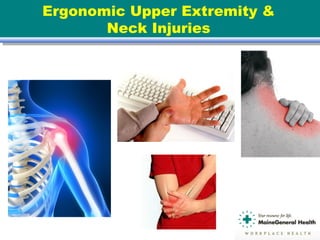
Ergonomic Upper Extremity &
Neck Injuries
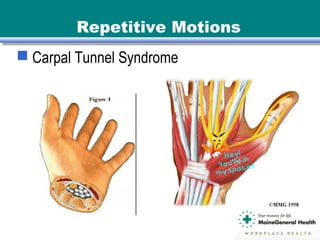
Repetitive Motions
 Carpal Tunnel Syndrome
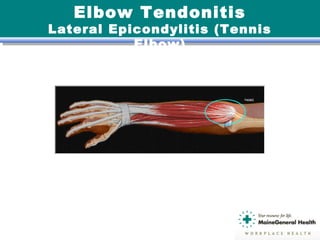
Elbow Tendonitis
Lateral Epicondylitis (Tennis
Elbow)
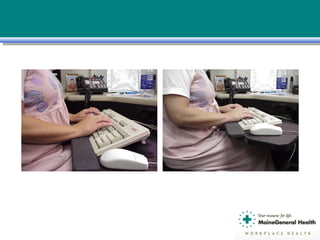
Awkward Joint Positions
and Postures
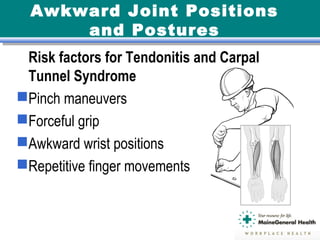
Risk factors for Tendonitis and Carpal
Tunnel Syndrome
Pinch maneuvers
Forceful grip
Awkward wrist positions
Repetitive finger movements
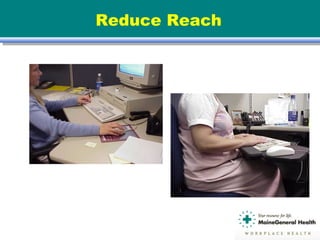
Reduce Reach
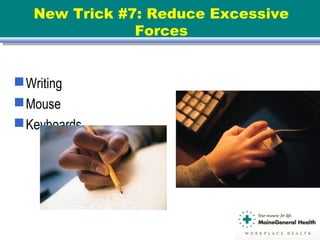
New Trick #7: Reduce Excessive
Forces
Writing
Mouse
Keyboards
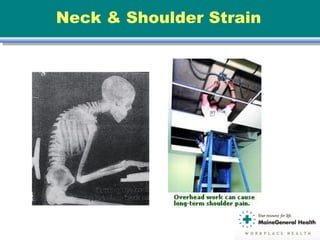
Neck & Shoulder Strain
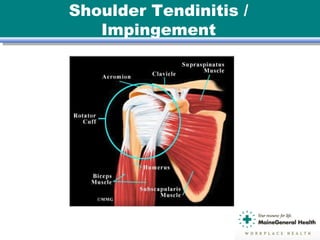
Shoulder Tendinitis /
Impingement
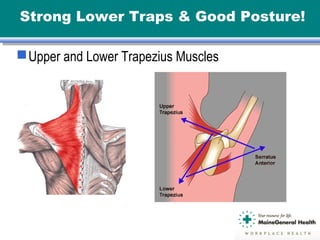
Strong Lower Traps & Good Posture!
Upper and Lower Trapezius Muscles
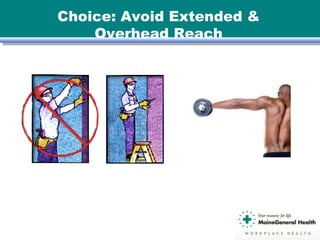
Choice: Avoid Extended &
Overhead Reach
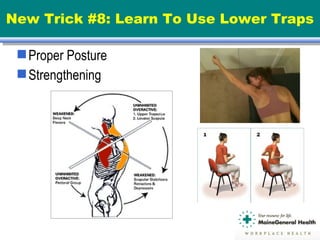
New Trick #8: Learn To Use Lower Traps
Proper Posture
Strengthening
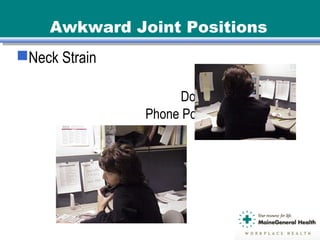
Awkward Joint Positions
Neck Strain
Document holders
Phone Posture
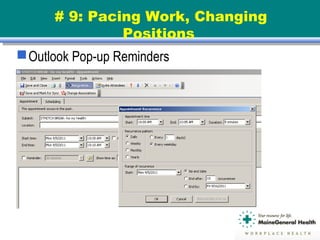
# 9: Pacing Work, Changing
Positions
Outlook Pop-up Reminders
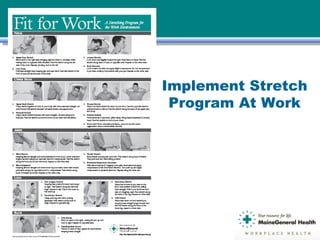
Implement Stretch
Program At Work
#10: Implement Wellness
Why Wellness?
● Prevalence of chronic conditions is growing
● Inactivity and obesity
contributes to chronic diseases
● Our workforce is aging
● Poor health costs more
● Employers can make a
difference
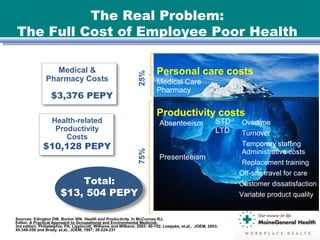
The Real Problem:
The Full Cost of Employee Poor Health
Personal care costs
Medical Care
Pharmacy
25%
Productivity costs
75%
STD
LTD
Overtime
Turnover
Temporary staffing
Administrative costs
Replacement training
Off-site travel for care
Customer dissatisfaction
Variable product quality
Absenteeism
Presenteeism
Medical &
Pharmacy Costs
$3,376 PEPY
Health-related
Productivity
Costs
$10,128 PEPY
Total:
$13, 504 PEPY
Sources: Edington DW, Burton WN. Health and Productivity. In McCunney RJ,
Editor. A Practical Approach to Occupational and Environmental Medicine.
3rd edition. Philadelphia, PA. Lippincott, Williams and Wilkens; 2003: 40-152. Loeppke, et.al., JOEM, 2003;
45:349-359 and Brady, et.al., JOEM, 1997; 39:224-231
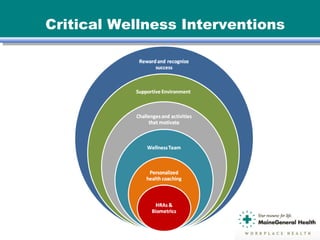
Critical Wellness Interventions
Ergonomics
Is An Inexact Science
In summary
Work, worker, worksite
Behavior change is not easy
Get to the “why?” (education)
Practice makes perfect (well almost)
Include fitness and wellness
Model and reward safe behaviors
Contact:
Denise Dumont-Bernier
denise.dumont-bernier@mainegeneral.org
207-242-3924
Thank You

Maine Safety Conference presentation 2011

Editor's Notes

  • #14 Pre- Who me? No intention of changing in foreseeable future Cont-Aware but not ready, weighing pro’s and cons Prep-intention to take action, sets a goal and plans Action-modifies behavior, experiences and environment to change problem Maintenance- relapse prevention, chooses effective support systems
  • #28 Lifting: Lifting or carrying objects with awkward or odd shapes . . . In addition, Reaching and lifting . . . over your head, across a table, or out the back of a truck . . . Twisting: Twisting at the waist while lifting or holding a heavy load . . . This frequently happens when using a shovel. Carrying: Make sure you can see Take small, stable steps Do not twist your back
  • #29 Discussion: Each disc is a circular pad filled with a gelatin type substance, that is under constant pressure. The disc acts like a shock absorber between the vertebrae and allows for the smooth segmental movement that occurs when you move. You may have a relative or you may have been told that you have arthritis, degenerative joint disease or a narrowing of the joint spaces in your spine, this is due to the compression of the discs over time and the loss of volume or fluid that they contain. You can see that as you bend and extend your back part of the disc is compressed while the other part is stretched. This is why therapists are always emphasizing the maintenance of your curves and keeping your back straight while you lift. You can see if you constantly bend and twist without maintaining a neutral spine, then the wear and tear on your disc becomes more and more of an issue and the joint spaces begin to approximate or touch one another, causing wear and tear on the joint surfaces.
  • #37 Discussion: When you twist in the flexed position, you are essentially winding up your spine; (demonstrate with spine model or with a towel the compressive forces). In this position, compressive forces in the discs along with the stretching that occurs on the other structures is extremely dangerous. You need to look at your work station and assess how you can reduce or eliminate the need to twist during your day.
  • #38 Discussion: Awkward or odd shaped objects are difficult to lift and carry typically because it is so hard to get close to them. Again, you must assess your situation, use assistive devices, like a cart or dolly or ask for help.
  • #39 Discussion: What can you do to your work environment to eliminate or reduce excessive reaching. Ask yourself, do you really need to stack the objects that high? Should you use a step stool? How do you have the objects situated? Heaviest at waist level, lightest on top and those items not routinely moved down low.
  • #40 Discussion: When I look at job during my onsite analysis, I ask myself, “would I do that job that way?”, and “how can I make that job more comfortable” These are the questions that you must ask yourself. Everyone has a comfort zone in which they should work, if you feel like you are moving outside of what is comfortable for you, you must stop and assess the situation, typically you can come up with a solution to improve the work postures. Go over the pictures with the audience, get their feedback; discuss the significance of the postures in terms of cervical compression and lumbar extension; weight bearing through the knee caps, etc.
  • #41 Discussion: What position is harder on the spine? (discuss the difference in sitting and standing and the compressive spinal forces that occur in the spine). You need to try and alternate between the two positions if at all possible (this should be reviewed in terms of the work behaviors observed). If you have a job that requires you to sit most of the day, then you must make sure that the chair is fitting you correctly and that it is adjusted properly. In addition, you must make it a habit to get up out of your chair every 45 – 60 minutes and perform some type of stretching activity. Even if it is to just bend backwards a few times, do some laps of the cubicle and some shoulder rolls (demonstrate), this will improve the blood flow to the spine and lower extremities and ultimately change and improve the spinal compression. Typically, if you have a job that requires you to stand most of the day, you can change your position readily, by raising one foot onto a ledge/platform or leaning against a surface intermittently, all of which helps to maintain the vascular supply and reduce the compressive forces occurring in the spine. It is also important for those that stand for prolonged periods to stretch those muscles being used most often, like the calves and hamstrings.
  • #42 Discussion: You’ve seen the saying, “Safety is No Accident”. You have to make yourself aware of your environment and the areas that may potentially impact your day. If you work in an environment that has wet, slippery floors, make sure that you have good rubber soled shoes that will grip to the floor. If you work in an environment that is cold, such as a freezer, make sure you take the time to put on the correct clothing and protective gear….do not be in such a hurry, take your time to assess the situation, use good work decisions and get the task done correctly and ultimately safely.
  • #45 Discussion: When you are performing your exercises, you need to be able to breath with minimal effort throughout the routine. Do not hold your breath, you muscles need the oxygen that your lungs and heart are supplying. Each exercise should be demonstrated with group participation. Again, these exercises should be based on the jobs observed and should be changed in the presentation to match the appropriate muscle groups.