
(DNA versus RNA)
• Properties of genetic material
Properties of genetic material (DNA versus RNA)
• Debate between proteins versus DNA as the genetic
material was resolved from Hershey-Chase experiment..
• In some viruses, RNA is the genetic material (for
example, Tobacco Mosaic viruses, QB bacteriophage,
etc.).
DNA vs RNA
• DNA is the predominant genetic material.
• Whereas RNA performs dynamic functions of
• messenger,
• adapter,
• Catalyst
• and structural role in the formation of Ribosomes.
A molecule that can act as a genetic material
must fulfill the following criteria:
1. It should be able to generate its replica (Replication).
2. It should chemically and structurally be stable.
3. It should provide the scope for slow changes (mutation)
that are required for evolution.
4. It should be able to express itself in the form of
'Mendelian Characters’.
1. It should be able to generate its replica
(Replication).
• Both the nucleic acids (DNA and RNA) have the ability to
direct their duplications.
• The other molecules in the living system, such as
proteins fail to fulfill first criteria itself.
It should chemically and structurally be stable.
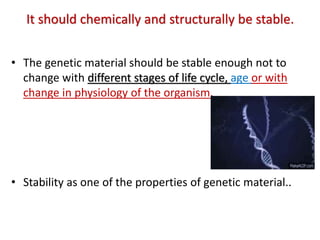
• The genetic material should be stable enough not to
change with different stages of life cycle, age or with
change in physiology of the organism.
• Stability as one of the properties of genetic material..
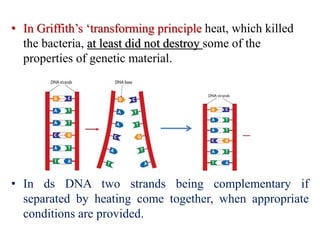
• In Griffith’s ‘transforming principle heat, which killed
the bacteria, at least did not destroy some of the
properties of genetic material.
• In ds DNA two strands being complementary if
separated by heating come together, when appropriate
conditions are provided.
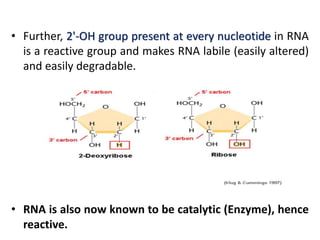
• Further, 2'-OH group present at every nucleotide in RNA
is a reactive group and makes RNA labile (easily altered)
and easily degradable.
• RNA is also now known to be catalytic (Enzyme), hence
reactive.
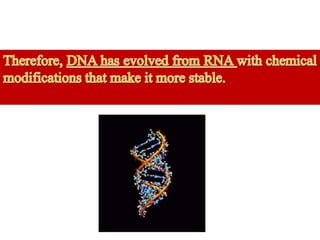
• Therefore, DNA chemically is less reactive and
structurally more stable when compared to RNA.
• Therefore, among the two nucleic acids, the DNA is a
better genetic material…..
• The presence of thymine at the place of uracil also
confers additional stability to DNA.
(iii) It should provide the scope for slow changes
(mutation) that are required for evolution.
• Both DNA and RNA are able to mutate.
• RNA being unstable, mutate at a faster rate.
• Viruses having RNA genome and having shorter life
span mutate and evolve faster…
IV. It should be able to express itself in the form
of 'Mendelian Characters’.
• RNA can directly code for the synthesis of proteins,
hence can easily express the characters.
RNA  Proteins
• DNA, however, is dependent on RNA for synthesis of
proteins.
DNARNA  Proteins
• The protein synthesising machinery has evolved around
RNA.
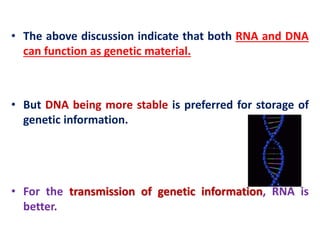
• The above discussion indicate that both RNA and DNA
can function as genetic material.
• But DNA being more stable is preferred for storage of
genetic information.
• For the transmission of genetic information, RNA is
better.
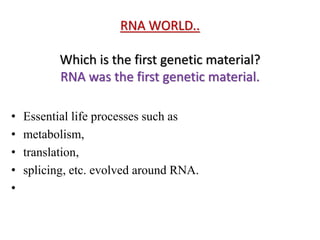
RNA WORLD..
RNA WORLD..
Which is the first genetic material?
RNA was the first genetic material.
• Essential life processes such as
• metabolism,
• translation,
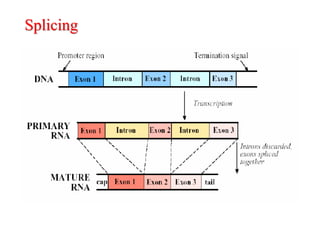
• splicing, etc. evolved around RNA.
•
Splicing
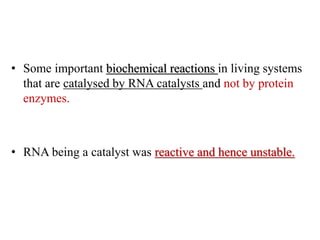
• Some important biochemical reactions in living systems
that are catalysed by RNA catalysts and not by protein
enzymes.
• RNA being a catalyst was reactive and hence unstable.
Dr. HarinathaReddy Aswartha
Assistant professor
Department of Microbiology
ANDHRAPRADESH
INDIA

DNA verses RNA

  • 1.
    (DNA versus RNA) •Properties of genetic material
  • 2.
    Properties of geneticmaterial (DNA versus RNA) • Debate between proteins versus DNA as the genetic material was resolved from Hershey-Chase experiment.. • In some viruses, RNA is the genetic material (for example, Tobacco Mosaic viruses, QB bacteriophage, etc.).
  • 3.
    DNA vs RNA •DNA is the predominant genetic material. • Whereas RNA performs dynamic functions of • messenger, • adapter, • Catalyst • and structural role in the formation of Ribosomes.
  • 4.
    A molecule thatcan act as a genetic material must fulfill the following criteria: 1. It should be able to generate its replica (Replication). 2. It should chemically and structurally be stable. 3. It should provide the scope for slow changes (mutation) that are required for evolution. 4. It should be able to express itself in the form of 'Mendelian Characters’.
  • 5.
    1. It shouldbe able to generate its replica (Replication). • Both the nucleic acids (DNA and RNA) have the ability to direct their duplications. • The other molecules in the living system, such as proteins fail to fulfill first criteria itself.
  • 6.
    It should chemicallyand structurally be stable. • The genetic material should be stable enough not to change with different stages of life cycle, age or with change in physiology of the organism. • Stability as one of the properties of genetic material..
  • 7.
    • In Griffith’s‘transforming principle heat, which killed the bacteria, at least did not destroy some of the properties of genetic material. • In ds DNA two strands being complementary if separated by heating come together, when appropriate conditions are provided.
  • 8.
    • Further, 2'-OHgroup present at every nucleotide in RNA is a reactive group and makes RNA labile (easily altered) and easily degradable. • RNA is also now known to be catalytic (Enzyme), hence reactive.
  • 9.
    • Therefore, DNAchemically is less reactive and structurally more stable when compared to RNA. • Therefore, among the two nucleic acids, the DNA is a better genetic material….. • The presence of thymine at the place of uracil also confers additional stability to DNA.
  • 10.
    (iii) It shouldprovide the scope for slow changes (mutation) that are required for evolution. • Both DNA and RNA are able to mutate. • RNA being unstable, mutate at a faster rate. • Viruses having RNA genome and having shorter life span mutate and evolve faster…
  • 11.
    IV. It shouldbe able to express itself in the form of 'Mendelian Characters’. • RNA can directly code for the synthesis of proteins, hence can easily express the characters. RNA  Proteins • DNA, however, is dependent on RNA for synthesis of proteins. DNARNA  Proteins • The protein synthesising machinery has evolved around RNA.
  • 12.
    • The abovediscussion indicate that both RNA and DNA can function as genetic material. • But DNA being more stable is preferred for storage of genetic information. • For the transmission of genetic information, RNA is better.
  • 13.
  • 14.
    RNA WORLD.. Which isthe first genetic material? RNA was the first genetic material. • Essential life processes such as • metabolism, • translation, • splicing, etc. evolved around RNA. •
  • 15.
  • 16.
    • Some importantbiochemical reactions in living systems that are catalysed by RNA catalysts and not by protein enzymes. • RNA being a catalyst was reactive and hence unstable.
  • 18.
    Dr. HarinathaReddy Aswartha Assistantprofessor Department of Microbiology ANDHRAPRADESH INDIA