DNA BARCODING
Presented To: Dr. Nadeem Abass
Presented By : Shakeela Mahwish Rana
13061714-015
INTRODUCTION
DNA barcoding was first proposed by Paul Herbert
in 2003.
Basic Principle
Dna Barcoding is based on premise that a short
standardized sequence can distinguish individuals
of a specie because genetic variation between specie
exceeds that within specie.
Utility Of Dna Barcoding For Rapid And
Accurate Assessment Of Bat Diversity In
Malaysia In The Absence Of Formally
Described Species
( Wilson et al., 2014)
ABSTRACT
• Bats are important species for biodiversity
research.
• Scientist investigated undescribed bat taxa in
Peninsular Malaysia and Pasir Raja
• Barcode library provides a mean of
recognizing and recording these taxa across
biodiversity inventories.
ABSTRACT
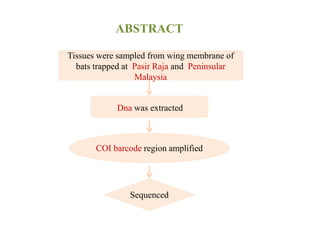
Tissues were sampled from wing membrane of
bats trapped at Pasir Raja and Peninsular
Malaysia
Dna was extracted
COI barcode region amplified
Sequenced
ABSTRACT
9 Species were identified, based on
analysis of DNA Barcodes.
This study confirms the high diversity
of bats within Peninsular Malaysia :
9 Species in 13 Samples
INTRODUCTION
• Bats ( Order Chiroptera) play a crucial role
in nature conservation.
• Action to protect bat species and specifically
their habitat , confers protection to broad range
of taxa that are endemic to natural area under
threat.
INTRODUCTION
• The incorporation of DNA Barcoding into bat
surveys has suggested the frequent
occurrence of cryptic taxa.
• They are so-called “ dark ˋ̏ taxa.
So in this research paper writer discuss
that
How “darkˋ̏ taxa are encountered in
Peninsular Malaysia?
How barcode library provides a mean of
recognizing these taxa?
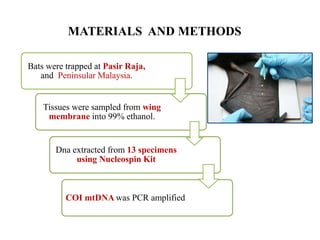
MATERIALS AND METHODS
Bats were trapped at Pasir Raja,
and Peninsular Malaysia.
Tissues were sampled from wing
membrane into 99% ethanol.
Dna extracted from 13 specimens
using Nucleospin Kit
COI mtDNA was PCR amplified
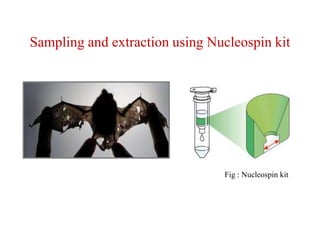
Sampling and extraction using Nucleospin kit
Fig : Nucleospin kit
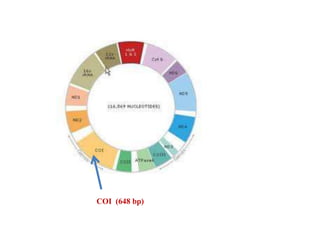
COI (648 bp)
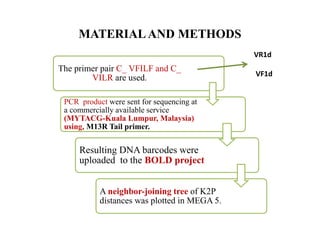
MATERIALAND METHODS
The primer pair C_ VFILF and C_
VILR are used.
PCR product were sent for sequencing at
a commercially available service
(MYTACG-Kuala Lumpur, Malaysia)
using, M13R Tail primer.
Resulting DNA barcodes were
uploaded to the BOLD project
A neighbor-joining tree of K2P
distances was plotted in MEGA 5.
VR1d
VF1d
RESULTS
DNA barcodes were successfully amplified and
sequenced from 13 specimens.
The samples contained 9 species.
Of these species, 4 species (44%) were dark
taxa within the genus Hipposideros.
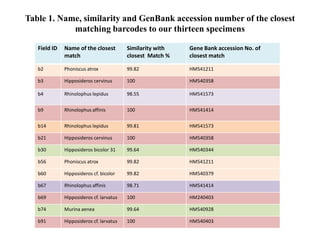
Table 1. Name, similarity and GenBank accession number of the closest
matching barcodes to our thirteen specimens
Field ID Name of the closest
match
Similarity with
closest Match %
Gene Bank accession No. of
closest match
b2 Phoniscus atrox 99.82 HM541211
b3 Hipposideros cervinus 100 HM540358
b4 Rhinolophus lepidus 98.55 HM541573
b9 Rhinolophus affinis 100 HM541414
b14 Rhinolophus lepidus 99.81 HM541573
b21 Hipposideros cervinus 100 HM540358
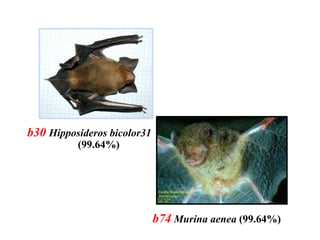
b30 Hipposideros bicolor 31 99.64 HM540344
b56 Phoniscus atrox 99.82 HM541211
b60 Hipposideros cf. bicolor 99.82 HM540379
b67 Rhinolophus affinis 98.71 HM541414
b69 Hipposideros cf. larvatus 100 HM240403
b74 Murina aenea 99.64 HM540928
b91 Hipposideros cf. larvatus 100 HM540403
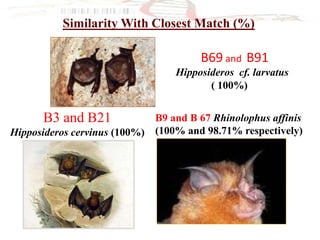
B3 and B21
Hipposideros cervinus (100%)
B69 and B91
Hipposideros cf. larvatus
( 100%)
B9 and B 67 Rhinolophus affinis
(100% and 98.71% respectively)
Similarity With Closest Match (%)
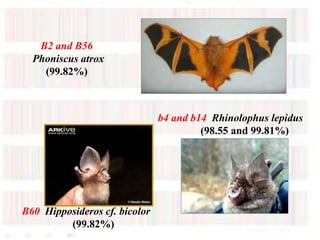
b4 and b14 Rhinolophus lepidus
(98.55 and 99.81%)
B2 and B56
Phoniscus atrox
(99.82%)
B60 Hipposideros cf. bicolor
(99.82%)
b74 Murina aenea (99.64%)
b30 Hipposideros bicolor31
(99.64%)
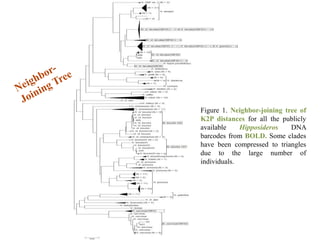
Figure 1. Neighbor-joining tree of
K2P distances for all the publicly
available Hipposideros DNA
barcodes from BOLD. Some clades
have been compressed to triangles
due to the large number of
individuals.
DISCUSSION
Definitive identification require analysis of
internal morphology (skull, dentation) and
comparison with reference material.
Field identifications remain questionable unless
voucher specimens are retained which is
impossible due to government controls and
ethical concerns.
An alternative is the bat detector- a device that
detect the presence of bats and attempts specie
determination based on echolocation ultrasound
signals.
DISCUSSION…
In our study, Dark Taxa are frequently
encountered during routine biodiversity
inventory of bats in Peninsular Malaysia.
Our records of Hipposideros cf. larvatus-
CMF04, H.bicolor 142, H.bicolor 131 and H.
cervinus CMF02 would not have been possible
without the integration of DNA barcoding into
our inventory.
DISCUSSION…
Due to rapid technological advances, a DNA
barcode can be obtained very easily and
inexpensively for less than US$10 per
specimen in Malaysia, making the method
easily accessible to biodiversity
researchers.
Dna barcoding

Dna barcoding

  • 1.
    DNA BARCODING Presented To:Dr. Nadeem Abass Presented By : Shakeela Mahwish Rana 13061714-015
  • 2.
    INTRODUCTION DNA barcoding wasfirst proposed by Paul Herbert in 2003. Basic Principle Dna Barcoding is based on premise that a short standardized sequence can distinguish individuals of a specie because genetic variation between specie exceeds that within specie.
  • 3.
    Utility Of DnaBarcoding For Rapid And Accurate Assessment Of Bat Diversity In Malaysia In The Absence Of Formally Described Species ( Wilson et al., 2014)
  • 4.
    ABSTRACT • Bats areimportant species for biodiversity research. • Scientist investigated undescribed bat taxa in Peninsular Malaysia and Pasir Raja • Barcode library provides a mean of recognizing and recording these taxa across biodiversity inventories.
  • 5.
    ABSTRACT Tissues were sampledfrom wing membrane of bats trapped at Pasir Raja and Peninsular Malaysia Dna was extracted COI barcode region amplified Sequenced
  • 6.
    ABSTRACT 9 Species wereidentified, based on analysis of DNA Barcodes. This study confirms the high diversity of bats within Peninsular Malaysia : 9 Species in 13 Samples
  • 7.
    INTRODUCTION • Bats (Order Chiroptera) play a crucial role in nature conservation. • Action to protect bat species and specifically their habitat , confers protection to broad range of taxa that are endemic to natural area under threat.
  • 8.
    INTRODUCTION • The incorporationof DNA Barcoding into bat surveys has suggested the frequent occurrence of cryptic taxa. • They are so-called “ dark ˋ̏ taxa. So in this research paper writer discuss that How “darkˋ̏ taxa are encountered in Peninsular Malaysia? How barcode library provides a mean of recognizing these taxa?
  • 9.
    MATERIALS AND METHODS Batswere trapped at Pasir Raja, and Peninsular Malaysia. Tissues were sampled from wing membrane into 99% ethanol. Dna extracted from 13 specimens using Nucleospin Kit COI mtDNA was PCR amplified
  • 10.
    Sampling and extractionusing Nucleospin kit Fig : Nucleospin kit
  • 11.
  • 12.
    MATERIALAND METHODS The primerpair C_ VFILF and C_ VILR are used. PCR product were sent for sequencing at a commercially available service (MYTACG-Kuala Lumpur, Malaysia) using, M13R Tail primer. Resulting DNA barcodes were uploaded to the BOLD project A neighbor-joining tree of K2P distances was plotted in MEGA 5. VR1d VF1d
  • 13.
    RESULTS DNA barcodes weresuccessfully amplified and sequenced from 13 specimens. The samples contained 9 species. Of these species, 4 species (44%) were dark taxa within the genus Hipposideros.
  • 14.
    Table 1. Name,similarity and GenBank accession number of the closest matching barcodes to our thirteen specimens Field ID Name of the closest match Similarity with closest Match % Gene Bank accession No. of closest match b2 Phoniscus atrox 99.82 HM541211 b3 Hipposideros cervinus 100 HM540358 b4 Rhinolophus lepidus 98.55 HM541573 b9 Rhinolophus affinis 100 HM541414 b14 Rhinolophus lepidus 99.81 HM541573 b21 Hipposideros cervinus 100 HM540358 b30 Hipposideros bicolor 31 99.64 HM540344 b56 Phoniscus atrox 99.82 HM541211 b60 Hipposideros cf. bicolor 99.82 HM540379 b67 Rhinolophus affinis 98.71 HM541414 b69 Hipposideros cf. larvatus 100 HM240403 b74 Murina aenea 99.64 HM540928 b91 Hipposideros cf. larvatus 100 HM540403
  • 15.
    B3 and B21 Hipposideroscervinus (100%) B69 and B91 Hipposideros cf. larvatus ( 100%) B9 and B 67 Rhinolophus affinis (100% and 98.71% respectively) Similarity With Closest Match (%)
  • 16.
    b4 and b14Rhinolophus lepidus (98.55 and 99.81%) B2 and B56 Phoniscus atrox (99.82%) B60 Hipposideros cf. bicolor (99.82%)
  • 17.
    b74 Murina aenea(99.64%) b30 Hipposideros bicolor31 (99.64%)
  • 18.
    Figure 1. Neighbor-joiningtree of K2P distances for all the publicly available Hipposideros DNA barcodes from BOLD. Some clades have been compressed to triangles due to the large number of individuals.
  • 19.
    DISCUSSION Definitive identification requireanalysis of internal morphology (skull, dentation) and comparison with reference material. Field identifications remain questionable unless voucher specimens are retained which is impossible due to government controls and ethical concerns. An alternative is the bat detector- a device that detect the presence of bats and attempts specie determination based on echolocation ultrasound signals.
  • 20.
    DISCUSSION… In our study,Dark Taxa are frequently encountered during routine biodiversity inventory of bats in Peninsular Malaysia. Our records of Hipposideros cf. larvatus- CMF04, H.bicolor 142, H.bicolor 131 and H. cervinus CMF02 would not have been possible without the integration of DNA barcoding into our inventory.
  • 21.
    DISCUSSION… Due to rapidtechnological advances, a DNA barcode can be obtained very easily and inexpensively for less than US$10 per specimen in Malaysia, making the method easily accessible to biodiversity researchers.