Evaluating Impact:Transliteracy and Creative Business Innovation via Social MediaDr SouvikMukherjee and Professor Sue ThomasDepartment of Media, Film and Journalism, Faculty of Humanities
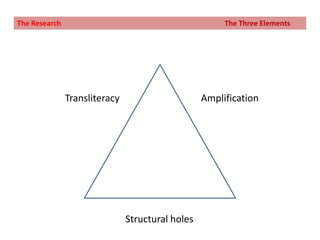
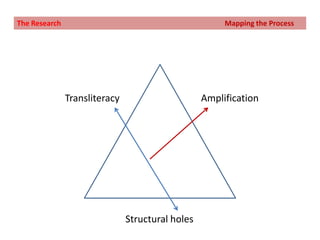
The Research				                          The Three ElementsTransliteracyAmplificationStructural holes
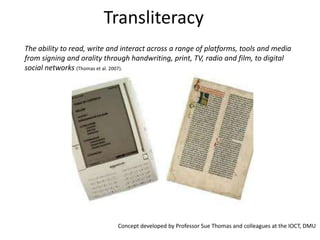
TransliteracyThe ability to read, write and interact across a range of platforms, tools and media from signing and orality through handwriting, print, TV, radio and film, to digital social networks (Thomas et al. 2007). Concept developed by Professor Sue Thomas and colleagues at the IOCT, DMU
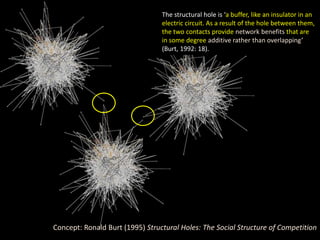
The structural hole is ‘a buffer, like an insulator in an electric circuit. As a result of the hole between them, the two contacts provide network benefits that are in some degree additive rather than overlapping’ (Burt, 1992: 18).Concept: Ronald Burt (1995) Structural Holes: The Social Structure of Competition
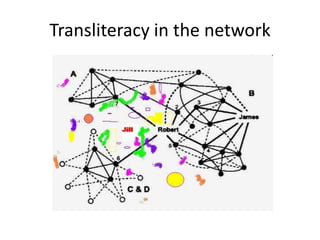
Transliteracy in the network
Amplified IndividualsArehighly social. They use tagging software, wikis, social networks, and other human intelligence aggregators to supplement their individual knowledge and to understand what their individual contributions mean in the context of the organization, giving meaning to even the most menial tasks. Are alsohighly collective, taking advantage of online collaboration software, mobile communications tools, and immersive virtual environments to engage globally distributed team members with highly specialized and complementary capacities. Are  highly improvisational, capable of banding together to form effective networks and infrastructures, both social and professional. Are highly augmented. They employ visualization tools, attention filters, e-displays, and ambient presence systems to enhance their cognitive abilities and coordination skills, thus enabling them to quickly access and process massive amounts of information.Concept developed at the Institute for the Future, Palo Alto
The ProjectsNLab Creative Network 2005-11CreativeCoffee Club 2007 > Amplified Leicester 2009-10Vision2020 2009 >
The Research				                          Mapping the ProcessTransliteracyAmplificationStructural holes
The research questions:Impact				                          The Research QuestionsDo new communication frameworks in social media benefit business practices in Leicester?
What are the roles of transliteracyand amplification in this context?Impact				                          REF Definitions and CriteriaThe Research Excellence Framework (REF) defines ‘impact’ as ‘all kinds of social, economic and cultural benefits and impacts beyond  academia’(HEFCE 2011)  or ‘any identifiable benefit to or positive influence on the economy, society, public policy or services, culture, the environment or quality of life’ (HEFCE 2011). Reach and Significance are the two recommended criteria for assessing impact. Reach has been defined as ‘how widely the impact was felt’ (HEFCE 2011) and Significance as ‘how much difference it made to the beneficiaries’, ‘incremental improvements that are wide-ranging but have been demonstrated’ and ‘major value with wide-ranging relevance’ (HEFCE 2011). Further clarifications might be available in the panel documents to be released by HEFCE in July 2011.
Methodology				Gathered data from the project archive (2005 to 2010): online and printed documents, website statistics, attendance databases, previous surveys, interviews and reports .
Carried out spot interviews (20 approx) and longer interviews of participants  (5) in different events.
Coded and analysed the interviews and other documents using a qualitative data analysis package (MAXQDA).
Established a set of indicators under the REF categories of reach and significance as well as the emergent category of transliteracy.
Ran an online survey (surveymonkey.com) for all the listed participants at the events since 2006 (73 people responded out of 734)
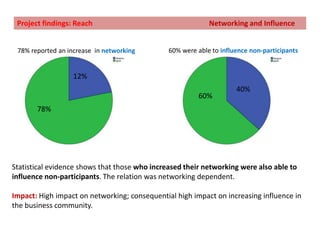
Analysed the survey results using a statistical software package (SPSS) and using queries designed in Microsoft SQL. Project findings: Reach 				Networking and Influence 12%60% were able to influence non-participants78% reported an increase  in networking40%60%78%Statistical evidence shows that those who increased their networking were also able to influence non-participants. The relation was networking dependent. Impact: High impact on networking; consequential high impact on increasing influence in the business community.
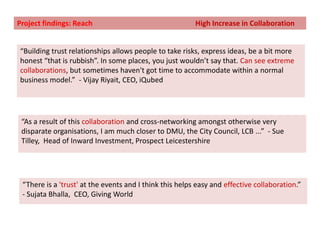
Project findings: Reach 			          High Increase in Collaboration “Building trust relationships allows people to take risks, express ideas, be a bit more honest “that is rubbish”. In some places, you just wouldn’t say that. Can see extreme collaborations, but sometimes haven't got time to accommodate within a normal business model.”  - Vijay Riyait, CEO, iQubed“As a result of this collaboration and cross-networking amongst otherwise very disparate organisations, I am much closer to DMU, the City Council, LCB ...”  - Sue Tilley,  Head of Inward Investment, Prospect Leicestershire“There is a 'trust' at the events and I think this helps easy and effective collaboration.”  - SujataBhalla,  CEO, Giving World
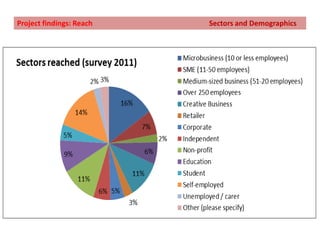
Project findings: Reach 			          	Sectors and Demographics
Project findings: Reach 			          		           SummaryPeople benefited through an increase in the number of networks they connected to. This was matched by an increase in collaborative practice.The project reached individuals from a wide range of subgroups in business and creative industries. The projects also spanned a wide demographic range in terms of gender, age and sectors of work.A high percentage of participants said they were able to influence non-participants.
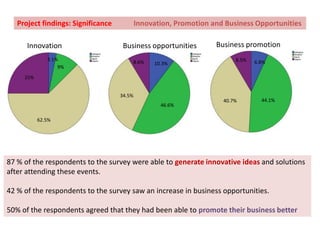
Project findings: Significance            Innovation, Promotion and Business OpportunitiesBusiness promotionInnovationBusiness opportunities3.1%8.5%6.8%8.6%10.3%9%25%34.5%44.1%40.7%46.6%62.5%87 % of the respondents to the survey were able to generate innovative ideas and solutions after attending these events. 42 % of the respondents to the survey saw an increase in business opportunities. 50% of the respondents agreed that they had been able to promote their business better
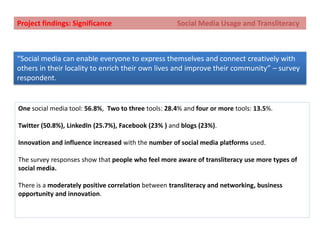
Project findings: Significance            		Social Media Usage and Transliteracy“Social media can enable everyone to express themselves and connect creatively with others in their locality to enrich their own lives and improve their community” – survey respondent.One social media tool: 56.8%,  Two to three tools: 28.4% and four or more tools: 13.5%.Twitter (50.8%), LinkedIn (25.7%), Facebook (23% ) and blogs (23%). Innovation and influence increased with the number of social media platforms used.The survey responses show that people who feel more aware of transliteracy use more types of social media.There is a moderately positive correlationbetweentransliteracy and networking, business opportunity and innovation.
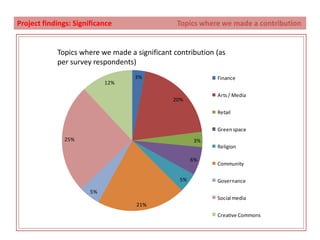
Project findings: Significance            		Topics where we made a contributionTopics where we made a significant contribution (as per survey respondents)
Project findings: Significance            				          Summary• These events, especially at the outset, helped people to articulate their expectations of social media and to understand its challenges.• A very high percentage of the respondents claimed that they were able to generate innovative ideas and solutions at their workplace.• The increase in networking and influence contributed to bettering business promotion and opportunities.• Social media was seen as playing an important role in people’s business practices, particularly in networking, innovation and influence.• Social media, community, the arts and creative commons emerged as the areas where people felt the main impact of the events.
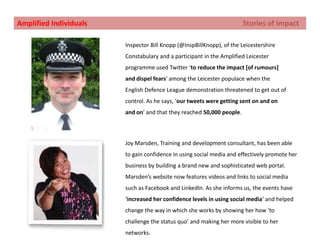
Amplified Individuals 		  			 Stories of ImpactInspector Bill Knopp (@InspBillKnopp), of the Leicestershire Constabulary and a participant in the Amplified Leicester programme used Twitter ‘to reduce the impact [of rumours] and dispel fears’ among the Leicester populace when the English Defence League demonstration threatened to get out of control. As he says, ‘our tweets were getting sent on and on and on’ and that they reached 50,000 people. Joy Marsden, Training and development consultant, has been able to gain confidence in using social media and effectively promote her business by building a brand new and sophisticated web portal.  Marsden’s website now features videos and links to social media such as Facebook and LinkedIn. As she informs us, the events have ‘increased her confidence levels in using social media’ and helped change the way in which she works by showing her how ‘to challenge the status quo’ and making her more visible to her networks.
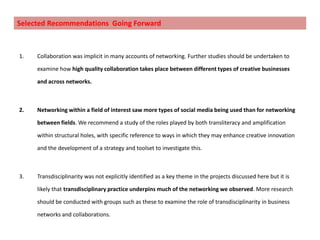
Selected Recommendations  Going Forward Collaboration was implicit in many accounts of networking. Further studies should be undertaken to examine how high quality collaboration takes place between different types of creative businesses and across networks.Networkingwithin a field of interest saw more types of social media being used than for networking between fields. We recommend a study of the roles played by both transliteracy and amplification within structural holes, with specific reference to ways in which they may enhance creative innovation and the development of a strategy and toolset to investigate this.Transdisciplinarity was not explicitly identified as a key theme in the projects discussed here but it is likely that transdisciplinary practice underpins much of the networking we observed. More research should be conducted with groups such as these to examine the role of transdisciplinarity in business networks and collaborations.
Revisiting Impact
Revisiting Impact
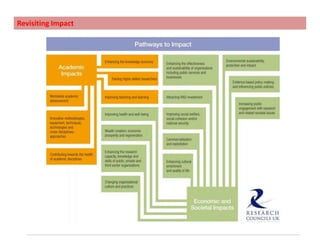
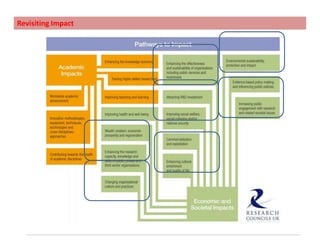
Revisiting Impact			         Reach and Significance need to be qualified in more detail. On the other hand, the impact indicators need to be made more flexible and inclusive, especially for transdisciplinary projects. HEFCE’s expectation that ‘there will be particular issues and challenges for assessing impact in a number of other disciplines not covered by the pilot’ still needs to be addressed.While it is possible to identify ground-breaking impact from public feedback as happens in this project, often the success measures identified for business improvement (such as ‘increased turnover’ or ‘spin-off companies’) are inadequate to represent impact.Often the impact is latent or only perceivable after a long period. Safeguards should be included in the analytical process so as not to ignore such impact. In this project, the impact of transliteracy in facilitating improved networking across media and consequent innovation and business improvement, would have gone largely unnoticed if the researcher restricted himself only to the initial survey figures.
Advice to colleaguesPlot a clear line between your research and your practice-based work as soon as possiblePlot the connections between your work and the REF indicators BUT be aware that they could changeThink about ways to translate between the terminology of your research, your practice, and the impact agenda so that they all match up. This includes the design of any publicity material, surveys, and research questions.
Future developmentsAmplified Resilient Community (Dir. Thilo Boeck)Developing pilot teaching sessionsExtending this research further in terms of transdisciplinary networks of collaboration inside and outside DMU

Evaluating Impact: NLab, Amplified Leicester, and creative innovation via social media

  • 1.
    Evaluating Impact:Transliteracy andCreative Business Innovation via Social MediaDr SouvikMukherjee and Professor Sue ThomasDepartment of Media, Film and Journalism, Faculty of Humanities
  • 2.
    The Research The Three ElementsTransliteracyAmplificationStructural holes
  • 3.
    TransliteracyThe ability toread, write and interact across a range of platforms, tools and media from signing and orality through handwriting, print, TV, radio and film, to digital social networks (Thomas et al. 2007). Concept developed by Professor Sue Thomas and colleagues at the IOCT, DMU
  • 4.
    The structural holeis ‘a buffer, like an insulator in an electric circuit. As a result of the hole between them, the two contacts provide network benefits that are in some degree additive rather than overlapping’ (Burt, 1992: 18).Concept: Ronald Burt (1995) Structural Holes: The Social Structure of Competition
  • 5.
  • 6.
    Amplified IndividualsArehighly social.They use tagging software, wikis, social networks, and other human intelligence aggregators to supplement their individual knowledge and to understand what their individual contributions mean in the context of the organization, giving meaning to even the most menial tasks. Are alsohighly collective, taking advantage of online collaboration software, mobile communications tools, and immersive virtual environments to engage globally distributed team members with highly specialized and complementary capacities. Are highly improvisational, capable of banding together to form effective networks and infrastructures, both social and professional. Are highly augmented. They employ visualization tools, attention filters, e-displays, and ambient presence systems to enhance their cognitive abilities and coordination skills, thus enabling them to quickly access and process massive amounts of information.Concept developed at the Institute for the Future, Palo Alto
  • 7.
    The ProjectsNLab CreativeNetwork 2005-11CreativeCoffee Club 2007 > Amplified Leicester 2009-10Vision2020 2009 >
  • 8.
    The Research Mapping the ProcessTransliteracyAmplificationStructural holes
  • 9.
    The research questions:Impact The Research QuestionsDo new communication frameworks in social media benefit business practices in Leicester?
  • 10.
    What are theroles of transliteracyand amplification in this context?Impact REF Definitions and CriteriaThe Research Excellence Framework (REF) defines ‘impact’ as ‘all kinds of social, economic and cultural benefits and impacts beyond academia’(HEFCE 2011) or ‘any identifiable benefit to or positive influence on the economy, society, public policy or services, culture, the environment or quality of life’ (HEFCE 2011). Reach and Significance are the two recommended criteria for assessing impact. Reach has been defined as ‘how widely the impact was felt’ (HEFCE 2011) and Significance as ‘how much difference it made to the beneficiaries’, ‘incremental improvements that are wide-ranging but have been demonstrated’ and ‘major value with wide-ranging relevance’ (HEFCE 2011). Further clarifications might be available in the panel documents to be released by HEFCE in July 2011.
  • 12.
    Methodology Gathered data fromthe project archive (2005 to 2010): online and printed documents, website statistics, attendance databases, previous surveys, interviews and reports .
  • 13.
    Carried out spotinterviews (20 approx) and longer interviews of participants (5) in different events.
  • 14.
    Coded and analysedthe interviews and other documents using a qualitative data analysis package (MAXQDA).
  • 15.
    Established a setof indicators under the REF categories of reach and significance as well as the emergent category of transliteracy.
  • 16.
    Ran an onlinesurvey (surveymonkey.com) for all the listed participants at the events since 2006 (73 people responded out of 734)
  • 17.
    Analysed the surveyresults using a statistical software package (SPSS) and using queries designed in Microsoft SQL. Project findings: Reach Networking and Influence 12%60% were able to influence non-participants78% reported an increase in networking40%60%78%Statistical evidence shows that those who increased their networking were also able to influence non-participants. The relation was networking dependent. Impact: High impact on networking; consequential high impact on increasing influence in the business community.
  • 18.
    Project findings: Reach High Increase in Collaboration “Building trust relationships allows people to take risks, express ideas, be a bit more honest “that is rubbish”. In some places, you just wouldn’t say that. Can see extreme collaborations, but sometimes haven't got time to accommodate within a normal business model.” - Vijay Riyait, CEO, iQubed“As a result of this collaboration and cross-networking amongst otherwise very disparate organisations, I am much closer to DMU, the City Council, LCB ...” - Sue Tilley, Head of Inward Investment, Prospect Leicestershire“There is a 'trust' at the events and I think this helps easy and effective collaboration.” - SujataBhalla, CEO, Giving World
  • 19.
    Project findings: Reach Sectors and Demographics
  • 20.
    Project findings: Reach SummaryPeople benefited through an increase in the number of networks they connected to. This was matched by an increase in collaborative practice.The project reached individuals from a wide range of subgroups in business and creative industries. The projects also spanned a wide demographic range in terms of gender, age and sectors of work.A high percentage of participants said they were able to influence non-participants.
  • 21.
    Project findings: Significance Innovation, Promotion and Business OpportunitiesBusiness promotionInnovationBusiness opportunities3.1%8.5%6.8%8.6%10.3%9%25%34.5%44.1%40.7%46.6%62.5%87 % of the respondents to the survey were able to generate innovative ideas and solutions after attending these events. 42 % of the respondents to the survey saw an increase in business opportunities. 50% of the respondents agreed that they had been able to promote their business better
  • 22.
    Project findings: Significance Social Media Usage and Transliteracy“Social media can enable everyone to express themselves and connect creatively with others in their locality to enrich their own lives and improve their community” – survey respondent.One social media tool: 56.8%, Two to three tools: 28.4% and four or more tools: 13.5%.Twitter (50.8%), LinkedIn (25.7%), Facebook (23% ) and blogs (23%). Innovation and influence increased with the number of social media platforms used.The survey responses show that people who feel more aware of transliteracy use more types of social media.There is a moderately positive correlationbetweentransliteracy and networking, business opportunity and innovation.
  • 23.
    Project findings: Significance Topics where we made a contributionTopics where we made a significant contribution (as per survey respondents)
  • 24.
    Project findings: Significance Summary• These events, especially at the outset, helped people to articulate their expectations of social media and to understand its challenges.• A very high percentage of the respondents claimed that they were able to generate innovative ideas and solutions at their workplace.• The increase in networking and influence contributed to bettering business promotion and opportunities.• Social media was seen as playing an important role in people’s business practices, particularly in networking, innovation and influence.• Social media, community, the arts and creative commons emerged as the areas where people felt the main impact of the events.
  • 25.
    Amplified Individuals Stories of ImpactInspector Bill Knopp (@InspBillKnopp), of the Leicestershire Constabulary and a participant in the Amplified Leicester programme used Twitter ‘to reduce the impact [of rumours] and dispel fears’ among the Leicester populace when the English Defence League demonstration threatened to get out of control. As he says, ‘our tweets were getting sent on and on and on’ and that they reached 50,000 people. Joy Marsden, Training and development consultant, has been able to gain confidence in using social media and effectively promote her business by building a brand new and sophisticated web portal. Marsden’s website now features videos and links to social media such as Facebook and LinkedIn. As she informs us, the events have ‘increased her confidence levels in using social media’ and helped change the way in which she works by showing her how ‘to challenge the status quo’ and making her more visible to her networks.
  • 26.
    Selected Recommendations Going Forward Collaboration was implicit in many accounts of networking. Further studies should be undertaken to examine how high quality collaboration takes place between different types of creative businesses and across networks.Networkingwithin a field of interest saw more types of social media being used than for networking between fields. We recommend a study of the roles played by both transliteracy and amplification within structural holes, with specific reference to ways in which they may enhance creative innovation and the development of a strategy and toolset to investigate this.Transdisciplinarity was not explicitly identified as a key theme in the projects discussed here but it is likely that transdisciplinary practice underpins much of the networking we observed. More research should be conducted with groups such as these to examine the role of transdisciplinarity in business networks and collaborations.
  • 27.
  • 28.
  • 29.
    Revisiting Impact Reach and Significance need to be qualified in more detail. On the other hand, the impact indicators need to be made more flexible and inclusive, especially for transdisciplinary projects. HEFCE’s expectation that ‘there will be particular issues and challenges for assessing impact in a number of other disciplines not covered by the pilot’ still needs to be addressed.While it is possible to identify ground-breaking impact from public feedback as happens in this project, often the success measures identified for business improvement (such as ‘increased turnover’ or ‘spin-off companies’) are inadequate to represent impact.Often the impact is latent or only perceivable after a long period. Safeguards should be included in the analytical process so as not to ignore such impact. In this project, the impact of transliteracy in facilitating improved networking across media and consequent innovation and business improvement, would have gone largely unnoticed if the researcher restricted himself only to the initial survey figures.
  • 30.
    Advice to colleaguesPlota clear line between your research and your practice-based work as soon as possiblePlot the connections between your work and the REF indicators BUT be aware that they could changeThink about ways to translate between the terminology of your research, your practice, and the impact agenda so that they all match up. This includes the design of any publicity material, surveys, and research questions.
  • 31.
    Future developmentsAmplified ResilientCommunity (Dir. Thilo Boeck)Developing pilot teaching sessionsExtending this research further in terms of transdisciplinary networks of collaboration inside and outside DMU

Editor's Notes

  • #16 Data from interviews show that most of the participants were from business , finance and the creative industries. The range, however, was much wider and included many professions and employment groups.Participants also represented minorities, multi-ethnic groups, single mothers and gay and lesbian groups.70 % of the attendees at Creative Coffee Club were from East Midlands SMEs.The survey also pointed out that the age groups 31-40 (21%), 41-40 (28%) and 51-60 (28%) were the most benefited.