The Machine in the Ghost: a
Socio-Technical Approach to User-
Generated Content Research
Dr. Cliff Lampe
Dept. of Telecommunication, Information Studies and Media
Michigan State University
Overall narrative:
We need to combine the theories, techniques,
and passions of multiple fields to truly
understand (and possibly affect) human
interaction mediated by information and
communication technology. We also need to
engage practitioners.
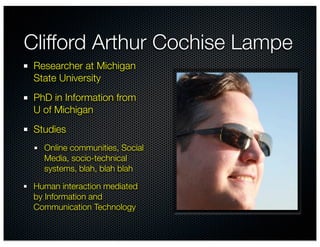
Clifford Arthur Cochise Lampe
 Researcher at Michigan
 State University
 PhD in Information from
 U of Michigan
 Studies
   Online communities, Social
   Media, socio-technical
   systems, blah, blah blah

 Human interaction mediated
 by Information and
 Communication Technology
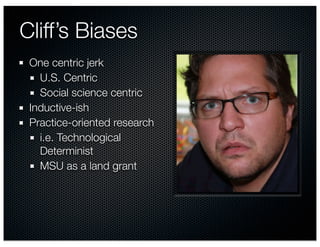
Cliff’s Biases
 One centric jerk
   U.S. Centric
   Social science centric
 Inductive-ish
 Practice-oriented research
   i.e. Technological
   Determinist
   MSU as a land grant
Sociotechnical systems
Definition, examples, totally sweet diagrams
My boiled down definition
Sociotechnical system:
  The interrelated social and technical aspects of
  mediated interactions


But really:
  Don’t get hung up on the definition.
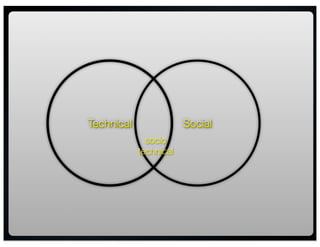
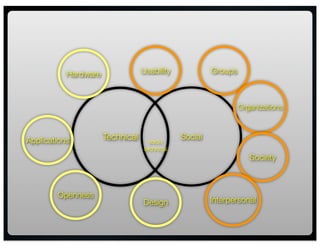
Technical               Social
              socio
            technical
Hardware               Usability            Groups


                                                                Organizations


Applications          Technical     socio
                                              Social
                                  technical
                                                                   Society


        Openness
                                  Design               Interpersonal
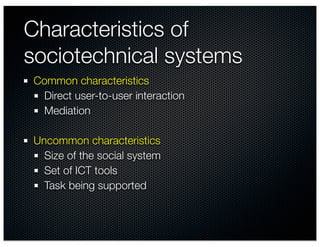
Characteristics of
sociotechnical systems
Common characteristics
 Direct user-to-user interaction
 Mediation

Uncommon characteristics
  Size of the social system
  Set of ICT tools
  Task being supported
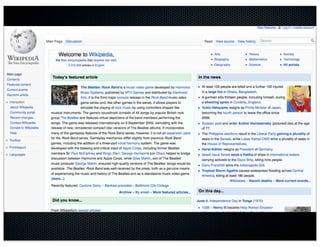
Some obvious examples of
 sociotechnical systems
Sociotechnical systems are
the interrelation between
technological and human
systems.
The science of
sociotechnical systems
Consistently multidisciplinary
  Leads to multiple methods, multiple theories
  Consequently dominated by disciplines that “play
  ball”
  Hard to feed findings/results back into the main
  disciplines
  Hard to bring in new disciplines fully (i.e. the “sucking
  hind tit” problem)
Some people who helped
me think about
sociotechnical systems
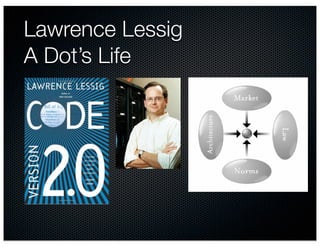
Lawrence Lessig
A Dot’s Life
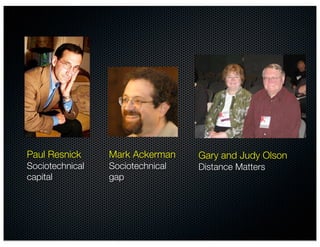
Paul Resnick     Mark Ackerman    Gary and Judy Olson
Sociotechnical   Sociotechnical   Distance Matters
capital          gap
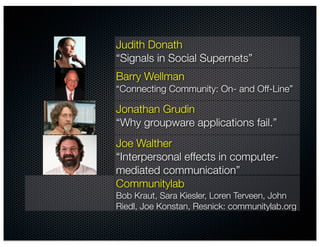
Judith Donath
“Signals in Social Supernets”
Barry Wellman
“Connecting Community: On- and Off-Line”

Jonathan Grudin
“Why groupware applications fail.”
Joe Walther
“Interpersonal effects in computer-
mediated communication”
Communitylab
Bob Kraut, Sara Kiesler, Loren Terveen, John
Riedl, Joe Konstan, Resnick: communitylab.org
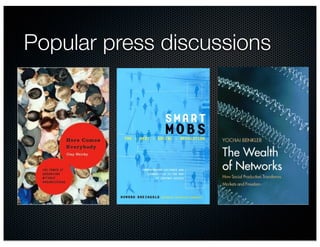
Popular press discussions
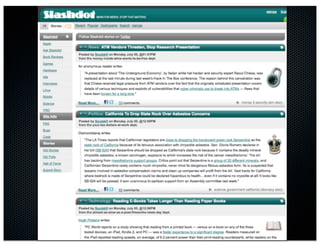
A sordid history
of sociotechnical systems
     I’ve researched
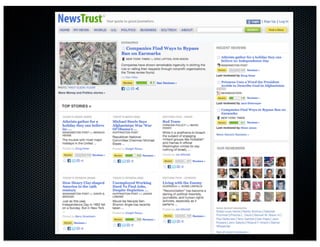
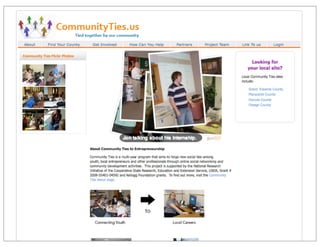
An even more sordid history
of sites I’ve been helping to create
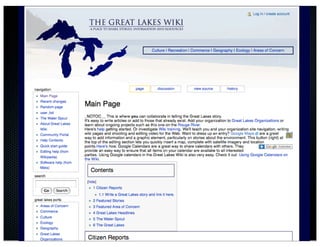
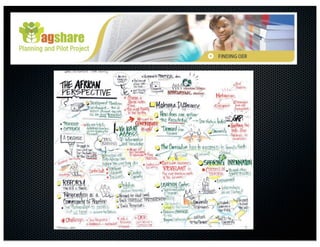
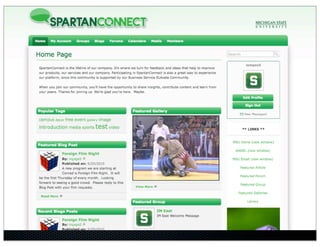
The MSU-INgage Collaboration
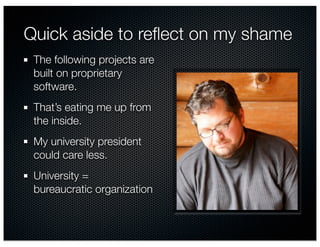
Quick aside to reflect on my shame
 The following projects are
 built on proprietary
 software.
 That’s eating me up from
 the inside.
 My university president
 could care less.
 University =
 bureaucratic organization
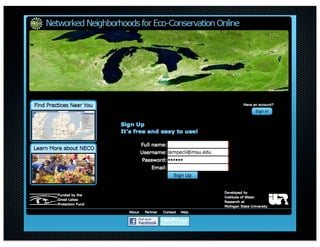
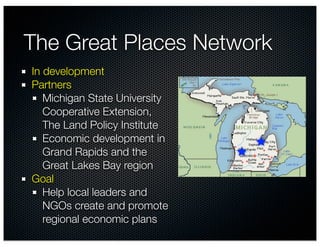
The Great Places Network
In development
Partners
   Michigan State University
   Cooperative Extension,
   The Land Policy Institute
   Economic development in
   Grand Rapids and the
   Great Lakes Bay region
Goal
   Help local leaders and
   NGOs create and promote
   regional economic plans
Michigan Energy Efficiency Network
 In development
 Partners
    Michigan Dept of Energy, Labor and
    Economic Growth; Office of the
    Governor, MI Depts of Information
    Technology, Education,
    Transportation, Wildlife and Natural
    Resources
 Goals
    Help anchor institutions in Michigan
    consume less energy, and save
    money on energy expenditures
Recurring questions
How do we get people to go
to this site?
How do we get people to
participate on the site?
How do we get them to do X

because they were on the
site?
Defining the success of STS

 System-internal metrics
   More common in the history of research in this area
   Focuses on a rich set of possible interactions in the
   system
   Still needs much research on the intersection of
   social and technical systems

 System-external metrics
   An effect of the wide scale use of STS?
   Crazy hard to measure.
Example questions
What has been the wide-scale effect of Wikipedia
been? How much more do people know than they did
before the site came along?

For the Michigan Energy Efficiency Network, how much
energy is saved as a result of the system? How much
money was saved? How many new jobs were created
because of this effort?

New jobs, more education, new grant money, less out-
migration, better schools, more social capital, more
voting, better decisions ETC ETC
The vitality of the online
system itself is no longer a
    sufficient outcome.
In other words:
Can STSs save the world?!
* p.s. Let’s hope so...
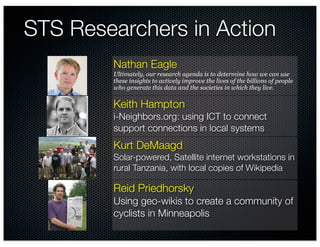
STS Researchers in Action
        Nathan Eagle
        Ultimately, our research agenda is to determine how we can use
        these insights to actively improve the lives of the billions of people
        who generate this data and the societies in which they live.

        Keith Hampton
        i-Neighbors.org: using ICT to connect
        support connections in local systems
        Kurt DeMaagd
        Solar-powered, Satellite internet workstations in
        rural Tanzania, with local copies of Wikipedia

        Reid Priedhorsky
        Using geo-wikis to create a community of
        cyclists in Minneapolis
So what’s the hold up?
Challenges to a sociotechnical perspective.
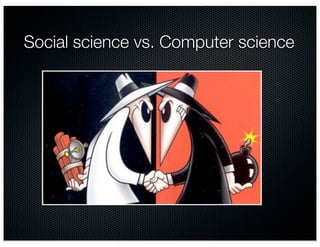
Social science vs. Computer science
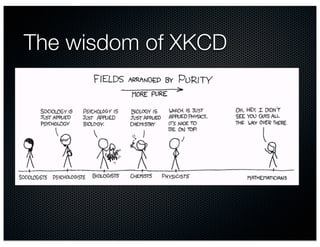
The wisdom of XKCD
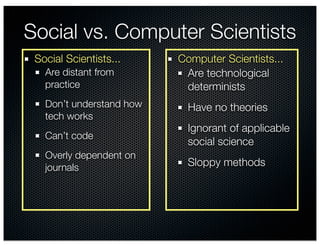
Social vs. Computer Scientists
 Social Scientists...     Computer Scientists...
   Are distant from        Are technological
   practice                determinists
   Don’t understand how     Have no theories
   tech works
                            Ignorant of applicable
   Can’t code
                            social science
   Overly dependent on
   journals                 Sloppy methods
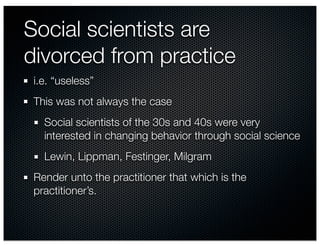
Social scientists are
divorced from practice
 i.e. “useless”
 This was not always the case
   Social scientists of the 30s and 40s were very
   interested in changing behavior through social science
   Lewin, Lippman, Festinger, Milgram
 Render unto the practitioner that which is the
 practitioner’s.
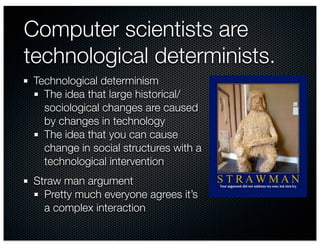
Computer scientists are
technological determinists.
 Technological determinism
   The idea that large historical/
   sociological changes are caused
   by changes in technology
   The idea that you can cause
   change in social structures with a
   technological intervention
 Straw man argument
   Pretty much everyone agrees it’s
   a complex interaction
General challenges to
academic collaborations
Mixed incentives
  Journals or conferences? Books or patents?
(Un)shared vocabularies
  For terms, but also for methods, seminal work,
  theories, ground knowledge
Competition for limited resources
  Who gets credit for what? Who manages the
  budgets? Are we helping them poach our turf?
Few opportunities to interact
  Cocktail hours every term don’t cut it
But it’s even harder than that...
We also have to get the practitioners on board
The ecology of STS in action
 Who do we need to get real change from online
 interactions?
    Social and technology researchers
    Practitioners
      Site designers
      entrepreneurs
      policy experts
      subject experts
      marketers/advertisers
      educators
      end users
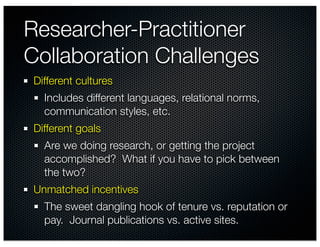
Researcher-Practitioner
Collaboration Challenges
Different cultures
  Includes different languages, relational norms,
  communication styles, etc.
Different goals
  Are we doing research, or getting the project
  accomplished? What if you have to pick between
  the two?
Unmatched incentives
  The sweet dangling hook of tenure vs. reputation or
  pay. Journal publications vs. active sites.
How to encourage this approach
Ways to combine the efforts of researchers in
multiple fields, STS practitioners, and more
general audiences.
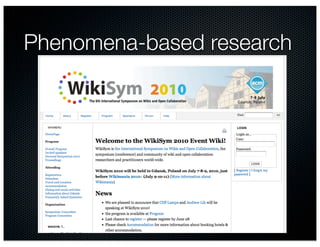
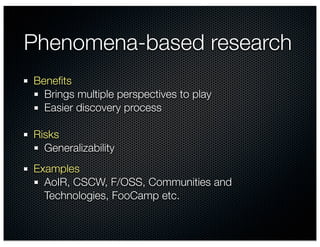
Phenomena-based research
Benefits
  Brings multiple perspectives to play
  Easier discovery process

Risks
  Generalizability
Examples
  AoIR, CSCW, F/OSS, Communities and
  Technologies, FooCamp etc.
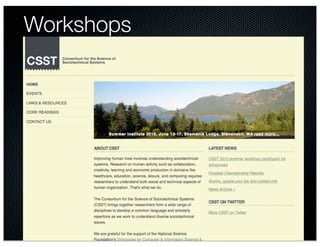
Workshops
Funding pressure to collaborate
 Existing opportunities
   Cross-disciplinary requirements in large grants
   Computing Innovation Fellows Program
   Supported Workshops
      e.g. Technology Mediated Social Participation

 Potential opportunities
   Paid academic internships

 But...
   Hard to do across borders
   Dominated by core disciplines/locations
Practitioners and researchers
making sweet STS love
 Practitioners
   Can help by making data and experience available
   Need to articulate their needs and interests
 Researchers
   Can help by explaining the interactions taking place
   in STSs
   Need to work harder to show the value of that work
 Examples of sort of success
   Sourceforge, Wikipedia, Twitter
How to make it happen
Mixed events like WikiSym, CHI, other ACM conferences
  But how to get the core social sciences involved?
Sabbaticals
  Industry sabbaticals need to be rewarded in new ways
Adjunct positions for practitioners
  Not just for teaching
Funding for practitioner participation
  Need to be included in academic grants
Specific project partnerships between the two
  not just talks in corporate settings, but actual
  problems to take on
These collaborations are
difficult, but they will be
worth it.
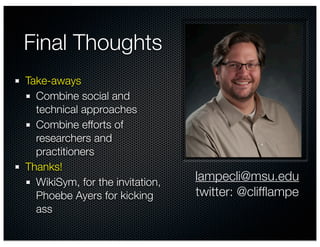
Final Thoughts
Take-aways
  Combine social and
  technical approaches
  Combine efforts of
  researchers and
  practitioners
Thanks!
  WikiSym, for the invitation,   lampecli@msu.edu
  Phoebe Ayers for kicking       twitter: @clifflampe
  ass

The machine in the ghost: a socio-technical perspective...

  • 1.
    The Machine inthe Ghost: a Socio-Technical Approach to User- Generated Content Research Dr. Cliff Lampe Dept. of Telecommunication, Information Studies and Media Michigan State University
  • 2.
    Overall narrative: We needto combine the theories, techniques, and passions of multiple fields to truly understand (and possibly affect) human interaction mediated by information and communication technology. We also need to engage practitioners.
  • 3.
    Clifford Arthur CochiseLampe Researcher at Michigan State University PhD in Information from U of Michigan Studies Online communities, Social Media, socio-technical systems, blah, blah blah Human interaction mediated by Information and Communication Technology
  • 4.
    Cliff’s Biases Onecentric jerk U.S. Centric Social science centric Inductive-ish Practice-oriented research i.e. Technological Determinist MSU as a land grant
  • 5.
  • 6.
    My boiled downdefinition Sociotechnical system: The interrelated social and technical aspects of mediated interactions But really: Don’t get hung up on the definition.
  • 7.
    Technical Social socio technical
  • 8.
    Hardware Usability Groups Organizations Applications Technical socio Social technical Society Openness Design Interpersonal
  • 9.
    Characteristics of sociotechnical systems Commoncharacteristics Direct user-to-user interaction Mediation Uncommon characteristics Size of the social system Set of ICT tools Task being supported
  • 10.
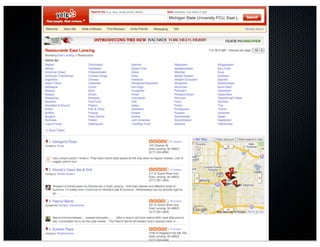
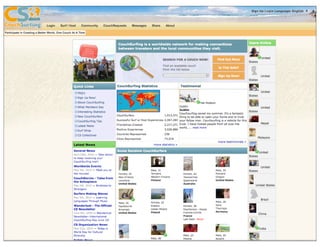
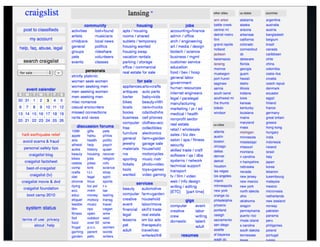
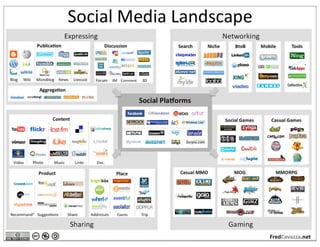
    Some obvious examplesof sociotechnical systems
  • 17.
    Sociotechnical systems are theinterrelation between technological and human systems.
  • 18.
    The science of sociotechnicalsystems Consistently multidisciplinary Leads to multiple methods, multiple theories Consequently dominated by disciplines that “play ball” Hard to feed findings/results back into the main disciplines Hard to bring in new disciplines fully (i.e. the “sucking hind tit” problem)
  • 19.
    Some people whohelped me think about sociotechnical systems
  • 20.
  • 21.
    Paul Resnick Mark Ackerman Gary and Judy Olson Sociotechnical Sociotechnical Distance Matters capital gap
  • 22.
    Judith Donath “Signals inSocial Supernets” Barry Wellman “Connecting Community: On- and Off-Line” Jonathan Grudin “Why groupware applications fail.” Joe Walther “Interpersonal effects in computer- mediated communication” Communitylab Bob Kraut, Sara Kiesler, Loren Terveen, John Riedl, Joe Konstan, Resnick: communitylab.org
  • 23.
  • 24.
    A sordid history ofsociotechnical systems I’ve researched
  • 29.
    An even moresordid history of sites I’ve been helping to create
  • 35.
  • 37.
    Quick aside toreflect on my shame The following projects are built on proprietary software. That’s eating me up from the inside. My university president could care less. University = bureaucratic organization
  • 40.
    The Great PlacesNetwork In development Partners Michigan State University Cooperative Extension, The Land Policy Institute Economic development in Grand Rapids and the Great Lakes Bay region Goal Help local leaders and NGOs create and promote regional economic plans
  • 41.
    Michigan Energy EfficiencyNetwork In development Partners Michigan Dept of Energy, Labor and Economic Growth; Office of the Governor, MI Depts of Information Technology, Education, Transportation, Wildlife and Natural Resources Goals Help anchor institutions in Michigan consume less energy, and save money on energy expenditures
  • 42.
    Recurring questions How dowe get people to go to this site? How do we get people to participate on the site? How do we get them to do X because they were on the site?
  • 43.
    Defining the successof STS System-internal metrics More common in the history of research in this area Focuses on a rich set of possible interactions in the system Still needs much research on the intersection of social and technical systems System-external metrics An effect of the wide scale use of STS? Crazy hard to measure.
  • 44.
    Example questions What hasbeen the wide-scale effect of Wikipedia been? How much more do people know than they did before the site came along? For the Michigan Energy Efficiency Network, how much energy is saved as a result of the system? How much money was saved? How many new jobs were created because of this effort? New jobs, more education, new grant money, less out- migration, better schools, more social capital, more voting, better decisions ETC ETC
  • 45.
    The vitality ofthe online system itself is no longer a sufficient outcome.
  • 46.
    In other words: CanSTSs save the world?! * p.s. Let’s hope so...
  • 47.
    STS Researchers inAction Nathan Eagle Ultimately, our research agenda is to determine how we can use these insights to actively improve the lives of the billions of people who generate this data and the societies in which they live. Keith Hampton i-Neighbors.org: using ICT to connect support connections in local systems Kurt DeMaagd Solar-powered, Satellite internet workstations in rural Tanzania, with local copies of Wikipedia Reid Priedhorsky Using geo-wikis to create a community of cyclists in Minneapolis
  • 49.
    So what’s thehold up? Challenges to a sociotechnical perspective.
  • 50.
    Social science vs.Computer science
  • 51.
  • 52.
    Social vs. ComputerScientists Social Scientists... Computer Scientists... Are distant from Are technological practice determinists Don’t understand how Have no theories tech works Ignorant of applicable Can’t code social science Overly dependent on journals Sloppy methods
  • 53.
    Social scientists are divorcedfrom practice i.e. “useless” This was not always the case Social scientists of the 30s and 40s were very interested in changing behavior through social science Lewin, Lippman, Festinger, Milgram Render unto the practitioner that which is the practitioner’s.
  • 54.
    Computer scientists are technologicaldeterminists. Technological determinism The idea that large historical/ sociological changes are caused by changes in technology The idea that you can cause change in social structures with a technological intervention Straw man argument Pretty much everyone agrees it’s a complex interaction
  • 55.
    General challenges to academiccollaborations Mixed incentives Journals or conferences? Books or patents? (Un)shared vocabularies For terms, but also for methods, seminal work, theories, ground knowledge Competition for limited resources Who gets credit for what? Who manages the budgets? Are we helping them poach our turf? Few opportunities to interact Cocktail hours every term don’t cut it
  • 56.
    But it’s evenharder than that... We also have to get the practitioners on board
  • 57.
    The ecology ofSTS in action Who do we need to get real change from online interactions? Social and technology researchers Practitioners Site designers entrepreneurs policy experts subject experts marketers/advertisers educators end users
  • 58.
    Researcher-Practitioner Collaboration Challenges Different cultures Includes different languages, relational norms, communication styles, etc. Different goals Are we doing research, or getting the project accomplished? What if you have to pick between the two? Unmatched incentives The sweet dangling hook of tenure vs. reputation or pay. Journal publications vs. active sites.
  • 59.
    How to encouragethis approach Ways to combine the efforts of researchers in multiple fields, STS practitioners, and more general audiences.
  • 60.
  • 61.
    Phenomena-based research Benefits Brings multiple perspectives to play Easier discovery process Risks Generalizability Examples AoIR, CSCW, F/OSS, Communities and Technologies, FooCamp etc.
  • 62.
  • 63.
    Funding pressure tocollaborate Existing opportunities Cross-disciplinary requirements in large grants Computing Innovation Fellows Program Supported Workshops e.g. Technology Mediated Social Participation Potential opportunities Paid academic internships But... Hard to do across borders Dominated by core disciplines/locations
  • 64.
    Practitioners and researchers makingsweet STS love Practitioners Can help by making data and experience available Need to articulate their needs and interests Researchers Can help by explaining the interactions taking place in STSs Need to work harder to show the value of that work Examples of sort of success Sourceforge, Wikipedia, Twitter
  • 65.
    How to makeit happen Mixed events like WikiSym, CHI, other ACM conferences But how to get the core social sciences involved? Sabbaticals Industry sabbaticals need to be rewarded in new ways Adjunct positions for practitioners Not just for teaching Funding for practitioner participation Need to be included in academic grants Specific project partnerships between the two not just talks in corporate settings, but actual problems to take on
  • 66.
    These collaborations are difficult,but they will be worth it.
  • 67.
    Final Thoughts Take-aways Combine social and technical approaches Combine efforts of researchers and practitioners Thanks! WikiSym, for the invitation, lampecli@msu.edu Phoebe Ayers for kicking twitter: @clifflampe ass