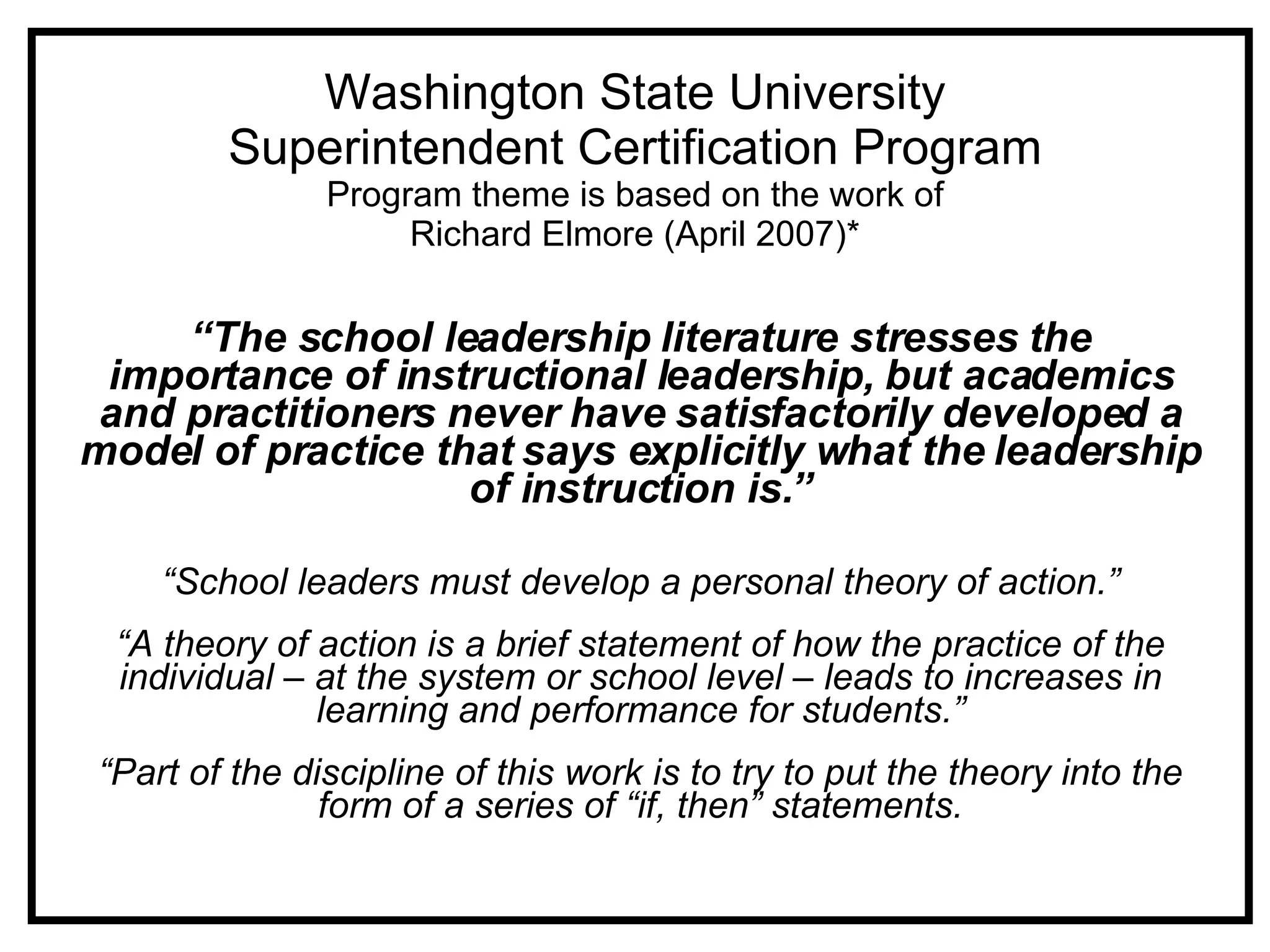
Washington State University Superintendent Certification Program Program theme is based on the work of Richard Elmore (April 2007)* “ The school leadership literature stresses the importance of instructional leadership, but academics and practitioners never have satisfactorily developed a model of practice that says explicitly what the leadership of instruction is.” “ School leaders must develop a personal theory of action.” “ A theory of action is a brief statement of how the practice of the individual – at the system or school level – leads to increases in learning and performance for students.” “ Part of the discipline of this work is to try to put the theory into the form of a series of “if, then” statements.
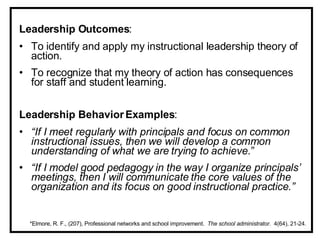
Leadership Outcomes : To identify and apply my instructional leadership theory of action. To recognize that my theory of action has consequences for staff and student learning. Leadership Behavior Examples : “ If I meet regularly with principals and focus on common instructional issues, then we will develop a common understanding of what we are trying to achieve.” “ If I model good pedagogy in the way I organize principals’ meetings, then I will communicate the core values of the organization and its focus on good instructional practice.” *Elmore, R. F., (207), Professional networks and school improvement.  The school administrator.   4(64), 21-24.
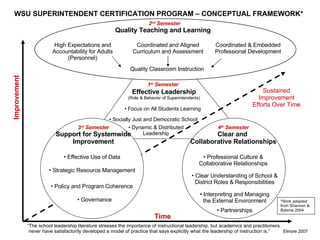
Focus on All Students Learning Dynamic & Distributed Leadership 3 rd  Semester Support for Systemwide Improvement Effective Use of Data Strategic Resource Management Policy and Program Coherence 4 th  Semester Clear and  Collaborative Relationships Professional Culture & Collaborative Relationships Clear Understanding of School & District Roles & Responsibilities Interpreting and Managing the External Environment 1 st  Semester   Effective Leadership (Role & Behavior of Superintendents) Sustained Improvement Efforts Over Time 2 nd  Semester Quality Teaching and Learning High Expectations and Accountability for Adults (Personnel) Coordinated and Aligned Curriculum and Assessment Coordinated & Embedded Professional Development Quality Classroom Instruction Time Improvement WSU SUPERINTENDENT CERTIFICATION PROGRAM – CONCEPTUAL FRAMEWORK* Governance “ The school leadership literature stresses the importance of instructional leadership, but academics and practitioners never have satisfactorily developed a model of practice that says explicitly what the leadership of instruction is.”   Elmore 2007 Socially Just and Democratic School Partnerships *Work adapted from Shannon & Bylsma 2004

Wsu Program Overview Elmore And Two Year Conceptual Framewrok

  • 1.
    Washington State UniversitySuperintendent Certification Program Program theme is based on the work of Richard Elmore (April 2007)* “ The school leadership literature stresses the importance of instructional leadership, but academics and practitioners never have satisfactorily developed a model of practice that says explicitly what the leadership of instruction is.” “ School leaders must develop a personal theory of action.” “ A theory of action is a brief statement of how the practice of the individual – at the system or school level – leads to increases in learning and performance for students.” “ Part of the discipline of this work is to try to put the theory into the form of a series of “if, then” statements.
  • 2.
    Leadership Outcomes :To identify and apply my instructional leadership theory of action. To recognize that my theory of action has consequences for staff and student learning. Leadership Behavior Examples : “ If I meet regularly with principals and focus on common instructional issues, then we will develop a common understanding of what we are trying to achieve.” “ If I model good pedagogy in the way I organize principals’ meetings, then I will communicate the core values of the organization and its focus on good instructional practice.” *Elmore, R. F., (207), Professional networks and school improvement. The school administrator. 4(64), 21-24.
  • 3.
    Focus on AllStudents Learning Dynamic & Distributed Leadership 3 rd Semester Support for Systemwide Improvement Effective Use of Data Strategic Resource Management Policy and Program Coherence 4 th Semester Clear and Collaborative Relationships Professional Culture & Collaborative Relationships Clear Understanding of School & District Roles & Responsibilities Interpreting and Managing the External Environment 1 st Semester Effective Leadership (Role & Behavior of Superintendents) Sustained Improvement Efforts Over Time 2 nd Semester Quality Teaching and Learning High Expectations and Accountability for Adults (Personnel) Coordinated and Aligned Curriculum and Assessment Coordinated & Embedded Professional Development Quality Classroom Instruction Time Improvement WSU SUPERINTENDENT CERTIFICATION PROGRAM – CONCEPTUAL FRAMEWORK* Governance “ The school leadership literature stresses the importance of instructional leadership, but academics and practitioners never have satisfactorily developed a model of practice that says explicitly what the leadership of instruction is.” Elmore 2007 Socially Just and Democratic School Partnerships *Work adapted from Shannon & Bylsma 2004