
A Problem Solving Approach to the teaching of Mathematics at the Secondary levelDeveloping Habits of MindJudith SediDavion  Leslie
ObjectivesTo explore the features of problemsTo establish a framework for developing problem solving skills in students.To explore the benefits of adopting a problem solving approach to teaching math.
Thinking-based curriculum Have you ever met students whocan perform operations and algorithms but are unaware of what they are doing? slavishly follow algorithms regardless of what they are doing? cannot respond to context based questions – even though they can perform the operations implied in the questions?require an example before they can ‘solve a problem’ are not able to try different approaches in order to arrive at a correct answer?
Thinking based curriculumWhat is the thinking based curriculum? How can it address some  of the problems mentioned before? What is the true purpose of teaching math in school?Does what exists now in schools qualify as the thinking based curriculum?
What is a Problem ?Any task or activity for which the students have no prescribed or memorized rules or methods, nor is there a perception by students that there is a specific ‘correct’ solution method (Hiebert et al. , 1997)What is a Problem ?We can safely say that most worded “problems” are simply “dressed up algorithms”, exercises that give prompts by using specific words such as “altogether”, “shared among” and students do them without truly understanding what the question is about.
“Problems that are truly problematic do not have clear or single solution paths” (Schoenfeld, 1985, p. 34).“Computational exercises for which students do not have a readily-accessible method or approach can be truly problematic” (Yackel, Cobb and Wood, 1988, p. 87).Problem solving
Problems are not to be seen as traditional word problems. Traditional word problems “provide contexts for using particular formulas or algorithms but do not offer opportunities for true problem solving” (NCTM, 1989, p. 76). Problems are, therefore, NOT contextualised  algorithms According to NCTM
Benefits of Problem solving It develops students’ higher order  thinking skills
It allows the student the opportunity to express their understanding of the concept
It reduces dependence on memory
It creates multi-dimensional classroom setting
It caters to the multiple intelligences of childrenDeveloping problem solving skillsThe aim of mathematics teaching is not to make students solve problems but to make them into problem solvers. Lessons should not only expose students to problems but also develop the habits of mind that enable them to become problem solvers. Students must be made to see an activity as an opportunity to think and not a question to be unpacked with and through algorithms.
Developing habits of mindIntroductory problemA tournament is being arranged among 22 teams. The competition will be on a league basis, where every team will play each other twice – once at home and once away. The organizer wants to know how many matches will be involved.
Habits of mindAt first the problem appears difficultNo known algorithms exist and students may not have an example of a similar problem.Students may not know how to approach the problem.  How would you intervene at this stage?What would you say? Would you give an example?Would you model an approach?Would you do anything at all?
Habits of mindHow do we start?How about simplifying the problem? Suppose instead of 22 teams, there were only 4?But still, how do we start? Well figure out a system for recording how many matches 4 teams will play.
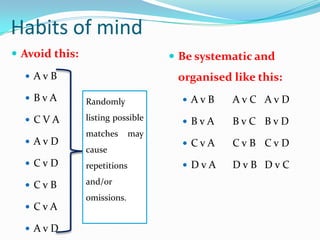
Habits of mindAvoid this:A v BB v AC V AA v DC v DC v BC v AA v DBe systematic and organised like this:
A v B	A v C	A v D
B v A	B v C	B v D
C v A	C v B	C v D
D v A 	D v B	D v CRandomly listing possible matches may cause repetitions and/or omissions.
Habits of mindOr better yet, like this:
Habits of mindBy now you should realise that 4 teams will play 12 matches. Does this mean that the number of matches will be 3 times the number of teams?Will 22 teams play 66 matches?Perhaps we should try a few more cases to see.Which cases would you try and why?

Problem solving secondary

  • 1.
    A Problem SolvingApproach to the teaching of Mathematics at the Secondary levelDeveloping Habits of MindJudith SediDavion Leslie
  • 2.
    ObjectivesTo explore thefeatures of problemsTo establish a framework for developing problem solving skills in students.To explore the benefits of adopting a problem solving approach to teaching math.
  • 3.
    Thinking-based curriculum Haveyou ever met students whocan perform operations and algorithms but are unaware of what they are doing? slavishly follow algorithms regardless of what they are doing? cannot respond to context based questions – even though they can perform the operations implied in the questions?require an example before they can ‘solve a problem’ are not able to try different approaches in order to arrive at a correct answer?
  • 4.
    Thinking based curriculumWhatis the thinking based curriculum? How can it address some of the problems mentioned before? What is the true purpose of teaching math in school?Does what exists now in schools qualify as the thinking based curriculum?
  • 5.
    What is aProblem ?Any task or activity for which the students have no prescribed or memorized rules or methods, nor is there a perception by students that there is a specific ‘correct’ solution method (Hiebert et al. , 1997)What is a Problem ?We can safely say that most worded “problems” are simply “dressed up algorithms”, exercises that give prompts by using specific words such as “altogether”, “shared among” and students do them without truly understanding what the question is about.
  • 6.
    “Problems that aretruly problematic do not have clear or single solution paths” (Schoenfeld, 1985, p. 34).“Computational exercises for which students do not have a readily-accessible method or approach can be truly problematic” (Yackel, Cobb and Wood, 1988, p. 87).Problem solving
  • 7.
    Problems are notto be seen as traditional word problems. Traditional word problems “provide contexts for using particular formulas or algorithms but do not offer opportunities for true problem solving” (NCTM, 1989, p. 76). Problems are, therefore, NOT contextualised algorithms According to NCTM
  • 8.
    Benefits of Problemsolving It develops students’ higher order thinking skills
  • 9.
    It allows thestudent the opportunity to express their understanding of the concept
  • 10.
  • 11.
  • 12.
    It caters tothe multiple intelligences of childrenDeveloping problem solving skillsThe aim of mathematics teaching is not to make students solve problems but to make them into problem solvers. Lessons should not only expose students to problems but also develop the habits of mind that enable them to become problem solvers. Students must be made to see an activity as an opportunity to think and not a question to be unpacked with and through algorithms.
  • 13.
    Developing habits ofmindIntroductory problemA tournament is being arranged among 22 teams. The competition will be on a league basis, where every team will play each other twice – once at home and once away. The organizer wants to know how many matches will be involved.
  • 14.
    Habits of mindAtfirst the problem appears difficultNo known algorithms exist and students may not have an example of a similar problem.Students may not know how to approach the problem. How would you intervene at this stage?What would you say? Would you give an example?Would you model an approach?Would you do anything at all?
  • 15.
    Habits of mindHowdo we start?How about simplifying the problem? Suppose instead of 22 teams, there were only 4?But still, how do we start? Well figure out a system for recording how many matches 4 teams will play.
  • 16.
    Habits of mindAvoidthis:A v BB v AC V AA v DC v DC v BC v AA v DBe systematic and organised like this:
  • 17.
    A v B Av C A v D
  • 18.
    B v A Bv C B v D
  • 19.
    C v A Cv B C v D
  • 20.
    D v A D v B D v CRandomly listing possible matches may cause repetitions and/or omissions.
  • 21.
    Habits of mindOrbetter yet, like this:
  • 22.
    Habits of mindBynow you should realise that 4 teams will play 12 matches. Does this mean that the number of matches will be 3 times the number of teams?Will 22 teams play 66 matches?Perhaps we should try a few more cases to see.Which cases would you try and why?

Editor's Notes

  • #17 Ensure that they try 2 – 6 teams.