Daily Lesson
Log
School: MalibatuanHigh School Grade Level: 10
Teacher: Echa A. Cagalitan, T1 Learning Area: English
Teaching Dates
and Time:
March 25, 2025
9:45-10:00 AM
Quarter: 4
I. OBJECTIVES
A. Grade Level Standards:
The learner demonstrates communicative competence through his/her understanding of British-American Literature,
including Philippine Literature and other text types for a deeper appreciation of Philippine culture and those of other
countries.
B. Content Standards
The learner demonstrates understanding of how world literature and other text types serve as instruments to resolve
social conflicts, also how to use the language of research, campaigns and advocacies.
B. Learning Competencies (Write the LC code for
each)
Compose a research report on a relevant social issue (EN10SS-IVe-2.3)
C. Specific Objectives
At the end of 75-minute class session, 80% of the students can:
1. identify the different parts of a research report,
2. explain the function of each part; and,
3. appreciate the importance of understanding the parts of a research report.
II. CONTENT TOPIC: PARTS OF A RESEARCH REPORT
III. LEARNING RESOURCES
A. References
1. Teacher’s Guide pages
2. Learner’s Materials pages
3. Textbook pages
4. Additional Materials from Learning Resource
(LR) Portal
Saranggani SLMs, LAS
B. Other Learning Resources Powerpoint presentation, hand-outs, educational videos, meta-strips,
IV. PROCEDURES ANNOTATIONS
Preliminaries
Prayer, Greetings, Checking of Attendance, Reminders about the Class
Rules, Group Rules and Scoring guide…
Class Rules and Group Rules
1. The teacher will present the class rules and will use flaglets as part of
the rules.
Indicator 4: Used effective
2.
2. The teacherwill raise green flag for “GO signal” or to acknowledge
the first group to finish the task.
3. Orange flag will be raised for a warning sign for deduction to
misbehaving group.
4. While red flag will be raised after a call to the group who will be
deducted 2 points for misbehaving twice.
verbal and non-verbal
classroom communication
strategies to support learner
understanding, participation,
engagement and
achievement.
A. Reviewing Previous lesson or presenting the new
lesson.
COUNT THE LETTER, GUESS THE WORD!
Mechanics:
1. The teacher will project number boxes with corresponding letters,
students will guess the word in each box.
2. Students will guess the words by counting in the letters that the
number in the box corresponds.
3. If a student knows the answer, he/she will raise his/her hand.
4. The first to give the correct answer will be given 3 points as a group
score.
Indicator 2. Used a range of
teaching strategies that
enhance learner achievement
in literacy and numeracy
skills.
B. Establishing a purpose for the lesson.
Guess the Riddle!
o What Body part Am I?
Mechanics:
1. The teacher will present the riddle for the students to read aloud.
2. The teacher will call 2 students in each group as participants to
answer a question.
3. Then, students will guess what body part does the riddle describes.
4. Every correct answer will be given 2 points as group score.
Later, the teacher will ask the connection of the riddle game to the topic.
Afterwards, the teacher will present the learning objectives and reveal the
topic.
Indicator 5: Maintained
supportive learning
environments that nurture
and inspire learners to
participate, cooperate and
collaborate in continued
learning.
Game Adopted from:
www.reallygreatsite.com
3.
C. Presenting examples/instances of the new
lesson.
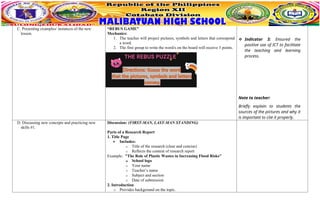
“REBUS GAME”
Mechanics:
1. The teacher will project pictures, symbols and letters that correspond
a word.
2. The first group to write the word/s on the board will receive 3 points.
Indicator 3: Ensured the
positive use of ICT to facilitate
the teaching and learning
process.
Note to teacher:
Briefly explain to students the
sources of the pictures and why it
is important to cite it properly.
D. Discussing new concepts and practicing new
skills #1.
Discussion: (FIRST-MAN, LAST-MAN STANDING)
Parts of a Research Report
1. Title Page
Includes:
o Title of the research (clear and concise)
o Reflects the content of research report
Example: "The Role of Plastic Wastes in Increasing Flood Risks"
o School logo
o Your name
o Teacher’s name
o Subject and section
o Date of submission
2. Introduction
o Provides background on the topic.
4.
o Introduces thetopic, explains its importance, and states the purpose
of the study
Example:
Plastic waste has become one of the most serious environmental
problems worldwide. Every year, millions of tons of plastic end up in
rivers, lakes, and oceans, affecting water quality and marine life.
Plastics take hundreds of years to break down, and during this
process, they release harmful chemicals and tiny plastic particles
called microplastics. These pollutants can contaminate drinking water
sources and harm aquatic ecosystems, (Zohan 2020).
This study aims to examine the impact of plastic waste on flood risks,
focusing on how plastic pollution affects water clarity, chemical
composition, and the presence of harmful substances. By understanding these
effects, we can find better ways to manage plastic waste and protect water
resources.
3. Literature Review (RRL)
Summarizes previous studies related to the topic.
Shows how the current research is connected to past findings.
Uses citations from books, journals, and websites.
5. Research Methods and Results
o Methods explains how the research was conducted, who are the
participants, how data is analyzed.
o Results present the outcome of the research and how it was presented
using (bar graphs, tables, charts, etc.)
6. Conclusions and Recommendation
Conclusion:
o This summarizes key findings.
o Answers the research question(s).
Indicator 1: Applied knowledge
of content within and across
curriculum teaching areas.
5.
Conclusion
This research highlightsthat plastic waste clogs drainage systems,
preventing proper water flow and leading to severe flooding during heavy
rains. Improper disposal of plastic waste in rivers and waterways also
worsens the situation by reducing water drainage capacity and increasing
pollution. Additionally, floods caused by plastic blockages not only
damage infrastructure but also pose health risks by contaminating water
sources.
Recommendations:
o Suggests improvements, further research, or real-world applications.
Example:
To reduce flood risks, it is recommended that;
1. Residents should help improve waste management practices,
promote plastic recycling, and raise public awareness about the
environmental impact of plastic pollution.
2. BLGU must have a clear implementing plan and strict regulations on
plastic use, encouraging eco-friendly alternatives, and enhancing
drainage system maintenance.
3. In case of floods, DRRM should have a proper coordination with the
communities when and where to evacuate for the safety of
individuals.
4. Government, should provide proper education on waste management
and disaster risks.
Indicator 8: Planned and delivered
teaching strategies that are
responsive to the special
educational needs of learners in
difficult circumstances, including:
geographic isolation; chronic illness;
displacement due to armed conflict,
urban resettlement or disasters; child
abuse and child labor practices.
Source:
Yoshioka, N., Era, M., & Sasaki, D. (2021).
Towards Integration of Climate Disaster Risk
and Waste Management: A Case Study of Urban
and Rural Coastal Communities in the
Philippines. Sustainability, p. 13(4), 1624.
https://doi.org/10.3390/su13041624
E. Discussing new concepts and practicing new
skills #2.
Gallery Walk
The teacher will present concrete examples of each part of research report
through a gallery walk.
Mechanics:
1. Each group of students will rotate to the 4 stations.
a. First station, visual representations of title page and
introduction
Indicator 7: Designed,
adapted and implemented
teaching strategies that are
6.
b. Second station,reading materials on RRL
c. Third station, reading materials graphics representations of
Methods and Results
d. Fourth station, reading materials and videos presenting
conclusions and recommendations
2. They will be given different tasks and 2 minutes time to spend in
every station.
3. They should write down what key details they observed on the
materials given by completing the information needed in the tables
and checklists given.
For group leaders, assistant leaders and secretary, they will use the
table.
Parts of Research Report What is its function?
Title Page
Literature Review
Methods
Results
Conclusion
Recommendation
For the group members, they will accomplish the checklist.
Direction: Put check (/) in the column if you agree to the
statement given. Write letter x (x) if you disagree.
QUESTIONS Check if
you agree,
responsive to learners with
disabilities, giftedness and
talents.
8.
Note to Teacher:
Designa differentiated
instruction for learners with
varying cognitive abilities.
This activity is designed based on the Theory of
John Dewey, "learning by doing," or
experiential learning, emphasizes that genuine
learning occurs through active engagement of
learners. The 4 stations serves as an arena where
students needed to extract information to grasp
further the topic. Another philosophy of teaching
highlighted in this part of the lesson is
diffirentiated instruction, which is based on the
premise that students learn best when their
teachers accommodate the differences in their
readiness levels, interests and learning profiles,
Tomlinson (2005).
F. Developing mastery (Leads to formative
Assessment 3)
NAME THE PART!
The teacher will give examples of statements, phrases or figures that signifies
parts of research report. Students will determine what part of the research it
belongs.
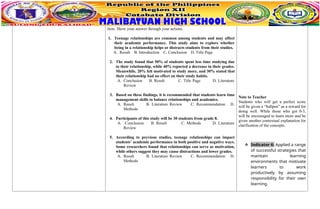
Directions: Identify what part of a research report is being stated in each
9.
item. Show youranswer through your actions.
1. Teenage relationships are common among students and may affect
their academic performance. This study aims to explore whether
being in a relationship helps or distracts students from their studies.
A. Result B. Introduction C. Conclusion D. Title Page
2. The study found that 50% of students spent less time studying due
to their relationship, while 40% reported a decrease in their grades.
Meanwhile, 20% felt motivated to study more, and 30% stated that
their relationship had no effect on their study habits.
A. Conclusion B. Result C. Title Page D. Literature
Review
3. Based on these findings, it is recommended that students learn time
management skills to balance relationships and academics.
A. Result B. Literature Review C. Recommendation D.
Methods
4. Participants of this study will be 30 students from grade 8.
A. Conclusion B. Result C. Methods D. Literature
Review
5. According to previous studies, teenage relationships can impact
students’ academic performance in both positive and negative ways.
Some researchers found that relationships can serve as motivation,
while others suggest they may cause distractions and lower grades.
A. Result B. Literature Review C. Recommendation D.
Methods
Note to Teacher
Students who will get a perfect score
will be given a “ballpen” as a reward for
doing well. While those who got 0-3,
will be encouraged to learn more and be
given another contextual explanation for
clarification of the concepts.
Indicator 6: Applied a range
of successful strategies that
maintain learning
environments that motivate
learners to work
productively by assuming
responsibility for their own
learning.
10.
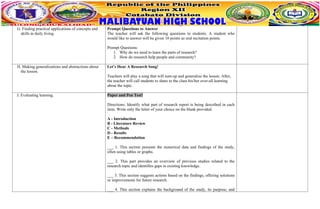
G. Finding practicalapplications of concepts and
skills in daily living.
Prompt Questions to Answer
The teacher will ask the following questions to students. A student who
would like to answer will be given 10 points as oral recitation points.
Prompt Questions:
1. Why do we need to learn the parts of research?
2. How do research help people and community?
H. Making generalizations and abstractions about
the lesson.
Let’s Hear A Research Song!
Teachers will play a song that will sum-up and generalize the lesson. After,
the teacher will call students to share to the class his/her over-all learning
about the topic.
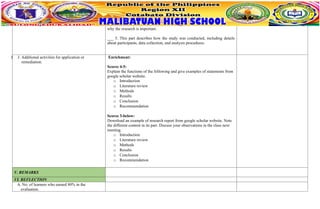
I. Evaluating learning. Paper and Pen Test!
Directions: Identify what part of research report is being described in each
item. Write only the letter of your choice on the blank provided.
A - Introduction
B - Literature Review
C - Methods
D - Results
E – Recommendation
___ 1. This section presents the numerical data and findings of the study,
often using tables or graphs.
___ 2. This part provides an overview of previous studies related to the
research topic and identifies gaps in existing knowledge.
___ 3. This section suggests actions based on the findings, offering solutions
or improvements for future research.
___ 4. This section explains the background of the study, its purpose, and
11.
why the researchis important.
___ 5. This part describes how the study was conducted, including details
about participants, data collection, and analysis procedures.
J J. Additional activities for application or
remediation.
Enrichment:
Scores 4-5:
Explain the functions of the following and give examples of statements from
google scholar website.
o Introduction
o Literature review
o Methods
o Results
o Conclusion
o Recommendation
Scores 3-below:
Download an example of research report from google scholar website. Note
the different content in its part. Discuss your observations in the class next
meeting.
o Introduction
o Literature review
o Methods
o Results
o Conclusion
o Recommendation
V. REMARKS
VI. REFLECTION
A. No. of learners who earned 80% in the
evaluation.
12.
B. No. oflearners who require additional activities
for remediation.
C. Did the remedial lessons work? No. of learners
who have caught up the lesson.
D. No. of learners who continue to require
remediation.
E. Which of my teaching strategies worked well?
Why did these works?
F. What difficulties did I encounter which my
principal or supervisor can help me solve?
G. What innovation or localized materials did I
use/discover which I wish to share with other?
Prepared and Submitted by: Checked by: Noted by:
ECHA A. CAGALITAN CHERYL C. VALENTE JESSIE D. ALOJADO, P-I
Teacher I Master Teacher I School Head