International Journal of Modern Engineering Research (IJMER)
www.ijmer.com Vol.3, Issue.2, March-April. 2013 pp-1146-1149 ISSN: 2249-6645
www.ijmer.com 1146 | Page
Sachin G. Maske, 1
Dr. P. S. Pajgade2
1
Department of civil Engineering Prof. Ram Meghe Institute of Technology and Research, Badnera,
M.E. (Structural Engineering) Final Year
2
Professor in Department of civil Engineering Prof. Ram Meghe institute of Technology and Research, Badnera
Abstract: Torsional behaviour of asymmetric building is one of the most frequent source of structural damage and failure
during strong ground motions. In this work a study on the influence of the torsion effects on the behaviour of structure is
done. In building two cases are considered, case one is without considering torsion and case two is considering torsion. The
Indian standard code of practice IS-1893 (Part I: 2002) guidelines and methodology are used to analyzed and designed
building. Results are compared in terms of % Ast in columns.
Keywords: Asymmetric plan, Earthquake, Eccentricity, Torsion.
I. Introduction
Seismic damage surveys and analyses conducted on modes of failure of building structures during past severe
earthquakes concluded that most vulnerable building structures are those, which are asymmetric in nature. Asymmetric-plan
buildings, namely buildings with in-plan asymmetric mass and strength distributions, are systems characterized by a coupled
torsional-translational seismic response. Asymmetric building structures are almost unavoidable in modern construction due
to various types of functional and architectural requirements. Torsion in buildings during earthquake shaking may be caused
from a variety of reasons, the most common of which are non-symmetric distributions of mass and stiffness. Modern codes
deal with torsion by placing restrictions on the design of buildings with irregular layouts and also through the introduction of
an accidental eccentricity that must be considered in design. The lateral-torsional coupling due to eccentricity between centre
of mass (CM) and centre of rigidity (CR) in asymmetric building structures generates torsional vibration even under purely
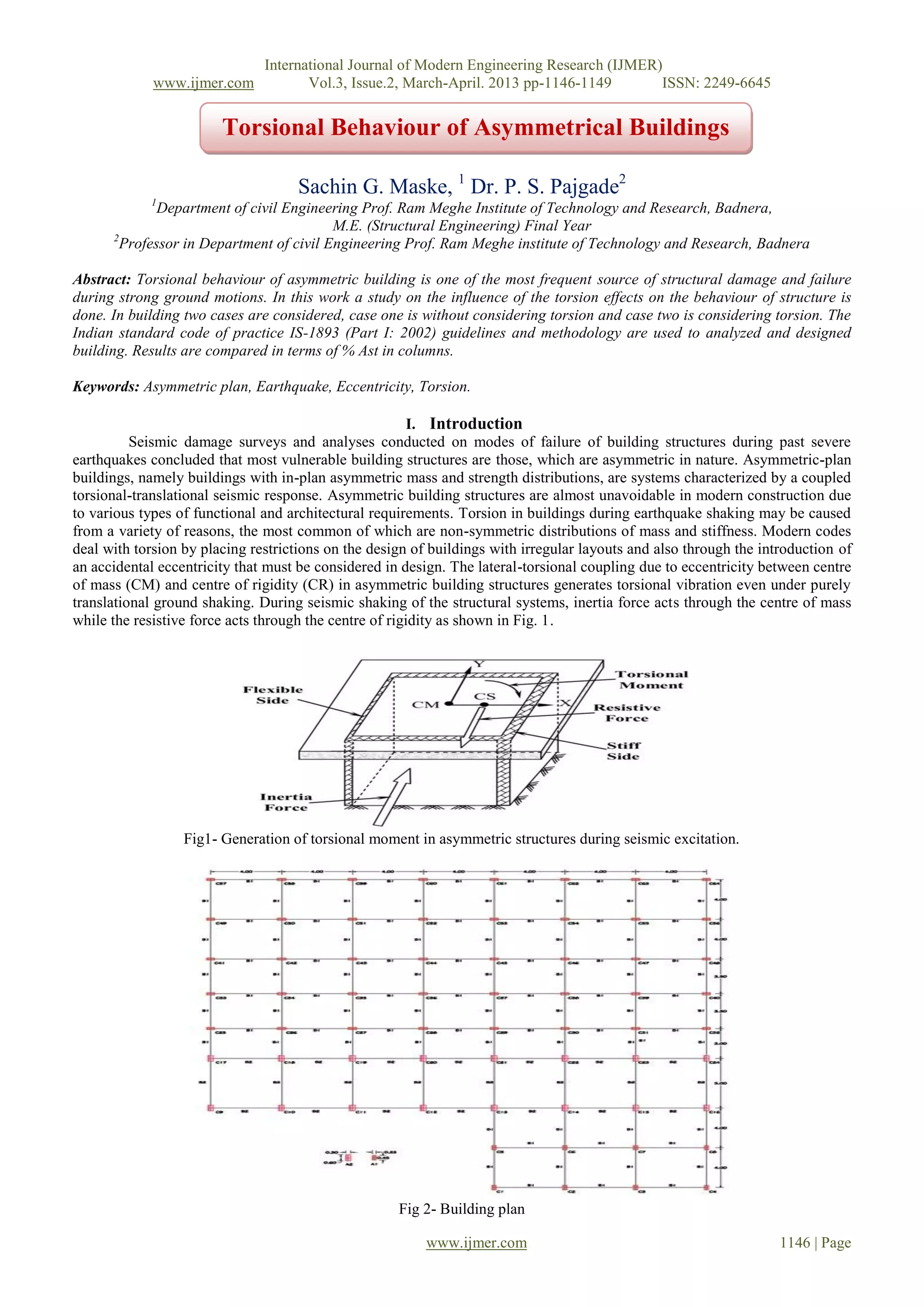
translational ground shaking. During seismic shaking of the structural systems, inertia force acts through the centre of mass
while the resistive force acts through the centre of rigidity as shown in Fig. 1.
Fig1- Generation of torsional moment in asymmetric structures during seismic excitation.
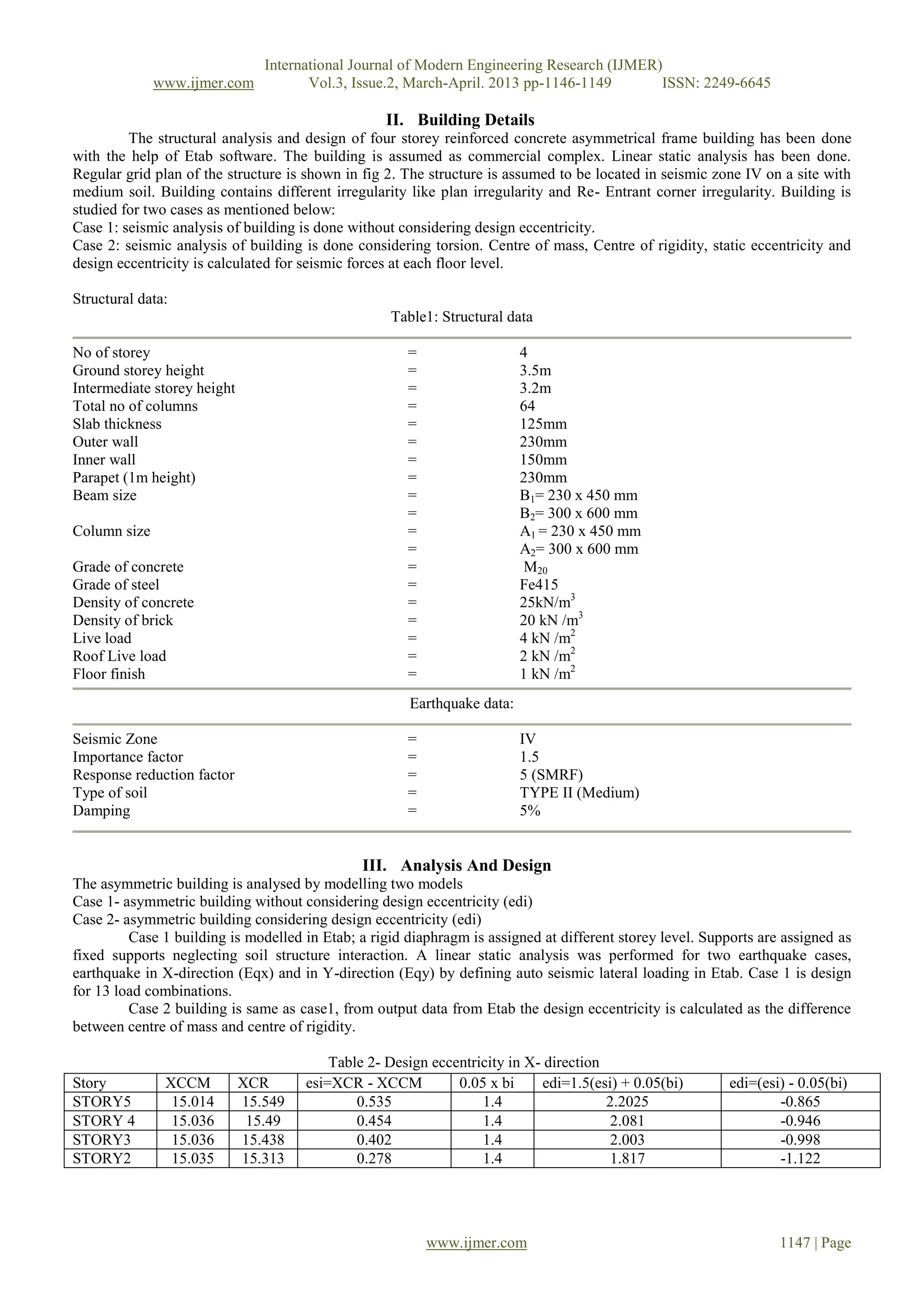
Fig 2- Building plan
Torsional Behaviour of Asymmetrical Buildings
International Journal of Modern Engineering Research (IJMER)
www.ijmer.com Vol.3, Issue.2, March-April. 2013 pp-1146-1149 ISSN: 2249-6645
www.ijmer.com 1147 | Page
II. Building Details
The structural analysis and design of four storey reinforced concrete asymmetrical frame building has been done
with the help of Etab software. The building is assumed as commercial complex. Linear static analysis has been done.
Regular grid plan of the structure is shown in fig 2. The structure is assumed to be located in seismic zone IV on a site with
medium soil. Building contains different irregularity like plan irregularity and Re- Entrant corner irregularity. Building is
studied for two cases as mentioned below:
Case 1: seismic analysis of building is done without considering design eccentricity.
Case 2: seismic analysis of building is done considering torsion. Centre of mass, Centre of rigidity, static eccentricity and
design eccentricity is calculated for seismic forces at each floor level.
Structural data:
Table1: Structural data
No of storey = 4
Ground storey height = 3.5m
Intermediate storey height = 3.2m
Total no of columns = 64
Slab thickness = 125mm
Outer wall = 230mm
Inner wall = 150mm
Parapet (1m height) = 230mm
Beam size = B1= 230 x 450 mm
= B2= 300 x 600 mm
Column size = A1 = 230 x 450 mm
= A2= 300 x 600 mm
Grade of concrete = M20
Grade of steel = Fe415
Density of concrete = 25kN/m3
Density of brick = 20 kN /m3
Live load = 4 kN /m2
Roof Live load = 2 kN /m2
Floor finish = 1 kN /m2
Earthquake data:
Seismic Zone = IV
Importance factor = 1.5
Response reduction factor = 5 (SMRF)
Type of soil = TYPE II (Medium)
Damping = 5%
III. Analysis And Design
The asymmetric building is analysed by modelling two models
Case 1- asymmetric building without considering design eccentricity (edi)
Case 2- asymmetric building considering design eccentricity (edi)
Case 1 building is modelled in Etab; a rigid diaphragm is assigned at different storey level. Supports are assigned as
fixed supports neglecting soil structure interaction. A linear static analysis was performed for two earthquake cases,
earthquake in X-direction (Eqx) and in Y-direction (Eqy) by defining auto seismic lateral loading in Etab. Case 1 is design
for 13 load combinations.
Case 2 building is same as case1, from output data from Etab the design eccentricity is calculated as the difference
between centre of mass and centre of rigidity.
Table 2- Design eccentricity in X- direction
Story XCCM XCR esi=XCR - XCCM 0.05 x bi edi=1.5(esi) + 0.05(bi) edi=(esi) - 0.05(bi)
STORY5 15.014 15.549 0.535 1.4 2.2025 -0.865
STORY 4 15.036 15.49 0.454 1.4 2.081 -0.946
STORY3 15.036 15.438 0.402 1.4 2.003 -0.998
STORY2 15.035 15.313 0.278 1.4 1.817 -1.122
International Journal of Modern Engineering Research (IJMER)
www.ijmer.com Vol.3, Issue.2, March-April. 2013 pp-1146-1149 ISSN: 2249-6645
www.ijmer.com 1148 | Page
Table3 - Design eccentricity in Y- direction
XCCM = Centre of mass in X -direction
YCCM = Centre of mass in Y -direction
XCR = Centre of rigidity in X -direction
YCR = Centre of rigidity in Y -direction
edi = Design eccentricity at ith floor
esi = Static eccentricity at ith floor
bi = Floor plan dimension of floor ith
perpendicular to the direction of force.
The value of design eccentricity is calculated from table 2 and 3 is assigned to auto seismic lateral loading cases by
overriding diaphragm eccentricity.
Earthquake cases
EXTP = Earthquake in X- direction torsion positive.
EXTN = Earthquake in X- direction torsion negative.
EYTP = Earthquake in Y- direction torsion positive.
EYTN = Earthquake in Y- direction torsion negative.
Case 2 building is design for 25 loading combination.
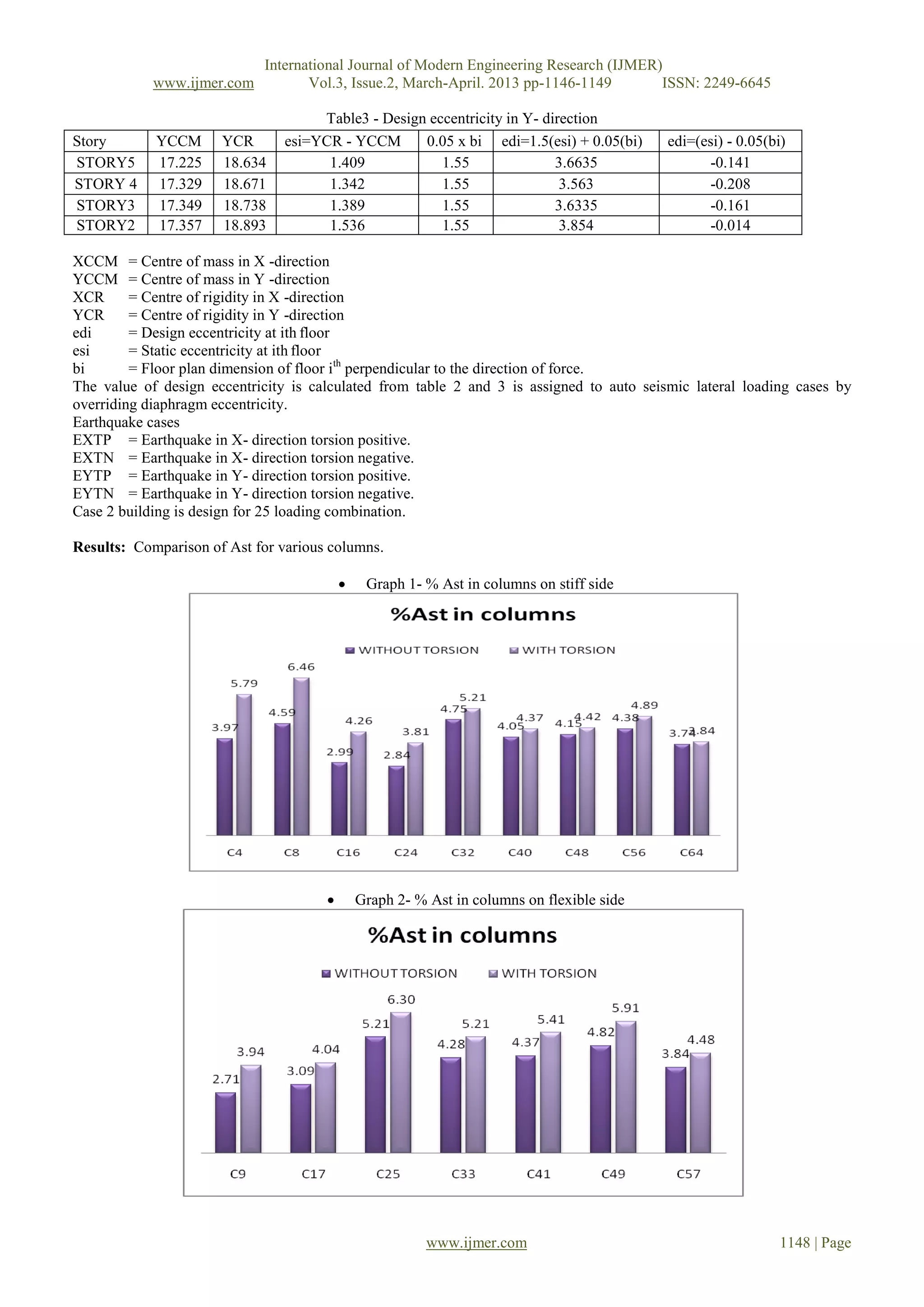
Results: Comparison of Ast for various columns.
 Graph 1- % Ast in columns on stiff side
 Graph 2- % Ast in columns on flexible side
Story YCCM YCR esi=YCR - YCCM 0.05 x bi edi=1.5(esi) + 0.05(bi) edi=(esi) - 0.05(bi)
STORY5 17.225 18.634 1.409 1.55 3.6635 -0.141
STORY 4 17.329 18.671 1.342 1.55 3.563 -0.208
STORY3 17.349 18.738 1.389 1.55 3.6335 -0.161
STORY2 17.357 18.893 1.536 1.55 3.854 -0.014
International Journal of Modern Engineering Research (IJMER)
www.ijmer.com Vol.3, Issue.2, March-April. 2013 pp-1146-1149 ISSN: 2249-6645
www.ijmer.com 1149 | Page
 Graph 3- % Ast in columns failed in torsion
IV. Conclusion
In the asymmetric building case 2, it was observed that the forces in the columns located in the stiff side of the plan
are much smaller than those obtained in the elements of the flexible side of the plan. There is no significant change in
column forces around centre of rigidity.
It is observed that column no C2, C3, C6, C7 and C8 in case 2(columns which are farthest from centre of rigidity) while
designing it considering design eccentricity are failed. Column no C25, C26 and C50 (columns on flexible side) are failed in
case 2. (Reinforcement required exceeds maximum allowed).
Most of the designer adopts approximate methods for the torsional analysis of building. However this may be an
inaccurate assessment. Several studies of structural damage during the past earthquake reveal that torsion is the most critical
factor leading to major damage or complete collapse of building. It is, therefore, necessary that irregular buildings should be
analyzed for torsion. A three dimensional analysis using Etab is able to calculate the center of rigidity; by getting these
values we can perform torsional analysis.
References
[1] Bijily B, (2012) Critical evaluation of torsional provision in IS-1893: 2002.
[2] Dutta, S. C., (2001). Effect of Strength Deterioration on Inelastic Seismic Torsional Behaviour of Asymmetric RC Buildings,
Building and Environment, 36(0), 1109-1118. 16.
[3] S. K. Dubey, (2011) Seismic behaviour of asymmetric R C buildings.
[4] H. J. Shah, S. K. Jain, Design example of six storey building.
[5] M.D. Bensalah, et. al., Assessments of the torsion effect in asymmetric buildings under seismic load.(15 WCEE).
[6] Rucha S. Banginwar, M. R. Vyawahare, (2012) Effects of plan configuration on the seismic behaviour of the structure by response
spectrum method.
[7] Rudra Nevatia, Torsional Provisions In IS: 1893(2002)
[8] IS 1893 Part 1, (2002).Indian Standard Criteria for Earthquake Resistant Design of Structures.
[9] S K Jain et. al. Proposed Draft Provision and commentary on Indian seismic code IS 1893 (Part 1).

Dl3211461149

  • 1.
    International Journal ofModern Engineering Research (IJMER) www.ijmer.com Vol.3, Issue.2, March-April. 2013 pp-1146-1149 ISSN: 2249-6645 www.ijmer.com 1146 | Page Sachin G. Maske, 1 Dr. P. S. Pajgade2 1 Department of civil Engineering Prof. Ram Meghe Institute of Technology and Research, Badnera, M.E. (Structural Engineering) Final Year 2 Professor in Department of civil Engineering Prof. Ram Meghe institute of Technology and Research, Badnera Abstract: Torsional behaviour of asymmetric building is one of the most frequent source of structural damage and failure during strong ground motions. In this work a study on the influence of the torsion effects on the behaviour of structure is done. In building two cases are considered, case one is without considering torsion and case two is considering torsion. The Indian standard code of practice IS-1893 (Part I: 2002) guidelines and methodology are used to analyzed and designed building. Results are compared in terms of % Ast in columns. Keywords: Asymmetric plan, Earthquake, Eccentricity, Torsion. I. Introduction Seismic damage surveys and analyses conducted on modes of failure of building structures during past severe earthquakes concluded that most vulnerable building structures are those, which are asymmetric in nature. Asymmetric-plan buildings, namely buildings with in-plan asymmetric mass and strength distributions, are systems characterized by a coupled torsional-translational seismic response. Asymmetric building structures are almost unavoidable in modern construction due to various types of functional and architectural requirements. Torsion in buildings during earthquake shaking may be caused from a variety of reasons, the most common of which are non-symmetric distributions of mass and stiffness. Modern codes deal with torsion by placing restrictions on the design of buildings with irregular layouts and also through the introduction of an accidental eccentricity that must be considered in design. The lateral-torsional coupling due to eccentricity between centre of mass (CM) and centre of rigidity (CR) in asymmetric building structures generates torsional vibration even under purely translational ground shaking. During seismic shaking of the structural systems, inertia force acts through the centre of mass while the resistive force acts through the centre of rigidity as shown in Fig. 1. Fig1- Generation of torsional moment in asymmetric structures during seismic excitation. Fig 2- Building plan Torsional Behaviour of Asymmetrical Buildings
  • 2.
    International Journal ofModern Engineering Research (IJMER) www.ijmer.com Vol.3, Issue.2, March-April. 2013 pp-1146-1149 ISSN: 2249-6645 www.ijmer.com 1147 | Page II. Building Details The structural analysis and design of four storey reinforced concrete asymmetrical frame building has been done with the help of Etab software. The building is assumed as commercial complex. Linear static analysis has been done. Regular grid plan of the structure is shown in fig 2. The structure is assumed to be located in seismic zone IV on a site with medium soil. Building contains different irregularity like plan irregularity and Re- Entrant corner irregularity. Building is studied for two cases as mentioned below: Case 1: seismic analysis of building is done without considering design eccentricity. Case 2: seismic analysis of building is done considering torsion. Centre of mass, Centre of rigidity, static eccentricity and design eccentricity is calculated for seismic forces at each floor level. Structural data: Table1: Structural data No of storey = 4 Ground storey height = 3.5m Intermediate storey height = 3.2m Total no of columns = 64 Slab thickness = 125mm Outer wall = 230mm Inner wall = 150mm Parapet (1m height) = 230mm Beam size = B1= 230 x 450 mm = B2= 300 x 600 mm Column size = A1 = 230 x 450 mm = A2= 300 x 600 mm Grade of concrete = M20 Grade of steel = Fe415 Density of concrete = 25kN/m3 Density of brick = 20 kN /m3 Live load = 4 kN /m2 Roof Live load = 2 kN /m2 Floor finish = 1 kN /m2 Earthquake data: Seismic Zone = IV Importance factor = 1.5 Response reduction factor = 5 (SMRF) Type of soil = TYPE II (Medium) Damping = 5% III. Analysis And Design The asymmetric building is analysed by modelling two models Case 1- asymmetric building without considering design eccentricity (edi) Case 2- asymmetric building considering design eccentricity (edi) Case 1 building is modelled in Etab; a rigid diaphragm is assigned at different storey level. Supports are assigned as fixed supports neglecting soil structure interaction. A linear static analysis was performed for two earthquake cases, earthquake in X-direction (Eqx) and in Y-direction (Eqy) by defining auto seismic lateral loading in Etab. Case 1 is design for 13 load combinations. Case 2 building is same as case1, from output data from Etab the design eccentricity is calculated as the difference between centre of mass and centre of rigidity. Table 2- Design eccentricity in X- direction Story XCCM XCR esi=XCR - XCCM 0.05 x bi edi=1.5(esi) + 0.05(bi) edi=(esi) - 0.05(bi) STORY5 15.014 15.549 0.535 1.4 2.2025 -0.865 STORY 4 15.036 15.49 0.454 1.4 2.081 -0.946 STORY3 15.036 15.438 0.402 1.4 2.003 -0.998 STORY2 15.035 15.313 0.278 1.4 1.817 -1.122
  • 3.
    International Journal ofModern Engineering Research (IJMER) www.ijmer.com Vol.3, Issue.2, March-April. 2013 pp-1146-1149 ISSN: 2249-6645 www.ijmer.com 1148 | Page Table3 - Design eccentricity in Y- direction XCCM = Centre of mass in X -direction YCCM = Centre of mass in Y -direction XCR = Centre of rigidity in X -direction YCR = Centre of rigidity in Y -direction edi = Design eccentricity at ith floor esi = Static eccentricity at ith floor bi = Floor plan dimension of floor ith perpendicular to the direction of force. The value of design eccentricity is calculated from table 2 and 3 is assigned to auto seismic lateral loading cases by overriding diaphragm eccentricity. Earthquake cases EXTP = Earthquake in X- direction torsion positive. EXTN = Earthquake in X- direction torsion negative. EYTP = Earthquake in Y- direction torsion positive. EYTN = Earthquake in Y- direction torsion negative. Case 2 building is design for 25 loading combination. Results: Comparison of Ast for various columns.  Graph 1- % Ast in columns on stiff side  Graph 2- % Ast in columns on flexible side Story YCCM YCR esi=YCR - YCCM 0.05 x bi edi=1.5(esi) + 0.05(bi) edi=(esi) - 0.05(bi) STORY5 17.225 18.634 1.409 1.55 3.6635 -0.141 STORY 4 17.329 18.671 1.342 1.55 3.563 -0.208 STORY3 17.349 18.738 1.389 1.55 3.6335 -0.161 STORY2 17.357 18.893 1.536 1.55 3.854 -0.014
  • 4.
    International Journal ofModern Engineering Research (IJMER) www.ijmer.com Vol.3, Issue.2, March-April. 2013 pp-1146-1149 ISSN: 2249-6645 www.ijmer.com 1149 | Page  Graph 3- % Ast in columns failed in torsion IV. Conclusion In the asymmetric building case 2, it was observed that the forces in the columns located in the stiff side of the plan are much smaller than those obtained in the elements of the flexible side of the plan. There is no significant change in column forces around centre of rigidity. It is observed that column no C2, C3, C6, C7 and C8 in case 2(columns which are farthest from centre of rigidity) while designing it considering design eccentricity are failed. Column no C25, C26 and C50 (columns on flexible side) are failed in case 2. (Reinforcement required exceeds maximum allowed). Most of the designer adopts approximate methods for the torsional analysis of building. However this may be an inaccurate assessment. Several studies of structural damage during the past earthquake reveal that torsion is the most critical factor leading to major damage or complete collapse of building. It is, therefore, necessary that irregular buildings should be analyzed for torsion. A three dimensional analysis using Etab is able to calculate the center of rigidity; by getting these values we can perform torsional analysis. References [1] Bijily B, (2012) Critical evaluation of torsional provision in IS-1893: 2002. [2] Dutta, S. C., (2001). Effect of Strength Deterioration on Inelastic Seismic Torsional Behaviour of Asymmetric RC Buildings, Building and Environment, 36(0), 1109-1118. 16. [3] S. K. Dubey, (2011) Seismic behaviour of asymmetric R C buildings. [4] H. J. Shah, S. K. Jain, Design example of six storey building. [5] M.D. Bensalah, et. al., Assessments of the torsion effect in asymmetric buildings under seismic load.(15 WCEE). [6] Rucha S. Banginwar, M. R. Vyawahare, (2012) Effects of plan configuration on the seismic behaviour of the structure by response spectrum method. [7] Rudra Nevatia, Torsional Provisions In IS: 1893(2002) [8] IS 1893 Part 1, (2002).Indian Standard Criteria for Earthquake Resistant Design of Structures. [9] S K Jain et. al. Proposed Draft Provision and commentary on Indian seismic code IS 1893 (Part 1).