Web 2.0 tools have revolutionized social interaction on the web,  what about learning? What are the implications of new technologies and eLearning 2.0 for teachers? eLearning 2.0April 1st, 2011Tiina Sarisalmi & Brian Holmes
Context of my researchResearching online communitiesPhD/Doctoral Programme in E-Research and Technology Enhanced Learning: supervisor Dr Julie-Ann SimePart-time distance learning, University of Lancaster, UKTwo years learning in an online cohort + two years thesisMy research area: online learning communities (Holmes, 2010)Influence on competence development ? Influence of social aspects ?Blog: http://holmesbrian.blogspot.com/http://www.lancs.ac.uk/fss/centres/csalt/csalt/tel_docprog.htm
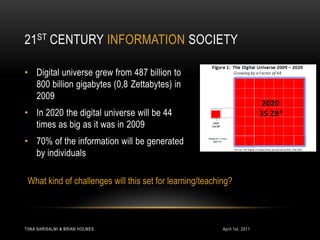
21st century information societyApril 1st, 2011Tiina Sarisalmi & Brian HolmesDigital universe grew from 487 billion to 800 billion gigabytes (0,8 Zettabytes) in 2009
In 2020 the digital universe will be 44 times as big as it was in 2009
70% of the information will be generated by individualsWhat kind of challenges will this set for learning/teaching?
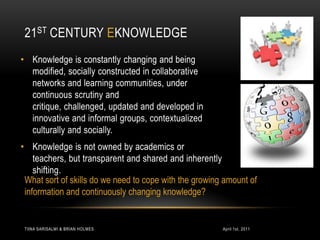
21st century eknowledgeApril 1st, 2011Tiina Sarisalmi & Brian HolmesKnowledge is constantly changing and being modified, socially constructed in collaborative networks and learning communities, under continuous scrutiny and critique, challenged, updated and developed in innovative and informal groups, contextualized culturally and socially.
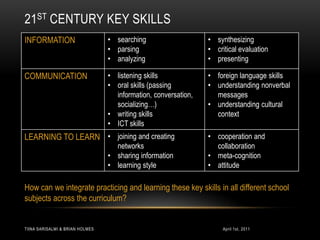
Knowledge is not owned by academics or teachers, but transparent and shared and inherently shifting.What sort of skills do we need to cope with the growing amount of information and continuously changing knowledge?
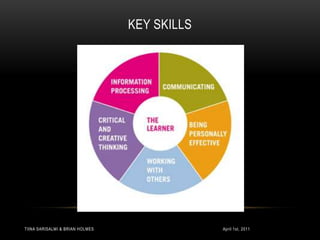
Key skillsApril 1st, 2011Tiina Sarisalmi & Brian Holmes
21st century key skillsApril 1st, 2011Tiina Sarisalmi & Brian HolmesHow can we integrate practicing and learning these key skills in all different school subjects across the curriculum?
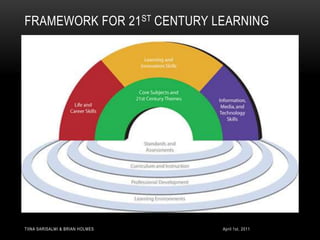
Framework for 21st century learningApril 1st, 2011Tiina Sarisalmi & Brian Holmes
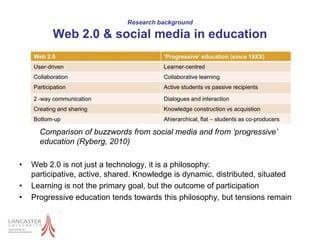
Research backgroundWeb 2.0 & social media in educationComparison of buzzwords from social media and from ‘progressive’ education (Ryberg, 2010)Web 2.0 is not just a technology, it is a philosophy: participative, active, shared. Knowledge is dynamic, distributed, situatedLearning is not the primary goal, but the outcome of participationProgressive education tends towards this philosophy, but tensions remain
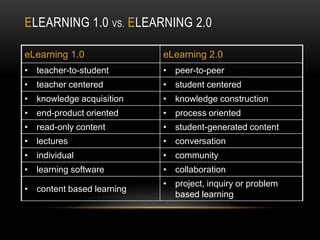
Elearning 1.0 vs.elearning 2.0
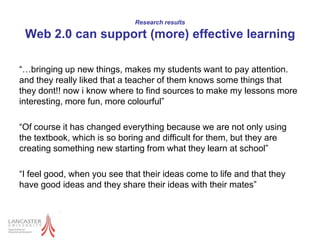
Research resultsWeb 2.0 can support (more) effective learning“…bringing up new things, makes my students want to pay attention. and they really liked that a teacher of them knows some things that they dont!! now i know where to find sources to make my lessons more interesting, more fun, more colourful”“Of course it has changed everything because we are not only using the textbook, which is so boring and difficult for them, but they are creating something new starting from what they learn at school”“I feel good, when you see that their ideas come to life and that they have good ideas and they share their ideas with their mates”
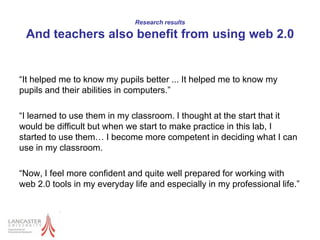
Research resultsAnd teachers also benefit from using web 2.0“It helped me to know my pupils better ... It helped me to know my pupils and their abilities in computers.”“I learned to use them in my classroom. I thought at the start that it would be difficult but when we start to make practice in this lab, I started to use them… I become more competent in deciding what I can use in my classroom.“Now, I feel more confident and quite well prepared for working with web 2.0 tools in my everyday life and especially in my professional life.”
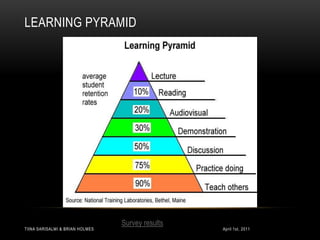
Learning pyramidApril 1st, 2011Tiina Sarisalmi & Brian HolmesSurvey results
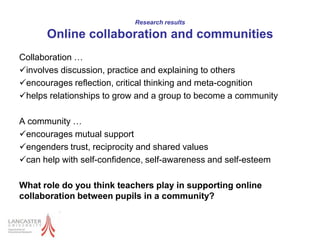
Research resultsOnline collaboration and communitiesCollaboration …involves discussion, practice and explaining to others
encourages reflection, critical thinking and meta-cognition
helps relationships to grow and a group to become a communityA community …encourages mutual support
engenders trust, reciprocity and shared values
can help with self-confidence, self-awareness and self-esteemWhat role do you think teachers play in supporting online collaboration between pupils in a community?
Planning an elearning processApril 1st, 2011Tiina Sarisalmi & Brian HolmesTeacher's role is crucial in the planning phase:
sets the pedagogical goals and integrates the process in the curriculum

eLearning 2.0

  • 1.
    Web 2.0 toolshave revolutionized social interaction on the web, what about learning? What are the implications of new technologies and eLearning 2.0 for teachers? eLearning 2.0April 1st, 2011Tiina Sarisalmi & Brian Holmes
  • 2.
    Context of myresearchResearching online communitiesPhD/Doctoral Programme in E-Research and Technology Enhanced Learning: supervisor Dr Julie-Ann SimePart-time distance learning, University of Lancaster, UKTwo years learning in an online cohort + two years thesisMy research area: online learning communities (Holmes, 2010)Influence on competence development ? Influence of social aspects ?Blog: http://holmesbrian.blogspot.com/http://www.lancs.ac.uk/fss/centres/csalt/csalt/tel_docprog.htm
  • 3.
    21st century informationsocietyApril 1st, 2011Tiina Sarisalmi & Brian HolmesDigital universe grew from 487 billion to 800 billion gigabytes (0,8 Zettabytes) in 2009
  • 4.
    In 2020 thedigital universe will be 44 times as big as it was in 2009
  • 5.
    70% of theinformation will be generated by individualsWhat kind of challenges will this set for learning/teaching?
  • 6.
    21st century eknowledgeApril1st, 2011Tiina Sarisalmi & Brian HolmesKnowledge is constantly changing and being modified, socially constructed in collaborative networks and learning communities, under continuous scrutiny and critique, challenged, updated and developed in innovative and informal groups, contextualized culturally and socially.
  • 7.
    Knowledge is notowned by academics or teachers, but transparent and shared and inherently shifting.What sort of skills do we need to cope with the growing amount of information and continuously changing knowledge?
  • 8.
    Key skillsApril 1st,2011Tiina Sarisalmi & Brian Holmes
  • 9.
    21st century keyskillsApril 1st, 2011Tiina Sarisalmi & Brian HolmesHow can we integrate practicing and learning these key skills in all different school subjects across the curriculum?
  • 10.
    Framework for 21stcentury learningApril 1st, 2011Tiina Sarisalmi & Brian Holmes
  • 11.
    Research backgroundWeb 2.0& social media in educationComparison of buzzwords from social media and from ‘progressive’ education (Ryberg, 2010)Web 2.0 is not just a technology, it is a philosophy: participative, active, shared. Knowledge is dynamic, distributed, situatedLearning is not the primary goal, but the outcome of participationProgressive education tends towards this philosophy, but tensions remain
  • 12.
  • 13.
    Research resultsWeb 2.0can support (more) effective learning“…bringing up new things, makes my students want to pay attention. and they really liked that a teacher of them knows some things that they dont!! now i know where to find sources to make my lessons more interesting, more fun, more colourful”“Of course it has changed everything because we are not only using the textbook, which is so boring and difficult for them, but they are creating something new starting from what they learn at school”“I feel good, when you see that their ideas come to life and that they have good ideas and they share their ideas with their mates”
  • 14.
    Research resultsAnd teachersalso benefit from using web 2.0“It helped me to know my pupils better ... It helped me to know my pupils and their abilities in computers.”“I learned to use them in my classroom. I thought at the start that it would be difficult but when we start to make practice in this lab, I started to use them… I become more competent in deciding what I can use in my classroom.“Now, I feel more confident and quite well prepared for working with web 2.0 tools in my everyday life and especially in my professional life.”
  • 15.
    Learning pyramidApril 1st,2011Tiina Sarisalmi & Brian HolmesSurvey results
  • 16.
    Research resultsOnline collaborationand communitiesCollaboration …involves discussion, practice and explaining to others
  • 17.
    encourages reflection, criticalthinking and meta-cognition
  • 18.
    helps relationships togrow and a group to become a communityA community …encourages mutual support
  • 19.
  • 20.
    can help withself-confidence, self-awareness and self-esteemWhat role do you think teachers play in supporting online collaboration between pupils in a community?
  • 21.
    Planning an elearningprocessApril 1st, 2011Tiina Sarisalmi & Brian HolmesTeacher's role is crucial in the planning phase:
  • 22.
    sets the pedagogicalgoals and integrates the process in the curriculum