ENGAGING STUDENTS IN
ONLINE LEARNING:
DEVELOPING A COMMUNITY
OF INQUIRY
Julie Gilbert and Elle Ting
CENTRE FOR TEACHING, LEARNING, AND RESEARCH (CTLR)
5 June 2020
Acknowledgement
of Traditional
Territories
What’s one thing you’re doing
to keep yourself grounded?
In just a few words,
please share in the chat box.
By the end of this session, you will be able to:
Discuss the value of student
engagement in the online classroom
1
Describe the fundamental principles
of the Community of Inquiry model
and how they support student
engagement
2
Identify strategies to support a
community of inquiry in the virtual
classroom
3
Student
Engagement
in Learning
In your experience, what impedes student engagement?
TRIZ activity: “Worst. Class. Ever.”
• Let’s make a list of all the ways we can imagine to make students unengaged. If
we were trying to make an online class as awful as possible for them, what
might we do?
• Go down this list item by item and ask, “Do I see any of these things happening
in my class[es] now?” Make a “troubleshooting” list for yourself — and be
brutally honest!
• Go through the items on your troubleshooting list and decide what first steps
will help you stop undesirable results.
(http://www.liberatingstructures.com/6-making-space-with-triz/)
Student Engagement
(or lack thereof)
in COVID-19 times
Of 3089 Higher Education Students Surveyed in May
2020:
• 75% miss face-to-face interaction with faculty and students
• 78 % of students* say the online class experience is unengaging
*Of these students:
53% are spending less time on coursework
39% don’t enjoy or see the value in real-time learning
75% think online instruction is worse than in-person instruction
(https://tophat.com/press-releases/adrift-in-a-pandemic-survey/)
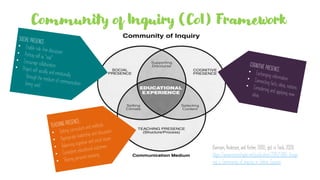
Community of Inquiry (CoI) Framework
(Garrison, Anderson, and Archer, 2000; qtd. in Fiock, 2020)
https://www.researchgate.net/publication/338525880_Design
ing_a_Community_of_Inquiry_in_Online_Courses
HOW do you
build a
community
of Inquiry ?
Let’s consider our own classes for a moment: what are some
ways that we and our learners could build and grow
social / cognitive / teacher presence?
1 - 2 – 4 – All (abridged)
Record your ideas @ Creating "Presence" Online
“Presence”:
What does it look like
in the virtual
classroom?
Summary
• Student Engagement has a direct impact on motivation and quality of learning.
• Community of Inquiry is a framework that promotes quality of learning through development of cognitive, teacher, and social
presence in the online environment.
• These presences are interdependent and together create a meaningful learning experience.
Share and enjoy!
Integrate the
Community of
Inquiry framework
into your virtual
classroom.
Tips,
Tools, and
Resources
• Garrison, D. R., Anderson, T., & Archer, W. (2000). Critical inquiry in a text-based
environment: computer conferencing in higher education. The Internet and Higher
Education, 2 (2-3), 87-105 http://communitiesofinquiry.com/model
• Fiock, Holly. (2020). Designing a Community of Inquiry in Online Courses. The
International Review of Research in Open and Distributed Learning. 21. 134-152.
10.19173/irrodl.v20i5.3985.
https://www.researchgate.net/publication/338525880_Designing_a_Community_
of_Inquiry_in_Online_Courses
• Liberating Structures: Including and Unleashing Everyone
http://www.liberatingstructures.com/
• Training for Change: Leading Groups Online
https://www.trainingforchange.org/training_tools/leading-groups-online-book/
This Photo by Unknown Author is licensed under CC BY
Questions?
IAsupport@vcc.ca
THANK YOU!

Engaging students in online learning

  • 1.
    ENGAGING STUDENTS IN ONLINELEARNING: DEVELOPING A COMMUNITY OF INQUIRY Julie Gilbert and Elle Ting CENTRE FOR TEACHING, LEARNING, AND RESEARCH (CTLR) 5 June 2020
  • 2.
  • 3.
    What’s one thingyou’re doing to keep yourself grounded? In just a few words, please share in the chat box.
  • 4.
    By the endof this session, you will be able to: Discuss the value of student engagement in the online classroom 1 Describe the fundamental principles of the Community of Inquiry model and how they support student engagement 2 Identify strategies to support a community of inquiry in the virtual classroom 3
  • 5.
    Student Engagement in Learning In yourexperience, what impedes student engagement?
  • 6.
    TRIZ activity: “Worst.Class. Ever.” • Let’s make a list of all the ways we can imagine to make students unengaged. If we were trying to make an online class as awful as possible for them, what might we do? • Go down this list item by item and ask, “Do I see any of these things happening in my class[es] now?” Make a “troubleshooting” list for yourself — and be brutally honest! • Go through the items on your troubleshooting list and decide what first steps will help you stop undesirable results. (http://www.liberatingstructures.com/6-making-space-with-triz/)
  • 7.
    Student Engagement (or lackthereof) in COVID-19 times Of 3089 Higher Education Students Surveyed in May 2020: • 75% miss face-to-face interaction with faculty and students • 78 % of students* say the online class experience is unengaging *Of these students: 53% are spending less time on coursework 39% don’t enjoy or see the value in real-time learning 75% think online instruction is worse than in-person instruction (https://tophat.com/press-releases/adrift-in-a-pandemic-survey/)
  • 8.
    Community of Inquiry(CoI) Framework (Garrison, Anderson, and Archer, 2000; qtd. in Fiock, 2020) https://www.researchgate.net/publication/338525880_Design ing_a_Community_of_Inquiry_in_Online_Courses
  • 9.
    HOW do you builda community of Inquiry ? Let’s consider our own classes for a moment: what are some ways that we and our learners could build and grow social / cognitive / teacher presence? 1 - 2 – 4 – All (abridged) Record your ideas @ Creating "Presence" Online
  • 10.
    “Presence”: What does itlook like in the virtual classroom?
  • 11.
    Summary • Student Engagementhas a direct impact on motivation and quality of learning. • Community of Inquiry is a framework that promotes quality of learning through development of cognitive, teacher, and social presence in the online environment. • These presences are interdependent and together create a meaningful learning experience.
  • 12.
    Share and enjoy! Integratethe Community of Inquiry framework into your virtual classroom.
  • 13.
    Tips, Tools, and Resources • Garrison,D. R., Anderson, T., & Archer, W. (2000). Critical inquiry in a text-based environment: computer conferencing in higher education. The Internet and Higher Education, 2 (2-3), 87-105 http://communitiesofinquiry.com/model • Fiock, Holly. (2020). Designing a Community of Inquiry in Online Courses. The International Review of Research in Open and Distributed Learning. 21. 134-152. 10.19173/irrodl.v20i5.3985. https://www.researchgate.net/publication/338525880_Designing_a_Community_ of_Inquiry_in_Online_Courses • Liberating Structures: Including and Unleashing Everyone http://www.liberatingstructures.com/ • Training for Change: Leading Groups Online https://www.trainingforchange.org/training_tools/leading-groups-online-book/ This Photo by Unknown Author is licensed under CC BY
  • 14.
  • 15.