TCP/IP and DoD Model
TCP/IP and the DoD Model
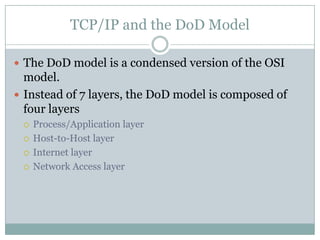
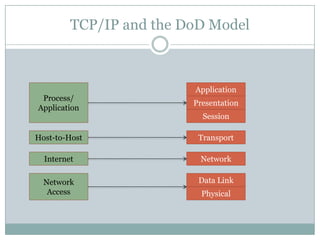
 The DoD model is a condensed version of the OSI
model.
 Instead of 7 layers, the DoD model is composed of
four layers
 Process/Application layer
 Host-to-Host layer
 Internet layer
 Network Access layer
TCP/IP and the DoD Model
Application
Presentation
Session
Transport
Network
Data Link
Physical
Process/
Application
Host-to-Host
Internet
Network
Access
TCP/IP and the DoD Model
 Process/Application layer
 Protocols used to integrate various activities of the upper
layers of the OSI model
 Defines protocols for nod-to-node application communication
 Also controls user-interface specifications
 Host-to-Host layer
 Performs same functions as OSI Transport layer
 Provides end-to-end communication
TCP/IP and the DoD Model
 Internet layer
 Performs same functions as OSI Network layer
 Logical (IP) addressing and routing
 Network Access layer
 Monitors data exchange between the host and the network
 Handles hardware addressing
 Defines protocols for the physical transmission of data
TCP/IP and the DoD Model
 Various different network protocols operate at
different layers of the DoD model
TCP/IP and the DoD Model
 Process/Application Layer Protocols
 Telnet
 Provides terminal emulation
 Allows a user on a remote machine to access the resources of
another remote machine
 File Transfer Protocol (FTP)
 Allows for files to be transferred between computers
 Also operates as a program: allows users to perform file tasks
 Limited to directory and file management; no remote execution
 Trivial File Transfer Protocol (TFTP)
 A stripped-down, stock version of FTP
 No directory browsing abilities
 Can only PUT and GET files
 Network File System
 Protocol to allow systems to share files across a network
 Allows different types of files systems to interoperate for file
sharing
 Simple Mail Transfer Protocol (SMTP)
 Protocol for sending e-mail
 Uses a queue method for mail deliver
 Line Printer Daemon (LDP)
 Protocol for printer sharing; print spooling via TCP/IP
 X Windows
 Protocol for writing cluster and servers apps based on a GUI
 Allows a program to run on a computer and have the display on
another computer using a server
 Simple Network Management Protocol (SNMP)
 Collects and manipulates valuable network data
 Polls devices on a network for a network station
 Used to notify of network events or changes
 Domain Name Service
 Resolves hostnames to IP addresses
 Operates with Fully Qualified Domain Name (FQDN)
 Can also append domain suffixes
 Dynamic Host Configuration Protocol (DHCP)
 Simplifies network address management
 Protocol to automatically assign network information to hosts
 IP address
 Subnet mask
 Domain name
 Default gateway (routers)
 Windows Internet Naming Service (WINS) information
 Dynamic Host Configuration Protocol (DHCP)
 DHCP Process
 1. DHCP client broadcasts a DHCP Discover message
looking for a DHCP server.
 2. The DHCP server that receives the broadcast will
respond to the client with a unicast DHCP Offer
message.
 3. The client will then broadcast back to the server as
DHCP Request asking for an IP address.
 4. The server makes the assignment and finalizes with
a unicast DHCP Acknowledgement.
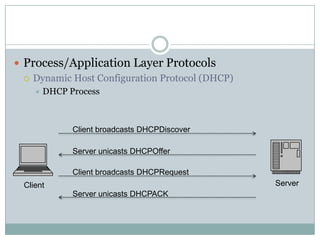
 Process/Application Layer Protocols
 Dynamic Host Configuration Protocol (DHCP)
 DHCP Process
Client Server
Client broadcasts DHCPDiscover
Server unicasts DHCPOffer
Client broadcasts DHCPRequest
Server unicasts DHCPACK
 Host-to-Host Layer Protocols
 Transmission Control Protocol (TCP)
 Full-duplex, connection-oriented, reliable, and accurate protocol
 Used to break large blocks of application information into
segments
 Segments and sequenced and number before transmission
 Before transmission, the TCP stack creates a virtual circuit
between its stack and the other computers TCP stack
 Receipt of transmission is verified with acknowledgements
 Reliability comes at a price: overhead
 Host-to-Host Layer Protocols
 User Datagram Protocol (UDP)
 Scaled-down model of TCP; sometimes called thin protocol
 Doesn’t offer the features of TCP
 Reliability, acknowledgements, etc.
 Provides for more traffic with less overhead
 No sequencing, no acknowledgements
 Some situations benefit from UDP instead of TCP
 SNMP
 Video data
 Host-to-Host Layer Protocols
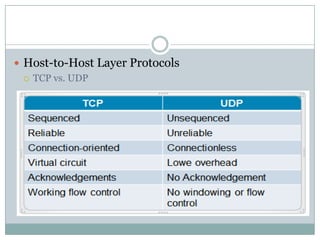
 TCP vs. UDP
 Internet Layer Protocols
 Internet Protocol (IP)
 Is essentially the Internet layer; all other protocols exist to support
IP
 Has a complete picture view of the network; allows IP to make
routing and forwarding decisions
 Receives segments from the Host-to-Host layer and fragments
these into packers before transmissions
 Internet Protocol (IP)
 ICMP
 Provide hosts with information about network problems
 Encapsulated within IP datagrams
 Ping, Traceroute, etc.
 Address Resolution Protocol (ARP)
 Finds the hardware address of a host using the IP address
 Broadcasts the local network attempting to find the machine
with the IP address
 Internet Protocol (IP)
 Reverse Address Resolution Protocol (RARP)
 Finds the IP address of a host given the hardware address
 Very useful for diskless machines
 Proxy Address Resolution Protocol (Proxy ARP)
 Allows hosts to utilize more than one default gateway
 Increases traffic on the network
 A better alternative is Cisco’s Hot Standby Router Protocol
(HSRP)

10. tcp ip and do d model

  • 1.
  • 2.
    TCP/IP and theDoD Model  The DoD model is a condensed version of the OSI model.  Instead of 7 layers, the DoD model is composed of four layers  Process/Application layer  Host-to-Host layer  Internet layer  Network Access layer
  • 3.
    TCP/IP and theDoD Model Application Presentation Session Transport Network Data Link Physical Process/ Application Host-to-Host Internet Network Access
  • 4.
    TCP/IP and theDoD Model  Process/Application layer  Protocols used to integrate various activities of the upper layers of the OSI model  Defines protocols for nod-to-node application communication  Also controls user-interface specifications  Host-to-Host layer  Performs same functions as OSI Transport layer  Provides end-to-end communication
  • 5.
    TCP/IP and theDoD Model  Internet layer  Performs same functions as OSI Network layer  Logical (IP) addressing and routing  Network Access layer  Monitors data exchange between the host and the network  Handles hardware addressing  Defines protocols for the physical transmission of data
  • 6.
    TCP/IP and theDoD Model  Various different network protocols operate at different layers of the DoD model
  • 7.
    TCP/IP and theDoD Model  Process/Application Layer Protocols  Telnet  Provides terminal emulation  Allows a user on a remote machine to access the resources of another remote machine  File Transfer Protocol (FTP)  Allows for files to be transferred between computers  Also operates as a program: allows users to perform file tasks  Limited to directory and file management; no remote execution
  • 8.
     Trivial FileTransfer Protocol (TFTP)  A stripped-down, stock version of FTP  No directory browsing abilities  Can only PUT and GET files  Network File System  Protocol to allow systems to share files across a network  Allows different types of files systems to interoperate for file sharing
  • 9.
     Simple MailTransfer Protocol (SMTP)  Protocol for sending e-mail  Uses a queue method for mail deliver  Line Printer Daemon (LDP)  Protocol for printer sharing; print spooling via TCP/IP  X Windows  Protocol for writing cluster and servers apps based on a GUI  Allows a program to run on a computer and have the display on another computer using a server
  • 10.
     Simple NetworkManagement Protocol (SNMP)  Collects and manipulates valuable network data  Polls devices on a network for a network station  Used to notify of network events or changes  Domain Name Service  Resolves hostnames to IP addresses  Operates with Fully Qualified Domain Name (FQDN)  Can also append domain suffixes
  • 11.
     Dynamic HostConfiguration Protocol (DHCP)  Simplifies network address management  Protocol to automatically assign network information to hosts  IP address  Subnet mask  Domain name  Default gateway (routers)  Windows Internet Naming Service (WINS) information
  • 12.
     Dynamic HostConfiguration Protocol (DHCP)  DHCP Process  1. DHCP client broadcasts a DHCP Discover message looking for a DHCP server.  2. The DHCP server that receives the broadcast will respond to the client with a unicast DHCP Offer message.  3. The client will then broadcast back to the server as DHCP Request asking for an IP address.  4. The server makes the assignment and finalizes with a unicast DHCP Acknowledgement.
  • 13.
     Process/Application LayerProtocols  Dynamic Host Configuration Protocol (DHCP)  DHCP Process Client Server Client broadcasts DHCPDiscover Server unicasts DHCPOffer Client broadcasts DHCPRequest Server unicasts DHCPACK
  • 14.
     Host-to-Host LayerProtocols  Transmission Control Protocol (TCP)  Full-duplex, connection-oriented, reliable, and accurate protocol  Used to break large blocks of application information into segments  Segments and sequenced and number before transmission  Before transmission, the TCP stack creates a virtual circuit between its stack and the other computers TCP stack  Receipt of transmission is verified with acknowledgements  Reliability comes at a price: overhead
  • 15.
     Host-to-Host LayerProtocols  User Datagram Protocol (UDP)  Scaled-down model of TCP; sometimes called thin protocol  Doesn’t offer the features of TCP  Reliability, acknowledgements, etc.  Provides for more traffic with less overhead  No sequencing, no acknowledgements  Some situations benefit from UDP instead of TCP  SNMP  Video data
  • 16.
     Host-to-Host LayerProtocols  TCP vs. UDP
  • 17.
     Internet LayerProtocols  Internet Protocol (IP)  Is essentially the Internet layer; all other protocols exist to support IP  Has a complete picture view of the network; allows IP to make routing and forwarding decisions  Receives segments from the Host-to-Host layer and fragments these into packers before transmissions
  • 18.
     Internet Protocol(IP)  ICMP  Provide hosts with information about network problems  Encapsulated within IP datagrams  Ping, Traceroute, etc.  Address Resolution Protocol (ARP)  Finds the hardware address of a host using the IP address  Broadcasts the local network attempting to find the machine with the IP address
  • 19.
     Internet Protocol(IP)  Reverse Address Resolution Protocol (RARP)  Finds the IP address of a host given the hardware address  Very useful for diskless machines  Proxy Address Resolution Protocol (Proxy ARP)  Allows hosts to utilize more than one default gateway  Increases traffic on the network  A better alternative is Cisco’s Hot Standby Router Protocol (HSRP)