• DMS willcreate an electronic
world.
• Technology advances in
computers high speed network,
data compression, and
consumer electronics couple
with the availability of
multimedia resource mechanism
and manipulation functions.
• an example of DMS is number of
multimedia PC with continuous
media services using the
internet that allows to browse
manipulate video or audio etc…
5.
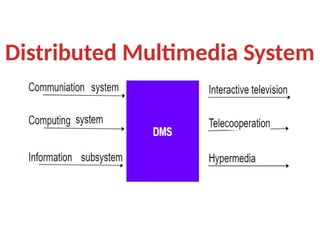
There are threesubsystems
1.Communication subsystem
2. Computing subsystem and
3. Information subsystem.
communication subsystem consists of
transmission medium, transmission
protocols.
Computing system consists of multimedia
platforms ,operating system ,presentation
and multimedia software.
Multimedia information system consists of
multimedia service information and
multimedia database system.
• The outputsof DMS system is
classified into three different
types
1. Interactive television
2. Telecoorporation and
3. Hypermedia
9.
• Interactive televisionallow subscribers to
access video programs and interact with them.
services includes
1. homeshopping,
2. interactive video games,
3. financial transactions,
4. Video on demand(VoD),
5. news on demand .
10.
• Telecooperation overcomes time and location restrictions
and allow remote participants to join a group activity
Services:
1. remote learning
2. Tele commuting
3. tele servicing
4. Tele operation
5. multimedia emails
6. video phone
7. desktop conferencing
8. electronic meeting rooms
9. join editing and group drawing
11.
• hypermedia documentis a multimedia
document the with links to other multimedia
documents and it allow uses to browse
multimedia information in an consequential
manner.
• services
1. digital libraries
2. multimedia magazines
3. multimedia documents and
4. Computer aided learning tools and the web
Multimedia Networking
• Thenetwork transports multimedia to satisfy Qos
guarantees on a end to end basis.
• The transmission media may be wired or wireless.
• The transport protocols may be connection oriented
or connectionless.
• The network can be LAN MAN WAN.
• A LAN maybe Ethernet token ring or token bus.
• A MAN is FDDI(Fiber Distributed data Interface).
• A WAN TCP IP ,ATM.
20.
• Multimedia traffichas diverse characteristics and various
QoS is requirements.
• one is discrete media traffic , continuous media traffic.
Discrete media a traffic is nothing but file transfer.
• Continuous media traffic is nothing but audio, video, real
time high speed transmission ,connection oriented.
• Network has to support application specific requirements
example
1. video conference ,
2. interactive television,
3. upstream and
4. downstream.
• Internet network architecture in might be an IP or ATM.
• ATM is asynchronous transfer mode.
21.
• IP Networkis a booming market for Telecom and
datacom service providers and equipment vendors.
• services
1. voice transport,
2. VPNs ,
3. Applications/prioritization
4. multimedia and
5. transport LANs.
IP Networking
22.
• Internet refersto the global network to which a large
percentage of existing networks are now
interconnected by routers or gateways running the TCP
IP suite.
• The key to success for the internet, IP provides
datagram delivery (best effort and connectionless)
service and leaves the reliability issues(delay, packet
loss) to the end systems.
• The round trip time(RTT) which is the time required by
a network to travel from your source to the destination
and back including the time to process the message
and the generate a reply, should be less than 250 ms.
IP Networking
23.
• Internet providesonly point to point and best afford services.
• Such services are suited for traditional application such as file
transfer and remote login.
• In real time media traffic example video and audio.
• UDP and real time transfer protocol (RTP) or typically used to
transfer a voice over IP packet.
• UTP is a connectionless transport layer Protocol in the TCP IP
protocol stack.
• It is simple protocol that exchange of datagram without
acknowledgement or guarantee of delivery.
• The major development efforts on the Internet towards
multimedia application or IP multicast, resource reservation
and high level RTPs.
IP Networking
RESOURSE RESERVATION PROTOCOL
•This protocol attempts to provide guaranteed QoS for
heterogeneous receiver across the internet with multipoint to
multipoint Communications.
• To reserve resources at a router the RSVP block communicates
with admission control and policy control module.
• Admission control determines if there are sufficient resources
to satisfy the QoS of the new request while guarantee in the
QoS requirements for existing connections.
• Policy control determines if the user has the administrative
permission for resource reservation.
• RSVP block set parameters in the packet classifier which
determine the QoS for each packet.
• Packet scheduler which orders packet transmissions.
REAL TIME PROTOCAL
•One of the IPs that can be used in conjunction with
reservation protocol at the network layer is RTP.
• RTP is an end to end protocol for the transport of real time
data.
• An important application type supported by RTP is multi
party conferencing because of its support for synchronisation
,framing, encryption, timing and service identification.
• RTP does not provide reordering or Retransmission of Lost
packets.
• RTP is directly used on top of UDP/IP.
• RTP specification, a number of companion documents exist
that provide encapsulation for various continuous media
format such as M JPEG.
• RTP itself provide no real QoS support, it relies on other
appropriate protocols and mechanism.



![PPT Multimedia_Communications (1)[1].pdf](https://cdn.slidesharecdn.com/ss_thumbnails/pptmultimediacommunications11-250227022007-06c7636d-thumbnail.jpg?width=640&height=640&fit=bounds)


