Distributed Multimedia 
Systems 
MCIT-103 
CGMM
Introduction 
 A distributed multimedia system combines 
a variety of multimedia information 
resources over a network into an 
application used by the client. 
 The system is based on the interaction 
between the user and the application. 
 The user can control when to receive what 
data and also control the data flow.
Introduction 
 Most multimedia is inherently time-based – 
the arrival time and arrival order of data 
packets is important. 
 The distributed environment is capable of 
serving a large number of end users to 
concurrently access a large number of 
repositories of stored data. 
 We just don’t want interactive multimedia 
over our networks… we want it to be 
reliable and of high-quality also.
History 
 60s-70s: Distributed computing research 
with earliest networks 
 80s: Compact disc, personal computer 
explosion 
 80s-90s: Distributed multimedia system 
research (video conferencing, et al) 
 90s: Current prevalent paradigm (quality of 
service management)
Goal 
 Simplicity in and of itself: We want and 
need high quality, reliable, interactive 
multimedia. 
 The general Internet structure is not 
sufficient to accomplish this, 
 A distributed multimedia system will add 
protocols and architectures on top of the 
Internet (or LAN) to guarantee quality 
levels, thereby satisfying our need.
Definitions 
 Bandwidth: data rate through a 
component. 
 Latency: time needed for a packet to travel 
end to end. 
 Loss rate: acceptable drop-frame ratio. 
 Quality of service management: 
negotiation and allocation of computing 
resources.
Definitions 
 Flow specification: explicit representation 
of required resources. 
 Traffic shaping: using buffers at source 
and destination to smooth data flow. 
 Admission control: allowing or denying 
client requests based on available 
resources.
Architecture of DMMS 
Distributed multimedia system 
consists of three different basic 
components: 
• an Information server, 
• a wide area network, and 
• a multimedia client on the user 
side.
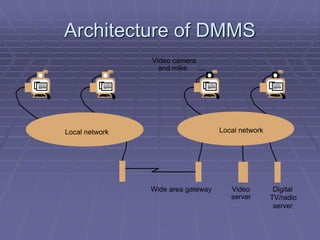
Architecture of DMMS 
Wide area gateway Video 
server 
Digital 
TV/radio 
server 
Video camera 
and mike 
Local network Local network
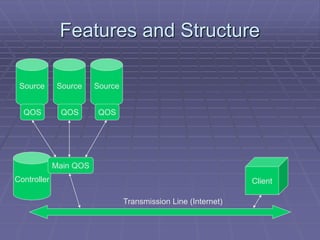
Controller 
Features and Structure 
Client 
Source Source Source 
QOS QOS QOS 
Main QOS 
Transmission Line (Internet)
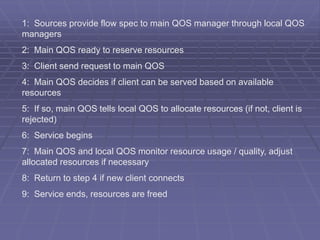
1: Sources provide flow spec to main QOS manager through local QOS 
managers 
2: Main QOS ready to reserve resources 
3: Client send request to main QOS 
4: Main QOS decides if client can be served based on available 
resources 
5: If so, main QOS tells local QOS to allocate resources (if not, client is 
rejected) 
6: Service begins 
7: Main QOS and local QOS monitor resource usage / quality, adjust 
allocated resources if necessary 
8: Return to step 4 if new client connects 
9: Service ends, resources are freed
Need of Multimedia Server 
 Current personal computers, workstations 
and servers are designed to handle 
traditional forms of data. 
 These systems do not perform well for 
multimedia data, requiring fast data 
retrieval and guaranteed real time 
capabilities. 
 The I/O capacity is usually a severe 
bottleneck.
Requirements for Multimedia 
Server 
 Minimal Response time: The server 
must be able to minimize response time 
to live onto the expectations of the 
user. 
 Fast Processing Capability: To 
guarantee fast response time, clients 
should be processed fast and data 
access rates should be minimized.
Requirements for Multimedia 
Server 
 Reliability and availability: 
 Like any other server, multimedia server 
must be reliable. 
 The larger the number of users and volume 
of data handled by the server, the more 
difficult is to guarantee reliability. 
 To provide fault tolerance special hardware 
and software mechanisms must be 
employed. The time the server is unavailable 
should be minimized.
Requirements for Multimedia 
Server 
 Ability to sustain guaranteed number of 
streams: 
 Another important factor is the 
maximum number of data streams the 
server can simultaneously handle. 
 This affects the total number of clients 
the server can handle.
Requirements for Multimedia 
Server 
 Real-time delivery: 
 This needs profound requirements on 
the resource scheduling at the 
operating system level. 
 For this accurate real-time operating 
systems have to be developed.
Requirements for Multimedia 
Server 
 High storage capacity: The server must 
have a large storage capacity to store 
MM data and variety of information. 
 For this, the server may be required to 
compress and encode video and image 
data prior to transport or storage. 
 The performance of compression and 
signal processing should be optimized. 
This might require special hardware.
Requirements for Multimedia 
Server 
 Quality of Service: (Qos) is a set of 
parameters describing the tolerable end-to-end 
delay, throughput, and the level of reliability in 
multimedia communication and presentation. 
 The server should be able to provide and adapt 
itself to different QoS requirements, according to 
the characteristics of the client's terminal, the 
network connection and the requested data 
type.
How To Use 
 A distributed multimedia system is a 
combination of source hardware, QOS 
manager software, and a transmission line 
 Can be bought as a complete, dedicated, 
proprietary package – very expensive! 
 Can be built using existing hardware and 
Internet / LAN connection lines… all that is 
needed beyond that is QOS management 
software – can be purchased or developed
Applications 
 Video conferencing 
 Live news feeds 
 Video-on-demand 
 Remote-control of exploratory robots 
 Remote musical collaborations 
 Remote surgical operations
Significant Points 
 Distributed multimedia systems exist to 
guarantee quality of delivery levels. 
 Resource reservation is the key. 
 Additional clients do not degrade system – 
they can be refused if resources are 
scarce. 
 Quality guarantees are of paramount 
importance, whether used for business, 
entertainment, scientific or health-related 
applications.
Current Trends in DMS 
Currently some of the distributed multimedia 
systems are: 
 Video on Demand: The consumer can 
select a video or any program on 
demand. The application consists of 
Interactive features like forward, rewind 
and pause. 
 Interactive shopping and electronic 
commerce: Home shopping will provide 
a customisable shopping environment.
Current Trends in DMS 
 News and Reference Services: News on 
Demand is similar to VOD but it 
provides sophisticated news retrieval 
and reference services that combine 
live and achieved video, access to 
textual data and still photography from 
various sources. 
 The information is delivered based on a 
filtering criteria kept by the user.
Summary 
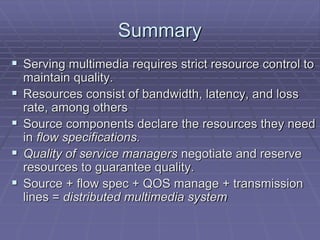
 Serving multimedia requires strict resource control to 
maintain quality. 
 Resources consist of bandwidth, latency, and loss 
rate, among others 
 Source components declare the resources they need 
in flow specifications. 
 Quality of service managers negotiate and reserve 
resources to guarantee quality. 
 Source + flow spec + QOS manage + transmission 
lines = distributed multimedia system
References 
 Distributed Multimedia Systems – An Overview - Gaurav Jain , Indian Institute of 
Information Technology
THANK YOU

Cgmm presentation on distributed multimedia systems

  • 1.
  • 2.
    Introduction  Adistributed multimedia system combines a variety of multimedia information resources over a network into an application used by the client.  The system is based on the interaction between the user and the application.  The user can control when to receive what data and also control the data flow.
  • 3.
    Introduction  Mostmultimedia is inherently time-based – the arrival time and arrival order of data packets is important.  The distributed environment is capable of serving a large number of end users to concurrently access a large number of repositories of stored data.  We just don’t want interactive multimedia over our networks… we want it to be reliable and of high-quality also.
  • 4.
    History  60s-70s:Distributed computing research with earliest networks  80s: Compact disc, personal computer explosion  80s-90s: Distributed multimedia system research (video conferencing, et al)  90s: Current prevalent paradigm (quality of service management)
  • 5.
    Goal  Simplicityin and of itself: We want and need high quality, reliable, interactive multimedia.  The general Internet structure is not sufficient to accomplish this,  A distributed multimedia system will add protocols and architectures on top of the Internet (or LAN) to guarantee quality levels, thereby satisfying our need.
  • 6.
    Definitions  Bandwidth:data rate through a component.  Latency: time needed for a packet to travel end to end.  Loss rate: acceptable drop-frame ratio.  Quality of service management: negotiation and allocation of computing resources.
  • 7.
    Definitions  Flowspecification: explicit representation of required resources.  Traffic shaping: using buffers at source and destination to smooth data flow.  Admission control: allowing or denying client requests based on available resources.
  • 8.
    Architecture of DMMS Distributed multimedia system consists of three different basic components: • an Information server, • a wide area network, and • a multimedia client on the user side.
  • 9.
    Architecture of DMMS Wide area gateway Video server Digital TV/radio server Video camera and mike Local network Local network
  • 10.
    Controller Features andStructure Client Source Source Source QOS QOS QOS Main QOS Transmission Line (Internet)
  • 11.
    1: Sources provideflow spec to main QOS manager through local QOS managers 2: Main QOS ready to reserve resources 3: Client send request to main QOS 4: Main QOS decides if client can be served based on available resources 5: If so, main QOS tells local QOS to allocate resources (if not, client is rejected) 6: Service begins 7: Main QOS and local QOS monitor resource usage / quality, adjust allocated resources if necessary 8: Return to step 4 if new client connects 9: Service ends, resources are freed
  • 12.
    Need of MultimediaServer  Current personal computers, workstations and servers are designed to handle traditional forms of data.  These systems do not perform well for multimedia data, requiring fast data retrieval and guaranteed real time capabilities.  The I/O capacity is usually a severe bottleneck.
  • 13.
    Requirements for Multimedia Server  Minimal Response time: The server must be able to minimize response time to live onto the expectations of the user.  Fast Processing Capability: To guarantee fast response time, clients should be processed fast and data access rates should be minimized.
  • 14.
    Requirements for Multimedia Server  Reliability and availability:  Like any other server, multimedia server must be reliable.  The larger the number of users and volume of data handled by the server, the more difficult is to guarantee reliability.  To provide fault tolerance special hardware and software mechanisms must be employed. The time the server is unavailable should be minimized.
  • 15.
    Requirements for Multimedia Server  Ability to sustain guaranteed number of streams:  Another important factor is the maximum number of data streams the server can simultaneously handle.  This affects the total number of clients the server can handle.
  • 16.
    Requirements for Multimedia Server  Real-time delivery:  This needs profound requirements on the resource scheduling at the operating system level.  For this accurate real-time operating systems have to be developed.
  • 17.
    Requirements for Multimedia Server  High storage capacity: The server must have a large storage capacity to store MM data and variety of information.  For this, the server may be required to compress and encode video and image data prior to transport or storage.  The performance of compression and signal processing should be optimized. This might require special hardware.
  • 18.
    Requirements for Multimedia Server  Quality of Service: (Qos) is a set of parameters describing the tolerable end-to-end delay, throughput, and the level of reliability in multimedia communication and presentation.  The server should be able to provide and adapt itself to different QoS requirements, according to the characteristics of the client's terminal, the network connection and the requested data type.
  • 19.
    How To Use  A distributed multimedia system is a combination of source hardware, QOS manager software, and a transmission line  Can be bought as a complete, dedicated, proprietary package – very expensive!  Can be built using existing hardware and Internet / LAN connection lines… all that is needed beyond that is QOS management software – can be purchased or developed
  • 20.
    Applications  Videoconferencing  Live news feeds  Video-on-demand  Remote-control of exploratory robots  Remote musical collaborations  Remote surgical operations
  • 21.
    Significant Points Distributed multimedia systems exist to guarantee quality of delivery levels.  Resource reservation is the key.  Additional clients do not degrade system – they can be refused if resources are scarce.  Quality guarantees are of paramount importance, whether used for business, entertainment, scientific or health-related applications.
  • 22.
    Current Trends inDMS Currently some of the distributed multimedia systems are:  Video on Demand: The consumer can select a video or any program on demand. The application consists of Interactive features like forward, rewind and pause.  Interactive shopping and electronic commerce: Home shopping will provide a customisable shopping environment.
  • 23.
    Current Trends inDMS  News and Reference Services: News on Demand is similar to VOD but it provides sophisticated news retrieval and reference services that combine live and achieved video, access to textual data and still photography from various sources.  The information is delivered based on a filtering criteria kept by the user.
  • 24.
    Summary  Servingmultimedia requires strict resource control to maintain quality.  Resources consist of bandwidth, latency, and loss rate, among others  Source components declare the resources they need in flow specifications.  Quality of service managers negotiate and reserve resources to guarantee quality.  Source + flow spec + QOS manage + transmission lines = distributed multimedia system
  • 25.
    References  DistributedMultimedia Systems – An Overview - Gaurav Jain , Indian Institute of Information Technology
  • 26.