Technological Innovations in
Management & Entrepreneurship
Module 1
Management and Planning
5/17/2024 1
Prepared by
Dr. Vineeth Kumar P.K
B Tech (EEE), M Tech (Power & Energy), MBA( operations
Management), PhD(Power Electronics)
Email: vineethkumar.pk_eee@svcengg.edu.in
Mobile: 9746738675
Syllabus
• Management: Nature and Functions of Management –
Importance, Definition, Management Functions, Levels
of Management, Roles of Manager, Managerial Skills,
Management & Administration, Management as a
Science, Art & Profession (Selected topics of Chapter 1,
Text 1).
• Planning: Planning-Nature, Importance, Types, Steps and
Limitations of Planning; Decision Making – Meaning,
Types and Steps in Decision Making (Selected topics
from Chapters 4 & 5, Text 1).
5/17/2024 2
Definition of management
• Definition 1: F.W. Taylor
Management is an art of knowing what to do, when to do, and
see that it is done in the best and cheapest way.
• Definition 2: Harold Koontz
The process of designing and maintaining an environment in
which the individuals working in groups efficiently employ
resources and accomplish the selected goals of self and the
organisation.
“Management is an art of getting things done through and
with people in formally organised groups”
5/17/2024 3
• Management is the process of planning, organizing, directing,
and controlling resources (such as human, financial,
technological, and physical) to achieve organizational goals
effectively and efficiently.
• It involves coordinating and overseeing the activities of
individuals or groups within an organization to ensure that they
are working towards common objectives in a coordinated and
coherent manner.
• Management encompasses various functions, including
decision-making, problem-solving, delegation, communication,
and leadership, aimed at optimizing resources and achieving
desired outcomes.
5/17/2024 4
Definition of management
5/17/2024 5
Thank You
Technological Innovations in
Management & Entrepreneurship
Module 1
Management and Planning
Importance of Management
5/17/2024 6
Prepared by
Dr. Vineeth Kumar P.K
B Tech (EEE), M Tech (Power & Energy), MBA( operations Management),
PhD(Power Electronics)
Lecture 2
Importance of Management
It helps in achieving group goals : Team work,
future expansion etc.
Optimum utilisation of resources : Trade-off
between maintaining the brand name and the
service quality and hiring in advance and bearing
the cost.
Reduces the cost: maximum results by using
minimum input through proper planning.
5/17/2024 7
 Establishes sound organisation: smooth and
coordinated functions.
 Establishes equilibrium : It enables the organisation to
survive in a changing environment.
 Essentials for prosperity of society : Efficient
management leads to better economical production
and also increases the economic, social, avoids wastage
of scarce resources ,and general welfare of the people.
5/17/2024 8
Importance of Management
5/17/2024 9
Thank You
Technological Innovations in
Management & Entrepreneurship
Module 1
Management and Planning
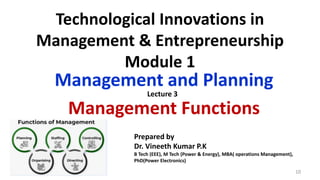
Management Functions
5/17/2024 10
Prepared by
Dr. Vineeth Kumar P.K
B Tech (EEE), M Tech (Power & Energy), MBA( operations Management),
PhD(Power Electronics)
Lecture 3
Management Functions
• Management functions refer to the
fundamental activities that managers perform
in organizations to achieve organizational
goals effectively and efficiently.
• Management functions: planning,
organizing,staffing, leading, and controlling.
5/17/2024 11
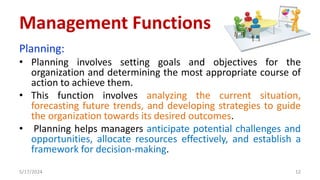
Planning:
• Planning involves setting goals and objectives for the
organization and determining the most appropriate course of
action to achieve them.
• This function involves analyzing the current situation,
forecasting future trends, and developing strategies to guide
the organization towards its desired outcomes.
• Planning helps managers anticipate potential challenges and
opportunities, allocate resources effectively, and establish a
framework for decision-making.
5/17/2024 12
Management Functions
Organizing
• Organizing involves arranging resources, such as
people, materials, and equipment, in a structured
manner to achieve the organization's objectives.
• Organizing ensures that resources are allocated
efficiently, tasks are divided appropriately, and
workflows are streamlined to facilitate goal
attainment.
5/17/2024 13
Management Functions
Staffing
• This involves recruiting, selecting, training, and
developing qualified employees.
• Managers need to assess staffing needs,
identify potential candidates, and create a
positive work environment to retain top talent.
5/17/2024 14
Management Functions
Leading
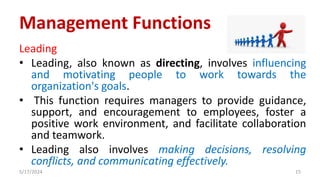
• Leading, also known as directing, involves influencing
and motivating people to work towards the
organization's goals.
• This function requires managers to provide guidance,
support, and encouragement to employees, foster a
positive work environment, and facilitate collaboration
and teamwork.
• Leading also involves making decisions, resolving
conflicts, and communicating effectively.
5/17/2024 15
Management Functions
controlling
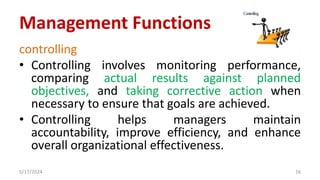
• Controlling involves monitoring performance,
comparing actual results against planned
objectives, and taking corrective action when
necessary to ensure that goals are achieved.
• Controlling helps managers maintain
accountability, improve efficiency, and enhance
overall organizational effectiveness.
5/17/2024 16
Management Functions
5/17/2024 17
Thank You
Technological Innovations in
Management & Entrepreneurship
Module 1
Management and Planning
Levels of Management
5/17/2024 18
Prepared by
Dr. Vineeth Kumar P.K
B Tech (EEE), M Tech (Power & Energy), MBA( operations Management),
PhD(Power Electronics)
Lecture 4
Levels of Management
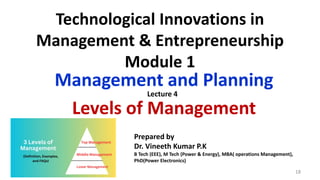
• Management is typically divided into three main
levels within an organization: Top-Level
Management (Strategic Management), Middle-
Level Management (Tactical Management), and
Front-Line Management (Operational
Management)
5/17/2024 19
Top-Level Management (Strategic Management)
• Top-level management consists of executives, such as
CEOs, presidents, and vice presidents, who are
responsible for setting the overall direction and
vision of the organization.
• They are responsible for the organization's survival
and growth in the larger market environment.
5/17/2024 20
Levels of Management
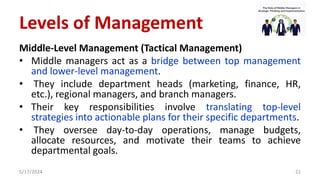
Middle-Level Management (Tactical Management)
• Middle managers act as a bridge between top management
and lower-level management.
• They include department heads (marketing, finance, HR,
etc.), regional managers, and branch managers.
• Their key responsibilities involve translating top-level
strategies into actionable plans for their specific departments.
• They oversee day-to-day operations, manage budgets,
allocate resources, and motivate their teams to achieve
departmental goals.
5/17/2024 21
Levels of Management
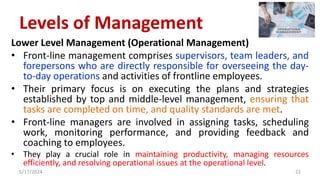
Lower Level Management (Operational Management)
• Front-line management comprises supervisors, team leaders, and
forepersons who are directly responsible for overseeing the day-
to-day operations and activities of frontline employees.
• Their primary focus is on executing the plans and strategies
established by top and middle-level management, ensuring that
tasks are completed on time, and quality standards are met.
• Front-line managers are involved in assigning tasks, scheduling
work, monitoring performance, and providing feedback and
coaching to employees.
• They play a crucial role in maintaining productivity, managing resources
efficiently, and resolving operational issues at the operational level.
5/17/2024 22
Levels of Management
5/17/2024 23
Thank You
Technological Innovations in
Management & Entrepreneurship
Module 1
Management and Planning
Roles of Managers
5/17/2024 24
Prepared by
Dr. Vineeth Kumar P.K
B Tech (EEE), M Tech (Power & Energy), MBA( operations Management),
PhD(Power Electronics)
Lecture 5
Roles of manager
Managers play several crucial roles within organizations, helping to
ensure that goals are achieved, resources are effectively utilized, and
teams are motivated and productive.
• Planning: Managers are responsible for setting goals and developing
strategies, analyzing the current situation, forecasting future trends, and
creating plans to guide the organization towards its objectives.
• Organizing:Managers organize resources, including people, materials, and
finances, to effectively execute plans. to ensure that resources are
allocated efficiently and tasks are carried out effectively.
5/17/2024 25
• Leading: Managers provide leadership to their teams, motivating
and guiding employees towards common goals. setting a vision,
communicating expectations, and inspiring team members.
• Staffing:Managers are involved in staffing activities, such as
recruiting, selecting, and training employees . To ensure right
people are in the right roles.
• Coordinating: Managers coordinate the activities of different
individuals and departments within the organization to ensure
that everyone is working towards the same objectives. facilitating
communication, resolving conflicts, and integrating efforts across
teams.
5/17/2024 26
Roles of manager
• Controlling: Managers monitor progress towards goals and take
corrective actions when necessary. To measure performance,
analyzing variances, and implementing changes to keep the
organization on track.
• Decision-making:They gather information, evaluate options, and
choose the best course of action to achieve desired outcomes.
• Problem-solving: Analyzing issues, generating solutions, and
implementing effective problem-solving strategies.
• Communication: Managers serve as communication channels
between different levels of the organization, conveying information,
goals, and expectations to employees and stakeholders.
5/17/2024 27
Roles of manager
• Development: Managers focus on the development of their
employees, providing feedback, coaching, and opportunities for
learning and growth. They help employees develop their skills and
capabilities to perform their current roles and prepare for future
responsibilities.
• Coaches and Mentors: Managers play a crucial role in helping
their team members develop their skills and grow in their careers.
This involves providing coaching, mentorship, and opportunities for
professional development.
• Representatives: Sometimes, managers represent their team or
department in meetings or other interactions with other parts of the
organization or with external stakeholders.
5/17/2024 28
Roles of manager
5/17/2024 29
Thank You
Technological Innovations in
Management & Entrepreneurship
Module 1
Management and Planning
Managerial Skills
5/17/2024 30
Prepared by
Dr. Vineeth Kumar P.K
B Tech (EEE), M Tech (Power & Energy), MBA( operations Management),
PhD(Power Electronics)
Lecture 5
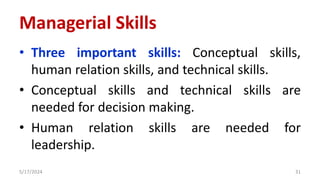
Managerial Skills
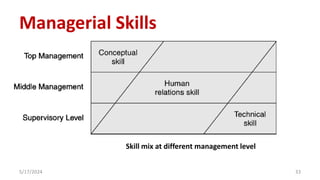
• Three important skills: Conceptual skills,
human relation skills, and technical skills.
• Conceptual skills and technical skills are
needed for decision making.
• Human relation skills are needed for
leadership.
5/17/2024 31
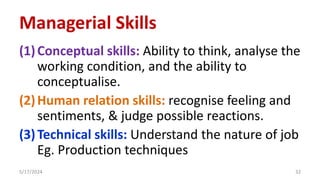
(1)Conceptual skills: Ability to think, analyse the
working condition, and the ability to
conceptualise.
(2)Human relation skills: recognise feeling and
sentiments, & judge possible reactions.
(3)Technical skills: Understand the nature of job
Eg. Production techniques
5/17/2024 32
Managerial Skills
5/17/2024 33
Managerial Skills
Skill mix at different management level
5/17/2024 34
Thank You
Technological Innovations in
Management & Entrepreneurship
Module 1
Management and Planning
Management and
Administration
5/17/2024 35
Prepared by
Dr. Vineeth Kumar P.K
B Tech (EEE), M Tech (Power & Energy), MBA( operations Management),
PhD(Power Electronics)
Lecture 6
Management & Administration
• Administration focuses on the implementation
and coordination of activities within an
organization.
• Management involves the broader aspects of
planning, organizing, leading, and controlling
to achieve organizational objectives.
5/17/2024 36
• Management involves guiding, directing, and
leading employees toward achieving
organizational goals.
• Administration involves establishing policies,
rules, and regulations that guide the actions of
employees and ensure organisational
efficiency.
5/17/2024 37
Management & Administration
• Manager is the key person in the case of management.
• Administrator is the key person in the case of
administration.
• Management is more dynamic, action-oriented, and
focused on achieving objectives through efficient
resource utilization.
• Administration is more concerned with establishing a
stable framework, ensuring adherence to rules, and
maintaining order within the organisation.
5/17/2024 38
Management & Administration
• Administration is top management function where
management is lower level and middle level function.
• The role of management is executive in nature. The
role of administration is decisive in nature.
• Managers make strategic and tactical decisions, setting
goals and formulating plans to achieve them.
• Administrators implement policies, procedures, and
rules established by management.
5/17/2024 39
Management & Administration
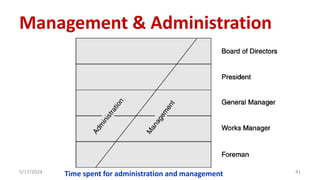
• Management takes into account the directing
and controlling functions of the organization.
• Administration is related to planning and
organizing function.
5/17/2024 40
Management & Administration
5/17/2024 41
Management & Administration
Time spent for administration and management
• Management-Policy Implementation, &
Administration-Policy Formulation.
• Management function-Executive and
Governing, and Administrative function-
Legislative and Determinative.
5/17/2024 42
Management & Administration
5/17/2024 43
Thank You
Technological Innovations in
Management & Entrepreneurship
Module 1
Management and Planning
Management as a Science
5/17/2024 44
Prepared by
Dr. Vineeth Kumar P.K
B Tech (EEE), M Tech (Power & Energy), MBA( operations Management),
PhD(Power Electronics)
Lecture 7
Why Management as a Science?
The following point suggested that management is a
science
i. Methods of inquiry are systematic and empirical-
Unbiased
ii. Information can be ordered & analysed- Statistical
tools
iii. Results are cumulative and communicable-Learn
mistakes from past
Management is like natural and behavioural science
5/17/2024 45
Technological Innovations in
Management & Entrepreneurship
Module 1
Management and Planning
Are Management principles are
culture bound?
5/17/2024 46
Prepared by
Dr. Vineeth Kumar P.K
B Tech (EEE), M Tech (Power & Energy), MBA( operations Management),
PhD(Power Electronics)
Lecture 8
Are Management principles are
culture bound?
• Management principles can be influenced by culture,
but they're not inherently culture-bound.
• The effectiveness of various management principles
can vary across different cultures due to differences in
values, norms, and societal expectations.
• This might involve adjusting communication styles,
decision-making processes, or leadership approaches
to align with cultural norms and preferences.
Eg. Automobile design varies w.r.t countries
5/17/2024 47
Technological Innovations in
Management & Entrepreneurship
Module 1
Management and Planning
Management as an art
5/17/2024 48
Prepared by
Dr. Vineeth Kumar P.K
B Tech (EEE), M Tech (Power & Energy), MBA( operations Management),
PhD(Power Electronics)
Lecture 8
Management as an art
• Management exhibits many characteristics of an art
form, requiring creativity, intuition (Decision making
and judgement), adaptability (Flexibility w.r.t situation),
interpersonal skills, vision, and craftsmanship (Practice
and skill development).
• Just as artists create meaningful and impactful works of
art, managers create value and drive success in their
organizations through their management practices.
5/17/2024 49
Technological Innovations in
Management & Entrepreneurship
Module 1
Management and Planning
Management as a Profession
5/17/2024 50
Prepared by
Dr. Vineeth Kumar P.K
B Tech (EEE), M Tech (Power & Energy), MBA( operations Management),
PhD(Power Electronics)
Lecture 9
Management as a Profession-
Justification
• Management can be considered a profession.
• A profession typically involves specialized knowledge, skills, and
ethical standards, which are often acquired through formal
education, training, and experience.
- Specialized knowledge: Leadership, Organizational behaviour,
finance, operations, HR etc.
- Skills: Decision making, problem solving, delegation, and team
building
- Ethical standard: Integrity, fairness, transparency etc
- Formal education and training: Eg. MBA degree
- Continuous professional development: Best practices and emerging
technologies
5/17/2024 51
Technological Innovations in
Management & Entrepreneurship
Module 1
Management and Planning
What is Planning?
5/17/2024 52
Prepared by
Dr. Vineeth Kumar P.K
B Tech (EEE), M Tech (Power & Energy), MBA( operations Management),
PhD(Power Electronics)
Lecture 9
What is Planning?
• Planning is the beginning process of management.
• Planning in management is the process of setting goals,
defining strategies, outlining tasks, and allocating
resources to achieve those goals effectively and
efficiently.
• It involves establishing a roadmap for the organization
or a specific project to guide decision-making and
action.
5/17/2024 53
Key components of planning
• Setting Goals/Objectives: goals should be Specific, Measurable,
Attainable, Relevant, and Time-bound (SMART).
• Defining Strategies:Strategies are the broad approaches or plans of
action to accomplish the objectives. They may involve market
expansion, product diversification, cost reduction, etc.
• Identifying Actions and Tasks:determining what needs to be done,
who will do it, when it will be done, and how it will be done.
• Resource Allocation:allocating resources such as finances, personnel,
time, and equipment to support the execution of the plan.
• Risk Assessment and Mitigation: risks and uncertainties
• Monitoring and Review: Regularly monitor progress against goals,
track performance metrics, and review the effectiveness of the plan.
5/17/2024 54
Technological Innovations in
Management & Entrepreneurship
Module 1
Management and Planning
Nature & Importance of
Planning
5/17/2024 55
Prepared by
Dr. Vineeth Kumar P.K
B Tech (EEE), M Tech (Power & Energy), MBA( operations Management),
PhD(Power Electronics)
Lecture 10
Nature of Planning
• Beginning process of management
• Intellectual process: Think before act
• Continuous process
• Plan must be flexible
• All pervasive function-regardless of designation and level
• Goal oriented: goals provide direction and purpose for the
planning process.
• Integrated: Planning is integrated across different levels and
functions of an organization.
5/17/2024 56
• Systematic-Goal setting, analysis, strategy
development, implementation, and
monitoring.
• Efficiency and Effectiveness: Planning aims to
improve both efficiency (doing things right)
and effectiveness (doing the right things).
5/17/2024 57
Nature of Planning
Importance of Planning
• Minimize the risks and uncertainty: Rational,
& fact based procedure for making decisions
• Leads to success: Proactive action and shaping
the environment.
• Focus the attention on the organizational goal:
Apply and coordinate the resources
5/17/2024 58
• Facilitate control: Goals and plans become
benchmark against which the performance
can be measured.
• Trains executives: Excellent yield of training
executives.
5/17/2024 59
Importance of Planning
5/17/2024 60
Thank You
Technological Innovations in
Management & Entrepreneurship
Module 1
Management and Planning
Types of Planning
5/17/2024 61
Prepared by
Dr. Vineeth Kumar P.K
B Tech (EEE), M Tech (Power & Energy), MBA( operations Management),
PhD(Power Electronics)
Lecture 11
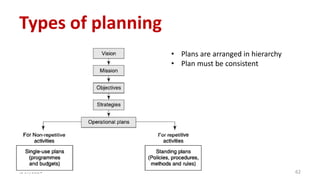
Types of planning
5/17/2024 62
• Plans are arranged in hierarchy
• Plan must be consistent
1. Vision:
• A dream that an entrepreneur creates about the
direction that his business should pursue in future.
• Vision, in its broadest sense, refers to the ability to see,
perceive, or imagine something as a goal or desired
outcome, often in the context of long-term planning or
personal aspiration.
• It's like a mental picture of what you want to achieve
or create in the future.
5/17/2024 63
Types of planning
2. Mission
• A mission is a statement that defines the purpose
and primary objectives of an organization or
individual.
• It outlines what they do, who they serve, and
how they achieve their goals.
• Mission includes purpose, value, and objectives.
5/17/2024 64
Types of planning
3. Objectives
• Objectives in management are specific,
measurable goals that an organization sets to
achieve its broader mission and strategic goals.
• These objectives serve as the targets or
milestones that guide the organization's actions
and measure its progress.
5/17/2024 65
Types of planning
3. Objectives
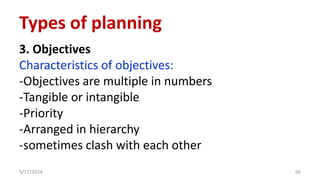
Characteristics of objectives:
-Objectives are multiple in numbers
-Tangible or intangible
-Priority
-Arranged in hierarchy
-sometimes clash with each other
5/17/2024 66
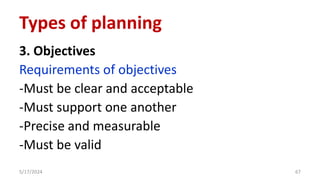
Types of planning
3. Objectives
Requirements of objectives
-Must be clear and acceptable
-Must support one another
-Precise and measurable
-Must be valid
5/17/2024 67
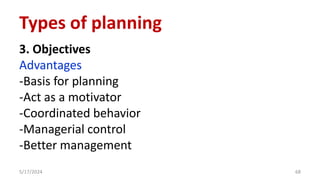
Types of planning
3. Objectives
Advantages
-Basis for planning
-Act as a motivator
-Coordinated behavior
-Managerial control
-Better management
5/17/2024 68
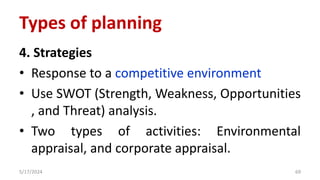
Types of planning
4. Strategies
• Response to a competitive environment
• Use SWOT (Strength, Weakness, Opportunities
, and Threat) analysis.
• Two types of activities: Environmental
appraisal, and corporate appraisal.
5/17/2024 69
Types of planning
4. Strategies
Environmental appraisal
-Relevant environmental results
-Identification of threat and opportunities
• Political and legal factors: Taxation, fiscal policies, stability of
government
• Economic factors: GDP, exchange rate, labour supply, raw material.
• Competitive factors: Principle competitor, product mix, credit and
delivery, pricing and branding, financial strength etc.
• Social & cultural factors: Literacy, culture, rate of urbanisation etc.
5/17/2024 70
Types of planning
4. Strategies
Corporate appraisal
• Analysis of company’s strength and weakness
• Strength: outstanding leadership, excellent
product design, efficient customer service,
logistic and supply chain management, etc.
• Core competency: company’s competitive edge
5/17/2024 71
Types of planning
4. Strategies
Modes of strategy formulation
i. Planning mode- systematic and rational, unique
product mix, etc. Eg. Promotional offers
ii. Entrepreneurial mode: Proactive and noval
approach
iii. Adaptive mode: Reactive and timed. Solving
issues.
5/17/2024 72
Types of planning
5. Operational plans
-Provides the details of how the plans will be
implemented.
-2 types: Standing plan and single use plans
5/17/2024 73
Types of planning
5. Operational plans
• (a) Standing plan
-It is for repetitive activities
-Eg. Banking policies
-Types of standing plans: Policies, procedures,
methods, and rules.
5/17/2024 74
Types of planning
5. Operational plans
(a) Standing plan
Policies: General guidelines for decision making
Deals with ‘how to do?’
Helps in uniformity action
Easy to delegate power
Types: originated policies, appealed policies, implied
policies (not a written policies) , and externally imposed
policies
5/17/2024 75
Types of planning
5. Operational plans
Procedures:
-Policies are carried out by detailed guidelines
-Doing a certain work
-Procedures ensure standard way of doing work
-Ensure uniformity
-Improve efficiency
-The drawbacks are duplication, conflicts, and overlapping.
5/17/2024 76
Types of planning
5. Operational plans
Methods:
-Method specifies one step of procedure is to be
followed.
-Eg. Way of conducting interviews
5/17/2024 77
Types of planning
5. Operational plans
Rules:
-Detailed and recorded instructions that a specific
action must or must not be performed in a given
situation.
Eg. As per VTU rules, student must maintain 85% to
write university examination.
5/17/2024 78
Types of planning
Single Use Plan
-Developed to achieve specific end
-2 types of single use plan: programmes & budgets
-Programmes: precise plan or a project
-Budgets: Plans for future period of time containing
statements of expected results in numerical terms.
5/17/2024 79
Types of planning
Technological Innovations in
Management & Entrepreneurship
Module 1
Management and Planning
Steps in Planning
5/17/2024 80
Prepared by
Dr. Vineeth Kumar P.K
B Tech (EEE), M Tech (Power & Energy), MBA( operations Management),
PhD(Power Electronics)
Lecture 9
Steps in Planning
1. Set goals to be achieved
-Determine enterprise objectives
-Top management-setting of vision
-Eg of setting of goal: growth rate, new product
development
-Goal selection depends on mission, potential of
organisation , and managers hold.
5/17/2024 81
2. Establishing planning premises:
-Second step
-Certain assumptions about future
-Factors such as economic condition, production
cost, level of competency, capital, material
availability, government control etc.
5/17/2024 82
Steps in Planning
2. Establishing planning premises:
-Planning premises: Internal and external premises, tangible
and intangible premises, controllable and non-controllable
premises.
-Internal and external premises: Premises within and outside
the company. Important internal premises are sales forecast,
policies, capital investment, labour force, machines, material
etc.
-External premises: Technological changes, government
policies, population growth, political stability, sociological
factors, industry product demand etc.
5/17/2024 83
Steps in Planning
2. Establishing planning premises:
Tangible premises-Quantitatively measured. Eg.
population growth, industry demand, capital
and resource invested.
Intangible premises-Qualitatively measured. Eg.
Political stability, sociological factors, business
and economic environment, philosophies etc.
5/17/2024 84
Steps in Planning
2. Establishing planning premises:
Controllable premises: Factors can be controlled.
Eg. Company’s advertisement policies, capital,
labour availability.
Non-controllable premises: Uncontrollable
factors like strikes, war, natural calamities,
emergency, and legislation.
5/17/2024 85
Steps in Planning
3. Deciding planning period
-Depends on the project
-Factors: Lead time in development &
commercialisation of new product, Time
required to recover capital investment ( pay
back period), and length of commitments
already made
5/17/2024 86
Steps in Planning
4. Finding alternate course of action
-Search for alternative course of action.
5. Evaluating and selecting course of action
-Using quantitative techniques and operational research
6. Developing derivative plans
-Middle and lower level management takes up planning
of sub units
5/17/2024 87
Steps in Planning
7. Establishing and deploying action plan
-Draft version of action plan
-How the organisation operate with plan?
8. Measure and Controlling the process
-Managers need to check the progress
-Change remedial action and delete unrealistic plan
5/17/2024 88
Steps in Planning
Strategic planning process
• Implemented by top management
• Proactive response of risk and opportunities
• Updating of information through customer
surveys, industry professional, and competitor
actions.
5/17/2024 89
Steps
1.Evaluate and improve last year strategic plan
2. Reframe organisation’s vision, mission, values and objectives
3.Review organisation’s last year operational performance
4. Evaluate organisational external environment
5. Conduct SWOT analysis (Strength, Weakness, Opportunities &
Threat)
6. Identify and evaluate alternative approaches
7. Deploy modified plan
8. Updates and tracking through out year
5/17/2024 90
Strategic planning process
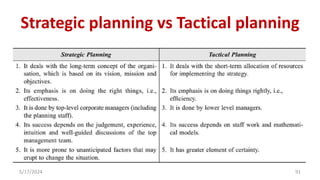
Strategic planning vs Tactical planning
5/17/2024 91
Limitations of planning
• Expensive and time consuming process. Involves more money and risks
• Planning controls the initiative of managers
• Restricts organisation to the most rational and risk free opportunities
• Delay in decision making
• Limited scope of planning in the rapidly changing situations
• Inflexible administration
• Lose of original plan during unforeseen circumstances
• Resistance to change for New plan by the managers
However , planning is desirable for an enterprise. Using coordination,
communication, participation, and proper climate, planning can be made
more effective.
5/17/2024 92
Decision making
What is decision making?
• Decision-making is the process of arriving at a
choice between different options.
• Decision is a choice between two or more
alternatives.
• There will be a purpose while making a decision.
5/17/2024 93
Types of decisions
1. Programmed and Non-programmed decisions
2. Major and minor decisions
3. Routine and strategic decisions
4. Individual and group decision
5. Simple and complex decisions
5/17/2024 94
Decision making
Programmed and Non-programmed decisions
• Programmed decisions are made accordance with some policy,
rule or procedure.
• Programmed decisions are repetitive in nature. Eg. Pricing of
ordinary customers order, salary payment during illness etc
• Non-programmed decisions are non-repetitive in nature.
Problems are arised first time.
• Not cut and dry rule to take up decision for non-programmed
type of decisions.
• An effective managers can handle non-programmed decisions
5/17/2024 95
Decision making
Major and minor decisions
• Degree of futurity of decision: Long range impact
• Impact of decision on other functional area: Decision affects
only one functional area called minor decision whereas
decision affects more than one functional unit is known as
major decision.
• Qualitative factors that enter the decision: Subjective factors
such as conduct, ethical values, social and political belief.
• Recurrence of decision: Rare decisions are major decisions
whereas recurring decisions are minor decisions.
5/17/2024 96
Decision making
Routine and strategic decisions:
• Routine decisions are supportive to company’s
functions. Eg. Installation of AC, Parking,
cafeteria, deputing employees to attend
conference etc.
• Lowering the price of product, installation of
automatic plant etc. are strategic decision which
require more investment.
5/17/2024 97
Decision making
Individual and group decision
• Individual decision is routine nature, definite procedure, &
problems are already existing.
• Important strategic decisions are taken by the group is known as
group decisions.
• Advantages of group decisions: Increased acceptance, easy
coordination, better communication, and more information is
processed.
• The drawbacks of group decisions are taking longer time,
compromise, dominated and dragging in nature.
• One of the group decision technique is known as Delphi technique.
5/17/2024 98
Decision making
Simple and complex decisions
• When the variables of solving the problems are few, the decision is
simple, when they are many decisions are complex.
• Simple problems high degree of certainty-routine decisions.
• Simple problems, but outcome has low degree of certainty-
Judgemental decisions.
• Complex problems with high degree of certainty-Analytical
decisions.
• Complex problems with low degree of certainty- Adaptive
decisions.
5/17/2024 99
Decision making
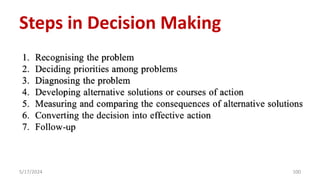
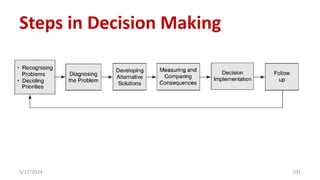
Steps in Decision Making
5/17/2024 100
5/17/2024 101
Steps in Decision Making
1. Recognising the problems
-Search for existing problem
-When there is a deviation from past experience
-Deviation from the plan
-When other people bring problem to the manager
-When competitor outperform the manager’s
organisation
5/17/2024 102
Steps in Decision Making
2. Deciding priorities among problems
-Identify the problems which can be resolved by the
subordinates, and higher authorities.
3. Diagnosing the problems
-Identify the symptoms of the problems
Eg. Declining sales
Poor admission in the schools
5/17/2024 103
Steps in Decision Making
4. Developing alternative solutions or course of
action
-Framing the feasible solution
-Considering limiting factors
-Eg. In order to meet the demand (i) increase
production (ii) By new equipment (iii) Add extra
shift , (iv) overtime etc. Among this manager finds
the better alternatives.
5/17/2024 104
Steps in Decision Making
5. Creativity and innovation
-Consider past experience
-Innovation successfully bring the invention
-Divergent thinking
5/17/2024 105
Steps in Decision Making
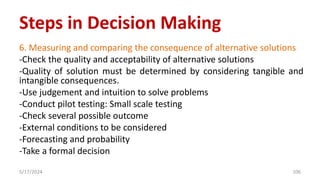
6. Measuring and comparing the consequence of alternative solutions
-Check the quality and acceptability of alternative solutions
-Quality of solution must be determined by considering tangible and
intangible consequences.
-Use judgement and intuition to solve problems
-Conduct pilot testing: Small scale testing
-Check several possible outcome
-External conditions to be considered
-Forecasting and probability
-Take a formal decision
5/17/2024 106
Steps in Decision Making
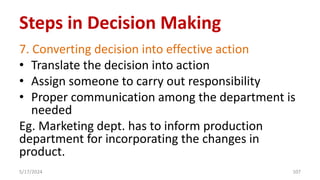
7. Converting decision into effective action
• Translate the decision into action
• Assign someone to carry out responsibility
• Proper communication among the department is
needed
Eg. Marketing dept. has to inform production
department for incorporating the changes in
product.
5/17/2024 107
Steps in Decision Making
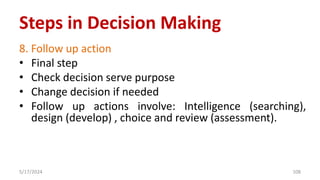
8. Follow up action
• Final step
• Check decision serve purpose
• Change decision if needed
• Follow up actions involve: Intelligence (searching),
design (develop) , choice and review (assessment).
5/17/2024 108
Steps in Decision Making
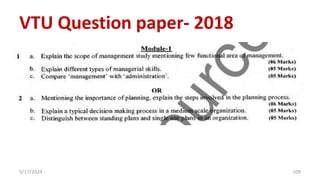
VTU Question paper- 2018
5/17/2024 109
5/17/2024 110
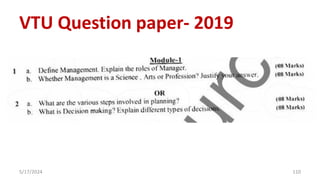
VTU Question paper- 2019
5/17/2024 111
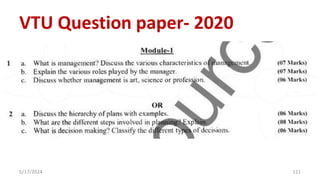
VTU Question paper- 2020
5/17/2024 112
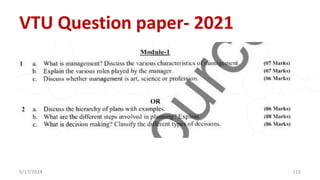
VTU Question paper- 2021
5/17/2024 113
Thank You

Tech innovations management entreprenuer

  • 1.
    Technological Innovations in Management& Entrepreneurship Module 1 Management and Planning 5/17/2024 1 Prepared by Dr. Vineeth Kumar P.K B Tech (EEE), M Tech (Power & Energy), MBA( operations Management), PhD(Power Electronics) Email: vineethkumar.pk_eee@svcengg.edu.in Mobile: 9746738675
  • 2.
    Syllabus • Management: Natureand Functions of Management – Importance, Definition, Management Functions, Levels of Management, Roles of Manager, Managerial Skills, Management & Administration, Management as a Science, Art & Profession (Selected topics of Chapter 1, Text 1). • Planning: Planning-Nature, Importance, Types, Steps and Limitations of Planning; Decision Making – Meaning, Types and Steps in Decision Making (Selected topics from Chapters 4 & 5, Text 1). 5/17/2024 2
  • 3.
    Definition of management •Definition 1: F.W. Taylor Management is an art of knowing what to do, when to do, and see that it is done in the best and cheapest way. • Definition 2: Harold Koontz The process of designing and maintaining an environment in which the individuals working in groups efficiently employ resources and accomplish the selected goals of self and the organisation. “Management is an art of getting things done through and with people in formally organised groups” 5/17/2024 3
  • 4.
    • Management isthe process of planning, organizing, directing, and controlling resources (such as human, financial, technological, and physical) to achieve organizational goals effectively and efficiently. • It involves coordinating and overseeing the activities of individuals or groups within an organization to ensure that they are working towards common objectives in a coordinated and coherent manner. • Management encompasses various functions, including decision-making, problem-solving, delegation, communication, and leadership, aimed at optimizing resources and achieving desired outcomes. 5/17/2024 4 Definition of management
  • 5.
  • 6.
    Technological Innovations in Management& Entrepreneurship Module 1 Management and Planning Importance of Management 5/17/2024 6 Prepared by Dr. Vineeth Kumar P.K B Tech (EEE), M Tech (Power & Energy), MBA( operations Management), PhD(Power Electronics) Lecture 2
  • 7.
    Importance of Management Ithelps in achieving group goals : Team work, future expansion etc. Optimum utilisation of resources : Trade-off between maintaining the brand name and the service quality and hiring in advance and bearing the cost. Reduces the cost: maximum results by using minimum input through proper planning. 5/17/2024 7
  • 8.
     Establishes soundorganisation: smooth and coordinated functions.  Establishes equilibrium : It enables the organisation to survive in a changing environment.  Essentials for prosperity of society : Efficient management leads to better economical production and also increases the economic, social, avoids wastage of scarce resources ,and general welfare of the people. 5/17/2024 8 Importance of Management
  • 9.
  • 10.
    Technological Innovations in Management& Entrepreneurship Module 1 Management and Planning Management Functions 5/17/2024 10 Prepared by Dr. Vineeth Kumar P.K B Tech (EEE), M Tech (Power & Energy), MBA( operations Management), PhD(Power Electronics) Lecture 3
  • 11.
    Management Functions • Managementfunctions refer to the fundamental activities that managers perform in organizations to achieve organizational goals effectively and efficiently. • Management functions: planning, organizing,staffing, leading, and controlling. 5/17/2024 11
  • 12.
    Planning: • Planning involvessetting goals and objectives for the organization and determining the most appropriate course of action to achieve them. • This function involves analyzing the current situation, forecasting future trends, and developing strategies to guide the organization towards its desired outcomes. • Planning helps managers anticipate potential challenges and opportunities, allocate resources effectively, and establish a framework for decision-making. 5/17/2024 12 Management Functions
  • 13.
    Organizing • Organizing involvesarranging resources, such as people, materials, and equipment, in a structured manner to achieve the organization's objectives. • Organizing ensures that resources are allocated efficiently, tasks are divided appropriately, and workflows are streamlined to facilitate goal attainment. 5/17/2024 13 Management Functions
  • 14.
    Staffing • This involvesrecruiting, selecting, training, and developing qualified employees. • Managers need to assess staffing needs, identify potential candidates, and create a positive work environment to retain top talent. 5/17/2024 14 Management Functions
  • 15.
    Leading • Leading, alsoknown as directing, involves influencing and motivating people to work towards the organization's goals. • This function requires managers to provide guidance, support, and encouragement to employees, foster a positive work environment, and facilitate collaboration and teamwork. • Leading also involves making decisions, resolving conflicts, and communicating effectively. 5/17/2024 15 Management Functions
  • 16.
    controlling • Controlling involvesmonitoring performance, comparing actual results against planned objectives, and taking corrective action when necessary to ensure that goals are achieved. • Controlling helps managers maintain accountability, improve efficiency, and enhance overall organizational effectiveness. 5/17/2024 16 Management Functions
  • 17.
  • 18.
    Technological Innovations in Management& Entrepreneurship Module 1 Management and Planning Levels of Management 5/17/2024 18 Prepared by Dr. Vineeth Kumar P.K B Tech (EEE), M Tech (Power & Energy), MBA( operations Management), PhD(Power Electronics) Lecture 4
  • 19.
    Levels of Management •Management is typically divided into three main levels within an organization: Top-Level Management (Strategic Management), Middle- Level Management (Tactical Management), and Front-Line Management (Operational Management) 5/17/2024 19
  • 20.
    Top-Level Management (StrategicManagement) • Top-level management consists of executives, such as CEOs, presidents, and vice presidents, who are responsible for setting the overall direction and vision of the organization. • They are responsible for the organization's survival and growth in the larger market environment. 5/17/2024 20 Levels of Management
  • 21.
    Middle-Level Management (TacticalManagement) • Middle managers act as a bridge between top management and lower-level management. • They include department heads (marketing, finance, HR, etc.), regional managers, and branch managers. • Their key responsibilities involve translating top-level strategies into actionable plans for their specific departments. • They oversee day-to-day operations, manage budgets, allocate resources, and motivate their teams to achieve departmental goals. 5/17/2024 21 Levels of Management
  • 22.
    Lower Level Management(Operational Management) • Front-line management comprises supervisors, team leaders, and forepersons who are directly responsible for overseeing the day- to-day operations and activities of frontline employees. • Their primary focus is on executing the plans and strategies established by top and middle-level management, ensuring that tasks are completed on time, and quality standards are met. • Front-line managers are involved in assigning tasks, scheduling work, monitoring performance, and providing feedback and coaching to employees. • They play a crucial role in maintaining productivity, managing resources efficiently, and resolving operational issues at the operational level. 5/17/2024 22 Levels of Management
  • 23.
  • 24.
    Technological Innovations in Management& Entrepreneurship Module 1 Management and Planning Roles of Managers 5/17/2024 24 Prepared by Dr. Vineeth Kumar P.K B Tech (EEE), M Tech (Power & Energy), MBA( operations Management), PhD(Power Electronics) Lecture 5
  • 25.
    Roles of manager Managersplay several crucial roles within organizations, helping to ensure that goals are achieved, resources are effectively utilized, and teams are motivated and productive. • Planning: Managers are responsible for setting goals and developing strategies, analyzing the current situation, forecasting future trends, and creating plans to guide the organization towards its objectives. • Organizing:Managers organize resources, including people, materials, and finances, to effectively execute plans. to ensure that resources are allocated efficiently and tasks are carried out effectively. 5/17/2024 25
  • 26.
    • Leading: Managersprovide leadership to their teams, motivating and guiding employees towards common goals. setting a vision, communicating expectations, and inspiring team members. • Staffing:Managers are involved in staffing activities, such as recruiting, selecting, and training employees . To ensure right people are in the right roles. • Coordinating: Managers coordinate the activities of different individuals and departments within the organization to ensure that everyone is working towards the same objectives. facilitating communication, resolving conflicts, and integrating efforts across teams. 5/17/2024 26 Roles of manager
  • 27.
    • Controlling: Managersmonitor progress towards goals and take corrective actions when necessary. To measure performance, analyzing variances, and implementing changes to keep the organization on track. • Decision-making:They gather information, evaluate options, and choose the best course of action to achieve desired outcomes. • Problem-solving: Analyzing issues, generating solutions, and implementing effective problem-solving strategies. • Communication: Managers serve as communication channels between different levels of the organization, conveying information, goals, and expectations to employees and stakeholders. 5/17/2024 27 Roles of manager
  • 28.
    • Development: Managersfocus on the development of their employees, providing feedback, coaching, and opportunities for learning and growth. They help employees develop their skills and capabilities to perform their current roles and prepare for future responsibilities. • Coaches and Mentors: Managers play a crucial role in helping their team members develop their skills and grow in their careers. This involves providing coaching, mentorship, and opportunities for professional development. • Representatives: Sometimes, managers represent their team or department in meetings or other interactions with other parts of the organization or with external stakeholders. 5/17/2024 28 Roles of manager
  • 29.
  • 30.
    Technological Innovations in Management& Entrepreneurship Module 1 Management and Planning Managerial Skills 5/17/2024 30 Prepared by Dr. Vineeth Kumar P.K B Tech (EEE), M Tech (Power & Energy), MBA( operations Management), PhD(Power Electronics) Lecture 5
  • 31.
    Managerial Skills • Threeimportant skills: Conceptual skills, human relation skills, and technical skills. • Conceptual skills and technical skills are needed for decision making. • Human relation skills are needed for leadership. 5/17/2024 31
  • 32.
    (1)Conceptual skills: Abilityto think, analyse the working condition, and the ability to conceptualise. (2)Human relation skills: recognise feeling and sentiments, & judge possible reactions. (3)Technical skills: Understand the nature of job Eg. Production techniques 5/17/2024 32 Managerial Skills
  • 33.
    5/17/2024 33 Managerial Skills Skillmix at different management level
  • 34.
  • 35.
    Technological Innovations in Management& Entrepreneurship Module 1 Management and Planning Management and Administration 5/17/2024 35 Prepared by Dr. Vineeth Kumar P.K B Tech (EEE), M Tech (Power & Energy), MBA( operations Management), PhD(Power Electronics) Lecture 6
  • 36.
    Management & Administration •Administration focuses on the implementation and coordination of activities within an organization. • Management involves the broader aspects of planning, organizing, leading, and controlling to achieve organizational objectives. 5/17/2024 36
  • 37.
    • Management involvesguiding, directing, and leading employees toward achieving organizational goals. • Administration involves establishing policies, rules, and regulations that guide the actions of employees and ensure organisational efficiency. 5/17/2024 37 Management & Administration
  • 38.
    • Manager isthe key person in the case of management. • Administrator is the key person in the case of administration. • Management is more dynamic, action-oriented, and focused on achieving objectives through efficient resource utilization. • Administration is more concerned with establishing a stable framework, ensuring adherence to rules, and maintaining order within the organisation. 5/17/2024 38 Management & Administration
  • 39.
    • Administration istop management function where management is lower level and middle level function. • The role of management is executive in nature. The role of administration is decisive in nature. • Managers make strategic and tactical decisions, setting goals and formulating plans to achieve them. • Administrators implement policies, procedures, and rules established by management. 5/17/2024 39 Management & Administration
  • 40.
    • Management takesinto account the directing and controlling functions of the organization. • Administration is related to planning and organizing function. 5/17/2024 40 Management & Administration
  • 41.
    5/17/2024 41 Management &Administration Time spent for administration and management
  • 42.
    • Management-Policy Implementation,& Administration-Policy Formulation. • Management function-Executive and Governing, and Administrative function- Legislative and Determinative. 5/17/2024 42 Management & Administration
  • 43.
  • 44.
    Technological Innovations in Management& Entrepreneurship Module 1 Management and Planning Management as a Science 5/17/2024 44 Prepared by Dr. Vineeth Kumar P.K B Tech (EEE), M Tech (Power & Energy), MBA( operations Management), PhD(Power Electronics) Lecture 7
  • 45.
    Why Management asa Science? The following point suggested that management is a science i. Methods of inquiry are systematic and empirical- Unbiased ii. Information can be ordered & analysed- Statistical tools iii. Results are cumulative and communicable-Learn mistakes from past Management is like natural and behavioural science 5/17/2024 45
  • 46.
    Technological Innovations in Management& Entrepreneurship Module 1 Management and Planning Are Management principles are culture bound? 5/17/2024 46 Prepared by Dr. Vineeth Kumar P.K B Tech (EEE), M Tech (Power & Energy), MBA( operations Management), PhD(Power Electronics) Lecture 8
  • 47.
    Are Management principlesare culture bound? • Management principles can be influenced by culture, but they're not inherently culture-bound. • The effectiveness of various management principles can vary across different cultures due to differences in values, norms, and societal expectations. • This might involve adjusting communication styles, decision-making processes, or leadership approaches to align with cultural norms and preferences. Eg. Automobile design varies w.r.t countries 5/17/2024 47
  • 48.
    Technological Innovations in Management& Entrepreneurship Module 1 Management and Planning Management as an art 5/17/2024 48 Prepared by Dr. Vineeth Kumar P.K B Tech (EEE), M Tech (Power & Energy), MBA( operations Management), PhD(Power Electronics) Lecture 8
  • 49.
    Management as anart • Management exhibits many characteristics of an art form, requiring creativity, intuition (Decision making and judgement), adaptability (Flexibility w.r.t situation), interpersonal skills, vision, and craftsmanship (Practice and skill development). • Just as artists create meaningful and impactful works of art, managers create value and drive success in their organizations through their management practices. 5/17/2024 49
  • 50.
    Technological Innovations in Management& Entrepreneurship Module 1 Management and Planning Management as a Profession 5/17/2024 50 Prepared by Dr. Vineeth Kumar P.K B Tech (EEE), M Tech (Power & Energy), MBA( operations Management), PhD(Power Electronics) Lecture 9
  • 51.
    Management as aProfession- Justification • Management can be considered a profession. • A profession typically involves specialized knowledge, skills, and ethical standards, which are often acquired through formal education, training, and experience. - Specialized knowledge: Leadership, Organizational behaviour, finance, operations, HR etc. - Skills: Decision making, problem solving, delegation, and team building - Ethical standard: Integrity, fairness, transparency etc - Formal education and training: Eg. MBA degree - Continuous professional development: Best practices and emerging technologies 5/17/2024 51
  • 52.
    Technological Innovations in Management& Entrepreneurship Module 1 Management and Planning What is Planning? 5/17/2024 52 Prepared by Dr. Vineeth Kumar P.K B Tech (EEE), M Tech (Power & Energy), MBA( operations Management), PhD(Power Electronics) Lecture 9
  • 53.
    What is Planning? •Planning is the beginning process of management. • Planning in management is the process of setting goals, defining strategies, outlining tasks, and allocating resources to achieve those goals effectively and efficiently. • It involves establishing a roadmap for the organization or a specific project to guide decision-making and action. 5/17/2024 53
  • 54.
    Key components ofplanning • Setting Goals/Objectives: goals should be Specific, Measurable, Attainable, Relevant, and Time-bound (SMART). • Defining Strategies:Strategies are the broad approaches or plans of action to accomplish the objectives. They may involve market expansion, product diversification, cost reduction, etc. • Identifying Actions and Tasks:determining what needs to be done, who will do it, when it will be done, and how it will be done. • Resource Allocation:allocating resources such as finances, personnel, time, and equipment to support the execution of the plan. • Risk Assessment and Mitigation: risks and uncertainties • Monitoring and Review: Regularly monitor progress against goals, track performance metrics, and review the effectiveness of the plan. 5/17/2024 54
  • 55.
    Technological Innovations in Management& Entrepreneurship Module 1 Management and Planning Nature & Importance of Planning 5/17/2024 55 Prepared by Dr. Vineeth Kumar P.K B Tech (EEE), M Tech (Power & Energy), MBA( operations Management), PhD(Power Electronics) Lecture 10
  • 56.
    Nature of Planning •Beginning process of management • Intellectual process: Think before act • Continuous process • Plan must be flexible • All pervasive function-regardless of designation and level • Goal oriented: goals provide direction and purpose for the planning process. • Integrated: Planning is integrated across different levels and functions of an organization. 5/17/2024 56
  • 57.
    • Systematic-Goal setting,analysis, strategy development, implementation, and monitoring. • Efficiency and Effectiveness: Planning aims to improve both efficiency (doing things right) and effectiveness (doing the right things). 5/17/2024 57 Nature of Planning
  • 58.
    Importance of Planning •Minimize the risks and uncertainty: Rational, & fact based procedure for making decisions • Leads to success: Proactive action and shaping the environment. • Focus the attention on the organizational goal: Apply and coordinate the resources 5/17/2024 58
  • 59.
    • Facilitate control:Goals and plans become benchmark against which the performance can be measured. • Trains executives: Excellent yield of training executives. 5/17/2024 59 Importance of Planning
  • 60.
  • 61.
    Technological Innovations in Management& Entrepreneurship Module 1 Management and Planning Types of Planning 5/17/2024 61 Prepared by Dr. Vineeth Kumar P.K B Tech (EEE), M Tech (Power & Energy), MBA( operations Management), PhD(Power Electronics) Lecture 11
  • 62.
    Types of planning 5/17/202462 • Plans are arranged in hierarchy • Plan must be consistent
  • 63.
    1. Vision: • Adream that an entrepreneur creates about the direction that his business should pursue in future. • Vision, in its broadest sense, refers to the ability to see, perceive, or imagine something as a goal or desired outcome, often in the context of long-term planning or personal aspiration. • It's like a mental picture of what you want to achieve or create in the future. 5/17/2024 63 Types of planning
  • 64.
    2. Mission • Amission is a statement that defines the purpose and primary objectives of an organization or individual. • It outlines what they do, who they serve, and how they achieve their goals. • Mission includes purpose, value, and objectives. 5/17/2024 64 Types of planning
  • 65.
    3. Objectives • Objectivesin management are specific, measurable goals that an organization sets to achieve its broader mission and strategic goals. • These objectives serve as the targets or milestones that guide the organization's actions and measure its progress. 5/17/2024 65 Types of planning
  • 66.
    3. Objectives Characteristics ofobjectives: -Objectives are multiple in numbers -Tangible or intangible -Priority -Arranged in hierarchy -sometimes clash with each other 5/17/2024 66 Types of planning
  • 67.
    3. Objectives Requirements ofobjectives -Must be clear and acceptable -Must support one another -Precise and measurable -Must be valid 5/17/2024 67 Types of planning
  • 68.
    3. Objectives Advantages -Basis forplanning -Act as a motivator -Coordinated behavior -Managerial control -Better management 5/17/2024 68 Types of planning
  • 69.
    4. Strategies • Responseto a competitive environment • Use SWOT (Strength, Weakness, Opportunities , and Threat) analysis. • Two types of activities: Environmental appraisal, and corporate appraisal. 5/17/2024 69 Types of planning
  • 70.
    4. Strategies Environmental appraisal -Relevantenvironmental results -Identification of threat and opportunities • Political and legal factors: Taxation, fiscal policies, stability of government • Economic factors: GDP, exchange rate, labour supply, raw material. • Competitive factors: Principle competitor, product mix, credit and delivery, pricing and branding, financial strength etc. • Social & cultural factors: Literacy, culture, rate of urbanisation etc. 5/17/2024 70 Types of planning
  • 71.
    4. Strategies Corporate appraisal •Analysis of company’s strength and weakness • Strength: outstanding leadership, excellent product design, efficient customer service, logistic and supply chain management, etc. • Core competency: company’s competitive edge 5/17/2024 71 Types of planning
  • 72.
    4. Strategies Modes ofstrategy formulation i. Planning mode- systematic and rational, unique product mix, etc. Eg. Promotional offers ii. Entrepreneurial mode: Proactive and noval approach iii. Adaptive mode: Reactive and timed. Solving issues. 5/17/2024 72 Types of planning
  • 73.
    5. Operational plans -Providesthe details of how the plans will be implemented. -2 types: Standing plan and single use plans 5/17/2024 73 Types of planning
  • 74.
    5. Operational plans •(a) Standing plan -It is for repetitive activities -Eg. Banking policies -Types of standing plans: Policies, procedures, methods, and rules. 5/17/2024 74 Types of planning
  • 75.
    5. Operational plans (a)Standing plan Policies: General guidelines for decision making Deals with ‘how to do?’ Helps in uniformity action Easy to delegate power Types: originated policies, appealed policies, implied policies (not a written policies) , and externally imposed policies 5/17/2024 75 Types of planning
  • 76.
    5. Operational plans Procedures: -Policiesare carried out by detailed guidelines -Doing a certain work -Procedures ensure standard way of doing work -Ensure uniformity -Improve efficiency -The drawbacks are duplication, conflicts, and overlapping. 5/17/2024 76 Types of planning
  • 77.
    5. Operational plans Methods: -Methodspecifies one step of procedure is to be followed. -Eg. Way of conducting interviews 5/17/2024 77 Types of planning
  • 78.
    5. Operational plans Rules: -Detailedand recorded instructions that a specific action must or must not be performed in a given situation. Eg. As per VTU rules, student must maintain 85% to write university examination. 5/17/2024 78 Types of planning
  • 79.
    Single Use Plan -Developedto achieve specific end -2 types of single use plan: programmes & budgets -Programmes: precise plan or a project -Budgets: Plans for future period of time containing statements of expected results in numerical terms. 5/17/2024 79 Types of planning
  • 80.
    Technological Innovations in Management& Entrepreneurship Module 1 Management and Planning Steps in Planning 5/17/2024 80 Prepared by Dr. Vineeth Kumar P.K B Tech (EEE), M Tech (Power & Energy), MBA( operations Management), PhD(Power Electronics) Lecture 9
  • 81.
    Steps in Planning 1.Set goals to be achieved -Determine enterprise objectives -Top management-setting of vision -Eg of setting of goal: growth rate, new product development -Goal selection depends on mission, potential of organisation , and managers hold. 5/17/2024 81
  • 82.
    2. Establishing planningpremises: -Second step -Certain assumptions about future -Factors such as economic condition, production cost, level of competency, capital, material availability, government control etc. 5/17/2024 82 Steps in Planning
  • 83.
    2. Establishing planningpremises: -Planning premises: Internal and external premises, tangible and intangible premises, controllable and non-controllable premises. -Internal and external premises: Premises within and outside the company. Important internal premises are sales forecast, policies, capital investment, labour force, machines, material etc. -External premises: Technological changes, government policies, population growth, political stability, sociological factors, industry product demand etc. 5/17/2024 83 Steps in Planning
  • 84.
    2. Establishing planningpremises: Tangible premises-Quantitatively measured. Eg. population growth, industry demand, capital and resource invested. Intangible premises-Qualitatively measured. Eg. Political stability, sociological factors, business and economic environment, philosophies etc. 5/17/2024 84 Steps in Planning
  • 85.
    2. Establishing planningpremises: Controllable premises: Factors can be controlled. Eg. Company’s advertisement policies, capital, labour availability. Non-controllable premises: Uncontrollable factors like strikes, war, natural calamities, emergency, and legislation. 5/17/2024 85 Steps in Planning
  • 86.
    3. Deciding planningperiod -Depends on the project -Factors: Lead time in development & commercialisation of new product, Time required to recover capital investment ( pay back period), and length of commitments already made 5/17/2024 86 Steps in Planning
  • 87.
    4. Finding alternatecourse of action -Search for alternative course of action. 5. Evaluating and selecting course of action -Using quantitative techniques and operational research 6. Developing derivative plans -Middle and lower level management takes up planning of sub units 5/17/2024 87 Steps in Planning
  • 88.
    7. Establishing anddeploying action plan -Draft version of action plan -How the organisation operate with plan? 8. Measure and Controlling the process -Managers need to check the progress -Change remedial action and delete unrealistic plan 5/17/2024 88 Steps in Planning
  • 89.
    Strategic planning process •Implemented by top management • Proactive response of risk and opportunities • Updating of information through customer surveys, industry professional, and competitor actions. 5/17/2024 89
  • 90.
    Steps 1.Evaluate and improvelast year strategic plan 2. Reframe organisation’s vision, mission, values and objectives 3.Review organisation’s last year operational performance 4. Evaluate organisational external environment 5. Conduct SWOT analysis (Strength, Weakness, Opportunities & Threat) 6. Identify and evaluate alternative approaches 7. Deploy modified plan 8. Updates and tracking through out year 5/17/2024 90 Strategic planning process
  • 91.
    Strategic planning vsTactical planning 5/17/2024 91
  • 92.
    Limitations of planning •Expensive and time consuming process. Involves more money and risks • Planning controls the initiative of managers • Restricts organisation to the most rational and risk free opportunities • Delay in decision making • Limited scope of planning in the rapidly changing situations • Inflexible administration • Lose of original plan during unforeseen circumstances • Resistance to change for New plan by the managers However , planning is desirable for an enterprise. Using coordination, communication, participation, and proper climate, planning can be made more effective. 5/17/2024 92
  • 93.
    Decision making What isdecision making? • Decision-making is the process of arriving at a choice between different options. • Decision is a choice between two or more alternatives. • There will be a purpose while making a decision. 5/17/2024 93
  • 94.
    Types of decisions 1.Programmed and Non-programmed decisions 2. Major and minor decisions 3. Routine and strategic decisions 4. Individual and group decision 5. Simple and complex decisions 5/17/2024 94 Decision making
  • 95.
    Programmed and Non-programmeddecisions • Programmed decisions are made accordance with some policy, rule or procedure. • Programmed decisions are repetitive in nature. Eg. Pricing of ordinary customers order, salary payment during illness etc • Non-programmed decisions are non-repetitive in nature. Problems are arised first time. • Not cut and dry rule to take up decision for non-programmed type of decisions. • An effective managers can handle non-programmed decisions 5/17/2024 95 Decision making
  • 96.
    Major and minordecisions • Degree of futurity of decision: Long range impact • Impact of decision on other functional area: Decision affects only one functional area called minor decision whereas decision affects more than one functional unit is known as major decision. • Qualitative factors that enter the decision: Subjective factors such as conduct, ethical values, social and political belief. • Recurrence of decision: Rare decisions are major decisions whereas recurring decisions are minor decisions. 5/17/2024 96 Decision making
  • 97.
    Routine and strategicdecisions: • Routine decisions are supportive to company’s functions. Eg. Installation of AC, Parking, cafeteria, deputing employees to attend conference etc. • Lowering the price of product, installation of automatic plant etc. are strategic decision which require more investment. 5/17/2024 97 Decision making
  • 98.
    Individual and groupdecision • Individual decision is routine nature, definite procedure, & problems are already existing. • Important strategic decisions are taken by the group is known as group decisions. • Advantages of group decisions: Increased acceptance, easy coordination, better communication, and more information is processed. • The drawbacks of group decisions are taking longer time, compromise, dominated and dragging in nature. • One of the group decision technique is known as Delphi technique. 5/17/2024 98 Decision making
  • 99.
    Simple and complexdecisions • When the variables of solving the problems are few, the decision is simple, when they are many decisions are complex. • Simple problems high degree of certainty-routine decisions. • Simple problems, but outcome has low degree of certainty- Judgemental decisions. • Complex problems with high degree of certainty-Analytical decisions. • Complex problems with low degree of certainty- Adaptive decisions. 5/17/2024 99 Decision making
  • 100.
    Steps in DecisionMaking 5/17/2024 100
  • 101.
    5/17/2024 101 Steps inDecision Making
  • 102.
    1. Recognising theproblems -Search for existing problem -When there is a deviation from past experience -Deviation from the plan -When other people bring problem to the manager -When competitor outperform the manager’s organisation 5/17/2024 102 Steps in Decision Making
  • 103.
    2. Deciding prioritiesamong problems -Identify the problems which can be resolved by the subordinates, and higher authorities. 3. Diagnosing the problems -Identify the symptoms of the problems Eg. Declining sales Poor admission in the schools 5/17/2024 103 Steps in Decision Making
  • 104.
    4. Developing alternativesolutions or course of action -Framing the feasible solution -Considering limiting factors -Eg. In order to meet the demand (i) increase production (ii) By new equipment (iii) Add extra shift , (iv) overtime etc. Among this manager finds the better alternatives. 5/17/2024 104 Steps in Decision Making
  • 105.
    5. Creativity andinnovation -Consider past experience -Innovation successfully bring the invention -Divergent thinking 5/17/2024 105 Steps in Decision Making
  • 106.
    6. Measuring andcomparing the consequence of alternative solutions -Check the quality and acceptability of alternative solutions -Quality of solution must be determined by considering tangible and intangible consequences. -Use judgement and intuition to solve problems -Conduct pilot testing: Small scale testing -Check several possible outcome -External conditions to be considered -Forecasting and probability -Take a formal decision 5/17/2024 106 Steps in Decision Making
  • 107.
    7. Converting decisioninto effective action • Translate the decision into action • Assign someone to carry out responsibility • Proper communication among the department is needed Eg. Marketing dept. has to inform production department for incorporating the changes in product. 5/17/2024 107 Steps in Decision Making
  • 108.
    8. Follow upaction • Final step • Check decision serve purpose • Change decision if needed • Follow up actions involve: Intelligence (searching), design (develop) , choice and review (assessment). 5/17/2024 108 Steps in Decision Making
  • 109.
    VTU Question paper-2018 5/17/2024 109
  • 110.
  • 111.
  • 112.
  • 113.