CHAPTER 5:
DISTINGUISHING AND
CONSTRUCTING VARIOUS
PAPER –AND- PENCIL TEST
GROUP 4
Loraine Felix
Jennylyn Fernandez
Jainey Ferrer
Catherine Gonzaga
Learning Outcomes
Explain the meaning of the planning a
test and construction of a table of
specification (TOS).
Define the types of paper-and-pencil
test.
Analyze the differences of assessment
tools.
5.1 Planning a Test and
Construction of a Table of
Specification (TOS)
The important steps in planning for
a test are;
1.Identifyng test objectives/lesson
outcomes
2. Deciding on the type of objectives
test to be prepared
3. Preparing a Table of Specification
(TOS)
4. Constructing the draft test
5. Try-out and validation
Multiple Choice
Type of test offers the student with
more than two options per item to
choose from each item in a multiple
choice test consists of two parts (a)
the stem and (b) the options in the set
of options,
Multiple Choice
there is a “correct” or “best” option
while all the others are considered
“Distracters”.
TYPES OF MULTIPLE CHOICE QUESTIONS
1). Single select multiple choice questions.
2). Multi select multiple choice questions.
3). Dropdown menu multiple choice
questions.
4). Star rating multiple choice questions.
TYPES OF MULTIPLE CHOICE
QUESTIONS
5). Smiley rating multiple choice
questions.
6). Thumbs up pr thumbs down
multiple choice questions.
Guidelines for Constructing
Multiple Choice
1). Do not use unfamiliar words, terms
and phrases. The ability of the item to
discriminate or its level of difficulty
should stem from the subject matter
rather than from wording of the
questions.
Guidelines for Constructing
Multiple Choice
2). Do not use modifiers that are vague
whose meanings can differ from one
person to the next such as; much,
often, usually, etc.
Guidelines for Constructing
Multiple Choice
3). Avoid complex or awkward word
arrangement. Also avoid use of
negatives in the stem as this may
unnecessary comprehension difficulties.
Guidelines for Constructing
Multiple Choice
4). Do not use negatives or double
negatives as such statement stem to be
confusing. It is best to use simpler
sentences rather than sentences that
would require expertise in grammatical
construction.
Guidelines for Constructing
Multiple Choice
5). Each item is stem should be as a
short as possible, otherwise here is
testing more for reading and
comprehension skills.
Guidelines for Constructing
Multiple Choice
6). Distractors should be equally plausible
and attractive.
7). All multiple choice options should be
grammatical consistent with the stem.
8). The length, explicitness, or degree of
Guidelines for Constructing
Multiple Choice
technicality of alternatives should not
be the determinants of the correctness
of the answer.
9). Avoid stems that reveal the answer
to the another item.
Guidelines for Constructing
Multiple Choice
10). Avoid alternatives that are
synonymous with others or those
that include or overlap others.
11). Avoid presenting sequence items
in the same order as in the text.
Guidelines for Constructing
Multiple Choice
12). Avoid use of assume qualifiers, that
may examinees may not be aware of.
13). Avoid use unnecessary words or
phrases which are not relevant to the
problem (unless such discriminating
ability is primary intent of the
Guidelines for Constructing
Multiple Choice
14). Avoid use of non- relevant sources
of difficulty such as requiring a
complex calculation when only
knowledge of a principle is being
tested.
15). Pack the question in the stem.
Guidelines for Constructing
Multiple Choice
Here is an example of question
which has no question. Avoid in why
all mean.
16). Use the “none of the above”
option only when the keyed answer
is totally correct.
Guidelines for Constructing
Multiple Choice
17). Note that use “all of the above”
may allow credit for partial
knowledge in a multiple option item,
(allowing only one option choice) if a
student only knew that (2) options
were correct, he could then duduce
Guidelines for Constructing
Multiple Choice
correctness of “all of the above”. This
assumes you are allowed only one
correct choice.
18). Better still use “none of the above”
and “all of the above” sparingly best not
use them at all.
Guidelines for Constructing
Multiple Choice
19). Having compound response
choices made purposefully increased
difficulty of an item.
The difficulty in a multiple choice item
may be controlled by varying of
Guidelines for Constructing
Multiple Choice
homogeneity or degree of similarity
of responses.
• The more homogenous the more
difficult the item, because they are
look alike the correct answer.
Types of Paper-and-Pencil Test
1). True or False Test –a binomial
choice or alternate response test,
these are the test that have to only
options either ( true or false).
Types of Paper-and-Pencil Test
2). Multiple Choice Test- type of test
that offers the students with more
than two options for the item to
choose from.
Types of Paper-and-Pencil Test
3). Matching Type- type items may be
considered modify multiple choice
type items where the choices
progressively reduced as one
successfully matches the items on the
left with the items on the test.
5.3. Constructing Selected-
Response Type
Selected-response questions are a
popular assessment tool used to
evaluate a wide range of
knowledge and skills. They offer
numerous advantages, such as
being easy to grade and allowing
5.3. Constructing Selected-
Response Type
coverage of content. Constructing
effective selected-response
questions requires carefull planning
and consideration.
5.3.1. True-False Test
These require to determine
the validity of a statement.
5.3.2. Multiple Choice Test
These consist of a stem
(question or statement) and
several options, including the
correct answer and distractors.
5.4.3. Matching Type
These involve pairing items from two
lists based on their relationships or
associations.
5.4. Constructing Supply Type or
Constructed-Response Type
This items consist of a stem and
a blank wear that students
would write the correct answer.
Constructing Supply Type or
Constructed-Response Type
5.4.1. Completion type of test-
possible to construct a test that will
test higher order thinking.
Example: Write an appropriate
synonym for each of the
following. Each blank corresponds
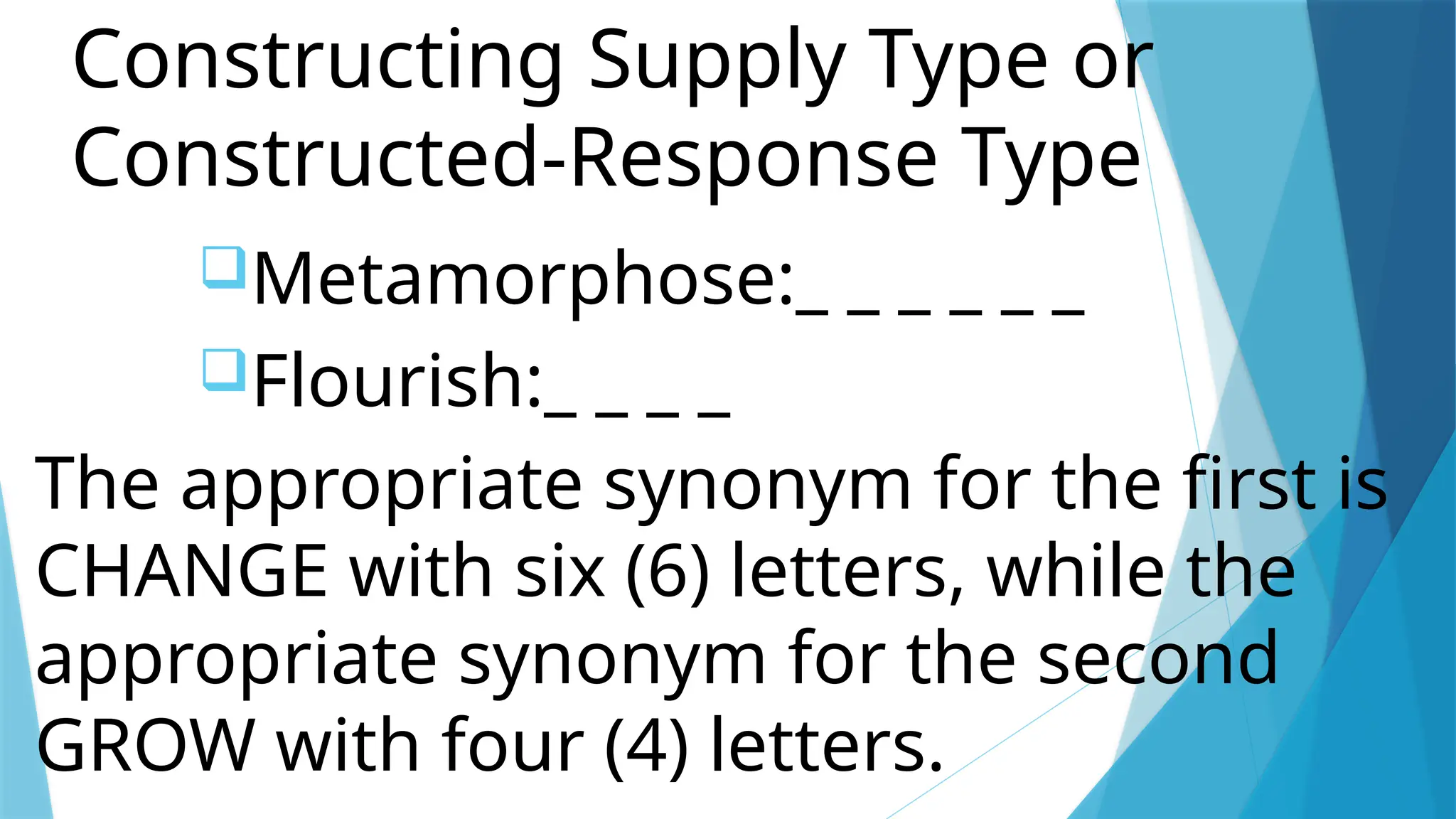
Constructing Supply Type or
Constructed-Response Type
Metamorphose:_ _ _ _ _ _
Flourish:_ _ _ _
The appropriate synonym for the first is
CHANGE with six (6) letters, while the
appropriate synonym for the second
GROW with four (4) letters.
Constructing Supply Type or
Constructed-Response Type
Notice that these questions require not
only mere recall of words but also
understanding of these words.
Constructing Supply Type or
Constructed-Response Type
5.4.2. Essay- classified as non-
objectives tests, allow for the
assessment of higher order thinking
skills. Such tests require students to
organize their thoughts on a subject
matter in coherent sentences in order
Type of Essay
1). Restricted Essay- referred to as short
focused response. Examples are asking
students t o “write an example” “list
three reasons” or “ compare and
contrast two techniques”.
Types of Essay
2). Non-restricted/Extended Essay- a
response that can be much larger and
complex than short responses. What
is student are encouraged to remain
focused and organized.
5.5. Exercises
Let’s have some mental exercises to
test your understanding.
Exercises 1
A. Give non-examples of each of the
following rules of thumb in the
construction of a true or false test.
Improve on the non-examples for
them to become good examples of
tests.
Exercises 1
1). Avoid giving hints in the body of
questions.
2). Avoid using the words "always",
"never" and other such adverbs which
tend to be always true or always false.
3). Avoid long sentences which tend to
Exercises 1
be true. Keep sentences short.
4). Avoid a systematic pattern for
true or false statements.
5). Avoid ambiguous sentences
which can be interpreted as true and
at the same time false.
Exercises II
A. Construct a 10-item matching type to
test their competency:
Identify the computer system – i.e. parts,
other components.
B. Construct a 10-item supply type test
to assess this competency:
Exercises II
Identify farm tools according to use
(Grade 7-8 Curriculum Guide;
Agriculture Fishery.)
C. Justify each rule used in
constructing essay type of test.
D. Construct a 10-item data sufficiency
test.
Exercises II
E. In a 10- item test, what types of
objective tests will you include? Justify
your answer.
F. In the sample essay “ Plant
Photosynthesis’’ given in this section,
why would you give a zero (0) score to
the student writing this essay?
Exercises II
Justify your answer?
G. Give an example of supply type o
test that will measure higher order
thinking skills (beyond mere recall o
facts and information).
H. In what sense is matching type t
Exercises II
a variant of a multiple choice type of
test? Justify your answer.
I. In what sense is supply type of a
test considered variant of a multiple
choice type of test? (Hint: In supply
type, the choices are not explicitly
given).Does
Exercises II
this make the supply type of test more
difficult than closed multiple choice
type of test? How?
J. Choose learning competencies from K
to 12 Curriculum Guide. Construct
aligned paper-and-pencil test observing
Exercises II
Guidelines in test construction.
Include all selected-response and
constructed-response type of test.
THANK YOU FOR
LISTENING

distinguishing and constructing various papr and pencil test

  • 1.
    CHAPTER 5: DISTINGUISHING AND CONSTRUCTINGVARIOUS PAPER –AND- PENCIL TEST GROUP 4 Loraine Felix Jennylyn Fernandez Jainey Ferrer Catherine Gonzaga
  • 2.
    Learning Outcomes Explain themeaning of the planning a test and construction of a table of specification (TOS). Define the types of paper-and-pencil test. Analyze the differences of assessment tools.
  • 3.
    5.1 Planning aTest and Construction of a Table of Specification (TOS) The important steps in planning for a test are; 1.Identifyng test objectives/lesson outcomes
  • 4.
    2. Deciding onthe type of objectives test to be prepared 3. Preparing a Table of Specification (TOS) 4. Constructing the draft test 5. Try-out and validation
  • 5.
    Multiple Choice Type oftest offers the student with more than two options per item to choose from each item in a multiple choice test consists of two parts (a) the stem and (b) the options in the set of options,
  • 6.
    Multiple Choice there isa “correct” or “best” option while all the others are considered “Distracters”.
  • 7.
    TYPES OF MULTIPLECHOICE QUESTIONS 1). Single select multiple choice questions. 2). Multi select multiple choice questions. 3). Dropdown menu multiple choice questions. 4). Star rating multiple choice questions.
  • 8.
    TYPES OF MULTIPLECHOICE QUESTIONS 5). Smiley rating multiple choice questions. 6). Thumbs up pr thumbs down multiple choice questions.
  • 9.
    Guidelines for Constructing MultipleChoice 1). Do not use unfamiliar words, terms and phrases. The ability of the item to discriminate or its level of difficulty should stem from the subject matter rather than from wording of the questions.
  • 10.
    Guidelines for Constructing MultipleChoice 2). Do not use modifiers that are vague whose meanings can differ from one person to the next such as; much, often, usually, etc.
  • 11.
    Guidelines for Constructing MultipleChoice 3). Avoid complex or awkward word arrangement. Also avoid use of negatives in the stem as this may unnecessary comprehension difficulties.
  • 12.
    Guidelines for Constructing MultipleChoice 4). Do not use negatives or double negatives as such statement stem to be confusing. It is best to use simpler sentences rather than sentences that would require expertise in grammatical construction.
  • 13.
    Guidelines for Constructing MultipleChoice 5). Each item is stem should be as a short as possible, otherwise here is testing more for reading and comprehension skills.
  • 14.
    Guidelines for Constructing MultipleChoice 6). Distractors should be equally plausible and attractive. 7). All multiple choice options should be grammatical consistent with the stem. 8). The length, explicitness, or degree of
  • 15.
    Guidelines for Constructing MultipleChoice technicality of alternatives should not be the determinants of the correctness of the answer. 9). Avoid stems that reveal the answer to the another item.
  • 16.
    Guidelines for Constructing MultipleChoice 10). Avoid alternatives that are synonymous with others or those that include or overlap others. 11). Avoid presenting sequence items in the same order as in the text.
  • 17.
    Guidelines for Constructing MultipleChoice 12). Avoid use of assume qualifiers, that may examinees may not be aware of. 13). Avoid use unnecessary words or phrases which are not relevant to the problem (unless such discriminating ability is primary intent of the
  • 18.
    Guidelines for Constructing MultipleChoice 14). Avoid use of non- relevant sources of difficulty such as requiring a complex calculation when only knowledge of a principle is being tested. 15). Pack the question in the stem.
  • 19.
    Guidelines for Constructing MultipleChoice Here is an example of question which has no question. Avoid in why all mean. 16). Use the “none of the above” option only when the keyed answer is totally correct.
  • 20.
    Guidelines for Constructing MultipleChoice 17). Note that use “all of the above” may allow credit for partial knowledge in a multiple option item, (allowing only one option choice) if a student only knew that (2) options were correct, he could then duduce
  • 21.
    Guidelines for Constructing MultipleChoice correctness of “all of the above”. This assumes you are allowed only one correct choice. 18). Better still use “none of the above” and “all of the above” sparingly best not use them at all.
  • 22.
    Guidelines for Constructing MultipleChoice 19). Having compound response choices made purposefully increased difficulty of an item. The difficulty in a multiple choice item may be controlled by varying of
  • 23.
    Guidelines for Constructing MultipleChoice homogeneity or degree of similarity of responses. • The more homogenous the more difficult the item, because they are look alike the correct answer.
  • 24.
    Types of Paper-and-PencilTest 1). True or False Test –a binomial choice or alternate response test, these are the test that have to only options either ( true or false).
  • 25.
    Types of Paper-and-PencilTest 2). Multiple Choice Test- type of test that offers the students with more than two options for the item to choose from.
  • 26.
    Types of Paper-and-PencilTest 3). Matching Type- type items may be considered modify multiple choice type items where the choices progressively reduced as one successfully matches the items on the left with the items on the test.
  • 27.
    5.3. Constructing Selected- ResponseType Selected-response questions are a popular assessment tool used to evaluate a wide range of knowledge and skills. They offer numerous advantages, such as being easy to grade and allowing
  • 28.
    5.3. Constructing Selected- ResponseType coverage of content. Constructing effective selected-response questions requires carefull planning and consideration.
  • 29.
    5.3.1. True-False Test Theserequire to determine the validity of a statement.
  • 30.
    5.3.2. Multiple ChoiceTest These consist of a stem (question or statement) and several options, including the correct answer and distractors.
  • 31.
    5.4.3. Matching Type Theseinvolve pairing items from two lists based on their relationships or associations.
  • 32.
    5.4. Constructing SupplyType or Constructed-Response Type This items consist of a stem and a blank wear that students would write the correct answer.
  • 33.
    Constructing Supply Typeor Constructed-Response Type 5.4.1. Completion type of test- possible to construct a test that will test higher order thinking. Example: Write an appropriate synonym for each of the following. Each blank corresponds
  • 34.
    Constructing Supply Typeor Constructed-Response Type Metamorphose:_ _ _ _ _ _ Flourish:_ _ _ _ The appropriate synonym for the first is CHANGE with six (6) letters, while the appropriate synonym for the second GROW with four (4) letters.
  • 35.
    Constructing Supply Typeor Constructed-Response Type Notice that these questions require not only mere recall of words but also understanding of these words.
  • 36.
    Constructing Supply Typeor Constructed-Response Type 5.4.2. Essay- classified as non- objectives tests, allow for the assessment of higher order thinking skills. Such tests require students to organize their thoughts on a subject matter in coherent sentences in order
  • 37.
    Type of Essay 1).Restricted Essay- referred to as short focused response. Examples are asking students t o “write an example” “list three reasons” or “ compare and contrast two techniques”.
  • 38.
    Types of Essay 2).Non-restricted/Extended Essay- a response that can be much larger and complex than short responses. What is student are encouraged to remain focused and organized.
  • 39.
    5.5. Exercises Let’s havesome mental exercises to test your understanding.
  • 40.
    Exercises 1 A. Givenon-examples of each of the following rules of thumb in the construction of a true or false test. Improve on the non-examples for them to become good examples of tests.
  • 41.
    Exercises 1 1). Avoidgiving hints in the body of questions. 2). Avoid using the words "always", "never" and other such adverbs which tend to be always true or always false. 3). Avoid long sentences which tend to
  • 42.
    Exercises 1 be true.Keep sentences short. 4). Avoid a systematic pattern for true or false statements. 5). Avoid ambiguous sentences which can be interpreted as true and at the same time false.
  • 43.
    Exercises II A. Constructa 10-item matching type to test their competency: Identify the computer system – i.e. parts, other components. B. Construct a 10-item supply type test to assess this competency:
  • 44.
    Exercises II Identify farmtools according to use (Grade 7-8 Curriculum Guide; Agriculture Fishery.) C. Justify each rule used in constructing essay type of test. D. Construct a 10-item data sufficiency test.
  • 45.
    Exercises II E. Ina 10- item test, what types of objective tests will you include? Justify your answer. F. In the sample essay “ Plant Photosynthesis’’ given in this section, why would you give a zero (0) score to the student writing this essay?
  • 46.
    Exercises II Justify youranswer? G. Give an example of supply type o test that will measure higher order thinking skills (beyond mere recall o facts and information). H. In what sense is matching type t
  • 47.
    Exercises II a variantof a multiple choice type of test? Justify your answer. I. In what sense is supply type of a test considered variant of a multiple choice type of test? (Hint: In supply type, the choices are not explicitly given).Does
  • 48.
    Exercises II this makethe supply type of test more difficult than closed multiple choice type of test? How? J. Choose learning competencies from K to 12 Curriculum Guide. Construct aligned paper-and-pencil test observing
  • 49.
    Exercises II Guidelines intest construction. Include all selected-response and constructed-response type of test.
  • 50.