LEYTE NORMAL UNIVERSITY
Tacloban City, Leyte
GRADUATE SCHOOL
GALINA V. PANELA Master in Education (Mathematics)
Math 526 (Linear Algebra) Professor: Mr. G. Estrada
MATRICES IN EXCEL: A TOOL FOR SENIOR HIGH SCHOOL TEACHERS IN
EASIER WAY OF GRADING THE LEARNERS
INTRODUCTION
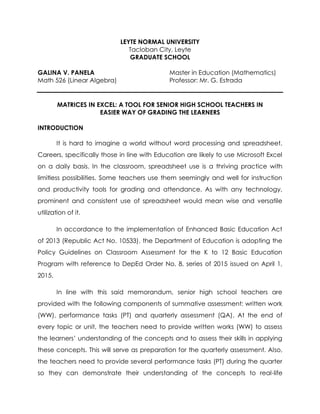
It is hard to imagine a world without word processing and spreadsheet.
Careers, specifically those in line with Education are likely to use Microsoft Excel
on a daily basis. In the classroom, spreadsheet use is a thriving practice with
limitless possibilities. Some teachers use them seemingly and well for instruction
and productivity tools for grading and attendance. As with any technology,
prominent and consistent use of spreadsheet would mean wise and versatile
utilization of it.
In accordance to the implementation of Enhanced Basic Education Act
of 2013 (Republic Act No. 10533), the Department of Education is adopting the
Policy Guidelines on Classroom Assessment for the K to 12 Basic Education
Program with reference to DepEd Order No. 8, series of 2015 issued on April 1,
2015.
In line with this said memorandum, senior high school teachers are
provided with the following components of summative assessment: written work
(WW), performance tasks (PT) and quarterly assessment (QA). At the end of
every topic or unit, the teachers need to provide written works (WW) to assess
the learners’ understanding of the concepts and to assess their skills in applying
these concepts. This will serve as preparation for the quarterly assessment. Also,
the teachers need to provide several performance tasks (PT) during the quarter
so they can demonstrate their understanding of the concepts to real-life
situations and activities. Lastly, they need to provide a quarterly assessment
(QA) once at the end of each quarter so that the learners can synthesize all the
learning skills, values and concepts in the entire quarter.
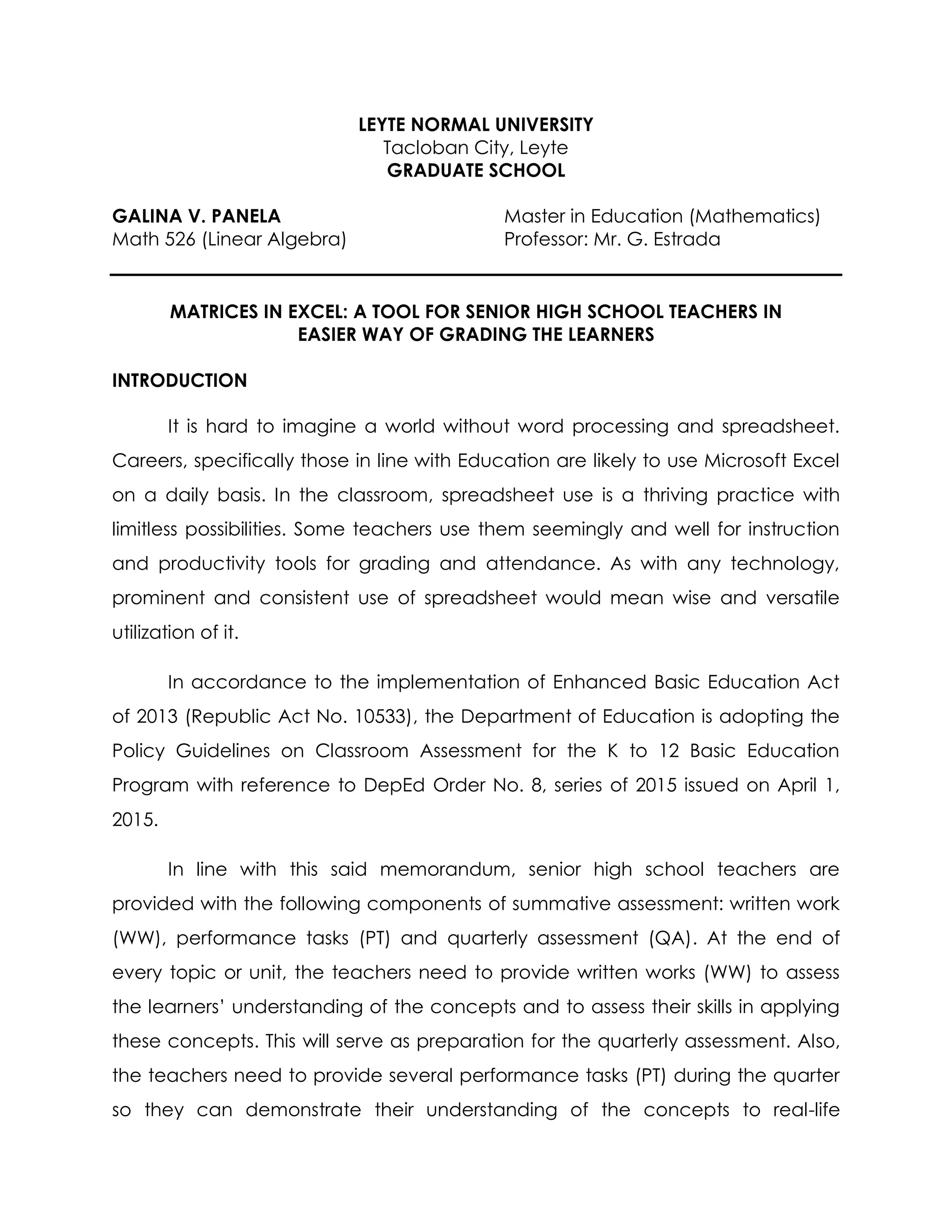
The Department of Education (DepEd) has also identified and provided
the subjects and the weights of every component in summative assessment to
every Senior High School Teachers. This will enable them to compute for the
initial grade of every learner.
The Senior School Curriculum includes the following core subjects: Oral
Communication, Komunikasyon at Pananaliksik sa Wika at Kulturang Filipino, 21st
Century Literature from the Philippines and the World, Contemporary Philippine
Arts from the Regions, Media and Information Literacy, General Mathematics,
Statistics and Probability, Earth and Life Sciences, Physical Science, Introduction
to Philosophy of Human Person, Physical Education and Health, Personal
Development, Understanding Culture, Society and Politics, Earth Science, and
Disaster Readiness and Risk Reduction. Table 1 presents weight of components
for the core subjects in Senior High School.
Table 1
Weight of Components for the Core Subjects
Components Weight
Written Works (WW) 25 %
Performance Tasks (PT) 50 %
Quarterly Assessment (QA) 25 %
Furthermore, the Senior School Curriculum includes the following applied
track subjects: English for Academic and Professional Purposes, Practical
Research 1, Practical Research 2, Filipino sa Piling Larangan (Akademik, Isports,
Sining and Tech-Voc), Empowerment Technologies, Entrepreneurship, and
Inquiries, Investigations and Immersions.
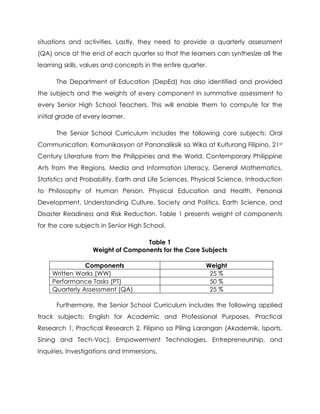
Academic tracks such as General Academic Strand (GAS), Pre-
Baccalaureate Maritime Strand, Humanities and Social Sciences (HUMSS)
Strand, Science, Technology, Engineering and Mathematics (STEM) Strand, and
Accountancy, Business and Management (ABM) Strand are provided with the
following weight of components as presented in Table 2.
Table 2
Weight of Components for the Academic Track Subjects
Components
Weight
All Other Subjects
Work Immersion/
Research/ Business
Enterprise
Simulation/ Exhibit/
Performance
Written Works (WW) 25 % 35 %
Performance Tasks (PT) 45 % 40 %
Quarterly Assessment
(QA)
30 % 25 %
However, the Technical-Vocational and Livelihood (TVL), Sports, Art and
Design Tracks are provided with the following weight of components as
presented in Table 3.
Table 3
Weight of Components for the TVL/Sports/Arts and Design Track Subjects
Components
Weight
All Other Subjects
Work Immersion/
Research/ Exhibit/
Performance
Written Works (WW) 20 % 20 %
Performance Tasks (PT) 60 % 60 %
Quarterly Assessment
(QA)
20 % 20 %
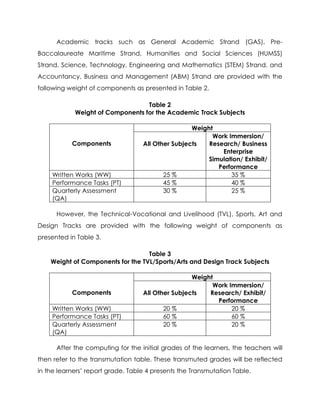
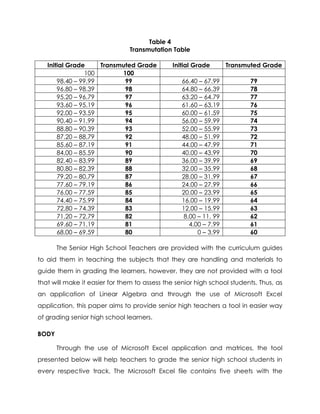
After the computing for the initial grades of the learners, the teachers will
then refer to the transmutation table. These transmuted grades will be reflected
in the learners’ report grade. Table 4 presents the Transmutation Table.
Table 4
Transmutation Table
Initial Grade Transmuted Grade Initial Grade Transmuted Grade
100 100
98.40 – 99.99 99 66.40 – 67.99 79
96.80 – 98.39 98 64.80 – 66.39 78
95.20 – 96.79 97 63.20 – 64.79 77
93.60 – 95.19 96 61.60 – 63.19 76
92.00 – 93.59 95 60.00 – 61.59 75
90.40 – 91.99 94 56.00 – 59.99 74
88.80 – 90.39 93 52.00 – 55.99 73
87.20 – 88.79 92 48.00 – 51.99 72
85.60 – 87.19 91 44.00 – 47.99 71
84.00 – 85.59 90 40.00 – 43.99 70
82.40 – 83.99 89 36.00 – 39.99 69
80.80 – 82.39 88 32.00 – 35.99 68
79.20 – 80.79 87 28.00 – 31.99 67
77.60 – 79.19 86 24.00 – 27.99 66
76.00 – 77.59 85 20.00 – 23.99 65
74.40 – 75.99 84 16.00 – 19.99 64
72.80 – 74.39 83 12.00 – 15.99 63
71.20 – 72.79 82 8.00 – 11. 99 62
69.60 – 71.19 81 4.00 – 7.99 61
68.00 – 69.59 80 0 – 3.99 60
The Senior High School Teachers are provided with the curriculum guides
to aid them in teaching the subjects that they are handling and materials to
guide them in grading the learners, however, they are not provided with a tool
that will make it easier for them to assess the senior high school students. Thus, as
an application of Linear Algebra and through the use of Microsoft Excel
application, this paper aims to provide senior high teachers a tool in easier way
of grading senior high school learners.
BODY
Through the use of Microsoft Excel application and matrices, the tool
presented below will help teachers to grade the senior high school students in
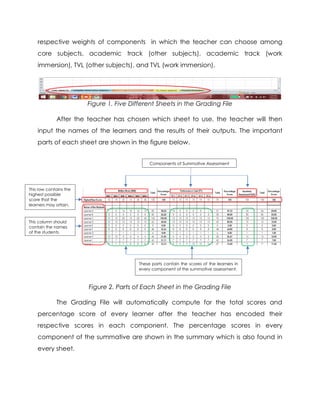
every respective track. The Microsoft Excel file contains five sheets with the
respective weights of components in which the teacher can choose among
core subjects, academic track (other subjects), academic track (work
immersion), TVL (other subjects), and TVL (work immersion).
Figure 1. Five Different Sheets in the Grading File
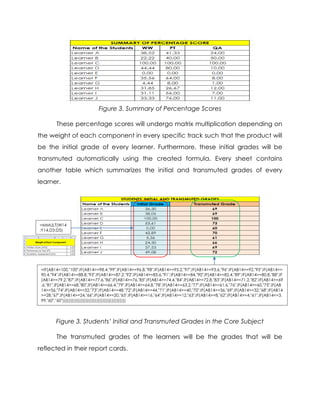
After the teacher has chosen which sheet to use, the teacher will then
input the names of the learners and the results of their outputs. The important
parts of each sheet are shown in the figure below.
Figure 2. Parts of Each Sheet in the Grading File
The Grading File will automatically compute for the total scores and
percentage score of every learner after the teacher has encoded their
respective scores in each component. The percentage scores in every
component of the summative are shown in the summary which is also found in
every sheet.
This row contains the
highest possible
score that the
learners may attain.
This column should
contain the names
of the students.
Components of Summative Assessment
These parts contain the scores of the learners in
every component of the summative assessment.
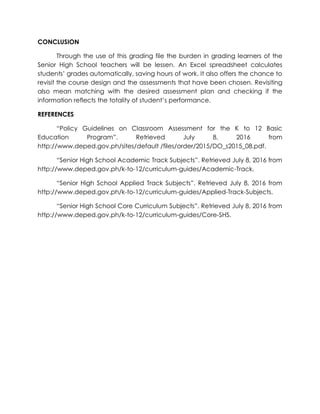
Figure 3. Summary of Percentage Scores
These percentage scores will undergo matrix multiplication depending on
the weight of each component in every specific track such that the product will
be the initial grade of every learner. Furthermore, these initial grades will be
transmuted automatically using the created formula. Every sheet contains
another table which summarizes the initial and transmuted grades of every
learner.
Figure 3. Students’ Initial and Transmuted Grades in the Core Subject
The transmuted grades of the learners will be the grades that will be
reflected in their report cards.
=IF(AB14=100,"100",IF(AB14>=98.4,"99",IF(AB14>=96.8,"98",IF(AB14>=95.2,"97",IF(AB14>=93.6,"96",IF(AB14>=92,"95",IF(AB14>=
90.4,"94",IF(AB14>=88.8,"93",IF(AB14>=87.2,"92",IF(AB14>=85.6,"91",IF(AB14>=84,"90",IF(AB14>=82.4,"89",IF(AB14>=80.8,"88",IF
(AB14>=79.2,"87",IF(AB14>=77.6,"86",IF(AB14>=76,"85",IF(AB14>=74.4,"84",IF(AB14>=72.8,"83",IF(AB14>=71.2,"82",IF(AB14>=69
.6,"81",IF(AB14>=68,"80",IF(AB14>=66.4,"79",IF(AB14>=64.8,"78",IF(AB14>=63.2,"77",IF(AB14>=61.6,"76",IF(AB14>=60,"75",IF(AB
14>=56,"74",IF(AB14>=52,"73",IF(AB14>=48,"72",IF(AB14>=44,"71",IF(AB14>=40,"70",IF(AB14>=36,"69",IF(AB14>=32,"68",IF(AB14
>=28,"67",IF(AB14>=24,"66",IF(AB14>=20,"65",IF(AB14>=16,"64",IF(AB14>=12,"63",IF(AB14>=8,"62",IF(AB14>=4,"61",IF(AB14<=3.
99,"60","60")))))))))))))))))))))))))))))))))))))))))
=MMULT(W14
:Y14,D3:D5)
CONCLUSION
Through the use of this grading file the burden in grading learners of the
Senior High School teachers will be lessen. An Excel spreadsheet calculates
students’ grades automatically, saving hours of work. It also offers the chance to
revisit the course design and the assessments that have been chosen. Revisiting
also mean matching with the desired assessment plan and checking if the
information reflects the totality of student’s performance.
REFERENCES
“Policy Guidelines on Classroom Assessment for the K to 12 Basic
Education Program”. Retrieved July 8, 2016 from
http://www.deped.gov.ph/sites/default /files/order/2015/DO_s2015_08.pdf.
“Senior High School Academic Track Subjects”. Retrieved July 8, 2016 from
http://www.deped.gov.ph/k-to-12/curriculum-guides/Academic-Track.
“Senior High School Applied Track Subjects”. Retrieved July 8, 2016 from
http://www.deped.gov.ph/k-to-12/curriculum-guides/Applied-Track-Subjects.
“Senior High School Core Curriculum Subjects”. Retrieved July 8, 2016 from
http://www.deped.gov.ph/k-to-12/curriculum-guides/Core-SHS.

Grading sh-learners

  • 1.
    LEYTE NORMAL UNIVERSITY TaclobanCity, Leyte GRADUATE SCHOOL GALINA V. PANELA Master in Education (Mathematics) Math 526 (Linear Algebra) Professor: Mr. G. Estrada MATRICES IN EXCEL: A TOOL FOR SENIOR HIGH SCHOOL TEACHERS IN EASIER WAY OF GRADING THE LEARNERS INTRODUCTION It is hard to imagine a world without word processing and spreadsheet. Careers, specifically those in line with Education are likely to use Microsoft Excel on a daily basis. In the classroom, spreadsheet use is a thriving practice with limitless possibilities. Some teachers use them seemingly and well for instruction and productivity tools for grading and attendance. As with any technology, prominent and consistent use of spreadsheet would mean wise and versatile utilization of it. In accordance to the implementation of Enhanced Basic Education Act of 2013 (Republic Act No. 10533), the Department of Education is adopting the Policy Guidelines on Classroom Assessment for the K to 12 Basic Education Program with reference to DepEd Order No. 8, series of 2015 issued on April 1, 2015. In line with this said memorandum, senior high school teachers are provided with the following components of summative assessment: written work (WW), performance tasks (PT) and quarterly assessment (QA). At the end of every topic or unit, the teachers need to provide written works (WW) to assess the learners’ understanding of the concepts and to assess their skills in applying these concepts. This will serve as preparation for the quarterly assessment. Also, the teachers need to provide several performance tasks (PT) during the quarter so they can demonstrate their understanding of the concepts to real-life
  • 2.
    situations and activities.Lastly, they need to provide a quarterly assessment (QA) once at the end of each quarter so that the learners can synthesize all the learning skills, values and concepts in the entire quarter. The Department of Education (DepEd) has also identified and provided the subjects and the weights of every component in summative assessment to every Senior High School Teachers. This will enable them to compute for the initial grade of every learner. The Senior School Curriculum includes the following core subjects: Oral Communication, Komunikasyon at Pananaliksik sa Wika at Kulturang Filipino, 21st Century Literature from the Philippines and the World, Contemporary Philippine Arts from the Regions, Media and Information Literacy, General Mathematics, Statistics and Probability, Earth and Life Sciences, Physical Science, Introduction to Philosophy of Human Person, Physical Education and Health, Personal Development, Understanding Culture, Society and Politics, Earth Science, and Disaster Readiness and Risk Reduction. Table 1 presents weight of components for the core subjects in Senior High School. Table 1 Weight of Components for the Core Subjects Components Weight Written Works (WW) 25 % Performance Tasks (PT) 50 % Quarterly Assessment (QA) 25 % Furthermore, the Senior School Curriculum includes the following applied track subjects: English for Academic and Professional Purposes, Practical Research 1, Practical Research 2, Filipino sa Piling Larangan (Akademik, Isports, Sining and Tech-Voc), Empowerment Technologies, Entrepreneurship, and Inquiries, Investigations and Immersions.
  • 3.
    Academic tracks suchas General Academic Strand (GAS), Pre- Baccalaureate Maritime Strand, Humanities and Social Sciences (HUMSS) Strand, Science, Technology, Engineering and Mathematics (STEM) Strand, and Accountancy, Business and Management (ABM) Strand are provided with the following weight of components as presented in Table 2. Table 2 Weight of Components for the Academic Track Subjects Components Weight All Other Subjects Work Immersion/ Research/ Business Enterprise Simulation/ Exhibit/ Performance Written Works (WW) 25 % 35 % Performance Tasks (PT) 45 % 40 % Quarterly Assessment (QA) 30 % 25 % However, the Technical-Vocational and Livelihood (TVL), Sports, Art and Design Tracks are provided with the following weight of components as presented in Table 3. Table 3 Weight of Components for the TVL/Sports/Arts and Design Track Subjects Components Weight All Other Subjects Work Immersion/ Research/ Exhibit/ Performance Written Works (WW) 20 % 20 % Performance Tasks (PT) 60 % 60 % Quarterly Assessment (QA) 20 % 20 % After the computing for the initial grades of the learners, the teachers will then refer to the transmutation table. These transmuted grades will be reflected in the learners’ report grade. Table 4 presents the Transmutation Table.
  • 4.
    Table 4 Transmutation Table InitialGrade Transmuted Grade Initial Grade Transmuted Grade 100 100 98.40 – 99.99 99 66.40 – 67.99 79 96.80 – 98.39 98 64.80 – 66.39 78 95.20 – 96.79 97 63.20 – 64.79 77 93.60 – 95.19 96 61.60 – 63.19 76 92.00 – 93.59 95 60.00 – 61.59 75 90.40 – 91.99 94 56.00 – 59.99 74 88.80 – 90.39 93 52.00 – 55.99 73 87.20 – 88.79 92 48.00 – 51.99 72 85.60 – 87.19 91 44.00 – 47.99 71 84.00 – 85.59 90 40.00 – 43.99 70 82.40 – 83.99 89 36.00 – 39.99 69 80.80 – 82.39 88 32.00 – 35.99 68 79.20 – 80.79 87 28.00 – 31.99 67 77.60 – 79.19 86 24.00 – 27.99 66 76.00 – 77.59 85 20.00 – 23.99 65 74.40 – 75.99 84 16.00 – 19.99 64 72.80 – 74.39 83 12.00 – 15.99 63 71.20 – 72.79 82 8.00 – 11. 99 62 69.60 – 71.19 81 4.00 – 7.99 61 68.00 – 69.59 80 0 – 3.99 60 The Senior High School Teachers are provided with the curriculum guides to aid them in teaching the subjects that they are handling and materials to guide them in grading the learners, however, they are not provided with a tool that will make it easier for them to assess the senior high school students. Thus, as an application of Linear Algebra and through the use of Microsoft Excel application, this paper aims to provide senior high teachers a tool in easier way of grading senior high school learners. BODY Through the use of Microsoft Excel application and matrices, the tool presented below will help teachers to grade the senior high school students in every respective track. The Microsoft Excel file contains five sheets with the
  • 5.
    respective weights ofcomponents in which the teacher can choose among core subjects, academic track (other subjects), academic track (work immersion), TVL (other subjects), and TVL (work immersion). Figure 1. Five Different Sheets in the Grading File After the teacher has chosen which sheet to use, the teacher will then input the names of the learners and the results of their outputs. The important parts of each sheet are shown in the figure below. Figure 2. Parts of Each Sheet in the Grading File The Grading File will automatically compute for the total scores and percentage score of every learner after the teacher has encoded their respective scores in each component. The percentage scores in every component of the summative are shown in the summary which is also found in every sheet. This row contains the highest possible score that the learners may attain. This column should contain the names of the students. Components of Summative Assessment These parts contain the scores of the learners in every component of the summative assessment.
  • 6.
    Figure 3. Summaryof Percentage Scores These percentage scores will undergo matrix multiplication depending on the weight of each component in every specific track such that the product will be the initial grade of every learner. Furthermore, these initial grades will be transmuted automatically using the created formula. Every sheet contains another table which summarizes the initial and transmuted grades of every learner. Figure 3. Students’ Initial and Transmuted Grades in the Core Subject The transmuted grades of the learners will be the grades that will be reflected in their report cards. =IF(AB14=100,"100",IF(AB14>=98.4,"99",IF(AB14>=96.8,"98",IF(AB14>=95.2,"97",IF(AB14>=93.6,"96",IF(AB14>=92,"95",IF(AB14>= 90.4,"94",IF(AB14>=88.8,"93",IF(AB14>=87.2,"92",IF(AB14>=85.6,"91",IF(AB14>=84,"90",IF(AB14>=82.4,"89",IF(AB14>=80.8,"88",IF (AB14>=79.2,"87",IF(AB14>=77.6,"86",IF(AB14>=76,"85",IF(AB14>=74.4,"84",IF(AB14>=72.8,"83",IF(AB14>=71.2,"82",IF(AB14>=69 .6,"81",IF(AB14>=68,"80",IF(AB14>=66.4,"79",IF(AB14>=64.8,"78",IF(AB14>=63.2,"77",IF(AB14>=61.6,"76",IF(AB14>=60,"75",IF(AB 14>=56,"74",IF(AB14>=52,"73",IF(AB14>=48,"72",IF(AB14>=44,"71",IF(AB14>=40,"70",IF(AB14>=36,"69",IF(AB14>=32,"68",IF(AB14 >=28,"67",IF(AB14>=24,"66",IF(AB14>=20,"65",IF(AB14>=16,"64",IF(AB14>=12,"63",IF(AB14>=8,"62",IF(AB14>=4,"61",IF(AB14<=3. 99,"60","60"))))))))))))))))))))))))))))))))))))))))) =MMULT(W14 :Y14,D3:D5)
  • 7.
    CONCLUSION Through the useof this grading file the burden in grading learners of the Senior High School teachers will be lessen. An Excel spreadsheet calculates students’ grades automatically, saving hours of work. It also offers the chance to revisit the course design and the assessments that have been chosen. Revisiting also mean matching with the desired assessment plan and checking if the information reflects the totality of student’s performance. REFERENCES “Policy Guidelines on Classroom Assessment for the K to 12 Basic Education Program”. Retrieved July 8, 2016 from http://www.deped.gov.ph/sites/default /files/order/2015/DO_s2015_08.pdf. “Senior High School Academic Track Subjects”. Retrieved July 8, 2016 from http://www.deped.gov.ph/k-to-12/curriculum-guides/Academic-Track. “Senior High School Applied Track Subjects”. Retrieved July 8, 2016 from http://www.deped.gov.ph/k-to-12/curriculum-guides/Applied-Track-Subjects. “Senior High School Core Curriculum Subjects”. Retrieved July 8, 2016 from http://www.deped.gov.ph/k-to-12/curriculum-guides/Core-SHS.