PROCESS
ENGINEERING &
DESIGN
Prepared By :
Pratik Dhola(140420105009)
Prateek Gandhi (140420105013)
Topic : Design Of Distillation Column
Guided By :
Prof. Anand Upadhyay
Prof. Parth Desai
CONTENTS
• Introduction
• Applications
• Design steps
• Numerical
• References
INTRODUCTION
• In Simple terms, vaporization followed by
condensation is known as Distillation.
•It is a method of separation components of solution
which are relatively volatile.
•It is the most widely used separation method in chemical
industries.
•Simple Distillation or Batch Distillation was known in
first century.
• Distillation Column is also known as Fractionating Column.
• So it can be said that , it is used in distillation of liquid
mixtures so as to separate the mixture into its component parts
or fractions , based on the differences in volatilities.
• They are used in small scale laboratory distillations as well as
large scale laboratory distillations.
APPLICATIONS
• For the separation of penicillin from the complex mixture,
LLE is used.
• For the removal of hydrogen & methane from aromatics,
stripping is used.
• For the removal of propane from the mixture called asphalt,
stripping is used. As volatility of propane is high compared to
other components of asphalt.
• For the removal of ammonia from lean aqueous solution,
steam stripping is preferred.
• For the removal of hydrogen sulfide from the natural gas
mixture, absorption using ethanolamine's as solvent is used.
• If all the components of air are to be separated in pure form ,
cryogenic distillation is preferred.
• But if only nitrogen in pure form is to be separated from air
then PSA is preferred.
DESIGN STEPS
1. If the feed mixture contains more than two components , then
select two key components from all the components of feed
mixture.
2. Decide the operating pressure of distillation column & find
the VLE data.
3. Specify the degree of separation.
4. Determine the minimum reflux ration Rm.
5. Determine the optimum reflux ratio R & find the number the
no. of theoretical stages required for desired separation.
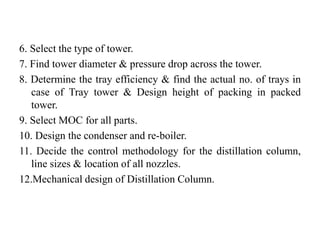
6. Select the type of tower.
7. Find tower diameter & pressure drop across the tower.
8. Determine the tray efficiency & find the actual no. of trays in
case of Tray tower & Design height of packing in packed
tower.
9. Select MOC for all parts.
10. Design the condenser and re-boiler.
11. Decide the control methodology for the distillation column,
line sizes & location of all nozzles.
12.Mechanical design of Distillation Column.
NUMERICALS
Q. In the production of chloromethane , a saturated liquid
mixture consisting of 60% methyl chloride, 28% methylene
dichloride, 9% chloroform and 3% carbon tetrachloride ( by
mass ), is sent to distillation section for the separation of pure
products. In first distillation column 99.9% ( by mass ) pure
methyl chloride is separated as top product. Determine :
1. Operating pressure of distillation column.
2. Minimum reflux ratio by Underwood’s method.
3. Find the no. of theoretical stages required.
CALCULATION
• Assume Bubble point = 50o C = T = 323K
Antoine Constant for CH3Cl ( Light key Component )
A = 6.9944
B = 902.41
C = 243.61
• Antoine equation :
ln Pv = [ A – (B/T+C) ]
Therefore Pv = 221.794 torr ( CH3Cl)
In the same way ;
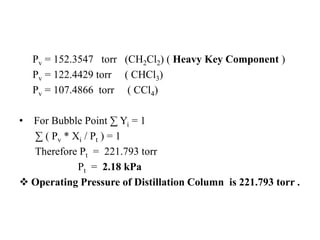
Pv = 152.3547 torr (CH2Cl2) ( Heavy Key Component )
Pv = 122.4429 torr ( CHCl3)
Pv = 107.4866 torr ( CCl4)
• For Bubble Point ∑ Yi = 1
∑ ( Pv * Xi / Pt ) = 1
Therefore Pt = 221.793 torr
Pt = 2.18 kPa
 Operating Pressure of Distillation Column is 221.793 torr .
• Dew Point of Vapor distillate
which is Top Temperature of Column
• ∑Xi = ∑Pt * Yi / Pv = 1
• So, at 500C (323 K) we get ∑Xi =1
• Therefore, Top Temperature of Column = 323 K
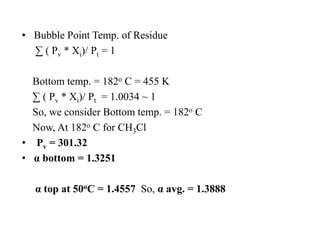
• Bubble Point Temp. of Residue
∑ ( Pv * Xi)/ Pt = 1
Bottom temp. = 182o C = 455 K
∑ ( Pv * Xi)/ Pt = 1.0034 ~ 1
So, we consider Bottom temp. = 182o C
Now, At 182o C for CH3Cl
• Pv = 301.32
• α bottom = 1.3251
α top at 50oC = 1.4557 So, α avg. = 1.3888
• Since our Feed is Saturated Liquid,
So, q = 1
∑ ( αi * Xif / αi – V) = 1 – q
• We assume V = 1.0672 , We get ∑ = .00107 ~ 0
So, ∑ ( αi * Xid / αi – V) = Rm + 1
Therefore, By Substituting the Values ;
Rm = 3.364
 The minimum Reflux ratio is 3.364
• Now , for No. of theoretical stages :
lk = light key
hk = heavy key
Nm = log [ {Xlk/Xhk}d * {Xhk/Xlk}b ] / log α lk
Nm = 51.221
 The Number of Theoretical stages are 51.
REFERENCES
• Introduction to Process Engineering and Design – S B
Thakore & B I Bhatt

Distillation

  • 1.
    PROCESS ENGINEERING & DESIGN Prepared By: Pratik Dhola(140420105009) Prateek Gandhi (140420105013) Topic : Design Of Distillation Column Guided By : Prof. Anand Upadhyay Prof. Parth Desai
  • 2.
    CONTENTS • Introduction • Applications •Design steps • Numerical • References
  • 3.
    INTRODUCTION • In Simpleterms, vaporization followed by condensation is known as Distillation. •It is a method of separation components of solution which are relatively volatile. •It is the most widely used separation method in chemical industries. •Simple Distillation or Batch Distillation was known in first century.
  • 4.
    • Distillation Columnis also known as Fractionating Column. • So it can be said that , it is used in distillation of liquid mixtures so as to separate the mixture into its component parts or fractions , based on the differences in volatilities. • They are used in small scale laboratory distillations as well as large scale laboratory distillations.
  • 5.
    APPLICATIONS • For theseparation of penicillin from the complex mixture, LLE is used. • For the removal of hydrogen & methane from aromatics, stripping is used. • For the removal of propane from the mixture called asphalt, stripping is used. As volatility of propane is high compared to other components of asphalt. • For the removal of ammonia from lean aqueous solution, steam stripping is preferred.
  • 6.
    • For theremoval of hydrogen sulfide from the natural gas mixture, absorption using ethanolamine's as solvent is used. • If all the components of air are to be separated in pure form , cryogenic distillation is preferred. • But if only nitrogen in pure form is to be separated from air then PSA is preferred.
  • 7.
    DESIGN STEPS 1. Ifthe feed mixture contains more than two components , then select two key components from all the components of feed mixture. 2. Decide the operating pressure of distillation column & find the VLE data. 3. Specify the degree of separation. 4. Determine the minimum reflux ration Rm. 5. Determine the optimum reflux ratio R & find the number the no. of theoretical stages required for desired separation.
  • 8.
    6. Select thetype of tower. 7. Find tower diameter & pressure drop across the tower. 8. Determine the tray efficiency & find the actual no. of trays in case of Tray tower & Design height of packing in packed tower. 9. Select MOC for all parts. 10. Design the condenser and re-boiler. 11. Decide the control methodology for the distillation column, line sizes & location of all nozzles. 12.Mechanical design of Distillation Column.
  • 9.
    NUMERICALS Q. In theproduction of chloromethane , a saturated liquid mixture consisting of 60% methyl chloride, 28% methylene dichloride, 9% chloroform and 3% carbon tetrachloride ( by mass ), is sent to distillation section for the separation of pure products. In first distillation column 99.9% ( by mass ) pure methyl chloride is separated as top product. Determine : 1. Operating pressure of distillation column. 2. Minimum reflux ratio by Underwood’s method. 3. Find the no. of theoretical stages required.
  • 10.
  • 11.
    • Assume Bubblepoint = 50o C = T = 323K Antoine Constant for CH3Cl ( Light key Component ) A = 6.9944 B = 902.41 C = 243.61 • Antoine equation : ln Pv = [ A – (B/T+C) ] Therefore Pv = 221.794 torr ( CH3Cl) In the same way ;
  • 12.
    Pv = 152.3547torr (CH2Cl2) ( Heavy Key Component ) Pv = 122.4429 torr ( CHCl3) Pv = 107.4866 torr ( CCl4) • For Bubble Point ∑ Yi = 1 ∑ ( Pv * Xi / Pt ) = 1 Therefore Pt = 221.793 torr Pt = 2.18 kPa  Operating Pressure of Distillation Column is 221.793 torr .
  • 13.
    • Dew Pointof Vapor distillate which is Top Temperature of Column • ∑Xi = ∑Pt * Yi / Pv = 1 • So, at 500C (323 K) we get ∑Xi =1 • Therefore, Top Temperature of Column = 323 K
  • 14.
    • Bubble PointTemp. of Residue ∑ ( Pv * Xi)/ Pt = 1 Bottom temp. = 182o C = 455 K ∑ ( Pv * Xi)/ Pt = 1.0034 ~ 1 So, we consider Bottom temp. = 182o C Now, At 182o C for CH3Cl • Pv = 301.32 • α bottom = 1.3251 α top at 50oC = 1.4557 So, α avg. = 1.3888
  • 15.
    • Since ourFeed is Saturated Liquid, So, q = 1 ∑ ( αi * Xif / αi – V) = 1 – q • We assume V = 1.0672 , We get ∑ = .00107 ~ 0 So, ∑ ( αi * Xid / αi – V) = Rm + 1 Therefore, By Substituting the Values ; Rm = 3.364  The minimum Reflux ratio is 3.364
  • 16.
    • Now ,for No. of theoretical stages : lk = light key hk = heavy key Nm = log [ {Xlk/Xhk}d * {Xhk/Xlk}b ] / log α lk Nm = 51.221  The Number of Theoretical stages are 51.
  • 17.
    REFERENCES • Introduction toProcess Engineering and Design – S B Thakore & B I Bhatt