DALI METHOD
Dr.J. Vardhana
Assistant Professor, Dept of Biotechnology
VISTAS
Introduction
• As proteins evolve, their structures change. Among the subtle details
that evolution has strongly tended to conserve are the patterns of
contacts between residues.
• That is, if two residues are in contact in one protein, the residues
aligned with these two in a related protein are also likely to be in
contact.
• This is true even in very distant homologues, and even if the residues
involved change in size.
• Mutations that change the sizes of packed buried residues produce
adjustments in packing of the helices and sheets against one
another.
• L. Holm and C. Sander applied these observations to the problem of
structural alignment of proteins.
• If the inter residue contact pattern is preserved in distantly related
proteins then it should be possible to identify distantly related
proteins by detecting conserved contact patterns.
• Using carefully chosen approximations, Holm and Sander
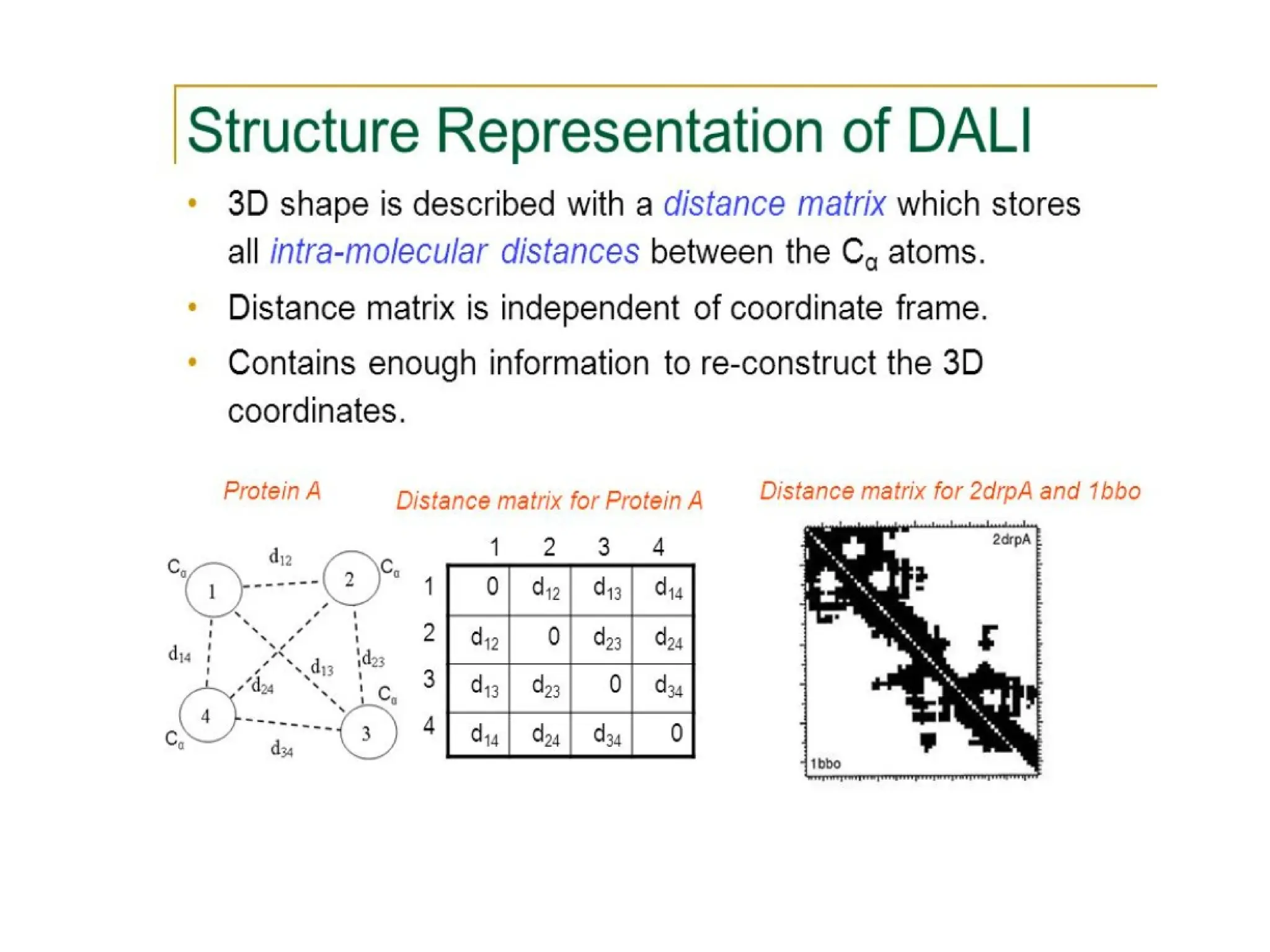
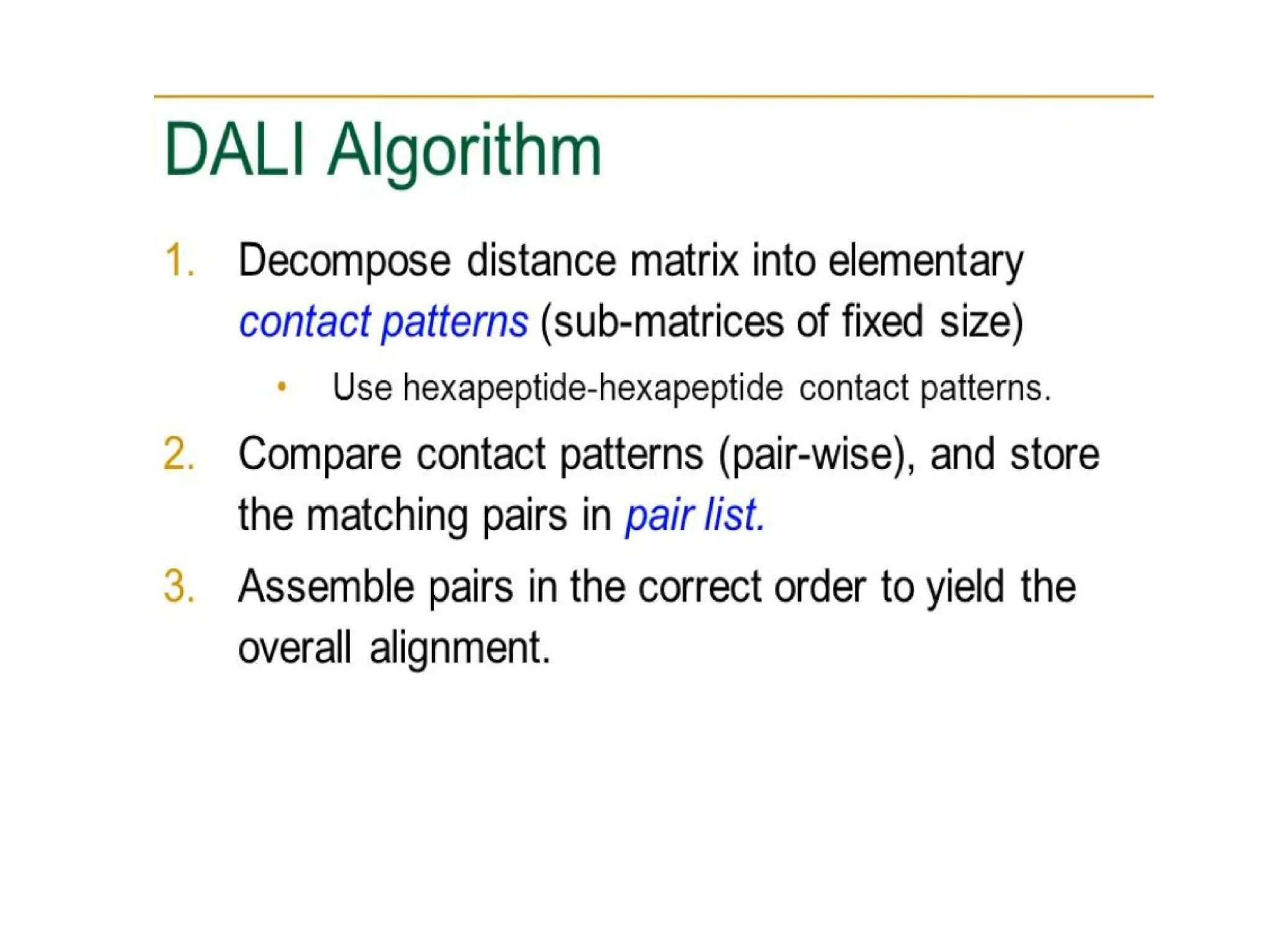
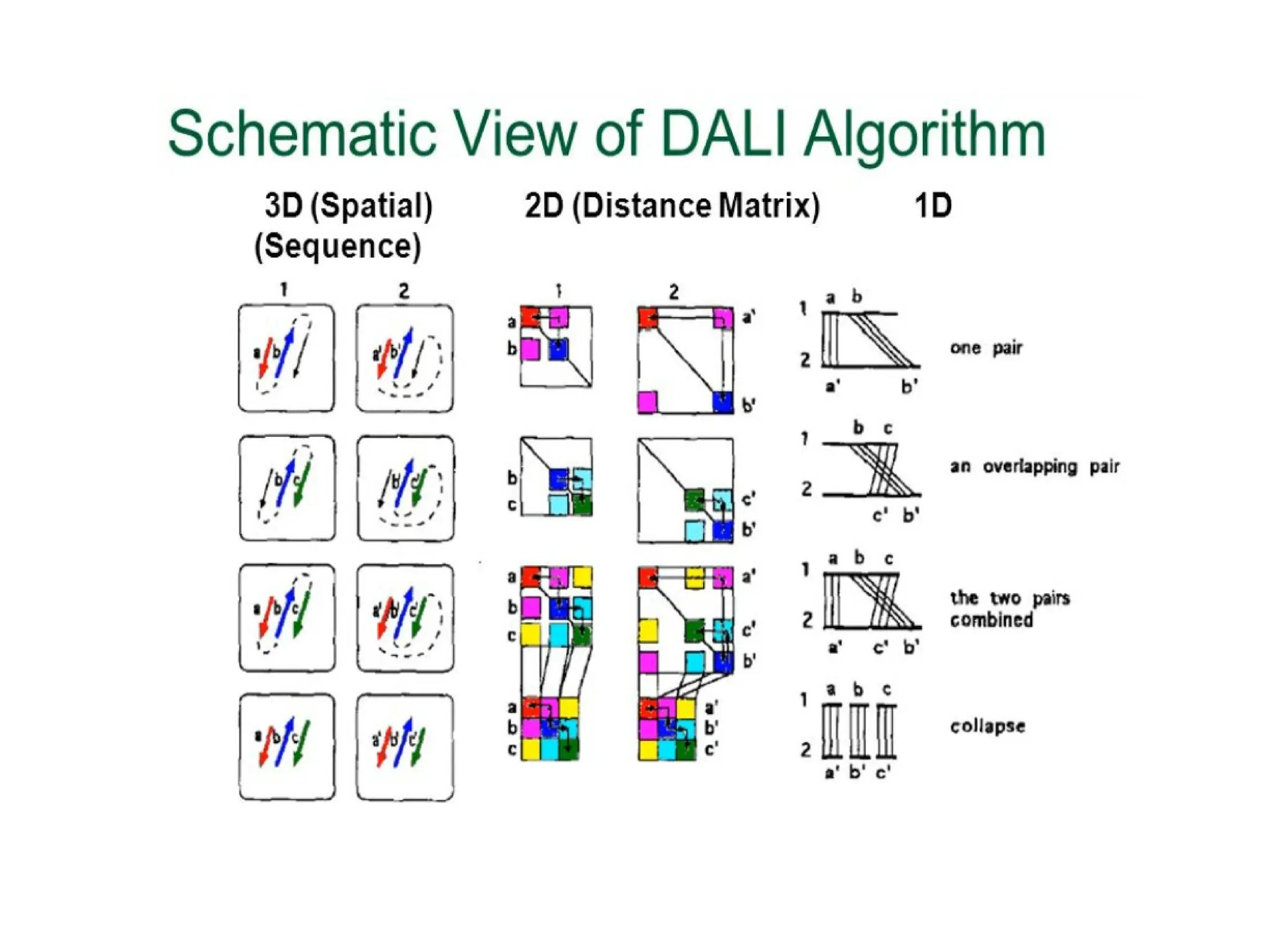
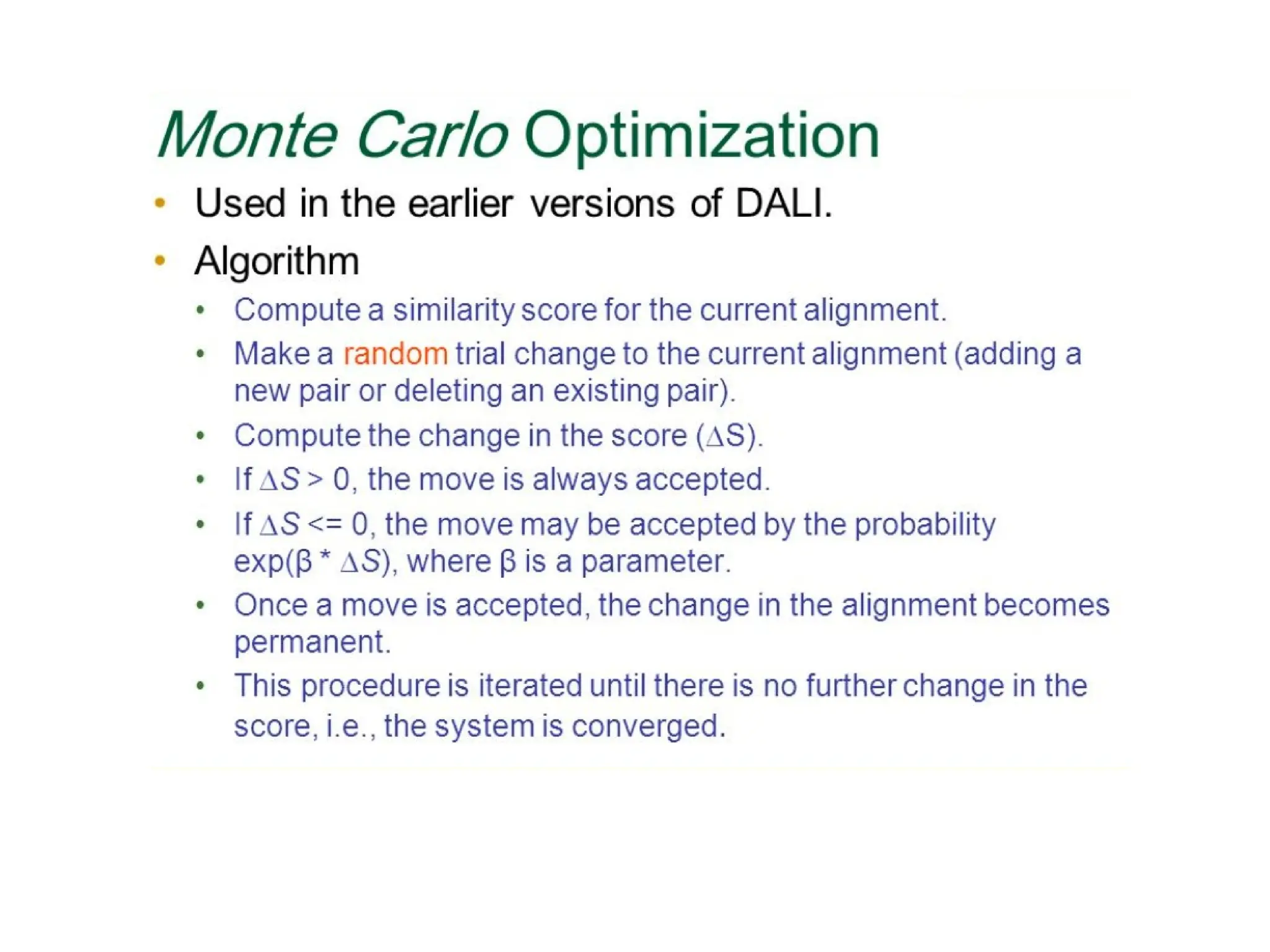
wrote an efficient program called DALI (for Distance-matrix
ALIgnment) that is now in common use for identifying
proteins with folding patterns similar to that of a query
structure.
• The program runs fast enough to carry out routine screens
of the entire Protein Data Bank for structures similar to a
newly determined structure, and even to perform a
classification of protein domain structures from an all-
against-all comparison.
• Holm and Sander have found several unexpected
similarities not detectable at the level of pairwise sequence
alignment.
• An example of DALI's ‘reach’ into recognition of very distant
structural similarities is its identification of the relationship
between mouse adenosine deaminase, Klebsiella aerogenes
urease, and Pseudomonas diminuta phosphotriesterase
The regions of common fold, as determined by the program DALI
by L. Holm and C. Sander, in the TIM barrel proteins mouse
adenosine deaminase [1FKX] (black) and Pseudomonas diminuta
phosphotriesterase [1PTA]
(green). In the alignment shown in this figure the sequences
have only 13% identical residues
Distance-matrix ALIgnment METHOD.pptx/pdf

Distance-matrix ALIgnment METHOD.pptx/pdf

  • 1.
    DALI METHOD Dr.J. Vardhana AssistantProfessor, Dept of Biotechnology VISTAS
  • 2.
    Introduction • As proteinsevolve, their structures change. Among the subtle details that evolution has strongly tended to conserve are the patterns of contacts between residues. • That is, if two residues are in contact in one protein, the residues aligned with these two in a related protein are also likely to be in contact. • This is true even in very distant homologues, and even if the residues involved change in size. • Mutations that change the sizes of packed buried residues produce adjustments in packing of the helices and sheets against one another. • L. Holm and C. Sander applied these observations to the problem of structural alignment of proteins. • If the inter residue contact pattern is preserved in distantly related proteins then it should be possible to identify distantly related proteins by detecting conserved contact patterns.
  • 3.
    • Using carefullychosen approximations, Holm and Sander wrote an efficient program called DALI (for Distance-matrix ALIgnment) that is now in common use for identifying proteins with folding patterns similar to that of a query structure. • The program runs fast enough to carry out routine screens of the entire Protein Data Bank for structures similar to a newly determined structure, and even to perform a classification of protein domain structures from an all- against-all comparison. • Holm and Sander have found several unexpected similarities not detectable at the level of pairwise sequence alignment. • An example of DALI's ‘reach’ into recognition of very distant structural similarities is its identification of the relationship between mouse adenosine deaminase, Klebsiella aerogenes urease, and Pseudomonas diminuta phosphotriesterase
  • 4.
    The regions ofcommon fold, as determined by the program DALI by L. Holm and C. Sander, in the TIM barrel proteins mouse adenosine deaminase [1FKX] (black) and Pseudomonas diminuta phosphotriesterase [1PTA] (green). In the alignment shown in this figure the sequences have only 13% identical residues